I. INTRODUCTION
High-strength steels have been used increasingly in recent years for critical aircraft and aerospace structural applications. In such applications, though material performance is of prime consideration, cost and availability make the low-alloy steels an attractive option. The low-alloy steels are the most widely used, studied, and discussed steels due to their inherent high strength and toughness combination and suitability and adaptability in many structural applications. HSLA-D6AC steel Reference Wei, Liu, Xiao, Zhao, Ding and Kang1 belongs to the high-strength low-alloy steel system, which is a low-alloy vacuum-melted steel containing several elements and a carbon content of 0.42–0.48% with a tensile strength of 1800–2000 Mpa. HSLA-D6AC steel has been in existence for many years and is being used in aircraft undercarriages, airframe parts, pressure vessels, missile applications, gun barrels, gears, bolts, springs, screws, machinery parts, connecting rods, crank shafts, etc. Reference Takahashi2–Reference Das and Davis5
Rare earth, as a useful element, can refine material microstructures and eliminate microcracks or microporosities. In the early 1970s, Ce was extensively used to spheroidize inclusions and improve the anisotropic mechanical properties of steel. Reference Waudby6 In recent years, a large number of experimental studies have focused on the effects of Ce addition on inclusions, Reference Cai and Li7–Reference Wen, Song, Pan, Shu, Hu and Mao9 precipitates, Reference Chaubey, Mohapatra, Jayasankar, Pradhan, Satpati, Sahay, Mishrab and Mukherjee10–Reference Xiao, Wang, Ding and Yang12 mechanical properties, Reference Cai and Li8 microstructure, Reference Cai and Li8,Reference Wen, Song, Pan, Shu, Hu and Mao9 and corrosion resistance Reference Cai and Li7,Reference Cai and Li8 of alloys. Reference Reference Wen, Song, Pan, Shu, Hu and Mao9 showed that the concentration of dissolved oxygen decreases greatly after adding Ce. It is found Reference Wen, Song, Pan, Shu, Hu and Mao9 that Ce2O2S and CeAlO3 are formed with the increase of the Ce content, while three cerium sulphides (CeS, Ce3S4, and Ce2S3), MnS, and Ce2O2S are formed with the increase of the S content and the decrease of the Ce content. Chaubey et al. Reference Chaubey, Mohapatra, Jayasankar, Pradhan, Satpati, Sahay, Mishrab and Mukherjee10 studied the effect of Ce in the 7055Al alloy and reported that the dendritic structure could be refined with the morphology of precipitates changed from spherical to needle shape when the Ce content varied from 0.1 to 0.4% (mass fraction). Wang et al. Reference Wang, Zhang, Gao, Jia, Ye, Zheng and Liu11 found that addition of Ce into the 2519Al alloy could retard the formation of GP zones and promote the precipitation of denser and finer phases. It is concluded from the work done by Cai et al. Reference Cai and Li8 that Ce refines the grain size of steels, significantly increasing the strength; in the meantime, its plasticity is improved, thereby solving the contraction between the strength and the plasticity of steel. Cai et al. Reference Cai and Li7 proposed that Ce addition to steels increased the corrosion resistance of low-nickel austenite stainless steels due to metamorphic inclusions and the improvement of electrode potential in the matrix. Zhang et al. Reference Zhang and Zuo13,Reference Gsong, Wang, Knysh and Korkolis14 reviewed that trace Ce can enhance the stability of the Ce conversion film, thereby improving the corrosion resistance of the aluminum alloy.
However, to date, there are few reports about the influence of Ce addition on the microstructure and mechanical properties of HSLA-D6AC steel. The purpose of this work here is therefore to explore the correlation between rare-earth Ce and the resulting strength, plasticity and toughness, and fracture features during tensile and impact tests.
II. EXPERIMENTAL PROCEDURES
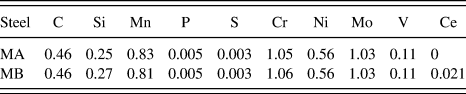
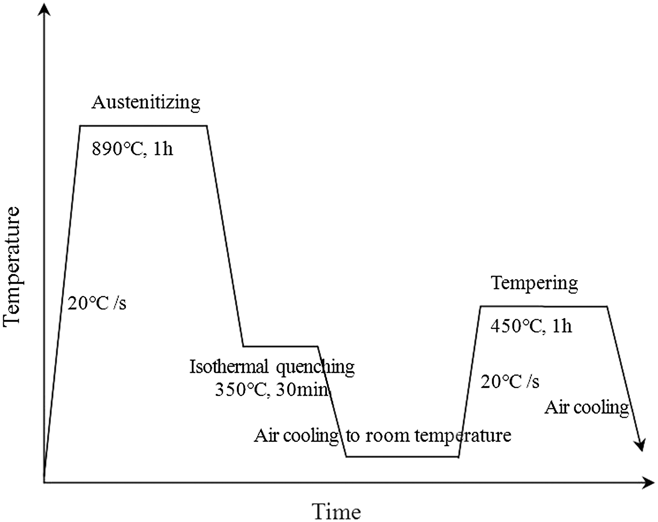
Two types of HSLA-D6AC steels (Fushun Special Steel Co., Ltd., Fushun, China) were melted in a vacuum induction furnace and cast into a 45 kg ingot. The chemical composition is listed in Table I. The ingots were forged into 25 × 25 mm, and the forging temperature ranged from 1200 to 950 °C. Figure 1 exhibits the principal pattern of the martensite process. The specimens abbreviated as MA (without Ce addition) and MB (with 0.021 wt% Ce addition) were austenitized at 890 °C for 1 h in a nitrogen atmosphere before subsequent isothermal quenching (350 °C for 30 min), and then they were cooled to room temperature in the air. Afterward, the specimens were reheated to 450 °C for 1 h and cooled to room temperature in the air again. According to the calculated result, the martensite start temperature of HSLA-D6AC steel is about 350 °C.
Chemical compositions (wt%).

Schematic time–temperature diagram of the heat treatment.

An OIM 4000 electron backscatter diffraction (EBSD) detector (Oxford Instruments, Oxford, United Kingdom) was used to observe the crystallographic characteristics of isothermal quenched samples. The samples were electrolytically polished in a solution of 8% perchloric acid–alcohol solution. EBSD maps were obtained at a step size of 0.1 μm and analyzed using HKL-Channel 5 software (Oxford Instruments, Oxford, United Kingdom). The microstructures of tempered samples were examined by a ZEISS ULTRA-55 field emission scanning electron microscope (FE-SEM; Zeiss, Heidenheim, Germany) at an acceleration voltage of 15 kV. Transmission electron microscope (TEM) specimens were prepared by mechanical polishing and then by electropolishing in a twin-jet polisher using 4% perchloric acid and 96% ethanol at −20 °C. TEM micrographs of the martensite microstructure in isothermal quenched specimens were obtained using a Tecnai G2 F30 microscope (FEI, Hillsboro, Oregon) at 200 kV.
The Charpy V-notch (Instron, Norwood, Masachusetts) specimens (5 × 10 × 55 mm) were machined to 2 mm deep. The transverse yield strength, ultimate tensile strength, and elongation were measured by means of tensile tests at room temperature with a strain rate of 5 × 10⁻³/s using an Instron Dynatup 9200 Series drop weight impact tester. The fracture surfaces were observed by a FEI Quanta 600 scanning electron microscope (SEM; FEI, Hillsboro, Oregon).
III. RESULTS AND DISCUSSION
A. Effects of Ce addition on microstructures
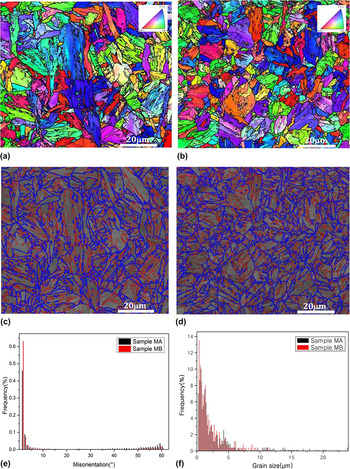
Figure 2 presents the crystallographic characteristics of isothermal quenched samples obtained by EBSD. As seen from Fig. 2(a), sample MA exhibits a typical lath martensitic microstructure, lath-shaped bainite (i.e., upper bainite), and small amounts of coarse upper bainitic laths with high-angle grain boundaries (>15° misorientation, HAGBs). After adding Ce, the microstructures of sample MB mainly consist of a lath-shaped martensite and a small leaf-shaped bainite (i.e., lower bainite) with low-angle grain boundaries (<15° misorientation, LAGBs) [Fig. 2(b)]. The corresponding quantitative results in Fig. 2(c) show that addition the Ce element in HSLA-D6AC steel can increase the ratio of LAGBs and decrease the ratio of HAGBs. In detail, the weight of LAGBs less than 15° misorientation in sample MA is obviously lower than the one in sample MB in the width range from 0° to 15°. The maximum frequency of LAGBs for sample MA is about 0.46% and calculated average LAGBs is 0.042%. However, the maximum value of frequency of LAGB for sample MB almost reaches 0.64%, and the average HAGBs is 0.008%. The influence of Ce on the size of grains is described in Fig. 2(f). It is found that throughout the scan region, the maximum size of grains and the average size of grains in sample MA are about 23.9 μm and 3.89 μm, respectively. After adding Ce, the maximum size of grains and average size of grains have dropped to 11.5 and 2.53 μm. The average LAGBs and HAGBs of MB are 0.054% and 0.004%, respectively.
Crystallographic characteristics of isothermal quenched samples analyzed by EBSD: (a) and (c) sample MA. (b) and (d) sample MB. (a) and (b) orientation image map, (c) and (d) structure of the grain boundaries (Red and blue lines denote LAGBs with having the misorientation less than 15° and HAGBs having the misorientation greater than 15°, respectively.), (e) frequency distribution of misorientations, and (f) histograms of the grain size distributions.

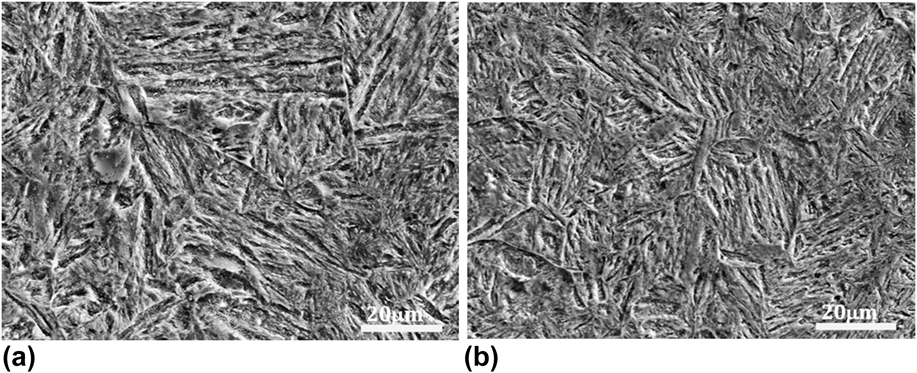
Figure 3 reveals the SEM micrographs of tempered samples. It is found that for sample MB with Ce, the tempered martensite laths are obviously refined [Fig. 3(b)]. The calculated average martensite lath width of MA and MB is about 25 nm and 10 nm, respectively.
SEM micrographs of tempered samples: (a) sample MA and (b) sample MB.

Because the lattice distortion energy of intragranular Ce is much higher than that of Ce segregation along the grain boundaries, Reference Jeon, Kim, Choi, Kim, Kim and Park15 for Ce, it is likely to segregate on grain boundaries via diffusion mechanism. Changes of the substructure of isothermal quenched and tempered samples may be explained with the grain boundary segregation effect of the Ce element: (i) In sample MA without Ce, the inhomogeneous upper bainite microstructure with various grain sizes observed during the isothermal quenched process [Fig. 2(a)] is even inherited in the subsequent tempering process. However, the Ce element segregating on metal grain boundaries can reduce the activity of other alloy elements and promote their dissolution in the austenite, Reference Cai and Li8 which is conducive to the lower bainite transformation at a medium temperature. As a result, after adding Ce, coarse upper bainitic laths transform into very fine lower bainite laths [Fig. 2(d)]; (ii) For tempered samples, the prior-austenite grain boundaries, martensitic packet boundaries, and martensitic block boundaries are the high-angle grain boundaries, whereas the martensitic lath boundaries belong to the low-angle grain boundaries. The high-angle grain boundaries with the high energy exist in the steel matrix due to complete recrystallization, and low-angle grain boundaries with low energy are formed through dynamic recovery and partial recrystallization. Reference Koohdar, Nili-Ahmadabadi, Habibi-Parsa and Jafarian16,Reference Xiao, Liu, Hu, Wang and Ma17 Due to the segregation effect of the Ce element, not only the nucleation sites are occupied but also nucleation and growth of the recrystallization grains are effectively suppressed. Reference Wang, Song and Han18,Reference Zhang, Ding, Xu, Gao, Chen, Chen, You, Huang and Tang19 So, in this case, the low-angle grain boundaries cannot completely transform into the high-angle grain boundaries [Fig. 2(f)], and the recrystallization grains are refined [Fig. 3(b)]. On another hand, the dragging effect produced by Ce can restrain the grain growth, refine grain sizes, and decrease impurity concentration on the grain boundaries, which are favorable for reducing the stress concentration. Reference Xiang, Chen, Wei and Wu20 In addition, it should be noted that as a surface active element, Ce can lower the surface tension and energy needed for the formation of a critical crystal nucleus, which results in the refinement of grain sizes.
Not only the martensite nucleation but also growth into lath is at the austenite grain boundary. With the prior-austenite grain size increasing, the martensite laths grow very fast and the lath packet size also increases. However, in general, if the size of the prior-austenite grain is small, the resulting width of most martensite laths is relatively small. Reference Liu, Lin, Song, Yang, Zhang, Wang and Huang21 So, when Ce is added into sample MB, the prior-austenite grains are refined, which lead to the smaller martensite lath packet size [Fig. 3(b)].
B. Effects of Ce addition on dislocations
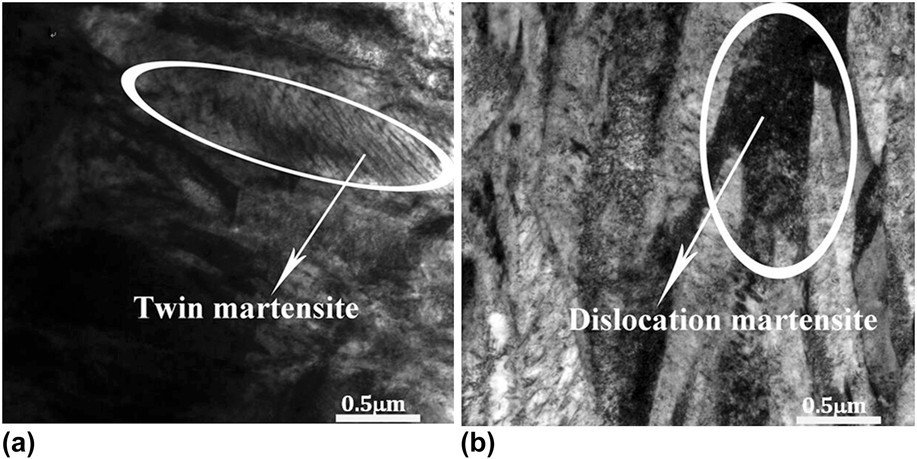
The morphology of twin martensite and dislocation martensite in TEM are in Fig. 4. According to Fig. 4(a), in isothermal quenched sample MA, twin martensite can be observed within martensite laths, and the thin plate of twin martensite is about 10 nm wide. After adding rare-earth Ce, the width of martensite laths becomes smaller; meanwhile, the morphology of martensite transforms from twin martensite to dislocation martensite [Fig. 4(b)].
TEM micrographs showing the morphology of twin martensite and dislocation martensite in isothermal quenched samples: (a) sample MA and (b) sample MB.

The volume expands when the austenite transforms into the martensite, Reference Azghandi, Ahmadabadi, Raoofian, Fazeli, Zare, Zabett and Reihani22 and the distortion energy is generated. The new martensite phase is under the large compression stress, whereas the parent phase suffers the large tension stress; therefore, the volume strain energy will be enhanced during the process of phase transition. Reference Hui, Zhang, Zhao, Shao, Wang, Sun and Yu23 For sample MA with high carbon content in martensite, due to continuous cooling, the distortion energy rises, if the direction of the martensitic growth points in the direction of the mirror symmetry in the martensitic nucleation and growth processes, and the strain energy is reduced, which is why twin martensite is formed [Fig. 4(a)]. Ce is a surface active element, and the activity interaction parameter between Ce and carbon is negative. Reference Yoo, Choi, Kim and Park24 After adding Ce, Ce reduces the activity coefficient of the C element and prevents the carbon diffusion. Reference Song, Yu, Li, Zhou, Lu and Liu25 With the reduction of carbon content in martensite, the atomic activity becomes stronger, and the elasticity modulus becomes larger in sample MB containing the Ce element. Meanwhile, the distortion energy caused by the formation of the new phase drops and the strain energy increases. So the morphology of martensite transforms from twin martensite [Fig. 4(a)] to dislocation martensite [Fig. 4(b)]. The dislocation martensite is the most important strengthening phase of HSLA-D6AC steel; in another words, after adding Ce, strength of the steel is improved.
C. Effects of Ce addition on precipitates
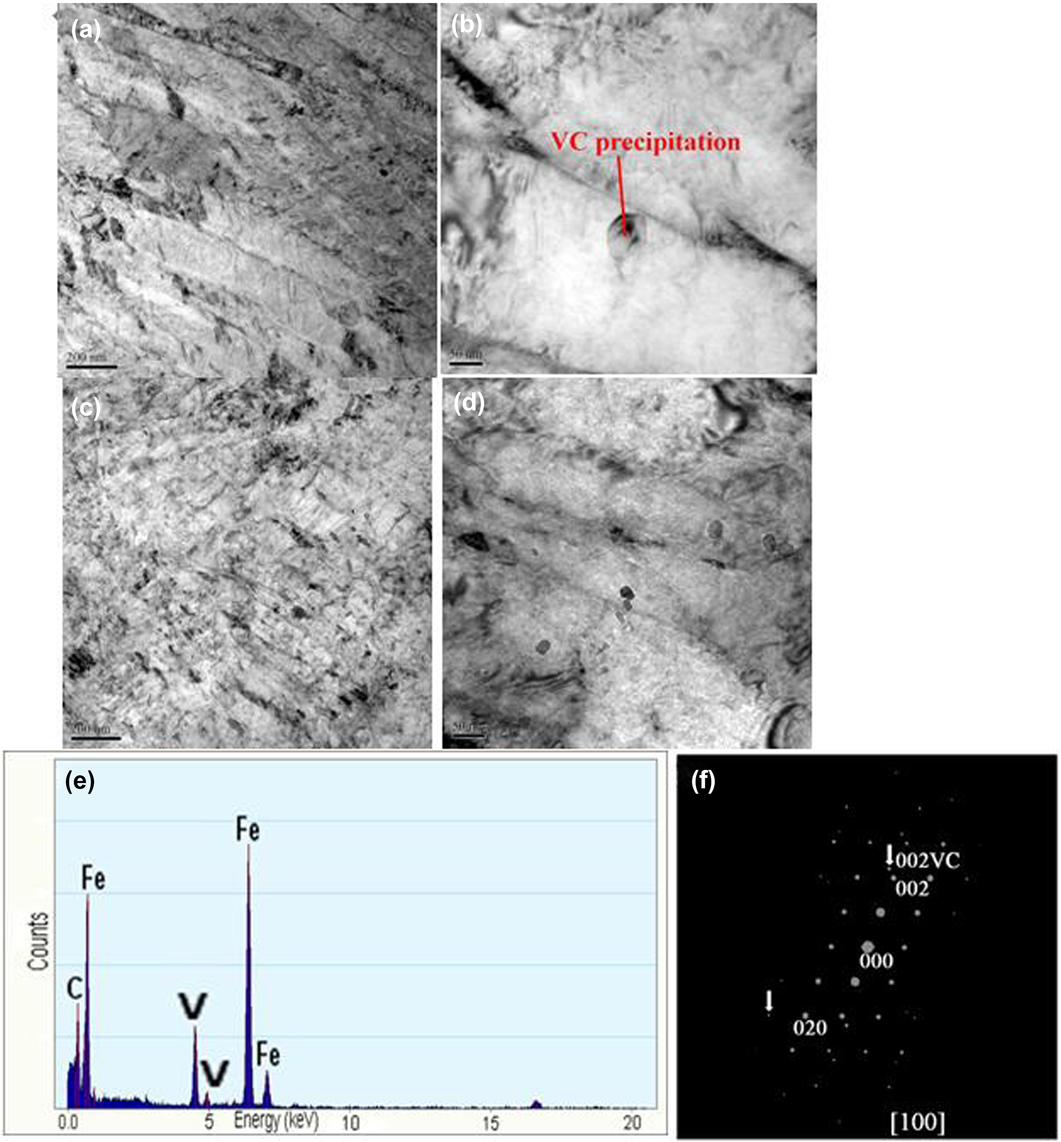
Figure 5 shows the TEM pictures of VC precipitates in tempered samples. Figures 5(b) and 5(d) are partially enlarged details corresponding to Figs. 5(a) and 5(c), respectively. The tempered sample MA without Ce has coarse grains [Fig. 5(a)], and the average diameter of precipitates is observed to be approximately 50 nm [Fig. 5(b)]. Figures 5(b) and 5(c) indicate that the Ce element in HSLA-D6AC steel shows a great effect on grain refinement and precipitation strengthening. From Fig. 5(b), the martensite laths are finer, which is in good agreement with the SEM results in Fig. 3(b). Meanwhile, the amount of precipitates increases, and the average size of the precipitates decreases [Fig. 5(d), average size of 20–30 nm]. In microalloy steel, there are three kinds of second-phase precipitation particles containing the V element, VC, VN, and V (C, N). In the present work, because the Nitrogen content in steel is detected to be less than 5 ppm, only the VC precipitate is taken into account, which is consistent with the chemical analyses result for precipitates in the martensite laths [Fig. 5(e)]. The diffraction pattern [Fig. 5(f)] indicates the fundamental spots of the [1 0 0] zone axis. Weak but clear small spots coming from VC compounds are observed. The orientation relationship between the precipitates and the matrix phase is (0 0 1)P//(0 0 1)M and [1 0 0]P//[1 0 0]M, that is, a VC compound is formed in the fcc matrix (γ) with each facial plane in parallel.
TEM pictures showing VC precipitates in tempered samples: (a) sample MA and (c) sample MB. (b) and (d) are the partially enlarged details corresponding to (a) and (b), respectively. (e) EDX analysis of sample MA. (f) Diffraction pattern structure of the VC compounds and the orientation relationship between the precipitates and the matrix.

The solubility of V (C, N) in austenite and ferrite is much larger than that of other microalloy elements. In general, at low temperatures, VC precipitates in tempered alloys can produce more and effective nucleation sites for subsequent intragranular ferrites, thus the grain is refined. Besides, V carbides precipitate at an early stage of the tempering process and pin the recrystallization grains, thus retarding abnormal grain growth. Reference Zhang, Miyamoto, Shinbob and Furuhara26
When the Ce atoms enter the Fe matrix, crystal lattice distortion is caused and the system energy is raised. To keep the system energy low, more oversaturated vacancies may aggregate around the Ce atoms. Because of the high vacancies binding energy, the Ce atoms would be relatively mobile, and it is much easier for VC precipitates to be formed and aggregate. It is believed that the higher lattice distortion energy and vacancy energy induced by Ce atoms can provide the driving force for the nucleation of V carbides. Reference Hao, Liao, Li, Dan, Ren, Yang and Liu27 So, due to the addition of Ce, the precipitated V carbides in steel are increased. In addition, because the activity interaction parameter between Ce and vanadium is negative, the precipitation effect of the V element is strengthened. The increased VC precipitates promote the refinement of grain sizes. One can say that the addition of the V element in HSLA-D6AC steel can provide an optimal combination of both high strength and good toughness through grain refinement and precipitation strengthening.
D. Effects of Ce addition on mechanical properties
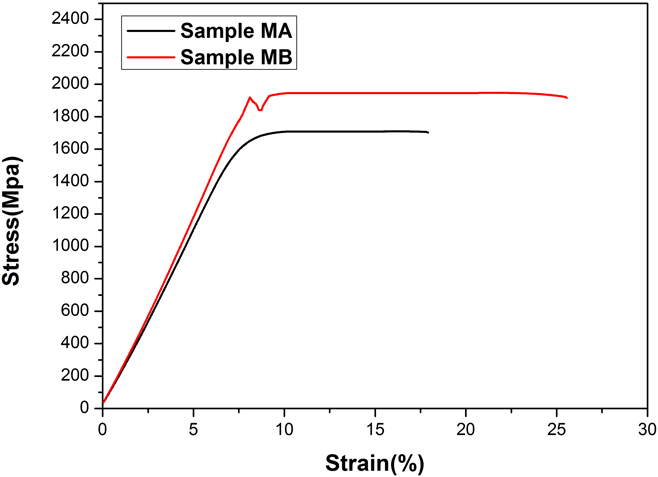
The conventional tensile properties of the tempered steels are summarized in Table II. The sample MA presents a tensile strength of 1702 MPa, whereas the sample MB has a tensile strength of 1982 MPa. This indicates that the addition of Ce results in a distinct enhancement in the tensile strength of the HSLA-D6AC specimen (16.5%). As listed in Table II, the Ce element has a similar effect on the yield strength. For sample MB, the yield strength value reaches 1820 MPa, which is 13.4% higher than the yield strength value of sample MA. On the other hand, the sample MB presents a higher elongation and reduction of area: after adding the Ce element, the elongation increases from 17.91 to 25.56%, and the reduction of area is improved from 32 to 56%. The increase in elongation and reduction of area demonstrate that the Ce element can stimulate the occurrence of necking during tensile tests. The ratio between yield strength and tensile strength, i.e., yield ratio, is recognized as an important performance factor in material specifications, design codes, and the analysis of structural integrity. From Table II, the yield ratio of the HSLA-D6AC sample decreases from 0.943 to 0.918 when the rare earth element Ce is added, which is sufficient for specific structural applications. In addition, a distinct necking stage on the stress–strain curve of sample MB obtained from tensile tests is observed in Fig. 6. This phenomenon is consistent with the experimental data in Table II: values of elongation and reduction of area of sample MB are 42.7 and 75% higher than the corresponding values of the sample MA, respectively. In a word, the tensile test results illustrate that the Ce element can promote the strength and plasticity of the tempered sample.
Tensile results of tempered steels.

Stress–strain curves of tempered steels obtained from the tensile test.
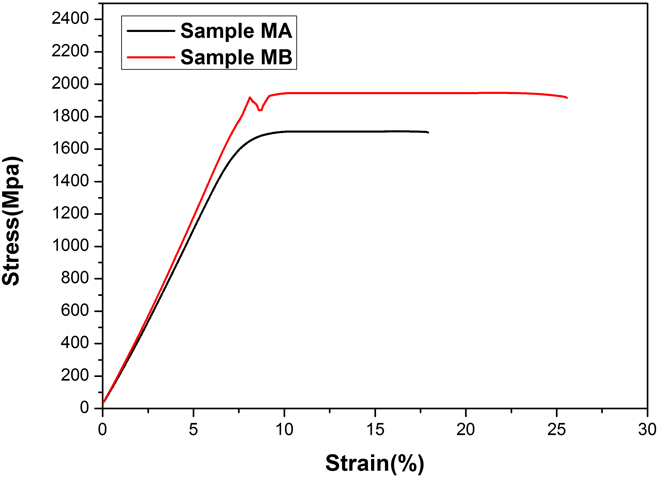
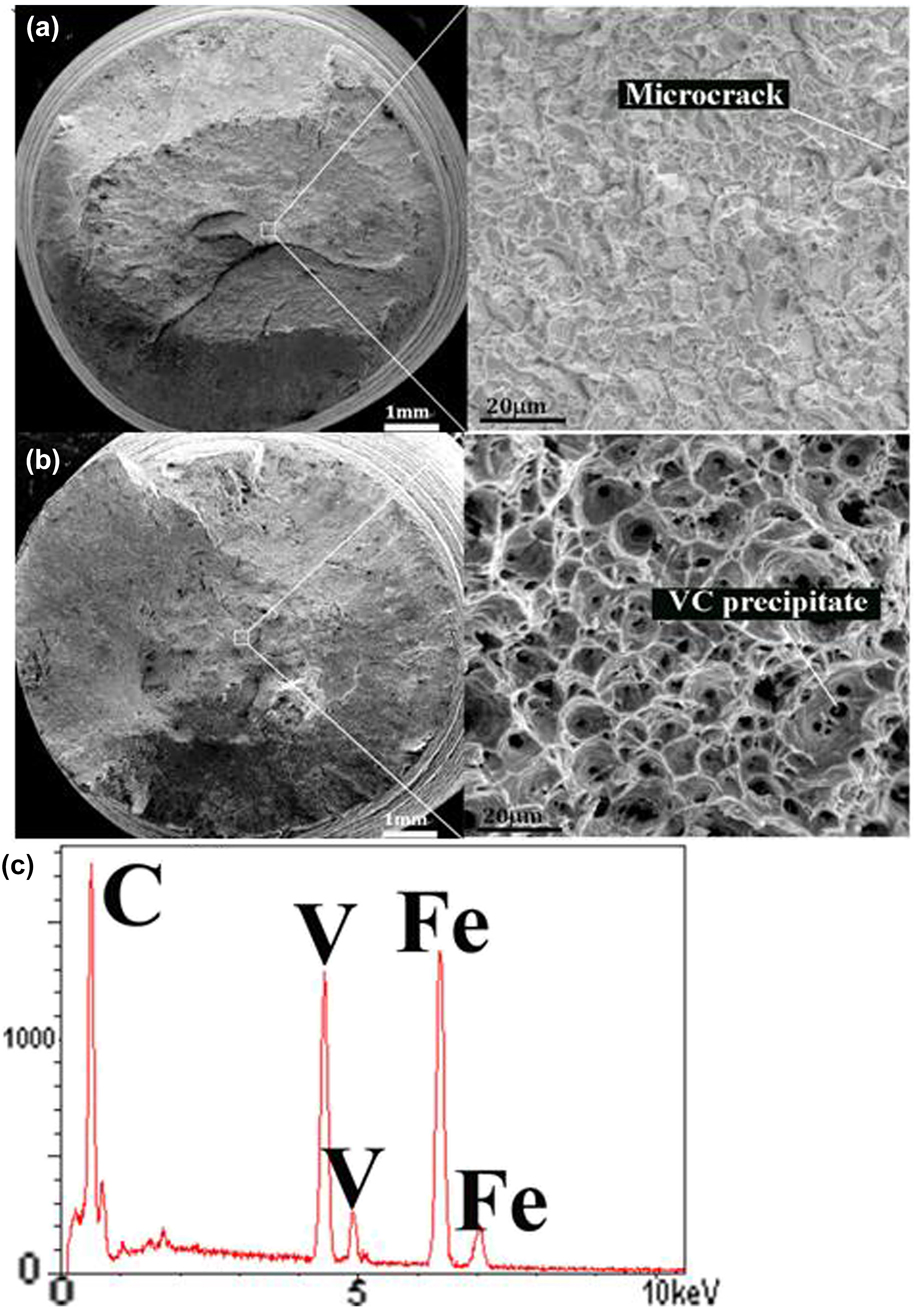
Figure 7 shows the cup-and cone-shaped fractures of two tempered steels. It is found that in Fig. 7(a), before adding Ce element, due to obvious branching cracks, the central zone surface is up-and-down and looks like a ridge; meanwhile, cracks expand rapidly. The equiaxial and shallow dimple-like structures are observed in the central zone of the sample MA fracture, and these fine ductile dimples with microcracks exhibit a mixed ductile-brittle fracture, which means that intense plastic deformation occurs prior to fracturing. In contrast, the fracture surface of sample MB comprises mainly of two zones: fiber zone and surrounding shear lip zone [Fig. 7(b)], showing obvious ductile fracture characteristics. When the Ce element is added into sample MB, the feature of fracture morphology varies from the original shear fracture [Fig. 7(a)] to microvoid coalescence fracture [Fig. 7(b)] and dimples are more deep. Furthermore, the energy spectrum of the precipitate in Fig. 7(c) indicates that multiple precipitates at the bottom of big equiaxed dimples are VC precipitates, which promote plasticity of sample MB. In ductile fracture of HSLA-D6AC steel, voids form at VC precipitates. As the description in section C, the Ce atoms make the precipitated V carbides finer and increase their dispersion on the surface. Second phase particles (VC precipitates) with a micrometre-scale grain size play an important role in the propagation process of ductile cracks. In the three-dimensional stress zone, due to the large plastic deformation, the internal voids grow and eventually link up by necking of the ligaments between the matrix and second phase particles, or the microcracks form around second phase particles firstly and then the microcracks are changed into voids. Reference Varshney, Sangal, Kundu and Mondal30 In this case, the microscopic necking is formed between adjacent voids. Therefore VC precipitates at the bottom of big equiaxed dimples promote the formation of a new microscopic necking (the initiation of voids) and delay the propagation of microcracks, thereby improving the strength and plasticity.
Fracture surface of tensile specimens for (a) sample MA, (b) sample MB, and (c) the energy spectrum of precipitate in sample MB.

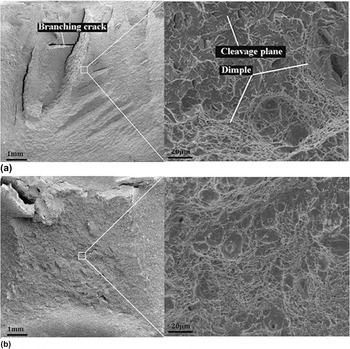
Figure 8 shows the impact specimen fractographs of tempered steels. The measured impact toughness value increases from 83 J (sample MA) to 136 J (sample MB). It is clear that the impact fracture of sample MA has deep branching cracks in the central fiber zone, and the impact fracture features a transgranular quasi-cleavage consisting of a clear cleavage river pattern and tiny cleavage planes, as well as a few uneven shallow dimples [Fig. 8(a)]. See Fig. 8(b), higher impact energy can be absorbed when the fracture surface has a lager fraction of shear lips and a fiber region with deeper and more homogeneous dimples. In addition, compared with the relatively flat impact fracture of sample MA with low plastic deformation, the impact fracture of sample MB with high plastic deformation is coarser. This is why the impact value of the tempered sample with Ce increases.
Impact specimen fractographs of tempered steels: (a) sample MA and (b) sample MB.

IV. CONCLUSIONS
-
(1) In the successive tempering stage, the recrystallization of HSLA-D6AC steel is delayed due to the segregation of the Ce element on the grain boundaries; in this case, the low-angle grain boundaries cannot completely transform into the high-angle grain boundaries, and the homogeneous growth of the recrystallization grains is effectively suppressed, which makes the recrystallization grains refined.
-
(2) After adding rare-earth Ce, the increased fine VC precipitates uniformly distribute and disperse in steel during the tempering stage, pin the recrystallization grains, and retard abnormal grain growth, thereby obtaining the fine grains and martensite laths.
-
(3) By TEM analysis, the twin martensite transforms into dislocation martensite with a high density dislocation due to the addition of Ce, resulting in the increase of strength after tempering.
-
(4) During tensile test, HSLA-D6AC steel containing the Ce element exhibits a distinct necking stage, and the fracture characteristics are influenced by the grain refinement and the increased nanoscale VC precipitates. The grain refinement caused by the fine VC precipitates and the strong dragging effect of the Ce element not only effectively enhances the strength but also improves plasticity of the steel significantly.
-
(5) The impact test indicates that the value of impact toughness increases from 83 to 136 J after adding the Ce element; meanwhile, some more and deeper homogeneous dimples appear and the quasi-cleavage fracture transforms into a ductile fracture characterized by microvoid coalescence, demonstrating that HSLA-D6AC steel containing the Ce element achieves excellent comprehensive mechanical properties.
ACKNOWLEDGMENT
This work is supported by the Young Scientists Fund of the National Natural Science Foundation of China (Grant No. 11404154).