By turn Spanish, French, Spanish, French, and American, the territory eventually transferred in the Louisiana Purchase of 1803 was the first, and largest, step on the United States' path to regional hegemony. The sale comprised considerably more than the contemporary state of Louisiana, virtually doubling the size of the republic. In addition, at a time when water transportation dominated communications and trade, the cession gave the United States control of the Mississippi River, the major north–south artery between the Appalachians and the Rockies, as well as of New Orleans, a choke-point that could dominate the economies of the interior.
The Background to the Purchase
Several European great powers had an interest in the region and, at various times, had exercised different degrees of control. The first Spanish expeditions in 1528 and 1541 resulted in no permanent settlements in Louisiana but helped to substantiate Spain's later claims to the territory (DeConde 1976, 4–5; see also Shepherd 1904, 443). A French mission down the Illinois and Mississippi rivers reached the Gulf in 1682. Its leader, Robert Cavelier, sieur de La Salle, claimed the territory for France, and named it in honor of Louis XIV (DeConde 1976, 6–7). France lost the east bank of the Mississippi (as well as New France) to England in 1763 following the Seven Years War. At the same time, England also received East and West Florida from Spain. France's exclusion from the continent was completed by its cession of the west bank of the Mississippi to Spain by the Treaty of Fontainebleau (Aiton 1931, 718).
Between 1762/63 and 1776 the only two colonial powers seriously vying for control of North America were England, in the north and east, and Spain, in the south and west. Having withdrawn from the continent, France was more interested in interfering with the English empire than in reestablishing its own (Fletcher 1930, 368, 375–76). England's position on the continent was dealt a serious blow by its defeat in the War of Independence. The Floridas were restored to Spain, and the remaining Anglo-American territory was divided between England and the United States. Despite recovering Florida, however, Spain gained little long-term advantage from these developments. While the amount of territory England controlled was much diminished, it was still easily capable of invading Louisiana from Canada. In addition, Spain now had to cope with increasing westward migration of Americans into territory it claimed, as well as with large-scale smuggling that undercut its own economy. For their part, the Americans considered themselves heirs to the English colonies' original land grants that gave competing titles to territory claimed by Spain. In addition, the Americans were determined to reduce the vulnerability of their trade to Spanish control of the Mississippi River.
Spanish–American friction was briefly eased by the Treaty of San Lorenzo (Pinckney's Treaty) of 1795. Spain ceded claims to land east of the Mississippi and north of the 31st parallel and guaranteed American vessels free navigation of the lower river. The United States was also granted the right to transship goods at New Orleans free of tax for three years, with Spain able to nominate an alternative site thereafter (DeConde 1976, 61–62; James 1914, 44). These generous Spanish concessions did not long solve their problems with either American expansion or American smuggling. Migration west of the Mississippi and south of the 31st parallel continued (DeConde 1976, 71). The American newcomers refused to assimilate in language or custom and were correctly viewed by Spain as an inevitably irredentist diaspora. In addition, American smuggling of goods via New Orleans to other Spanish colonies was a constant source of irritation to the authorities (Deconde 1976, 72).
In November 1799 France's interests in the Western Hemisphere, renewed under the Directory, were boosted by Napoleon Bonaparte's seizure of power (Fletcher 1930, 374–75; Lokke 1925, 80; Sloane 1899; 1904, 508–9; Turner 1905, 268–69, 277). France sought to mold a new empire in the west, with Louisiana supplying food, timber, and other commodities to the sugar island of St. Domingue (DeConde 1976, 77, 86; Lyon 1934/74, 109; see also Turner 1905, 257). While Louisiana would supply St. Domingue, it was the island colony that would turn a profit by restoring what had previously been the source of 70% of France's sugar, which in turn produced 20% of its exports (Kukla 2003, 213–14).7
See Lyon 1934/74, 28–29 on how colonies were valued during the eighteenth century and the high value placed on the sugar islands of the West Indies compared to other colonies.
Without St. Domingue, Louisiana was a doubtful economic proposition.
While ostensibly offered by France as compensation for Spanish losses in the Seven Years War, the original cession in 1763 was in large part made between two states for which “Louisiana was not merely destitute of intrinsic value, it entailed a positive deficit” (Shepherd 1904, 439). One French official observed, on September 20, 1762, that the colony “costs France eight hundred thousand livres a year, without yielding a sou in return” (447; see also Cerami 2003, 11). The Spanish in the intervening decades had done little better (Fletcher 1930, 368–69). On June 22, 1800, Mariano Luis de Urquijo, Spain's secretary of state for foreign affairs, observed to the Spanish ambassador in Paris that the territory “costs us more than it is worth” (cited in Lyon 1934/74, 104; also cited in DeConde 1976, 92; Kukla 2003, 214, and Whitaker 1934, 469–70). Spain regarded Louisiana as a necessary part of its defense-in-depth for its much more valuable holdings farther south and west. A twice-yearly grant from Mexico to Louisiana was regarded as part of the cost of doing business (Kukla 2003, 18, 37–39, 74, 91–92; see also DeConde 1976, 72).
While not an economic asset as a stand-alone colony, a French-controlled Louisiana would nevertheless serve three strategic roles, all operating to contain the United States: a barrier to westward expansion, a choke-point on the Mississippi, and a rival metropole. First, French Louisiana would provide a much stronger obstacle to American expansion than Spain's rapidly declining empire (Fletcher 1930, 375; James 1914, 47–48; Lyon 1934/74, 149; Whitaker 1934, 456). The barrier rationale was a central theme in discussions of the comparative merits of French and Spanish ownership, both in the 1790s and earlier (Kukla 2003, 205; see also DeConde 1976, 8, 26, 78, 80, 82–83, 86–87, 93, and Lyon 1934/74, 14, 51, 81, 88). Second, New Orleans “commanded the single most strategic point between the Appalachians and the Rocky Mountains of North America” (Kukla 2003, 31; see also 231). The economies of the interior depended on the Mississippi River for transport, and New Orleans controlled the waterway (Lyon 1934/74, 117). A state that could restrict egress from the Mississippi had powerful leverage over upstream territories (Robertson 1885, 254). Finally, French Louisiana could serve as a rival metropole for parts of the United States to the west of the Appalachian mountains. Given the long-standing rivalry between northeastern and southern states, and the widespread acceptance of Montesquieu's argument that large republics inevitably fragment, it was believed that America was ripe for division (Cerami 2003, 13–14; Kukla 2003, 59–66, 93, 97–98). France hoped that, in order to guarantee access to the lower Mississippi, territories on the Eastern bank would transfer their loyalty from the United States. Hence a contemporary British observer noted that “the state of Kentucky must unite with France as the Mississippi is the only communication that fine country has with the Sea, and she is deprived of Commerce with the United States by that Barrier the Apalachian [sic] mountains…” (quoted in H. Bailey and Weber 1960, 244, emphasis in the original). The French would be adopting a strategy previously advocated by the Spanish and feared by the United States, but doing so with a government that was far more attractive to some Americans than the decaying Spanish monarchy (Kukla 2003, 20, 77–78; Riley 1897, 180–81). For these reasons, it was hoped that territories to the east of the Mississippi could be persuaded to remove to Louisiana, and a French state could be constructed stretching from the Rockies to the Appalachians (DeConde 1976, 59, 83; Lyon 1934/74, 113–14).
In October 1800, by the second Treaty of San Ildefenso, the Spanish agreed to retrocede Louisiana to France in return for territory in northern Italy and six ships (DeConde 1976, 95; Lyon 1934/74, 108). At the same time, France verbally agreed not to alienate the territory to a third party. In July 1802 this assurance was repeated in a written promise by Gouvion St. Cyr, French Ambassador to Spain, which included the sentence, “I am authorized to declare to you in the name of the First Consul that France will never alienate [Louisiana]” (quoted in Lyon 1934/74, 124). Documents authorizing transfer of the territory were finally prepared on October 15, 1802 (DeConde 1976, 105; Lyon 1934/74, 120).
The United States had caught wind of an impending agreement between Spain and France earlier, although it was unsure about both the timing—believing that the retrocession might have been agreed as early as the 1795 Treaty of Basel—and the extent—believing that the deal included the Floridas. By May 1801, the Americans were certain that some kind of deal had taken place, although they were still unclear on what territory had been transferred (DeConde 1976, 107–108). If France's possession was allowed to operate as a barrier to westward expansion, as a chokehold on the Mississippi, and as a magnet for disunion, it would do so entirely at the expense of the United States. Americans were acutely aware of these risks (see, e.g., Cerami 2003, 27, DeConde 1976, 69, 81–82, and Lyon 1934/74, 150). Not surprisingly, the United States much preferred “pacific” and “feeble” Spain, which “might have retained it quietly for years” (Skolnik 1969, 36–39). The Spanish were viewed as “more safe, quiet, and useful neighbors” (DeConde 1976, 84), and Rufus King, U.S. representative to Britain, observed that the Spanish, like the Turks, “are the most proper to possess a great Empire with great insignificance” (Kukla 2003, 227).
In December 1801, Robert Livingstone, America's ambassador to France, was directed to discover the extent of the retrocession and whether the French intended to send troops to its North American possessions (Kukla 2003, 238). Livingstone was instructed to persuade the French not to reoccupy Louisiana and to obtain the Floridas from them if they had title or from the Spanish if they did not (Kukla 2003, 239). U.S. concerns about Louisiana were considerably heightened on October 16, 1802, when Spain's Acting Intendant of Louisiana, Juan Ventura Morales, disregarded the Treaty of San Lorenzo by suspending America's right to deposit goods at New Orleans (Documents 1927, 822–23; 1928, 331–32, 341; Lyon 1934/74, 167; Skolnik 1969, 54–55). The move enraged Americans, especially those whose livelihoods depended on free egress from the lower Mississippi (Pelzer 1913, 122; Perkins 1955, 285). The United States (as it turns out, wrongly) believed that Spain had already transferred the territory to France and that the suspension was the first act of the new owners (Lyon 1932).8
The closure was a wholly Spanish adventure in which France played no role and was likely a retaliation for American smuggling. Lyon (1932, 282) suggests that the French did not know about the closure until they were told by their representative in Washington.
U.S. President Thomas Jefferson calmed the situation by appointing James Monroe as Minister Plenipotentiary and Extraordinary to France and Spain. Monroe was dispatched to Paris to help Livingstone persuade the French to part with New Orleans (Lyon
1934/74, 177–78).
Monroe's arrival in Paris coincided with a remarkable reversal by the French. Napoleon told his ministers on April 11, 1803: “Irresolution and deliberation are no longer in season. I renounce Louisiana. It is not only New Orleans that I will cede, it is the whole colony without any reservation” (quoted by Barbé-Marbois 1830/1977, 274). Neither Livingstone nor Monroe was instructed to ask for, or expected to be offered, the whole colony (Lyon 1934/74, 240). Nevertheless, even without instructions from Jefferson, they readily agreed to France's proposal. By the first week of May 1803, 10 months after France's written promise to Spain not to alienate its new possession, negotiations were completed for the territory's purchase by the United States.
The purchase met with overwhelmingly positive reactions in the United States. To be sure, die-hard northeasterners were very critical of westward expansion, and some were deeply angered by the acquisition. Knudson (1969, 184) relates the “hard-core Federalist” response: “The price was not right. The territory was too large; the Union would be rended. Spain would never agree to the transaction…. The cities of the east would be depopulated…the center of political power would drift southward and westward… New England would be ruined” (see also Knudson 1969, 198–202; Robertson 1885, 262–63). But previous critics of the administration who were not so driven by sectional interests had to admit the obvious value of the territory to the United States and were largely reduced to claiming that Jefferson's administration deserved no credit for a happy accident (Kukla 2003, 290–91).
France's Options in 1803
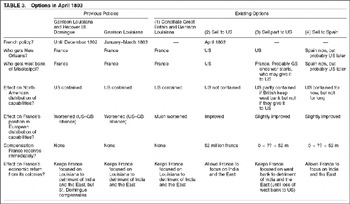
While America's readiness to buy Louisiana clearly fits both versions of offensive realism, France's sale poses a problem for the argument that continental great powers prefer to contain would-be extraregional hegemons. By contrast, the decision fits my prediction that extraregional foreign policies are subordinate to local power considerations. The possible options France had in April 1803 are shown in Table 3, together with two previous policies that were no longer feasible.
Until the end of 1802, French policy was based on the hope that it could suppress the rebellion on St. Domingue. By December, the prospect of a larger Caribbean empire was much reduced, and with it the economic raison d'être of the Louisiana retrocession (Kukla 2003, 254). France's military force on St. Domingue had been decimated by yellow fever, with 29,000 troops killed or incapacitated (Stoddard 1914, 326–28, 338–40; see also Sloane 1904, 513). From January to March 1803, France continued to pursue the retrocession, despite the very bad news from St. Domingue. In March 1803, however, with Britain preventing French troops from sailing for Louisiana, Napoleon had four options: conciliate the British long enough to allow the military expedition to depart; sell its whole interest to the United States; sell only New Orleans and navigation rights on the Mississippi River to the United States; or live up to the nonalienation promise and transfer Louisiana back to Spain.
France Conciliates Britain to Allow Garrisoning Louisiana in the Spring of 1803
If France retained control of New Orleans, a U.S. alliance with Britain and war with France were both likely to follow (Cerami 2003, 155, 165; DeConde 1976, 85; Kukla 2003, 268; Lyon 1934/74, 182; Perkins 1955, 286–87, 295; Skolnik 1969, 126). Accordingly, the barrier, blockade, and rival metropole benefits all depended on France garrisoning Louisiana before war commenced with enough troops to deter or withstand an attack (DeConde 1976, 94–95). Hence the instructions to General Victor, the leader of France's expedition to garrison Louisiana, suggested that “the intention of the First Consul is to give Louisiana a degree of strength which will permit him to abandon it without fear in time of war, so that its enemies may be forced to the greatest sacrifices merely in attempting to attack it” (quoted in Lyon 1934/74, 135; see also Smith 1971, 30).
That there was not already a French military presence in early 1803 was largely due to Spanish delays. The territory could have been retroceded as early as the Treaty of Basel in 1795 (DeConde 1976, 80; Whitaker 1936). Even the 1800 retrocession by the second Treaty of San Ildefenso would have been soon enough, if Spain had not then forced France to endure a two-year delay until signing the formal authorization for the transfer in October 1802. Since yellow fever had killed most of the troops already sent to reestablish the western empire, a garrison for Louisiana would have to come from France. By the time General Victor's expedition to Louisiana was ready to depart in January 1803, it found itself trapped by ice that did not melt until mid-March (Adams 1955, 174; Lyon 1934/74, 129–44). At that point the expedition found itself blockaded by the British fleet (Smith 1971, 33). Unless and until France conciliated Britain by modifying its territorial ambitions, the garrison could not leave.
Full Sale to the United States.
By selling the territory France would receive a net sum of 52 million francs: The 80 million francs purchase price, less 20 million francs to settle American claims on France for seizure of vessels and 8 million francs in brokers fees to discount the bonds issued by the U.S. government for cash (Barbé-Marbois 1830/1977, 402–12; Colomb 1929; Winston 1929, 190). Since the colony was indefensible without a garrison, the sale would represent a 52 million franc gain on something that would otherwise be lost for nothing (Barbé-Marbois 1830/1977, 264; Kukla 2003, 235, 268; Lyon 1934/74, 200). In addition, the benefit of the territory would go to the United States and not to the British (Knudson 1969, 192, 194; see also Sloane 1899, 447). At the same time, Franco-American relations would be considerably improved and an Anglo-American alliance would be prevented. Another reason for selling the entire colony was that, by removing itself from the continent, France would free up its commercial classes to concentrate on developing its colonial interests elsewhere (Lyon 1934/74, 205).9
It is also possible that, by selling Louisiana with indistinct borders, Napoleon hoped to draw the Spanish, British, and Americans into a conflict in North America, drawing resources away from Europe. See Barbé-Marbois 1830/1977, 283–89, for a discussion of the borders of the purchase. See also Cerami 2003, 180; Lyon 1934/74, 225; and Robertson 1885, 256–60.
Finally, by selling Louisiana, the French could help create a great naval power to counter Britain (Sloane
1904, 512, 514).
Partial Sale to the United States.
France could have sold the United States the town of New Orleans, together with free navigation of the Mississippi River, and kept the rest of the territory. As Jefferson made clear in his April 18, 1802 letter to Robert R. Livingstone (reproduced in Skolnik 1969, 36–39), this would have been enough to satisfy the Americans. Indeed, the instructions to Monroe and Livingstone were to make an offer for New Orleans, the Floridas, and some small islands in the Mississippi. Failing that they were to ask for territory on which a new American town could be constructed, and if that was not forthcoming, they could be satisfied with a renewal of the right of deposit in New Orleans (Lyon 1934/74, 213). The United States certainly never expected France to offer it the whole colony. Shorn of its control of the Mississippi River, France would have been welcome to keep the west bank, at least for the time being (Kukla 2003, 233–34, 244–45, 265, 275; Lyon 1934/74, 177–78, 224).
There were several reasons why a partial sale was unlikely. First, when the Peace of Amiens broke down, the British could easily take what the French retained. Second, even if the British did not attack in the interim, the French would only be postponing an inevitable clash when the United States continued and intensified its westward pressure (Lyon 1934/74, 205). Third, if Louisiana without New Orleans could be made a going concern, it would still have to export its produce down a river now controlled by the Americans. The French would be in the same position vis-à-vis New Orleans that the Americans had been in with the Spanish, and that they now contemplated with the French. Finally, retaining the territory would keep the French commercial classes focused on the Western Hemisphere, to the detriment of their interests in Asia and the eastern Mediterranean. The Americans “were ready to buy an empire to get a city” (Lyon 1934/74, 224). The French, correctly concluding that without the city there was no empire, were unwilling to divide Louisiana.
Sale or Transfer to Spain.
If the French could not keep all or part of Louisiana, a final alternative would have been to abide by the promise not to alienate the territory to a third party. A transfer to Spain would not have earned the French as much U.S. goodwill as a partial or full transfer to America. But since the United States considered Spain much less of a threat, it would probably have forestalled an Anglo-American alliance against France. There were, however, at least three reasons why such a transfer was unlikely. First, Napoleon was furious with Spain for the two-year delay between agreeing retrocession and the transfer, and was not minded to do it a good turn (Lyon 1934/74, 122, 125, 198–99, 231; Smith 1971, 22). Second, while it is not clear what Spain might have offered by way of compensation for returning Louisiana, it is unlikely that it would have met the price paid by the Americans. Finally, a transfer to Spain was merely a delayed conveyance to the United States. It was widely recognized that because of the weakness of its defenses in Louisiana, “Spain's days in Louisiana were numbered” (DeConde 1976, 71; see also Whitaker 1934, 456). This was due in part to the disparity in population growth. Between 1785 and 1800 the population of the Ohio River Valley increased seven times faster than that of Louisiana (Kukla 2003, 113). The relative weakness of Spain is demonstrated by its anemic reaction to France breaking its promise not to alienate Louisiana. Spain acquiesced because to do otherwise was to risk war with the United States and the loss of the Floridas (Lyon 1934/74, 245).
Analysis
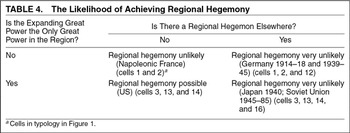
The key argument made in my extended version of offensive realism is that the anarchic international system provides dissimilar cues to different types of states to engage in extraregional balancing. An analysis of France's sale of Louisiana tests the hypothesis set out in cell (13) of Figure 1 that continental great powers make indifferent extraregional balancers, because local power considerations dominate their calculations. It investigates the central question of what local price France was willing to pay to contain the United States in another region. French policy evolved as the costs and benefits of containment changed.
Until December 1802, Napoleon was willing to risk an Anglo-American alliance by garrisoning Louisiana as part of a larger western empire that included the sugar producing island of St. Domingue. The period from January through March 1803 partly disentangles the economic benefits of the Caribbean from the strategic benefits of the west bank of the Mississippi. By January, Napoleon knew that France's plans for St. Domingue were in serious trouble, and he had firm indications that French control of Louisiana would provoke an alliance between the United States and Great Britain (Lyon 1934/74, 194–195; see also Lokke 1925, 86). Yet neither the failure of the St. Domingue expedition nor the strength of America's reaction to the closure of New Orleans led Napoleon to cancel plans for garrisoning Louisiana. For example, in February 1803, ignorant of the ice that prevented it from leaving Holland, Napoleon ordered “the entire Louisiana expedition to sail directly to its destination,” countermanding his previous order to divert much of its military force to St. Domingue (DeConde 1976, 152; Lyon 1934/74, 139–40). The expedition was repeatedly ordered to depart throughout February and early March (Smith 1971, 33, note 36). This suggests that, with or without St. Domingue, had local (i.e., European) power considerations allowed, Napoleon would have tried to contain the United States.
French policy changed in March 1803 when deteriorating relations with Britain forced Napoleon to make a choice between containing American power and pursuing French ambitions in Europe. France was unable to hold Louisiana unless it could get troops to the colony, which was only possible if Britain permitted the Helvoet-Sluys expedition to sail (Barbé-Marbois 1830/1977, 253). Britain's control of the sea routes to the Western Hemisphere had been readily demonstrated when France sent earlier military expeditions to St. Domingue. France's first attempt in May 1800 was only made possible by a storm dispersing the British blockading squadron, and the second by the Peace of Amiens and British sympathies with the aims of the expedition (Lokke 1925, 81, 85). By contrast, in early 1803, as the Peace of Amiens unraveled, France found itself faced by an uncooperative and potentially hostile Britain, in large part thanks to French provocation.
The Treaty of Amiens had restored all of France's overseas colonies, but required France to evacuate Naples and the Roman States and surrender Egypt to Turkey (Ward and Gooch 1922/70, 306). In return, Britain was to vacate Elba and Malta (Mahan 1897, 81). In the summer of 1802, Franco-British relations were reasonably congenial, but they quickly deteriorated in September and October following evidence of France's renewed ambitions, most notably in Egypt and Switzerland (Schroeder 1994, 231–32). France compounded its provocation by publishing a report by the leader of its Egyptian expedition in the Moniteur on January 30, 1803, including the observation that it could be conquered by 6,000 French troops. Britain subsequently refused to surrender Malta (Gill 1909, 73; Mahan 1897, 93–96; Sloane 1904, 509). On February 21, France published the official View of the State of the Republic, which noted, inter alia, that France needed an army of 500,000 men to be safe from the threat from Britain (Ward and Gooch 1922/70, 318). On March 8 the British government sent a royal message to Parliament announcing that in consequence of military pre- parations going on in the ports of Holland and France, it was prudent to make additional provision for defense (Ward and Gooch 1922/70, 319; Mahan 1892, 97).
Lord Whitworth, the British Ambassador to France, forwarded a March 12 memorandum from Napoleon noting that the troops in Helvoet-Sluys were intended for America but that, given the royal message, orders for their embarkation and departure had been countermanded (quoted in Browning 1887, 114). Napoleon's message was at best misleading, since he did not order the expedition to stand down until after the sale of Louisiana had been completed in April (Smith 1971, 34–35). Indeed, French Foreign Minister Charles Talleyrand complained to Lord Whitworth on March 25 that English frigates cruising off of Helvoet-Sluys were preventing the French vessels from leaving (Browning 1887, 142). Lord Hawkesbury (147) replied to Talleyrand, via Whitworth:
With respect to the British vessels alleged to be cruising off the ports of the Batavian Republic, his Majesty has several ships of war in the seas adjacent to those ports; but if their commanders have made any movements or held any language which could be regarded as being of a hostile nature, their conduct has been in direct opposition to the tenor of their instructions. His Majesty has received assurances from the French government that it is not their intention that the expedition to Louisiana should proceed to its destination under the present circumstances; in which assurances his Majesty places the most entire confidence.
March and April saw fruitless negotiations and mutual recriminations, culminating in the delivery of a British ultimatum that essentially required France to evacuate its troops from Holland and to permit Britain to keep Malta (Christie
1982, 260; Ward and Gooch
1922/70, 326–27). The French refused, and on May 18 Britain declared war.
Because France was unwilling to modify its territorial ambitions in Europe, it had no opportunity to garrison Louisiana, and hence a sale was mandated (Perkins 1993, 116). The three sale options (all to the United States, part to the United States, all to Spain) had the same basic configuration of costs and benefits: All would provide some immediate remuneration to France and forestall an Anglo-American alliance, but each would result in U.S. regional hegemony. Transfer of the whole colony to the United States was the best of the three sale options for France, because it provided the largest monetary return and gave France the best chance of befriending the Americans.
Since local power considerations dominated French calculations, it is entirely unsurprising that the sale was directed to improving French power in Europe, especially vis-à-vis Britain. For example, the 52 million francs France received was used to build barges for an invasion of Britain (Barbé-Marbois 1830/1977, 313; Richmond 1941, 53). In addition, Napoleon viewed the sale as helping the United States become a more formidable competitor for Britain, observing that “this accession of territory strengthens for ever the power of the United States; and I have just given to England a maritime rival, that will sooner or later humble her pride” (quoted in Barbé-Marbois 1830/1977, 312).10
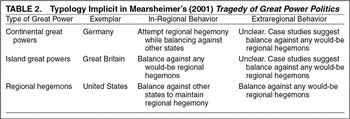
Napoleon's reasoning on this benefit was uncharacteristically weak. By removing all barriers to westward expansion, the Louisiana Purchase shifted the United States' center of gravity a thousand miles inland (Sloane 1904, 518). For the next 100 years, most of the republic's energies were spent acquiring and consolidating control over its continental empire. In addition, when the United States did eventually turn its attention eastward, it was to act in concert with Great Britain in two world wars and the cold war. In short, as suggested in cells (2) and (12) of the extended typology, the United States and Great Britain had the same interest in preventing the rise of a European regional hegemon.
To build the United States into a major competitor to the British, however, required helping it to become more powerful. The main drawback to the sale was that the United States was put firmly on the path to regional hegemony. Barbé-Marbois (
1830/1977, 290), a participant in the negotiations, captures the trade-off France was willing to make in selling the colony: “The cession of Louisiana was a certain guarantee of the future greatness of the United States, and opposed an insurmountable obstacle to any design formed by the English to become predominant in America.”
11 Similarly Sloane 1899 (447) observes that to keep control of the Gulf out of British hands, Napoleon was prepared to see it permanently in America's hands.
The increase in American power was clearly recognized and dismissed as a reason not to proceed with the sale. Napoleon observed,
Perhaps it will also be objected to me, that the Americans may be found too powerful for Europe in two or three centuries: but my foresight does not embrace such remote fears. Besides, we may hereafter expect rivalries among the members of the Union. The confederations, that are called perpetual, only last till one of the contracting parties finds it to its interest to break them…. (quoted in Barbé-Marbois 1830/1977, 276)
By selling, France received full compensation for the territory, forestalled an Anglo-American alliance, and built the United States into a potential competitor to the British. The question of whether the resulting regional hegemon would one day threaten France was left to posterity, and the hopeful hypothesis that a larger union would inevitably fragment.
In sum, so long as the cost of securing Louisiana could be borne largely by the colonies, and so long as retaining it did not unduly interfere with its own strategic interests vis-à-vis the other European great powers, France was willing to prevent American regional hegemony. But by April 1803 that was no longer a plausible position. Thanks to Spanish delays, the constant drain of rebellion and disease in St. Domingue, and the failure of the Louisiana garrison to depart Holland because of ice and blockade, France did not have the means to hold the territory once it took clear title. The only way to garrison Louisiana was to appease Britain and reign in French ambitions in Europe. Since France was unwilling to do this, at that point it reversed course because going into war with an indefensible Louisiana was worse than surrendering the colony before the conflict with Britain resumed.






Comments
No Comments have been published for this article.