

Introduction
With the development of modern society, the incidence of metabolic syndrome (MS) is increasing. MS is a group of metabolic abnormal pathological conditions characterised by abdominal obesity, dyslipidemia, and elevated blood pressure. Triglycerides (TAG) accumulation is closely related to the development of MS (Refs Reference Coudray1, Reference Yu2). Triacylglycerol (TAG) is the main form of energy storage in mammalian cells and is the main source of diet-related hepatic steatosis (Ref. Reference Wang, Airola and Reue3). In mammals, the synthesis of TAG is two pathways: the phosphoglycerol pathway and the monoacylglycerol pathway. Triglycerol-3-phosphate acyltransferase (GPAT) is involved in the synthesis of glycerolipids (TAG and phospholipid, PL) (Ref. Reference Yang4). It is a key enzyme in the first step of the ‘phosphoglycerol pathway’ of TAG synthesis (Refs Reference Morgan-Bathke5, Reference Kiegerl6), which catalyses glycerol 3-phosphate (G3P) and fatty acyl-CoA (acyl-CoA) to produce lysophosphatidic acid (lipolytic acid, LPA). Then LPA is transported to microsomes and further acylated by acylglycerophosphate acyltransferase (AGPAT) to phosphatidic acid (PA), which acts as a precursor for glycerophospholipid and TAG biosynthesis (Refs Reference Bratschi7, Reference Goossens8). This is the main pathway of TAG synthesis in most mammalian tissues. Therefore, the regulation and function of GPATs have a pivotal role in MS (Ref. Reference Cao9).
Mutations in genes encoding enzymes in the glycolipid biosynthetic pathway can cause diseases (Ref. Reference Gimeno and Cao10). Due to the subcellular location of GPAT subtypes, substrate preference and sensitivity to sulfhydryl reagents (such as N-ethylmaleimide, NEM) are different (Ref. Reference Wendel, Lewin and Coleman11). In this review, we will describe in detail the tissue distribution of several GPAT subtypes, new functional characteristics, the characteristics of each subtype gene knockout mouse, and the relationship between each subtype and metabolic syndrome.
GPATs phenotype
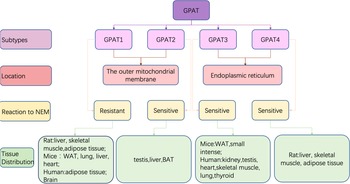
GPAT subtypes all have conserved structural motifs (I-IV) involved in catalytic reactions (Ref. Reference Yamashita12). They initiate the synthesis of glycerolipids in different cells. The distribution of GPAT subtypes is tissue-specific. GPAT1 and GPAT4 are mainly distributed in hepatocytes, while GPAT3 plays a major role in differentiated adipocytes. In the skeletal muscle, GPAT1 accounts for the vast majority of GPAT activity. In the liver, GPAT1 accounts for half of the GPAT activity, while in the heart, white adipose tissue (WAT), and brown adipose tissue (BAT), GPAT 3, and GPAT 4 account for most of the activity. The activities of GPAT1, GPAT3, and GPAT4 are related to the synthesis of TG and PLs, and the expression of GPAT2 is more prominent in the testis (Ref. Reference Gonzalez-Baro, Lewin and Coleman13). The following figure (Fig. 1) briefly introduces GPAT subtypes and their intracellular location.
GPATs Phenotype. The graph shows the characteristics of four subtypes of GPATs, their sensitivity to NEM is different. Except for GPAT1, the activities of other GPATs isoforms are inhibited by NEM, and tissue distribution of their subtypes. GPAT1 and GPAT2 are located in the outer mitochondrial membrane, while GPAT3 and GPAT4 are located in the endoplasmic reticulum.

Structure and properties of GPAT1
GPAT1 is the first cloned mammalian GPAT subtype. It is located in the outer mitochondrial membrane and is an NEM -resistant enzyme. GPAT1 has a substrate preference for saturated palmitoyl-CoA and selectively transfers acyl-CoA to the sn-1 position of G3P (Ref. Reference Kojta14). GPAT1 is a secondary transmembrane protein. Both the amino-terminal and the carboxy-terminal are oriented towards the cytoplasm. The loop structure is located in the mitochondrial membrane space. The active domain of acyltransferase faces the cytoplasm, close to the amino terminus. The dominant substrate of GPAT1 is C16:0 saturated fatty acyl-CoA. Experiments with knockout mice indicated that GPAT1 increases the expression of the transcription factor sterol regulatory element-binding protein (SREBP)-1c, which is a transcription factor regulated by insulin (Ref. Reference Ellis15). GPAT1 has the highest expression level in adipose tissue and liver, and GPAT1 is the main site of TAG synthesis, followed by muscle, brain, kidney, and lung. GPAT1 mRNA is most highly expressed in the liver, adipose tissue, and oxidised skeletal muscle in the rat. In mice, GPAT1 mRNA is also expressed highest in WAT, lung, liver, and heart. GPAT1 is most abundantly expressed in human adipose tissue (more than 10 times higher than in other tissues), indicating that GPAT1 plays an important role in glycerolipid synthesis in human adipose tissue. GPAT1 contributes half of the total GPAT activity in the liver and is regulated by the nutritional status (Ref. Reference Mitka, Ropka-Molik and Tyra16).
Phenotype of GPAT1 knock-out mice
GPAT1−A mice showed decreased VLDL and TAG concentrations in the liver, indicating that GPAT1 plays an important role in liver TAG accumulation. GPAT1 has a substrate preference for saturated palmitoyl-CoA and selectively transfers acyl-CoA to the sn-1 position of G3P. Therefore, the content of palmitate at the sn-1 position in hepatic phosphatidylcholine and phosphatidylethanolamine is decreased in GPAT1−/− mice. GPAT1−/− liver contains more harmful production, like 4-hydroxynonenal, which will increase the rate of cell renewal with oxidative stress (Ref. Reference Hammond17). GPAT1−/− mice fed with a high-fat diet (HFD) cannot avoid weight gain. Overexpression of GPAT1 did not significantly affect the weight gain in mice (Ref. Reference Linden18) and rats (Ref. Reference Nagle19). Therefore, the inhibitory effect of GPAT1 is unlikely to have a substantial effect on body weight, in this aspect, a more systematic and theoretical study is required.
Novel features of GPAT1
Recent studies have found that compared with males, the phenotype of GPAT1−/− mice is more pronounced in female animals. This result suggested that the role of GPAT1 may be gender-specific (Ref. Reference Gimeno and Cao10). In addition to the role in the synthesis of TAG, GPAT1 is also involved in regulating other physiological functions. Studies have found that GPAT1−/− mice are less susceptible to liver cancer because non-alcoholic fatty liver disease is one of the risk factors for liver cancer. This conclusion also indirectly indicates that GPAT1 plays an important role in the synthesis of TAG. In addition, GPAT1 is also important for the normal development of the thymus and the subsequent maintenance of peripheral T cell function. Many key functional abnormalities were found in GPAT1−/− mouse T cells, including reduction of IL-2, changes of the quality of PLs, and the increase of apoptosis (Ref. Reference Faris20). The function of T lymphocytes in GPAT1−/− mice becomes aging (Ref. Reference De Angulo21), and the proliferation of T lymphocytes in GPAT1−/− mice is inhibited (Ref. Reference Gulvady22), mitochondrial function is abnormal, resulting in cell metabolism disorder (Ref. Reference Faris23), and mitochondrial fragmentation (Ref. Reference Ohba24).
Structure and properties of GPAT2
Unlike GPAT1, the activity of GPAT2 is inhibited by NEM and has no substrate preference for C16:0-Co A and C18:0-Co A. GPAT2 is also a secondary transmembrane protein. Both the amino-terminal and the carboxy-terminal face the cytoplasm. The ring structure is located in the mitochondrial membrane space. The active domain of acyltransferase faces the cytoplasm and is close to the amino terminus. The conserved acyltransferase motifs (I–III) are located near the amino terminus, while motif IV is located in the membrane (Ref. Reference Nakagawa25). GPAT2 mRNA has the highest expression level in the testis and higher expression levels in the liver and BAT. The GPAT2 mRNA will not change due to fasting or refeeding, which means that GPAT2 has nothing to do with TAG synthesis or energy storage in the liver. Compared with GPAT1, GPAT2 is sensitive to NEM and highly selective for arachidonic acid-CoA as an acyl donor (Ref. Reference Cattaneo26).
Phenotype of GPAT2 knock-out mice
GPAT2 plays a key role in the development of human tumours. It promotes the proliferation of breast cancer cells and promotes the malignant phenotype. According to the latest reports, knocking out GPAT2 in breast cancer cell lines (MDA-MB-231 cells) affects cell membrane integrity, increases membrane permeability, and significantly reduces the proliferation of MDA-MB-231 cells (Ref. Reference Karasawa27). In addition, studies have found that in GPAT2-silent MDA-MB-231 cells, several miRNAs related to poor survival prognosis are down-regulated, and these miRNAs are usually up-regulated in breast cancer (Ref. Reference Lacunza28). These results indicate that GPAT2 may become a potential target for cancer treatment.
GPAT2 has a great influence on spermatogenesis, and it can regulate the biosynthesis of PIWI-interacting RNA (piRNA). Knockout of GPAT2 will impair the production of piRNA (Ref. Reference Shiromoto29). Male mice with GPAT2 knockout showed sperm damage, and the sperm stopped at the thick line stage. These mice have reduced reproductive capacity and express apoptosis-related genes (Ref. Reference Garcia-Fabiani30). On the contrary, compared with the control group, the TAG content of GPAT2-deficient mice did not change, which indicates that the acyltransferase activity is not necessary for normal spermatogenesis, and we need further study (Ref. Reference Karasawa27).
Novel features of GPAT2
During the sexual maturation of rats, the content of TAG in the testis and arachidonic acid increased with the increase of GPAT2 expression. Arachidonic acid plays an important role in maintaining sperm quantity and quality. In addition, GPAT2 also participates in regulating spermatogenesis by P-element-induced wimpy testis (PIWI) protein and piRNA (Ref. Reference Pellon-Maison31). As the binding protein of the murine PIWI subtype MILI, GPAT2 can regulate the biosynthesis and epigenetic regulation of piRNA, and help maintain the integrity of the germline cell genome. In addition to normal testicular tissues, GPAT2 is a tumour-testicular antigen, which is highly expressed in a variety of tumour tissues. The expression of GPAT2 relates to the histological grade of the tumour. GPAT2 promotes the proliferation of breast cancer cells and improves tumorigenicity. The role of GPAT2 in male reproduction is unclear. Atomic force microscopy studies found that, compared with GPAT2-expressing cells in the control group, the GPAT2-silenced cells have a smoother morphology and pore-like structure. This pore-like structure only exists in GPAT2 subtype expressing cells. These results prove that GPAT2 is involved in the regulation of these cell surface features (Ref. Reference Cattaneo32).
Structure and properties of GPAT3
The microsomal GPAT3 subtype is also called GPAT3/AGPAT10. It has both GPAT and AGPAT activities. GPAT3 is only expressed in the endoplasmic reticulum, with at least two transmembrane segments, where the amino and carboxyl ends face the cytoplasm. Unlike GPAT1 and GPAT2, the conserved acyltransferase motif (I-IV) of GPAT3 is located at the carboxyl end of the second segment of the transmembrane. GPAT3 is widely expressed in mouse epididymal peripheral membrane WAT and small intestine, human kidney, testis, heart, skeletal muscle, adipose tissue, lung, and thyroid. Overexpression of GPAT3 in cells can significantly increase the activity of NEM-sensitive GPAT and increase the synthesis of TAG, while knocking down the expression of GPAT3 significantly reduces the total activity of GPAT. This directly inhibits lipid synthesis, indicating that GPAT3 plays a key role in lipid formation. GPAT3 can catalyse both saturated and unsaturated fatty acyl-Co A. Adipocyte differentiation, peroxisome proliferator-activated receptor γ (PPARγ) agonist and PPARδ agonist treatment can increase the expression of GPAT3 (Ref. Reference Lu33). For example, after treatment with rosiglitazone (a PPAR-γ agonist), the activity of GPAT3 in WAT of diabetic mice increased (Ref. Reference Cao34). What's more, similar to GPAT1, GPAT 3 can also be phosphorylated by insulin, thereby increasing enzyme activity.
Phenotype of GPAT3 knock-out mice
The total GPAT activity of WAT in GPAT3−/− mice was significantly reduced, while the total activity of liver GPAT remained unchanged. This result indicates that GPAT3 may play an important role in WAT TAG synthesis. Knockout of GPAT3 can reduce the postprandial blood glucose levels in obese mouse models induced by high fat and improve glucose tolerance (Ref. Reference Cao35). Compared with the wild-type control group, the metabolism of GPAT3−/− female mice fed with a normal diet did not change significantly, while GPAT3−/− female mice under HFD feeding conditions decreased bodyweight, fat, and energy consumption. The body weight of GPAT3−/− male mice remained unchanged, but energy consumption increased (Ref. Reference Cao35).
In adipocytes with GPAT3 knockdown alone, PPARγ and SREBP1c, as the main transcription factors for adipocyte differentiation and adipogenesis, their expression was significantly suppressed. At the same time, the gene expression levels of glucose, fatty acid (FA) uptake, and adipogenesis decreased in GPAT3 knockdown cells. Therefore, knockout of GPAT3 may not only reduce the synthesis of TAG but also impair the process of lipid programming (Ref. Reference Shan36). These results fully prove that GPAT3 plays a key role in lipid synthesis.
Novel characteristics of GPAT3
Even though both microsomal GPAT3 and GPAT4 mRNA are highly expressed in adipose tissue, and the two are closely related and form an independent subgroup with high homology, they also have their characteristics. During adipocyte differentiation, GPAT3 is highly induced (approximately 60 times), while GPAT4 is only moderately induced (approximately 5 times). GPAT3 plays a unique role in adipogenesis. Studies have shown that it is GPAT3 rather than GPAT4 that plays a role in adipocyte differentiation. GPAT3 is a key regulator of lipid accumulation during adipocyte differentiation, and GPAT4 may be responsible for constitutive glycerolipid metabolism. Compared with the GPAT4 mRNA level, the GPAT3 mRNA level in fully differentiated 3T3-L1 adipocytes was significantly increased (approximately 4 folds). These results prove that GPAT3 is the main microsomal GPAT subtype in adipose tissue and 3T3-L1 adipocytes (Ref. Reference Shan36).
Structure and properties of GPAT4
AGPAT6 encodes the second type of microsomal GPAT (Ref. Reference Nagle37), now called GPAT4. The enzyme has GPAT activity but not AGPAT activity (Ref. Reference Lewin38). GPAT4 is only expressed in the endoplasmic reticulum. Overexpression of GPAT4 can significantly increase the activity of NEM-sensitive GPAT, and knockdown can significantly reduce the activity of NEM-sensitive GPAT. GPAT4 prefers to use C16:0-CoA as a substrate. Same as GPAT3, GPAT4 is detected at mRNA levels in most mammalian tissues. Human GPAT4 mRNA is ubiquitous. GPAT4 is highly expressed in BAT, testis, and mammary glands of mice, and moderately expressed in the liver and WAT. It is also significantly expressed in mouse renal tubular cells, cerebellum, and hippocampus (Ref. Reference Vergnes39).
GPAT4 plays a vital role in the liver and BAT. At the subcellular level, GPAT4 can be translocated from the endoplasmic reticulum to lipid droplets and promote the growth of lipid droplets (Ref. Reference Wilfling40).
Phenotype of GPAT4 knock-out mice
GPAT4 regulates TAG synthesis. In GPAT4 knock-out mice, the importance of GPAT4 in mediating TAG biosynthesis has been confirmed. Compared with wild-type mice fed a normal diet, GPAT4−/− mice have reduced body weight by 25%, and are resistant to diet-induced obesity and hereditary obesity. The metabolic rate has increased by 5%. It has a protective effect on diet-induced insulin resistance. At 12 weeks of age, the TAG content in the plasma and liver of GPAT4−/− mice was reduced by 45~50%, the white fat of the gonadal glands was reduced, and there was no subcutaneous fat layer. The weight loss of GPAT4−/− mice is also associated with increased energy expenditure and compensatory loss of body temperature caused by subcutaneous fat deficiency, which may particularly reflect the important role of GPAT4 in lipid storage, rather than the high expression of oxidation in BAT important role (Ref. Reference Sim41).
In the liver of GPAT4−/− mice, the total specific activity of GPAT and the content of TAG were reduced by 45%. GPAT4 usually limits the oxidation of exogenous FA by brown adipocytes, so a lack of GPAT4 can protect mice from obesity (Ref. Reference Cooper42).
GPAT4 regulates the production of pro-inflammatory signalling molecules. GPAT4 can inhibit the typical inflammatory response activated by M1 macrophages (Ref. Reference Quiroga43). TAG synthesis is the process of transition from macrophages to foam cells. The expression and activity of GPAT4 also increase in this process, which is required for cell labelling and PL accumulation. A study of bone marrow-derived macrophages (BMDM) treated with oxidised high-low-density lipoprotein (oxLDL) showed that after the transition from macrophages to foam cells, compared with control wild-type mouse cells, GPAT4−/− BMDM increases the release of pro-inflammatory cytokines and chemokines during macrophage activation (Ref. Reference Quiroga44). This indicates that the activity of GPAT4 may be related to the reduction of inflammatory response. There is no doubt that the balance between TAG synthesis and degradation is critical to the function of macrophages.
The results we obtained prove that TAG synthesis directed by GPAT4 is necessary for the formation of lipid droplets and the regulation of the inflammatory response during the macrophage-to-foam cell transition. (Ref. Reference Quiroga44). These results indicate that GPAT4 regulates the production of pro-inflammatory signalling molecules.
Novel characteristics of GPAT4
GPAT4 is highly expressed in spermatocytes and sperm cells of mouse testes. Overexpression of GPAT4 can promote cell proliferation. The LPA produced by GPAT4 can stimulate the activity of mitosis, and can also regulate various cellular processes, such as cell proliferation and cytoskeletal reorganisation. That is, GPAT4 is of great importance to the process of spermatogenesis.
GPAT isoforms and metabolic syndrome
Many previous studies have proven that hyperlipidemia is an important factor in inducing metabolic syndromes, such as obesity, diabetes, and cardiovascular disease (Ref. Reference Kim45). Since GPAT is the key rate-limiting enzyme in TAG synthesis, it can be speculated that GPAT subtypes may be crucial for the synthesis of metabolic syndrome-related diseases. Next, we will focus on GPAT subtypes in insulin resistance and obesity. This article describes and discusses the physiological /pathological effects of GPAT subtypes in detail.
Insulin resistance
Insulin resistance is caused by excessive insulin in the body to produce hyperinsulinemia to maintain the stability of blood sugar. Insulin resistance can easily cause metabolic syndrome and type 2 diabetes (T2DM). Insulin resistance is not only a feature of metabolic syndrome but is also considered to be a unified condition for the pathophysiological basis of other elements of metabolic syndrome (Ref. Reference Reaven46). Hepatic steatosis and intracellular ectopic accumulation of TAG in the liver are related to insulin resistance and T2DM. The intake of a HFD induces insulin resistance, which is directly proportional to the blood lipid concentration and the level of bioactive lipids in the muscle. The accumulation of diacylglycerol (DAG) has a significant effect on inducing muscle insulin resistance, and inhibition of DAG by GPAT can help treat insulin resistance. Here, we mainly discuss the relationship between GPAT1, GPAT3, and GPAT4 and insulin resistance.
GPAT1 and insulin resistance
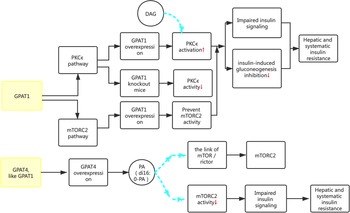
Prior research suggests that mitochondrial GPAT1 is involved in liver steatosis. Overexpression of GPAT1 can cause liver steatosis and insulin resistance. Consistent with the results of GPAT1 overexpression, the liver TAG content of GPAT1 knockout mice was significantly reduced and was prevented by hepatic steatosis and hepatic insulin resistance induced by high-fat feeding. This indicates that GPAT1 is involved in insulin resistance. There are two putative mechanisms for insulin resistance, one is the protein kinase C ɛ pathway, and the other is the mTOR complex2(mTORC2) pathway. In the figure below (Fig. 2), we will discuss these two speculative mechanisms in detail.
PKCɛ pathway and mTORC2 pathway. These two speculative mechanisms are mainly related to the involvement of GPAT1 in insulin resistance, namely the protein kinase Cɛ pathway and the mTOR complex2 (mTORC2) pathway. These two mechanisms lead to impaired insulin signalling and insulin resistance in the surrounding liver. The role of GPAT4 in insulin resistance is similar to the mechanism by which GPAT1 damages insulin signalling.

As can be seen from the mechanism in the figure above, we can conclude that mitochondrial GPAT1 is a key regulator of TAG metabolism and systemic energy homoeostasis. The overexpression of GPAT1 may contribute to the development of insulin resistance in mice through the PKC-ε pathway and the mTOR2 pathway. DAG induces the activation of protein kinase Cɛ (PKCɛ) (Ref. Reference Samuel47), and PA mediates the mTOR/rictor connection to form mTORC2. Overexpression of GPAT1 essentially prevents the activity of mTOR complex2 (mTORC2). These two mechanisms can lead to impaired insulin signal transduction, which in turn leads to insulin resistance in the surrounding and liver.
Compared with the wild-type control group, there was no difference in insulin sensitivity of GPAT1 knockout mice fed a normal diet. When fed a high fat, high sugar, or high coconut oil diet, GPAT1 knockout mice increased insulin resistance. Although the total liver fatty acyl-CoA increased, the insulin resistance of a HFD rich in safflower oil decreased. In ob/ob mice with T2DM, down-regulation of the GPAT1 gene did not significantly improve glucose homoeostasis. Overexpression of GPAT1 in mice has no significant effect on insulin sensitivity. According to different dietary conditions, GPAT1 regulation causes complex changes in liver lipid metabolism, leading to improved or impaired glucose metabolism.
GPAT3 and insulin resistance
Studies have shown that GPAT3 plays an important role in regulating glucose and lipid metabolism and energy balance. GPAT3−/− mice improved the balance of glycolipids in the body, but did not improve insulin levels. Overexpression and knockout of GPAT3 will not change insulin signal transduction. The dipalmitoyl (PA) produced by GPAT3 and the subsequent enzymatic reaction can inhibit insulin-stimulated Akt (Ser473 and Thr308) phosphorylation. This indicates that inhibition of GPAT3 is helpful for the treatment of metabolic diseases.
GPAT4 and insulin resistance
Similar to the mechanism by which GPAT1 damages insulin signal transduction, overexpression of GPAT4 in mouse liver cells inhibits mTOR/rictor association and mTORC2 activity, impairs the generation of insulin-inhibited glycogen, reduces insulin-stimulated glycogen synthesis, and inhibits insulin-stimulated Akt phosphorylation. Lipid signals produced by GPAT4 (such as di16:0PA) interfere with insulin signal transduction in mouse liver cells, and these changes ultimately lead to hepatic insulin resistance and decreased glucose homoeostasis. Compared with the wild-type mice in the control group, GPAT4−/− mice have increased body weight, decreased TG levels, and increased insulin resistance. In addition, by reducing the content of di16:0 PA, the development of insulin resistance in GPAT4−/− mice can be protected. These results indicate that GPAT4, not GPAT3, produces signals that inhibit mammalian rapamycin (mTOR) complex2 (mTORC2) kinase activity and insulin signal transduction, thereby promoting the development of hepatic insulin resistance (Ref. Reference Zhang48).
Obesity
Obesity is a condition caused by excessive accumulation of body fat, especially TAG. It can cause abnormal blood lipid metabolism, endocrine disorders, diabetes, and many other diseases. Obesity affects approximately 500 million adults and is the fifth leading risk of death in the world, with at least 2.8 million deaths each year. Although obesity and obesity-related diseases are increasing, there are currently few effective pharmacological therapies to combat excessive TAG accumulation (Ref. Reference Outlaw49). Obesity is considered to be the result of WAT expansion. When the homoeostasis of TAG is dysregulated, WAT expansion is associated with excessive TAG accumulation. According to reports, the total activity of pancreatic islet GPAT in obese rats was significantly up-regulated (about 5 times). We concluded that GPAT plays a vital role in mammalian fat synthesis. Therefore, we can start with the development of GPAT inhibitors to effectively treat obesity (Ref. Reference Wydysh50). In the following discussion, we will thoroughly focus on the connection between GPAT1, GPAT3, GPAT4 and obesity.
GPAT1 and obesity
GPAT1 plays a crucial part in liver lipid metabolism. Compared with the wild-type mice in the control group, we found that GPAT1−/− mice had decreased fat accumulation, decreased liver TAG, decreased VLDL, and weight loss. In mice with liver overexpressing GPAT1, liver and serum TAG increased. It shows that GPAT1 is related to obesity and abnormal blood lipid metabolism. Previous statistics have found that the activity of GPAT1 in obese patients accounts for a larger proportion of the total activity of GPAT in the omentum and abdominal subcutaneous fat tissue. This suggests that GPAT1 activity in adipose tissue may have an impact on the development of obesity, especially in humans. If GPAT-1 is not present, the accumulation of fat (ie, TAG) can be reduced (Ref. Reference Yu51).
GPAT3 and obesity
GPAT3 gene knockout experiments proved that GPAT3−/− mice plasma TAG decreased, energy consumption increased, and glucose metabolism improved. The total GPAT activity of WAT was significantly reduced, but the liver volume increased. These results prove that GPAT3 plays an important role in the synthesis of WAT TAG. This is closely related to the occurrence and development of obesity. The body weight and obesity of female GPAT3−/− female mice fed with a HFD decreased. Males did not show this phenomenon, and there were gender differences. These findings support the importance of GPAT3 in liver TAG accumulation.
GPAT4 and obesity
Previous studies have confirmed that GPAT4 is widely expressed in mouse WAT and BAT, and plays an important role in liver and BAT (Ref. Reference Vergnes39). Compared with wild-type control mice, GPAT4−/− mice fed with a normal diet have significantly reduced body weight, significantly reduced TAG content, increased energy consumption, and enhanced anti-obesity ability. GPAT4 is the closest homologue of GPAT3 in the GPAT subtypes. It shows that more obvious manifestations are obesity, selective subcutaneous lipodystrophy, and reduced lactation disorders. Analysis of GPAT4 knockout mice showed that GPAT4−/− mice are resistant to genetic and diet-induced obesity, with reduced subcutaneous, epididymal, and inguinal fat, and defective breast lipid productions in the mammary gland. Therefore, a lack of GPAT4 can protect mice from obesity (Ref. Reference Sim41). These data have strongly indicated that GPAT4 may be a potential drug target for the prevention and treatment of obesity (Ref. Reference Cao35).
Small molecule GPAT inhibitor
GPAT has attracted attention as a potential therapeutic target for metabolic syndromes such as obesity and diabetes (Ref. Reference Thuresson52). People have been committed to the development of treatments for the enzymes of the 3-phosphoglycerol pathway. Among them, the most widely studied drugs are acyltransferase inhibitors (Ref. Reference Ohshiro and Tomoda53), including GPAT small molecule inhibitors, diacylglycerol acyltransferase1 inhibitor AZD7687, diacylglycerol acyltransferase2 and MGAT2 inhibitors, and so on. Here, we are mainly discussing 2-(nonylsulfonamido) benzoic acid or also known as FSG67, which is a small molecule GPAT inhibitor, that has been studied in recent years. By studying the pharmacological inhibitory effect of FSG67, researchers explored the metabolic consequences of systemic pharmacological GPAT inhibition in lean and diet-induced obesity (DIO) mice. FSG67 inhibits GPAT1 and GPAT2 (Ref. Reference Wydysh54) and reduces the lipid synthesis in 3T3-L1. Acute FSG67 treatment can reduce body weight and reduce food consumption in lean mice and DIO mice. In addition, in the conditioned taste aversion (CTA) test, researchers found that FSG67 did not produce conditioned taste aversion at a dose that gradually reduces body weight. Moreover, chronic low-dose FSG67 treatment can reduce weight and food intake, reduce obesity, and prevent the decrease in metabolic rate and increase in fat oxidation due to insufficient swallowing. Systemic administration of FSG67 downregulates gene expression of lipogenic enzymes in DIO mice. Chronic FSG67 treatment can make blood sugar clear faster and require less insulin output. In other words, FSG67 can improve glucose tolerance and insulin sensitivity. What's more, chronic intake of FSG67 can reduce the size of white fat cells in DIO mice and alleviate liver steatosis.
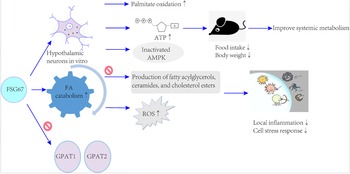
In general, these results indicate that FSG67 has a very large effect on the metabolism of DIO mice, which can reduce food intake, reduce weight and obesity, reduce liver steatosis, and improve energy utilisation, such as enhancing FA oxidation, increasing ATP, inactivates AMP-activated protein kinase (AMPK) in hypothalamic neurons (PHNs) in vitro, and enhancing insulin sensitivity and reversal of hepatic steatosis (Ref. Reference Kuhajda55). The mechanism of FSG67 to improve energy metabolism is shown in Figure 3 (Ref. Reference McFadden56).
The mechanism of FSG67 regulating energy homoeostasis. FSG67, a small molecule GPAT inhibitor, affects energy metabolism and reduces local inflammation and cellular stress response, enhances the oxidation of FAs such as palmitate oxidation, and increases ATP and reactive oxygen species (ROS) production in PHN. Finally, FSG67 leads to decreased food intake and body weight to improve systemic metabolism.

Conclusion and future outlook
This review article mainly discussed the tissue distribution and characteristics of the four GPAT isoforms, the differences in gene knockout mice, the latest progress of GPAT family enzymes, and the relationship between several GPAT isoforms and metabolic syndrome. We conclude that GPATs play an important role in the development of metabolic syndromes, such as liver steatosis, insulin resistance, and obesity. GPAT has been recognised as one of the drug targets for the treatment of metabolic syndrome (Ref. Reference Kim57). With the improvement of living standards, the incidence of metabolic syndrome continues to increase. The progress of this research will open the door for us to understand the relationship between GPAT subtypes and the physiological and pathophysiological functions of metabolic syndrome in the future.
In addition to the role in fat metabolism or fat storage, GPAT subtypes also have other cellular functions. GPAT1 regulates the proliferation and development of T cells, and instead of GPAT4, GPAT1 incorporates newly synthesised FAs into triacylglycerols and reduces FA oxidation (Ref. Reference Wendel58). GPAT2 plays an important role in normal spermatogenesis and tumorigenesis. GPAT3, not GPAT4, is the main microsomal GPAT subtype in adipose tissue and 3T3-L1 adipocytes. Besides, GPAT4-deficient mice lack breast milk, making it difficult for pups to survive unless they are replaced or the adoptive mother is changed (Ref. Reference Kappelt59). Information about different GPAT subtypes is still limited, and not yet fully understood, so further research is necessary to better understand the physiological and pathological effects of GPAT subtypes. Intervention strategies to prevent and treat metabolic syndrome have attracted widespread attention. There are some GPAT inhibitors. For example, FSG67, the first small molecule inhibitor of GPAT, showed improved glucose tolerance and insulin sensitivity, and reduced food intake and body weight. However, there were still some advert effects we should consider like insufficient swallowing. These results have promoted the research of the therapeutic potential of GPAT inhibitors,and may promote the recommendations of GPAT inhibitors for the treatment of metabolic syndrome in the future.
Data
All relevant data is contained within the article. Further inquiries can be directed to the corresponding author.
Acknowledgements
None.
Authors' contributions
Yinqiong Huang and Keyue Hu contributed equally to this manuscript. Yinqiong Huang and Keyue Hu contributed to the literature search and manuscript writing. Xiahong Lin made the figures and the manuscript writing. Shu Lin contributes to the study design and manuscript writing. All the authors read and approved the final manuscript. All the authors read and approved the final manuscript.
Financial support
Funding for this work was supported by the Science and Technology Bureau of Quanzhou (grant number 2020CT003); the Key Young Talents Health Training Project of Fujian Province (2020GGA057); the Natural science Foundation of Fujian Province (2020J01221, 2020J01226); Medical Innovation Project of Fujian Province (2020CXA044); the Postdoctoral Start-up fund of the Second Affiliated Hospital of Fujian Medical University (2020BSH02); the Doctoral Start-up fund of the Second Affiliated Hospital of Fujian Medical University (BS202113).
Conflict of interest
The authors declare that the research was conducted in the absence of any commercial or financial relationships that could be construed as a potential conflict of interest.
Ethical standards
Not applicable.
Consent for publication
All authors have read and consented to the publication of the article.