


1. Introduction
Macroeconomic populism presents a critical challenge in Latin America by emphasizing short-term economic growth and income redistribution through lax economic policy, deemphasizing inflation levels, fiscal deficits, external restrictions, and the potential reaction of economic agents to aggressive anti-market policies (Dornbusch and Edwards Reference Dornbusch, Edwards, Dornbusch and Edwards1991; Edwards, Reference Edwards2019a; Campos and Casas, Reference Campos and Casas2021). This approach suggests that expansive economic policy becomes lax by relaxing controls, as authorities adopt a more permissive stance, allowing fiscal and monetary imbalances to surpass expected limits (e.g., exceeding deficit and inflation targets). The International Monetary Fund (2017) notes that persistent deficits and inflation stem from lax economic policies. The enduring cyclical pattern of lax economic policy in Latin America, intertwined with populist responses to recessions and inadequate social security, persists despite varying forms and intensities in countries such as Argentina and Venezuela (Stankov, Reference Stankov2018).
In retrospect, the “Chilean road to socialism” of Salvador Allende’s government (1970–1973) serves as a model of 21st-century Latin American populism (Harnecker, Reference Harnecker2015). As Edwards (Reference Edwards2023, 56) stresses, “In many ways, what the Allende government engaged in, decades before it got its name, were policies very similar to those touted by the [Latin American] supporters of Modern Monetary Theory.”Footnote 1 Allende’s approach marked the first instance in democratically elected Latin America where populism and socialism converged, emphasizing structural transformations to shift resources from the private to the public sector (Larraín and Meller, Reference Larraín, Meller, Dornbusch and Edwards1991). A lax economic policy strategy was adopted to achieve distributional objectives in the short term, overlooking internal and external restrictions, accompanied by the Marxist ideology incorporated in Allende’s paradigm to supplant capitalism with socialism (Espinosa, Reference Espinosa2021; Caputo, Reference Caputo2022). What might initially appear to have been a success failed?
On the 50th anniversary of the 1973 Chilean recession, the surprising absence of consensus on its causes obscures the crucial link between lax economic policies and the business cycle (boom-and-bust period) (Newman, Reference Newman2020; Espinosa et al., Reference Espinosa, Alonso-Neira and Huerta de Soto2023). Salvador Allende’s economic policies are central to debates among economists, politicians, and international organizations, serving as examples of preferred policy positions. Some credit effective planning for the boom, attributing the bust to opposition boycotts, while others link the boom to a surge in demand and tie the bust to insolvency resulting from extensive expropriations and price controls (Cademartori, Reference Cademartori2003; Corvalán, Reference Corvalán2003; Bitar, Reference Bitar and Brundenius2020). However, these claims misinterpret the key macroeconomic and political factors contributing to this unsustainable period.
This paper provides a comprehensive examination of macroeconomic populism, utilizing the 1973 recession during Salvador Allende’s presidency as a case study to enhance the economic history lessons regarding the effects of loose economic policies in Latin American countries. It argues that Allende’s lax economic policies in 1970 and 1971 were the primary catalysts for the 1971 boom, laying the groundwork for the 1972 financial crisis and subsequent 1973 economic recession. Beyond its historical significance, the paper holds substantial practical implications. Lax economic policies can initiate boom-and-bust cycles, and when combined with anti-market policies such as restrictions on international trade, expropriations, and price controls, can precipitate an abrupt decline in money demand. This phenomenon, exemplified in Allende’s macroeconomic populism, led to a rapid shift from boom to bust, resolving misrepresentations about Chile’s economic recession. Consequently, lax fiscal policy propelled the fiscal deficit into double digits, while lax monetary policy fueled triple-digit inflation.
To this end, Section 2 describes why lax economic policies contributed to the 1971 boom. Section 3 examines how lax economic policies and politics contributed to the 1972 financial crisis and the subsequent 1973 economic recession. Section 4 examines some misrepresentations of the economic events of the 1973 recession, evaluating recent cases in Argentina and Venezuela. Section 5 presents conclusions and extensions.
2. The Chilean economic boom
This section explains why lax economic policies contributed to the 1971 boom. The first part focuses on the background of the Chilean economy, which led to a paradigm shift towards macroeconomic populism. The second part analyses Chile’s economic boom, which began in 1970 and ended abruptly in 1971.
2.1. Macroeconomic reformism and developmentalism
Before the “Chilean road to socialism” became a well-known phrase in the 1970s, Chile suffered a severe economic recession following the First World War, mainly due to the decline in income from saltpetre, one of its leading export sources. In the 1920s, governments took control of saltpetre production and distribution. For the first time, economic policies aimed at promoting industrial production were introduced, marking a departure from the liberalism that had been dominant until then (Edwards, Reference Edwards1995). However, the Great Depression’s impact from 1929 to 1939 played a pivotal role in politically motivating the gradual transition from orthodox economic policies, centred on balanced budgets and monetary soundness, to the lax economic policy approach of deficit spending financed by monetary issuance. Braun et al. (Reference Braun, Braun, Briones, Díaz, Lüders and Wagner2000) show that the economic orthodoxy period between 1810 (the beginning of Chile’s independence process) and 1940 (the end of the Great Depression era) annually averaged a fiscal deficit of −0.4% and inflation of 2.5%.Footnote 2
In the 1940s, Import Substitution Industrialization (ISI) solidified Chile’s development strategy. This strategy employed protectionist trade policies, characterized by high tariffs, multiple exchange rates, and limited trade openness. Following World War II, the Economic Commission for Latin America (ECLAC), established in 1948, presented the ISI model as a response to the economic dependence of Third World countries on international fluctuations (Arndt, Reference Arndt1985). ECLAC aimed to foster industrial development in Latin America by providing financing and technical support to private and public enterprises, reducing reliance on foreign nations to substitute imported goods (Sunkel, Reference Sunkel1989).
ECLAC’s promotion of “inward growth” structuralism significantly influenced Latin America’s academic and policy landscape until the late 1970s. It is essential to note that each Latin American country applied the ISI model differently, with varying approaches and policies (Love Reference Love2005; Fishwick, Reference Fishwick2019). However, the common denominator was an active government role in the economy, directing investments, controlling strategic sectors, and directly participating in industrial production. While the ISI model initially yielded some successes, its drawbacks became evident. Excessive protectionism and a lack of competition resulted in economic inefficiencies and the emergence of uncompetitive industries. Moreover, dependence on state investment and foreign indebtedness for industrialization led to monetary and fiscal issues across many countries (Agosin and Ffrench-Davis, Reference Agosin and Ffrench-Davis1993).
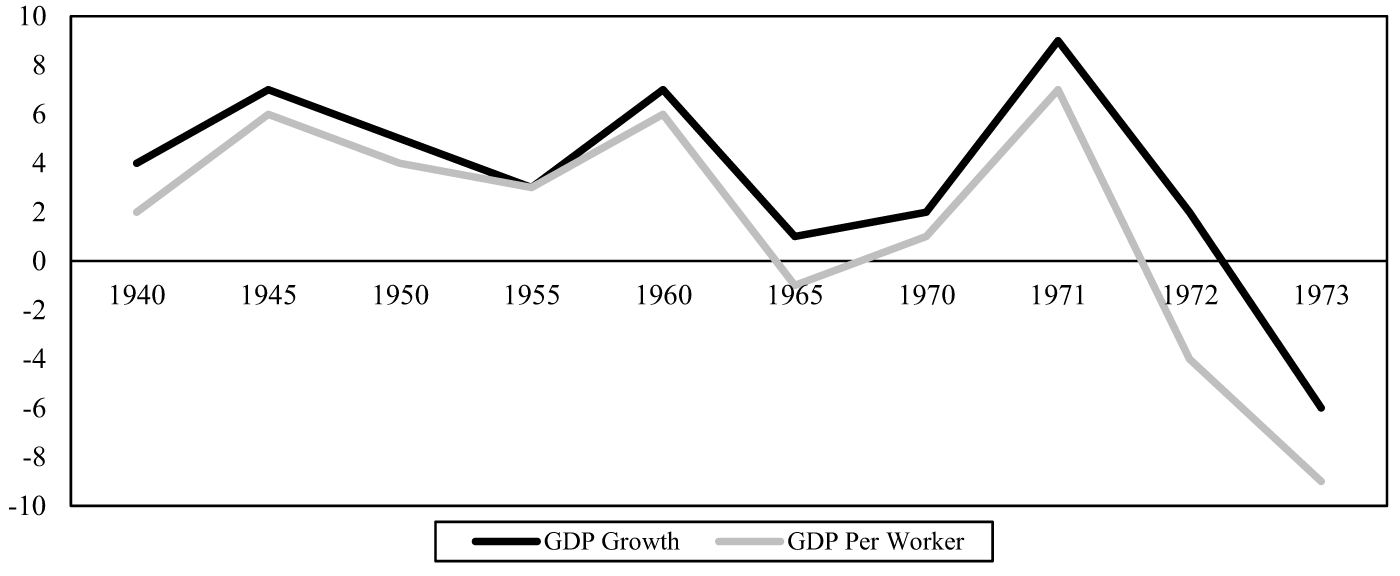
The adoption of lax economic policies in Chile during the period from 1940 to 1970, in line with the ISI model advocated by ECLAC, propelled economic growth and labor productivity to an average of 4% per year between 1940 and 1960 but then declined to an average of 2% per year between 1960 and 1970 (see Figure 1). This growth came at the expense of severe macroeconomic imbalances. Ffrench-Davis (Reference Ffrench-Davis1973) notes that during this period, Chile had no central bank independence or quantitative fiscal and monetary targets to evaluate the effect of lax economic policy.Footnote 3
GDP growth and GDP per worker in Chile (annual%). Source: Braun et al. (Reference Braun, Braun, Briones, Díaz, Lüders and Wagner2000)

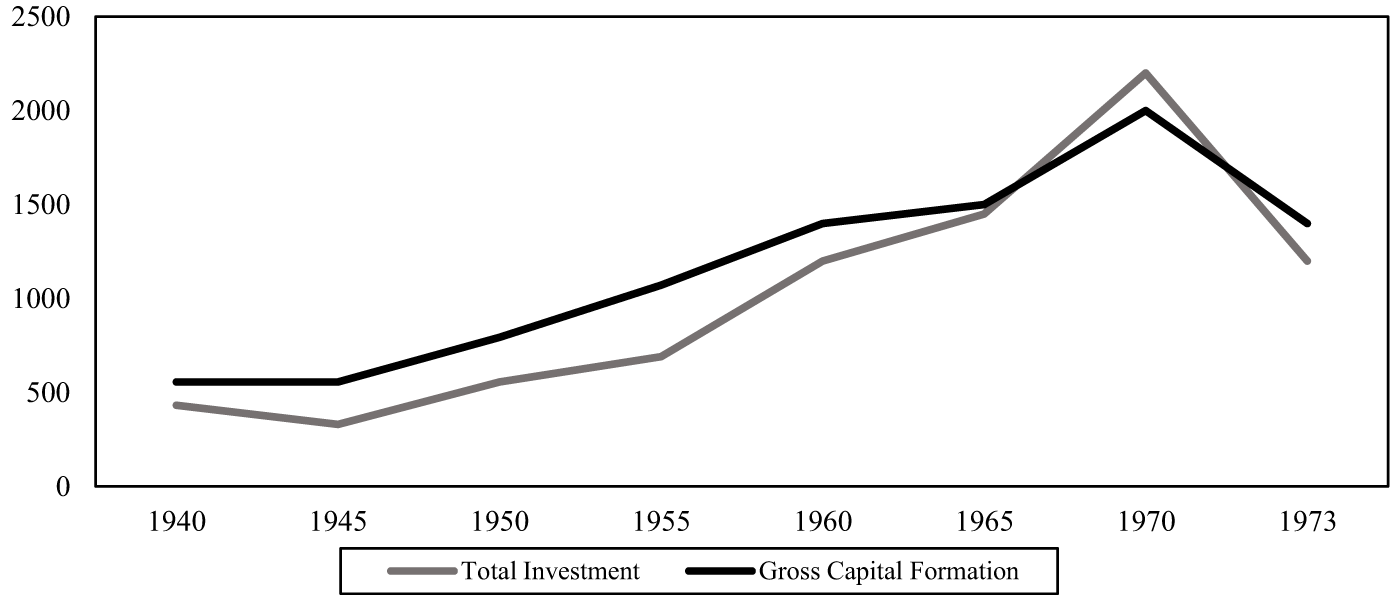
However, the annual averages of a −0.4% deficit and 2.5% inflation between 1810 and 1940, characterized by economic orthodoxy, serve as proxies for fiscal and monetary targets, respectively. Lax fiscal policy resulted in an annual deficit averaging 5% between 1940 and 1970, a deviation of 12.5 times the reference, contributing to a public debt exceeding 22% of GDP with an effective interest rate of 12%. At the same time, lax monetary policy led to a surge in inflation from 1.4% in 1939 to an annual average of 27% (a deviation of 10.8 times from the reference), accumulating to 104,000%. The volume of investment and gross capital formation remained stagnant between 1940–1945 and 1960–1973 (see Figure 2). As a result, the structuralist alternative seemed a failure.
Investment in millions of 1995 Chilean pesos. Source: Braun et al. (Reference Braun, Braun, Briones, Díaz, Lüders and Wagner2000)

In the ISI model crisis context, Salvador Allende came to power in 1970, supported by the Unidad Popular (UP), his left-wing political coalition dominated by the Socialist and Communist parties (Fleet, Reference Fleet1973). Corvalán et al. (Reference Corvalán, Rodríguez, Morales and Chonchol1969) explain that the UP’s diagnosis was catastrophic yet consistent with the economic reality in Chile.
Chile is a capitalist country, dependent on imperialism, dominated by sectors of the bourgeoisie structurally linked to foreign capital, which cannot solve the country’s fundamental problems, which derive precisely from their class privileges which they will never voluntarily renounce […] Chile is experiencing a deep crisis that manifests itself in widespread poverty. All kinds of postponements reformist and developmentalist recipes [of the governments between 1940 and 1970] have shown that they are incapable of solving the people’s problems […] The only trendy alternative and, therefore, the critical task that the People’s Government has before it, as the Unidad Popular proposed, is to put an end to the domination [by armed means if necessary] of the imperialists, of the monopolies, of the landowning oligarchy, and begin the construction of socialism (own translation). (Corvalán et al., Reference Corvalán, Rodríguez, Morales and Chonchol1969, 2-4)
Dornbusch and Edwards (Reference Dornbusch, Edwards, Dornbusch and Edwards1991) stressed that Salvador Allende’s government was driven by a macroeconomic populist agenda, emphasizing short-term economic growth and aggressive income redistribution through anti-market policies. This Marxist approach became a central point in the confrontational political rhetoric of integrating low-income individuals into the modern sector and overthrowing domestic and foreign capitalist elites (Corvalán et al., Reference Corvalán, Rodríguez, Morales and Chonchol1969; Collier and Sater, Reference Collier and Sater2004).
On the one hand, Allende’s proposals were grounded in the conviction that achieving revolutionary transformations in Chile necessitated the active involvement and empowerment of the people. This philosophy materialized in the vision of a Government of the People led by the Unidad Popular, dedicated to effecting tangible and practical changes. Diverging from the period between 1940 and 1969, Allende strategically advocated for a recrudescent lax economic policy, not merely as a financial choice but as a means to garner increased popular support for the government project. According to Allende, a government with control over its currency possesses the autonomy to create money without the risk of devaluation (Cademartori, Reference Cademartori2003). Deliberately fostering a growing fiscal deficit with a sovereign currency was considered a viable strategy to stimulate aggregate demand and achieve full employment in the short term. This approach involved a loose fiscal policy through increased deficit spending and a loose monetary policy through financing the deficit through monetary and credit expansion.
On the other hand, Allende’s departure from his predecessors was evident within Chile’s structuralist tradition. He emphasized the establishment of a centrally planned economy (Vuskovic, Reference Vuskovic and Zammit1973; Velasco, Reference Velasco, Bosworth, Dornbusch and Labán1994). Allende envisioned a coexistence of lax economic policies with trade restrictions, expropriations, and price controls as integral components of his program for economic and social transformation towards socialism. The strategy to impose restrictions on international trade during Salvador Allende’s tenure involved implementing tariffs and quotas to curtail imports. This approach sought to enhance domestic production, reduce reliance on foreign nations, and foster self-sufficiency. The government pursued the nationalization of pivotal sectors, such as copper mining, banking, and industry, intending to increase state interventionism in strategic resources to redistribute wealth and progress toward a socialist model. Simultaneously, the price control policy involved state intervention to regulate essential goods’ prices, aiming to curb inflation and ensure accessibility for the population.
While these policies were designed to reduce inequalities and implement a socialist model, they presented substantial economic challenges, contributing to instability and political conflicts that ultimately culminated in the 1973 coup d’état (Vial, Reference Vial2005; Espinosa, Reference Espinosa2021).
2.2. Macroeconomic boom
The Chilean macroeconomic populism experienced a vigorous economic boom between 1970 and 1971, but its cause differs from what many thought. The government’s lax economic policies aimed to achieve a short-term full employment equilibrium. Despite initial gains in productivity and economic growth, these policies set the stage for an unsustainable trajectory, giving rise to a business cycle. The growing macroeconomic imbalances were characterized by a lax fiscal policy, marked by deficit spending, and a loose monetary policy reliant on monetary issuance and cheap credit.
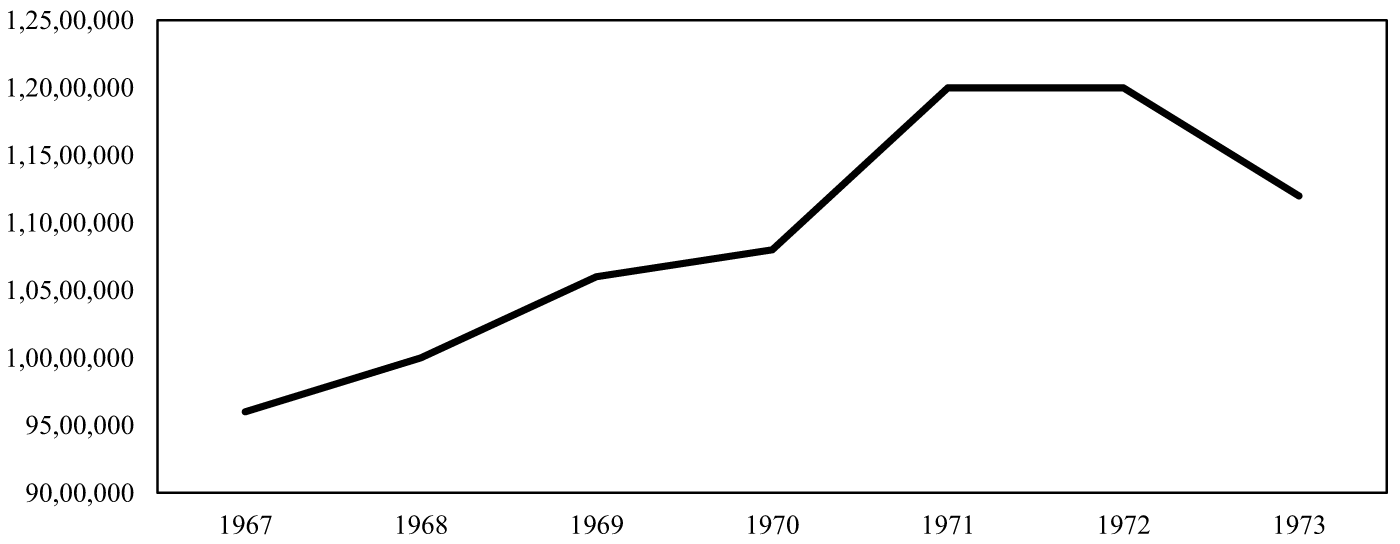
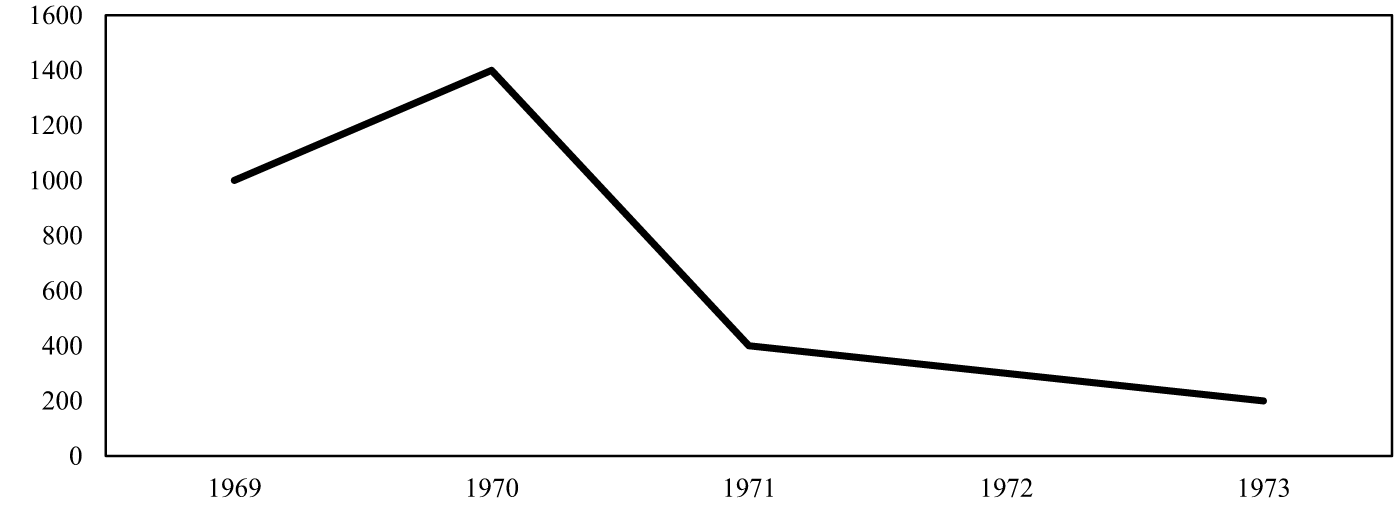
The new political authorities considered underconsumption to be Chile’s main economic problem. According to Corvalán et al. (Reference Corvalán, Rodríguez, Morales and Chonchol1969), most Chileans suffered from underconsumption due to insufficient demand, which made it challenging to use all available resources efficiently. First, a lax fiscal policy of increased public spending was implemented as part of a Big Push to achieve a state of full employment equilibrium through the Keynesian multiplier effect. As Braun et al. (Reference Braun, Braun, Briones, Díaz, Lüders and Wagner2000) estimated, real aggregate expenditure increased by 24% between 1969 and 1971 (see Figure 3). If individuals consume a fixed proportion of their disposable income (net of taxes), additional government spending will not reduce individuals’ income in the short run. Aggregate demand would grow so much that it would even tend to reduce the fiscal deficit.
Real aggregate expenditure in millions of 1995 Chilean pesos. Source: Braun et al. (Reference Braun, Braun, Briones, Díaz, Lüders and Wagner2000)

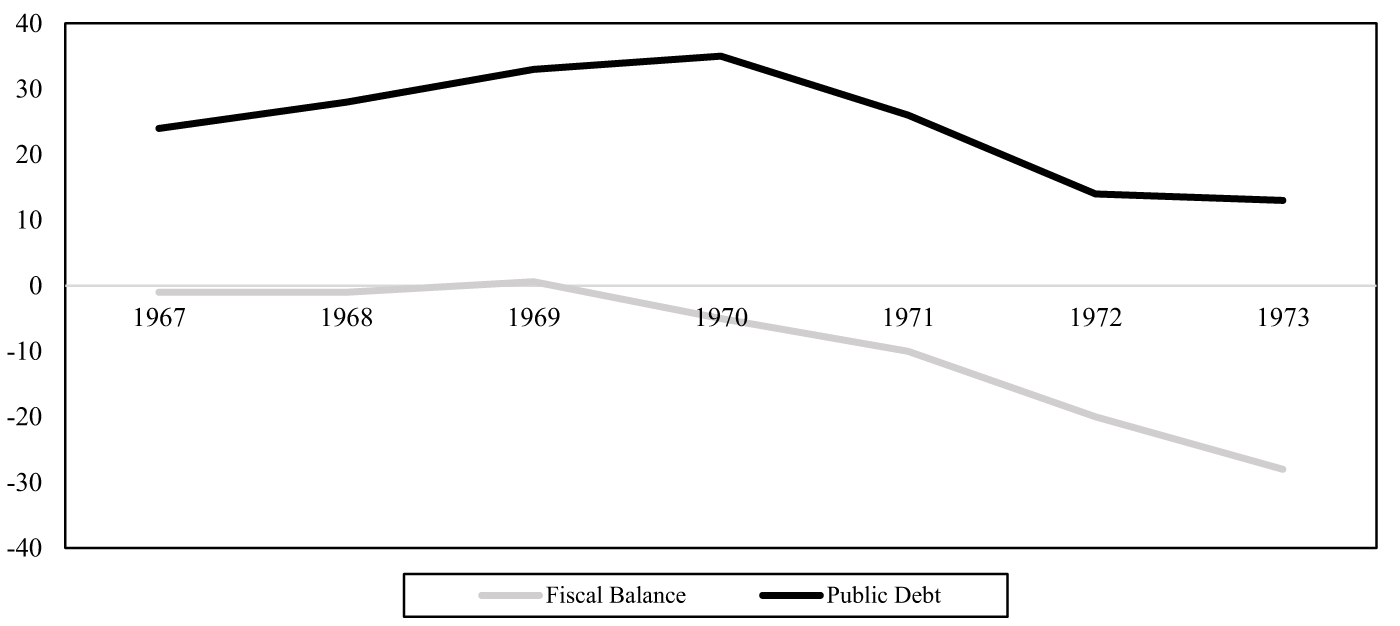
The response to this increase in aggregate demand was a 26% growth in public spending and a 15% growth in private consumption, which induced strong GDP growth, from 2% in 1970 to 9% in 1971, and GDP per capita per worker, from 1% in 1970 to 7% in 1971 (Figure 1). However, the macroeconomic fundamentals of GDP growth were managed by a public administration in which expenditures increasingly exceeded tax revenues. The fiscal deficit was the first imbalance of a lax fiscal policy, going from a surplus of 0.6% in 1969 to a deficit of −24.5% in 1972. Figure 4 places this in the context of Chile’s evolution of public debt. It shows that while the pace of the fiscal deficit accelerated between 1970 and 1971, the public debt fell by 26% between 1970 and 1971 and 40% between 1970 and 1973. In other words, economic activity in Chile increased rapidly. This result indicates a marked deviation, with a fiscal deficit 61 times greater than the reference average between 1810 and 1940. This also reveals that fiscal policy was five times laxer than implemented between 1940 and 1970, underscoring an unprecedented growth in laxity in economic management during 1970–1972.
Fiscal accounts (% of GDP). Source: Braun et al. (Reference Braun, Braun, Briones, Díaz, Lüders and Wagner2000)

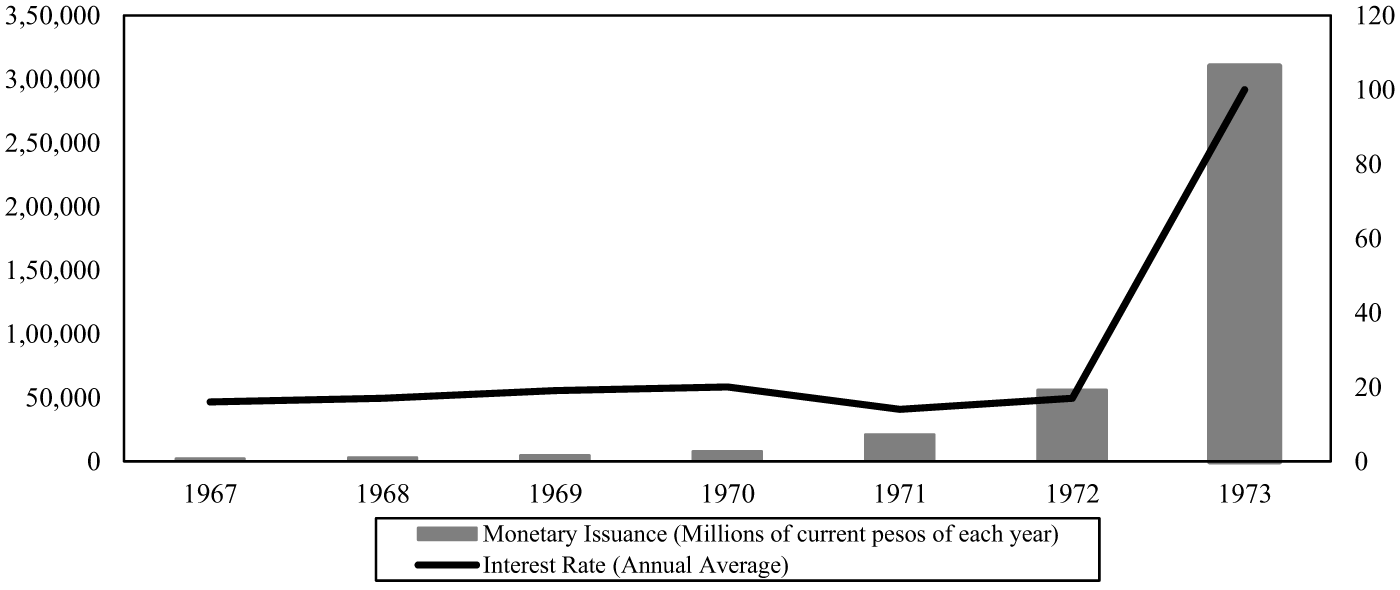
Second, a lax monetary policy was implemented to finance the growing fiscal deficit and the reduction of public debt. The primary purpose of issuing money was to inject liquidity into the economy for commercial operations. It should be noted that cash can only be created by the official institution in charge of it, the central bank. De Vylder (Reference De Vylder1976) argued that Chile’s Central Bank served as an ATM for the government during those years, lacking clear rules of autonomy or inflation targets. Hence, monetary issuance increased 65 times between 1969 and 1973 to influence the fiscal deficit and aggregate demand (see Figure 5).
Monetary issuance (left axis) and effective nominal interest rate (right axis). Source: Braun et al. (Reference Braun, Braun, Briones, Díaz, Lüders and Wagner2000)

The lax monetary policy led to a fall in interest rates and, thus, to an increase in business investment through artificial credit expansion (see Figures 1 and 2). Interest rates fell by 30% between 1970 and 1971, increasing the present value of capital goods, which induced a rise in the prices of production factors (see Figure 5). Entrepreneurs received the signal that the supply of loanable funds had increased and invested in stages that were more roundabout to final consumption, as they did according to the ISI model. The result was the emergence of fictitious profit promises in capital-intensive investment projects requiring more time. Meanwhile, credit expansion also reached consumers, who increased the demand for consumer goods. It will be seen later that the delay in the production stages slowed the arrival of new consumer goods on the market and, coupled with higher consumer demand, led to sharp rises in the prices of consumer goods. The intertemporal mismatch between supply and demand was the second latent macroeconomic imbalance.
In summary, Chile’s boom consisted of a business cycle phase characterized by the highest percentage of GDP growth, accompanied by increases in consumption, investment, and productivity. Lax fiscal and monetary policies were employed to stimulate aggregate demand. The statement that these events occurred together does not imply that the economy was in a phase of sustained economic expansion. As shown below, macroeconomic populism can increase aggregate demand in the short term but simultaneously accumulate growing imbalances that, sooner rather than later, can lead to a crisis.
3. The crash
3.1. Financial crisis
A financial crisis emerges as an economic disruption, often rooted in issues within a country’s financial or monetary system, causing a loss of value and credibility in the financial sector. This occurrence is closely tied to the business cycle, where macroeconomic imbalances can trigger shocks, leading to substantial problems and rapid asset devaluation. In the case of Chile, specific sectors of the economy experienced bubbles due to these imbalances, resulting in a crisis of confidence among the population.
The purchasing power of a dynamic economy is never static because supply and demand influence the price of money in the market process. In an ideal scenario, inflation would be zero, with supply and demand determining the price of money. However, central banks can control the fiat money supply, thereby influencing the inflation rate. Changes in the money supply by the central bank impact the public’s trust in the currency, leading to positive inflation. Money demand, as the need for people to decide whether to hold funds in cash, acts as an accumulator of funds—a demand for liquidity. A decline in money demand can accelerate the onset of a financial crisis as people question the soundness of central bank money, increasing demand for consumer goods and putting pressure on prices (White, Reference White2023).
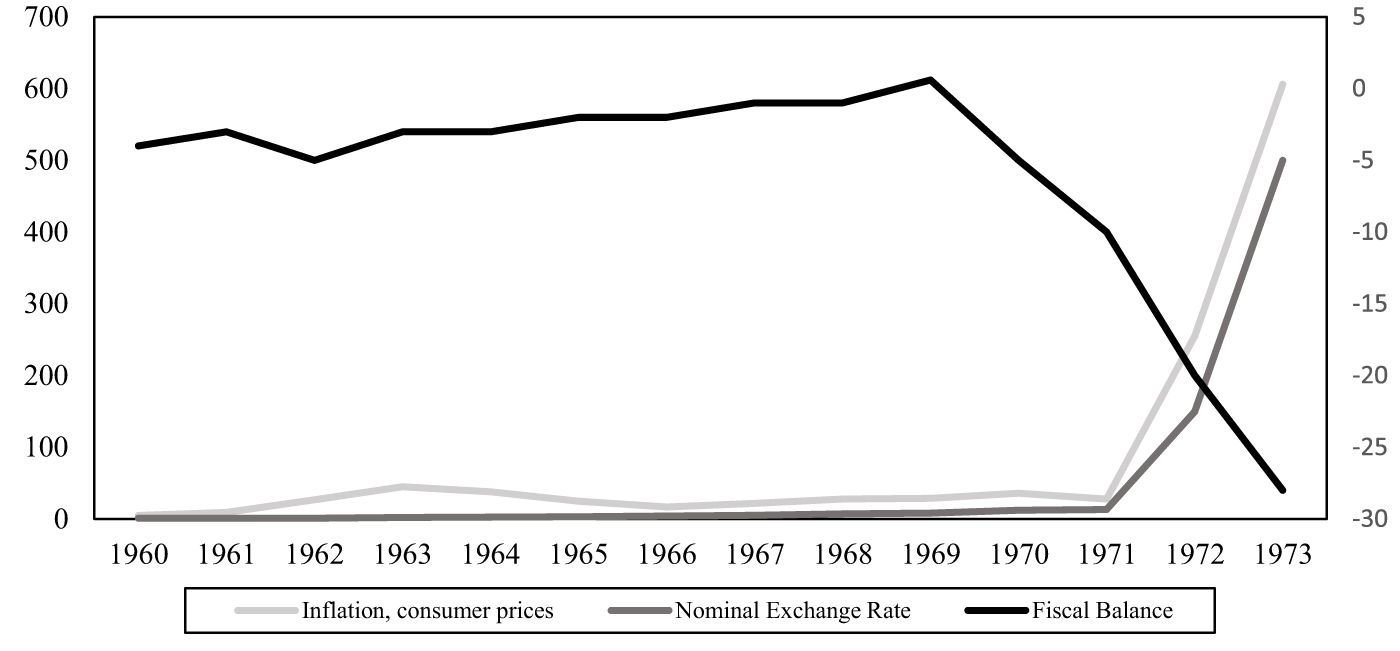
The causal analysis of the 1972 financial crisis in Chile suggests that the central bank’s fiscal deficit financing led to an increase in the money supply, resulting in upward pressure on prices. Money demand reacts to these developments, often through downward pressure on the exchange rate, concluding in a bear market and depressed stock prices (Young, Reference Young, Boettke and Coyne2015). Initially, the crisis unfolded with soaring inflation, attributed to financing the fiscal deficit through money and credit expansion by the Central Bank of Chile (see Figure 6). The data reveal a direct correlation between the increase in inflation and the preceding rise in the fiscal deficit (Horwitz, Reference Horwitz2003; Bagus et al., Reference Bagus, Howden and Gabriel2014; Caputo and Saravia, Reference Caputo, Saravia, Kehoe and Nicolini2021; Espinosa and Cueva, Reference Espinosa and Cueva2024).
Inflation (annual %, left axis), nominal exchange rate (annual average, left axis) and fiscal balance (% of GDP, right axis). Source: Braun et al. (Reference Braun, Braun, Briones, Díaz, Lüders and Wagner2000), Caputo and Saravia (Reference Caputo, Saravia, Kehoe and Nicolini2021)

While the short-term expansion of aggregate demand in 1971 led to a decrease in inflation from 36% to 28%, the subsequent increase in the money supply pushed prices and inflation to 255% in 1972. This represented an unprecedented laxity, with monetary policy being 9.4 times laxer than the period between 1940 and 1970, deviating 102 times from the reference average between 1810 and 1940. Inflation eroded the purchasing power of money, prompting people to quickly consume income and savings due to the anticipation of even higher prices. The consequence was a sustained increase in the prices of all goods and services in the economy.
The galloping inflation in Chile during the early 1970s had multifaceted causes, one of which was a significant drop in money demand starting in late 1971, effectively resulting in an increase in monetary issuance. This decline in the desire to hold money led to accelerated circulation, or an increase in its velocity, exacerbated by high inflation expectations. Despite ruling out the possibility of a collapse in money demand, Allende inadvertently fueled macroeconomic populism, resulting in a surge in money velocity nine times per year between 1970 and 1972 (Edwards, Reference Edwards2019b; Lüders et al., Reference Lüders, Díaz and Wagner2016). The consequences were profound, as illustrated in Figure 6, depicting a 70% devaluation of the Chilean peso against the U.S. dollar between 1970 and 1972. This politically charged monetary issuance contributed to the loss of the Chilean peso’s value, creating uncertainty about financial stability. Citizens experienced a decrease in purchasing power, requiring more money to purchase the same goods. Section 3.2 will explore how the subsequent exchange rate crisis impacted workers’ wages and savings deposited in the devalued currency.
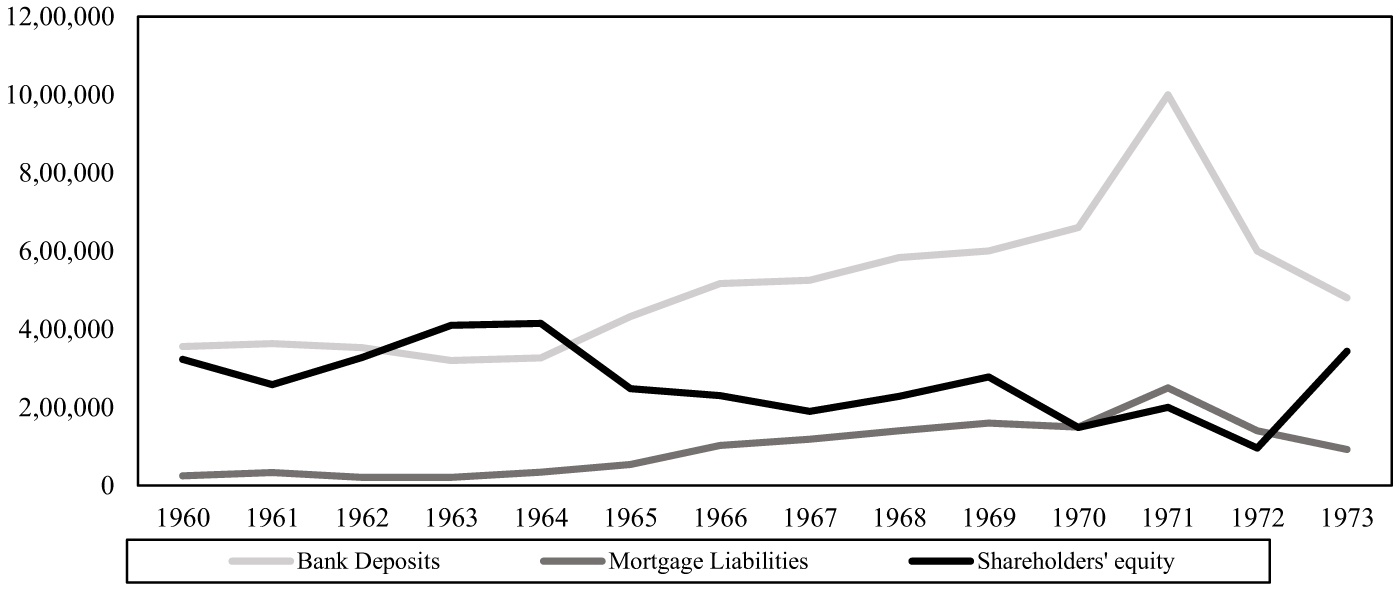
Figure 7 illustrates the evolution of the capital market, highlighting the impact of the exchange rate crisis on the subsequent banking crisis. Macro imbalances and distortions in the financial sector played a pivotal role in influencing the banking crisis, as evident in a 40% drop in bank deposits and a 44% increase in mortgage liabilities between 1971 and 1972. Despite these warning signs, the government failed to implement swift corrective measures, allowing lax economic policies to persist.Footnote 4 Shareholders’ equity rose by 25% over 1970. However, partner contributions and retained earnings fell by 52% in 1972. This lack of decisive action compounded losses, making them increasingly challenging to manage. The 1972 financial crisis, akin to “market corrections,” manifested as a bear market, indicating a stock market collapse (see Figure 8). A bear market is more likely after substantial GDP growth driven by lax economic policies that reach unprecedented peaks.
Capital markets in millions of 1995 Chilean pesos. Source: Braun et al. (Reference Braun, Braun, Briones, Díaz, Lüders and Wagner2000)

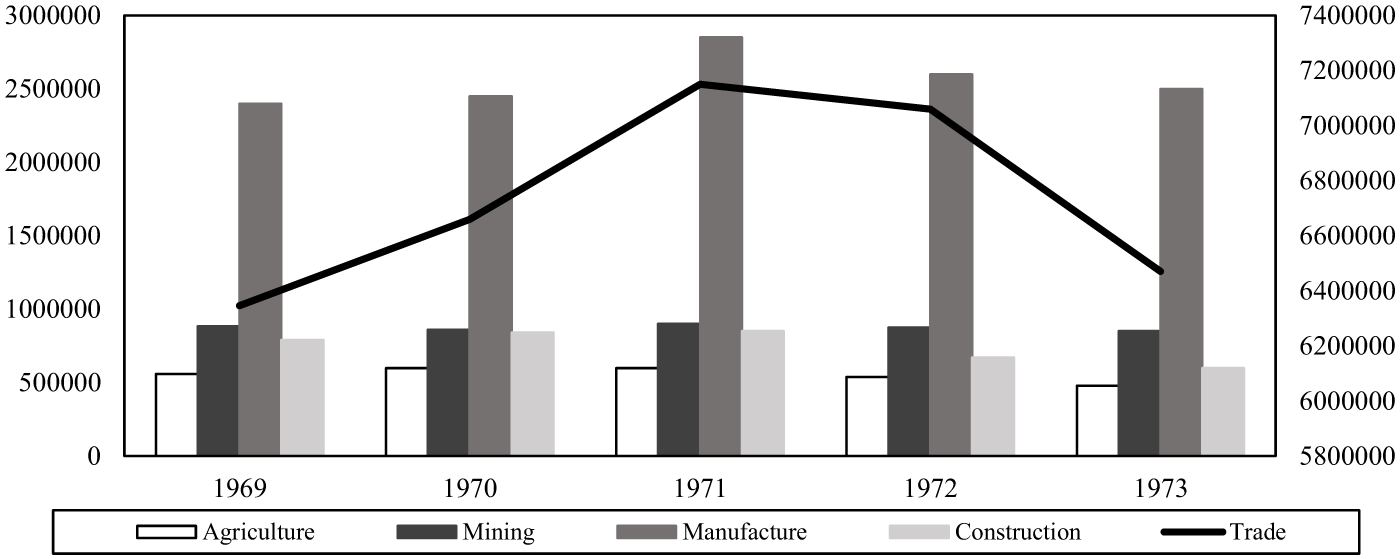
GDP by sectors of economic activity (left axe) and trade (right axe) in millions of 1995 Chilean pesos. Source: Braun et al. (Reference Braun, Braun, Briones, Díaz, Lüders and Wagner2000)

The bear market was an early indicator of Chile’s impending financial crisis, signalling reduced product demand and business activity. Depositors and investors, foreseeing a recessionary phase with a sharp decline in the purchasing power of money and corporate profits, were cautious. These expectations fueled the exchange rate and banking crisis, setting the stage for the profound economic challenges ahead. It becomes evident that lax economic policies substantially boosted these industries in 1970 and 1971 by examining the main sectors of economic activity (agriculture, mining, manufacturing, construction, and trade) in Figure 8. However, the gains during the boom were eclipsed by losses in the bust of 1972 and notably in 1973. The exposure of the Chilean economy to the financial crisis, driven by the potential insolvency that triggered an economic recession, has been analysed by Larraín and Meller (Reference Larraín, Meller, Dornbusch and Edwards1991) and Meller (Reference Meller2000).
3.2. Economic recession
The preceding sections have expounded that macroeconomic populism, driven by loose economic policies, has spurred the business cycle by robustly stimulating aggregate demand at the expense of macroeconomic imbalances. If the financial crisis originated from lax economic policies, it was not inherent in Chile’s real economy. However, anti-market policies from 1971 to 1973—trade restrictions, expropriations, and price controls—precipitated an institutional crisis, intensifying the decline in money demand and triggering a swift transition from boom to bust (Espinosa, Reference Espinosa2021). Macroeconomic populism led to a double-digit fiscal deficit and triple-digit inflation, coupled with structural deficiencies.
Restrictions on international trade materialized primarily through exorbitant average tariff rates of 94% and effective protection rates of 182%. The economy grappled with 57 tariff rates, ranging from zero to 220%, and numerous non-tariff measures, hindering imports. Importers faced significant hurdles, including mandatory initial deposits of up to 10,000%, a fixed multiple exchange rate system, and eight different prices for the dollar. Despite aiming to shield domestic industries, these measures strained international trade relations and impeded the acquisition of foreign goods and technologies.
Second, the expropriation process aimed to transfer private property of the means of production to the Socialist Property Area (SPA), which was under government control.Footnote 5 In July 1971, the government seized 100% of significant mining enterprises, justifying compensation reductions to zero by citing “excessive profits” earned since 1965 (Larraín and Meller, Reference Larraín, Meller, Dornbusch and Edwards1991; Meller, Reference Meller2000). By November 1971, CORFO gained majority control of 14 out of 17 banks and 30% control of the remaining three, thereby controlling 85% of the financial system and 90% of all credit (Inostroza, Reference Inostroza and Sideri1979). Subsequently, the government occupied nearly 80% of industries by July 1973 through various means (generally preceded by the takeover of the industry by its workers). The agrarian reform also expropriated 60% of Chile’s agricultural land and more than 2,520 illegal agrarian occupations. The rapid expansion of the SPA accounted for the reduction in Chile’s economic activity (Figure 9).
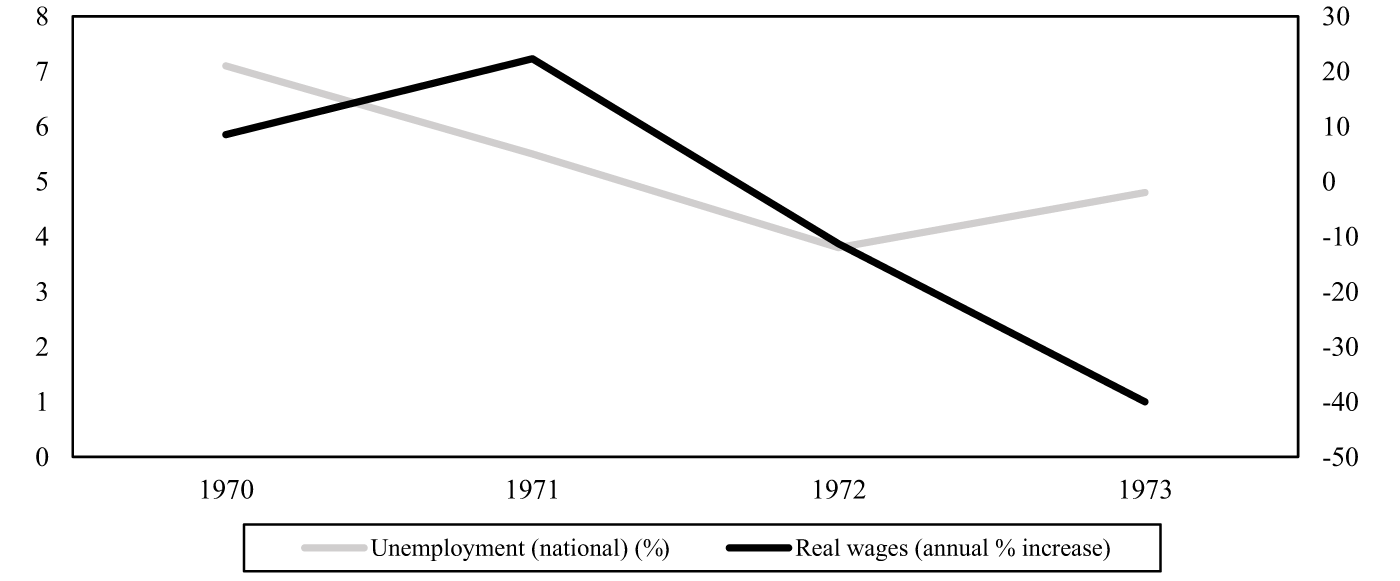
Unemployment (left axe) and real wages (right axe). Source: Braun et al. (Reference Braun, Braun, Briones, Díaz, Lüders and Wagner2000)

The expansion of the SPA meant the inclusion of workers into the labor force in the intervened private sector and in the public sector, which boosted the reduction of the unemployment rate by 47% between 1970 and 1972 (see Figure 9). The unemployment rate rose by 26% between 1972 and 1973 and remained low. However, the upward trend resulted from the unsustainability of expropriations. This propensity is especially true because real wages increased by 22% in 1971 but fell by 11% in 1972 and 40% in 1973, giving rise to labor precariousness among low-productivity labor types.
Third, the imposition of price controls on over 3,000 products aimed to boost consumption and control inflation during the 1970 and 1971 boom (Velasco, Reference Velasco, Bosworth, Dornbusch and Labán1994). While intended to ensure accessibility, these controls led to market distortions, shortages, and disincentives for production, disrupting market dynamics and hindering productive incentives. Therefore, the Chilean underground market emerged as a means of subsistence where the free production and distribution of goods were impossible. Edwards (Reference Edwards2023) explains that underground market prices were up to 10 times higher because the producers assumed more risks, as their activity was illegal. The underground market allowed consumers to purchase goods urgently if needed; otherwise, they would have been unable to do so. Operating outside the law and unable to resolve their disputes in court, the underground market gave rise to violence and corruption. The exchange rate to pay for food imports sold clandestinely indicates a difference of up to 110 times (De Vylder, Reference De Vylder1976). Although Chile prohibited these transactions and speculation, the need to acquire scarce essential goods led to the spread of these practices.
Implementing these three policies had tragic short- and long-term effects on the real economy. On the one hand, these government interventions opened the door for industries to exert pressure based on often less objective criteria than in the market process, which triggered mutually destructive labor–management conflicts. On the other hand, corporate taxes of up to 40%, wage taxes of up to 65%, and excise taxes of up to 50% hindered entrepreneurship and capital accumulation (Cheyre, Reference Cheyre1986). Chile’s political dynamics contributed to a decline in output, productivity, investment, and gross capital formation (see Figures 1, 2, 7, and 8). In addition to the impact on employment and wages, the balance of payments, and international reserves, these policies accelerated and deepened the fiscal deficit and inflation.
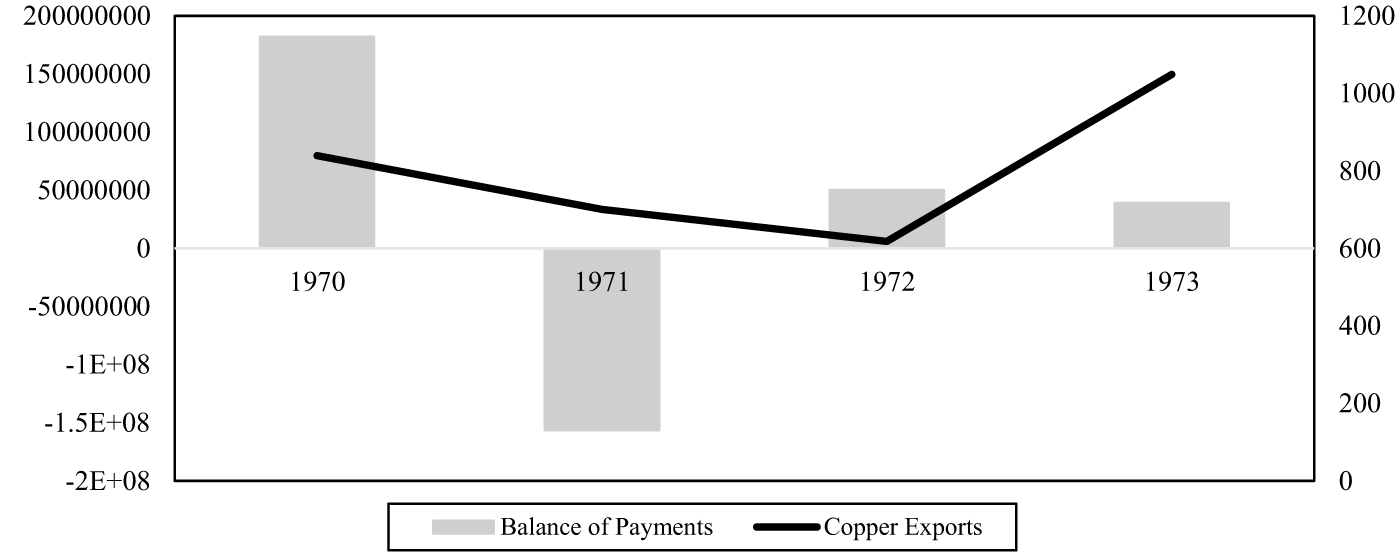
Figure 10 shows that, despite trade restrictions, the 1971 balance of payments deficit was mainly due to the country’s limited productive capacity to meet the population’s consumption demands, despite the rising price of copper, which accounted for 75% of Chilean exports between 1970 and 1973. Furthermore, the balance of payments deficit represented an 80% decline in international reserves between 1970 and 1973 (Figure 11). International reserves refer to capital deposits held by central banks. These deposits consist of foreign currencies such as the dollar. Their purpose is to accumulate reserve currencies that form the balance sheet of the Chilean central bank (Fajnzylber, Reference Fajnzylber and Sideri1979). Therefore, the reduction in Chile’s international reserves was the result of the increase in capital outflows abroad: it is the capital that remains after the payment of debts and interest that the country maintains outside the territory, as well as the payment of imports and remittances to be paid to foreign investors (Almeida, Reference Almeida and Sideri1979).
Balance of payments (US$ million, left axe) and copper exports (US$ million, right axe). source: Braun et al. (Reference Braun, Braun, Briones, Díaz, Lüders and Wagner2000)

Gross international reserves in millions of 1995 dollars. Source: Braun et al. (Reference Braun, Braun, Briones, Díaz, Lüders and Wagner2000)

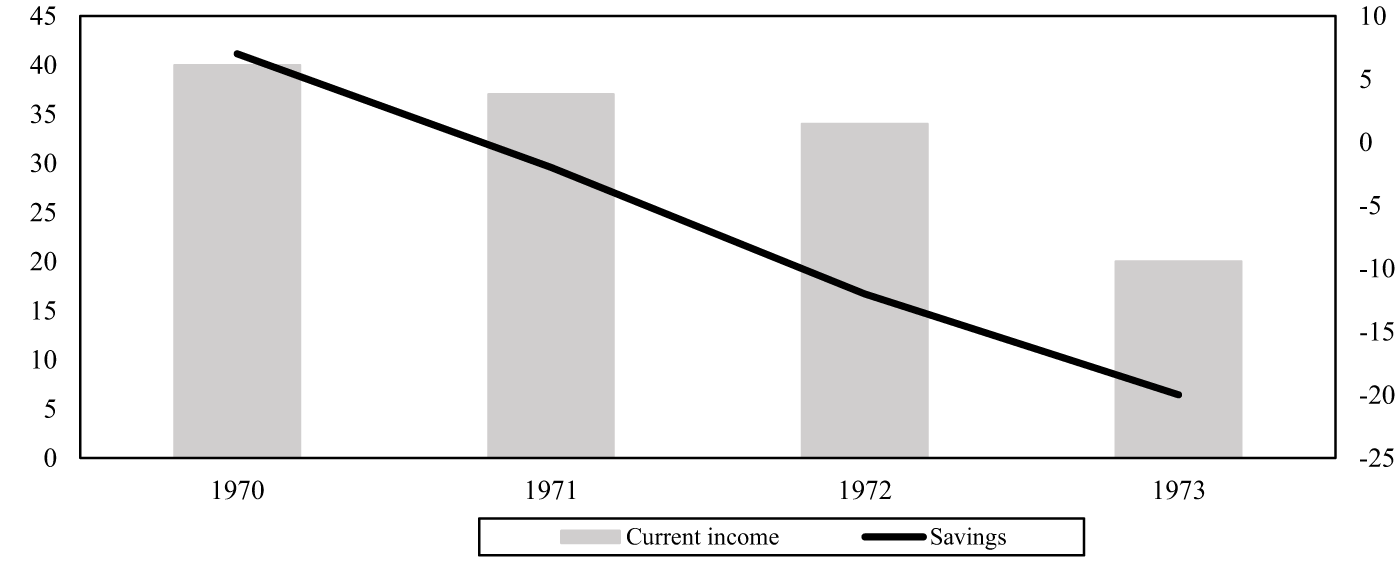
The profound and far-reaching impact of lax fiscal policies on Chile’s economic landscape was enduring. The fiscal deficit, skyrocketing to an alarming −30.4%, thrust the government into insolvency. The administration had to resort to financing through public debt to meet budgetary expenditures, resulting in significant payment delays. This surge represented an unprecedented 76-fold increase, dwarfing the historical average between 1810 and 1940. It exceeded the average between 1940 and 1970 by six times and surpassed the outcome in 1970 by 4.5 times. Figure 12, depicting non-financial fiscal accounts (% of GDP), vividly illustrates the dire straits faced by the public sector. Tax revenues plummeted by 50% from 1970 to 1973, aggravating the financial shortfall. Non-financial public sector savings nosedived by over 400%, turning negative from 1970 to 1973, as highlighted by Lüders et al. (Reference Lüders, Díaz and Wagner2016).
Non-financial public sector accounts (% GDP): current income (left axe) and savings (right axe). Source: Braun et al. (Reference Braun, Braun, Briones, Díaz, Lüders and Wagner2000)

Confronted with this economic recession, the government turned to monetary issuance to address the expanding fiscal deficit, as highlighted by Ramos (Reference Ramos and Sideri1979). On the monetary front, lax policies persisted, leading to the collapse of bank deposits and a surge in the velocity of money in 1973. This signalled a decline in money demand, reflecting eroding trust in the government-issued fiat currency. Citizens shifted towards tangible goods, exerting upward pressure on prices, including the nominal exchange rate. The increased monetary issuance went hand in hand with the decline in money demand, a trend clearly illustrated in Figs 6 and 7.
The financing of the fiscal deficit through monetary issuance, coupled with restrictive trade measures, expropriations, and price controls, exacerbated the failure in money demand. This manifested in an 18-fold acceleration in the velocity of circulation in 1973, which triggered an alarming inflationary spiral. Hyperinflation surged to 606% in 1973, surpassing the historical reference period of 1810–1940 by 242 times, 22 times more than the increase between 1940 and 1970, and 2.3 times more than the rise between 1970 and 1972.
The economic collapse of 1973 left a lasting impact on key economic indicators. Consumption plummeted by 33%, investment contracted by 50%, and GDP experienced a troubling decline of −6%. The impact on GDP per worker was even more severe, recording a dismal −9% (see Figures 1 and 2). Structural shortages of essential goods pushed poverty and indigence levels beyond 50%. In response, Chile initiated food rationing through the Juntas de Abastecimiento y Control de Precios (JAP), aiming to allocate food quotas for each family. Regulatory Committees were established to ensure the exclusive distribution of SPA-produced goods by the government, prohibiting direct sales by companies to the public.
The wide-ranging consequences of lax fiscal and monetary policies, trade restrictions, expropriations, and price controls were crucial in triggering the 1972 financial crisis and the subsequent 1973 economic recession. The aftermath was marked by a decline in the capital–labor ratio, which impeded capital formation and hindered technological development. The nation faced the challenge of low real incomes, which contributed to a lack of capital accumulation and perpetuated Chile as an underdeveloped economy. In essence, macroeconomic populism, characterized by unprecedented laxity in fiscal and monetary policies, combined with anti-market policies such as trade restrictions and expropriations, led to economic challenges that ultimately limited productivity and hindered the country’s progress toward development.
4. Macroeconomic populism and recession
Finally, reflections on macroeconomic populism in Chile between 1970 and 1973 are provided for analysing recent economic policies in other Latin American countries. First, some common misrepresentations of the economic events of the 1973 recession are analysed. Second, some lessons for Latin America on the role of lax economic policy and trade restrictions are discussed.
4.1. Some misrepresentations about Chile’s economic recession
Despite the availability of data and extensive literature on Chilean history, many obscurities still need to be discovered about the causes of the 1973 recession. Rosenstein-Rodan (Reference Rosenstein-Rodan1974, 7) is credited with raising the widely accepted belief that the 1973 recession “had nothing to do with socialism [because] it is not inherent in socialism to be inefficient,” but rather with harassment by the opposition and the U.S. government. The extreme polarization of the political forces before the coup d’état of September 11, 1973, aggravated the economic difficulties. Following Whitehead (Reference Whitehead1973), the Unidad Popular was the victim of an inevitable confrontation that they initiated.
First, it is a mistake to attribute the boom to the government’s successful economic planning and the bust to the opposition boycott. The previous sections showed that lax economic policy induced a boom period in the short term that ended in a bust in the long term. It was also explained that the government’s economic planning triggered a decline in money demand, resulting in a decrease in capital formation and tax revenues, and consequently, a rapid increase in the deficit and inflation rate, creating a vicious circle of poverty.
While it is accurate that the U.S. government supported the opposition Allende government with $8.8 million, 74% of that amount was disbursed in 1973 (Kornbluh and Block, Reference Kornbluh and Block2020). The resources were used for the survival of the press, business, political activism, and support for opposition mobilizations cornered by the UP government. On the other hand, the Unidad Popular government maintained a fluid relationship with the International Monetary Fund (IMF), thanks to the systematic depoliticization and technocratization of the links between the two, which even allowed it to circumvent an embargo imposed by the United States (Kedar, Reference Kedar2015). Allende obtained credits in capitalist countries for more than $600 million without problems exporting copper. Could the opposition have been responsible for the macroeconomic populism that led to the business cycles? The total amount of resources allocated to the opposition was incomparably less than the foreign aid of the Allende government. There was no world capitalist plot against Allende.Footnote 6 The inadequate policies of Allende’s economic advisers destroyed the Chilean economy. Only a flawed analysis would absolve the lax economic policies of responsibility for the 1973 recession.
External influences (debt crises and economic blockades, among others), domestic structural policies (socialisation of firms, banks nationalisation), and inconsistent fiscal and exchange rate policies bring about an unsustainable situation; inflation goes out of control, and the foreign exchange constraints force realism on policymakers. Accounts of these experiences often emphasise politics and, especially, external factors as central to the demise. External destabilisation can be an essential part of the unravelling of an economic program. But we emphasise the extreme vulnerability that makes destabilisation possible. By and large, these potential results are from unsustainable economic policies. We think that only to the extent that the mechanics of the macroeconomics of populist programs are fully understood, will these policies cease to be popular among politicians. (Dornbusch and Edwards Reference Dornbusch, Edwards, Dornbusch and Edwards1991, 248)
Second, it is confusing to attribute the boom to a temporary rise in aggregate demand and the bust to the insolvency resulting from massive expropriations and price controls. Again, the Chilean experience demonstrates that macroeconomic populism was the driving force behind the business cycle between 1970 and 1973. Lax economic policies stimulated unsustainable economic growth based on deficit spending financed by monetary issuance. Fiscal and monetary stimuli increased aggregate demand in the short run at the cost of fiscal and monetary crises in the long run. Although the bubble bursting may be distant, the profound shift in money demand activated the crash. The financial crisis and economic recession were not only the result of expropriations and price controls. Inflation reached 1000% in August 1973, one month before the coup (Lüders et al., Reference Lüders, Díaz and Wagner2016). However, they triggered the rapid recessive patterns of lax economic policies by decapitalizsing the economy and structural poverty.
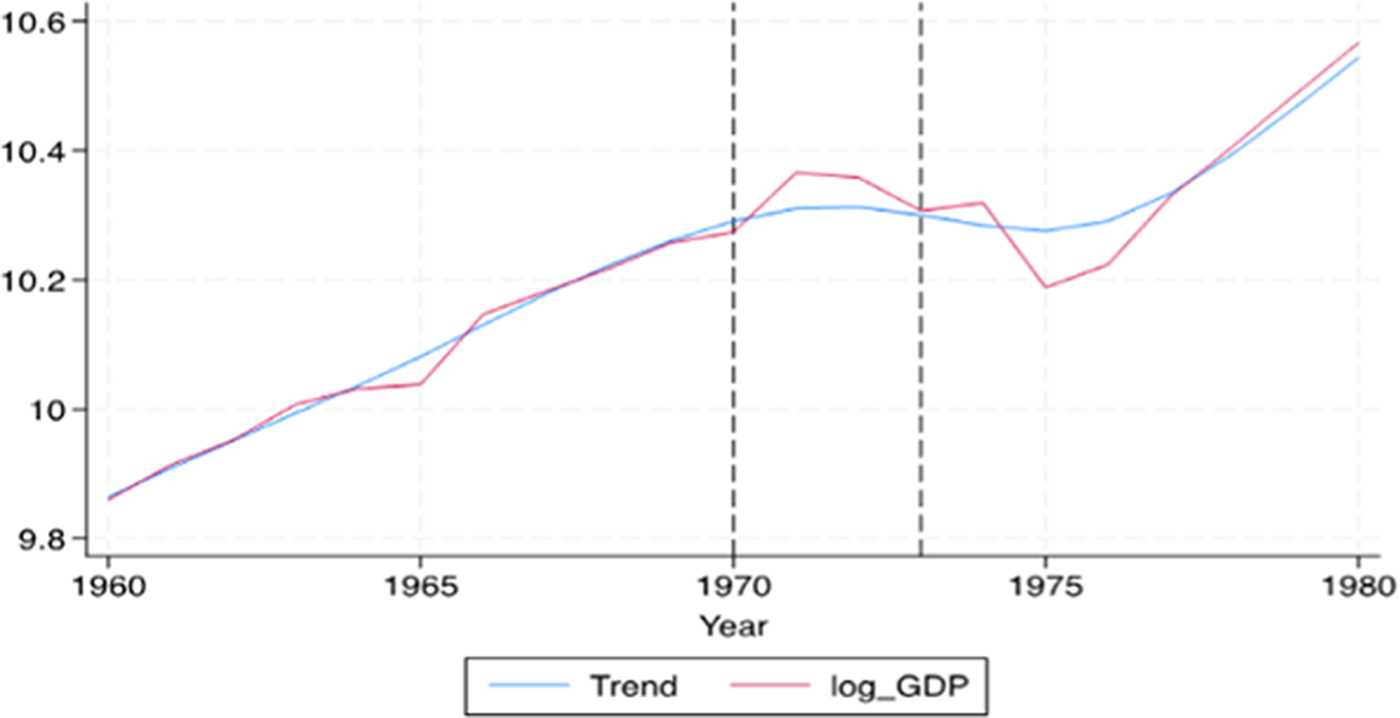
The above can be verified by studying the seasonally adjusted and smoothed data series using the Hodrick–Prescott (HP) filter to extract the trend of GDP expenditure from 1970–1973 by smoothing the data. The series has been extended to study the long-term trend, using data that shows the short-term cycles between 1960 and 1980. The HP filter is applied during the analysis to remove short-term fluctuations associated with the business cycle, revealing long-term trends.
The data yielding the components of aggregate demand at chained previous year’s prices (benchmark 2018) have been analyzed with the HP filter, which has shown that during the period of Salvador Allende’s government, the lax fiscal and monetary policies created an artificial boom abruptly deviating from the trend and then falling rapidly well below trend (see Figure 13). The behavior of spending as a percentage of GDP after 1973 shows a smooth upward trend until 1980. Chilean economic history reveals that this trend persisted and continued to grow steadily during the transition to democracy in the 1990s.
Hodrick–Prescott filter for GDP expenditure volume at chained prices of the previous year, 2018 benchmark, and historical data (in chained billions of pesos). Source: Central Bank of Chile (2023).

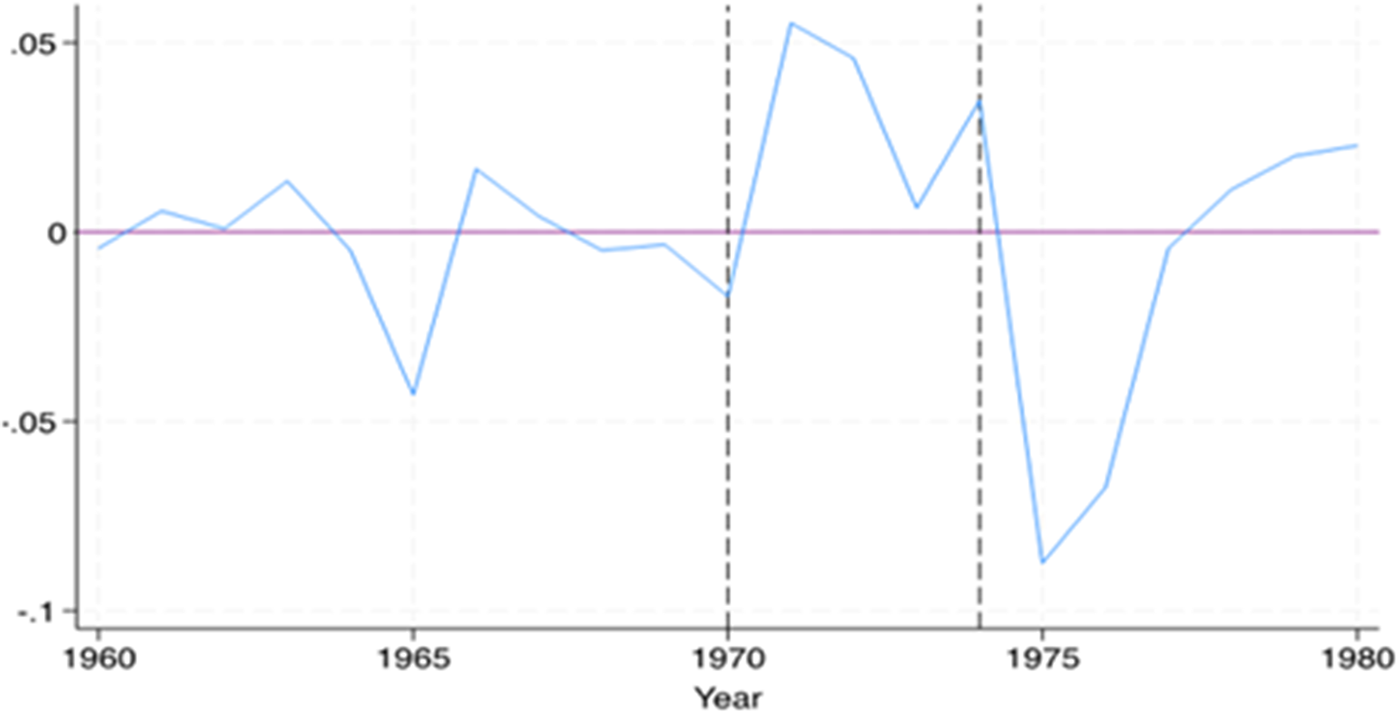
An alternative approach is to examine the cyclical fluctuations of the economy, where the time series represent deviations from their long-term trends. The cyclical deviations in the time series of gross domestic product (GDP) from its long-term trend reveal how lax economic policies induced a business cycle, which is characterized by the deviations of the observations from the estimated direction. These deviations persist only between 1970 and 1973, within the 20 years considered (Figure 14). The pronounced nature of the deviations in the GDP results from the magnitude of the economic policy laxity initiated between 1970 and 1972.
Cyclical component from the volume GDP expenditure trend at the previous year’s prices, benchmark 2018, historical information (chained billions of pesos). Source: Central Bank of Chile (2023).

4.2. Lessons for economic policy in latin america
In the 21st century, some Latin American economies applied macroeconomic populism, as in Chile, between 1970 and 1973. Analyzing the reasons for adopting these policies today under the literary name of Modern Monetary Theory (MMT) is the subject of another investigation (see, for example, Edwards, Reference Edwards2019b; Skousen, Reference Skousen2020; Newman, Reference Newman2020). What is essential here is to recognize the patterns and predictions to interpret the effects of these measures on the business cycle.
Chile’s 1973 recession provides lessons on the impact of macroeconomic stability and planning on the solvency of developing countries. The financing of fiscal deficits with growing debt and monetary issuance is a persistent problem in some Latin American countries. Edwards (Reference Edwards2019a,Reference Edwardsb) and Cachanosky and Padilla (Reference Cachanosky and Padilla2019) explain that Argentina under Kirchnerism (2003 and 2023) and Venezuela under Chavism (1999–present) are two illustrative cases of business cycles that followed the macroeconomic populism of the Salvador Allende government. Although the failure in money demand was crucial in the emergence of the crisis in Argentina and Venezuela, the causes that led to that failure deserve special attention.
4.2.1. Macroeconomic stability
Inflation is one of the most worrying macroeconomic problems in Latin American economies. The average annual inflation in the region was 7.4% between 2010 and 2022, 3.7 times higher than the Federal Reserve (Fed) and the European Central Bank (ECB) inflation target. Venezuela and Argentina promoted macroeconomic populism in recent decades, generating the region’s highest fiscal and monetary imbalances. Unlike other Latin American countries, Argentina and Venezuela are among the 10 countries with the highest annual inflation levels in the world (World Bank, 2024). These countries do not have fiscal and inflation targets or independent central banks. The available data shows that Venezuela and Argentina share an average annual fiscal deficit of −1% and an average annual inflation of 2% between 1810 and 1940 (Cartay, Reference Cartay1988; Cavallo and Runde, Reference Cavallo and Runde2020). However, this section uses Chile’s annual average of −0.4% deficit and 2.5% inflation between 1810 and 1940 to compare the laxity of the economic policies of these countries with those used by Allende.
First, Venezuela has the world’s largest oil reserves, accounting for over 80% of its exports and about one-third of fiscal revenues. Despite an oil price boom that provided Venezuela with revenues of US$960,589 billion between 1999 and 2014, the country pushed a lax fiscal policy based on increasing aggregate demand through deficit spending. According to the reference, the fiscal deficit exceeded double digits between 2010 and 2022, peaking at 17% in 2012, a deviation of 42.5 times the reference. The fall in oil prices from 2015 onwards reduced tax revenues and increased debt to 240% of GDP in 2023—the second most indebted country after Japan, with 260% of GDP (World Bank, 2024). Venezuela has the highest country risk in Latin America, reaching magnitudes never seen before, 54,079 in 2022.
Venezuela also opted for a lax monetary policy by financing the deficit with monetary issuance to face the fiscal crisis. As a percentage of GDP, the monetary base to finance deficit spending increased from 2% in 2011 to 12% in 2017. While the annual inflation rate ranged between 23% and 26% between 1999 and 2012, the runaway increase in monetary issuance led to hyperinflation with a year-on-year peak of 344.509% in 2019—the highest in the world—and an annual average of 10,000% inflation and a double-digit fiscal deficit between 2015 and 2023. It implies a deviation of 4000 times the reference (Rogoff, Reference Rogoff, Pastén and Reis2021; World Bank, 2024). In the last 14 years, Venezuela has removed 14 zeros from its currency.
Second, lax fiscal policy is the main problem of the Argentine economy (from 1900 to 2023, total spending has exceeded the revenues available to the treasury in 113 years). While most countries engage in deficit spending and issue debt to finance the imbalance, Argentina cannot solve it similarly because it is the region’s second most indebted country after Venezuela, with 88.4% of its GDP in 2023 (World Bank, 2024). The eagerness to carry out public spending beyond the capacity to generate commensurate tax revenues has led to successive debt crises, resulting in default on eight occasions, with the largest default in history in 2001, amounting to approximately US$96 billion. The distrust caused by Argentina results in it having the second-highest country risk in Latin America, reaching a maximum of 2,976 in 2022. Argentina must pay increasingly higher interest rates to continue borrowing on international markets.
Argentina resorted to a lax monetary policy to finance the fiscal deficit with monetary issuance. Over the last 100 years, monetary imbalances have led to a country’s average inflation rate of 105% annually, with a historical maximum of 3,079% in 1989. The Convertibility Law of 1991 fixed the parity of the dollar and peso, reducing inflation drastically from 147% in 1992 to 0% between 1993 and 1999.Footnote 7 Although monetary equilibrium had been achieved, growing fiscal imbalances prompted the abolition of the Convertibility Law to finance the treasury with monetary issuance again (Cachanosky and Mazza, Reference Cachanosky and Mazza2021). Inflation increased from 3.7 in 2003 to 211.4% in 2023 (a deviation of 85 times from the reference), and a fiscal and quasi-fiscal deficit reached 17% of GDP in 2023 (a deviation of 42.5 times from the reference). Argentina destroyed five currency signs and removed 13 zeros from the currency since the creation of the Central Bank in 1935 (Rogoff, Reference Rogoff, Pastén and Reis2021; World Bank, 2024).
Evidence from these countries elucidates how macroeconomic populism can circumvent budget constraints, as occurred in the Allende government, laying the groundwork for diverse crises within these economies. Masking extravagant expenditures through an escalation of debt beyond sustainable thresholds leads to debt crises and defaults. Persistent reliance on financing through heightened monetary issuance results in the emergence of inflationary and hyperinflationary crises.
4.2.2. Macroeconomic populism
Argentina and Venezuela, accompanied by economic policies, implemented aggressive anti-market policies, including price controls, expropriations, and international trade controls, with the intention of achieving accelerated income redistribution (Abuelafia and Saboin, Reference Abuelafia and Saboin2020). As in Chile’s 1973 recession, these policies resulted in a severe institutional crisis, with plummeting money demand and an increase in the velocity of money circulation, as agents sought to get rid of it by buying dollars or consumer goods. When money demand falls, relative prices rise rapidly, and the country’s productive capacity collapses, temporarily hidden by government spending and imports in a boom-bust cycle. As Edwards (Reference Edwards2019a, 97) states, “A recurrent development in every one of these populist episodes is that once inflation gets to a certain level (say, mid-two digits or higher), the velocity of circulation increases significantly. People still have to use domestic money to pay taxes, but it is not used for anything else.”
While Venezuela applied price controls to the basic goods basket between 2000 and 2023, Argentina did so between 2013 and 2023. These programs were promoted to reduce inflationary expectations, achieve price stability, and restore the purchasing power of money in the short term. However, suppose prices are lower than market prices. Business costs exceed revenues. In a context of inflation where production costs are rising, inflation expectations increase, resulting in the unfeasibility of production and shortages of controlled products.
Venezuela expropriated, nationalized, or intervened in more than 5,000 companies in the last two decades. Only 3,000 survive in 2023, with most requiring ever-increasing subsidies to offset their growing accounting losses. The misappropriation of private property undermines private property and incentives to save, invest and undertake, devastating the country’s economy. Thus, the country’s industrial base operates with 20% of the installed capacity. Alternatively, Argentina does not have a policy of directly expropriating companies. However, it has 167 taxes, 12 of which collect 91% of the tax revenues, a tax burden for a family of 48% of the income, and an average of 106.3% for companies’ net profits. As Almada and Atienza (Reference Almada and Atienza2019) state, an Argentine SME that pays all its taxes on average obtains accounting losses.
Both countries have capital controls, such as transaction taxes or volume caps, and other limitations to regulate inflows and outflows on the capital account, which can encourage capital flight and multiple exchange rates. In response to the effects of inflation and controls, agents have spontaneously dollarized to safeguard their purchasing power (Cachanosky et al., Reference Cachanosky, Salter and Savanti2022). The profitability of companies remains under pressure due to higher production costs, which explains why labour informality and the underground market reached 85% in Venezuela and 45% in Argentina in 2023 (International Labour Organisation, 2023).
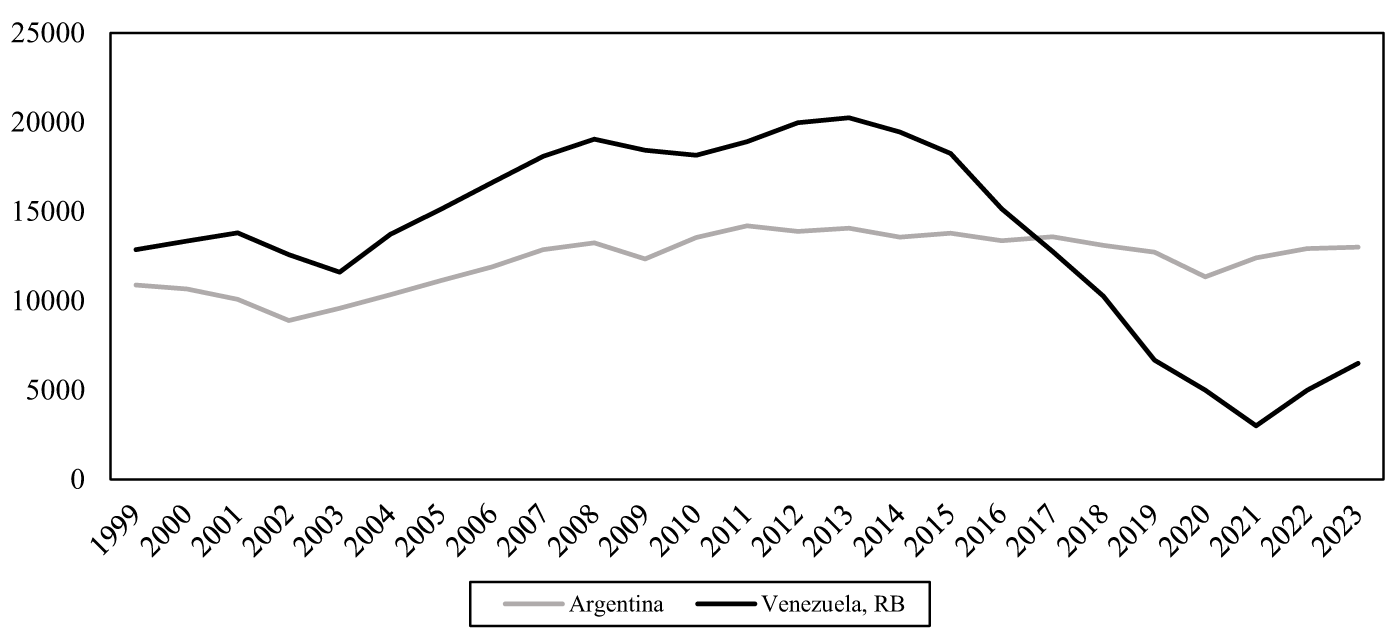
Considering the beginning of the political regime and the peak growth of GDP per capita, the lax fiscal and monetary policy induced an artificial boom, multiplying GDP per capita by 1.5 times in Venezuela between 1999 and 2014 and 1.3 times in Argentina between 2003 and 2015. However, the long-term effects of macroeconomic imbalances and planning triggered the crash. Venezuela’s 2023 GDP per capita was lower than in 1999 when Hugo Chavez came to power. Argentina’s was like in 2007 (Figure 15). Consequently, in 2023, 70% of Venezuelans lived below the poverty line (53.3% were in extreme poverty), and 41.7% of Argentines lived below it (11.9% were in extreme poverty).
GDP per capita (constant 2015 US$). Source: World Bank (2023).

4.2.3. Liquidity versus solvency
Evidence from Chile’s 1973 recession indicates that lax economic policy contributed to excess liquidity, ultimately leading to macroeconomic instability. As discussed above, the recent incidents in Latin America, specifically in Venezuela and Argentina, reinforce this hypothesis. The objective is to briefly analyze how Chile became solvent, facilitating economic growth and closing the gap in macroeconomic imbalances.
Espinosa (Reference Espinosa2023, 220) explains that economic development implies “the widening range of solutions to human problems” through entrepreneurship and capital accumulation (see Endres and Harper, Reference Endres and Harper2020). In this sense, between 1973 and 1990, Chile initiated a two-pronged macroeconomic stabilization program to escape macroeconomic populism by facilitating entrepreneurship and capital accumulation. On the one hand, private property rights were restored, and expropriated land or companies were returned to their owners or privatized in the financial market. Price controls and trade barriers were abolished, and deficit spending was reduced to lower corporate taxes to 10% for distributed profits—the corporate tax was 0% if profits were reinvested in the firm. On the other hand, the 1980 Constitution secured property rights, limiting political discretion in all areas of society. For example, expropriation is allowed exclusively if a law authorizes it. Initial payment in cash and at the market price of “all the patrimonial damage caused” was required before taking material possession of the confiscated property unless the expropriated party consents otherwise (Art. 19 No. 24).
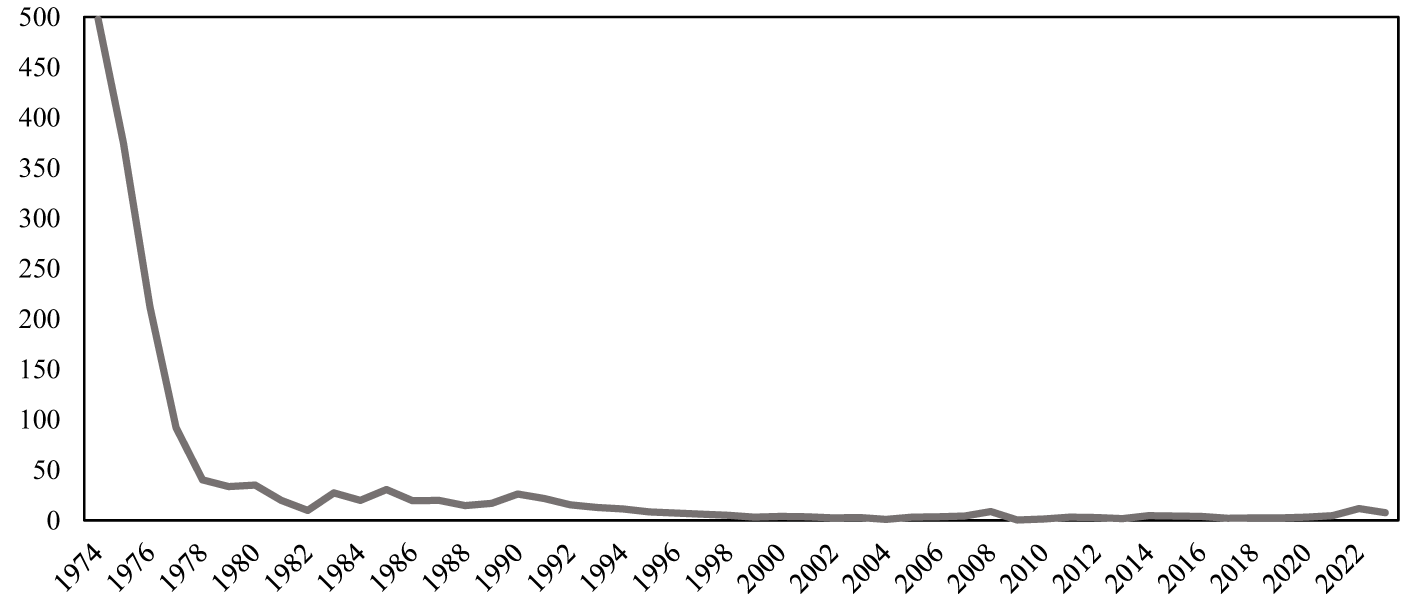
Empirical evidence suggests that improvements in central bank independence lead to a steady decline in inflation (Bernanke and Mishkin, Reference Bernanke and Mishkin1997; Jácome and Pienknagura, Reference Jácome and Pienknagura2022). Central bank independence is associated with a reduction in the probability of high inflation episodes, especially when accompanied by cuts in the fiscal deficit (Taylor, Reference Taylor2019). A monetary rule was first established in Chile’s 1980 Constitution but was fully implemented in 1989 to guarantee an annual inflation target of 3%. This implied that the Central Bank of Chile was an autonomous technical body with its assets. At that time, it transitioned from being dependent on the President of Chile to becoming an independent body within the state structure. This framework contributed to an average annual inflation of 6% between 1990 and 2023, deviating 2.4 times from the inflation target (Figure 16).
Inflation, consumer prices (annual %). Source: World Bank (2024)

In 2001, a fiscal rule was also promoted through the Structural Balance Law. It consists of estimating revenues, adjusting them for the business cycle, and authorizing public spending consistent with revenues to avoid a fiscal crisis. In compliance with this rule, the effective balance will be less than 0% of GDP when cyclical conditions are unfavorable and greater than 0% when cyclical conditions are favorable to the fiscal budget (Frankel, Reference Frankel2011). The Autonomous Fiscal Council (AFC) has a technical and consultative nature, validating the calculations of the cyclically adjusted balance and contributing to the responsible management of the government’s fiscal policy (Law No. 21,148).
Blanchard et al. (Reference Blanchard, Leandro and Zettelmeyer2021) and Funke et al. (Reference Funke, Schularick and Trebesch2023) emphasize that implementing robust fiscal and monetary rules diminishes the probability of macroeconomic populism, ensuring that fiscal and monetary accounts align with anticipated limits. Hence, after the fiscal rule, combined with the monetary rule, took effect, the average annual inflation rate was 3% and the fiscal surplus reached 0.7% between 2001 and 2020, marking a departure from 60 years of lax economic policies in Chile.Footnote 8
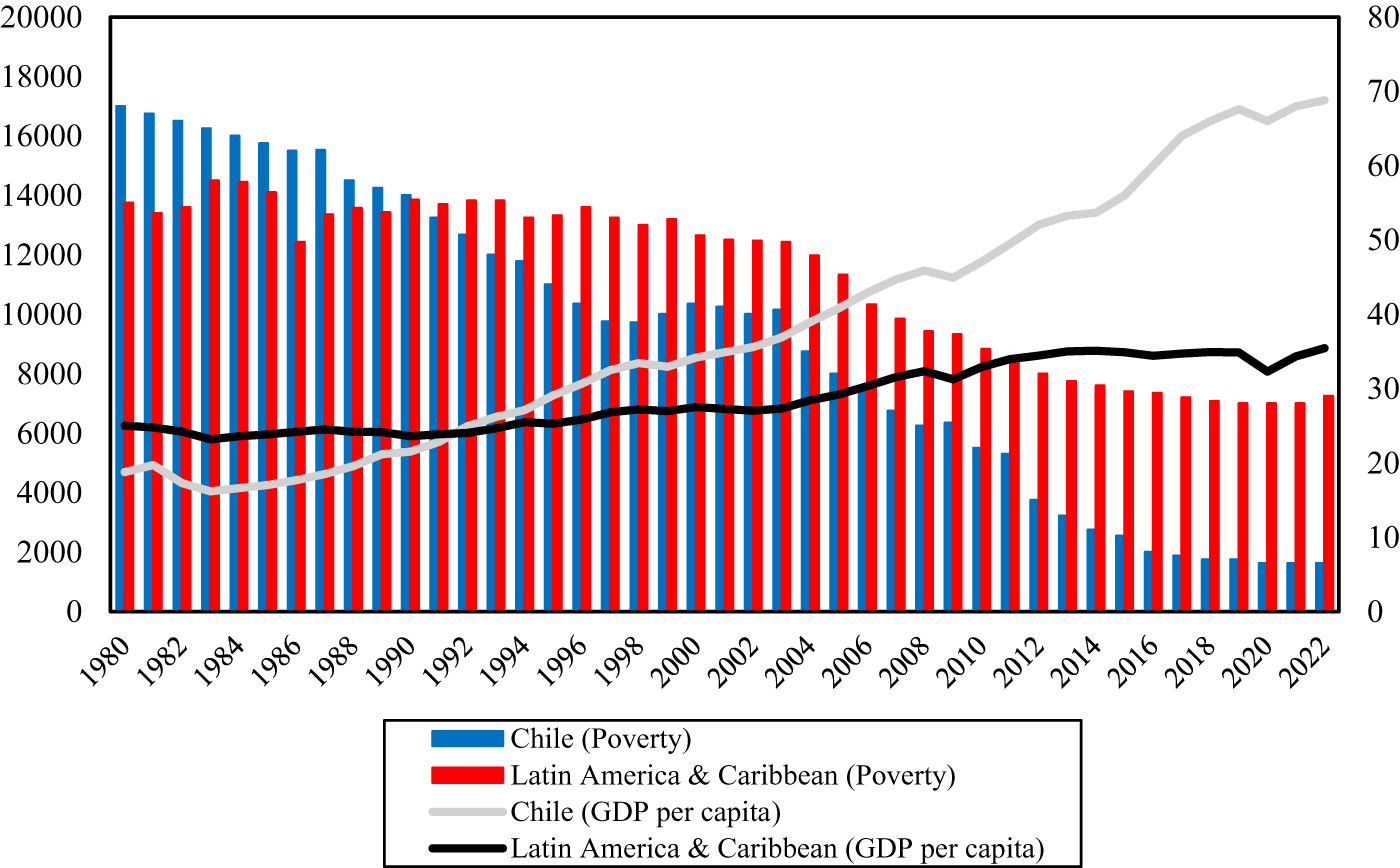
Finally, Chile’s fiscal and monetary rules, which secure private property rights, restricted lax economic policies, facilitating entrepreneurship and capital accumulation between 1990 and 2020.Footnote 9 Figure 17 shows Chile’s GDP per capita tripled in those years, but the Latin American average multiplied by 1.4. Therefore, poverty in Chile, which had historically been above 50%, decreased to 8% in 2020, while the Latin American average was 28%.
GDP per capita (constant 2015 US$, left axe) and poverty headcount ratio at $6.85 a day (2017 PPP) (% of population, right axe). Source: World Bank (2024)

5. Conclusions
The causes of the 1973 Chilean recession remain a topic of misrepresentation, related to opposition boycotts and insolvency due mainly to expropriations and price controls, with no consensus on the role of economic policy in the business cycle. This paper identifies macroeconomic populism, driven by lax economic policies, as the force behind the boom and subsequent bust. The initiation of lax fiscal and monetary policies in 1970 aimed at accelerating economic growth and income redistribution, leading to increased aggregate demand and the 1971 boom. However, these policies resulted in a growing macroeconomic imbalance, culminating in the 1972 financial crisis and the subsequent 1973 economic recession.
Populist measures, such as expropriations, price controls, and trade restrictions, accelerated the shift from boom to bust by causing a decline in money demand, thereby discarding alternative theories on the 1973 Chilean recession. Recent cases in Venezuela and Argentina support these findings. Despite challenges such as double-digit fiscal deficits and hyperinflation, Chile’s adherence to fiscal and monetary rules enabled it to achieve macroeconomic stability, paving the way for recovery. This experience underscores the importance of establishing robust rules that limit discretionary economic policy for developing economies, particularly in Latin America.
As a broader lesson, the paper advocates for policymakers in developing economies to promote institutions supporting private property rights, balanced budgets, and monetary soundness, which are crucial for economic growth and poverty reduction through entrepreneurship and capital accumulation. Studying macroeconomic populism based on lax economic policy could prompt future research to conduct cross-sectional empirical exercises at the international level. Moreover, the events surrounding Chile’s recession and subsequent recovery raise questions about the effectiveness of the development strategies proposed by Modern Monetary Theory.
Acknowledgements
We thank the History of Economics Society (HES) for the opportunity to present an earlier version of this paper at its 51st meeting in Santiago, Chile (July 14–18, 2024), and the journal’s anonymous reviewers for their valuable comments. Usual caveat applies.