Natural and man-made disasters have always threatened human societies and have been the source of many casualties and financial losses. Reference Sena, Forde and Yu1,Reference Amiri, Rezapour and Nekoei-Moghadam2 The World Health Organization considers disasters as occurrences disrupting the normal conditions of a society, resulting in widespread damage of humans, economy, or environment that exceeds the capacity of adjustment of the affected society. 3,Reference Amiri, Rezapour and Nakhaee4 Preparedness is defined as knowledge, capabilities, and actions of governments, organizations, social groups and individuals to effectively anticipate, respond to, and recover from the impacts of likely, imminent, or current hazard events or conditions. Reference Djalali, Carenzo and Ragazzoni5–Reference Amiri, Nakhaee and Nagyova7 Among several components of disaster management, the health centers and affiliated units can reduce physical, financial, and social damage due to disasters by providing the preparedness plans and appropriate strategies. Reference Khankeh, Golamreza and Nasiri8–Reference Beyramijam, Khankeh and Farrokhi10 Soji Nika et al. have concluded in their study that disaster management and its consequences are now essential for maintaining communities and stability, and that the health sector has a special place among all the elements involved in disaster management because people’s first and foremost demand and concern is health. Reference Suginaka, Okamoto and Hirano11
Disaster exercises are one of the important steps in developing and implementing disaster risk management programs in different areas of the health system. Reference Skryabina, Riley and Reedy12 Exercises simulate the realistic conditions so that people improve their mental and physical skills in situations similar to real conditions and provide an appropriate response based on existing programs to emergencies and disasters. Reference Blum and Paradise13 Skrabina et al. found that operational exercises were activities aimed at training and practicing empowerment and identifying core competencies in preventing and mitigating effects, reducing vulnerability, responding, and rehabilitating in a risk-free environment for participants. Reference Skryabina, Riley and Reedy12 Disaster exercises can be used to test and validate policies, programs, procedures, as well as train personnel roles and responsibilities, improve individual performance, and improve interorganizational communication and coordination. Reference McCreight14 For designing an exercise, an organization should first conduct a needs assessment to assist in defining the problems, establishing the need for the exercise, and identifying the functions that need to be exercised. Reference Blum and Paradise13 Also, disaster researchers declared that evaluation indicators of an exercise should be selected during the design phase of the exercise. Reference Sena, Forde and Yu1,Reference Khankeh, Lotfolahbeygi and Dalvandi15,Reference Heidaranlu, Ebadi and Khankeh16
The health system resources are annually used for disaster preparedness exercises, but due to the lack of well-designed programs and guidelines for these exercises, macro goals and outlined prospects in the field of health system preparedness for disasters have not been achieved or they do not have capabilities and necessary scientific measurement. Therefore, considering the importance of promoting health system preparedness through exercise, the present study aimed at identifying and explaining the components affecting the design of preparedness exercises of the health system in disasters. The findings of this study can be considered a guideline for the design of principled and standardized health preparedness exercises for a timely response to disasters.
Methods
Study Design
This qualitative study was done by a directed content analysis approach in 2019. Content analysis is a method that can be used with either qualitative or quantitative data and in an inductive or deductive way. This approach is useful when an existing theory or research literature on a phenomenon is limited. Reference Green and Thorogood17,Reference Marshall and Rossman18 In this study, we used a deductive approach to achieve the objectives of the study.
Setting, Participants, and Data Collection
This qualitative study was conducted in Iran, one of the most disaster-prone countries in the world. Study population included 25 experts in disasters, who had practical experience or theoretical knowledge about “designing of preparedness exercises in disasters” and had been present at least once in operation-based or discussion-based exercises. Participants were chosen using a purposeful sampling method with maximum diversity. Sampling was carried out until data saturation occurred, that is, when the researcher concluded that further interviews would fail to provide new information. Participants included 7 prehospital directors, 4 hospital directors, 2 nursing experts in a hospital emergencies committee, 4 experts in Emergency Operation Centers (EOC) in the University of Medical Science, 6 health experts in disaster risk reduction, and 2 deputies of the logistic of the University of Medical Sciences.
In this study, Hojjat Sheikhbardsiri (HS) conducted the interviews face to face and individually. The process of data collection was under the supervision of Ali Sahebi (AS). The interviewees answered a similar set of questions, which included (1) Have you ever experienced the preparedness exercises of the health system in disasters? (2) Describe the worst and best disaster exercises that you have experienced in the health system. (3) Based on your experience, what components and features should be considered in a standard discussion-based exercise? (4) What components and features should be considered in a standard operation-based exercise? (5) What requirements and functions should be considered for the design of operation- and discussion- based exercises in disasters? Based on the above guide, additional questions were raised during the interview and when authors found new concepts. Moreover, who, when, why, and how were used for concept saturation as well as “Could you please give an example” or “Please explain more” for data and concept saturation. The interviews were taped and lasted 25-74 minutes. The place and time of the interview were selected by agreement between the interviewer and the interviewee, and field notes were written during interviews to describe and interpret the responses correctly.
Reliability and Validity
This study employed strategies recommended by Lincoln and Guba Reference Lincoln19 for reliability and validity tests. According to this recommendation, 4 criteria of credibility, dependency, conformability, and transferability are required to ensure reliability. Credibility was ensured through assignment of sufficient time for data collection and analysis, prolonged engagement with the participants, constant comparison of participants’ expressions, understanding of their experiences by the researcher, and maximum variety of the participants. Conformability was achieved by a member check, a peer check, and an expert check. The member check was done by returning the text of interview and summary of results to 4 participants for a confirmation of the findings. Two qualitative researchers in the research team (expert check and peer check) checked the validity of data collection and analysis process.
Ethical Consideration and Consent to Participate
The study was approved by the Ethics Committee of Kerman University of Medical Sciences with Reg. No. 400000883 and Ethic Code IR.KMU.REC.1400.714. Informed consent was obtained orally and in writing before the interview after explaining the aim and process of the study. In addition, participants were informed about the purpose of the study, the interview method, confidentiality of their information, and the right to withdraw from the study at any time.
Data Analysis
A qualitative content analysis was used to analyze the data. Systematic stages were followed and a simultaneous analysis was undertaken: First, recorded interviews were transcribed verbatim by the first author; then, prior to coding, the transcribed text was read several times for familiarization by the first, second, and third authors. In the initial coding process, the participants’ words were used and condensed meaning units were formed; then, the codes were categorized into subcategories based on their similarities and differences. This process continued for all interviews until the formation of the main categories by the first author.
Results
Demographic Information of Participants
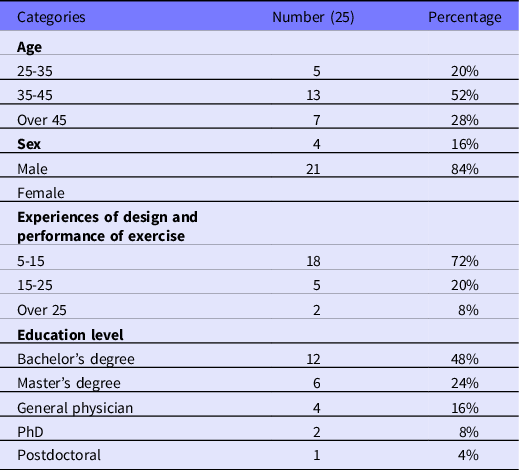
The participants included 4 females and 21 males with a mean age of 42.25 ± 4.8 years ranging from 25 to 63 years. The mean duration of work experience was 15.5 ± 3.4 years, and all participants had more than 5 years of work experience in designing preparedness exercises of the health system in disasters (Table 1).
Demographic characteristics of the participants in study on identifying and explaining the components affecting for design preparedness exercises health system in disasters in Iran

Main Results
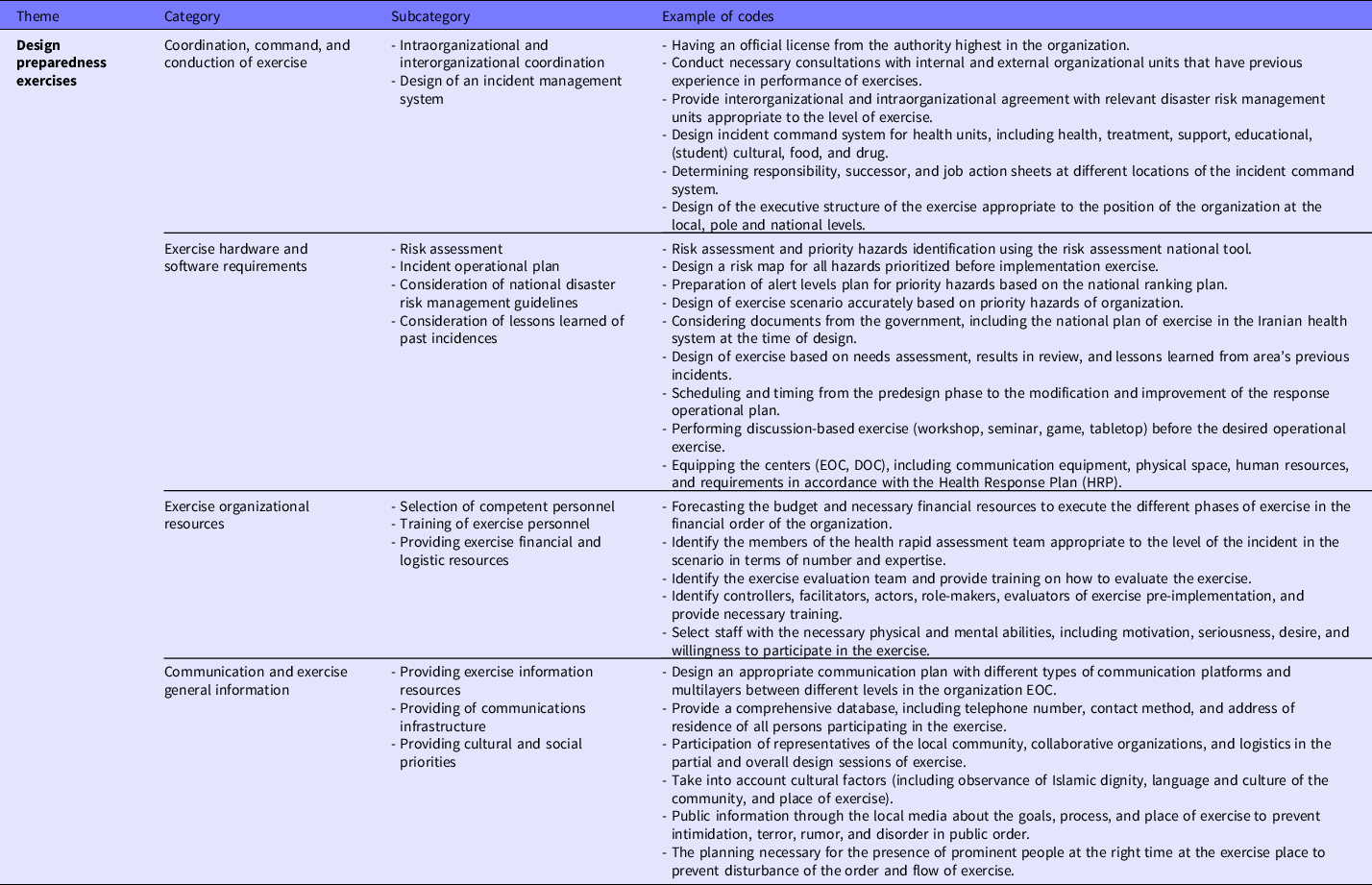
An original theme of the exercise design, 4 main categories, 12 subcategories, and 50 codes were formed: coordination, command, and conduction of exercise (with 2 subcategories of intraorganizational and interorganizational coordination and design of an incident management system), exercise hardware and software requirements (with 4 subcategories of risk assessment, incident operational plan, consideration of documents, and lessons learned from past emergencies), organizational exercise resources (with 3 subcategories of selection of competent personnel, training personnel, and providing financial and logistic exercise resources), communication and general exercise information (with 3 subcategories of providing exercise information resources, providing communications infrastructure, and cultural and social priorities) (Table 2). The main categories and subcategories are described in the following sections.
Categories and subcategories of components affecting the design of preparedness exercises of the health system in disasters

Main Theme
Design of Exercise
One of the most important steps to measure and improve health system preparedness in disasters is the standardized design of discussion-based and operation-based exercises to run comprehensive and long-term programs of the disaster risk management.
Main Categories and Subcategories
First Category: Coordination, Command, and Conduction of Exercise
The findings of the fieldwork indicate that coordination, command, and guidance play a crucial role in the design phase of the exercise.
Intraorganizational and interorganizational coordination
Interviewees believed that coordination before exercise, including the formal approval of top executives and the support of senior managers and organizational support, will play an important role in speeding up health preparedness for disasters through exercise. One of the best intraorganizational and interorganizational coordination solutions is to have a collaborative agreement for proper response to disasters:
Intra- and inter-organizational coordination when designing an exercise and the authorization of top executives to execute an important exercise are very important. For example, I as an expert wanted to do an exercise, which was scientific and very effective, but the security guard at the university prevented me and believed that it might cause a social seizure. (Participant 2)
Most importantly, we need to be aware of the response plans of other organizations and read them to prevent unexpected events. In addition, we should consult with organizations that have already conducted exercises; we need to see what goals they had. (Participant 7)
Design of an incident management system
From the experts’ point of view, the University Incident Management System (UIMS), the Hospital Incident Command System (HICS), and Pre-Hospital System (PICS) are essential organizational structures to be fully prepared and respond effectively to an incident through exercise. Design, implementation, and evaluation of the exercise are also essential. The following are statements regarding the necessity for the organizational structure of the exercise in the Emergency Operational Plan (EOP):
If we are going to have a proper and meaningful exercise from the very beginning, we have to launch an exercise design system for universities similar to a pre-hospital incident command system or a hospital command system. (Participant 6)
Designing an incident management system in a physical location such as the University Emergency operations Center can play a managerial role in the disasters and also provides the necessary coordination for supply of the incident command needs. (Participant 9)
Second Category: Exercise Hardware and Software Requirements
One of the main categories of the present study is the provision of hardware and software requirements prior to the implementation of the main exercise.
Risk assessment
Interviewees believe that disaster risk assessment is the first step in disaster risk management, and it is very complex and time-consuming and requires multiple specialties, active involvement of all organizations, relevant people, consistent conscientious managers, and dedication of sufficient time and space:
Before designing any exercise, our incident center manager has to ask the experts in the operations management center to identify the main hazards using the Iranian hazards National Assessment Tool. (Participant 17)
A ready-made medical university is a university that first knows what it is ready for? What does it want to exercise for? Then it needs to know the hazards, to prioritize them, and identify their effects on its various sections. (Participant 3)
Providing an operational incident plan
From the interviewees’ points of view, the purpose of designing the operational incident plan is to formulate a standardized, structured operational plan, with proper and accurate functions that must be available in all organizational units participating in the exercise:
In my opinion, the unclear key elements of an operational exercise plan, such as early warning system, command, timing and hazards analysis cause dis-coordination of the organizational units in the exercise, and we know that the world is trying to respond to disasters with minute planning and execution and they are more likely to reach their goal. (Participant 20)
One of the important things in the operational incident plan was the design of the exercise scenario. The experts of disasters argued that the exercise scenario was one of the most important elements of the exercise and that compiling and writing comprehensible, realistic, and rational scenarios was essential:
In my opinion, scenario is the infrastructure and basis of a good exercise and gives everyone a chance to test their response to the actual simulated incident, even we can see our weaknesses and strengths and finally achieve our goal after the exercise. (Participant 11)
Consideration of national disaster risk management guidelines
The experts referring to upstream documentation and consulting with organizational units that previously have experienced successful exercises emphasized on designing the exercise:
Before designing the exercise, we need to study our upstream documentation well, so that the exercise has had no inconsistency or contradiction with the upstream documentation, there may be laws and regulations that approve the order or type of organization that should perform the exercise. However, exercise is not included; therefore, we must review the rules of the document. (Participant 9)
Consideration of lessons learned from past incidences
From the point of view of disaster specialists in Iran, lessons learned from past events are a valuable and important step to avoid repeating mistakes in disaster risk management, so we should know what resources were used in past exercises. Findings that we gained from past exercises could be headline organization upcoming exercises because past exercises will tell us the main problem of lack of preparedness and organization and poor response to disasters:
Most of the lessons learned are related to an incident happened previously and I think summarizing the results of a past exercise is very helpful, meaning what was done correctly and what could have done better. (Participant 22)
Third Category: Organizational Exercise Resources
Supplying the organizational exercise resources is very sensitive and important, and if managers do not pay special attention to it, the exercise will not be prepared and prevent the organization from achieving the anticipated development programs.
Selection of competent personnel
Selection of employees, one of the most valuable resources for the preparedness exercises in disasters, can play a significant role in advancing exercise and achieving predetermined goals, so employees should have the minimum qualifications needed to perform their role at the time of the exercise:
The physical and mental preparedness of the staff at various exercise sites is very important; for example, the rapid assessment team staff should have these physiological, physical abilities and important skills. (Participant 25)
In the hypothetical incident field, the controller and exercise evaluators must have complete physical and mental capabilities to evaluate all aspects of the exercise. (Participant 4)
It is very important that the staff of the organizational unit of exercise have the emotional and mental self-control you know exactly what do I mean? The mirror that I saw the staff coming into the field was doing everything in jest, playing the movie with reluctance. They make weblogs laugh, take pictures of each other. (Participant 15)
Training of the exercise personnel
Iranian health professionals believe that the organizational unit of exercise should take place before implementation of the original operational exercise using discussion-based exercises, including workshop and educational seminars preparing the employees for participating in exercises and also to be aware of their duties during operational exercise; any training to increase staff preparedness before operational exercise will increase their coordination and performance at the time of exercise to better prepare them for an emergency response during an actual incident:
There is definitely a role for training in various exercise stages, for example when designing an incident command system, we need to be trained. When we are organizing a team, we have to train them to see how they are organized; when we are equipping an organization, we should have the necessary training, the process of training is available in the whole phase of preparation because we see they design and execute the exercise within a day without having trained resources. Therefore, those that perform design and codify the exercise process have not received any training related to the exercise. (Participant 1)
Providing financial and logistic resources of the exercise
One of the essential needs of an exercise is the financial resources for the preparedness programs, especially the training and design of exercise. Most interviewees believe that human resources, equipment, and physical space are basic principles for an organization to respond to disasters through exercise:
I think financial regulations are not ready to compensate for the exercise costs and we do not see separate funding sources in the financial regulations of the organization, meaning there is no official financial document for the exercise costs and sometimes we may use other resources for preparedness and performance of the exercise. It is therefore imperative that the costs involved in designing and implementing the exercises be separately addressed in the financial regulations of the university and that the financial rewards following the exercise must also be pursued. (Participant 10)
Communication and general exercise information
The right communication is a system that can prepare organizations in disasters, with the highest possible capabilities.
Providing exercise information resources
Information is one of the most important and valuable tools in disasters and every manager needs it to decide when to respond to disasters. Health experts emphasized that the baseline database related to exercise resources—comprehensive information including telephone number, contact method and location of all exercise staff, and updated contact information for other centers and organizations related to disaster exercise at the organization (EOC)—should be prepared and updated every month:
It is very important that you have all organizational information from the down to the top at EOC, so that you can warn your employees when notification early waning and in addition have your personnel should be have a series information from another unit of inter-organization and even collaborate and logistic organizations in time of responding to disasters. (Participant 2)
Providing communication infrastructure
Standard communication means predicting the minimum appropriate communication platform between the executing organization (EOC) and all intraorganizational and interorganizational units participating in the exercise:
We should consider and use different communication and information methods, especially those that are less damaging in times of disasters, such as space-based technologies, for example, Remote control sensors or satellite mobile phones in the design phase of the exercise. (Participant 16)
When doing the exercises, we should check all ways of communicating with our organizational unit, or other organizations like the Red Crescent, the fire department, law enforcement, etc. because the first things that are d in disasters are the communication ways. (Participant 9)
Fourth Category: Providing Cultural and Social Priorities
Cultural factors are a set of functions consistent with the cultural context of the community for implementation of the exercise, including observance of Islamic traditions, language, and culture of the local community, place of exercise, and public awareness of the exercise proportional to the type and level of exercise to prevent intimidation, panic, gossip, and disorder in the community:
Before an exercise is available to the media or the public, we must have a formal authorization from the highest-ranking person in the organization to execute the exercise. The organization, itself and at a higher level the Provincial Council and the Governor are responsible for this information and they should determine at what level the exercise needs to be informed. (Participant 8)
From the practitioners’ viewpoints, the exercise should be proportional to the cultural context of the community, which can play an important role in enhancing preparedness. In addition to the health organizations, the community becomes more aware and prepared:
To do the exercise, we better use the reference organizations and people that are already involved in the matter. One part of them is engaged in this way and for the second part, we can randomly train the people of the area before the exercise takes place. (Participant 17)
An important and practical issue insisted by the participants was the presence of a very important person (VIP) during the exercise who would disrupt the exercise order and activities:
One thing that annoys a lot of people is the intrusive presence of high officials of the universities or the city in the middle of executing of exercise that disrupts exercise coordination and discipline. (Participant 4)
Discussion
The present study aimed to identify and explain the components affecting the design of preparedness exercises of the health system in disasters. The main components affecting the design of preparedness exercises in the health system are coordination, command and conduction of exercise, exercise hardware and software requirements, organizational exercise resources, communication, and general exercise information.
The findings of this study indicated that coordination, command, and conduction of exercise were one of the foundations for designing discussion-based and operation-based exercises of the health system in disasters. This finding is consistent with the study. Reference Kaji and Lewis20–Reference Norman, Aikins and Binka22 Other studies have shown that for an organization to be fully prepared to respond effectively to an incident by conducting exercises, all constituent organizational units require synchronization and coordination of functions. Reference Perry and Lindell23–Reference Rüter, Kurland and Gryth25 Ardalan found that coordination was always a challenge in the incident management and that the health system should employ mechanisms to better collaborate responsible organizations and respond to incident so that information can be effectively exchanged between organizations. Reference Ardalan, Kandi and Talebian26
According to the findings, the main foundation of the exercise program in the design phase is the provision of hardware and software requirements before executing the main exercise. Issues such as risk assessment and identification of hazards with priority, provision of risk map, operational incident plan, early warning program, exercise scenario, and execution of discussion-based exercise before operation-based exercise should be considered during the design phase of the exercise. Various studies suggest that risk assessment is a method that determines the nature and extent of the risk, and it is based on the analysis of potential hazards and the vulnerability of the property, livelihoods, and environment involved with risk or potential harm. The risk assessment process reviews technical aspects of hazards such as location, severity, frequency, probability of occurrence, as well as analysis of physical, social, economic, and environmental aspects of vulnerability and exposure. Reference Sena, Forde and Yu1,Reference Djalali, Carenzo and Ragazzoni5,Reference Khankeh27–Reference Becker, Majers and Moody29
Providing organizational resources for exercise was one of the factors explaining the concept of the exercise design. This finding is consistent with studies conducted Reference Maher, Yeganeh and Lari30,Reference Zaboli, Toufighi and Amerioun31 on exercise as one of the practical tools for maintaining and promoting organizational preparedness in disasters. Studies indicate that equipment and human resource are not enough for responding to disasters, but the physical space, education, and research are the requirements that an organization must consider to promote preparedness and response capacity. Reference Djalali, Carenzo and Ragazzoni5,Reference Sorani, Tourani and Khankeh32–Reference Emant, Syed Hossein, Arab and Khankeh34 Some research has shown that supplying alternative staff commensurate with the situational assessment and identifying potential human resources capacities are factors affecting the organizational preparedness in disasters. Reference Walsh, Christen and Lord35,36 Regarding the preparedness of health organizations through design and implementation of exercise, enhancement of the organizational efficiency is dependent on increasing the human resource efficiency, which in turn is dependent on developing knowledge, skills, and creating appropriate behaviors for successful performance to obtain preparedness in disasters. Reference Sena, Forde and Yu1,Reference Djalali, Carenzo and Ragazzoni5,Reference Higgins, Wainright and Lu37,Reference Tang, Fitzgerald and Hou38
Communications and public information on exercise was one of the main categories of interviewing with health experts. Some research has shown that predicting appropriate communication between organizations and important locations is one of the requirements of the organizational preparedness in disasters. Reference Wiens, Wilson and Honeywell39–Reference Savoia, Biddinger and Burstein42 Based on the participants’ views, obtaining and exchanging incident information from reliable sources with the EOC and Department Operation Center (DOC), the University Headquarters, the incident command system; developing an information-seeking plan through an email, wireless, courier, and radio communications; developing information process through channels dedicated within the organization and dissemination of information through the EOC; and providing comprehensive information databases for staff are key indicators of communication and information to enhance organizational preparedness in disasters. In a number of studies, a multilayer communication system, wireless, Internet, courier, SMS, and satellite wireless indicate appropriate communication equipment to gain preparedness in disasters through the exercise. Reference Barbera, Yeatts and Macintyre43,Reference Fallahi, Mahdavi and Karimi44
Strengths and Limitations
The strength of this study is the diversity of participants from different sections of the health system, including prehospital, hospital, disaster risk reduction, health (environment, family, physiological), deputies of logistic, nutrition, and drug organization in the different universities of medical sciences in Iran. One of the limitations of the qualitative study was the bias in the analysis and interpretation of the results that maximized the consistency and accuracy of the study by using strategies such as checking the qualitative data with the selected participants and co-researchers at various stages of the analysis. In addition, comparing quantitative studies and the low number of participants are other limitations; however, rich and well-saturated information from participants could overcome them.
Conclusion
The findings of this study can greatly increase the attention of senior managers in all areas of health, especially managers of prehospitals and hospitals who are in the front line of the response to disasters to design standard and scientific preparedness exercises. Therefore, with early detection, mitigation, and removal of the weak points of health system performance in duration of exercise and reinforcement of strengths after performing disaster exercises, economic, social, physical, and psychological damage by disasters can be prevented and decreased. This study provides a clear picture and rich, constructive information on the concept of designing health system preparedness exercises in disasters.
Data availability statement
The data sets generated during the current study are available from the corresponding author.
Acknowledgments
The authors would like to express their gratitude to all the disaster specialists who participated in this study.
Funding statement
Kerman University of Medical Sciences financially supported this study.
Conflict(s) of interest
The authors declare no potential conflicts of interest with respect to the research, authorship, and/or publication of this article.