Because of their physical and chemical characteristics (pH, a w, redox potential), dairy products provide a favourable habitat for the growth and survival of many microorganisms including fungi (Garnier et al., Reference Garnier, Valence, Pawtowski, Auhustsinava-Galerne, Frotté, Baroncelli, Deniel, Coton and Mounier2017). Determining the fungal microbiota is useful to improve production processes, dairy product quality and consumer safety. The variety and number of fungi in dairy products together with the microbial quality of the milk used, the heat treatment, the production and the ripening conditions, all vary widely. Some yeasts and moulds play a major role in the production of certain cheeses and in developing their flavour and aroma (Mounier et al., Reference Mounier, Monnet, Vallaeys, Arditi, Sarthou, Hélias and Irlinger2008). The most familiar examples are Camembert, Roquefort, Stilton and Gorgonzola, also known as blue cheese, made from two species of Penicillium, P. camemberti in Camembert cheese and P. roqueforti in other blue cheeses. In contrast, yeasts and moulds can also cause dairy product spoilage (Banjara et al., Reference Banjara, Suhr and Hallen-Adams2015).
According to the literature, the main genera involved in dairy product spoilage are Galactomyces and Yarrowia among yeasts and Penicillium, Mucor and Cladosporium among moulds, respectively (Pitt and Hocking, Reference Pitt and Hocking2009). Contaminations can originate from the dairy-plant environment, including not only surfaces, air and the operators' equipment, but also from raw milk and other ingredients (Kure et al., Reference Kure, Skaar and Brendehaug2004). Fungal spoilage of cheeses can be invisible, when it is due to fungal metabolism, resulting in the production of gas and catabolites, which leads to undesirable odours and flavours and texture alteration. On the contrary, when spoilage is linked to the growth of fungi (colony or thallus), it is clearly visible, e.g. so-called ‘cat hair’ (Mucor spp.) or ‘toad skin’ (Galactomyces geotrichum) (Ledenbach and Marshall, Reference Ledenbach, Marshall, Sperber and Doyle2010). Furthermore, some fungi species are opportunistic pathogens and can represent a risk for some consumer categories (Jacques and Casaregola, Reference Jacques and Casaregola2008), and several mould species (Aspergillus spp. and Penicillium spp.) can produce mycotoxins (Huis in't Veld, Reference Huis in't Veld1996).
In this study, we aimed to analyse yeast and mould species in milk and dairy products from three plants located in Umbria, central Italy. Samples included raw milk, curds, fresh cheeses, medium and long-aged cheeses from bovine and ovine origin. Isolates were characterised based on macro- and microscopic aspect of colonies and subsequently identified by PCR and genome sequencing.
Materials and methods
A total of 69 samples were taken from 3 dairy-plants located in Umbria, central Italy, over a period of 4 months (from March to June 2018). The following product categories were analysed: bovine and ovine raw milk (12 samples), curd (11 samples), cream cheese (10 samples), fresh cheese (12 samples), aged cheese at the medium and high end of the spectrum (24 samples). Samples were collected in sterile containers and immediately transported to the laboratory in a refrigerated container for subsequent analysis. The analysis procedure followed the ISO regulation number 21527-1 for samples with a water activity of over 0.95 and the ISO regulation number 21527-2 for samples with a water activity below or equal to 0.95. The actual procedure is described in the online Supplementary File. Isolates were preliminarily characterised at the genus level, using phenotypic methods, including macro- and microscopic observations. The isolates morphology was studied macroscopically by observing the colony features (colour, shape, size and hyphae), and microscopically by a compound microscope with a digital camera using a lactophenol cotton blue (LCB) stained slide mounted with a small portion of the mycelium (conidia, conidiophores and arrangement of spores for moulds, cells shape for yeasts). Isolates were identified by PCR and genome sequencing of the ITS region and the D1–D2 domain of the large-subunit rRNA gene for filamentous fungi and yeasts, respectively. The primers, amplification condition and sequencing method used are described in the Supplementary File.
Results
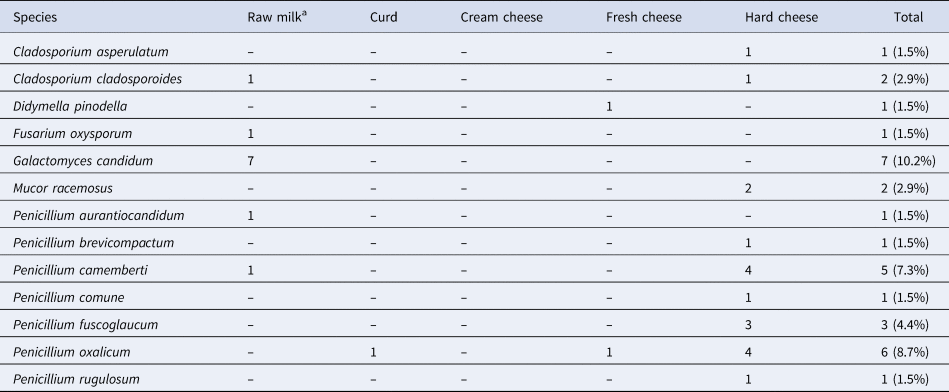
The presence of filamentous fungi (moulds) was detected in 25 out of 69 samples (36.2%) for a total of 32 isolates belonging to 6 genera (5 from Ascomycota phylum and 1 from Mucoromycotina subphylum) and 13 species. Among Ascomycota, Penicillium was the most frequently isolated genus (18 isolates, 26.1%; 6 P. oxalicum, 5 P. camemberti, 3 P. fuscoglaucum, 1 P. aurantiocandidum, 1 P. brevicompactum, 1 P. commune, 1 P. rugulosum) followed by Galactomyces (7 isolates, 10.2%; all isolates were identified as G. candidum) and Cladosporium (3 isolates, 4.4%; 2 C. cladosporoides and 1 C. asperulatum). Only 1 isolate (1.5%) was identified as Didymella pinodella and another 1 (1.5%) as Fusarium oxysporum. Penicillium specimen were isolated mainly from hard cheese (14 out of 18) while Galactomyces candidum was isolated only from milk samples. Among Mucoromycotina, the only species isolated was Mucor racemosus (2 isolates, 2.9%); both specimen were isolated from hard cheese (Table 1).
Diversity of moulds isolated from dairy products

a Raw milk samples were both bovine and ovine.
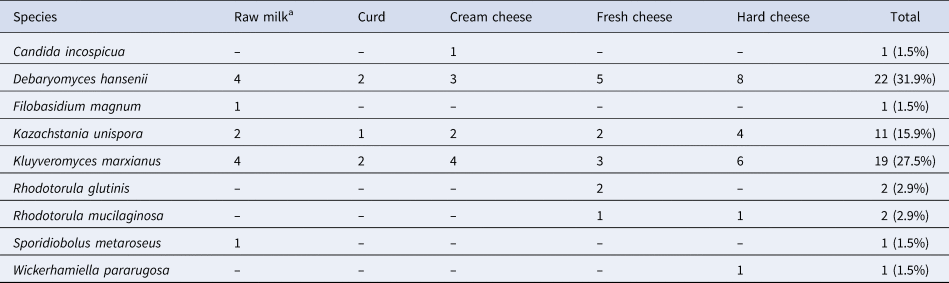
Yeasts were detected in 51 out of 69 samples (73.9%). Sixty isolates belonging to 8 genera (5 from Ascomycota phylum and 3 from Basidiomycota phylum) and 9 species. Among Ascomycota, Debaryomyces hansenii was the dominant species (22 isolates, 31.9%) followed by Kluyveromyces marxianus (19 isolates, 27.5%) and Kazachstania unispora (11 isolates, 15.9%). These three species were common in every category of dairy products analysed during this study. Only 1 isolate (1.5%) was identified as Candida incospicua and 1 other (1.5%) as Wickerhamiella pararugosa. Among Basidiomycota, the dominant genus was Rhodotorula (4 isolates, 2 R. glutinis and 2 R. mucilaginosa, 5.8%). The species Filobasidium magnum and Sporidiobolus metaroseus had 1 isolate each (1.5%) (Table 2).
Diversity of yeasts isolated from dairy products

a Raw milk samples were both bovine and ovine.
Discussion
These results highlighted a wide diversity of fungi in dairy products of central Italy, with a total of eleven different genera and twenty-two species. It is worth noticing the substantial difference between the fungal species isolated from raw milk samples and those isolated from dairy products obtained after pasteurisation. This is obviously linked to the heat treatment of the milk. Therefore, it appears safe to say that the majority of the species found in cheeses during this study came from the environment of the dairy plant as contaminants.
The Penicillium genus was found in the majority of product types analysed, representative of local production, and was very common in hard cheeses. P. brevicompactum has been reported not only as a major dairy product contaminant in southern Italy (Montagna et al., Reference Montagna, Santacroce, Spilotros, Napoli, Minervini, Papa and Dragoni2004) and Spain (Barrios et al., Reference Barrios, Medina, Lopez and Jordano1998), but also as the most common species isolated from the internal environment of three plants in Norway (Kure et al., Reference Kure, Skaar and Brendehaug2004). The presence of Penicillium species belonging to the Brevicompacta section is not surprising, considering the fact that they grow well at refrigerated temperatures and are often considered as the most xerophilic penicillia (Pitt and Hocking, Reference Pitt and Hocking2009). Species of Fasciculata section (e.g. P. commune) are well-known spoilage agents for dairy products (Pitt and Hocking, Reference Pitt and Hocking2009; Ledenbach and Marshall, Reference Ledenbach, Marshall, Sperber and Doyle2010). P. camemberti is used in the production of Camembert, Brie, Coulommiers and Cambozola cheeses, on which its colonies form a hard, white crust and are responsible for the typical taste. It is worth mentioning that the products analysed in this study are not produced with the addition of P. camemberti, so it can be considered as a contaminant. The prevalence of P. oxalicum reported in this study is similar to what is reported by Kandasamy et al. (Reference Kandasamy, Park, Yoo, Yun, Kang, Seol, Oh and Ham2020) in the Korean dairy product and plant environment. The species of the Galactomyces genus are spoilage fungi, often isolated from fresh dairy products (Banjara et al., Reference Banjara, Suhr and Hallen-Adams2015): they are well adapted to dairy matrices and are able to grow at refrigeration temperatures. In our study, all the G. candidium isolates came from raw milk samples.
Cladosporium and Didymella are two genera that have undergone major taxonomical changes in the last decade. Even though the presence of Cladosporium spp. was reported in various dairy products in the past, its identification was only based on phenotypic characteristics without species level being identified. Instead, in this study, a molecular approach allowed us to identify 2 Cladosporium species (C. alsperulatum and C. cladosporoides) from hard cheese and raw milk, respectively. Other authors noticed the Sphaerospermum complex from butter identifying it by molecular tools for the first time. The isolation of Didymella pinodella from fresh cheese in our study is worth mentioning because previously its presence was only reported in cream cheese (Garnier et al., Reference Garnier, Valence, Pawtowski, Auhustsinava-Galerne, Frotté, Baroncelli, Deniel, Coton and Mounier2017). Among Didymella spp., it is also worth mentioning that D. glomerata was shown to be responsible for the abnormal colouration of Mozzarella cheese and the necessity of a correct differential diagnosis with the alterations caused by Pseudomonas spp. (Cenci-Goga et al., Reference Cenci-Goga, Karama, Sechi, Iulietto, Novelli and Mattei2014). The genus Mucor includes many species of spoilage fungi: their presence was also reported in Taleggio cheese (Dragoni et al., Reference Dragoni, Papa and Vallone1997). In our study, M. racemosus was isolated from two samples of hard cheese.
Debaryomyces hansenii is one of the most common yeast species isolated from dairy products: it plays a major role in cheese ripening and in limiting the growth of spoiling bacteria (Cholet et al., Reference Cholet, Henaut, Casaregola and Bonnarme2007). This species is an important component in the production of many cheeses, in particular the Italian ‘Pecorino cheese’ (Del Bove et al., Reference Del Bove, Lattanzi, Rellini, Pelliccia, Fatichenti and Cardinali2009). In our study, D. hansenii was the most common species isolated, with a total of 22 specimen identified: 4 from raw milk, 2 from curd, 3 from cream cheese, 5 from fresh cheese and 8 from hard cheese. The other yeast species isolated in this study have previously been reported to spoil dairy products and are known to be well adapted to growing in dairy products (Garnier et al., Reference Garnier, Valence, Pawtowski, Auhustsinava-Galerne, Frotté, Baroncelli, Deniel, Coton and Mounier2017).
In conclusion, this study provides new and interesting information on the diversity of fungal species found in dairy products in Umbria, central Italy. Some of the yeast and mould species isolated during this study are part of the normal flora of milk and dairy products and have often been reported in similar studies in other parts of the world, while other species are able to cause spoilage of these products. This data is of great importance to develop new strategies to decrease the occurrence of fungal spoilage and/or control its growth in dairy products and thus reduce food waste and increase the quality and safety of these products.
Supplementary material
The supplementary material for this article can be found at https://doi.org/10.1017/S002202992100042X.