INTRODUCTION
The flagellated protozoan, Trichomonas gallinae, is the causative agent of avian trichomonosis (Stabler, Reference Stabler1954; Locke and James, Reference Locke and James1962). The parasite is globally distributed and infects the upper digestive tract of a wide range of bird species, including columbiformes, accipitriformes, strigiformes, psittaciformes and passeriformes (Forrester and Foster, Reference Forrester, Foster, Atkinson, Thomas and Hunter2008). Such infections of the upper digestive tract may lead to pathological changes ranging from mild inflammation of the mucosa to large caseous lesions that can obstruct the lumen of the oesophagus (Kocan and Herman, Reference Kocan, Herman, Davis, Anderson, Karstad and Trainer1971). Therefore, diseased wild birds frequently die due to starvation. However, avian T. gallinae infection can result in a broad spectrum of clinical presentations ranging from aclinical parasite carriage to lethal infection.
Typically, this disease is known as a cause of morbidity and mortality in columbiform species and birds of prey (Forrester and Foster, Reference Forrester, Foster, Atkinson, Thomas and Hunter2008). In recent years, trichomonosis was described as an emerging infectious disease of wild finches in Europe. The first appearance of the disease was recognized in 2005 in the UK with a late summer/autumn seasonal epidemic mortality of passerine hosts especially greenfinches Chloris chloris and chaffinches Fringilla coelebs (Pennycott et al. Reference Pennycott, Lawson, Cunningham, Simpson and Chantrey2005; Lawson et al. Reference Lawson, Cunningham, Chantrey, Hughes, Kirkwood, Pennycott and Simpson2006). In addition, trichomonosis was also diagnosed in a small number of other passerine birds including bullfinch Pyrrhula pyrrhula, goldfinch Carduelis carduelis, brambling Fringilla montifringilla, siskin Carduelis spinus, house sparrow Passer domesticus, yellowhammer Emberiza citronella, dunnock Prunella modularis and great tit Parus major (Robinson et al. Reference Robinson, Lawson, Toms, Peck, Kirkwood, Chantrey, Clatworthy, Evans, Hughes, Hutchinson, John, Pennycott, Perkins, Rowley, Simpson, Tyler and Cunningham2010). From April to September 2006, over 1000 finch trichomonosis incidents involving single or multiple individuals were recorded in the UK with the greatest incidence in western and central England and Wales (Robinson et al. Reference Robinson, Lawson, Toms, Peck, Kirkwood, Chantrey, Clatworthy, Evans, Hughes, Hutchinson, John, Pennycott, Perkins, Rowley, Simpson, Tyler and Cunningham2010). In 2007 there was a pronounced eastward shift in the spatial distribution of the disease within England which was followed by the spread of finch trichomonosis to southern Fennoscandia in the following year (Lawson et al. Reference Lawson, Robinson, Neimanis, Handeland, Isomursu, Agren, Hamnes, Tyler, Chantrey, Hughes, Pennycott, Simpson, John, Peck, Toms, Bennett, Kirkwood and Cunningham2011b ). During the second half of 2008, appearance of greenfinch and chaffinch mortality was reported in southern Fennoscandia with the index incident documented in Sweden, followed by Norway and Finland (Neimanis et al. Reference Neimanis, Handeland, Isomursu, Agren, Mattsson, Hamnes, Bergsjo and Hirvela-Koski2010). Large-scale greenfinch population declines have occurred as a result of this emerging infectious disease in the UK (Lawson et al. Reference Lawson, Robinson, Colvile, Peck, Chantrey, Pennycott, Simpson, Toms and Cunningham2012) and Finland (Lehikoinen et al. Reference Lehikoinen, Lehikoinen, Valkama, Väisänen and Isomursu2013). Furthermore, since April 2009 an increased incidence of greenfinch mortality due to finch trichomonosis was recognized in northern Germany (Peters et al. Reference Peters, Kilwinski, Reckling and Henning2009). Lawson et al. (Reference Lawson, Robinson, Neimanis, Handeland, Isomursu, Agren, Hamnes, Tyler, Chantrey, Hughes, Pennycott, Simpson, John, Peck, Toms, Bennett, Kirkwood and Cunningham2011b ) hypothesized that finch trichomonosis spread from the UK to Fennoscandia with seasonal migratory chaffinches. Ring return data show that chaffinches migrate directly from the UK to Fennoscandia across the North Sea in the spring (Norman, Reference Norman, Wenham, Toms, Marchant, Clark, Siriwardena and Baille2002). For their return migration route in autumn, chaffinches pass through Denmark, Germany, the Netherlands and Belgium, before they cross the English Channel (Norman, Reference Norman, Wenham, Toms, Marchant, Clark, Siriwardena and Baille2002). Therefore, the location and timing of the emergence of finch trichomonosis in northern Germany in 2009 is consistent with the hypothesized route of spread of the parasite mediated by chaffinch migration. In May 2010, finch trichomonosis was first diagnosed in France (Gourlay et al. Reference Gourlay, Decors, Jouet, Treilles, Lemberger, Faure, Moinet, Chi, Tyler, Cunningham and Lawson2011) and in summer 2012, the disease was first confirmed as a cause of finch mortality in Slovenia (Zadravec et al. Reference Zadravec, Marhold, Slavec, Rojs and Racnik2012). This further spread of the disease could also be associated with finch movement.
To diagnose T. gallinae as the causative agent of infection, and to determine the phylogenetic relationship amongst isolates, sequence analyses are commonly performed. Most investigations of sequence data are based on the ITS1-5.8S-ITS2 region and the 18S rRNA gene, which are used to discriminate T. gallinae from other trichomonads and to resolve certain lineages (Felleisen, Reference Felleisen1997; Kleina et al. Reference Kleina, Bettim-Bandinelli, Bonatto, Benchimol and Bogo2004; Gerhold et al. Reference Gerhold, Yabsley, Smith, Ostergaard, Mannan, Cann and Fischer2008; Sansano-Maestre et al. Reference Sansano-Maestre, Garijo-Toledo and Gomez-Munoz2009; Grabensteiner et al. Reference Grabensteiner, Bilic, Kolbe and Hess2010). Within phylogenetic analyses several genes encoding proteins such as glyceraldehyde-3-phosphate dehydrogenase, malate dehydrogenase, enolase, α- and β-tubulin have also been used to resolve the evolutionary relationships between different Trichomonadida (Viscogliosi and Müller, Reference Viscogliosi and Müller1998; Wu et al. Reference Wu, Fiser, ter, Sali and Muller1999; Gerbod et al. Reference Gerbod, Sanders, Moriya, Noel, Takasu, Fast, Delgado-Viscogliosi, Ohkuma, Kudo, Capron, Palmer, Keeling and Viscogliosi2004; Keeling, Reference Keeling2004; Gerhold et al. Reference Gerhold, Yabsley, Smith, Ostergaard, Mannan, Cann and Fischer2008). However, these genetic markers were insufficient to reliably resolve inter- and intraspecific relationships, because they underwent recombination, horizontal gene transfer or duplication (Viscogliosi and Müller, Reference Viscogliosi and Müller1998; Wu et al. Reference Wu, Fiser, ter, Sali and Muller1999; Gerbod et al. Reference Gerbod, Sanders, Moriya, Noel, Takasu, Fast, Delgado-Viscogliosi, Ohkuma, Kudo, Capron, Palmer, Keeling and Viscogliosi2004; Keeling, Reference Keeling2004; Stechmann et al. Reference Stechmann, Baumgartner, Silberman and Roger2006; Rogers et al. Reference Rogers, Watkins, Harper, Durnford, Gray and Keeling2007). For this reason, two single copy genes, rpb1 and Fe-hydrogenase, were established as novel genotyping markers (Malik et al. Reference Malik, Brochu, Bilic, Yuan, Hess, Logsdon and Carlton2011; Lawson et al. Reference Lawson, Cunningham, Chantrey, Hughes, John, Bunbury, Bell and Tyler2011a ). The rpb1 gene encodes for the largest subunit of the RNA Polymerase II, which carries out the transcription of all protein-coding genes in eukaryotes (Archambault and Friesen, Reference Archambault and Friesen1993; Cramer et al. Reference Cramer, Bushnell, Fu, Gnatt, Maier-Davis, Thompson, Burgess, Edwards, David and Kornberg2000). The hydrogenosomal Fe-hydrogenase gene belongs to the housekeeping genes of amitochondrial protozoa. The enzyme catalyses the activation of hydrogen and functions to either couple hydrogen oxidation to energy-yielding processes or reduces protons as a mechanism to recycle reduced electron carriers that accumulate during fermentation (Vignais and Billoud, Reference Vignais and Billoud2007). Phylogenetic analyses based on both single copy genes were recently applied and the rpb1 gene was used successfully to resolve species and isolate-level parabasilid relationships, including two T. gallinae isolates (Malik et al. Reference Malik, Brochu, Bilic, Yuan, Hess, Logsdon and Carlton2011). Sequence data of the Fe-hydrogenase gene were analysed from multiple T. gallinae isolates derived from British passeriformes, columbiformes, accipitriformes and strigiformes, demonstrating the potential for detecting fine-scale variation amongst T. gallinae strains (Chi et al. Reference Chi, Lawson, Durrant, Beckmann, John, Alrefaei, Kirkbride, Bell, Cunningham and Tyler2013).
Sequence analyses of T. gallinae isolates from finch trichomonosis cases based on the ITS1-5.8S-ITS2 and the 18S rRNA regions showed no variation between the British and the Fennoscandian parasite strains (Lawson et al. Reference Lawson, Robinson, Neimanis, Handeland, Isomursu, Agren, Hamnes, Tyler, Chantrey, Hughes, Pennycott, Simpson, John, Peck, Toms, Bennett, Kirkwood and Cunningham2011b ). Moreover, the comparison of sequence data obtained for the Fe-hydrogenase gene and the random amplified polymorphic DNA data confirmed the lack of sequence variation amongst a large number of British T. gallinae isolates from different passerine host species (Lawson et al. Reference Lawson, Cunningham, Chantrey, Hughes, John, Bunbury, Bell and Tyler2011a ). These results indicated that the British finch trichomonosis epidemic was caused by a clonal strain of the parasite (Lawson et al. Reference Lawson, Cunningham, Chantrey, Hughes, John, Bunbury, Bell and Tyler2011a ) and they supported the spread of the disease to southern Fennoscandia from the UK (Lawson et al. Reference Lawson, Robinson, Neimanis, Handeland, Isomursu, Agren, Hamnes, Tyler, Chantrey, Hughes, Pennycott, Simpson, John, Peck, Toms, Bennett, Kirkwood and Cunningham2011b ). Recently, Chi et al. (Reference Chi, Lawson, Durrant, Beckmann, John, Alrefaei, Kirkbride, Bell, Cunningham and Tyler2013) demonstrated that the finch epidemic strain of T. gallinae was preponderant amongst the British columbiformes and birds of prey which died between the years 2007 and 2012 and were examined. The application of the Fe-hydrogenase locus enabled identification of the wide strain diversity of the parasite in these wild bird groups.
In the present paper, we report for the first time the occurrence of finch trichomonosis in Austria, which emerged in summer 2012, accompanied by mortality predominant in greenfinches. The primary aims of the present study were to (i) investigate the genetic heterogeneity within T. gallinae isolates from incidents in Austria and Slovenia, where the disease occurred recently, and (ii) to establish whether these T. gallinae isolates were identical to those from Britain where finch trichomonosis first emerged. In order to address these questions, comparative analyses of T. gallinae isolates were performed using four different genetic markers which comprised the ITS1-5.8S-ITS2 region, the 18S rRNA gene, the rpb1 gene and the Fe-hydrogenase gene.
MATERIALS AND METHODS
Source of protozoa
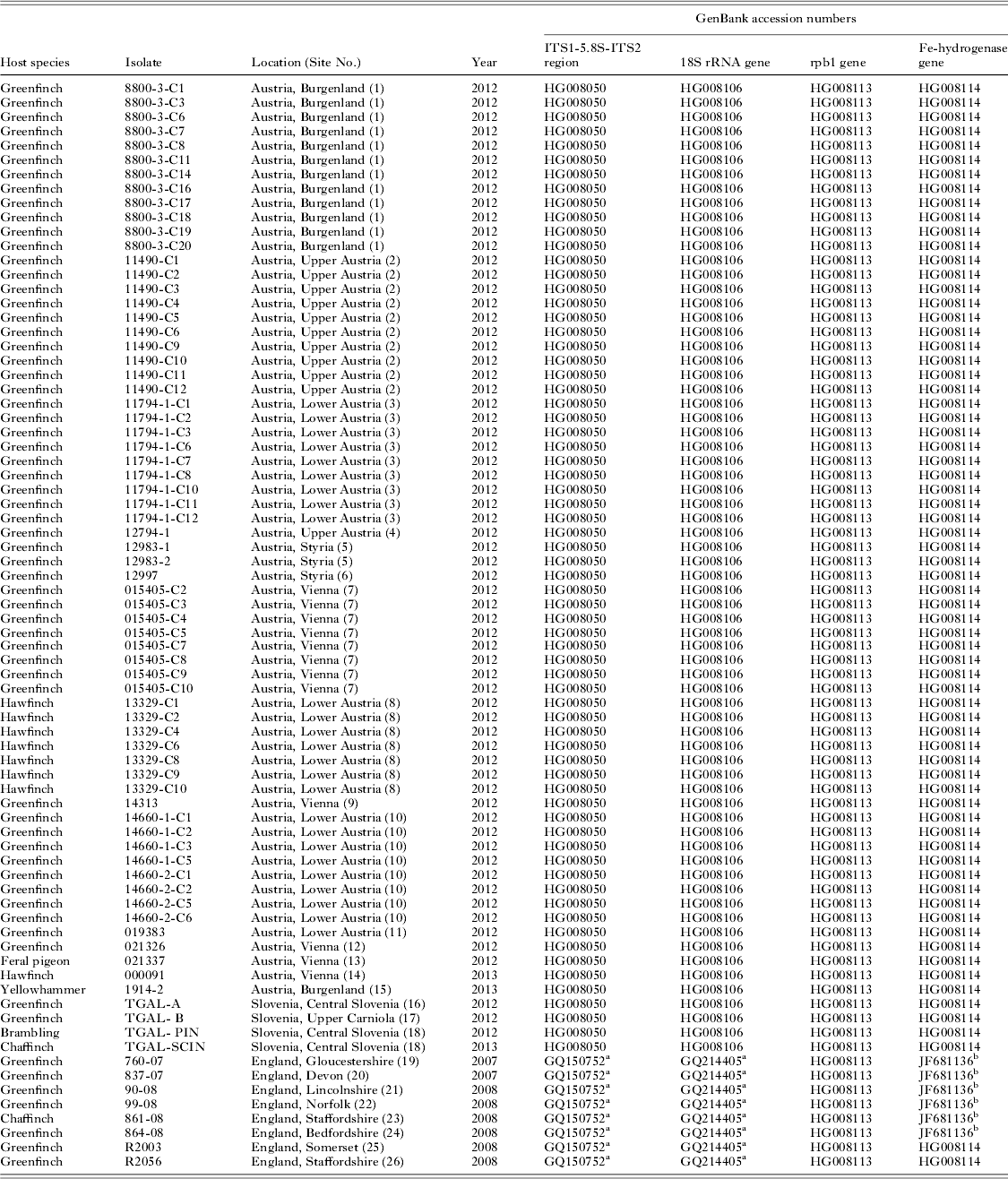
A total of 29 trichomonad isolates obtained from wild birds of six different species from 26 sites, and 15 counties were investigated in the present study. A detailed list of the isolates is displayed in Table 1. All 17 protozoan isolates originating from Austria were cultured post-mortem in the years 2012 and 2013 from the oropharynx of 13 greenfinches, two hawfinches Coccothraustes coccothraustes, one feral pigeon Columba livia and one yellowhammer. Post-mortem examination detected crop and/or oesophageal lesions that were typical of finch trichomonosis in these birds.
List of trichomonads investigated in the present study. Clonal cultures of protozoan isolates are labelled with C

a Published (Robinson et al. Reference Robinson, Lawson, Toms, Peck, Kirkwood, Chantrey, Clatworthy, Evans, Hughes, Hutchinson, John, Pennycott, Perkins, Rowley, Simpson, Tyler and Cunningham2010).
b Published (Lawson et al. Reference Lawson, Cunningham, Chantrey, Hughes, John, Bunbury, Bell and Tyler2011a ).
The four trichomonad isolates from Slovenia obtained from two greenfinch carcasses with upper alimentary tract lesions that were examined post-mortem and two live wild birds caught in mist nets, one brambling and one chaffinch, were received as in vitro cultures of the parasite. Live bird sampling in Slovenia was performed with permission from the Slovenian Environment Agency, Ministry of Agriculture and Environment, Republic of Slovenia (permit number 35601-125/2009-8).
The eight isolates from the UK obtained from seven greenfinches and one chaffinch were received as extracted DNA solutions. The British isolates were selected from 2007 and 2008, around the period of hypothesized spread from eastern England to Fennoscandia.
The clonal isolate T. gallinae/Budgerigar/Austria/5895-C1/06 (Grabensteiner et al. Reference Grabensteiner, Bilic, Kolbe and Hess2010) was also included in the study.
In vitro cultivation
Cultures of the Austrian T. gallinae isolates were established from oesophagus and/or crop lesions collected at post-mortem examination from birds with confirmed trichomonosis. The material was placed in 9 mL of Medium 199 containing Earle's salts, L-glutamine, 25 mm HEPES and L-amino acids (Gibco™, Invitrogen, Vienna, Austria). In addition, 15% heat-inactivated FBS (Gibco™, Invitrogen, Vienna, Austria) and 0·22% rice starch (Sigma–Aldrich, Vienna, Austria) were added. Following incubation at 40 °C, growth of trichomonads was monitored daily by light microscopy. Parasites were sub-cultured every 2–3 days of incubation by transferring 1 mL of culture into a new sterile 50 mL tube (Sarstedt, Wiener Neudorf, Austria) containing 9 mL of fresh medium before aliquots were collected for further analyses. For seven protozoan isolates (Table 1) clonal cultures were established by micromanipulation and in vitro propagation as previously described (Hess et al. Reference Hess, Kolbe, Grabensteiner and Prosl2006). If clonal cultures were available, they were used for further investigations. All of the progenitor and clonal cultures were cryo-preserved at −150 °C by adding 5% dimethylsulphoxide.
In vitro cultures of the Slovenian T. gallinae isolates were obtained primarily from swab samples taken from the crop and oesophagus of fresh passerine carcasses of two greenfinches and live apparently healthy birds. In total 18 live birds, 11 chaffinches, one greenfinch, one brambling, two great tits, two blue tits Cyanistes caeruleus and one robin Erithacus rubecula were caught in mist nests in November and December 2012 in Vrhnika, Slovenia and sampled for detection of T. gallinae. Growth of the parasite in culture medium was only detected in the samples taken from the two greenfinch carcasses and two live birds, one brambling and one chaffinch. The brambling was in good body condition and apparently healthy. Contrary to this, the chaffinch was in poor body condition, displayed severe neck distension consistent with necrotic ingluvitis and/or food impaction and died shortly after capture, which was congruent with finch trichomonosis. All isolates were cultivated in Diamond's media. The medium contained the following: 80 mg of K2HPO4 and 80 mg of KH2PO4 (Kemika, Zagreb, Croatia), 2 g of trypticase peptone and 1 g of yeast extract (BD, Heidelberg, Germany), 0·5 g of maltose (Merck, Ljubljana, Slovenia), 100 mg of L-cysteine hydrochloride (Sigma-Aldrich, Maribor, Slovenia), 20 mg of L-ascorbic acid (Kemika, Zagreb, Croatia) and 50 mg agar (Biolife, Ljubljana, Slovenia) per 90 mL of distilled water. After sterilization for 10 min at 121 °C, 10 mL heat-inactivated lamb serum (homemade), 100 000 units of crystalline penicillin C (Sigma-Aldrich, Maribor, Slovenia) and 100 mg of streptomycin sulphate (Pliva, Zagreb, Slovenia) were added to the medium. The presence of motile parasites was determined by light microscopy. After receiving the cultures at the clinic in Vienna, Austria, the protozoan cells were transferred to Medium 199 containing FBS and rice starch and were incubated at 40 °C. Following a few passages of the parasites to fresh medium, aliquots were collected for the further investigations.
For the establishment of protozoan cultures from British cases oesophageal lesions obtained from post-mortem examinations were incubated at 30 °C in Trichomonas Media No. 2 (Oxoid, UK) and screened for motile trichomonads at 48, 72 h and 5 days using light microscopy (Robinson et al. Reference Robinson, Lawson, Toms, Peck, Kirkwood, Chantrey, Clatworthy, Evans, Hughes, Hutchinson, John, Pennycott, Perkins, Rowley, Simpson, Tyler and Cunningham2010).
PCR amplification, sequencing and sequence analyses
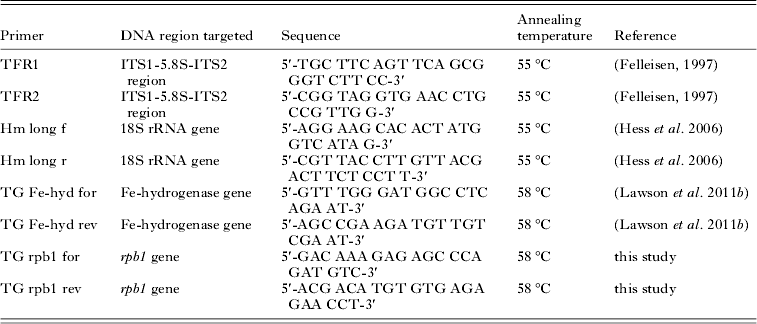
For DNA extraction, 1 mL of progenitor or clonal cultures from Austrian and Slovenian isolates was used. The samples were centrifuged at 500 g for 5 min and after removing the supernatant the pellets were frozen at −20 °C. DNA was extracted using the DNeasy® Blood and Tissue Kit (Qiagen, Hilden, Germany) according to the manufacturer's instructions. For the British isolates extraction of DNA from trichomonad cultures was performed using the Biosprint 15 DNA Blood Kit (Qiagen, UK) for purification of DNA from tissue (Robinson et al. Reference Robinson, Lawson, Toms, Peck, Kirkwood, Chantrey, Clatworthy, Evans, Hughes, Hutchinson, John, Pennycott, Perkins, Rowley, Simpson, Tyler and Cunningham2010). Specific primer pairs were used for PCRs to amplify the following four different genomic regions of the parasite: the ITS1-5.8S-ITS2 region, the 18S rRNA gene, the rpb1 gene and the Fe-hydrogenase gene (Table 2). Amplifications were carried out in 25 μL reaction mixtures employing the HotStarTaq Master Mix Kit (Qiagen, Hilden, Germany). A reaction mixture consisted of 12·5 μL of HotStarTaq Master Mix, 8 μL of distilled water, 1 μL of forward primer, 1 μL of reverse primer (all primers were used at concentrations of 10 pmol μL−1) and 2·5 μL of DNA template. After the initial denaturation step at 95 °C for 15 min, the reaction mixtures were subjected to 40 cycles of heat denaturation at 94 °C for 30 s, primer annealing at 55 or 58 °C for 1 min (Table 2) and DNA elongation at 72 °C for 2 min, followed by the final elongation step at 72 °C for 10 min.
List of primers used for amplification

The PCR products were visualized using agarose gel electrophoresis. PCR products of the expected sizes (approximately 350 bp for the ITS1-5.8S-ITS2 region, 1·5 kb for the 18S rRNA gene, 1·5 kb for the rpb1 gene and 1 kb for the Fe-hydrogenase gene) were excised from the agarose gel and purified using the QIAquick gel extraction kit® (Qiagen, Hilden, Germany) according to the manufacturer's instructions. Sequencing service was provided by LGC Genomics (Berlin, Germany). All PCR amplification products were sequenced in both directions. Sequence alignments were carried out by Accelrys Gene version 2.5 (Accelrys, San Diego, CA) software. In order to find identical GenBank database entries the BLAST search algorithm was performed with nucleotide sequences of the newly sequenced loci.
RESULTS
A total of 21 trichomonad isolates from Austria and Slovenia were obtained from five different passerine and one columbiform species (Table 1). For seven of the 21 isolates clonal cultures were established. The sequence data obtained for the ITS1-5.8S-ITS2 region, the 18S rRNA region, the rpb1 gene and the Fe-hydrogenase gene were used for comparative analyses. Identical nucleotide sequences of the four analysed genomic regions were identified for trichomonad isolates, including the clonal cultures, from all of the Austrian and Slovenian T. gallinae infections regardless of host species and geographical region. The lengths of the identical consensus sequences were 271 bp for the ITS1-5.8S-ITS2 region (HG008050), 1378 bp for the 18S rRNA gene (HG008106), 1356 bp for the rpb1 gene (HG008113) and 910 bp for the Fe-hydrogenase gene (HG008114). No multiple parasite strain concurrence within an individual host was observed in the seven trichomonosis cases from which clonal cultures were established.
Investigation of the genetic relationship between the trichomonad isolates from Austria and Slovenia with the ones collected from British finches was performed. For this purpose partial sequences of the rpb1 gene of eight selected T. gallinae isolates from British finches were examined in this study. In addition, the Fe-hydrogenase gene was amplified and sequenced from two of these British isolates for which the data were not yet available. Comparison of the consensus sequences for the ITS1-5.8S-ITS2 region (HG008050) and the 18S rRNA gene (HG008106) with the sequences GQ150752, GQ150753 and GQ214405 (Robinson et al. Reference Robinson, Lawson, Toms, Peck, Kirkwood, Chantrey, Clatworthy, Evans, Hughes, Hutchinson, John, Pennycott, Perkins, Rowley, Simpson, Tyler and Cunningham2010) obtained from the British trichomonad isolates showed no sequence variation. No sequence variation was detected amongst the Austrian, Slovenian and British parasite isolates based on the Fe-hydrogenase gene (JF681136 (Lawson et al. Reference Lawson, Robinson, Neimanis, Handeland, Isomursu, Agren, Hamnes, Tyler, Chantrey, Hughes, Pennycott, Simpson, John, Peck, Toms, Bennett, Kirkwood and Cunningham2011b ) and HG008114). Comparison of the newly determined sequences from this study based on the rpb1 gene (HG008113) revealed 100% sequence identity for all examined T. gallinae isolates from Austria, Slovenia and the UK.
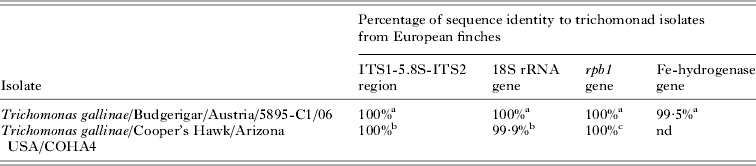
Performing BLAST search algorithm on the ITS1-5.8S-ITS2 region (HG008050) and the 18S rRNA gene (HG008106) sequences obtained from the finch-trichomonad isolates resulted in many GenBank entries with 100% sequence identity. However, identical sequences for both loci were detected in several clonal T. gallinae isolates from budgerigar Melopsittacus undulatus and chicken Gallus gallus (FN433476 and FN433484; Grabensteiner et al. Reference Grabensteiner, Bilic, Kolbe and Hess2010). In order to compare these isolates and the finch-trichomonad strain the loci rpb1 and Fe-hydrogenase were analysed for one of those, T. gallinae/Budgerigar/Austria/5895-C1/06. No sequence variation was found in the rpb1 gene between the finch-trichomonad isolates and the isolate 5895-C1 (Table 3). However, the comparison of the sequence for the Fe-hydrogenase gene of the isolate 5895-C1 (HG008115) showed only 99·5% identity to the consensus finch-trichomonad sequence (HG008114). Interestingly, the Fe-hydrogenase sequence for 5895-C1 demonstrated 100% identity to the sequence JF681141 obtained for a T. gallinae isolate from a Madagascar turtle-dove Streptopelia picturata from Mahé, Seychelles (Lawson et al. Reference Lawson, Cunningham, Chantrey, Hughes, John, Bunbury, Bell and Tyler2011a ) and to the isolate obtained from a Scottish budgerigar B306472 (Chi et al. Reference Chi, Lawson, Durrant, Beckmann, John, Alrefaei, Kirkbride, Bell, Cunningham and Tyler2013). Another interesting isolate, Cooper's hawk 4 (Accipiter cooperii) from Arizona, USA, demonstrated identical sequences for two typing loci. The ITS1-5.8S-ITS2 region (EU215369; Gerhold et al. Reference Gerhold, Yabsley, Smith, Ostergaard, Mannan, Cann and Fischer2008) and the rpb1 gene (HM016230; Malik et al. Reference Malik, Brochu, Bilic, Yuan, Hess, Logsdon and Carlton2011) demonstrated 100% identity to the sequences determined for finch-trichomonad isolates (HG008050 and HG008114, respectively) (Table 3). However, when the finch-trichomonad sequence of the 18S rRNA gene (HG008106) was compared with the GenBank entry for this isolate (EU215372; Gerhold et al. Reference Gerhold, Yabsley, Smith, Ostergaard, Mannan, Cann and Fischer2008), two single nucleotide polymorphisms (SNPs) were identified (Table 3). No Fe-hydrogenase sequence data are available for this isolate.
Percentage of sequence identity between the trichomonad isolates from European finches and Trichomonas gallinae/Budgerigar/Austria/5895-C1/06 and Trichomonas gallinae/Cooper's hawk/Arizona USA/COHA4

nd stands for not determined.
a This study.
b Published (Gerhold et al. Reference Gerhold, Yabsley, Smith, Ostergaard, Mannan, Cann and Fischer2008).
c Published (Malik et al. Reference Malik, Brochu, Bilic, Yuan, Hess, Logsdon and Carlton2011).
DISCUSSION
Here we report for the first time the occurrence of finch trichomonosis in Austria which emerged in summer 2012. Subsequent to this further geographical spread of the disease, the genetic heterogeneity amongst T. gallinae isolates collected from finch trichomonosis incidents in Austria and Slovenia and their genetic relationship with British isolates was investigated. The analyses were based on the following four different genomic regions: the ITS1-5.8S-ITS2, 18S rRNA gene, the rpb1 gene and the Fe-hydrogenase gene. Comparison of sequence data obtained for the four genomic loci displayed no sequence variation between all tested Austrian and Slovenian isolates. Moreover, 100% identity was found between the newly determined sequences and the ones obtained from finch trichomonosis cases in the UK. The Austrian and Slovenian isolates also showed 100% sequence identity to the Fennoscandian finch-trichomonad isolates at the ITS1-5.8S-ITS2 region and the 18S rRNA gene (Robinson et al. Reference Robinson, Lawson, Toms, Peck, Kirkwood, Chantrey, Clatworthy, Evans, Hughes, Hutchinson, John, Pennycott, Perkins, Rowley, Simpson, Tyler and Cunningham2010; Lawson et al. Reference Lawson, Cunningham, Chantrey, Hughes, John, Bunbury, Bell and Tyler2011a , Reference Lawson, Robinson, Neimanis, Handeland, Isomursu, Agren, Hamnes, Tyler, Chantrey, Hughes, Pennycott, Simpson, John, Peck, Toms, Bennett, Kirkwood and Cunningham b ). This result corroborates the hypothesis of Lawson et al. (Reference Lawson, Cunningham, Chantrey, Hughes, John, Bunbury, Bell and Tyler2011a ) that one clonal strain of T. gallinae is the causative agent of the emerging infectious disease within passerine birds in Europe. It also underlines the continuing dissemination of this parasite strain within Europe.
Analyses of the newly obtained sequences indicated that several earlier reported T. gallinae isolates might be the same strain as that which caused the finch trichomonosis epidemic, since sequences of two loci, the ITS1-5.8S-ITS2 region and the 18S rRNA gene, showed 100% identity. Most of these isolates were from budgerigars and another was isolated from a chicken (Grabensteiner et al. Reference Grabensteiner, Bilic, Kolbe and Hess2010). To clarify this observation, two additional loci, the rpb1 and the Fe-hydrogenase genes, were analysed for one of these isolates, T. gallinae/Budgerigar/Austria/5895-C1/06. The sequences for the rpb1 gene were fully identical, whereas a variation of five SNPs was found in the sequences for the Fe-hydrogenase gene. Although clinical signs of infection with the finch-trichomonad strain (Lawson et al. Reference Lawson, Robinson, Neimanis, Handeland, Isomursu, Agren, Hamnes, Tyler, Chantrey, Hughes, Pennycott, Simpson, John, Peck, Toms, Bennett, Kirkwood and Cunningham2011b ) and experimental data from in vitro studies with the trichomonad isolate 5895-C1 (Amin et al. Reference Amin, Bilic, Berger and Hess2012a , Reference Amin, Nobauer, Patzl, Berger, Hess and Bilic b ) indicate high pathogenicity for both isolates, it is clear from the Fe-hydrogenase sequence data that these parasite strains are related but not the same. Similarly, the comparative analyses of sequences between the finch-trichomonad isolates and the available sequence data for the isolate Cooper's hawk 4 (Gerhold et al. Reference Gerhold, Yabsley, Smith, Ostergaard, Mannan, Cann and Fischer2008; Malik et al. Reference Malik, Brochu, Bilic, Yuan, Hess, Logsdon and Carlton2011) demonstrated that the only difference between these two isolates was detected in the 18S rRNA gene. Collectively, these findings indicate the necessity of multi-locus sequence analysis when characterizing T. gallinae isolates.
Interestingly, the Fe-hydrogenase sequence determined for isolate 5895-C1 (HG008115) displayed 100% identity to the sequence JF681141 obtained for a trichomonad isolate from a Madagascar turtle-dove from Mahé, Seychelles (Lawson et al. Reference Lawson, Cunningham, Chantrey, Hughes, John, Bunbury, Bell and Tyler2011a ; Chi et al. Reference Chi, Lawson, Durrant, Beckmann, John, Alrefaei, Kirkbride, Bell, Cunningham and Tyler2013). The sequence data from 5895-C1 also shared 100% identity with a captive Scottish budgerigar (B306472; Chi et al. Reference Chi, Lawson, Durrant, Beckmann, John, Alrefaei, Kirkbride, Bell, Cunningham and Tyler2013), implying that this might be the preponderant circulating strain in European budgerigars. This is supported by the observation that all trichomonads from eight budgerigars in the Grabensteiner et al. (Reference Grabensteiner, Bilic, Kolbe and Hess2010) study seemed to be the same strain based on the two loci, ITS1-5.8S-ITS2 region and 18S rRNA gene. However, to investigate this hypothesis, further analyses using more isolates and multi-locus sequence analysis are required.
Finch trichomonosis is an emerging infectious disease now established across several western European countries. Besides chaffinches (Lawson et al. Reference Lawson, Robinson, Neimanis, Handeland, Isomursu, Agren, Hamnes, Tyler, Chantrey, Hughes, Pennycott, Simpson, John, Peck, Toms, Bennett, Kirkwood and Cunningham2011b ) and possible other passerine birds, which are hosts of the parasite, it is conceivable that columbiform species may also function as carriers of the finch epidemic T. gallinae strain. Chi et al. (Reference Chi, Lawson, Durrant, Beckmann, John, Alrefaei, Kirkbride, Bell, Cunningham and Tyler2013) found that whilst sequence diversity exists amongst T. gallinae isolates from British columbiformes, the finch epidemic strain of T. gallinae was predominant. Importantly, the one feral pigeon from Austria, investigated in the present study, was also shown to be infected by the same strain which supports the hypothesis for parasite transmission between columbid and passerine populations, perhaps at shared food and water sources. This is not surprising since amongst columbiformes, C. livia is considered the primary reservoir of T. gallinae (Stabler, Reference Stabler1954; Bondurant and Honigberg, Reference Bondurant, Honigberg and Kreier1994). Some pigeons and doves are able to develop an immunity preventing harmful effects of virulent strains which may result in aclinical parasite carriage. Therefore, they act as reservoir hosts and can transmit the parasite to other birds (Kocan and Herman, Reference Kocan, Herman, Davis, Anderson, Karstad and Trainer1971).
Although natural lethal infections of T. gallinae in passerine birds have not been frequently reported, localized outbreaks have been described in North America. In 2002, there was an outbreak of trichomonosis in Kentucky, USA, that involved approximately 200 wild house finches Carpodacus mexicanus and house sparrows (NWHC, 2002). Furthermore, an increased mortality of purple finches Carpodacus purpureus and American goldfinches Carduelis tristis due to trichomonosis was reported in the Canadian Maritime provinces (Nova Scotia, New Brunswick and Prince Edward Island) in 2007 and 2008 (Forzan et al. Reference Forzan, Vanderstichel, Melekhovets and McBurney2010). Due to the lack of sequence data of T. gallinae isolates from these outbreaks, no further comparison with the European finch trichomonosis epidemic strain could be made.
From 2001 to 2005, at the wildlife rehabilitation hospital at the Lindsay Wildlife Museum in Walnut Creek, CA, USA, several passerine birds including house finches, scrub jays Aphelocoma californica, crows Corvus brachyrhynchos and ravens Corvurs corax were screened for T. gallinae infection using wet mount preparations (Anderson et al. Reference Anderson, Grahn, Van Hoosear and Bondurant2009). Sequence data of these parasite isolates based on the ITS1-5.8S-ITS2 region were identical to each other and to the European isolates collected from finch trichomonosis cases, however sequence data from other loci are not available for comparison.
From the present study it can be concluded that a single clonal strain of the parasite T. gallinae is the causative agent of the emerging infectious disease within passerine birds in Europe. The disease is continuing to spread southwards on the continent most likely mediated by bird migration. The strain retains infectivity to both passerine and columbiform species and it is likely that it can be transmitted between these populations. Furthermore, all the reports of trichomonosis outbreaks for which T. gallinae isolates show a 100% ITS1-5.8S-ITS2 sequence identity to the European wild finch isolates may hint to a wider distribution of this virulent parasitic strain. However, the results of the present work showed evidently that the resolution of the ITS1-5.8S-ITS2 region is insufficient to identify trichomonad strains and multi-locus analysis such as that performed in this study is therefore necessary to confirm the finch-trichomonad strain as the aetiological agent of any other outbreak of avian trichomonosis. Some of the sequence loci used in the present study, such as Fe-hydrogenase and 18S rRNA, already showed good typing potential for T. gallinae isolates, whereas this still needs further evaluation for the rpb1 gene. In future, complete genome analyses may offer the gold standard for strain differentiation, but at the moment this remains expensive, time consuming and requires extensive interpretation. Therefore, effort should be focused to improve multi-locus approaches by further defining those loci that facilitate best resolution between T. gallinae strains.
ACKNOWLEDGEMENTS
The authors thank Mag. Rene Brunthaler, Institute of Pathology and Forensic Veterinary Medicine, University of Veterinary Medicine Vienna, Austria, for supplying tissue material from diseased birds; Dr Salome Troxler, Clinic for Avian, Reptile and Fish Medicine, University of Veterinary Medicine Vienna, Austria, for post-mortem examinations; Dr Dieter Liebhart, Clinic for Avian, Reptile and Fish Medicine, University of Veterinary Medicine Vienna, Austria, for establishment of clonal cultures; Dr Joško Račnik and Dr Igor Gruntar, Veterinary Faculty, University of Ljubljana; SLO, for their help to obtain isolates from Slovenia; Shinto John, Institute of Zoology (IoZ), UK, for assistance with parasite culture from British finches; members of the British public and participants in the British Trust for Ornithology Garden BirdWatch scheme for assistance with reporting of garden bird mortality incidents and submission of birds for examination; and Dr Kevin Tyler, University of East Anglia, UK, for his constructive comments on earlier drafts of this manuscript.
FINANCIAL SUPPORT
The Garden Bird Health initiative in the UK was supported by the British Veterinary Association Animal Welfare Foundation, CJ Wildbird Foods Ltd, Cranswick Pet Products, Defra, Gardman Ltd, RSPB, The Birdcare Standards Association, and the Universities Federation for Animal Welfare.