Flexible bronchoscopes are semicritical devices that come in contact with mucous membranes and are essential for diagnostic and therapeutic procedures. Flexible bronchoscopes are used to visualize the nasal passages, vocal cords, tracheal bronchial tree and lungs. Between uses, these thermosensitive devices must be thoroughly cleaned followed by high-level disinfection. Reference Spaulding1 The reprocessing can be done manually by scrupulously following specific steps. The use of automatic endoscope reprocessors (AERs) and/or washer-disinfectors can simplify the decontamination procedure. Several professional associations have developed guidelines on the correct reprocessing of bronchoscopes. 2–Reference Latta7 However, bronchoscopes are sophisticated tools that are difficult to disinfect on a routine basis. Thus, damaged and contaminated bronchoscopes are often used, even when high-level disinfection protocols are followed. Reference Ofstead, Quick and Wetzler8 In the literature, rates of contamination following microbiological testing can vary from 6% to 26.3%. Reference Marino, Grieco and Moscato9–Reference Saliou, Garlantézec and Baron11
Recent published studies have shown that nosocomial infections have occurred from contaminated bronchoscopes. Also, several outbreaks or pseudo-outbreaks due to flexible bronchoscopes have been described, especially in intensive care units. Reference Waite, Georgiou, Abrishami and Beck12 Many of these outbreaks were related to Pseudomonas aeruginosa. Transmissions of other pathogens have been identified, including Stenotrophomonas maltophilia, Mycobacterium tuberculosis, Klebsiella pneumoniae and Serratia marcescens. Reference Kovaleva, Peters, van der Mei and Degener13–Reference Botana-Rial, Leiro-Fernández and Núñez-Delgado17 More disturbing is that these outbreaks are sometimes linked to highly resistant bacteria such as carbapenem-resistant Enterobacteriaceae (CRE) or carbapenem-resistant P. aeruginosa. Reference Galdys, Marsh and Delgado18 However, recognition of endoscopy-associated transmission remains difficult in routine and needs genetic testing technology to identify particular strains implicated in outbreaks.
Surveillance cultures of endoscopes and using a automatic endoscope washer-disinfector are good ways to assess the effectiveness of disinfection despite the high cost. Reference Ofstead, Doyle and Eiland19–Reference Xia, Lu and Zhao23 Thus, many French, European and Australian guidelines recommend surveillance cultures for quality assurance. Reference Beilenhoff, Neumann and Rey24,25 However, this method is not unanimously accepted, and guidelines from learned societies of the United Kingdom, the United States, and Canada do not recommend it. 4,Reference Latta7,Reference Du Rand, Blaikley and Booton26
Hygiene teams can also practice regular audits of disinfection procedures to assess compliance with protocols. Regular audits allow continuous improvement of the quality of disinfection. The errors observed are reported to the teams, which makes it possible to correct the discrepancies. Audits and microbiological cultures are recommended by French authorities to improve reprocessing of endoscopes.
We evaluated the impact of routine microbiological surveillance testing and audit practice on bronchoscope contamination rates.
Methods
This prospective study was undertaken from January 2007 to June 2020 at the Brest hospital, a 2,800-bed teaching facility in France. We reviewed the evolution of contamination rates of flexible bronchoscopes, endobronchial ultrasound bronchoscopes, video-bronchoscopes and AERs. We also evaluated the efficacy of audits of decontamination and disinfection procedures to improve contamination rates.
Bronchoscope reprocessing cycle
At Brest teaching hospital, bronchoscopes are cleaned manually immediately after an examination with a peracetic acid-based detergent disinfectant. Bronchoscopes undergo manual high-level disinfection or disinfection in an automatic endoscope reprocessor (Soluscope AER, Aubagne, France). If high-level disinfection is used, the bronchoscopes are rinsed with filtered water. They are then dried and stored in a sterile field. If time of storage is >12 hours, bronchoscopes must undergo a new disinfection before use. Bronchoscope reprocessing is done in unit where it is used, in the pneumology unit, in an operating room, or in an intensive care unit.
Bronchoscope and automatic endoscope reprocessor microbiological surveillance
Bronchoscope and AER microbiological surveillance testing were conducted once per week by well-trained technicians of the microbiology laboratory during the study period. The sampling and microbial culture protocols were based on the French national recommendations. 27 This included all routine microbiological testing performed: routine testing (once per year per bronchoscope), after maintenance, retesting controls after a previous contaminated test, and on all new bronchoscopes. The sampling was done using neutralizing pharmacopoeia diluent (NPD) buffer with sodium thiosulfate (AES Laboratoire, Combourg, France). Results were interpreted according to the National Technical Committee on Nosocomial Infection guideline (Table 1). When the action or alert level were reached, disinfection was considered as ineffective, and bronchoscope was subjected to a double manual reprocessing before being retested.
Interpretation Criteria of Microbiological Testing for Bronchoscopes

Note. CFU, colony-forming units.
a Main indicator microorganisms: Staphylococus aureus, Enterobacteriaceae, Pseudomonas aeruginosa and other Pseudomonas spp, Stenotrophomonas altophilia, Acinetobacter spp and Candida spp.
Microbiological surveillance of automatic endoscope reprocessor are also performed once each year for quality assurance. Total flora must be ≤1 colony-forming unit (CFU)/100 mL without Pseudomonas spp.
Audit of disinfection practices
The disinfection process was regularly evaluated by the hospital hygiene team, which is also responsible for training professionals. They used an audit grid that assesses all the stages in the treatment of bronchoscopes: pretreatment, transport, manual leak testing, brushing and swabbing, manual disinfection or in an automatic washer-disinfector, drying, storage, and step traceability. The expiration and proper use of detergent disinfectant products are also checked. A risk assessment inspection was done every 2 years to evaluate the respect of hygiene precautions.
Statistical analysis
We conducted statistical analyses using R software version 3.5.3 (R Core Team, R Foundation for Statistical Computing, Vienna, Austria). Rates of contamination were calculated per year, and we used a Poisson regression model to study their evolution.
We assessed the risk factors for microbiological contamination using a multivariable logistic regression model. We first included in a univariate model, variables described as risk factors for contamination in the literature Reference Gabard, Borderan and Chevrie28,Reference Saliou, Cholet, Jézéquel, Robaszkiewicz, Le Bars and Baron29 : the reason of testing (routine testing, after maintenance, routine retesting control, new bronchoscope), process of disinfection (manual or automatic endoscope washer-disinfector), the brand of bronchoscopes (Pentax vs others), the user service (pneumology unit vs others), and age of bronchoscopes. Variables with a P value < .20 were included in the multivariable logistic regression model. All tests were 2-sided, and P < .05 was considered significant. Adjusted odds ratios with their 95% confidence intervals (CIs) are presented.
Results
Between 2007 and 2020, 91 different bronchoscopes were tested: 75 flexible bronchoscopes, 8 echo-bronchoscopes and 8 video-bronchoscopes. In total, 478 microbiological surveillance tests were conducted. Of these, 74 tests (15.5%) showed that high-level disinfection of bronchoscopes was not reached. However, the rate of contamination significantly decreased over the testing period, varying from 30.2 to 0% (P < .0001). Characteristics of bronchoscopes along with microbiological test results are presented in Table 2. When routine microbiological testing failed to reach the target level, a second microbiology sample was taken after the second manual reprocessing of the bronchoscope. Univariate analysis found that routine retesting of bronchoscopes was significantly associated with higher risk of contamination (OR, 4.16; 95% CI, 2.04–8.47; P < .0001). The results of logistic regression analyses are presented in Table 3.
Characteristics of Samples According to Levels of Contamination

Note. AER, automatic endoscope reprocessor.
a Routine testing: microbiological testing of every bronchoscope is made at least once per year.
b After maintenance: bronchoscope returned from manufacturers after repair are systematically tested.
c Routine retesting: when microbiological routine testing failed to comply with the target level, a second test is done after double manual reprocessing of the bronchoscope.
d New bronchoscope: every new bronchoscope is systematically tested before use.
e Bronchoscopes packaged in a sterile field and stored horizontally in dedicated boxes.
Results of Logistic Regression Analysis Testing the Association Between Bronchoscopes’ Characteristics and Microbiological Contamination

Note. OR, odds ratio; CI, confidence interval; AER, automatic endoscope reprocessor.
a Routine testing: microbiological testing of every bronchoscope is made at least once per year
b After maintenance: bronchoscopes returned back from manufacturers are systematically tested.
c Routine retesting: when microbiological routine testing failed to comply with the target level, a second test is done after double manual reprocessing of the bronchoscope.
d New bronchoscope: new bronchoscope is systematically tested before use.
e Bronchoscope packaged in a sterile field and stored horizontally in dedicated boxes.
We found no significant risk associated with the type of bronchoscope. However, bronchoscopes from the pneumology unit were at higher risk of contamination (OR, 2.38; P = .007). Paradoxically, the risk of contamination significantly decreased with age of the bronchoscope; the risk of contamination was reduced for those aged >2 years (OR, 0.45, 95% CI, 0.27–0.75; P < .002).
Multivariate analysis confirmed that when routine testing failed to comply with the target level, retesting of bronchoscopes was significantly associated with a higher risk of contamination (OR, 2.58; P ≤ .015), but the risk of contamination was not associated with the age of bronchoscope.
Microorganisms identified from cultures of samples
The microorganisms isolated from samples are presented in Table 4. Many of the microorganisms recovered during the study were gram-positive bacteria (n = 65, 48.1%), mostly coagulase-negative staphylococci and Bacillus spp. Pseudomonas spp were mostly gram-negative isolates (44 of 61, 72.1%). Candida spp and other yeasts were isolated from 9 samples.
Main Identified Microorganisms Isolated From Bronchoscope Sampling

Among the 74 microbiological tests that did not reach the target level, 64 (86.5%) found indicator microorganisms (Staphylococus aureus, Enterobacteriaceae, P. aeruginosa, and other Pseudomonas spp, Stenotrophomonas maltophilia, Acinetobacter spp, and Candida spp). Also, 10 microbiological tests (13.5%) did not find indicator microorganisms but had microorganism levels at ≥25 CFU.
Persistence of a strain of P. aeruginosa in a flexible bronchoscope
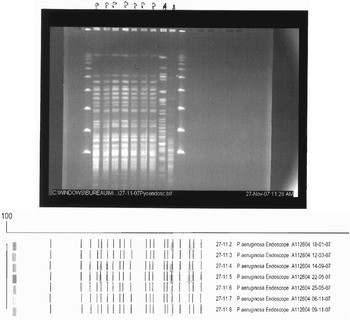
In 2007, a Pentax bronchoscope remained contaminated by a strain of P. aeruginosa P10 during nearly 1 year. From January to November 2007, this bronchoscope was tested 14 times. The same strain of P. aeruginosa identified by pulsed-field gel electrophoresis was found 7 times from January to November (Fig. 1). During this period, 7 controls revealed no bacteria, whereas the P10 strain was still in the bronchoscope. Indeed, the bronchoscope has been sent several times to the manufacturer, who certified that the disinfection was effective after maintenance. During the period, 74 patients were identified in contact with this bronchoscope, but the strain of P. aeruginosa was not found in any of them.
Persistent strain of Pseudomonas aeruginosa P10 identified by pulsed-field gel electrophoresis on a Pentax bronchoscope (A112604).

Microbiological testing of automatic endoscope reprocessor
Over the study period, 57 microbiological tests of automatic endoscope washer-disinfectors were performed. No sample was determined to be contaminated. No microbiological test revealed P. aeruginosa.
Audits of practice
The first risk assessment inspection was done in 2007 in the department of bronchial endoscopy and had only 65% of conformities. The main deviation observed was the lack of control of the disinfectant baths and the absence of traceability of their renewal. In 2009, audit showed that procedures of reprocessing were known but the products used were not always good ones. Baths of disinfectant were not controlled. In 2012, the same risk assessment inspection showed 90% of conformity. In 2015, the French national audit revealed that professionals were not trained enough. The main mistake was the use of unsuitable swab to clean the bronchoscopes. In 2017, the risk assessment inspection reached 69% of conformities: the differences observed were not related to the treatment of bronchoscopes but to noncompliant professional clothing and lack of knowledge on standard hygiene precautions. Finally, the audit carried out in 2019 showed that the practices were well mastered by the teams and that only a few personal protective equipment did not comply.
Discussion
We investigated the evolution of contamination rates of flexible bronchoscopes after reprocessing. The overall rate of contamination we reported here (15.5%) is relatively high, but similar to those described in published studies where rates varied from 6% to 26%. Reference Marino, Grieco and Moscato9–Reference Saliou, Garlantézec and Baron11 However, routine microbiologic surveillance allowed us to significantly lower the contamination rate from 30% to 0% over the 13-year period. This improvement is related to the practice audits of bronchoscope cleaning and disinfection, which made it possible to detect errors made during reprocessing and correct them. Manual reprocessing of bronchoscopes is a complex procedure, which can be the source of many errors. High-level disinfection should be performed by well-trained personnel. The preparation of the soaking baths, the handling of the disinfection products and the control of their effectiveness require in-depth training.
We also found that routine retesting of bronchoscopes was significantly associated with higher risk of contamination (OR, 2.58; P ≤ .015). It is highly probable that the more the bronchoscope is used, the higher the risk of damage, making it difficult to decontaminate. The reuse and disinfection of this equipment also can lead to damage of channels and the formation of biofilms that are difficult to remove. The use of disinfectants based on oxidizing agents, such as peracetic acid, also may have deleterious effects on bronchoscopes. Reference Brown, Merritt, Woods, McNamee and Hitchins30 In a previous study of the gastrointestinal endoscopy unit, we concluded that endoscopes that remained contaminated despite repeated reprocessing and maintenance should be withdrawn from further use. These endoscopes were usually old, and wear of channels made their disinfection inefficient. Reference Saliou, Le Bars and Payan31 Despite these risks, in a recent study, Ofstead et al Reference Ofstead, Quick and Wetzler8 observed that damaged and contaminated endoscopes were used routinely in hospitals. Also, new technology of endoscopes may make it more difficult to disinfect them. Verfaillie et al Reference Verfaillie, Bruno and Voor in’t holt A32 describe a large outbreak of VIM-2 P. aeruginosa that was linked to the use of a recently introduced duodenoscope with a specific modified design.
The microbiological investigation in our study found that the level of contamination may be high. Indeed, 34 microbiologic tests revealed >5 CFU even though these devices were cleaned and disinfected just before sampling. Most of indicator microorganisms were P. aeruginosa. This finding may reveal failure in bronchoscope drying. Indeed, endoscope drying has been described as one of the most important steps in limiting bacterial proliferation. Reference Muscarella33 In wet conditions, P. aeruginosa is able to form biofilms that are difficult to remove by cleaning. Reference Kovaleva, Peters, van der Mei and Degener13 Moreover, biocides are less efficient on bacteria present in biofilms. Reference Otter, Vickery and Walker34 This conclusion was confirmed in our study by the persistence of a strain of P. aeruginosa in a flexible bronchoscope for nearly a year.
Our study has several limitations. We did not analyze the presence of multidrug-resistant microorganisms. Routinely, in accordance with French recommendations, the germs are simply identified to determine the level of disinfection but no antibiogram is performed. We did not sample for Mycobacterium tuberculosis. Also, we did not sample to detect viruses such as influenza, but no guidance recommends doing so. The study was conducted at a teaching hospital in France, and the findings may not be generalizable to other settings.
Carrying out audits makes it possible to detect the errors made during the reprocessing of the endoscopes and to correct them. Manual reprocessing of bronchoscopes is a complex procedure, which can be the source of many errors. High-level disinfection should be performed by well-trained personnel. The preparation of the soaking baths, the handling of the products and the control of their effectiveness by strips requires in-depth training. Audits are essential to identify errors and improve procedures. This study has enabled us to considerably improve the efficiency of disinfection and reduce the contamination rates.
In conclusion, our study showed that practice audits for quality assurance improve the reprocessing of bronchoscopes and routine microbial surveillance of bronchoscopes can reduce the rate of contamination. Surveillance cultures of these semicritical devices and automatic endoscope reprocessors is an effective way to assess the effectiveness of disinfection despite the cost and should be recommended by appropriate professional organizations.
Acknowledgments
The authors thank Raymond Kerouanton, Claudie Le Moigne, and Monique Magnin for their contribution to the microbiological testing and to Lénaïg Daniel, Morgane Cosse, Solène Cabon, Anne Le Grand, and Maryline Canevet for the audits.
Financial support
No financial support was provided relevant to this article.
Conflicts of interest
All authors report non conflict of interest relevant to this article.