Introduction
In temperate dairy systems, the length of the grazing season is variable and can be as long as 10 months/year. In many cases, during the full grazing season, daily access time of cows to pasture is not limited since cows are only off the pasture for milking, i.e. 2 to 4 h/day. However, various situations may constrain or lead farmers to voluntarily limit the daily access time at pasture. For example, extending the grazing season at the end of the winter, at the beginning of spring or in autumn provides a useful means of increasing the proportion of grazed pasture in the diet of dairy cows, thus reducing production costs (Chénais et al., Reference Chénais, Seuret, Brunschwig and Fiorelli2001; Dillon et al., 2005). During these periods, which are characterized by low herbage growth rate and allowance, cows are often kept indoors and supplemented with silage at night time to meet their nutritional requirements. Another example is when swards are saturated after heavy rainfall and can be heavily pugged if cows stay in the paddocks throughout the day. Limiting access at pasture for a short period of time each day might prevent pasture degradation. Time at pasture may also be reduced in hot dry climates with high rates of supplementation off the pasture. Allowing the cows to graze for some hours per day can also improve the welfare of cows fed indoors (Sairanen et al., Reference Sairanen, Khalili, Virkajärvi and Hakosalo2006), and limit manure deposition and nitrogen excretion at grazing in regions with high stocking rates (Kristensen et al., Reference Kristensen, Oudshoorn, Munksgaard and Søegaard2007). Short times at pasture may limit herbage intake if cows are unable to ingest sufficient pasture in a short period of time.
In general, compared to conserved forage, dairy cows at pasture have low intake rate and high eating time (Hodgson et al., Reference Hodgson, Forbes, Armstrong, Beattie and Hunter1991; Baumont et al., Reference Baumont, Chenost and Demarquilly2004; Penning and Rutter, Reference Penning and Rutter2004). Thus, reducing time at pasture might represent a strong behavioural limitation, particularly if cows are unable to increase their intake rate. The factors affecting intake rate in grazing cattle have been extensively studied, mainly on the short-term scale. In addition to factors related to sward structure such as sward height, herbage mass, bulk density and proportion of stem and pseudostem (McGilloway and Mayne, Reference McGilloway and Mayne1996; Prache and Peyraud, Reference Prache and Peyraud1997), animal factors such as physiological state, animal nutritional requirements and fasting duration have been shown to affect intake rate at pasture (Chilibroste et al., Reference Chilibroste, Tamminga and Boer1997; Patterson et al., Reference Patterson, McGilloway, Cushnahan, Mayne and Laidlaw1998; Gibb et al., Reference Gibb, Huckle, Nuthall and Rook1999). However, little is known about the effect of restricting time at pasture on the performance, daily intake and feeding behaviour of dairy cows. Some studies on restricted time at pasture have been carried out on sheep (Iason et al., Reference Iason, Mantecon, Sim, Gonzalez, Foreman, Bermudez and Elston1999), heifers (Ginane and Petit, Reference Ginane and Petit2005) and beef cattle (Bayer, Reference Bayer1990; Gekara et al., Reference Gekara, Prigge, Bryan, Nestor and Seidel2005; Smith et al., Reference Smith, Cuddeford and Pearson2006). In these studies, restricting time at pasture had a variable effect on performance and feeding behaviour according to the severity of the time restriction and the grazing conditions. Recent studies (Mattiauda et al., Reference Mattiauda, Tamminga, Elizondo and Chilibroste2003; Chilibroste et al., 2004; Kristensen et al., Reference Kristensen, Oudshoorn, Munksgaard and Søegaard2007) have shown that restricting time at pasture to 4 h per day does not allow dairy cows to maintain milk production and herbage intake, in spite of high rates of supplementation. On the other hand, performance seems unaffected if time at pasture is at least 8 h/day.
The aim of this study was to evaluate the ability of dairy cows to adapt their feeding behaviour and maintain performance when the time at pasture is restricted. The effect of restricting time at pasture is studied in two feeding regimes (combination of rate of supplementation and herbage allowance (SHA)), which may affect the nutritional state of the cows and thus their motivation to graze.
Material and methods
Treatments, experimental design and animals
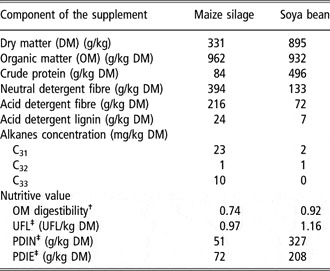
Forty-eight mid-lactation Holstein cows were assigned to four treatments in a 4 × 4 Latin square design replicated 12 times balanced for residual effects (Winer et al., Reference Winer, Brown and Michels1991), with a 2 × 2 factorial arrangement of treatments. The factors studied were the daily time at pasture and the feeding regime. The two times at pasture were 4 h (from 0900 h to 1300 h) or 8 h (from 0900 h to 1700 h) per day. When they were not at pasture, the cows were kept indoors in a free housing system. The two feeding regimes’ combined rate of SHA was 5 kg dry matter (DM) of supplement plus 11 kg DM of herbage allowance per cow per day above 5 cm v. 10 kg DM of supplement plus 6 kg DM of herbage allowance per cow per day above 5 cm. The supplement was a mixture of maize silage and soya bean meal in a ratio 87 : 13 (DM basis). The chemical composition and nutritive value of maize silage and soya bean meal are given in Table 1. Cows had individual access to the supplement only after evening milking at 1830 h and throughout the night, each cow having access to only one trough by means of an electronic collar. The two herbage allowances were calculated from a predictive intake model for grazing dairy cows (Delagarde et al., Reference Delagarde, Faverdin, Baratte and Peyraud2004) with the objective of attaining similar post-grazing sward height between the two feeding regimes.
Chemical composition and nutritive value of the two components of the supplement (maize silage and soya bean)

†Calculated from pepsin-cellulase digestibility (Aufrère and Demarquilly, 1989).
‡UFL = Unité Fourragère Lait (1 UFL = 7.115 MJ net energy); PDIN = Protein truly Digested in the Intestine when Nitrogen is limiting for microbial synthesis in the rumen; PDIE = Protein truly Digested in the Intestine when Energy is limiting for microbial synthesis in the rumen (Institut National de la Recherche Agronomique, 2007).
The experiment was carried out in May and June 2005 with four successive periods of 14 days. Each experimental period consisted of an 8-day period of adaptation to the treatments and a 6-day period of measurements. The 48 cows were divided into four groups, each of which was allocated to a treatment sequence. The groups were balanced according to the number of lactations (four primiparous cows per group), stage of lactation (166 ± 38 days in milk), milk production at peak (38.3 ± 5.7 kg), milk production (29.6 ± 3.7 kg), milk fat concentration (37.7 ± 4.7 g/kg), milk protein concentration (31.2 ± 2.1 g/kg), live weight (599 ± 62 kg) and body condition score (2.2 ± 0.4, scale 0 to 5) measured in a pre-experimental period from 4 to 24 April. During this period, the cows grazed day and night and were supplemented with maize silage (5 kg DM), soya bean meal (2 kg) and cereals (2 kg). Cows were milked twice daily at 0700 h and 1730 h.
Paddock management
The experiment was carried out at the INRA experimental farm of Méjusseaume (1.71°W, 48.11°N, Brittany, France), on two perennial ryegrass (Lolium perenne L. cultivar Ohio) paddocks of 3.2 and 4.3 ha in their third and fourth year of use. During February and March 2005, these two paddocks were grazed by dairy cows or heifers until a post-grazing sward height of approximately 4 cm was obtained 3 weeks before the beginning of each period. Each paddock was then divided longitudinally into four sub-paddocks, each one being assigned to a given treatment. Areas of sub-paddocks were proportional to herbage allowances. One paddock was grazed in periods 1 and 3, while the second paddock was grazed in periods 2 and 4. At the end of periods 1 and 2, the entire paddock (refusals and ungrazed area) was mowed approximately at 5 cm to allow homogeneous regrowth in periods 3 and 4 irrespective of the treatment. Rest period was then of 14 days at the beginning of periods 3 and 4, i.e. 21 to 25 days for the intake measurement period.
A first nitrogen fertilization was applied in mid-April after the last grazing of preparation (60 kg N/ha, as ammonium nitrate). A similar N fertilization was applied at the end of periods 1 and 2. The average temperature during the experiment was 12.4°C, while the total precipitation was 136 mm, compared with an average of 12.2°C and 195 mm, respectively, for the last 10 years.
Pasture management
A strip-grazing system was used throughout the experiment. Each day, the area to be allocated for each treatment was calculated from the pre-grazing herbage mass estimated from pasture height and pasture bulk density. The front fences were moved once daily for each treatment and the back fence 1 day after. Water was always available. Mineral blocks were available only indoors.
Measurements on pasture
Pre-grazing herbage mass above 5 cm was measured by cutting with a motorscythe on days 0, 4, 7 and 11 of each period. On each occasion, two 10 × 0.5 m strips were cut per treatment. To estimate pasture bulk density, the pasture height was measured on each strip before and after cutting (10 measurements), with an electronic platemeter (30 × 30 cm, 4.5 kg/m2, AGRO-Systèmes, France). The pasture DM concentration was determined on a 700-g sub-sample per strip. The chemical composition of the pasture was determined from the samples on days 7 and 11, which were composited by treatment and period.
Pre- and post-grazing pasture heights were measured every day by a platemeter (30 measurements per treatment). Pre- and post-grazing extended tiller heights were determined using a ruler. Before grazing, 50 tillers per treatment were randomly selected on days 8 and 11. After grazing, 100 tillers per treatment were randomly selected on days 11, 13 and 14.
Animal measurements
Milk production was recorded individually at each milking. Milk fat and protein concentrations were determined from day 11 to 14 by near-infra-red spectrophotometry (Milkoscan, Foss Electric, Hillerød, Denmark). Live weight was measured on the last day of each period after the morning milking.
The individual herbage intake was determined by the method of n-alkanes (Mayes et al., Reference Mayes, Lamb and Colgrove1986) using tritriacontane (C33) as the internal marker and dotriacontane (C32) as the external marker, according to the following equation:

where Q h represents daily herbage intake (kg DM), H i, S i and F i represents the concentrations (mg/kg DM) of internal alkane (C33) in herbage, supplement and faeces, respectively; H e, S e and F e represent the concentrations (mg/kg DM) of external alkane (C32) in herbage, supplement and faeces, respectively; Q s represents the supplement intake (kg DM), D e represents the amount (mg) of alkane C32 orally dosed.
Throughout the experiment, cows were dosed at each milking with a cellulose stopper (Carl Roth, Germany) containing 392 ± 11 mg of C32. Herbage intake was estimated over 5 consecutive days at the end of each period. Faeces were rectal-sampled after morning milking and before evening milking from day 10 to 14, and stored at +4°C. On day 14, faeces samples were composited by cow and frozen at −20°C before freeze-drying. To determine the n-alkanes concentration of selected herbage, 20 herbage handfuls (approximately 700 g fresh) were randomly selected at pasture and cut with scissors at ground level on days 8, 11 and 12. The handfuls were carefully placed in a tray respecting the vertical structure of the sward, aligning the basis of tillers and then frozen. At the end of the experiment, frozen handfuls were cut to the average post-grazing extended tiller height avoiding clearly refused patches. The higher fraction, considered as representative of the selected herbage, was freeze-dried and composited by treatment and period before chemical analysis.
The amounts of maize silage and soya bean meal offered were weighed daily for each cow. Dry matter concentration was determined once daily for maize silage and once weekly for soya bean meal. The refusals were weighed each morning individually. Weekly samples of maize silage and soya bean meal were collected and composited before chemical analyses.
Net energy balance was calculated by difference between net energy intake and net energy requirements for milk production and maintenance, after correction for the digestive interactions (Institut National de la Recherche Agronomique, 2007). Net energy intake was calculated from herbage and supplement intakes, using their respective net energy contents.
Grazing time was visually and continuously recorded by trained operators on days 12 and 13, each operator working by sequences of 2 h. Every 5 min, from 0900 h to 1700 h (presence of the cows in the paddock), they noted whether or not each cow was in a grazing activity sequence. Grazing time was calculated by summation of all 5-min intervals of grazing activity. The proportion of time spent grazing was estimated by dividing the grazing time by the total time spent at pasture. A meal was defined as a sequence of at least 10 min of grazing (two consecutive observations). The end of a meal was defined by a non-grazing period of at least 10 min (two consecutive observations). The average meal duration was calculated by dividing grazing time by the number of meals. Herbage intake rate (g DM/min) was calculated per cow and period by dividing herbage intake by the average grazing time.
Feeding time of the supplement was recorded individually by a video camera on days 12 and 13. When a cow was observed active in a head-down position in the trough, it was recorded as being in feeding activity. Because the supplement was consumed quickly, the feeding time was calculated by considering all meals having a duration longer than 1 min. The intake rate of the supplement was calculated each day by dividing the feeding time by the supplement intake.
Chemical analyses
All the dried and freeze-dried samples were ground through a 0.8 mm screen before chemical analysis. The DM concentration was determined by drying at 80°C in an oven for 48 h. Except for n-alkanes determination, the chemical analyses were carried out on dried samples. Ash was determined by incineration at 550°C for 5 h (Association Française de Normalisation, 1988) and nitrogen by the method of Dumas (Association Française de Normalisation, 1988). The pepsin-cellulase digestibility of pasture was determined according to the procedure described by Aufrère and Demarquilly (1989). The NDF, ADF and ADL concentrations were measured according to van Soest et al. (Reference van Soest, Roberson and Lewis1991). N-alkanes were determined after freeze-drying according to Mayes et al. (Reference Mayes, Lamb and Colgrove1986) after a direct saponification (Vulich et al., Reference Vulich, O’Riordan and Hanrahan1991).
Statistical analyses
All the animal data were analysed according to a 4 × 4 Latin square design, using the General Linear Model procedure of Statistical Analysis System Institute Inc. (1987), and considering the animal as the statistical unit, with the following model:

where μ, αi, βj, γk, δl, [γk × δl], εijkl, respectively, represent the general average, the fixed effects of cow, period, time at pasture, feeding regime, the interaction time at pasture × feeding regime and the residual error. For each variable, a statistical analysis was carried out on the average value by cow and period. The average milk production from day 8 to day 14 was used in this analysis.
The pasture data, averaged per treatment and period, were analysed according to a 4 × 4 Latin square design with the following model:

Results
For the statistical analyses, one cow was eliminated from the entire experiment because of early drying-off. One cow in period 1 and two cows in period 3 were also eliminated because of health problems.
Pasture and supplements
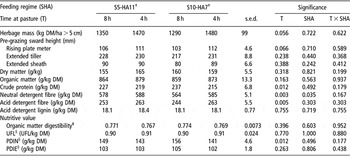
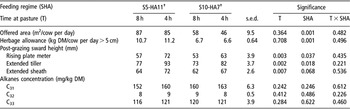
Pre-grazing pasture characteristics were virtually identical between treatments, for mass, height, chemical composition and nutritive value (Table 2). Only some small differences between treatments were observed for herbage mass, herbage CP, NDF and ADF concentrations. The C32 and C33 concentrations in pasture selected were, respectively, of 8 and 120 mg/kg DM, and were unaffected by treatments (Table 3). The C32 and C33 concentrations in maize silage and soya bean meal were low, representing less than 8% of the corresponding n-alkanes concentrations in selected pasture.
Effects of time at pasture under two feeding regimes on pre-grazing herbage mass, sward height, chemical composition and nutritive value of herbage offered

†Feeding regimes: S5-HA11: 5 kg dry matter (DM) of supplement + 11 kg DM of herbage allowance; S10-HA7: 10 kg DM of supplement + 7 kg DM of herbage allowance.
‡Calculated from pepsin-cellulase digestibility (Aufrère and Demarquilly, 1989).
§UFL = Unité Fourragère Lait (1 UFL = 7.115 MJ Net Energy); PDIN = Protein truly Digested in the Intestine when Nitrogen is limiting for microbial synthesis in the rumen; PDIE = Protein truly Digested in the Intestine when Energy is limiting for microbial synthesis in the rumen (Institut National de la Recherche Agronomique, 2007).
Effects of time at pasture under two feeding regimes on offered area, herbage allowance, post-grazing sward height and alkanes concentration in the herbage selected

†Feeding regimes: S5-HA11: 5 kg dry matter (DM) of supplement + 11 kg DM of herbage allowance; S10-HA7: 10 kg DM of supplement + 7 kg DM of herbage allowance.
Area per cow per day and herbage allowance showed no significant variation with time at pasture (Table 3). Post-grazing sward height was higher when time at pasture decreased from 8 to 4 h (+12 mm for platemeter height, +13 mm for extended tiller height, P < 0.01) (Table 3). On average, post-grazing sward height was lower by 7 mm (platemeter) and 8 mm (extended height) at the high compared with the low-supplement feeding regime (P < 0.05).
Milk production, milk composition and live weight
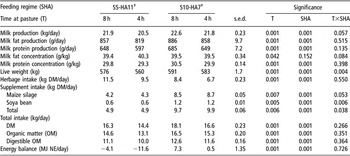
Milk production varied significantly with time at pasture and feeding regime (P < 0.001). On average, milk production decreased by 1.1 kg/day when time at pasture was reduced (Table 4). This reduction tended to be greater with the low-supplement (−1.3 kg/day) than the high-supplement (−0.8 kg/day) feeding regime (interaction time at pasture × feeding regime, P < 0.06). Milk production was greater by 1.0 kg/day at the high-supplement compared to the low-supplement feeding regime (P < 0.001). Milk fat and protein production showed similar trends as milk production, without any interaction between time at pasture and feeding regime.
Effects of time at pasture under two feeding regimes on milk production, milk composition, herbage intake, total intake and energy balance in grazing dairy cows

†Feeding regimes: S5-HA11: 5 kg dry matter (DM) of supplement + 11 kg DM of herbage allowance; S10-HA7: 10 kg DM of supplement + 7 kg DM of herbage allowance.
The milk fat concentration was greater only on the treatment of 4 h at pasture and low-supplement feeding regime (interaction time at pasture × feeding regime, P < 0.09). The milk protein concentration was lower (−0.5 g/kg, P < 0.001) when time at pasture decreased and higher (+0.6 g/kg, P < 0.001) at the high-supplement compared to the low-supplement feeding regime.
Live weight decreased by 12 kg (P < 0.001) on average when time at pasture was reduced. This reduction was more marked with the low-supplement (−18 kg) than with the high-supplement (−6 kg) feeding regime (interaction time at pasture × feeding regime, P < 0.01). Live weight was higher by 18 kg at the high-supplement compared to the low-supplement feeding regime (P < 0.001).
Intake and energy balance
Herbage intake decreased on average by 1.8 kg DM/day when time at pasture was reduced from 8 to 4 h/day (P < 0.001, Table 4). Herbage intake was lower by 3.0 kg DM/day at the high-supplement compared to the low-supplement feeding regime (P < 0.001). Supplement intake was on average 4.9 and 9.8 kg DM/day for the low- and high-supplement feeding regime, respectively (P < 0.001). Supplement intake slightly differed between time at pasture treatments (0.1 kg DM, P < 0.01). This variation was only due to some refusal on treatment with 8 h of time at pasture and high-supplement feeding regime.
Total intake varied from 14.4 to 18.1 kg DM between treatments, following the same variations as herbage intake. The net energy balance of the cows was lower when time at pasture was reduced (P < 0.001) and higher at the high compared to the low-supplement feeding regime (P < 0.001).
Feeding behaviour
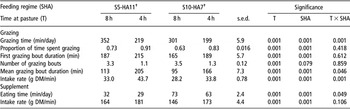
Feeding behaviour was strongly affected by time at pasture. When time at pasture was reduced from 8 to 4 h, cows spent 118 min less grazing (P < 0.001, Table 5). This reduction of grazing time with time at pasture was greater at the low-supplement (−133 min, i.e. −38%) than the high-supplement (−102 min, i.e. −34%) feeding regime (interaction time at pasture × feeding regime: P < 0.001).
Effects of time at pasture under two feeding regimes on feeding behaviour in grazing dairy cows

†Feeding regime: S5-HA11: 5 kg dry matter (DM) of supplement + 11 kg DM of herbage allowance; S10-HA7: 10 kg DM of supplement + 7 kg DM of herbage allowance.
Cows allowed 8 and 4 h of time at pasture spent, respectively, 68% and 87% of their available time grazing (P < 0.001). The reduction of time at pasture increased the duration of the first meal (+26 min, P < 0.001), the average meal duration (+81 min, P < 0.001) and strongly reduced the number of meals (−2.2 meals/day, P < 0.001). The grazing time, the proportion of time spent grazing and the average meal duration were lower with the high than the low-supplement feeding regime (−35 min, −0.09 and −28 min, respectively; P < 0.001, Table 5).
On average, pasture intake rate increased by 8 g DM/min (i.e. +26%, P < 0.001) when time at pasture was reduced. This increase was greater on the low-supplement (+11 g DM/min, i.e.+33%) than the high-supplement (+6 g DM/min, i.e.+21%) feeding regime (interaction time at pasture × feeding regime: P < 0.001). Pasture intake rate was lower (−7 g DM/min, P < 0.001) at the high-supplement compared to the low-supplement feeding regime. Finally, pasture intake rate varied between treatments from 28 to 44 g DM/min, i.e. an increase in 57% between the least restrictive treatment (8 h at pasture and high-supplement feeding regime) and the most restrictive treatment (4 h at pasture and low-supplement feeding regime).
Time spent eating the supplement indoors decreased by 7 min when the time at pasture decreased from 8 to 4 h (−13%, P < 0.001). This variation was less marked with the low than the high-supplement feeding regime (interaction time at pasture × feeding regime: P < 0.05). The intake rate of the supplement increased (+22 g DM/min, i.e. +22%, P < 0.001) when time at pasture was reduced (Table 5). The feeding time of the supplement was higher by 38 min (P < 0.001) and the rate of intake of the supplement was lower by 12 g DM/min (P < 0.001) on the high-supplement compared to the low-supplement feeding regime.
Discussion
The aim of this study was to evaluate the ability of dairy cows to maintain their performance and adapt their feeding behaviour when time at pasture was restricted according to the feeding regime. Feeding regime was characterized by a combination of rate of SHA. In our study, the effect of the rate of supplementation in itself is not easy to interpret since we did not compare the two rates of supplementation at similar herbage allowance or at similar post-grazing sward height. Therefore, this aspect is not discussed here.
Effect of restricted time at pasture on milk production and herbage intake
In this study, we tested the hypothesis that cows might adapt to restricted time at pasture by modifying their feeding behaviour in order to maintain their performance. Our study showed that milk production could not be maintained (−1.1 kg, i.e. −5%) when time at pasture was reduced from 8 to 4 h per day. This result is similar to that reported by Mattiauda et al. (Reference Mattiauda, Tamminga, Elizondo and Chilibroste2003) in dairy cows. These authors showed that the reduction of time at pasture from 8 to 4 h decreased milk production on average by 1.9 kg, i.e. −8%, despite a high rate of supplementation (6 kg DM of concentrate and 4.5 kg DM of maize silage). For Zebu cows producing only 4.5 kg milk per day, Jung et al. (Reference Jung, Yngvesson and Jensen2002) observed a 7% reduction of milk production when time at pasture was reduced from 9 to 5 h per day. However, in this latter study, the reduction in time at pasture was associated with an increase in walking time from 0.5 to 4.5 h. García-Rodriguez and Oregui (Reference García-Rodriguez and Oregui2003 and 2004) showed that Laxta ewes were unable to maintain their milk production when time at pasture was reduced from 7 to 4 h per day (−0.11 and −0.14 kg milk, i.e. −8% and −9% in 2003 and 2004, respectively).
However, other studies have failed to show any significant effect of restricting time at pasture on milk production, either because the times at pasture studied were long (16 h v. 8 h, Mattiauda et al., 2004) or because of the narrow range in time at pasture tested (6 h v. 8 h, Chilibroste et al., 2004).
In our study, the reduction in milk production with restricted time at pasture was related to a decrease of herbage intake (−1.8 kg DM, i.e. −18%). This result is consistent with the study of Mattiauda et al. (Reference Mattiauda, Tamminga, Elizondo and Chilibroste2003) in dairy cows, which showed a reduction in DM intake of 1.7 kg when time at pasture was reduced from 8 to 4 h. Similar to milk production results, other studies show that restricted time at pasture does not affect herbage intake, provided that it remains longer than 7 to 8 h per day (Smith, 1997; Gekara et al., Reference Gekara, Prigge, Bryan, Nestor and Seidel2005; Smith et al., Reference Smith, Cuddeford and Pearson2006). Iason et al. (Reference Iason, Mantecon, Sim, Gonzalez, Foreman, Bermudez and Elston1999) studied the effect of time at pasture (24 h v. 9.5 h) on the intake of ewes in two sward heights under continuously stocked grazing management. The restricted time at pasture had no influence on intake in the taller sward (5.5 cm), but herbage intake was reduced by 12% on the shorter sward (3.0 cm).
In our study, live weight highly decreased (−12 kg) when restricting time at pasture, in spite of the short length of experimental periods. This weight loss mainly results from the reduction of intake and weight of digestive content (Agabriel and Giraud, Reference Agabriel and Giraud1988). In the study of Smith et al. (Reference Smith, Cuddeford and Pearson2006), the restricted time at pasture had no effect either on intake or on live weight.
The reduction of milk protein concentration when restricting time at pasture from 8 to 4 h per day was not observed by Mattiauda et al. (Reference Mattiauda, Tamminga, Elizondo and Chilibroste2003) and Chilibroste et al. (Reference Chilibroste, Mattiauda and Bruni2001). However, such an effect is consistent with the reduction of intake and energy supply (Coulon and Rémond, Reference Coulon and Rémond1991). The increase in milk fat concentration observed along with restricting time at pasture at a low rate of supplementation agrees with the results of Chilibroste et al. (Reference Chilibroste, Mattiauda and Bruni2001). However, Mattiauda et al. (Reference Mattiauda, Tamminga, Elizondo and Chilibroste2003) observed a reduction of milk fat concentration when time at pasture was reduced from 8 to 4 h. In our study, although the effect of time at pasture on milk composition remained numerically low, it reaches a statistically significant level because of the high power of the experimental design.
Feeding behaviour adaptation when restricting time at pasture
Restricting time at pasture strongly modified the feeding behaviour of cows. The main behavioural adaptations observed (i.e. concentration of grazing activity and increased intake rate) were the same features generally described in ruminants when there is a restriction on the time allocated to collecting the food resource (Newman et al., Reference Newman, Parsons and Penning1994a). In our study, restricting time at pasture strongly reduced daily grazing time (−36%), but this reduction was less than in proportion with the restriction of time at pasture (−50%). In fact, cows increased the proportion of time spent grazing from 68% with 8 h to 87% with 4 h of access. Other studies have also showed that ruminants concentrate their grazing activity when a restriction of time at pasture is imposed (Jung et al., Reference Jung, Yngvesson and Jensen2002; Gekara et al., Reference Gekara, Prigge, Bryan, Nestor and Seidel2005; Ginane and Petit, Reference Ginane and Petit2005). The increase in duration of the first grazing bout, the mean duration of grazing bout and the reduction in the number of grazing bouts with restricted time at pasture can be interpreted as a response to a difficult feeding situation. Such effects have already been observed with continuously stocked dairy cows under low sward height conditions (Gibb et al., Reference Gibb, Huckle, Nuthall and Rook1999).
The large increase in herbage intake rate with decreasing time at pasture (on average +8 g DM/min, i.e. +27%) clearly indicates a higher motivation of cows for grazing. Gekara et al. (Reference Gekara, Prigge, Bryan, Nestor and Seidel2005) found that a restriction of time at pasture in beef cattle from 24 to 12 h increases pasture intake rate by 2.5 g DM/min, i.e. +14%. In continuously stocked ewes, a restriction of time at pasture from 24 h to 9.5 h resulted in an average increase of 35% in intake rate irrespective of sward height (Iason et al., Reference Iason, Mantecon, Sim, Gonzalez, Foreman, Bermudez and Elston1999). The positive effect of food restriction on intake rate at pasture was also shown on a short-term scale through the effect of a fasting period on the subsequent meal (Greenwood and Demment, Reference Greenwood and Demment1988; Newman et al., Reference Newman, Penning, Parsons, Harvey and Orr1994b). Under these conditions, the effect of restriction on the ruminant motivation to graze is higher since fasting from 24 to 36 h increases pasture intake rate during the subsequent meal (or the first hour) from 30% to 70% compared with non-fasted animals. These results support the hypothesis that the intake rate of grazing cows in normal conditions (time or access not limited) is lower than their capacity (Newman et al., Reference Newman, Parsons and Penning1994a). Cows are able to modify some behavioural traits such as intake rate and efficiency of grazing activity in response to short-term or long-term constraints, in order to control intake and nutrient supply. The increased rate of intake of the supplement under restricted time at pasture could also be related to a higher state of hunger and motivation to eat.
In our study, the important behavioural adaptations of dairy cows to restricted time at pasture were insufficient to maintain daily intake and performance. These results corroborate other studies carried out with times at pasture shorter than 8 h (Jung et al., Reference Jung, Yngvesson and Jensen2002; Mattiauda et al., Reference Mattiauda, Tamminga, Elizondo and Chilibroste2003; García-Rodriguez and Oregui, 2004). On the other hand, for time at pasture longer than 8 h, ruminants seem to have adequate capacities of behavioural adaptation to maintain their performance when herbage availability is sufficient (Iason et al., Reference Iason, Mantecon, Sim, Gonzalez, Foreman, Bermudez and Elston1999; Mattiauda et al., 2004).
Interaction between restricted time and feeding regime
In our study, we tested the hypothesis that restricting time at pasture might be more limiting for intake and production with the low-supplement feeding regime, considering that, in this case, cows have to eat more pasture in the same time to meet their energy requirements.
In a general way, the effect of restricting time at pasture on performance and intake was only slightly affected by feeding regime, due to a higher behavioural adaptation in the low-supplement feeding regime. No results have been reported on the interaction between time at pasture and feeding regime varying by the rate of supplementation, and only few studies have been carried out on the interaction between time at pasture and grazing management. Mattiauda et al. (2004) showed an interaction between time at pasture and herbage allowance, milk production being more affected by time at pasture at low compared with high herbage allowance. Similarly, for Iason et al. (Reference Iason, Mantecon, Sim, Gonzalez, Foreman, Bermudez and Elston1999), the intake of ewes was only affected by time at pasture at low sward height.
Our study shows that cows exhibit a greater behavioural adaptation under a more severe feeding regime when time at pasture is reduced. This is probably because a low-supplement intake increases the state of hunger and hence the motivation to graze. This interaction between feeding regime and time at pasture was particularly noteworthy for grazing time and intake rate. This additional capacity of adaptation of cows could be expressed in our study because there was no constraint on sward height and availability. It has been shown that the ability of ruminants to concentrate their grazing activity with restricted time at pasture increases with decreasing sward height (Iason et al., Reference Iason, Mantecon, Sim, Gonzalez, Foreman, Bermudez and Elston1999; Soca et al., 2002; Ginane and Petit, Reference Ginane and Petit2005). However, Iason et al. (Reference Iason, Mantecon, Sim, Gonzalez, Foreman, Bermudez and Elston1999) did not observe such an additional adaptation with regard to intake rate.
Conclusion
The present study shows that grazing dairy cows receiving either 5 or 10 kg DM of a maize silage-based supplement at approximately similar post-grazing sward height have a good ability to adapt their feeding behaviour when time at pasture is reduced from 8 h to 4 h per day. Cows increased the proportion of time spent grazing and the pasture intake rate to partially compensate for the reduction of time at pasture. However, these adaptations were insufficient to maintain pasture intake and performance. Under the conditions of this study, the decrease of milk production with the shorter time at pasture remained moderate irrespective of the feeding regime. This could occur because the cows showed an increased ability of behavioural adaptation to a short time at pasture when the feeding regime was more severe.
Acknowledgements
The CONACYT is gratefully acknowledged for financing the PhD studies of Efraín Pérez Ramírez. This study was partly financed by ANR in the framework of the ADD Praiterre programme and also received financial support from the GALA association. Thanks are also due to Antoine Antin, Gaël Boulet, Lionel Davenet, Michel Fargetton, Jacques Lassalas, Patrick Leconte, Alain Marchais, Nicolas Maurice, Arnaud Mottin, Erwan Ogès, Joseph Orinel, Patrick Pichot, Robert Ricou and Ginette Théaud for the milking, feeding and care of the cows, for measurements and data processing throughout the experiment. We are also indebted to Annick Brasseur, Laurence Finot, Nicole Huchet and Thibaud Le Mouel for chemical analyses and to Jean-Louis Peyraud for helpful comments on the paper. Michael Carpenter post-edited the English style.