Chromosome 22q11.2 deletion syndrome (22q11DS; also known as velo-cardio-facial and DiGeorge syndromes) is a neurogenetic disorder caused by a microdeletion of over 50 genes at the q11 locus of one copy of chromosome 22. Prevalence rates vary from 1:1000 (Grati et al., Reference Grati, Molina Gomes, Ferreira, Pinto, Dupont, Alesi, Gouas, Horelli-Kuitunen, Choy, García-Herrero and Vega2015) to 1:6000 (Botto et al., Reference Botto, May, Fernhoff, Correa, Coleman, Rasmussen, Merritt, O'Leary, Wong, Elixson, Mahle and Campbell2003) live births. Multiple reports, based on one-site or two-site samples, have confirmed the high incidence of psychiatric disorders in 22q11DS, including schizophrenia spectrum disorders (Murphy et al., Reference Murphy, Jones and Owen1999; Antshel et al., Reference Antshel, Fremont, Roizen, Shprintzen, Higgins, Dhamoon and Kates2006, Reference Antshel, Shprintzen, Fremont, Higgins, Faraone and Kates2010; Bassett and Chow, Reference Bassett and Chow2008; Green et al., Reference Green, Gothelf, Glaser, Debbane, Frisch, Kotler, Weizman and Eliez2009; Stoddard et al., Reference Stoddard, Niendam, Hendren, Carter and Simon2010). Importantly, a paper published by the International Consortium for Brain and Behavior in 22q11.2 Deletion Syndrome in 2014 (Schneider et al., Reference Schneider, Debbané, Bassett, Chow, Fung, Van Den Bree, Van Den Bree MBM, Owen, Murphy, Niarchou and Kates2014) validates the findings of these previous, smaller studies. Based on a cross-sectional, pooled sample of 1402 individuals with 22q11DS, Schneider et al. reported that attention-deficit hyperactivity disorder (ADHD) dropped significantly, from approximately 37% during childhood, to 24% during adolescence, and finally to 16% during adulthood. Anxiety disorders (ADs) dropped less dramatically but still significantly with age, from a rate of 36% in childhood to a mean rate of 26% during adulthood. In contrast, mood disorders (MDs) increased from over 3% during childhood to a mean rate of nearly 18% during adulthood. Schizophrenia spectrum disorders increased significantly with age, from about 2% during childhood, to over 10% during adolescence, to 24% between the ages of 18 and 25, and to over 41% in adults over the age of 25 years.
Despite the high prevalence of psychiatric disorders in 22q11DS, however, individuals with this syndrome are reported to be undertreated (Tang et al., Reference Tang, Yi, Calkins, Whinna, Kohler, Souders, McDonald-McGinn, Zackai, Emanuel and Gur2014). This may be due, in part, to the paucity of treatment studies focused specifically on 22q11DS, leading to reluctance on the part of practitioners to prescribe medications. Nonetheless, the extant treatment studies that have been conducted support the effectiveness and safety of stimulants for ADHD (Green et al., Reference Green, Weinberger, Diamond, Berant, Hirschfeld, Frisch, Zarchi, Weizman and Gothelf2011), and clozapine for schizophrenia spectrum disorder (Butcher et al., Reference Butcher, Fung, Fitzpatrick, Guna, Andrade, Lang, Chow and Bassett2015) as long as the risks of side effects are managed (Boot et al., Reference Boot, Butcher, Vorstman, van Amelsvoort, Fung and Bassett2015; Butcher et al., Reference Butcher, Fung, Fitzpatrick, Guna, Andrade, Lang, Chow and Bassett2015).
One limitation of the studies reported above is that they are largely based on cross-sectional data. A few studies of longitudinal trajectories of psychiatric disorders in this syndrome are limited primarily to two timepoints (Gothelf et al., Reference Gothelf, Schneider, Green, Debbane, Frisch, Glaser, Zilkha, Schaer, Weizman and Eliez2013; Tang et al., Reference Tang, Moore, Calkins, Yi, Savitt, Kohler, Souders, Zackai, McDonald-McGinn, Emanuel, Gur and Gur2017). Availability of longitudinal data over multiple timepoints would extend this work by providing critical information about age-related trajectories of psychiatric disorders and medication usage in individuals with 22q11DS. Moreover, longitudinal data would permit us to identify individuals whose disorders persist into adulthood, thereby allowing us to determine potential predictors of persistence over time. For this report, therefore, we assessed participants every three years at four timepoints, allowing us to describe trajectories of psychiatric disorders and medication usage from late childhood to early adulthood.
The current study was organized around the following aims:
Aim 1: To describe the trajectories of major psychiatric diagnoses in both individuals with 22q11DS (probands) and controls, and to determine the extent to which change across diagnostic classes was significant. Based on the cross-sectional data provided by Schneider et al., we hypothesized that, in probands, ADHD and anxiety disorders would decrease with age, and that MDs and psychosis-spectrum disorders (PSDs) would increase with age.
Aim 2: To determine predictors of persistence of psychiatric diagnoses in probands. (Reduced statistical power prevented us from examining predictors in controls.) Based on a few studies of predictors of psychiatric disorders in 22q11DS, and more numerous studies of predictors of idiopathic disorders (e.g. Kessler et al., Reference Kessler, McGonagle, Zhao, Nelson, Hughes, Eshleman, Wittchen and Kendler1994, Reference Kessler, Avenevoli and Merikangas2001; Knappe et al., Reference Knappe, Beesdo, Fehm, Höfler, Lieb and Wittchen2009; Merikangas et al., Reference Merikangas, He, Burstein, Swanson, Avenevoli, Cui, Benjet, Georgiades and Swendsen2010; Biederman et al., Reference Biederman, Petty, O'Connor, Hyder and Faraone2012), we hypothesized that predictors across all disorders would include baseline individual functioning and aspects of family environment. We further hypothesized that a history of anxiety would predict PSDs, and that family history of psychopathology would predict persistence of ADHD and MDs.
Aim 3 (exploratory): To determine rates and trajectories of pharmacological treatment in individuals’ comorbid for psychiatric disorders.
Methods
Participants
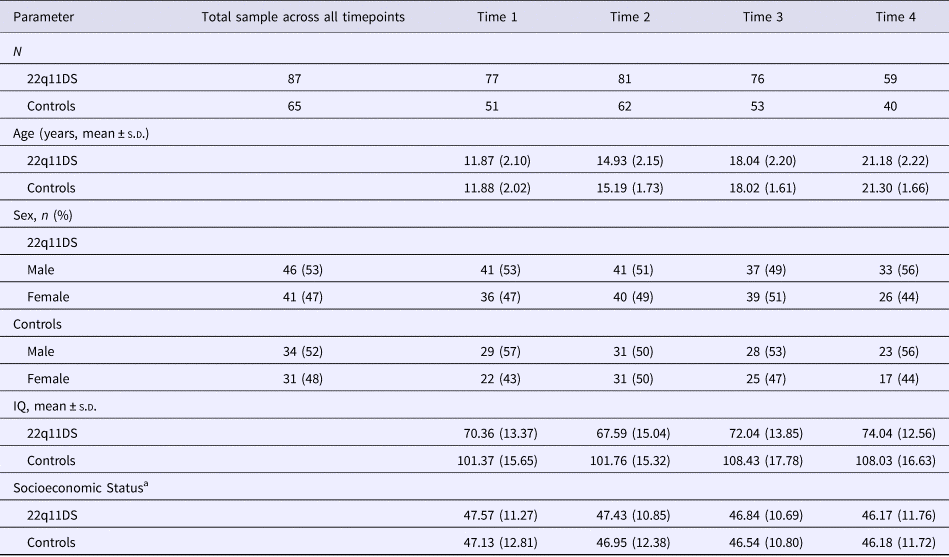
The current sample consisted of 87 probands, 33 unaffected siblings and 32 community controls participating in a longitudinal study examining risk factors for psychosis in 22q11DS. Probands and their siblings were recruited through a large, academic medical center. Community controls were recruited from local public schools. Participants were between the ages of 9 and 15 years at the first timepoint (T1; mean age 11.87 ± 2.1) of the study, and were evaluated at four timepoints over the course of 9 years, approximately 3 years apart. By the 4th timepoint, participants had reached a mean age of 21.3 ± 2.0 years. Please see Table 1 for demographic data. Fluorescence in situ hybridization (FISH) confirmed the presence of a microdeletion in all probands. Exclusion criteria for all participants consisted of an identifiable genetic condition (other than 22q11DS), parent-reported traumatic brain injury or preterm birth. Controls were additionally excluded if a first-degree relative was diagnosed with psychosis or if they were receiving special educational services. At study onset, we had little evidence that childhood diagnoses of ADHD and anxiety in typical samples predicted later onset of psychosis. Accordingly, we did not exclude siblings or controls who received those diagnoses at baseline assessments. Since the rate of psychiatric disorders in the sibling and control samples was low, and the two samples did not differ in baseline age, gender, or rates/persistence of psychiatric disorders (all p values >0.05), we combined them into one control group to increase statistical power. Participants did not differ from individuals lost to follow-up after baseline (13.6%; all p values >0.05) in initial age, gender, or intelligence quotient (IQ). Accordingly, the current sample is representative of the larger, initial sample of participants at baseline.

Diagnostic and predictor operationalization
Cognitive, psychiatric, and familial measures are described in detail in online Supplementary material. Online Supplementary Table S1 describes all measures used to predict persistence of diagnoses across timepoints.
Trajectories and predictors of persistence of the four most prevalent classes of psychiatric diagnoses were examined for the current report, including ADHD, AD, MD, and PSDs. T3 data were used as outcome data for those participants who did not return at T4 (e.g. two probands diagnosed with psychosis at T3 were too ill to return for T4).
For all diagnoses, persisters were defined as meeting criteria for a diagnosis at final assessment and, at least one previous timepoint. For PSD, we also categorized participants as ‘emergent’ if criteria were met at the final timepoint only. When analyzing predictors to persistence of PSD, we included both persistent and emergent participants, a strategy that has precedence in the literature (Tang et al., Reference Tang, Moore, Calkins, Yi, Savitt, Kohler, Souders, Zackai, McDonald-McGinn, Emanuel, Gur and Gur2017). Multiple comorbid diagnoses (which were not included in models of predictors to persistence) were categorized as having two or more concurrent diagnoses at each timepoint.
Medication classes include stimulants/atomexetine, anti-depressants/anxiolytics, anti-psychotics, and mood stabilizers. Our child psychiatrist (WF) reviewed psychiatric diagnoses and parent-reported medications for each participant at each timepoint, and determined whether the participant was taking medications that adhered to the Practice Parameters of the American Association of Child and Adolescent Psychiatry (AACAP Work Group on Quality Issues, Reference Birmaher, Brent, Bernet, Bukstein, Walter, Benson, Chrisman, Farchione, Greenhill, Hamilton, Keable, Kinlan, Schoettle, Stock, Ptakowski and Medicus2007a, Reference McClellan, Kowatch and Findling2007b, Reference Pliszka2007c; American Academy of Child and Adolescent Psychiatry (AACAP) Committee on Quality Issues (CQI), Reference McClellan and Stock2013) for the psychiatric diagnoses that we ascertained. Accordingly, we report rates of treatment by medication class for the entire sample, and trajectories of AACAP-adherent usage at each timepoint for the subset of youth with diagnosed psychiatric disorders.
Statistical analyses
Rates of psychiatric disorders were compared between study groups with χ2 analyses. Diagnostic class and medication use across timepoints were described using non-parametric statistics. Cochran's Q was employed to examine the trajectory of psychiatric diagnoses and medication use across timepoints. For probands, significant predictors of diagnostic persistence were identified first through univariate regression analyses for each diagnostic category. Significant predictors (p < 0.05) were then entered into a backward multiple logistic regression analysis, which predicted persistence of diagnosis (e.g. ADHD) v. no diagnosis (e.g. no ADHD) over time. Finally, receiver operator characteristic (ROC) analyses ascertained the extent to which risk for persistence in each psychiatric diagnostic class could be predicted. Values for the area under the ROC curve (AUC) were also calculated. ROC curves and associated AUC values are provided in online Supplementary Fig. S1.
Results
Below, we describe trajectories of each psychiatric diagnostic category across four timepoints, rates and predictors of persistence of each diagnostic category, and rates and trajectories of medication usage. Results reported below are organized by diagnostic category. Results are also summarized in Tables 2 and 3, and online Supplementary Table S2, and Figs 1 and 2, online Supplementary Figs S1–S4.
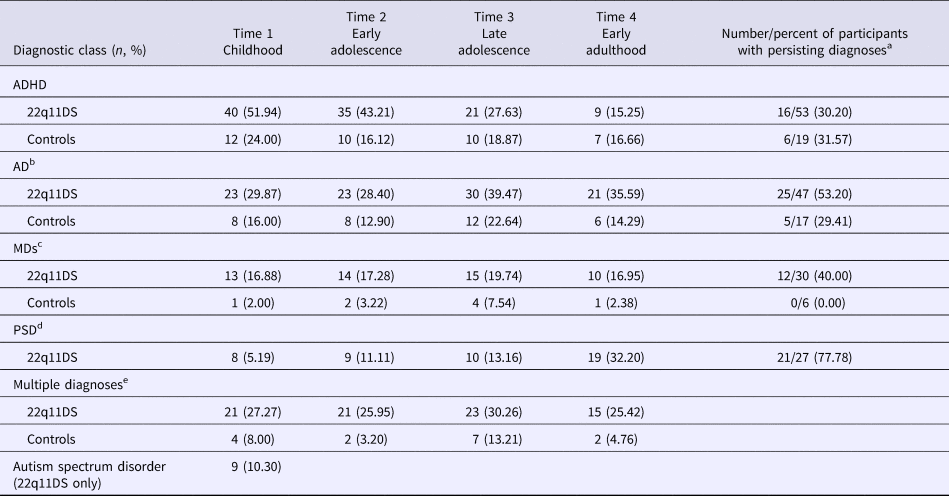
Trajectories of psychiatric diagnoses across timepoints. This figure depicts rates (percentages) of psychiatric diagnoses, by diagnostic class, in probands across the four timepoints of the study.

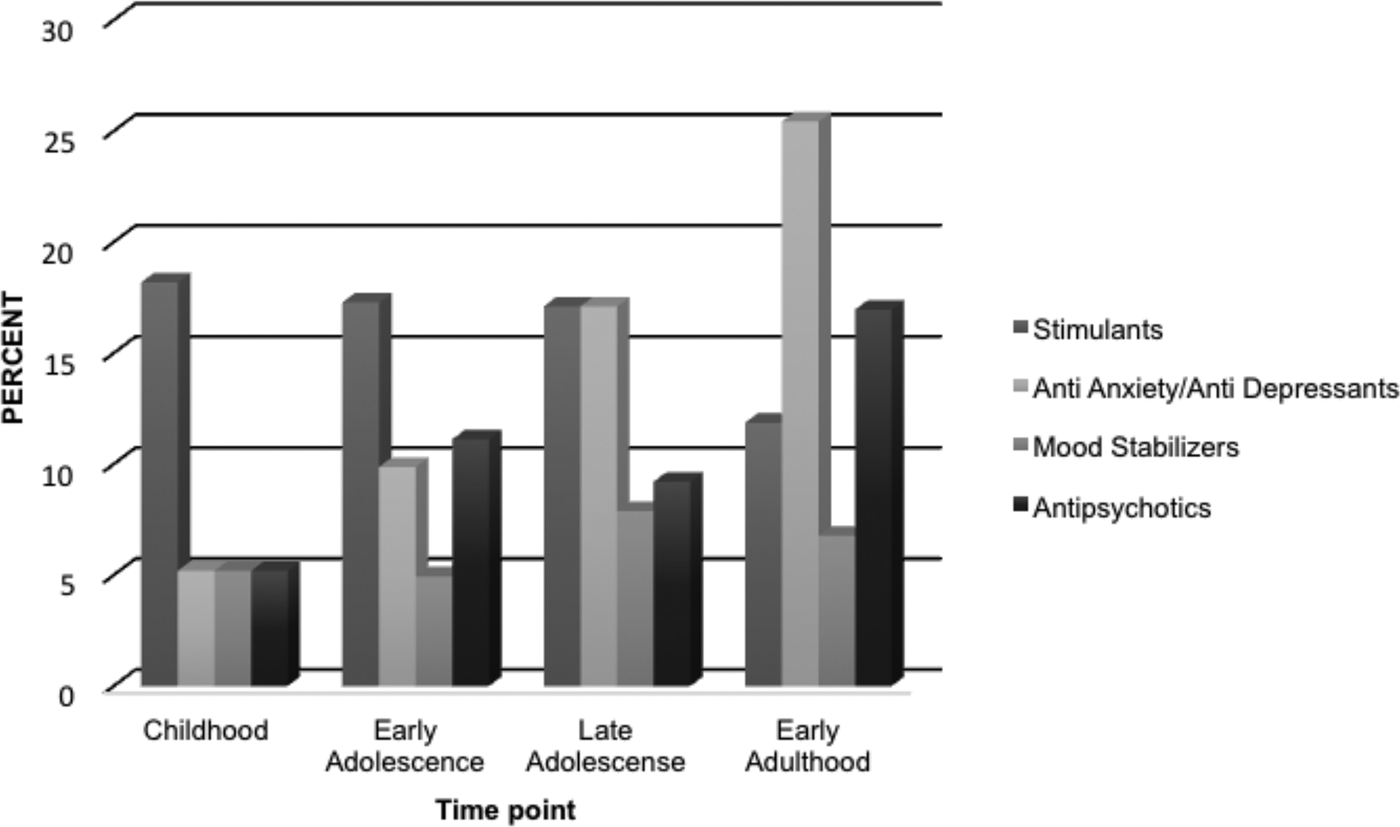
Parent-reported medication usage by medication class and timepoint. This figure depicts percent of parent-reported medication usage across timepoints, by medication class, in the total sample of probands.

Rates (percentage) of diagnoses of probands and controls across timepoints

a Participants who had the diagnosis at their final timepoint and at least one other timepoint, relative to total number of participants with that diagnosis at any given timepoint.
b ADs: simple or social phobia, separation anxiety disorder, generalized anxiety disorder, obsessive-compulsive disorder, post-traumatic-stress disorder diagnoses.
c MDs: depression or bipolar diagnoses.
d PSD: prodromal or emergent/persistent psychotic disorders.
e Multiple diagnoses: two or more diagnoses.
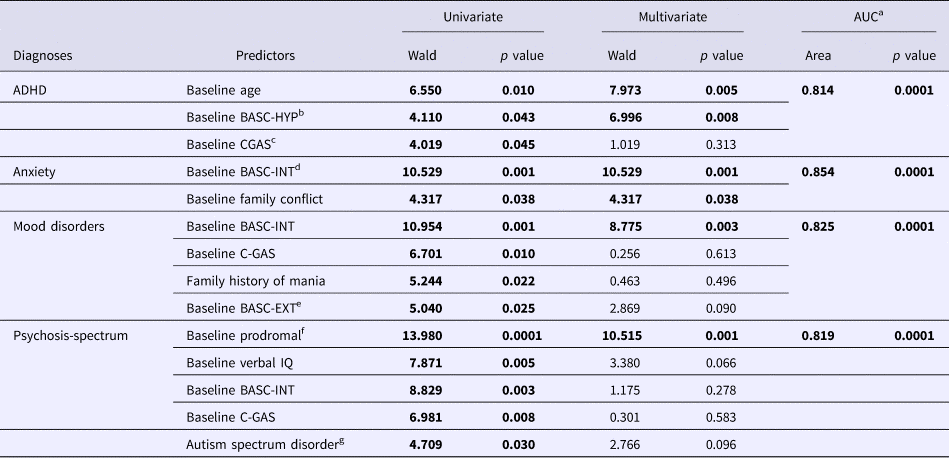
Significant predictors (denoted in boldface type) of diagnostic persistence in probands

a Area under the curve.
b Behavior Assessment Scale for Children-Hyperactivity.
c Children's Global Assessment Scale (Shaffer et al., Reference Shaffer, Gould, Brasic, Ambrosini, Fisher, Bird and Aluwahlia1983).
d Behavior Assessment Scale for Children-internalizing (Reynolds and Kamphaus, Reference Reynolds and Kamphaus1992).
e Behavior Assessment Scale for Children-externalizing (Reynolds and Kamphaus, Reference Reynolds and Kamphaus1992).
f Baseline presence of prodromal symptoms.
g Autism Diagnostic Interview-Revised (Lord et al., Reference Lord, Rutter and Le Couteur1994).
Study group differences in rates of psychiatric disorders
Probands differed significantly from controls in rates of AD (p = 0.001), MD (p = 0.001), and PSD (p = 0.0001). Differences in rates of ADHD just reached significance (p = 0.05).
Psychiatric and medication trajectories
ADHD
Trajectories of ADHD in controls declined, but not significantly, from a rate of 24% during late childhood to 16.7% in young adulthood, whereas probands declined significantly from a rate of 51.9% to 15.3% (Cochran's Q = 42.9, p < 0.0001). This was driven by significant declines between T2 and T3 (Cochran's Q = 8.9, p < 0.003) and T3 and T4 (Cochran's Q = 7.2, p < 0.007). Of those participants who were diagnosed with ADHD at any timepoint, 31.6% of controls and 30.2% of probands persisted in this diagnosis. Younger baseline age (p < 0.01), higher baseline Behavior Assessment Scale for Children (BASC) hyperactivity scores (p < 0.03), and lower baseline global functioning [i.e. Children's Global Assessment Scale (CGAS) scores; p < 0.045] predicted persistence in probands. Multiple logistic regression analyses indicated that baseline age and BASC hyperactivity scores both remained significant predictors [Wald = 8.0, p = 0.005; Wald = 7.0, p = 0.008, respectively; AUC = 0.81, p = 0.0001 (online Supplementary Fig. S1)].
AD
Rates of AD remained stable for both study groups. AD declined in controls from 16% to 14.3%, and increased in probands from 29.9% to 35.6%. In probands, simple phobias and generalized anxiety disorders accounted for the majority of AD diagnoses (online Supplementary Fig. S2). AD persisters included 29.4% of controls and 53.2% of probands who were diagnosed with AD at any timepoint. Higher baseline internalizing scores on the BASC (p = 0.001) and higher baseline family conflict scores (p = 0.04) predicted persistence in probands, and remained significant in a multiple logistic regression (internalizing, Wald = 10.5, p = 0.001; family conflict, Wald = 4.3, p = 0.04), yielding an AUC of 0.85, p = 0001.
MD
Rates of MD remained stable for both study groups, varying across timepoints between 2% and 7.5% in controls, and between 16.9% and 17.3% in probands. Of the individuals diagnosed with MD at any timepoint, no controls and 40% of probands were persisters. Higher baseline internalizing (p = 0.001) and externalizing (p = 0.03) scores on the BASC, lower baseline global functioning (p = 0.01), and higher family history of mania (p = 0.02) initially predicted persistence in probands. Baseline BASC internalizing score remained significant in the multiple logistic regression analysis (Wald = 8.8, p = 0.003), yielding an AUC of 0.83, p = 0001.
PSD
Twenty-one (24.1% of all probands; 77.78% of probands with PSD at any timepoint) participants had persistent or emergent PSD by their final assessment. Trajectories of PSD increased significantly (Cochran's Q = 9.8; p = 0.021) over the four timepoints of this study, from a rate of 9% (N = 8) at T1 to 22% (N = 19) at T4. This was driven by a significant increase in rates between T3 (late adolescence) and T4 (Cochran's Q = 6.4, p = 0.01). Those with persistent or emergent PSD at final assessment included 61.9% (N = 13) individuals with a prodromal disorder and 38.1% (N = 8) individuals with overt psychosis. Univariate predictors of PSD persistence included higher baseline internalizing score (p = 0.003), lower baseline global functioning (p = 0.008), lower baseline verbal IQ (p = 0.005), the presence of autism spectrum disorder (p = 0.03), and higher baseline prodromal symptoms (p = 0.0001). Baseline prodromal symptoms (Wald = 10.5, p = 0.001) remained significant in the multiple logistic regression, yielding an AUC of 0.83 (p = 0.0001).
Parent-reported medication usage
Use of stimulants in probands decreased and mood stabilizers increased (both non-significantly) between T1 and T4 (Fig. 2). Anti-depressant and anxiolytic usage increased significantly (Cochran's Q = 12.33; p = 0.006), whereas anti-psychotic medication usage increased at the trend level from T1 to T4 (Cochran's Q = 3.60; p = 0.058). Use of stimulants and anti-depressants/anti-anxiolytics were stable in controls, but rates of usage were lower than in probands (online Supplementary Table S2). When categorized by the class of psychiatric disorder, reported treatment (with any class of medication) of probands with ADHD or anxiety disorders increased (45% to 66.7%, and 26.1% to 52.3%, respectively) from T1 to T4. Reported treatment of probands with MDs fell slightly from 53.8% at T1 to 40% at T4, and remained stable over time for PSDs (50% at T1 to 52.6% at T4; online Supplementary Fig. S3). Note that at T1 and T2, all probands diagnosed with PSD met criteria for prodromal but not overt psychosis. Accordingly, reported medications for that subsample (many of whom had multiple psychiatric diagnoses) were more likely to be anti-depressants/anxiolytics or mood stabilizers than anti-psychotics. Although the actual numbers of controls with psychiatric disorders who were using medications were smaller than probands, percentages did not differ dramatically for ADHD, AD, and MD (online Supplementary Fig. S4).
Discussion
This is the first study, to our knowledge, to report longitudinal trajectories of psychiatric disorders over a 9-year period, and across four timepoints, in a large sample of youth with 22q11DS and controls. In probands, we identified the behavioral, psychiatric, and familial factors that predicted the persistence of these diagnoses, and observed that usage of anti-depressants/anxiolytics increased over time. Here we place our results in the context of what we know about predictors of persistence in both syndromal and non-syndromal samples, and discuss implications for treatment.
Psychiatric disorder persistence
ADHD
Prevalence rates for ADHD coincided with Schneider et al. (Reference Schneider, Debbané, Bassett, Chow, Fung, Van Den Bree, Van Den Bree MBM, Owen, Murphy, Niarchou and Kates2014) cross-sectional study of 22q11DS, but exceeded rates for our control sample, as well as youth with idiopathic ADHD (Faraone et al., Reference Faraone, Sergeant, Gillberg and Biederman2003; Merikangas et al., Reference Merikangas, He, Burstein, Swanson, Avenevoli, Cui, Benjet, Georgiades and Swendsen2010). Rates were also higher than a recent, population-representative study of youth with intellectual disabilities (ID; Platt et al., Reference Platt, Keyes, McLaughlin and Kaufman2018) as well as a large, clinic-based sample (Dekker and Koot, Reference Dekker and Koot2003). The rate of 29% that we observed for persistence of ADHD into young adulthood was higher than published rates of persistence for idiopathic ADHD, estimated at about 15% (Faraone et al., Reference Faraone, Biederman and Mick2006), although they were comparable to our control sample. Our finding that lower baseline global functioning and higher baseline scores on hyperactivity predicted persistence coincided with reports of youth with idiopathic ADHD. In contrast to those with idiopathic ADHD, however, we did not observe predictors of psychiatric comorbidity, lower IQ, and parental psychopathology (Biederman et al., Reference Biederman, Petty, Clarke, Lomedico and Faraone2011, Reference Biederman, Petty, O'Connor, Hyder and Faraone2012; Cherkasova et al., Reference Cherkasova, Sulla, Dalena, Ponde and Hechtman2013). Significant differences in the behavioral phenotype of youth with 22q11DS + ADHD from those with idiopathic ADHD (Antshel et al., Reference Antshel, Faraone, Fremont, Monuteaux, Kates, Doyle, Mick and Biederman2007) may account for divergence in predictors of persistence. In addition, a previous analysis of persistence of ADHD during the initial three years of our study (Antshel et al., Reference Antshel, Hendricks, Shprintzen, Fremont, Higgins, Faraone and Kates2013) found that predictors of persistence of ADHD from middle childhood to mid-adolescence included the presence of baseline major depressive disorder and family history of ADHD, coinciding with predictors in idiopathic ADHD. Accordingly, observed predictors to persistence of ADHD in young adulthood diverged from earlier predictors, supporting the notion that predictors of persistence may change developmentally (Cherkasova et al., Reference Cherkasova, Sulla, Dalena, Ponde and Hechtman2013; Seguin and Leckman, Reference Seguin and Leckman2013).
AD
Prevalence rates for AD in probands did not change significantly with age, ranging from 30% at T1 to 36% at T4. These rates are consistent with the report on 22q11DS by Schneider et al. (Reference Schneider, Debbané, Bassett, Chow, Fung, Van Den Bree, Van Den Bree MBM, Owen, Murphy, Niarchou and Kates2014), and are slightly higher than the rate reported for idiopathic anxiety disorders in adolescence, estimated at 32% (Merikangas et al., Reference Merikangas, He, Rapoport, Vitiello and Olfson2013). Interestingly, rates exceeded both population-based (Platt et al., Reference Platt, Keyes, McLaughlin and Kaufman2018) and clinical samples of individuals with ID (Dekker and Koot, Reference Dekker and Koot2003), as well as rates for our control sample. Rates of persistence of AD into adulthood reached 44%, exceeding the persistence rate of 13–22% reported in idiopathic AD (Bruce et al., Reference Bruce, Yonkers, Otto, Eisen, Weisberg, Pagano, Shea and Keller2005; Legerstee et al., Reference Legerstee, Verhulst, Robbers, Ormel, Oldehinkel and van Oort2013; Copeland et al., Reference Copeland, Angold, Shanahan and Costello2014; Skodol et al., Reference Skodol, Geier, Grant and Hasin2014). Despite the consistency between our observations and those of Schneider et al., we cannot rule out the possibility that the relatively high rates that we observed in both ADHD and AD relative to both idiopathic and ID samples suggest that our proband sample may be biased toward more psychiatrically impaired youth, whose families were willing to travel to our center multiple times in hopes of receiving guidance and recommendations for treatment.
We further observed that higher baseline, parent-rated internalizing, and family conflict scores predicted persistence of AD. This is in line with studies of persistence of idiopathic AD, for which predictors include comorbid depressive disorder (Bruce et al., Reference Bruce, Yonkers, Otto, Eisen, Weisberg, Pagano, Shea and Keller2005), and the presence of multiple anxiety disorders (Bruce et al., Reference Bruce, Yonkers, Otto, Eisen, Weisberg, Pagano, Shea and Keller2005). Our observation that higher baseline family conflict predicted persistence of AD in 22q11DS may reflect the negative impact of family dysfunction that has been reported in idiopathic AD (Grover et al., Reference Grover, Ginsburg and Ialongo2005; Legerstee et al., Reference Legerstee, Verhulst, Robbers, Ormel, Oldehinkel and van Oort2013; Asselman and Beesdo-Baum, Reference Asselmann and Beesdo-Baum2015). In contrast to idiopathic anxiety disorders (Legerstee et al., Reference Legerstee, Verhulst, Robbers, Ormel, Oldehinkel and van Oort2013), gender did not predict persistence of anxiety disorders, potentially due to syndrome-related differences in brain chemistry or hormonal status, which have been associated with female preponderance of anxiety in typical populations.
MD
The stable rates of 17–19% observed for MD were consistent with the report by Schneider et al. (Reference Schneider, Debbané, Bassett, Chow, Fung, Van Den Bree, Van Den Bree MBM, Owen, Murphy, Niarchou and Kates2014). These rates are relatively consistent with idiopathic depressive disorders, estimated at 10–18% during adolescence (Merikangas et al., Reference Merikangas, He, Burstein, Swanson, Avenevoli, Cui, Benjet, Georgiades and Swendsen2010) and 19% in adulthood (Kessler et al., Reference Kessler, Avenevoli and Merikangas2001), and only slightly higher than population-based ID samples (Platt et al., Reference Platt, Keyes, McLaughlin and Kaufman2018). However, they exceeded rates of MD in our control sample. Rates of persistence of MD into adulthood exceeded 40%, which is considerably higher than rates of recurrence of idiopathic depression, estimated at 10% (Kessler et al., Reference Kessler, Avenevoli and Merikangas2001; Dunn and Goodyer, Reference Dunn and Goodyer2006; Maughan, Reference Maughan2013). Our finding that both internalizing and externalizing scores predicted persistence of MD is in line with findings that childhood comorbid anxiety, oppositional defiant, and substance abuse disorders predict recurrence of idiopathic depressive disorders (Copeland et al., Reference Copeland, Shanahan, Costello and Angold2009). Interestingly, whereas family history of depression predicts idiopathic depressive disorders, we observed that family history of mania predicted MD in our sample. It is unlikely that the small number of youth in our sample with bipolar disorder (N = 2) accounted for this finding, suggesting that the genetic underpinnings of bipolar disorders and depressive disorders may be on a continuum in 22q11DS.
We further observed that decreased baseline global functioning not only predicted persistent ADHD, but also persistent MD (and PSD, noted below). Our measure of global functioning encompassed school, social, and adaptive functioning. Although the breadth of the global functioning construct makes it difficult to interpret, its robustness as a predictor across several diagnostic classes suggest that youth with 22q11DS may not have the social and adaptive resources to manage developmental tasks, particularly in combination with the cognitive impairments that they face, which in turn increase their risk for psychiatric disorders.
PSD
Consistent with cross-sectional studies of 22q11DS (Schneider et al., Reference Schneider, Debbané, Bassett, Chow, Fung, Van Den Bree, Van Den Bree MBM, Owen, Murphy, Niarchou and Kates2014), PSD increased with age significantly, from 9% at T1 to 24% by final assessment. Approximately 71% of the individuals who met criteria for psychosis spectrum disorder by their final assessment were persisters, whereas the remainder were emergent. Several of the predictors of either persistent or emergent PSD that we observed (i.e. higher baseline prodromal symptoms, lower global functioning, and lower verbal IQ) were consistent with previous studies of youth with 22q11DS (Gothelf et al., Reference Gothelf, Schneider, Green, Debbane, Frisch, Glaser, Zilkha, Schaer, Weizman and Eliez2013; Vorstman et al., Reference Vorstman, Breetvelt, Duijff, Eliez, Schneider, Jalbrzikowski, Armando, Vicari, Shashi, Hooper, Chow, Fung, Butcher, Young, McDonald-McGinn, Vogels, van Amelsvoort, Gothelf, Weinberger, Weizman, Klaassen, Koops, Kates, Antshel, Simon, Ousley, Swillen, Gur, Bearden, Kahn, Bassett, International Consortium on, Behavior and Deletion2015; Tang et al., Reference Tang, Moore, Calkins, Yi, Savitt, Kohler, Souders, Zackai, McDonald-McGinn, Emanuel, Gur and Gur2017). Our analyses were underpowered to detect a predictive effect of verbal IQ decline, as has been reported by others (Vorstman et al., 2015).
We previously reported (Kates et al., Reference Kates, Russo, Wood, Antshel, Faraone and Fremont2015) that higher parent-rated internalizing symptoms at T1 (based on the BASC) predicted PSD at T3. Our current observation that higher levels of internalizing symptoms significantly predicted PSD persisters is consistent with our previous work and that of Gothelf et al. (Reference Gothelf, Feinstein, Thompson, Gu, Penniman, Van Stone, Kwon, Eliez and Reiss2007). On the other hand, we did not observe that baseline, Diagnostic and Statistical Manual of Mental Disorders (DSM)-based diagnoses of anxiety disorders were predictive, in contrast to studies by Gothelf et al. (Reference Gothelf, Schneider, Green, Debbane, Frisch, Glaser, Zilkha, Schaer, Weizman and Eliez2013) and Tang et al. (Reference Tang, Moore, Calkins, Yi, Savitt, Kohler, Souders, Zackai, McDonald-McGinn, Emanuel, Gur and Gur2017). However, both of those studies were based on comparisons of participants who were adolescents at initial assessment, and who were followed-up in about 3 years, in contrast to our sample whose mean age at T1 was 11.9, and for whom nine years elapsed between baseline and final follow-up.
Psychiatric medication usage in 22q11DS
Based on rates for the entire sample of probands, parent-reported medication usage was very low during childhood and early adolescence, hovering between 5% and 10% with the exception of stimulants, which reached over 15%. As probands moved into late adolescence and young adulthood, rates of usage of anti-anxiety and anti-depressant medication, primarily Selective Serotonin Reuptake Inhibitors (SSRI's), increased significantly, reaching over 25% in young adulthood. Use of anti-psychotics increased as well, although not significantly.
Rates of medication usage for the subset of probands diagnosed with DSM-IV psychiatric disorders, however, increased from 32.1% at T1 to 56.4% by T4. These rates are slightly higher than cross-sectional reports of treatment of youth with this syndrome (Tang et al., Reference Tang, Yi, Calkins, Whinna, Kohler, Souders, McDonald-McGinn, Zackai, Emanuel and Gur2014). Again, this may be due to the effects of participating in a longitudinal study: families received with written reports and recommendations at each timepoint, likely increasing awareness over time of both the proband's psychiatric status and potential positive effects of psychopharmacological treatment. Still, treatment rates rarely exceeded 50% of individuals diagnosed with a psychiatric disorder. Although these rates are higher than rates for individuals in epidemiological samples (Merikangas et al., Reference Merikangas, He, Rapoport, Vitiello and Olfson2013), it has been noted (Rubin, Reference Rubin2013) that such discrepancies may reflect differences between large, population-based studies and those of groups with increased access to referral for medication use (e.g. youth who are being followed by a team of health-care professionals). Accordingly, the elevated risk for, and reported treatment rates of, psychiatric illness in 22q11DS underscores the critical importance of early interventions that could potentially mitigate the onset or severity of eventual psychiatric impairment. Multi-site, longitudinal treatment trials for youth with this syndrome are needed to fully understand the effects of mental health treatment on future disease risk and burden.
Limitations and conclusions
This is the first study, to our knowledge, to report longitudinal trajectories of psychiatric disorders, predictors of persistence, and medication usage at four timepoints in youth with 22q11DS. Strengths of the study include the young age (mean = 11.9 years) at which our observations of 9-year trajectories began, the relatively large sample of youth with 22q11DS, and the narrow, 6-year age range of participants at each timepoint. To the extent that we observed discontinuities in the importance of specific predictors over time, and age-related changes in medication usage, our study underscores the critical importance of following cohorts with 22q11DS longitudinally from childhood into adulthood to fully understand the natural history of psychiatric illnesses in this syndrome and to identify potential moderators of risk over time.
Several limitations to this study should be noted. Some of our predictors of persistence were moderately correlated with each other. Accordingly, several of the variables that predicted persistence in univariate regression analyses lost significance in multiple regression analyses. Since intercorrelation coefficients did not exceed 0.51, these variables are most likely measuring distinct constructs; however, some variables may have mediated other variables, accounting for the variance in our multiple regression analyses. Importantly, individuals with 22q11DS are often comorbid for multiple psychiatric disorders and treated with multiple medications, so it was difficult to determine via parent report which disorders were being targeted by which medications. In addition, we did not consider other treatment modalities (e.g. psychotherapy) that could have contributed to reductions in psychiatric diagnoses or changes in medication usage over time. Finally, as noted in Fig. 1, the sample's comorbidity rate ranged from 25% to 30% across timepoints, and the study was underpowered to consider interaction effects, potentially accounting for the overlap in predictors that we observed between diagnostic classes.
Our results carry implications for identifying youth who are at the highest risk for persistence of psychiatric illness and for providing treatment to those youth. We observed that scores on parent-rated instruments measuring child behavior and family environment predicted persistence of ADHD, AD, and MD. These instruments are relatively easy and cost-effective to administer in a clinical setting. Early predictors of persistent PSD require a psychiatric evaluation and intelligence test, which are more intensive and costly than the administration of the BASC and the Family Environment Scale, yet may be cost-effective in the long run if they result in early intervention that reduces the public-health burden of psychosis.
Cross-validation on independent samples of youth with 22q11DS is essential to determine the replicability of these results. If replicated, our data suggest that regular (preferably yearly) psychiatric/behavioral evaluations, beginning during the elementary school-aged years, could aid the identification of children with 22q11DS at highest risk for all of these disorders. Once identified, children at risk should be monitored intensively and provided with interventions (described below) at relatively young ages, potentially mitigating the detrimental functional effects (Yi et al., Reference Yi, Calkins, Tang, Kohler, McDonald-McGinn, Zackai, Savitt, Bilker, Whinna, Souders, Emanuel, Gur and Gur2015; Taylor et al., Reference Taylor, Kates, Fremont and Antshel2018) wrought by these disorders.
The results of ROC analyses can be utilized to identify such children (see online Supplementary Fig. S1). ROC analyses provide thresholds for scores that would yield optimal sensitivity rates to detect highest risk for persistence of psychiatric disorder (i.e. true positives), and optimal ‘1 – specificity’ rates to rule out children who are at lower risk for persistence of psychiatric disorder (i.e. false positives), increasing accurate identification of youth with highest need for intensive monitoring.
The predictors that we identified underscore the importance of providing integrated treatments to youth at highest risk for emerging psychiatric disorders. Although our preliminary studies support the efficacy of cognitive remediation for executive function (Mariano et al., Reference Mariano, Tang, Kurtz and Kates2015), additional randomized controlled studies are indicated. In addition, our results suggest that studies of the efficacy of treatments that focus on family functioning and adaptive functioning are needed.
Education of community medical and mental health providers involved in the ongoing treatment of youth with 22q11DS is also critical. Although only a handful of studies have focused on the efficacy of pharmacotherapy in youth with 22q11DS (Green et al., Reference Green, Weinberger, Diamond, Berant, Hirschfeld, Frisch, Zarchi, Weizman and Gothelf2011; Butcher et al., Reference Butcher, Fung, Fitzpatrick, Guna, Andrade, Lang, Chow and Bassett2015; Dori et al., Reference Dori, Green, Weizman and Gothelf2017; Weinberger et al., Reference Weinberger, Weisman, Guri, Harel, Weizman and Gothelf2018), all of the extant studies converge to suggest that standard-of-care medications are largely efficacious for youth with this syndrome. Accordingly, efforts to increase awareness of the syndrome among community providers, and to encourage consistent, integrated treatments are critical.
Acknowledgements
The authors gratefully acknowledge all of the families who committed their time and dedicated interest over a nine-year period to participate in this study.
Supplementary material
The supplementary material for this article can be found at https://doi.org/10.1017/S0033291718002696.
Financial support
This work was supported by the National Institutes of Health (NIH/NIMH) (WRK, R01MH064824).
Conflict of interest
None.
Ethical standards
The authors assert that all procedures contributing to this work comply with the ethical standards of the relevant national and institutional committees on human experimentation and with the Helsinki Declaration of 1975, as revised in 2008.