In 1928, the experimental psychologist L. L. Thurstone emerged from his laboratory at the University of Chicago to announce that attitudes could be measured. Shortly thereafter, Bogardus, Likert, Guttman, Combs, and others began to make significant contributions to attitude assessment. These “measurement men,” as Banaji and Heiphetz call them, “achieved the previously unthinkable; for the first time ever, they took the ephemeral mental quality of favoring and disfavoring and rendered it the subject of scientific study” (Reference Banaji and Heiphetz2010, 349). The rest, as they say, is history. Attitude became and arguably remains the “keystone in the edifice of American social psychology” (Allport Reference Allport1935, 798), and, more to the point here, the central concept in research on voting, public opinion, and political communication.
Early efforts to measure attitudes took a variety of forms but virtually all presumed that attitudes (or their mental manifestations) were accessible to introspection. In one way or another, people were asked to reflect on a subject and then to declare whether they were favorably or unfavorably disposed toward it.
That was then. Now, psychology is flooded with findings that underscore the importance and pervasiveness of automatic and unconscious processes, mental mechanisms that operate outside the reach of introspection. Attitudes exist in “implicit” as well as “explicit” form (Fazio et al. Reference Fazio, Jackson, Dunton and Williams1995; Greenwald and Banaji Reference Greenwald and Nosek1995; Dovidio et al. Reference Dovidio, Kawakami, Johnson, Johnson and Howard1997; Greenwald, McGhee and Schwartz Reference Greenwald, McGhee and Schwartz1998; Banaji Reference Banaji2001; Gawronski and Payne 2010). Our purpose here is to assess the implications of the concept of implicit attitude for studies of public opinion.
We focus in particular on the political consequences of implicit prejudice. The indirect methods used to measure implicit attitudes may be especially applicable to attitudes, like prejudice, that people might not care to express to others or even acknowledge to themselves. Prejudice is a good test case also because race remains a potent source of political conflict. Moreover, we already know a great deal about the political effects of explicit prejudice. Prejudice, directly assessed, predicts voting against candidates seen as sympathetic to blacks and for candidates seen as opposed to blacks (e.g., Terkildsen Reference Terkildsen1993; Mendelberg Reference Mendelberg2001; Tessler and Sears Reference Tesler and Sears2010; Kinder and Dale-Riddle Reference Kinder and Dale-Riddle2012); predicts opposition to policies designed to diminish racial inequality, as in affirmative action in college admissions (Kinder and Sanders Reference Kinder and Sanders1996; Sears, Henry and Kosterman Reference Sears, Henry and Kosterman2000); and to a lesser but still significant extent, predicts disapproval of policies that are race-neutral on their face but are understood as having disproportionate benefit for black citizens, as in expanding welfare (e.g., Peffley, Hurwitz and Sniderman Reference Peffley, Hurwitz and Sniderman1997; Gilens Reference Gilens1999; Winter Reference Wegner and Bargh2008; Peffley and Hurwitz Reference Peffley and Hurwitz2010).
Public opinion scholars trained in classical approaches might be unsure of how to respond to the mounting evidence concerning implicit prejudice. Viewed in one light, implicit prejudice seems to demand more attention than it has received. Scores of studies in psychology show that implicit prejudice predicts behavior across a host of social situations: whites who test high on implicit prejudice tend to smile less, avoid eye contact more, stand further away from, and display more discomfort when they encounter a black person, compared with those who test low (for a review, see Greenwald et al. Reference Greenwald, Poehlman, Uhlmann and Banaji2009). To the extent such effects carry over to political behavior, it would imply something quite remarkable: that although we have long recognized the important role prejudice plays in American politics (e.g., Carmines and Stimson Reference Carmines and Stimson1989; Hutchings and Valentino Reference Hutchings and Valentino2004; Kinder Reference Kinder2013), we have done so while ignoring an entirely different sense in which prejudice might matter. There might be a methodological implication, too. The measurement of implicit attitudes requires new, elaborate, and expensive instrumentation. Of course, if such methods substantially advance our understanding of politics, the costs are surely worth paying.
Then again, early returns from studies that attempt to estimate the political significance of implicit prejudice in a serious way—drawing on representative samples of the electorate, controlling on alternative explanations—are mixed. The literature relies disproportionately, and, we think, unfortunately, on a single measure of implicit prejudice (the Affect Misattribution Procedure (AMP) discussed in more detail below); and the reported effects of implicit prejudice are generally inconsequential: occasionally statistically significant, always small, and showing up under some specifications but not others (Pasek et al. Reference Pasek, Tahk, Lelkes, Krosnick, Payne, Akhtar and Tompson2009; Finn and Glaser Reference Finn and Glaser2010; Knowles, Lowery and Schaumberg Reference Knowles, Lowery and Schaumberg2010; Payne et al. Reference Payne, Burkley and Stokes2010; Ditonto, Lau and Sears Reference Ditonto, Lau and Sears2013; Kalmoe and Piston Reference Kalmoe and Piston2013).
Our paper contributes to emerging work on implicit prejudice in politics in three important ways.
First, where past work on implicit prejudice has relied on the AMP, we assess the political impact of implicit prejudice as measured both by the AMP and by the Implicit Association Test (IAT). The IAT is much more prominent than the AMP in the psychological literature. Indeed, one could say that the explosion of research on implicit attitudes in psychology is due, in large measure, to the invention of the Implicit Association Test. Moreover, as we elaborate below, there are some difficulties in administering the AMP on a national sample, making our reliance on the AMP and the IAT crucial to our conclusions.
Second, our analysis is deliberately and systematically comparative. We offer two pictures of racial politics in the United States: one from the perspective provided by explicit prejudice (the more or less standard look); the other from the perspective provided by implicit prejudice (the new look). This comparison allows us to determine the extent to which the standard understanding of racial politics is altered when we consider prejudice in its implicit form.
Third, we supply a broad assessment of the political effects of prejudice. Where vote choice has been focal in existing studies of implicit prejudice in politics, we assess the consequences of implicit and explicit prejudice for a wide range of political activities: for the candidates Americans choose, the policies they favor, the assessments they make of government performance, and the racialized information they absorb.
The paper begins by spelling out in more detail the nature of implicit attitudes. Next comes a description and evaluation of how implicit and explicit prejudice are measured. Then, in the heart of the paper, we assess the political consequences of prejudice, in both implicit and explicit forms. As we will see, across multiple tests, implicit and explicit prejudice provide radically different pictures of racial politics in America. In the paper’s final section, we summarize our findings, draw out their implications, and argue that the explanatory power of implicit prejudice has less to do with politics and more to do with everyday social interaction.
Implicit Attitudes
Attitudes are mental states of readiness, propelling us toward those things we like and away from those things we dislike. As such, attitudes are fundamental to the human enterprise, both in the immediate present and the evolutionary past. In their absence, “the individual is confused and baffled. Some kind of preparation is essential before he can make a satisfactory observation, pass suitable judgment, or make any but the most primitive reflex type of response” (Allport Reference Allport1935, 806). We are, one could say, creatures of attitude. Increasingly, psychology has said, we are creatures of implicit attitude.
In the last decade, a distinction has emerged in psychology between automatic and effortful mental processes, between, as Kahneman (Reference Kahneman2003) would put it, intuition and reason. The operations of the intuitive system are “fast, automatic, effortless, associative, implicit (not available to introspection), and often emotionally charged; they are also governed by habit and are therefore difficult to control or modify” (Kahneman Reference Kahneman2003, 698). The operations of the reasoning system are, by comparison, “slower, serial, effortful, more likely to be consciously monitored and deliberately controlled; they are also relatively flexible and potentially rule governed” (Kahneman Reference Kahneman2003, 698). Roughly speaking, implicit attitudes belong to intuition, whereas explicit attitudes belong to reason. By comparison to their explicit counterparts, implicit attitudes are more likely to exist outside conscious awareness; easier to activate; and harder to control (Greenwald and Banaji Reference Greenwald and Nosek1995; Fazio and Olson Reference Fazio and Olson2003). For these reasons, implicit attitudes about race might play a significant role in shaping citizens’ judgments about facets of politics related to race.
Then again, there are reasons why—when compared with explicit racial attitudes—the effects of implicit prejudice might be quite subtle. The reasons come from what psychology has found about the relationship between implicit and explicit attitudes. Although implicit attitudes represent a reflexive gut reaction, explicit attitudes reflect a subsequent stage of processing that is “corrective” in nature (Olson and Fazio Reference Olson and Fazio2007, 26). Thus, for one example, implicit attitudes about people with AIDS predicted rapid approach/avoidance decisions, but explicit attitudes predicted behaviors that required more reflection (Neumann, Hülsenbeck and Seibt Reference Neumann, Hülsenbeck and Seibt2004). Political choices resemble reflective choices more than spontaneous ones, as citizens have more than a few milliseconds to contemplate their decisions. Thus, in the realm of politics, explicit attitudes might typically supersede the implicit gut response.Footnote 1 This might be particularly true as concerns racial attitudes: despite low levels of political attention and knowledge, racial attitudes are one of the most accessible and clearly established embryonic ingredients to political opinions (Converse Reference Converse1964; Carmines and Stimson Reference Carmines and Stimson1989; Hutchings and Valentino Reference Hutchings and Valentino2004). Thus, our purpose here is to provide a systematic comparison of how implicit and explicit prejudice bear on a spectrum of political outcomes.
Data and Methods
To assess the political effects of implicit prejudice, and to compare implicit and explicit varieties of prejudice, we rely on two studies conducted by the American National Election Studies (ANES) in 2008. First, there is the ANES cross-section (“X-Section,” as we will refer to it), which is based on face-to-face interviews with a representative sample of the American electorate. It includes an ample supply of the kinds of political outcomes we seek to explain as well as a comprehensive set of standard social and political predispositions, enabling us to control on alternative explanations as we estimate the political effects due to prejudice.
We also make use of the 2008 ANES Panel Study (“Panel,” for short). The Panel enlisted a national sample of the American electorate and was carried out online. Respondents were recruited by telephone and participated in a series of monthly Internet interviews, commencing in January of 2008 and continuing on into the early stages of the Obama Presidency.Footnote 2
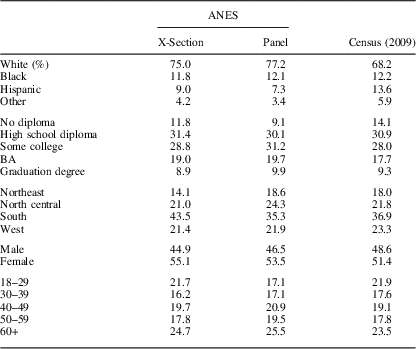
Both ANES studies are based on probability sampling procedures. In this respect (as in others), both enjoy obvious advantages over the convenience samples of college students or the opt-in samples of indeterminate representativeness that have been and remain standard practice in research on implicit attitudes. On basic characteristics, the ANES X-Section and Panel samples closely match national figures (see Table 1).Footnote 3
Sample Characteristics of the 2008 American National Election Studies (ANES) X-Section and the 2008 ANES Panel

Source: census data come from US Census Bureau, Current Population Survey Annual Social and Economic Supplement 2009; Census Bureau Population Division Annual Estimate of the Resident Population for the United States, Regions, States, and Puerto Rico: April 1, 2000–July 1, 2009.
Note: the ANES data incorporate suggested sample weights. The ANES Panel data focus on respondents who completed waves 9, 10 (the two that had the Affect Misattribution Procedure), and 20 (which measured racial resentment and included the Implicit Association Test). The analyses to follow focus on non-Hispanic whites.
The Measurement of Prejudice
The measurement of implicit attitudes requires new methods. The ANES samples we use offer two measures of implicit prejudice: the AMP, developed by Payne et al. (Reference Payne, Cheng, Govorun and Stewart2005), and the Implicit Association Test (IAT), developed by Greenwald and colleagues (Greenwald, McGhee and Schwartz Reference Greenwald, McGhee and Schwartz1998).Footnote 4
The AMP appeared toward the end of the post-election X-Section interview. It was self-administered by respondents using laptop computers supplied by ANES interviewers. Each AMP trial began with presentation on the computer screen of a fixation point (in order to orient the participant’s attention and to signal the beginning of a new trial). This was followed by a brief (75 ms) but visible presentation of a photograph of a face. In half the trials, the photographs displayed the face of a prototypic white man; in the other half, the photographs displayed the face of a prototypic black man. After the photograph disappeared, a Chinese pictograph came onto the screen for a somewhat longer period (250 ms). On each trial respondents were instructed to decide quickly whether the Chinese pictograph was “pleasant” or “unpleasant” and to do so without being influenced by the photograph that immediately preceded it. In all, the AMP consisted of 48 trials: 48 Chinese pictographs, each used once; 12 black faces, 12 white faces, each presented twice, with order and pairings randomized across respondents.
In the standard interpretation of the AMP, the presentation of photographs is assumed to automatically activate racial feelings. Such feelings spill over onto the immediately following pictograph. Participants are aware of these feelings; the feelings are a primary basis for their rating of each pictograph’s pleasantness. But they are unaware of the rapid transfer from photograph to pictograph. Payne et al. refer to the transfer as a “mental sleight of hand” (Reference Payne, Cheng, Govorun and Stewart2005, 291). Interpreted in this way, scores on the AMP are said to capture prejudice in implicit form.
The IAT was administered to the Panel sample on the July 2009 wave. On each IAT trial, survey participants were presented on their computer screen with a single stimulus and asked to classify it as quickly as possible. The stimulus was either a picture or a word. The picture was a photograph of a white person’s face or a photograph of a black person’s face. The word referred obviously either to a good thing (“Friend,” “Love,” or “Good”) or a bad thing (“Enemy,” “Hate,” “Bad”). In one series of trials, respondents were instructed to press, as fast as they could, one computer key (P) if they saw either a picture of a black person or one of the positive words—Friend, Love, or Good—and to press another key (Q) if they saw something else. In another series of trials, the instructions were changed so that respondents now were required to press, as fast as they could, one key (P) if they saw either a picture of a white person or one of the positive words and to press another key (Q) if they saw something else. In total, the IAT consisted of instructions, practice trials, and two blocks of 28 test trials. Crucial to the measurement of implicit prejudice is speed of classification. According to the IAT, racial bias is revealed insofar as participants react faster when the task pairs positive words with a white face as against when the task pairs positive words with a black face.
Both the ANES X-Section and the ANES Panel also included a standard measure of explicit racial prejudice, the four-item Racial Resentment Scale. Racial resentment is one of a family of explicit measures of modern or cultural racism—modern as distinguished from old fashioned, cultural as distinguished from biological (Sears Reference Sears1988; Kinder and Sanders Reference Kinder and Sanders1996; Bobo and Smith Reference Bobo and Smith1998; Fredrickson Reference Fredrickson2002). The scale distinguishes between those who are generally sympathetic toward blacks from those who are generally unsympathetic, who resent the failure of blacks, as they see it, to demonstrate the American values of self-reliance and hard work.Footnote 5
Racial Bias?
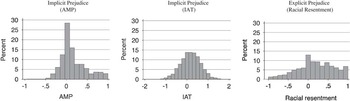
According to the AMP, racial bias is revealed insofar as Chinese ideographs are rated as more pleasant when preceded by a white face than when preceded by a black face. Racial bias is what we find. In the 2008 X-Section, whites were more likely to classify a Chinese character as pleasant when preceded by a white face (0.67) than when preceded by a black face (0.50). The difference is highly significant (p<0.001). Figure 1 shows the distribution of AMP scores we use for analysis. The summary AMP score is the proportion of ideographs rated as pleasant when preceded by a white face, minus the proportion rated as pleasant when preceded by a black face. (These scores can range from −1, indicating a pro-black bias, to +1, indicating a pro-white bias.)
Distribution of implicit prejudice and explicit prejudice among white Americans Source: 2008 American National Election Study X-Section (Affect Misattribution Procedure (AMP)) and Panel Study (Implicit Association Test (IAT) and Racial Resentment). Note: for the AMP, a score of 0 means the respondent was equally likely to rate the Chinese pictogram as pleasant, irrespective of whether it was preceded by a black or a white face. Positive values mean the pictogram was more likely to be rated as pleasing when preceded by a white face, up to a theoretical maximum of +1 (i.e., all white-faced pictograms were pleasing, and none of the black-faced pictograms were). Negative scores simply reflect bias in the opposite direction. For the IAT, positive scores mean the respondent took longer to associate black faces with positive words and white faces with negative words than the reverse. Racial resentment scores range from −1 (racially liberal scores on all four racial resentment questions) to +1 (racially conservative scores on the same).

Under the IAT, racial bias is revealed insofar as participants react faster when the classification task pairs positive words with a white face compared with when the task pairs positive words with a black face. Following standard practice, we calculate a “D score,” (Sriram and Greenwald Reference Sriram and Greenwald2009), which is the difference in average response latency (time) in the two types of blocks, divided by the standard deviation of the latencies across all blocks.Footnote 6 Once again, and consistent with scores of published reports, racial bias is what we see. White Americans taking part in the 2008 Panel do in fact respond faster in the first case than in the second (p<0.001).
Responses on the four racial resentment questions are scaled to range from racial sympathy (−1) to racial resentment (+1). Unlike the AMP or IAT, the Racial Resentment Scale lacks a natural neutral point, though it seems reasonable to interpret the middle of the scale (coded 0) as an approximation to racial neutrality. Under that assumption, the average score for white Americans in the ANES sample is located well off the neutral point, toward the racial resentment end of the scale (a score of 0.24).
In short, all three measures—the AMP, the IAT, and the Racial Resentment Scale—reveal evidence of racial bias. As can be seen in Figure 1, scores in each case are displaced to the right. They are otherwise distributed in more or less normal fashion: more so for the IAT, and less so for racial resentment, where the numbers thin out much more rapidly in the direction of sympathy than in the direction of resentment.
There is something else worth noting in Figure 1. Conspicuous in the distribution of AMP scores is a tall column in the center of the figure. In fact, 9.8 percent of white respondents in the ANES X-Section achieved perfect “color blind” scores on the AMP, rating an equal proportion of pictograms as positive, whether they were preceded by a white face or a black face.Footnote 7 This is unlikely enough to merit additional investigation. In fact, we find that all of the respondents who received an AMP score of 0 did so by clicking either “like” or “dislike” for all 48 pictograms, thereby rating the same proportion (0 or 1) as positive, irrespective of what kind of face preceded the pictogram. Perhaps, this behavior arises because subjects were eager to finish their interview session. Perhaps, it arises because they recognized the purpose of the test and sought to undermine it. We cannot say.Footnote 8 What we can say is that evading the AMP correlates with our explicit measure of prejudice, raising the possibility that the AMP is not a valid measure for an important subset of respondents.Footnote 9 , Footnote 10
The IAT has an advantage here. A subject cannot breeze through the IAT by tapping the same key over and over again. (The subject cannot proceed until he or she provides a “correct” response.) And since it tests the speed with which subjects can associate white and black faces with positive and negative words, color blindness is harder to fake.Footnote 11 These are additional reasons to pay close attention to what the IAT has to show.
Are Implicit and Explicit Prejudice the Same?
As a general matter, measures of implicit prejudice and measures of explicit prejudice are positively correlated. The correlations are, on average, modest, perhaps surprisingly so, and they are also surprisingly variable (e.g., Dovidio et al. Reference Dovidio, Kawakami, Johnson, Johnson and Howard1997; Fazio and Olson Reference Fazio and Olson2003; Payne, Burkley and Stokes Reference Payne, Krosnick, Pasek, Lelkes, Akhtar and Tompson2008; Greenwald et al. Reference Greenwald, Poehlman, Uhlmann and Banaji2009). Many of the estimates come from studies run on college students participating for course credit. Others arise from huge but unrepresentative opt-in samples. In many cases, the estimates are based on studies that include top-of-the-line measures of implicit prejudice but off-hand measures of explicit prejudice. The ANES’s design allows us to do better.
In representative samples of the national electorate, we find implicit and explicit prejudice to be modestly associated. The Pearson correlation between the AMP and the Racial Resentment Scale in the X-Section is 0.28. In the Panel, the correlation between the IAT and the Racial Resentment Scale is 0.15. Correcting these correlations for attenuation due to measurement error strengthens the association, of course, but only slightly. Corrected for attenuation, the correlations are 0.35 and 0.24 (Carmines and Zeller Reference Carmines and Zeller1979).Footnote 12
The relationship between implicit and explicit prejudice is modest—and it is robustly modest. By this we mean that the correlation between the AMP and the Racial Resentment Scale, like the correlation between the IAT and the Racial Resentment Scale, remain underwhelming for all kinds of people: men and women; young and old; Democrats, Independents, and Republicans; poorly educated and well educated; for those who are engaged in public affairs and for those who are not.
To summarize, with excellent samples, standard measures, and statistical corrections for unreliability, we find implicit and explicit prejudice to be largely distinct. As a practical matter, this means that implicit and explicit prejudice may have different stories to tell about race and politics in America.
Political Consequences of Implicit and Explicit Prejudice
Drawing conceptual and empirical distinctions between kinds of prejudice is one thing. Assessing whether such differences lead to different interpretations and conclusions is another. In the end, the value of the distinction should be assessed on instrumental grounds (Kaplan Reference Kaplan1964). How useful is it to distinguish between implicit and explicit forms of prejudice? What do we learn about politics that we otherwise would not?
Prejudice and the 2008 Election(s)
Americans Elect a Black President
On the first Tuesday of November 2008, the American electorate chose the son of a Kenyan immigrant to be the 44th president of the United States. Barack Obama won the election, but he lost the white vote decisively. Obama was elected president in spite of his race. Absent race, Obama would have won the 2008 election in a landslide. And without a deeply unpopular president of the opposite party and a terrifying economic and financial crisis, Obama likely would not have been elected at all (Tesler and Sears Reference Tesler and Sears2010; Kinder and Dale-Riddle Reference Kinder and Dale-Riddle2012). Our object here is to determine the extent to which white opposition to Obama in 2008 was driven by prejudice.
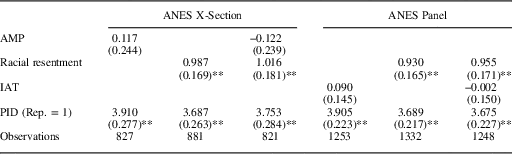
To do so we estimate the effect of prejudice on the 2008 vote controlling on other factors. Our model includes (in addition to prejudice) party identification, the single most important force in accounting for votes in partisan elections. It also includes a small number of nuisance variables, those that are correlated with both prejudice and the vote: age, sex, education, and region. We run the model twice: once on the ANES X-Section, and once on the ANES Panel. In both cases, we compare the effect of explicit prejudice, as assessed by the Racial Resentment Scale, with the effect of implicit prejudice, as assessed either by the AMP (in the X-Section) or by the IAT (in the Panel). For each analysis, we estimate models in which explicit and implicit prejudice are each examined alone—an approach that allows us to detect an effect by implicit prejudice even if explicit prejudice mediates its relationship with the dependent variable.Footnote 13 We also estimate a model in which explicit and implicit prejudice are examined simultaneously, which allows us to see if implicit prejudice provides incremental predictive power above and beyond explicit prejudice. Looking across the three models paints a picture of racial politics under both the classical view, and its “new look.” In each analysis, vote is coded 0 (Obama) or 1 (McCain), and parameters are estimated by probit.
The results, presented in Table 2, are striking. We find a large effect and virtually identical effect of explicit prejudice in both the X-Section and the Panel. As far as implicit prejudice is concerned, we replicate previous work finding that the effect of prejudice as measured by the AMP is much smaller, if it exists at all. When we consider that IAT as an alternative to the AMP, we see much the same story: a potent effect for explicit prejudice, and no detectable effect for implicit prejudice. In short, our understanding of the role of prejudice in vote choice depends crucially on how we conceive it.Footnote 14
The Effect of Prejudice on White Voting Against Obama in the 2008 Presidential Election

Note: probit model, whites only. Non-voters excluded. The dependent variable is reported vote choice in the presidential election coded such that Barack Obama=0, John McCain=1. Controls for age, gender, region, and education are included but not shown. This and all other analyses incorporate the design-appropriate weights provided by ANES. Standard errors in parentheses.
ANES=American National Election Studies; AMP=Affect Misattribution Procedure; IAT=Implicit Association Test; PID = Party Identification.
**p<0.01, *p<0.05.
Obama Versus Clinton
Heading into the 2008 presidential election cycle, Senator Hillary Clinton was the Democratic Party’s presumptive nominee. She enjoyed the backing of party elites, an experienced and professional staff, and widespread public support. But as we know, in a tight and fiercely contested race, it was Senator Obama who eventually emerged victorious.
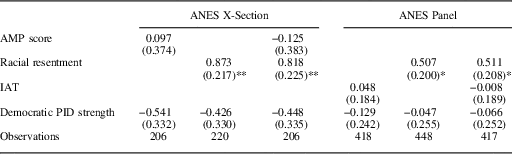
Table 3 shows the extent to which prejudice motivated the vote against Obama in the Democratic nomination race. If by prejudice we mean the explicit variety, as assessed by the Racial Resentment Scale, prejudice was a major obstacle to the Obama candidacy. If by prejudice we mean the implicit variety, as assessed either by the AMP or the IAT, the story is very different: in the nomination struggle between Senator Clinton and Senator Obama, there is scant evidence that prejudice plays either a direct or a complementary role.
The Effect of Prejudice on White Voting Against Obama in the 2008 Democratic Nomination Contest

Note: probit model, whites only. Republican identifiers (including leaners) and individuals who did not vote in the primary election excluded. The dependent variable is vote choice in the primary election coded such that Barack Obama=0, any other candidate=1. Controls for age, gender, region, and education are included but not shown. Standard errors in parentheses.
ANES=American National Election Studies; AMP=Affect Misattribution Procedure; IAT=Implicit Association Test; PID = Party Identification.
**p<0.01, *p<0.05.
Taken together, the results on prejudice and voting are consistent with the claim that Obama’s presence—his racial identity—changed politics in 2008, altering both the Democratic Party nomination and the general election contest. Obama was nominated and then elected in spite of prejudice eating into support he would otherwise have enjoyed. That, at least, is the story that unfolds from the perspective of explicit prejudice. It is a story that implicit prejudice misses entirely.
Prejudice and Policy
Public opinion on policy is generally “group centric”—that is, shaped in powerful ways by the feelings citizens harbor toward the social groups they see as the principal beneficiaries of the policy (Converse Reference Converse1964; Sniderman, Brody and Tetlock Reference Sniderman, Brody and Tetlock1991; Nelson and Kinder Reference Nelson and Kinder1996). By this logic, white opposition to policies seen as advancing the interests of blacks should be due, in part, to prejudice.
The X-Section and Panel carry questions on race policy: one deals with the federal government’s role in prohibiting employment discrimination; another takes up the practice of affirmative action in hiring and promotion. We code these such that the more restrictive stances take high values, and examine the relationship to prejudice.
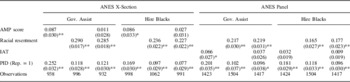
As shown in Table 4, opposition to egalitarian policies in the realm of race is explained, in important part, by explicit prejudice. The effect is substantial in both surveys and for each of the four policies we consider. There is some evidence for an indirect relationship on the part of implicit prejudice, too: examined alone, implicit prejudice is significant in three of the four models. As we discuss in the conclusion, that implicit prejudice would emerge as significant here, and not among the other dependent measures we examine, is suggestive of the idea that these policy opinions are “top-of-the-head” judgments, more than deliberated opinions, and thus most susceptible to the influence of implicit prejudice. This said, even here, implicit prejudice illuminates less than explicit prejudice. For each policy, the effect of implicit prejudice is perhaps one-third that of explicit prejudice, and when the two are examined simultaneously, implicit prejudice is indistinguishable from 0.
The Effect of Prejudice on White Opposition to Policies in the Domain of Race

Note: ordinary least squares, whites only. Controls for region and education are included but not shown. The dependent variables (X-Section questions V083137 and V085157 plus Panel questions ZB1 and N15 from the November 2008 wave) are coded such that opposition to government helping blacks and opposition to preferences in hiring and promotion take high values. Standard errors in parentheses.
ANES=American National Election Studies; AMP=Affect Misattribution Procedure; IAT=Implicit Association Test; PID = Party Identification.
**p<0.01, *p<0.05.
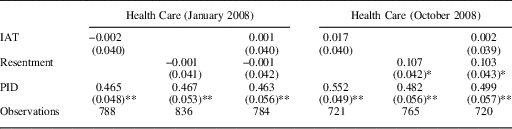
During the 2008 campaign, Senator Obama argued that the American health care system was broken, that reform was necessary, and that he would fix the system if he were elected. Panel respondents were asked for their views on heath care twice: once in January, as the primary season was getting underway, and once in October, on the eve of the election. This allows us to see whether Obama’s embrace of health care reform had the effect of racializing opinion on health care.
In January, by a slight majority, whites favored government stepping in to guarantee all Americans health insurance (50.6 in favor, 49.4 percent against); in October, a decisive majority opposed such action (43.4 percent in favor, 56.6 percent against). And as expected, the effect of prejudice on opposition to government health care increased significantly over this period (see Table 5). More precisely, the effect of explicit prejudice increased (consistent with Tesler’s 2012 experimental results). Implicit prejudice (measured via the IAT) did not predict opinions about health care reform as the campaign began, nor did it predict opinion at the end of the campaign. The racialization of health care attitudes is an important finding, and one that measures of implicit prejudice appear not to detect.
The Effect of Prejudice on White Opposition to Health Care Reform (Early in 2008 Versus Late in 2008)

Note: ordinary least squares, whites only. Controls for region and education are included but not shown. The dependent variables (question P13 from each wave) are coded such that opposition to health care reform takes high values. Standard errors in parentheses.
IAT=Implicit Association Test; PID = Party Identification.
**p<0.01, *p<0.05.
Assessments of Presidential Performance
Obama began his Presidency with very favorable ratings, but by the 2010 mid-term elections, a majority of Americans disapproved of his performance. In some ways this is not surprising. Declining popularity over the first term is a common experience for American presidents. However, Obama’s decline was unusually steep. In his first two years, Obama lost nearly one-third of his support in the general public, with virtually all of the decline taking place in the first nine months. Among Obama’s modern predecessors, no one fell as far or as fast (Kinder and Dale-Riddle Reference Kinder and Dale-Riddle2012). What role, if any, did prejudice play in Obama’s swift and steep descent?
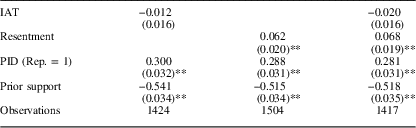
Table 6 presents the results of our statistical assessment. Using the ANES Panel, we predict support for Obama in July of 2009 as a consequence of three factors: prejudice, partisanship, and prior support (the last measured by ratings of Obama delivered at the tail end of the 2008 presidential campaign). In effect, we are predicting change in support for Obama, from the time of the election to the summer of his first year in office.
Prejudice and Disapproval of Obama’s Performance as President

Note: ordinary least squares, whites only. Controls for region and education are included but not shown. The dependent variable (question WS1 from the July 2009 wave) is approval of President Obama’s performance, reverse coded. Prior support is the average liking of Obama in September and October of 2008, coded 0–1. Standard errors in parentheses.
IAT=Implicit Association Test; PID = Party Identification.
**p<0.01, *p<0.05.
The results follow a now familiar pattern. Explicit prejudice predicts declining support for Obama. Obama’s fall is mostly a story of partisanship, but prejudice plays a role as well: racially resentful Americans, motivated to find fault with the new president, found it. If implicit prejudice has a similar story to tell, the effects—whether or not we control for explicit prejudice—are too small to detect.Footnote 15
Prejudice and Racialized Misinformation
At the conclusion of the 2008 campaign, shortly after the votes were counted and Obama proclaimed the winner, 19.8 percent of white respondents to the ANES Panel said that they believed Obama was Muslim. This despite the fact that Obama openly and visibly identifies as a Christian; that he was baptized in Chicago’s Trinity United Church of Christ; that he was married there; that his two children were baptized there; and that Obama attended services regularly at Trinity United when living in Chicago.
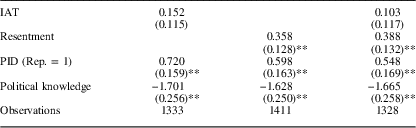
“Motivated reasoning” is the tendency to accept information, whatever its provenance, as long as it reinforces one’s predispositions (Taber and Lodge Reference Taber and Lodge2006). White Americans’ mistaken belief about Obama’s faith would seem to be an excellent case in point. Table 7 shows that prejudiced Americans were much more likely to believe that Obama was Muslim than were their less prejudiced counterparts. The impact of prejudice is over and above the substantial effects due to partisanship and general ignorance about politics.
Prejudice and Belief that Obama is Muslim

Note: probit model, whites only. The dependent variable is response to a question (WV3) on the November 2008 wave asking what Barack Obama’s religion is. Responses are coded Muslim=1, other=0. The equations also included measures of age, sex, education, and region (not shown). Standard errors in parentheses.
IAT=Implicit Association Test; PID = Party Identification.
**p<0.01, *p<0.05.
Once again, it is explicit prejudice that does the heavy lifting. Racial resentment discriminates sharply between those who believe, falsely, that the president is Muslim from those who believe, correctly, that he is not. Meanwhile, the effect of implicit prejudice, measured via the IAT, is small—so small that, by conventional standards, it cannot be distinguished from 0.Footnote 16
Conclusions and Implications
Implicit attitudes have been cast as a promising way to peer more deeply and more accurately into the human mind. We have made it our business to provide an assessment of the implications of this new kind of attitude for an understanding of politics, using prejudice as an important test case. We did so by comparing the political effects associated with implicit racial bias with the political effects associated with explicit racial bias. The differences are striking.
Consider first the nature of American racial politics looked at through the lens provided by explicit prejudice:
Racial bias played a major role in the 2008 presidential election, the first in American history to feature an African American major party candidate, and a major role as well in the fiercely-contested nomination struggle between Obama and Clinton.
Opposition to policies designed to diminish racial inequality – affirmative action, fair employment – is motivated in part by prejudice; so is resistance to health care reform after it became connected to Obama.
Support for Obama declined precipitously over the first months of his presidency – both in absolute terms and in comparison to his predecessors. This free fall in support was motivated partly by racial bias.
At the close of the 2008 campaign, 20% of white Americans believed that Obama was Muslim. This erroneous and stigmatizing belief can be explained, in part, by prejudice.
Some of these findings are sadly familiar, given a substantial literature showing that racial attitudes substantially influence political choices (Hutchings and Valentino Reference Hutchings and Valentino2004). Others are particular to Barack Obama’s presidency, underlining that explicit racial attitudes are still a fruitful avenue of inquiry. In contrast, when we examine how two measure of implicit prejudice bear on the same outcomes, the relationships are subtle and tentative, where we can find them at all. In no instances does implicit prejudice provide a statistically significant improvement over the relationships we would have found examining explicit prejudice alone.
It bears underscoring that the pattern is the same for implicit prejudice as measured by the AMP as it is for the IAT. Political applications of implicit prejudice have relied disproportionately on the AMP. And as we showed earlier, there are problems with implementing the AMP outside a controlled laboratory environment. That the differences between explicit and implicit prejudice are just as stark for the IAT as for the AMP is an important result.
This leaves the worry that our conclusions depend on a single measure of explicit prejudice, the Racial Resentment Scale. The scale has been criticized on the grounds that it conflates prejudice and ideology (e.g., Sniderman, Crosby and Howell Reference Sniderman, Crosby and Howell2000; and for a response, Sears and Henry Reference Sears and Henry2005). Our results here are unaffected by controlling statistically on the effects due to various representations of ideology. Going a step further, we repeated our analyses, after first replacing the Racial Resentment Scale with a standard measure of racial stereotyping included on both the X-Section and the Panel study, and found essentially the same results. (We report these results in our online appendix.) In short, the contrast we uncover between the two forms of prejudice—a strong political effect traceable to explicit prejudice and a weak political effect traceable to implicit prejudice—is robust.
Still, we do not mean to suggest that our result should serve as the final word on our subject. For one thing, our results do not tell us that implicit racial bias has no bearing on political judgments. The ability to detect effects is a function of sample size. Our samples are reasonably large by industry standards, but not so large that they can rule out small relationships that, accumulating over millions of citizens, could matter politically.
It also bears discussion that the data we examine were collected in an unusual context: the campaign and election of America’s first black president. In one sense, this makes our tests conservative. Valentino and colleagues suggest that when racial attitudes are made more accessible—an effect that Obama’s prominence seems to have had (Tesler and Sears Reference Tesler and Sears2010; Kinder and Dale-Riddle Reference Kinder and Dale-Riddle2012)—they should become more important to political judgments (Valentino Reference Valentino1999; Valentino, Hutchings and White Reference Valentino, Hutchings and White2002). Under this line of thinking, the effect of implicit attitudes should be easiest to detect in a racialized context. Then again, Valentino’s studies focus on the activation of explicit racial attitudes. Perhaps, Obama’s prominence would activate implicit prejudice to a lesser degree. Or perhaps explicit attitudes, having been activated by Obama’s presidency, mute the effects of implicit attitudes. (See our above discussion of the relationship between implicit and explicit attitudes as predictors of behavior.) A more certain verdict as concerns the relationship between implicit and explicit prejudice simply requires data collected in a less racialized context.
Finally, our analysis has focused on but one kind of implicit attitude: prejudice. Prejudice is an excellent place to begin an investigation of implicit attitudes in politics. American society has been and continues to be marked by profound racial inequalities of income and wealth, education, health, and safety, and of everyday justice. Prejudice both justifies such inequalities and provides an excuse for inaction. Prejudice is important. And as we said earlier, the indirect methods used to measure implicit attitudes may be especially applicable to attitudes like prejudice, that people might not care to express to others or even acknowledge to themselves
We do not assume that what we have learned about implicit prejudice here is representative of implicit political attitudes generally. Indeed, there are good empirical reasons to think otherwise (e.g., Arcuri et al. 2008; Roccato and Zogmaister 2010). Most interesting is a study by Pérez (2010), who finds that implicit prejudice directed at Hispanic immigrants, as measured by a version of the IAT, significantly and quite substantially predicts white Americans’ opinions on immigration policy. Pérez finds that explicit prejudice (in particular, ethnocentrism) weighs more heavily in opinions on immigration than implicit prejudice, and in that respect his findings resemble ours. But the importance of implicit prejudice reported by Pérez stands in sharp contrast to what we find.
Why the difference? We of course cannot say for sure, but perhaps the difference has to do with history. Since the civil rights movement, most white Americans have come to acknowledge that prejudice and discrimination are bad. They have learned to be careful what they say when it comes to race. Perhaps, they have learned to think twice before they express their views, to put to one side their impulsive reactions—when they have the time and space to do so. In principle at least, politics affords such time and space. The new immigration from South and Central America has yet to inspire a full-blown political movement that might teach whites the same lessons. Perhaps, whites react to immigration without giving the issue “a sober second thought.” Clearly, there is more work to do.
Even if the political consequences of implicit prejudice turn out to be as limited as we have shown here, that is very far from concluding that implicit prejudice is generally innocuous. On the contrary, the psychology literature is running over with demonstrations that implicit prejudice influences judgment and action in social life. As we note in our analysis of attitudes about racially sensitive policies, implicit measures of prejudice seem especially important in predicting “spontaneous” judgments and behaviors, those that occur without planning and deliberation (Dovidio et al. Reference Dovidio, Kawakami, Johnson, Johnson and Howard1997).
Since the 1964 Civil Rights Act, discrimination by race has been illegal, and surely it is neither as flagrant nor as pervasive today as it once was. But it is far from gone. Scores of careful studies convincingly establish that African-Americans still face discrimination at work; are still steered away from white neighborhoods when looking for housing; still suffer harassment by police officers in public spaces, and rudeness, excessive surveillance, and higher prices while they shop; still encounter coolness from their teachers and bosses, and racist jokes from their co-workers (e.g., Kirschenman and Neckerman Reference Kirschenman and Neckerman1991; Ayres Reference Ayres2001; Ross and Yinger Reference Ross and Yinger2002; Quillian Reference Quillian2006). Some, perhaps many, of these behaviors are likely to be spontaneous, impulsive, and not the product of careful deliberation. Along with Quillian (Reference Quillian2008), we suspect that implicit prejudice may be an important source of everyday acts of discrimination.
In our account, implicit and explicit prejudice both have important parts to play in American life. This position runs against the tendency within some quarters to privilege implicit attitudes over their explicit counterparts, to regard implicit attitudes as more representative of what people really feel (e.g., Fazio et al. Reference Fazio, Jackson, Dunton and Williams1995; Wegner and Bargh Reference Winter1998; Dijksterhuis Reference Dijksterhuis2008). We think it more useful to imagine that implicit and explicit measures capture different aspects of underlying predispositions. Under this premise, our task is not to assess which is more authentic, but to scrutinize the properties of each, evaluating when and how they come to bear on judgment and behavior. When it comes to understanding central aspects of racial politics, we find explicit attitudes—the things people say to others and perhaps say to themselves—carry the day.
Supplementary Material
To view supplementary material for this article, please visit http://dx.doi.org/10.1017/psrm.2015.49