In his book, Why Music Matters, David Hesmondhalgh (Reference Hesmondhalgh2013, p. 11) acknowledges that ‘Musicologists have recently turned their attention to emotion’. Although Hesmondhalgh's critical scope is generously broad, it is acutely focused on a popular repertory, whereas the affective turn in musicology has by and large concentrated on classical music. Perhaps that partly explains Hesmondhalgh's ambivalence about the direction this affective turn has taken, given the association of classical music studies with score-based and analytical approaches. Referencing my own work in this field, Hesmondhalgh cautions that ‘the shadows of formalism and structuralism … still loom’ (p. 13).Footnote 2 Hesmondhalgh's intervention deserves a response, not so much to defend ‘formalism and structuralism’ as to demonstrate that formal analysis can illuminate emotion in popular music as well as in classical.
First, music and emotion. It would be too intrusive even to sketch this rapidly emerging field here. Juslin and Sloboda's massive Handbook of Music and Emotion (Reference Juslin and Sloboda2010) is an established guide, bringing together perspectives from many disciplines (chiefly psychology, but also philosophy, brain science, anthropology, sociology and many others). From my own perspective, the biggest lacuna in the book is any representation from music analysis. And by ‘analysis’, I don't necessarily mean especially abstract, complex or arcane systems of modelling the musical experience. I mean, rather, any engagement with the musical detail at a level which would interest students, teachers and scholars working in a university music department (as opposed to a department of psychology or media and communication). To tar an interest in musical detail with the brush of ‘formalism and structuralism’, as if it were a revenant symptom of a defunct ideology, would be unfair, not least because it begs a number of invidious questions. The main question is whether there is anything wrong with ‘formalism’ per se, particularly in a musical context – and whoever agreed that formalism is dead? It is also problematic to elide ‘formalism’ (whatever that might be) with musical form – as if songs didn't have form, and this form isn't rewarding to look at in technical detail.
Second, there is a suggestion in Hesmondhalgh's position that even if a ‘formalist’ approach to music and emotion were sanctioned, then it would detract from what Georgina Born terms a ‘theorization of the multiply mediated nature of modern music culture’ (cited in Hesmondhalgh Reference Hesmondhalgh2013, p. 22). Hesmondhalgh applauds Born's theorisation, which is worth citing in full:
Since meaning inheres in the social, theoretical, technological and visual mediations of music as well as in the musical sound [emphasis mine], and since these all play a part in the construction of the musical sound, we should consider the musical object as subsuming these mediations. (p. 22)
Born's ‘the musical sound’ is a hazy place-holder, and I see no reason why the slot cannot be filled by musical ‘form’. Nor do I think that analysing a song's musical form in any way gainsays its mediation of the many processes Hesmondhalgh's book eloquently describes, including music's contribution to identity formation, a sense of sociability and place, and to wellbeing and flourishing, as if this were a zero-sum game. On the contrary, without something more formalised within this slot, it is hard to see what holds these many mediations together: in short, what mediates them? More to the point, this sceptical attitude to musical form(-alism) collides with a dramatic upsurge of formal analysis in popular music studies. This article puts these four building blocks together – emotion, music, form, popular song – in an analytical study of a band that has been noted for its powerfully emotional effects, presenting an analysis of the 10 songs which make up Arcade Fire's first album (2004), Funeral.
Arcade Fire
Arcade Fire is a seven-piece indie band from Montreal composed of husband-and-wife team Win Butler and Régine Chassagne, and an assortment of multi-instrumentalists. Funeral was hailed by Jim Fusilli, rock critic of the Wall Street Journal, as ‘the best album of the decade’.Footnote 3 The Suburbs, their third album, won the 2011 Grammy. Dazzled today by the hype around Arcade Fire's fourth album, Reflektor, it is easy to forget how improbable it was that a Canadian indie group signed with Merge Records should become, in the space of 10 years, and in their own estimation at least, ‘the biggest band in the world’.Footnote 4
Part of what makes Arcade Fire so broadly appealing is their infectious energy and sense of fun. They make conscious display of swapping instruments: guitars, violins, cellos, bass, accordion, horns, piano, organ, an assorted battery of percussion, including xylophones and glocks. The facts of Arcade Fire's sheer size – its membership ranging between six and eight artists – and the fluency of their instrumental exchange go to the heart of the songs' intricate colour schemes, how the timbres change from section to section. Instrumental circulation is compounded by a still richer stylistic interplay owing to the band-members' wide-flung backgrounds. Win Butler, the lead singer, was raised as a Mormon in a wealthy Texan suburb, and took a degree in theology (his brother Will is also in the band). His religiosity is counterpointed by an early enthusiasm for Manchester post-punk bands such as Joy Division and New Order, some of whose songs the band covers. Butler's voice, with its edgy vulnerability sometimes bordering on hysteria, is often compared with David Byrne's of Talking Heads. Régine Chassagne's profile is equally eclectic. Her grandparents were refugees from Haiti, and she sings some of the songs in French. Arcade Fire's preoccupation with drones possibly originates in Chassagne's background in medieval music: she studied it at McGill University, and performed in a neo-medieval band called Les Jongleurs de la Mandragore. Chassagne's child-like vocal delivery is reminiscent of Björk's, and her duets with Butler make for a distinctive clash of voice types. Sarah Neufeld and Richard Reed Parry pursue a parallel project playing in a ‘neo-baroque’ instrumental band called Bell Orchestre. Owen Pallett, who plays violin on Funeral and contributed the album's elegant string arrangements, is a renowned solo artist in his own right.
Praise for Arcade Fire fixes on their capacity to whip up extreme states of emotion through deceptively simple means. Here is one revealing review of Funeral on Sputnikmusic, representative of hundreds of others on the internet.Footnote 5
The problem with Funeral being my favourite album of all time was that at some point, I'd have to deal with the fact that despite being a great album, it isn't very musically complex … I was very conscious of the fact that Funeral lacked the complicated pieces Pet Sounds delivered or the insane amount of musical layers you'd get with your usual Animal Collective production.
The fan then records a revelation:
And then it hit me. Funeral didn't need complex pieces or tons of musical layers to be the best there is; it has a trump card that I'll take any day over the aforementioned qualities: emotion. Whether it be lamenting the places they grew up in, urging the children to grow up and seek power for themselves, singing for lost loved ones or just letting a girl know how much you love her, Arcade Fire did it all from the heart. Every syllable they sang, screamed or shouted, they meant. Every note they hit was the band member channeling what they felt at the time. Funeral is magic because it's genuine. That's its charm.
The fan is of course deceived that Funeral is ‘simple’, as my analysis of its 10 songs will show. It is revealing, however, to connect the phenomenal impression of simplicity with emotion, since this points to how Arcade Fire elicit emotion through the disposition of broad formal blocks and through a minimalist stylistic idiom. The majority of this article is dedicated to the songs' formal structures, on the basis of a theoretical model of how the music creates its intense emotional effects. This model is a hybrid of two quite well-established techniques: the ‘intensification’ (or Steigerung) model; and the ‘hydraulic’ model. I'll begin by reviewing both models separately, although they are richly implicated within each other in dialectical fashion.
Intensification
Mark Spicer (Reference Spicer2004) influentially noted that it is a trait of many popular songs to grow in intensity, both within the intro and across the track as a whole. He calls the progressive layering of the groove within the intro, as the various parts are successively fitted into the aural jig-saw, ‘accumulative’ form. He calls the gradual pan-parametric ‘crescendo’ across the whole song – the rise in pitch, dynamics, tempo, register, complexity, etc. – ‘cumulative’. (Ac)cumulative forms climax with an anthemic rendition of a melodic idea outlined less forcefully earlier in the song. If Spicer's idea suggests the notion of a through-composed process, then Allan Moore (Reference Moore2012, p. 84) reminds us that it is fairly common for tracks to superimpose a sense of growth over a conventional formal layout. That is, (ac)cumulation is compatible with pop songs' proclivity for formal repetition. Indeed, it is possible that (ac)cumulative form has become even more pronounced since 2000. In an important recent article, Brad Osborn (Reference Osborn2013) has observed a tendency of ‘post-millenial’ rock songs to push towards a ‘terminal climax’. These climaxes are often marked by anthemic choruses, clinching the song's emotional climax.
Nevertheless, build-up towards a melodic climax is hardly a new procedure. Spicer acknowledges that he borrowed the term from Peter Burkholder, who identifies increasing use of ‘cumulative’ forms across nineteenth-century classical music, beginning with Beethoven. In parallel with that, ethnomusicologists' interest in cumulative form follows E.O. Henry's (Reference Henry2002) seminal article, ‘The rationalization of intensity in Indian music’, which explored intensification processes in Hindu and Muslim ecstatic and religious music across the world (see also Widdess Reference Widdess2013, p. 40). (Ac)cumulation, then, is a fairly obvious way of exciting listeners' emotions. It is also quite deeply rooted in Western aesthetics, being one of the most pervasive principles in nineteenth- and early-twentieth-century philosophy as well as science, often under its originally German rubric, ‘Steigerung’ (see Spitzer Reference Spitzer2004). Wearing his theoretical hat, the poet and polymath Johann Wolfgang von Goethe detected Steigerung in all traits of human artistic endeavor, as well as in aspects of the natural universe such as botany and optics (Spitzer Reference Spitzer2004, pp. 294–5). My contribution in this article is to relate Steigerung to a branch of formal theory called ‘sentence’ form. Sentence form, as I shall show, is (ac)cumulative form at the level of the phrase. After Goethe, the sentence was theorised in the sphere of classical instrumental music by Schoenberg and his followers, the music theorists Erwin Ratz and William Caplin. However, it is potentially useful for popular music analysis too, saving it the trouble of re-inventing several wheels.
The hydraulic model
The hydraulic model views emotion as a kind of suppressed pressure or force which finally erupts from within. It conceptualises emotion as a liquid which is alternately contained and discharged. The philosopher Robert C. Solomon (Reference Solomon1993) critiqued the hydraulic model because it seems to minimise the role of judgment (which he endorses).Footnote 6 Whilst it vividly evokes a sense of an emotional subject being passively in the grip of a passion like an external force, it doesn't capture the rational, intensional, aspects of emotion: most philosophers now think that emotion involves an attitude to, or appraisal of, something in the environment. However, this is not to gainsay the hydraulic model's heuristic value, its historical significance (including, most notably, the idea of emotion as ‘discharge’ in Freudian psychoanalysis), or indeed peoples' everyday-life construction of their subjectivity in terms of liquid/container schemas. For example, Nicola Dibben, in her rich analysis of emotion in Björk, invokes the hydraulic model in terms of ‘filling up’, ‘bursting’ and ‘spilling out’ (Dibben Reference Dibben2006, p. 171).
The model has lent itself comfortably to music aesthetics on the basis of In/Out schemas of emotional expression (see Spitzer Reference Spitzer2004). Musical emotion erupts like volcanic magma from ‘within’ the musical structure; expression first resists and then breaks ‘out’ of form. The schema is heuristically useful but ultimately misleading because of course there is no such thing as formless expression, just as form has its own expressive qualities. Nevertheless, it is worthwhile pushing through the aporias identified by Solomon's critique because the hydraulic model is even more richly suggestive when put into relation with the intensification model. It is useful to imagine the songs' internal ‘pressure’ itself as powering their cumulative drive towards emotional discharges inscribed within their anthemic climaxes; that is, to see the hydraulic model as pushing forward as well as ‘out’.
*
Analysing Funeral in terms of a dialectic between (ac)cumulation and eruption begs the question, what are the ‘internal pressures' which power Arcade Fire's songs? I argue that they emanate from a stylistic contradiction: the band's maximalist tendencies – the extraordinary diversity of idiom, genre, and colour, noted at the start of my essay – pull against the minimalism traditionally imputed to the indie ethos by Wendy Fonarow (Reference Fonarow2006), Simon Reynolds (Reference Reynolds2007) and earlier critics. In its mixed gender (indie is masculine), large size (indie is small), baroque luxuriance (compared with the stripped-down quality of ‘authentic’ indie) and, not least, in its enormous fan base, Arcade Fire breaks many of the cardinal indie principles. Moreover, indie's alleged ‘undanceability’ is refuted by Reflektor’s easy assimilation of disco.Footnote 7 The generic omnivorousness of their four albums, culminating in Reflektor’s confrontation with dance music, sharpens the conundrum that Arcade Fire can maintain its identity both in itself and as an indie band. Arcade Fire's maximalism, then, surges centrifugally out of a minimalism which seeks to rein it in. This minimalism is another name for the ‘simplicity’ identified in the Sputnikmusic review. Its elements can be unpacked.
The melody tends towards the anthemic, with repeated hooks. The harmony is largely static, with drones and pedals; it seldom modulates, is mostly diatonic or pentatonic, and avoids chromatic or blue notes. The metre is nearly always 4/4, containing little syncopation or swing. This regularity is compounded by the music's form, which is marked by metrical periodicity at rising levels, clear sectional blocks, and a fidelity to standard verse/chorus patterns. The songs are assembled from highly contrasted block-like sections. Whilst keeping to standard verse/chorus designs, the contrast between these sections is maximised chiefly by levelling off the internal contrast through static harmonies, drones and minimalist repeated hooks; through shifting combinations of instrumental colour; and by a strong orientation towards anthemic choruses. The homogenising of the musical material into blocks helps lift the listener's attention onto the larger-scale processes unfolding across their architecture. This creates the link between formal simplicity and (ac)cumulative processes.
The dialectic spirals into delicious complexities. The very gap between the band's minimalist form and maximalist content gives the listener an aural vantage-point upon the eclectic material. This distancing effect, positioning Arcade Fire's audience as spectators of a sonic spectacle, aligns the band with the indie metaphysics Fonarow (Reference Fonarow2006) develops after the ethnomusicologist John Chernoff. It epitomises what Chernoff terms ‘Western conceptions of ideal spectatorship … based on complete mental engagement’, a cognitive focus which bodily motion would seem to disturb (cited p. 173). Regarded from another angle, the stasis of spectacle tugs against the telos of progressive intensification. Arcade Fire songs push forward as much as they stand still or look back. This chimes with the torsion of the lyrics, twisted between the relentless drive (literally) of car culture, and the retrospective glance of funereal mourning. Arcade Fire are always leaving, and always returning to, the suburbs. Arcade Fire burst through the ‘little boxes' of verse–chorus conventions – perfect analogues of suburban conformity – and yet, at the end of the road, these conventions are celebrated.
Another facet of this conflict is a tussle between the expansive teleology of intensification, and the micro-periodicities of swing – as it were, between long arrows and little circles. Hence the classic indie/dance antithesis, rehearsed by Reynolds et al., doesn't work for Arcade Fire, who take dance (and ‘danceability’) in their stride, as a counter-force to (ac)cumulation. (That said, what ‘Wake Up’ does to Motown groove is very telling, as I shall show.) Finally, to home in on the crux of the matter, the dialectic is also expressed by the fact that Arcade Fire's anthemic climaxes are also breakthroughs. This works at a trivial level, of a melodic idea, buried at the outset of the song by multiple sonic layers, becoming unearthed from those layers at the end. It also obtains at the more sophisticated philosophical level of aesthetic self-reflection, as when the climax of a song reveals the particularities or essence of an earlier thematic idea. An (ac)cumulative climax, then, is not just higher, louder, faster, fuller etc.; it can also be revelatory. To capture this effect, we need new tools of thematic analysis.
Formal theory and the sentence principle
A good place to start is Osborn's (Reference Osborn2013) refinement of the concept of (ac)cumulative form. Osborn makes a useful distinction between the cumulative and the ‘terminally climactic’. In the former, climaxes are derived developmentally through a continuous process, or else recapitulate or refer to previous material. Terminal climaxes, in contrast, are ‘completely new’ (p. 23) and their impact is due to their novelty and freshness. Now, I would argue that Osborn's distinction is fairly moot, and is at best a matter of degree. To take a classic precursor of terminally climactic form (Osborn Reference Osborn2013, p. 23), why can't the 19 performances of the double-plagal cadence (E♭–B♭–F) in the cathartic coda of ‘Hey Jude’ (Everett Reference Everett1999, p. 192) not be heard as intensifications of the subdominant chorus? Even if the material were heard as being completely new, the coda is functionally integrated within the song by virtue of affording its first ‘structural downbeat’ (p. 192). A related issue is that much of what Osborn says about terminal climaxes applies equally well to choruses, particularly in a band such as Arcade Fire which ostensibly works within established verse–chorus paradigms rather than ‘subverting’ them.
These questions do not detract from the many illuminating points Osborn makes particularly about the distinctive ways climaxes – be they in choruses or codas – function in rock music. Whereas classically orientated music theory identifies ‘climactic points, rather than identifying entire sections as sustained climaxes', climaxes in rock music ‘are typically structured as sectional events’ or ‘plateaus’, generally featuring looped chord progressions and repeated melodic hooks (Osborn Reference Osborn2013, p. 26). There is a paradox here: repetition sustains climaxes in rock into sections rather than moments; simultaneously, as Everett points out with respect to ‘Hey Jude’, ‘repetition can be so continuous as to function as a be-here-now mantra that savors the moment to promote a transcendent anthemic experience’ (Everett Reference Everett2009, p. 154). The ‘moment’, then, can be alternatively chronometric, in clock-time (classical highpoints), or phenomenological, as when mantra-like repetition suspends the experience of time passing (rock plateaus).
How does this paradox affect the (climactic) chorus's functional relationship to the verse? ‘In a verse–chorus form’, writes John Covach (Reference Covach and Stein2005, p. 71), ‘the focus of the song is squarely on the chorus’, a judgment echoed more recently in Christopher Doll's (Reference Doll2011) concept of the ‘breakout chorus’. However, the peculiarity of the chorus's role has been understated by rock theory. The chorus's formal obligations with respect to the verse involve a double functional blend. A chorus is both a climax (high intensity) and a resolution (low intensity); it is both a highpoint (momentary) and a section (sustained). By ‘functional blend’, I draw from recent theoretical literature on classical sentence form, which potentially gives us new tools for understanding anthemic climaxes in rock.
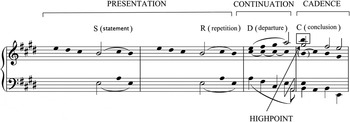
According to William Caplin's Schoenbergian theory of formal functions in classical music, a ‘sentence’ is a phrase structure which unfolds a through-composed (and thus non-symmetrical) trajectory from ‘presentation’ through ‘continuation’ climaxing with ‘cadence’ (Caplin Reference Caplin1998, pp. 9–12). Its teleological, continuous progression marks it off from the much more familiar, but actually less common, ‘period’ structure, with its ‘question, answer’ (antecedent, consequent), open–closed phrase pairings (Moore Reference Moore2012, p. 85). A sentence is a ‘cumulative’ form in nuce. This concept is far from a new arrival in popular music scholarship; one of its most compelling applications is Everett's analysis of the verse structure of ‘Please Please Me’, albeit without referring to the ‘sentence’ by name (Example 1).
Beatles, ‘Please Please Me’, sentence form (Adapted from Reference EverettEverett 2001, p. 132).

Instead, Everett calls it Statement–Restatement–Departure–Conclusion form (SRDC), and identifies it as the most prevalent verse structure in the Beatles' early music (Everett Reference Everett2001, pp. 131–5). Everett's analysis is worth reviewing in detail.
The verse's opening four-bar phrase (‘Statement’, or S) dwells on an upper-neighbour, C♯–B, motif, supported by a IV–I progression (repeated as ‘Restatement’, R). Although Everett characterises the next phrase as ‘Departure’ (D), its behaviour conforms to a sentential ‘continuation’, as described by Caplin. The progression is fairly striking. John sustains a C♯ pedal against Paul's step-wise ascent E–F♯–G♯–A, with the harmony progressing from IV through VI and III back to IV. By pivoting on this C♯ as a common tone, this prolongation of IV (via VI and III) seizes upon and intensifies the opening phrases' central feature, the C♯ upper neighbour. As well as picking out and intensifying a material aspect, this D phrase also accelerates the relatively slow harmonic rhythm of the opening phrase (S: two bars of I, then IV–I, I–iii–IV–V; R: two bars of I, then IV–I, I) to one chord-per-bar in a modulating sequence. Finally, the song climaxes at its registral highpoint when John leap-frogs Paul to sing a falsetto top B (unlike Everett, who places the B beneath the C's Schenkerian ‘obligatory register’, my graph projects it above the G♯ to highlight its role as the song's high-point). It is worth underlining that this climax occurs within the cadential ‘Conclusion’ (C) phrase: the intensification of the sentence's ‘continuation’ phrase flows into and, to use Caplin's word, is ‘fused’ with, the cadential function of the final phrase (Caplin Reference Caplin1998, p. 10). C's intensity, its tonic orientation notwithstanding, is compounded by its odd harmonies (deferring tonic resolution until the last moment by oscillating between VI and III) and fractured voicing.
Everett's designation of the middle phrase as ‘Departure’ is a misnomer. It really performs the sentential ‘continuation’ functions of fragmentation (seizing on the C♯) and acceleration (of harmonic rhythm), creating an overall feeling of intensification. It also flows into, and ‘fuses’ with, the C phrase, as is conventional of classical sentences, so that the climax is both a peak of intensity, and a resolution (including providing the motto of the song). In other words, it displays the functional hybridity of a chorus. According to Caplin, ‘the two functions of continuation and cadential normally fuse into a single “continuation phrase” in the eight-measure sentence’ (p. 11). The Beatles are on the same page as Beethoven with regard to functional ‘fusion’: see the locus classicus of sentence form from Schoenberg through Erwin Ratz to Caplin, the opening theme of Beethoven's own debut, his first piano sonata, Op. 2/1 in F-minor (Caplin Reference Caplin1998, p. 10). Caplin's concept of ‘form-functional fusion’ has also been taken up by Trevor de Clercq in a wide-ranging theory of ‘functional blending’ in rock music (de Clercq Reference De Clercq2012). By de Clercq's lights, the full spectrum of sectional roles interpenetrates quite freely within single songs (not just verse and chorus but also refrain, bridge, solo, prechorus, etc.). What is missing in de Clercq's analysis, however, is the sense of cumulative teleology intrinsic to Caplin's theory of the sentence.
Sentence form in popular-music studies has been explored more directly by Jay Summach (Reference Summach2011). In a corpus study of some 700 songs drawn from the Billboard Annual Top 20's from 1955 to 1989, Summach finds that strophes were sentential in nearly half of them, and he also notes the momentum-building function of pre-choruses. Nevertheless, Summach stops short of exploring the sentence principle across the entire structure of a song, an expansion of role which is only possible when sentence form converges with (ac)cumulative form. Although it could be argued that the confluence of sentential and (ac)cumulative processes was only historically possible in the post-punk era of the 1980s, it is interesting to linger a while longer with the Beatles to understand why it took so long.
The affinity between climaxes within a verse, and climaxes between verses and choruses (in Caplin's parlance, ‘intrathematic’ and ‘interthematic’) is played out differently within the Beatles’ early songs because their choruses tend to fall in the subdominant. Hence they strike a balance of another kind, where both the verse and the song as a whole unfold aaba patterns. Thus the songs are sentential both on a micro- and macro-level. Yet, despite the songs representing a kind of formal perfection in themselves, this micro/macro balance is an historical dead-end because the functions of verse climax and chorus would later re-align along different principles. Verse ‘Conclusions’ become more chorus like, and choruses drift into the tonic, turning into quasi-cadential resolutions. The Beatles take steps in this direction in several later songs. Anthemic, tonic-based choruses can usurp phrase C (‘Lucy in the Sky with Diamonds’; ‘While my Guitar Gently Weeps’; ‘She's Leaving Home’) or even both D and C (‘Penny Lane’; ‘All you Need is Love’).
Surveying how these developments feed into a much later band like Arcade Fire, we see the crucial influence of the post-punk stripping-down, homogenising and polarising of formal functions. These influences are disclosed by the band's covers of two songs by Joy Division and New Order. Joy Division's ‘Love will Tear us Apart’ (1979) is built from a single, repeated riff. All that distinguishes the verse from the chorus is treatment of the riff: sketchy in the verse; anthemic in the chorus. Arcade Fire's cover of this song is revealing, in that they add their trademark block-like instrumental contrast across repetitions of the riff.Footnote 8 With their eye on the architectonic level, Arcade Fire do not seem to be particularly interested in sentence form within verses. Their verse structure is often simplified into naked repetition, exploding the first two parts of Everett's SRDC model, eliding the third, and commuting the fourth to the chorus.
In New Order's ‘Age of Consent’ (1983), verse and chorus are assigned different ideas, but reduced to a bare minimum: the verse is one line, alternating with a chorus comprising a (variedly) repeated line. Arcade Fire both halve the length of the main part of the song by dropping the original's contrasting middle verse (‘I saw you this morning …’) and massively extend the outro (based on repetitions of ‘I've lost you’) into a quintessential example of one of their seemingly endless anthemic climaxes.Footnote 9 In short, they re-compose the form of ‘Age of consent’ into the AABABC pattern which is the prototypical song structure in Funeral. Many of the songs on the album are formally more complex than that, but it is worth considering how AABABC epitomises the way Arcade Fire commute the sentence principle from the level of the verse (which is now formally simplified into naked repetitions) to the level of the track as a whole.
AABABC displays all of Caplin's three sentential functions: ‘initiating’, ‘medial’ and ‘cadential’. AA, the repeated verse, comprises the initiating first part of the sentence, akin to Everett's SR verse pattern. After B (the first chorus), the second half of the song eliminates the verse repetition, thus foreshortening the form, by analogy to the accelerated harmonic rhythm of Everett's D section. Intensification is also expressed by cumulative growth across the song, with each succeeding verse and chorus being more intense than before. Finally, each return of the chorus, climaxing with the anthemic coda, functions as a quasi-cadential resolution.
The songs
Nine of the 10 tracks on Funeral culminate with derived terminal climaxes, with codas that sound new yet transform previous material (the exception, ‘Haiti’, is an interesting special case).Footnote 10 Although all these nine songs are sentential, they divide, roughly half-and-half, according to whether they approach their climax in two or three ‘waves’. The five binary songs, ‘Neighborhood #1 (Tunnels)’ (track 1), ‘Une année sans lumiere’ (track 3), ‘Neighborhood #4 (Kettles)’ (track 5), ‘Rebellion (Lies)’ (track 9), and ‘In the Backseat’ (track 10), have an AAB|ABC structure, divided after the first chorus. Two verses (AA) lead to chorus 1 (B), which rounds off the first wave of the sentence. The second wave foreshortens the form by eliding one iteration of A. The chorus, which may or may not be repeated, leads to the climax in the coda or outro (C), which is usually based on the material of the chorus or verse. The four ternary songs, ‘Neighborhood #3 (Laïka)’ (track 2), ‘Neighborhood #4 (Power Out)’ (track 3), ‘Crown of Love’ (track 6), and ‘Wake Up’ (track 7), are based on an AB|AB|ABC pattern, which can be compounded in various ways. The three-wave songs are by far the more complex and formally interesting on Funeral. After reviewing seven of these songs, I will focus on the most sophisticated examples of the binary and ternary categories, respectively ‘Tunnels’ and ‘Wake Up’.
The distribution of two-and three-wave sentences across the album is systematic. Up until track 7 (‘Wake Up’), the alternation is regular: tracks 1, 3, 5 (two-wave) mesh with tracks 2, 4, 6 (three-wave). The levelling out into two-wave songs (tracks 7, 9 and 10; ‘Haiti’, track 8, notwithstanding) in the second half of the album serves to book-end Funeral with a satisfying symmetry.
The two-wave sentence
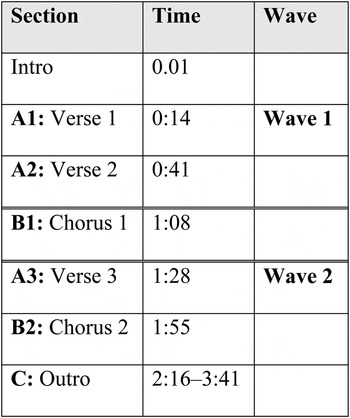
‘Neighborhood # 4 (Kettles)’ affords the simplest example of the AAB|ABC two-wave sentence (Figure 1). A G-major lament with a captivating kettle-drum riff and folk-orientated violin playing (the sul ponticello scratching evokes the sound of a boiling kettle), the contrast between verse and chorus is relatively subdued. The chorus's crucial input is an affecting violin riff (E–F♯–G–B–A–G), which seeds Butler's lullaby-like vocalisation in the coda, at 3:53 (D–E–D–B–A–G).
‘Neighborhood #4 (Kettles)’.

‘Une année sans lumiere’ begins as a gentle, contemplative song, Butler alternating lines in English and French to light acoustic-guitar accompaniment. As in ‘Kettles’, the verse/chorus contrast is fairly flat (Figure 2).
‘Une année sans lumiere’.

The main difference lies in the lines’ cadential endings: lines 2 and 4 of the verse feature a rising-third melody, scale-steps 1–2–3 (D–E–F♯). The chorus complements these repeated rises with a single span of melody descending from high C natural, relaxing into a 3–2–1 cadence. These rising/falling-third progressions will be taken up and compressed at the end of the coda (3:05), when the whole band starts shouting them out to new text, ‘Give it to her’. This climax is quintessentially sentential, in encapsulating the thematic kernel of the song. The song is also interesting for its recursive 2/3 (40/60%) proportionality. ‘Accumulative’, according to Spicer's strict sense of the term, this long coda begins by building a series of layers upon the track's ostinato guitar figure. It starts at 2:16, 60% through the track's total duration of 3:41. After 32 seconds – 40% through the coda – and four iterations of 8 second, four-bar blocks, this accumulative process is interrupted by a much faster section lasting 56 seconds (tempo accelerated 60% faster to 5 second blocks); and 40% through this section (20 seconds), the voices enter with ‘Give it to her’. The ratio of acceleration is nicely honed around the motivic liquidation.
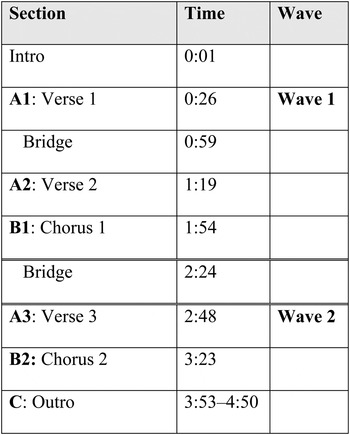
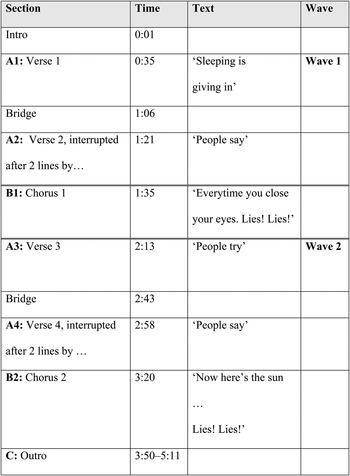
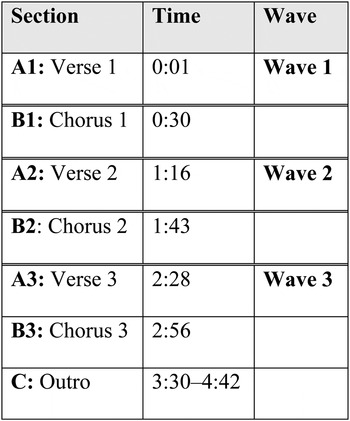
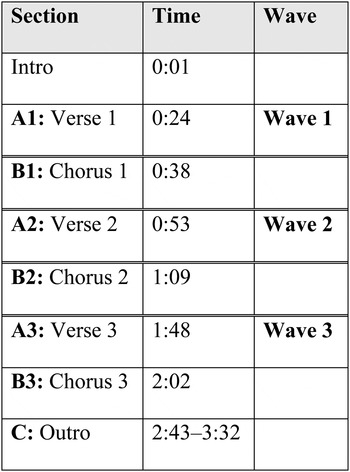
‘Neighborhood # 1 (Tunnels)’, which I will look at in detail below, extends the pattern to AB′ABBC by repeating the second chorus (Figure 3). The sunny, breezy ‘Rebellion (Lies)’ shows the flexibility of the pattern (Figure 4).
‘Neighborhood # 1 (Tunnels)’.

‘Rebellion (Lies)’.

The two-wave sentence is doubled, or rather, split into two constituent little sentences: AAB|AABC (with bridges). The length of the second ‘A’ in each wave is halved from four lines to two, creating an impression that the verse is interrupted by – or even transformed processually into – the chorus. Moreover, the two verses in the second wave are atomised by lots of repetition, so that the song as a whole expresses sentential liquidation. ‘Rebellion’ also contains the album's clearest anthemic breakthrough. As the chorus takes harmonic flight from the B♭ tonic to D♭-major, this bit of harmonic colour is underpinned by a hidden statement of a soaring new melody. This expansive, eight-bar instrumental melody emerges in the outro as an anthemic vocalisation as celebrated as the chorus of ‘Wake Up’, also evincing the step-wise descending contours distinctive of Arcade Fire's anthems (Example 2).
Arcade Fire, ‘Rebellion’, chorus, 3:48’.

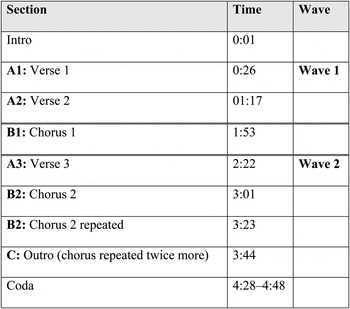
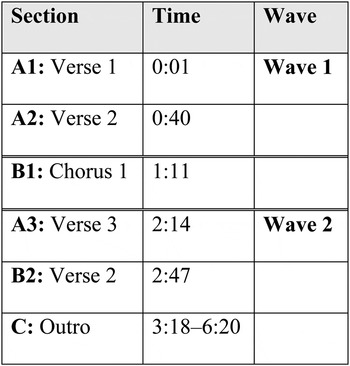
It is repeated four times in the outro, but extended indefinitely in live concert: typically (and fans come to expect this), after the instrumentalists have rounded off the song and stopped playing, Butler leads the audience in repetitions of the mantra. The same thing happens in ‘In the Backseat’, which contains proportionately the longest coda of the album, lasting three minutes (nearly half of the track's 6:20) (Figure 5).
‘In the Backseat’.

This coda is an expansion of the chorus in a track which is the most chorus-orientated of all Funeral’s numbers. ‘In the Backseat’ is also the only song which begins off-tonic, reserving the arrival of its D-major home key, and structural downbeat, to the entry of the chorus (compare with ‘Lucy in the Sky with Diamonds’). The verse enters in A-minor, and meanders through a sequence of descending triads towards D-major. The chorus's repeated three-chord sequence, D-major–B-minor–F♯-minor, underpins Chassagne's ecstatic vocalisations through the outro, together with a haunting violin riff. The outro's theatricality is brought out in live performance, where the band parodies a Pentecostal revivalist healing ritual.Footnote 11 As Chassagne stands swaying as if in a trance, the other band-members subdue their playing and take up her vocalisation. Chassagne seems to collapse and die, and the music dies down, luring the audience to start applauding, before storming back in at high volume, and leading the congregation of spectators in the continuing chant of the mantra-like riff. The instrumentalists take it in turns to try and awaken Chassagne, banging drums above her head, or sideling up to her on the stage floor and stroking the violin directly into her ear. This arch bit of drama epitomises the religiosity lurking within the band's ethos, albeit gently undercut by the band's surreal behaviour (Richard Parry walks around with a bass drum on his head). It is also a perfect close to the set, just as the outro's length and sentiment is appropriate for the final track of the album. The staged version connects ‘In the Backseat’ to Funeral’s overarching theme of children ‘awakening’ after death, expressed most overtly by ‘Wake Up’ and the official video to ‘Rebellion’.
The three-wave sentence
‘Crown of Love’ is a straightforward instance of the ternary AB|AB|ABC pattern (Figure 6). Its outro, starting at 3:30, is notable for the most schematic acceleration in Funeral, doubling the beat at 3:43 and re-doubling it at 3:57. The other representatives of this pattern take sentence form in far more interesting directions.
‘Crown of Love’.

‘Neighborhood # 2 (Laïka)’, a garish tale of Alexander, ‘our older brother’, who runs away from home and is ‘bit by a vampire’, is formally far suppler than the binary songs (Figure 7). Its chief addition to the sentence principle is chorus growth: chorus 1 is a single line (16 seconds); chorus 2 expands to four lines (42 seconds); chorus 3 over-flows into the coda, totalling 10 lines (1 minutes 30 seconds). This process is beautifully underscored by a repertory of timbrally variegated riffs. The intro accumulates three successive riffs in four-bar blocks: kettle drums (riff 1); guitar and glocks (riff 2); and accordion (riff 3). Riff 1 accompanies verse 1, in which Butler chants on a monotone F♯ (the tonic is B-minor). Chorus 1, which shifts into the relative major D, takes up the accordion timbre of riff 3 without its actual melody. The full accordion riff is reserved for verse 2. Chorus 2 is not only expanded; it also creates a striking ‘timbral event’. The brash repeated guitar chords fall away, and the word ‘neighborhood’ – the key concept of Arcade Fire's first three albums – is spot-lit by accordion and high violin playing in luminous octaves. Verse 3 is the most intense yet, with all the band shouting the text together to a new guitar rhythm. In the climactic third chorus, Chassagne undercuts Butler's melody with monotone shouting. This dissonance inflects the next treatment of ‘Neighborhood’: the emollient violin octaves are displaced by off-pitch distorted guitar introducing a new riff (riff 4). This new guitar riff links into the coda (‘When daddy comes home …’), with its vivid image of neighbours dancing ‘in the police disco lights’. The phrase timbrally ‘rhymes’ with previous treatments of ‘Neighborhood’, yet now picked out with even brighter intensity by a combination of piano, glocks, violin harmonics, even whistling. The recapitulatory gesture of ‘police disco lights’, recuperating and heightening the timbral smoothness of the first ‘Neighborhood’ after the roughness of the second, is compounded by the coda's final lines (‘Now the neighbors can dance’), which folds the chorus material into the monotone repetitions of the verse.
‘Neighborhood #2 (Laïka)’.

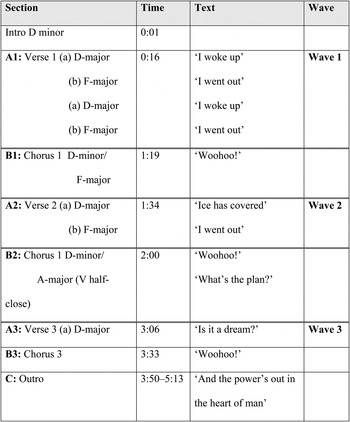
‘Neighborhood # 3 (Power Out)’ is an urgent, angry song about children dying one night in an ice storm, the urgency communicated through a siren-like C–A ostinato figure cutting across the looped alternation between D-minor and F-major harmonies (Figure 8).
‘Neighborhood #3 (Power Out)’.

Like ‘Laïka’, it proceeds by gradually growing its chorus; unlike the earlier song, this growth is achieved at the expense of the verse, which is halved, quartered and finally disposed of. The song also moves on a number of formal levels; in its urgent rush, the units’ formal significance become clear only in retrospect. Its initial form is deceptive: an alternation of verses in D-major (starting ‘I woke up …’) with choruses in F-major (starting ‘I went out’), recalling the simple ABAB sequence of ‘Crown of Love’. When the real chorus arrives, a repeated cry of ‘Woohoo!’ (1:19), taking the music back to D-minor, the previous material is reinterpreted retrospectively as a single compound verse structure. At the next level, then, the music till 1:32 turns out to have unfolded a larger-scale AB structure. The song then resumes the D/F alternation, but this time the D-major/F-major verse-sequence is stated once, not twice. Compensating for this liquidation, the second ‘Woohoo!’ chorus (2:00) is expanded through the addition of a sententious, quasi-Biblical couplet: ‘And the power's out in the heart of man, take it from your heart put it in your hand’, accompanied by a striking guitar riff which comes increasingly to the fore in the remainder of the song. The chorus climaxes with a pressingly repeated dominant half-close on the question, ‘What's the plan?’ The question/dominant cadence cuts the song in half, sounding like, in Hepokoski & Darcy's terms, a ‘grand antecedent’ of an expanded period structure.Footnote 12 Periods can be constituted from sentential sub-phrases; chorus 2 sets up an expectation that ‘Power Out’ will be completed by a complementary, sentential consequent phrase; i.e. paralleling the ABAB ‘Woohoo!’ – AB ‘Woohoo’ structure of the antecedent sentence, but cadencing on the tonic. Despite this expectation, the second half of the song is deformed and compressed. We begin, once again, with the D-major verse, A, but now there is no F-major B. Step by step, the song has compressed the verse structure from ABAB to AB to A. In tandem with this three-part liquidation process, ‘Power Out’ fills in the empty slot of the chorus, first with a couplet in chorus 2; and finally, in chorus 3, segueing into the coda, with the couplet repeated over looped repetitions of the guitar riff.
‘Neighborhood #1 (Tunnels)’
The iconic opening track of Funeral epitomises the band's charm. Toy-piano-like figures, heavy on reverb, tinkle away over a pulsating drone in bass, cello and organ; the guitar then enters, highly distorted, with a rising tonic triad arpeggio, as if mediating between earth and sky. This instantly winning rainbow of sounds typifies Arcade Fire's trademark blend of classical, folk and rock instrumentation. It also perfectly expresses its surreal, bittersweet lyrics. Snow is piled high through a neighborhood suburb; a teenage lover tunnels through the snow-drift from his bedroom window to his girlfriend's. She climbs through her chimney onto the roof. They meet in the middle of the town, let their hair grow long and have babies. Their parents are crying. The lyrics express one of indie's oldest tropes: children straining to leave the suburbs. The song's faux naïf video, its Monty-Pythonesque animation courtesy of Josh Deu, who both co-wrote the song and helped found the band, figures two striking images in its climactic coda.Footnote 13 First, Chassagne strains towards a black moon, carrying her house literally on her back. Then the kids drive away in Butler's car, through mountains beyond mountains.
The ostensible spaciousness of the intro of ‘Tunnels’ is deceptive, as it is not particularly long by the album's standards. At 26 seconds, the intro lags behind the 30 seconds of ‘Haiti’ and the 34 seconds of ‘Rebellion’. Perhaps its phenomenal appearance of space arises, firstly, because so much happens within this intro; and, secondly, because its timbral richness is often associated with ambient music suggestive of musical landscape, such as Bell Orchestre or, less close to home, the Icelandic band Sigur Rós (the vast open spaces of Canadian and Icelandic indie sit possibly on the same spiritual latitude). Tracks by Belle Orchestre and Sigur Rós are typically twice as long as the 4 minutes of ‘Tunnels’, giving their musical landscapes ample time to breathe and unfold. The squeezing of the material of ‘Tunnels'into 26 seconds is responsible for much of the song's hydraulic energy – the music's urge, or – better – yearning, to burst out.Footnote 14
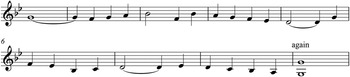
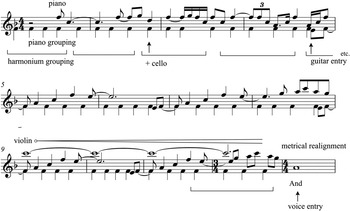
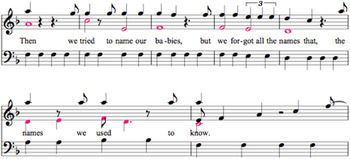
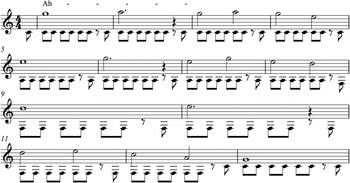
The intro's ethereal colours hook the attention instantly, particularly the toy-piano-like tinklings (reminiscent of Radiohead's ‘Kid A’), which elicit the type of sentimental, disarmed sympathy one gives to a child (Example 3).
‘Tunnels’, intro.

Such a strong intro serves perfectly to ground a song structure which is actually the most end-directed on the album. Rooted in the binary, AAB|ABC pattern, ‘Tunnels’ quadruples the second chorus, disguising iterations 4 and 5 within the outro: AAB|ABB[BB]. Unlike my schematic analysis of the other songs, I'd like to explore how the sentence form of ‘Tunnels'grows organically from its material.
A pertinent comparison is with the sprawling, 2 minute-long intro to New Order's ‘Blue Monday’, analysed by Spicer as a model of accumulative processes (39–42). Next to the techno riffs of ‘Blue Monday’, the acoustic instrumentation of ‘Tunnels’ sounds very warm and Arcade Fire's rhythmic subtleties are tame compared with the metrical dissonances of ‘Blue Monday’. Yet worthy of note is how the band smooths out its square periodicities. Ostensibly, the 12-bar intro divides simply into four bars of tinkly piano overlaid by eight bars of a rising-arpeggio guitar riff. Yet the band makes fine adjustments to obscure any clear sense of metre or phrasing. Metre is dissipated not just by the piano's free tinklings. The game turns on the furtive, almost silent, entry of the harmonium one beat before the piano. Although the harmonium begins the bar, the ear fixes onto the brighter piano timbre, which begins its four-beat cycles 1 beat out-of-phase with the real metre. After two bars, the harmonium's original groove is reinforced by the punchy attack of the cello, as it is at bar 5 by the electric guitar and at bar 12 by Butler's voice. From the aural viewpoint of an ear entrained to the piano cycles, cello, guitar and voice all enter one quaver too early. Yet the escalating stridency of harmonium, cello, guitar and voice outline a finely wrought ‘timbral modulation’, in delicious counter-metre to the piano. Part of the reason why Butler's entry sounds so climactic – and conversely, why the intro is so accumulative – is that it definitely confirms the music's original metre, sweeping the piano away.
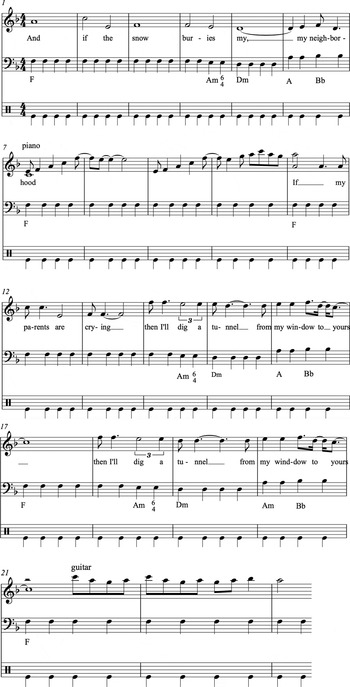
‘Tunnels’ shows that, when it suits them, Arcade Fire can craft sentence forms within a verse, not just across the track. The opening verse is a couplet with half the second line repeated:
And if the snow buries my, my neighborhood
And if my parents are crying, then I'll dig a tunnel from my window to yours
Yeah, a tunnel from my window to yours
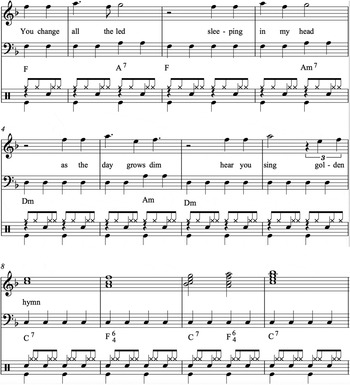
There are several reasons why line 2 is more intense than line 1. First, Butler packs nearly double the number of syllables into its ‘verbal space’ (see Griffiths Reference Griffiths and Moore2003, p. 43): line 1 sets 11 syllables; line 2 sets 20 (see Example 4).
‘Tunnels’, verse 1.

Second, line 2 shifts up an octave half-way through (its fourth bar). Third, the tetrachord descent (F–E–D–C) is now repeated, eliding the verse's opening tonic gambit (A–C–E–F), hence focusing on harmonic motion. Fourth, the repetition of this four-bar subphrase fills in the ‘empty’ space originally outlined by the four-bar instrumental episode at bars 7–10, heightening the effect of compression. All these factors – the denser syllabic count; the registral shift; the repetition; the zooming in on the theme's tetrachord core; the elision of the instrumental link – are accumulative. Although, strictly speaking, the verse doesn't correspond to classical sentence practice (which is much more oriented towards motivic development), it parallels its effect of gradual intensification.
What happens within verse 1 is itself intensified in verses 2 and 3. In verse 2, the octave leap is brought forward half-way through line 1, and line 2 now transposes the melody's incipit as well, Butler straining up to a high A natural. Verse 3 makes a radical change. The ‘tonic gambit’ figure (A–C–E–F) is lost altogether, while the voice first riffs on falling and rising scales, and then gets stuck on the top A, belted out in climactic declamation, this A jarring against the bass B♭ (Example 5).
‘Tunnels’, verse 3.

This is the cathartic climax to the three verses’ build-up. On the face of it, the descending tetrachord also seems to have been lost, together with the ‘tonic gambit’ figure. In reality, the tetrachord has been commuted to an over-dubbed contrapuntal extra voice, sung by either Butler himself or someone else in the band. This over-dubbed ghosted voice was present all along in the first verse, although extremely faint. Howard Bilerman, the producer of the album, has gradually brought out this ghost voice as the song proceeds. This is how the song manages to have its cake and eat it – the cathartic highpoint (the repeated A apex), plus fidelity to the tetrachord.
Another parameter of accumulation is increasing syllabic density within ‘verbal space’, already noted at the start of the song. One more reason for the strenuousness of the climax at verse 3 is the sheer number of syllables Butler packs in, compared with the leisurely start of the song. As we have seen, the first phrase of verse 1 sets 11 syllables. This is eventually doubled to 22 syllables in both the second phrase of verse 2 and the first phrase of verse 3. The second phrase of verse 3 compresses 38 syllables into the verbal space, and is the densest point of the song. Whilst Griffiths conceives verbal space in terms of syllables, ‘Tunnels’ seems to pace its delivery of words with equal care, and there are signs here that the song-craft is not just highly wrought, but even mechanically calculating. There appears to be a system. In verse 1, the first phrase sets eight words and the second phrase doubles that to 16, plus a further eight for the phrase extension, the repeated tetrachord. These 16 words then become the starting-point for the first phrase of verse 2, which sets 16 words. The second phrase extends that to 20, which in turn becomes the starting point for verse three, whose first phrase also has 20 words, and whose second phrase – the song's super-dense ‘singularity’ – has 27.
Density of syllabic and word setting is why verse three zones in on declamatory note repetitions. It is at this level of repeated notes that the voice intersects with percussion; at this point, the arc of vocal intensity intersects with the song's gradual rhythmic acceleration. The apex is precise: the very end of verse 3, the phrase ‘Whatever happened to them?’, delivered on Butler's highest note, and in synch with a string of quavers on snare-drum and hi-hat, a point which comprises the climax of the percussion kit's own journey of acceleration.
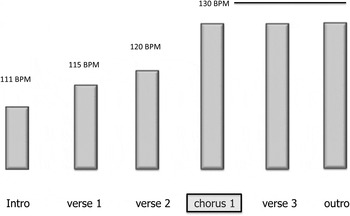
Rhythm takes us to tempo. ‘Tunnels’ traces a marked increase in tempo, from 111 BPM at the start, to 130 at the end (Figure 9).
‘Tunnels’, studio recording, tempo chart.

Whilst not unexpected, this acceleration is noteworthy for several reasons. First, the live versions accelerate more. For instance, at the Reading festival, the band begin at about the same rate, 113 BPM, but end up a lot faster at 144.Footnote 15 Perhaps one reason for this is that, in the original studio recording, the percussion was played not by Chassagne, but, unusually, by the producer himself, Bilerman. Hence the producer and mixer effectively sat in the song's rhythmic driving seat. There is one telling detail here. In the studio recording, the song's tempo attains its climax of 130 in chorus 1, after which the tempo plateaus out. In the Reading version, ‘Tunnels’ reaches a similar tempo of 132, and then continues to accelerate, reaching 144 BPM at the outro. This suggests that Bilerman saw something special and defining about the chorus; it fits with an analysis of the song as chorus-orientated.
Let's now turn to the chorus. The song's acceleration of phrase length climaxes with the chorus's four-fold repetition of one-bar strains (Example 6).
‘Tunnels’, chorus.

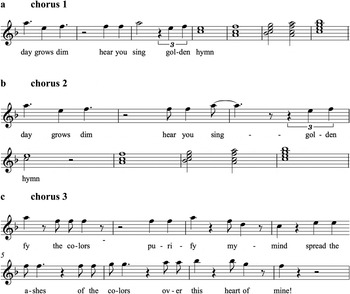
The emotional discharge is beautifully simple and fitting, achieved by slotting in three missing pieces of the jigsaw. The first piece is the dominant chord. A peculiarity of the melody's descending tetrachord is that the harmony eschews chord V, progressing from I through VI and IV directly back to the tonic, in a series of subdominant cadences. (Otherwise put, the harmony traces a ‘50s’, or ‘Stand by Me’ I–VI–IV–V progression, but without the V.) The second piece is the pitch B♭, the dominant's 7th, the very first B♭ in the song, and its highest note. The third piece is registral: the chorus climaxes with the song's first rising scale, inverting the tetrachord, whose descent traditionally connotes funereal lament. Across choruses 1–3, Butler's three successive assaults on this high-point get progressively more desperate (Example 7a–c).
‘Tunnels’, highpoints in chorus 1–3.

The first time, at the end of chorus 1, he gives up on trying to reach a top B♭, dropping to a C and ceding the ineffable – indeed, unsingable – ‘golden hymn’ to instruments alone. The second time, in chorus 2, he collapses into a heap of indeterminate pitches, squishing together the words, quite pointedly, ‘I've been trying to sing’. The third and final time, he gets there, although not without Butler over-leaping the bounds of his voice. Vocal high-points are emotional also because they tend to be where the singer's voice ‘cracks’. The register and melodic arc of ‘Tunnels’ are beautifully gauged to the limitations of Butler's voice.
The opening track of Funeral, especially with Dieux's video, is a remarkable example of a multi-dimensional intensity curve. Every musical and textual parameter conspires in a cumulative progression towards a high-point and climactic discharge, not least the poetic imagery of climbing onto roof-tops and transmuting led to gold, and Dieux's animation of Chassagne straining for the moon, and the band breaking free from the suburbs in Butler's car.
‘Wake Up’
‘Wake Up’ is a three-wave sentence but with the order of verse and chorus inverted. After a viscerally rhythmic groove reminiscent of Queen's ‘We Will Rock You’,Footnote 16 accumulating efficiently through guitar power chords, drums and cymbals, and hairpin string crescendos, the song erupts with an ecstatic chorus sung by all the band and, when live, the audience too (Example 8).
‘Wake Up’, chorus anthem.

‘Wake Up’ is not the first song to start with a chorus (Abba's ‘Dancing Queen’ is a distinguished precursor). Moreover, in live performances, the band like to sing along with Butler from the outset, as in the Reading version of ‘Tunnels’, in which respect all the songs could be thought of as beginning with a chorus – realising the anthemic potential of the material (in other words, following ‘Love will Tear us Apart’, the functional difference between verse and chorus becomes a matter of cumulative degree). Nevertheless, the frankness of the tactic of ‘Wake Up’ captures something essential about Arcade Fire's emotionalism, the way that cumulative processes flow against the tide of, and are even pulled back by, the static (‘undanceable’) aspects of the indie ethos.
This ‘bi-directional’ tendency – intensifying and declining at cross-purposes – is present in the melody of ‘Tunnels’. Yes, the verse climbs overall sententially, yet it does so in blocks of ever-higher descents: Butler's fall to a quiet, almost whispered bottom C in his opening phrase sets the depressive key-note of the album. Funeral’s sentential triumphs work by overcoming the downward curves of depression. Actually, these triumphs are by no means straightforward, and even a track as ostensibly celebratory as ‘Wake Up’ isn't as it seems (with an arch nod to Joyce's pun in Finnegans Wake, infolding senses both of death and re-awakening). After delivering two sugar-rush climaxes at the opening – the groove and the chorus – the song's only way is down. It pursues this depressive trajectory at all levels. The chorus melody itself is a dying fall, the sequences sinking a full octave. The harmony brings back the dominant-truncated ‘Stand by Me’ progression of ‘Tunnels’ (I–VI–IV–I). The verse melody is clipped, and the short, spaced-out lines leave verbally empty most of the 12-bar space of the groove and chorus which they occupy. Emptiness is also the sense of the words themselves: ‘Something filled up my heart with nothing’. The verbal space is filled up by the outburst at the end of verse 2, packing 20 syllables into the line: ‘We're just a million little gods causin’ rain storms turnin’ every good thing to rust’. Despite rock's general subdominant orientation, the diatonicism of Arcade Fire makes the music hanker after dominant chords where these are originally set up as conspicuous absences (as in ‘Tunnels’). In ‘Wake Up’, the tonal emptiness of the I–VI–IV–I harmonic loop gets filled at the climactic chorus, as it does in ‘Tunnels’, but not with the missing dominant. The music takes flight from C-major through E♭ and F-major; through a remarkable slight of hand, its final F chord is made to sound like a secondary dominant of E♭ while relaxing back into C-major for the outro as a subdominant cadence: F ‘fills up’ the dominant-shaped harmonic gap ‘with nothing’, and the outro is the most anti- or better, post-climactic coda on the album. It wrenches the song into a Motown beat of throw-away bathos, and it dies away to a fade-out.
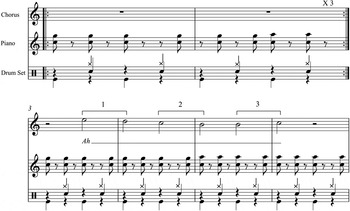
The outro uses a groove made famous by The Supremes's ‘You Can't Hurry Love’ (borrowed also by Iggy Pop's ‘Lust for Life’). After three iterations of the two-bar groove, a strange echo of the chorus anthem cuts across it (Example 9).
‘Wake Up’, outro, with echo of anthem in 3/2 hypermetre.

The comparison with The Supremes encapsulates Reynolds's and Fonarow's claims about the ‘undanceability’ of indie. Although notated in 4/4, ‘You Can't Hurry Love’ exemplifies the habanera 3 + 3 + 2 ‘bell time’ (or ‘bell pattern’) common in sub-Saharan Africa music and that of the African diaspora (see Pressing Reference Pressing2002; Butterfield Reference Butterfield2011). When used in popular music of this tradition, bell time allows the music to ‘breathe’ polymetrically between metrical groupings of three and two. During the verse of ‘You Can't Hurry Love’, 4/4 time dominates; in the chorus, each bar shifts the grouping patterns into a 6/8 metre (3 + 3), shifting back into duple for the remainder of the bar (+2), returning to 6/8 in the next bar. This oscillation backwards and forwards across the main metre is why ‘You Can't Hurry Love’ swings, and why the outro of ‘Wake Up’ does not: Arcade Fire borrow the groove, without grouping the voices in such a way as to bring out the 4/4–6/8 cycles implicit within it. The overlay of the chorus anthem (compressed, but recognisable) in a hypermetrical 3/2 pattern against the groove (see Example 9) makes the texture more interesting, without, however, necessarily entraining the body to dance. Arguably, by throwing the metre into doubt (as in the intro of ‘Tunnels’), the 3/2 overlay serves actually to freeze the listener, just as the falling line, sounding like a bleached echo of the chorus, neutralises the anthem's original ecstasy. Sentential liquidation now works in reverse, building not climax but bathos, or indeed pathos.
Conclusions: affects, complex emotions and ‘moving past the feeling’
Focusing on the sentential forms of Funeral’s 10 songs has led us, I hope, away from a false notion of musical structure as something rigid or standard, or indeed ‘formalistic’. What emerges, instead, is a sense of form as a force-field of currents and cross-currents. These counter-flows unfold along two axes: forward-moving intensifications (Steigerung) pulled back by indie's static spectacle; maximalist energies breaking through minimalist means. The two axes – backwards/forwards; in/out – intertwine around each other in a kind of musical double-helix.
As a complex of vectors or energies, this double-helix seems to fit contemporary accounts of affect rather than of emotion per se. Brian Massumi (Reference Massumi2002), for instance, theorises affect as an energetics of indeterminate bodily intensity, a fluid process anterior to emotion proper. In contrast, emotional signification – as in the meaning of discrete emotional categories such as sadness, tenderness, or anger – marks a stage where the fluid vectors of affect are stalled, frozen and rendered determinate. It is easy to identify these emotional categories across the songs of Funeral, especially as expressed by timbres and textures, and labelled by text and scenario. For instance, the quasi toy-piano tinklings of ‘Tunnels’ effortlessly project an emotion of childlike tenderness; equally immediate, yet opposite in meaning, is the mix of rage and panic signalled by the abrasive voices and wailing sirens of ‘Power Out’. Even if concepts of emotion and affect can be clearly distinguished – and I have my doubts – it is possible that this article may have more to say about the latter than the former. By the same token, formal analysis might be more suited to the vectored processes of affect than to the specificities of emotional categories – categories which are perhaps more easily captured by spectographic snapshots of their timbre, texture or articulation.
Yet these are complex issues, hedged by caveats both pro and contra. On the one hand, Funeral’s sentence forms are more indeterminate, and hence like affects, because of the very fact that they apply throughout the album to songs of vibrantly contrasting emotional colours. On the other hand, the formal helix can be characterised in emotional terms in its own right, terms which correlate with its tensions and torsions. Whilst the radiant laments of Funeral celebrate loved family members who have recently died, its tone of joyful triumph is odd, given the type of musical/emotional material that the scholarly industry generally thinks is expressive of sadness: slow tempi, quiet dynamics, minor-mode keys, descending contours, etc.Footnote 17 Its cocktail of joy and grief constitutes a genuinely complex emotion, one that Alex Petrides perfectly describes as ‘triumphant gloom’. According to Petrides, Arcade Fire's ‘masterstroke is to set all this doom-mongering to joyously uplifting music’.Footnote 18 To invoke a counter-example, (ac)cumulative processes and ‘thwacking, propulsive rhythms’ (Petrides) are conspicuously lacking in an album such as Bright Eyes's Lifted (2002), whose tremulous pathos and static wallowing correspond to the more conventional representation of sadness.Footnote 19
If Funeral’s emotion, then, inheres as much in its (forward-pressing) ‘joy’ as in the (backward-lingering) ‘gloom’, there is more to the band's master trope, which I suggest is encapsulated in the eponymous opening track of its third album, ‘The Suburbs', than initially meets the eye: ‘Sometimes I can't believe it, I'm moving past the feeling’. At first glance, the phrase suggests getting over a feeling of grief, but that discounts the feeling of ‘moving’ itself, with those ‘thwacking propulsive rhythms’, a feeling which Arcade Fire connect with the exhilaration of driving in a car. A recherché touch is that the chugging D–B–F♯ harmonic mantra of Funeral’s last song, ‘In the Backseat’, returns to open the first song of The Suburbs, with the words ‘In the suburbs I learned to drive’.Footnote 20 Between the ‘primary’ feeling of backward-facing nostalgia and the ‘secondary’ feeling of forward-chugging drive comes, as it were, a ‘tertiary’ feeling of these two emotions rubbing up against each other. This gear-like meshing of past and future affords the song's present-tense emotion, a ‘feeling of feeling’; or, better, ‘the feeling of “moving past the feeling”’. The gear-stick pivots, deliciously, on contradictory senses of ‘past’: the music passes something in the past. Its feeling can only be glimpsed backwards through a car's rear-view mirror, vanishing into the past of our childhood.
The figure of the dead child – a hyperbolic twist on indie's standard trope of lost childhood – is the most potent source of Funeral’s emotional power. It is curious that Arcade Fire foreground children, since the album is a symbolic funeral for older relatives, such as Chassagne's grandmother. However, that is to miss the point, which is that, whether by circumstance or design, Arcade Fire's images of dead children have come to serve as proxy for an epochal trauma, and here the pastness of ‘moving past the feeling’ swells into an historical dimension. Here is Jim Fusilli again:
I listen to ‘Funeral’ every year on September 11 because all the tears and all the bodies bring about our second birth. It reminds me we are not defeated, and it reminds me that rock can be a wonderful, thrilling thing.Footnote 21
Arcade Fire is one of a number of bands which came of age in the wake of 9/11, and it broke through to mass appeal partly because Funeral’s personal griefs were folded into a collective process of mourning.Footnote 22 The reasons why mourning for 9/11 became linked to children are complex, but are related to a revitalised appreciation of the suburbs as a sanctuary of family life, away from the perceived threat of the city.Footnote 23 Spike Jonze's film of ‘The Suburbs’, in which he brings the war to the leafy housing estates, speaks viscerally to these anxieties.Footnote 24 Hence Funeral’s morbidly childlike innocence was an historical marker in the early 2000s: the album's surreal, gothic-tinged obsession with the death of children is perfectly in tune with a time when, according to Atchison (Reference Atchison, Fisher and Flota2011, p. 150), ‘undead, goth-punk culture infiltrated teen suburbia, attracting awkward and standoffish adolescents’. We see this trend not only in popular film and TV, including the Twilight saga, the True Blood Series, and the Hunger Games franchise (for which Arcade Fire wrote the song, ‘Abraham's Daughter’). It also permeates the high culture of oratorio: David Lang's Little Match Girl Passion, based on Hans Christian Anderson's lachrymose children's tale, won the Pulitzer Prize in 2008. Closer to home, the model for Funeral itself is arguably an album about the diary of Anne Frank. Neutral Milk Hotel, whose emotionalism the Pitchfork reviewer of Wolf Parade perceptively bracketed with that of Arcade Fire, wrote their second (and last) album, The Aeroplane over the Sea, in 1998. Whilst it made no impression at that time, its reissue in 2005, refracted through the post-9/11 market, turned it into an indie classic. Issued, like Funeral, by Merge, and with similarly faux-naïf artwork, its songs also feature bizarre tales of the death of children. In the first track, ‘The King of Carrot Flowers Pt. 1’, the children build ‘a tower tumbling through the trees’. In Funeral’s ‘Tunnels’, two children climb the roofs of their house. The ne plus ultra of this sub-genre is possibly the video to Dead Man's Bones's 2009 ‘Name in Stone’. Ryan Gosling leads a procession of undead children wearing Halloween costumes through a cemetery, singing strains reminiscent of Win Butler's closing lullaby in ‘Kettles’ (the procession itself parodies Arcade Fire's own video to ‘Rebellion’).Footnote 25 The arch pretentiousness of ‘Name in Stone’ shows that, by 2009, this sub-genre is beyond parody – another reason why it would have been risible for Arcade Fire to revisit their feeling of 2004 in future albums without collapsing into camp.
If the feeling of Funeral is both of its time, and of its subgenre, what, then, makes it particular? Its particularities are revealed by formal analysis, a species of close listening (analogous to close reading) intimately associated with indie, with emotion and with the emotion that indie induces. A review of an album by another indie band (Wolf Parade's 2005 Apologies to the Queen Mary), nicely captures these three-fold connections: ‘Groups like Neutral Milk Hotel and Arcade Fire inspire listeners to both feel their music and listen closely to what's being said’.Footnote 26 They listen because of, not despite, their feelings. A truism of emotion theory is that it can take time for us to become aware of what we feel. Emotion is a process, in life as in music. By helping us interrogate what we hear and feel, music analysis (with its ‘shadows of formalism’), far from being an enemy of emotions in popular music, can help them come to light.