Introduction
Soil-transmitted helminth (STH) infections constitute a major public health problem, affecting more than 1 billion people worldwide (Crompton, Reference Crompton1999). These infections most frequently affect children in developing countries and are associated with poor growth, reduced physical activity and impaired learning ability (Stoltzfus et al., Reference Stoltzfus, Albonico and Chwaya1996; Hadju et al., Reference Hadju, Abadi and Stephenson1997; Saldiva et al., 1999).
The prevalence of STHs in Nigeria had been reported to be very high with variations in each region. In south-western Nigeria, a previous study conducted in Ile-Ife, Osun State, Nigeria, over a decade ago showed that the prevalence of Ascaris lumbricoides rose from 50 to 60% among children in the age group 0–4 years, reaching a peak of over 80% at age 11–14 years, and thereafter fell gradually to 60% at age 50 years and above (Asaolu et al., Reference Asaolu, Holland, Jegede, Fraser and Stoddart1992).
School-aged children are particularly vulnerable to STH infections and are known to harbour the heaviest burden of infections and therefore suffer most from associated morbidity. Therefore, this age group is being targeted for mass drug administration in order to bring the infections under control in the endemic countries. Information from the literature indicate that pre-school age children, who have been largely excluded from the preventive chemotherapy programme in endemic countries, also frequently suffer from a heavy burden of infection (Albonico et al., Reference Albonico, Allen, Chitsulo, Engels, Gabrielli and Savioli2008; Kirwan et al., Reference Kirwan, Asaolu, Abiona, Jackson, Smith and Holland2009). Hence, it is now recommended to include these children (who should be at least 12 months of age) in the deworming programme.
Since the investigation carried out earlier by Asaolu et al. (Reference Asaolu, Holland, Jegede, Fraser and Stoddart1992), there have been no other published studies on the status of STH infections among school-age children in the Ile-Ife area. Therefore the present study aimed at providing information on the current status of prevalence and intensity of soil-transmitted helminths among pre-school and school-aged children attending nursery and primary schools in Ile-Ife. It is hoped that this will contribute useful baseline information to the planned national programme for the control of these parasitic infections in Nigeria.
Materials and methods
Study area
The study area, Ile-Ife, has been described earlier (Sowemimo, Reference Sowemimo2007). The study was carried out in two schools, St. Peter Nursery and Primary School, Ile-Ife, which is government owned, and Seventh Day Adventist Nursery and Primary School, Ile-Ife, which is privately owned. These schools are located in Ife Central Local Government Educational District.
Consent and ethical approval
Prior to the commencement of the study, permission was sought and obtained from the Local Educational Authority of the Ife Central Local Government Area. The headteacher and teachers of each school were contacted and informed of the purpose of the study. A consent letter was written and sent to the parents/guardians of each child explaining the purpose of the study, and their approval was sought for the participation of their children in the study. Only pupils who returned a signed consent form by their parents/guardians were allowed to participate in the study. Ethical clearance for the study was given by the ethical committee of the Obafemi Awolowo University Teaching Hospital Complex (OAUTHC) Ile-Ife, Osun State, Nigeria.
Collection of personal data and faecal samples
A total of 352 children comprising 121 pre-school children (aged 2–5 years) and 231 school-aged children (aged 6–10 years and above) took part in the study between January and March 2009. The children were randomly selected from a total of 456 children in the two schools. Labelled plastic bottles with a wooden spatula for the collection of faeces were distributed to the schoolchildren for a small portion of their early morning faeces. Faecal samples were collected from each selected child on the same day or within 24 h of being passed and examined for the eggs of soil-transmitted helminths. A pre-tested questionnaire was sent to the parents/guardians to be filled out to assess parental education and occupation, hygiene habits, the use of anthelminthics and the knowledge, attitudes and practices related to intestinal parasites, particularly soil-transmitted helminths. Questionnaires were administered to the parents/guardians of 149 children and 203 children attending private and government schools, respectively.
Parasitological procedures
Each faecal sample was collected in a clean 30 ml universal plastic bottle, thoroughly mixed with an applicator stick and fixed in 10% aqueous formaldehyde solution. In the laboratory, the samples were examined for A. lumbricoides, Trichuris trichiura and hookworm eggs by the modified Kato–Katz technique (Forrester & Scott, Reference Forrester and Scott1990). This involved passing a subsample of each specimen through double-ply gauze to remove rough materials and washing with water, as necessary. The filtrate was then centrifuged at 2500 rpm for 5 min, the supernatant fluid decanted, and the tube allowed to drain for 5 min. About 50 mg of the substrate was transferred on to a clean microscope slide, covered with a cover-slip soaked overnight in 50% glycerine–malachite green solution and carefully pressed to spread evenly. The slide was examined under a microscope at × 100. The number of eggs was multiplied by 20 to convert the values obtained to eggs per gram (epg) of faeces.
Data analyses
SPSS version 16.0 (SPSS Inc., Chicago, Illinois, USA) was used for statistical analysis. The differences in prevalence of helminth infection between age group, sex and school were tested by chi-squared (χ2) tests. The eggs per gram (epg) data for A. lumbricoides were not normally distributed and it was necessary to transform the data using log10 (epg +1). A Mann–Whitney U-test was used to test the difference in epg between sexes, while Kruskal–Wallis tests were used to test the difference in epg among age groups. Multivariate logistic regression was further applied to determine the predictive effect of the various variables investigated (source of water supply, type of latrine, mother's occupation and educational background, father's occupation and educational background, sex, age, personal hygiene of the child and the use of anthelminthics) on the prevalence of ascariasis in the schools.
Results
Prevalence of helminth infections
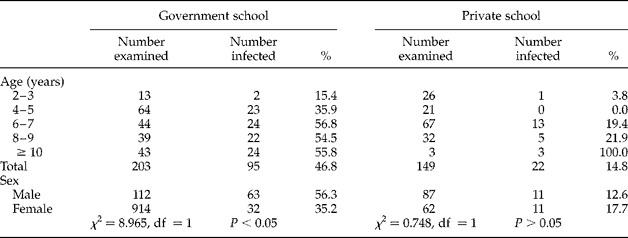
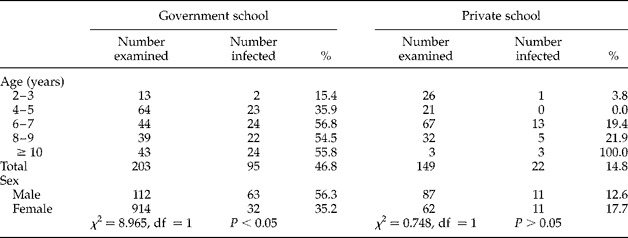
The overall prevalence of soil-transmitted helminth (STH) infection recorded in this study was 34.4%. The overall prevalences of A. lumbricoides, T. trichiura and hookworms recorded were 33.2%, 3.7% and 0.9%, respectively. The prevalence of STH infection in the government school (47.8%) was significantly higher than in the private school (16.1%) (P < 0.05) (table 1). The prevalence of STH infection in the government school was lowest (15.4%) in children of age group 2–3 years and peaked at 55.8% in children aged 10 years and above. In the private school, no infection was recorded in children aged 4–5 years, while the highest (100%) was recorded in children aged 10 years and above (table 2). In the private school, the prevalence of helminth infection was higher in girls (17.7%) than in boys (12.6%); however, the difference was not significant. In the government school, the prevalence of infection was significantly higher among boys (56.3%) than in girls (35.2%) (P < 0.05) (table 2). The predominant helminth found in the two schools was A. lumbricoides while hookworm infection was very low in both schools.
The prevalence of soil-transmitted helminths (STHs) in government and private schools.

The prevalence of soil-transmitted helminth infections by age and sex of schoolchildren in government and private schools.
Prevalence and intensity of A. lumbricoides by age and sex
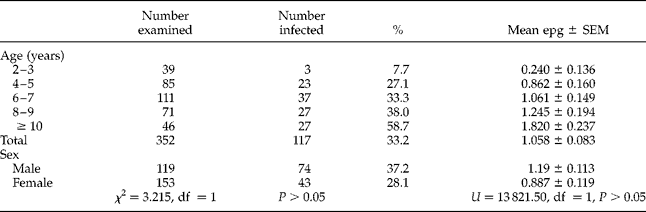
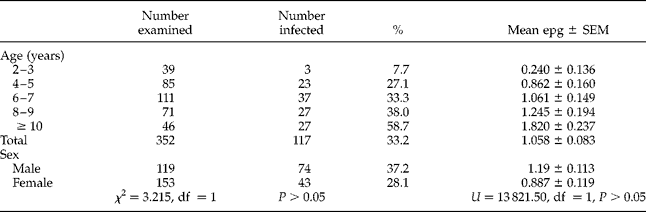
The age of the child is a significant factor with respect to the prevalence and intensity of A. lumbricoides infection. Among the 352 children examined, it was observed that the prevalence of A. lumbricoides infection increased gradually from 7.7% in children aged 2–3 years until it reached the peak (58.7%) in children aged 10 years and above (table 3). Similarly, the intensity of infection (i.e. mean epg ± SEM) was lowest in children age group 2–3 years (0.240 ± 0.136) and highest in children aged 10 years and above (1.820 ± 0.237). The prevalence of A. lumbricoides infection was higher among boys (37.2%) than in girls (28.1%), although there was no significant difference in prevalence between the two sexes (P>0.05). The prevalence of infection was also observed to be significantly higher in children aged 6–10 years and above (39.4%) than in children aged 2–5 years (21.5%) (χ2 = 11.474, P = 0.001).
The overall prevalence and intensity of A. lumbricoides by age and sex of schoolchildren in both government and private schools.
A questionnaire survey showed that 73% of the children attending the private school had been treated with anthelminthics less than 2 months prior to the collection of faecal specimens, while 43% of the children attending the government school received anthelminthic treatment during the same period. There was widespread ignorance and misconception among the respondents regarding the mode of transmission of soil-transmitted helminths. Most of the respondents (83.2%) did not have an idea about the mode of ascarid worm infection, although some of them reported that their children had passed out worms sometimes. In general, the answers many individuals gave to the question of how children become infected with worms varied: 6.5% thought meat and fish cause worm infection while the remainder (9.6%) thought that eating bad food, sugar, sweets, fruits and not wearing slippers or sandals are responsible for worm infection in children.
Logistic regression analysis
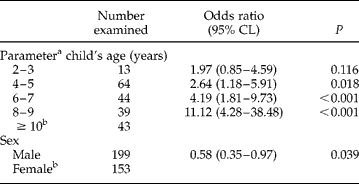
The logistic regression analysis combining data from both schools revealed that after adjusting for the effect of other variables, only the age and sex (out of 11 variables entered into the model) of the children played significant roles in the prevalence of ascariasis (table 4), all other variables were not significant (data not shown). The odds of being infected with A. lumbricoides increased as the children grew older. The risk of infection was at the peak in children aged 8–9 years. Children aged 2–3 years were less likely to be infected. Male children were 0.58 times less likely to be infected with Ascaris than female children.
Logistic regression analysis showing the effect of age and sex on the prevalence of Ascaris lumbricoides in Ile-Ife, Osun State, Nigeria.
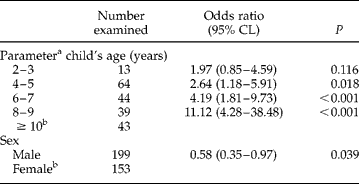
95% CL, 95% confidence limit.
a Variables are arranged in the order they were removed by the backward stepwise method (Wald).
b Reference group. Variables entered but not in the equation are type of latrine, source of water supply, mother's educational background and occupation, father's educational background and occupation, boiling water before drinking, hand washing before eating and use of anthelminthics.
Discussion
This study has revealed that the current overall prevalence of soil-transmitted helminths among the population of schoolchildren (aged 2–10 years and above) investigated in two schools was 34.4%. The prevalences of A. lumbricoides, T. trichiura and hookworms recorded in this study were far less compared with prevalences of 88.5%, 84.5% and 33.1% for A. lumbricoides, T. trichiura and hookworm, respectively, reported in a study conducted on primary school children aged 5–16 years from Ile-Ife, Nigeria over two decades ago (Holland et al., Reference Holland, Asaolu, Crompton, Stoddert, MacDonald and Torimiro1989). The lower overall prevalences of individual helminth parasite recorded in this study might have been due to the anthelminthic treatments given to some of the children, according to the information obtained from the questionnaire. This study also showed that the burden of parasitic infections in schoolchildren in the government school was greater than in pupils attending the private school. The higher prevalence of soil-transmitted helminths in children in the government school recorded in this study is in agreement with the result of the study reported by Ekpo et al. (Reference Ekpo, Odoemene, Mafiana and Sam-Wobo2008). This may be due to the poor socio-economic status, poor hygienic habits and lack of sanitation in the government school, which all enhance helminth infection, as suggested by previous studies (Asaolu et al., Reference Asaolu, Holland, Jegede, Fraser and Stoddart1992; Adeleye & Akinlabi, Reference Adeleye and Akinlabi2002; Ekpo et al., Reference Ekpo, Odoemene, Mafiana and Sam-Wobo2008), and also revealed in the questionnaire.
In this study, A. lumbricoides was the predominant helminth species observed, which is in agreement with previous studies in Nigeria and other parts of the world (Holland et al., Reference Holland, Asaolu, Crompton, Stoddert, MacDonald and Torimiro1989; Allen et al., Reference Allen, Sithey, Padmasiri and Montresor2004; Agbolade et al., Reference Agbolade, Agu, Adesanya, Odejayi, Adigun, Adesanlu, Ogunleye, Sodimu, Adeshina, Bisiriyu, Omotoso and Udia2007; Ekpo et al., Reference Ekpo, Odoemene, Mafiana and Sam-Wobo2008). Several studies have reported that age is a significant factor for A. lumbricoides infection (Hagel et al., Reference Hagel, Lynch, Perez, Di Prisco, Lopez and Rojas1993; Udonsi et al., Reference Udonsi, Behnke and Glibert1996; Botero & Restrepo, Reference Botero and Restrepo1998; Curtale et al., Reference Curtale, Pezzotti, Saad and Aloi1999), and that the peak of infection was recorded in school-aged children. In this study, age was the most significant risk factor, as revealed in the logistic regression model, with the highest prevalence of 58.7% for A. lumbricoides infection recorded in children aged 10 years and above. In addition, the highest intensity for the same parasite was recorded in children of the same age group (i.e. ≥ 10 years), confirming the earlier reports that the greatest burden and morbidity occur in school-aged children (Nwosu, Reference Nwosu1981). The high prevalence of A. lumbricoides (21.5%) recorded among the pre-school children in this study, supports the recommendation of WHO to include pre-school children (who should be at least 12 months of age) in control programmes for soil-transmitted helminths (STH).
The prevalence of hookworms recorded among the schoolchildren investigated in the two schools was very low, which is in agreement with the results obtained in a similar study conducted recently in Ikenne, Ogun State, Nigeria (Ekpo et al., Reference Ekpo, Odoemene, Mafiana and Sam-Wobo2008). The hookworm infections observed might have been acquired by children who do not wear protective shoes to school. A mixed infection was also observed, with the combination of Ascaris and Trichuris being the most common (6.8%). Co-infections have been reported to be a common feature in school-aged children in previous studies (Kightlinger et al., 1995; Udonsi et al., Reference Udonsi, Behnke and Glibert1996; Needham et al., Reference Needham, Hoang, Nguyen, Cong, Michael, Drake, Hall and Bundy1998). This study has shown that soil-transmitted helminth infections are endemic and are of public health concern among schoolchildren in Ile-Ife. Currently there is no control programme in place, either in community or school, to address STH infections. Therefore, a control programme, including mass deworming of children in the schools in the area, is required in order to improve the health status of the children. In addition, a health education programme is also recommended to teach community members about the mode of infection of ascariasis, in view of the widespread ignorance among the inhabitants of Ile-Ife.
Acknowledgements
We thank the head teachers of the two schools for their cooperation during the period of the study and the schools' pupils for providing stool samples. We equally thank the management of the Seventh Day Adventist Nursery and Primary School and St. Peter Nursery and Primary School, Ile-Ife for access to their pupils. Finally, we are grateful to parents/guardians of children who participated in the study for their consent.