Implications
The results indicate that the micro-climate surrounding growing broilers affects the birds in different ways depending on their genotype. Modern, fast-growing broilers use behavioural changes when trying to adapt to warm environments, whereas slow-growing broiler strains use metabolic changes to adapt to cooler ambient temperatures. The former are typically kept in large uniform flocks at pre-set temperature regimes above 20°C without the possibility to move to a cooler environment. The optimal ambient temperature for fast-growing broilers in terms of both animal welfare and productivity may be slightly lower than the present recommended standards.
Introduction
Strains of broilers with fast and slow growth rates, respectively, show large differences in their behaviour. Fast-growing broiler strains are considerably less active and perform less appetitive foraging compared with slower growing broilers (Barbato et al., Reference Barbato, Cherry, Siegel and van Krey1980) and layers (Gerken and Jaenecke, Reference Gerken and Jaenecke1997). Fast-growing broilers are motivated to perform the same activities as other chickens, but have restricted locomotion caused by their greater BW (Rutten et al., Reference Rutten, Leterrier, Constantin, Reiter and Bessei2002; Bokkers and Koene, Reference Bokkers and Koene2003). Forcing modern broilers to increase their daily activity has been found to strengthen their legs and reduce the incidence of leg problems (Reiter and Bessei, Reference Reiter and Bessei1998). However, increased activity also leads to an increase in heat production, and fast-growing broiler strains appear to have difficulties dissipating heat even under conventional rearing conditions, where panting is seen (Lott et al., Reference Lott, Simmons and May1998; McLean et al., Reference McLean, Savory and Sparks2002).
Two possible ways to achieve the benefits of increased activity without forcing the broilers to move are (1) to select birds that are spontaneously more active and (2) to lower the ambient temperature, thereby removing some of the constraint to heat dissipation.
Layers are generally much more active than broilers (Savory, Reference Savory1975), and differences in activity have also been found between these breeds when tested in an open-field test (Saito et al., Reference Saito, Takagi, Koutoku, Saito, Hirakawa, Tomonaga and Tachibana2004). Increased test activity has also been found when comparing slower growing broiler strains with conventional broilers (Blomqvist and Nielsen, Reference Blomqvist and Nielsen2000). Faure (Reference Faure1981) has successfully created active and passive selection lines of chickens using activity as day-old in an open-field test as the selection criterion. It is therefore possible that measurements of activity in an open-field test while the birds are a few days old may be used as a proxy for spontaneous activity later in life.
Meltzer (Reference Meltzer1983) indicated decreasing upper and lower critical temperatures with age for broilers, levelling out at 42 to 56 days of age to 28°C and 23°C, respectively. However, critical temperatures are calculated on starved birds kept in individual pens with little room to move. Thermoregulatory behaviours include movement, feeding and huddling with conspecifics, and these activities cannot be performed in the conditions under which critical temperature measurements are obtained. The ambient temperatures used for broilers at the end of their growth period depend on a number of economic factors, but tend to be between 18°C and 24°C (Rose, Reference Rose1997). However, these measures are usually not taken at the bird level, where the temperature level usually is much higher, measured to be 29°C at commercial stocking levels (Reiter and Bessei, Reference Reiter and Bessei2000).
In the present experiment, I aimed to investigate to what extent ambient temperature at the bird level could influence the behaviour, feed intake and growth of broilers from fast- and slow-growing strains. The latter were included to compare the effects between strains differing in activity as well as metabolic heat production. In addition, the early open-field response of the birds was used to create groups potentially differing in activity during the growth period.
Material and methods
Animals and housing (1)
Chicks that were a day old from a conventional fast-growing strain (Ross 208) and from a slower growing strain (i657) were used. From each strain, 369 female chicks were wing-tagged and housed as day-old (day 1) in two solid-floor pens measuring 4.5 m × 4.2 m, one strain in each pen, where they were kept until day 13. Each pen was equipped with four circular feed troughs. The feed consisted of 2 mm pellets, and contained in grams per kg 300 oats; 200 barley; 167 wheat; 145 toasted soybean meal; 120 peas; 25 fishmeal; and 10 soy oil plus mineral and vitamin mix (metabolisable energy (ME) content: 11.1 MJ/kg; protein content: 17 g/MJ ME). The same feed was fed throughout the entire experiment to avoid confounding effects of growth and changes in food with time.
The room was heated by wall-mounted radiators. Ambient temperature was set to 33.0°C during the first 3 days (days 1 to 3), followed by a gradual decline of 0.6°C each day, resulting in 26.4°C on day 13. Lights were on 24 h during the first 5 days, at which point a lighting schedule was applied with 8 h of continuous darkness between 2100 and 0500 h, with 30 min of artificial dusk from 2030 h.
Open-field test
On day 3, 252 randomly chosen chicks from each strain (i.e. 504 birds in total) were tested individually in an open-field test. A total of four test boxes (L × W × H: 120 cm × 90 cm × 60 cm), each with two arenas (60 cm × 90 cm) separated by a 60 cm wall, were placed in the corridor between the home cages. The floor of each arena was covered with a rubber mat. A video recorder was installed above each test box, recording the test in real time for subsequent logging of behavioural data. The test person calmly entered the home pen and randomly picked four chicks, which were gently lifted into a transport box. The chicks were then carried to the test arenas (maximum 20 m) and placed one by one in the middle of four arenas. This procedure was repeated for the other home pen with birds of the other strain. The test person did not approach the eight test arenas within the test duration of 180 s. After the test, the chickens were gently lifted from the arena, their wing tag was noted and the birds were moved to a circular enclosure within their home pen to ensure that the same bird was not tested again. Defecations were counted and removed from the arenas after each test.
The behaviour of each chick was recorded from the video tapes by placing a grid of 3 × 5 squares (each corresponding to 18 cm × 20 cm of the arena) on top of the video image. Recorded variables were latency to first step (s), number of grid lines crossed, number of squares out of 15 visited and jumps against the wall of the arena.
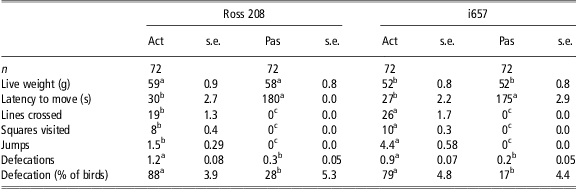
The birds were ranked according to their activity of in the open-field test, and the 72 most active (i.e. had crossed most lines during the test) and the 72 most passive birds (i.e. had the longest latency to move) from each strain were identified (Table 1). In order to take into account the possible effects of the test order, the birds were allocated to four blocks, with the test order deliberately confounded with block.
Least square means and standard errors of variables measured in the open-field test at 3 days of age for each strain and activity level

Within rows, values with different superscripts differ significantly (jumps P < 0.01; defecations P < 0.02; the rest P < 0.001).
Animals and housing (2)
On day 13, the 144 birds (72 active and 72 passive) from each strain (i.e. 288 birds in total) were weighed, fitted with leg-bands of one of six colours and allocated to 48 groups of six birds. All birds were supposed to be female, but examination at slaughter on day 58 showed that 9 of the Ross 208 and 15 of the i657 were male. The 48 pens were situated in a neighbouring room, where the initial temperature was the same as the room from which the chicks were moved (26 °C). Each group consisted of one strain (fast- or slow-growing), one type of behaviour in the open-field test (active or passive) and was allocated to one ambient temperature treatment (HH, HC or CC). These 12 combinations were tested in four replicates, yielding a total of 48 groups.
Each pen (1.0 m × 1.6 m) had solid floors bedded with wood chips, and was constructed of metal square mesh that was lined on three sides with ply-wood to confine the allocated temperature treatment within each pen as well as to prevent visual contact between adjoining pens (Figure 1); one drinking nipple was provided at the centre back of the pen and one feeding trough at the front. On the meshed roof, two heat lamps were placed. The heat lamps were fitted with ceramic bulbs; thus, no visible light was emitted. In the HH treatment, both heat lamps were left on during the entire experimental period. In the CC treatment, none of the heat lamps were on, and in the HC treatment, one of the heat lamps was on, alternating each week between the left- and the right-hand sides.
Diagram of the pens used. The stippled square indicates the wire mesh and the solid line shows the ply-wood walls fitted within each pen. The positions of the food trough, the heat lamps and the drinking nipple are indicated. The dotted lines indicate the five areas used in the behavioural observations. The area numbers are indicated together with the relative area size in brackets.

The treatments were allocated to the 48 (6 rows of 8) pens so that four blocks (of 6 × 2 pens) were positioned from one end of the room to the other. Across these blocks, all treatments were represented equally in both halves of the room. Each row of 8 pens contained equal numbers of active and passive groups, and each strain was represented four times.
Ambient temperature was measured on days 27, 34 and 41 under 32 heat lamps, half of which were on, immediately above or on the litter surface. To measure ambient air temperature, radiant heat and heat from the litter surface, three different methods were used: air temperature (measured inside a foil-wrapped cylinder to shield the radiation from the heat lamp), black bulb temperature (thermometer encased in a 15 cm diameter matte-black sphere) and litter temperature (measured on top of the litter using a laser thermometer). These temperatures under the heat lamps (on or off) are shown in Table 2.
Ambient and litter surface temperatures (°C) at floor height under heat lamps

The ambient temperature in the experimental room was reduced by ∼1.3°C/day until day 21, when the ambient temperature was maintained constant (mean ± s.d.: 16.2 ± 1.21°C). The relative humidity during the same period (days 21 to 57) was 38 ± 6.1%.
The chickens were weighed individually on days 3, 13 and 55. The feed troughs were weighed on days 13, 27, 41 and 55. Litter samples for analysis of dry matter content were taken on days 20, 34, 41 and 48 from 16 pens each time. Within each pen, samples were taken underneath both heat lamps as well as at the front of the pen (areas 1 and 5 in Figure 1). Except for the HC treatment, the samples from underneath the heat lamps were pooled within pen before dry matter analysis.
Behavioural recordings
Behavioural observations were made on 2 consecutive days when the chickens were 22, 36 and 50 days of age. These observations were carried out between 0930 and 1400 h, and consisted of 5-min continuous observations of a focal bird interspersed with behavioural time sampling (scanning) of all pens. The focal birds were chosen randomly in advance and identified using the leg-bands. No bird was chosen more than once as a focal bird.
During the continuous observations, the position, posture and behaviour of the focal bird were registered. Position was recorded in five categories, either under one of the heat lamps (areas 2 or 4; Figure 1), between the lamps (area 3) or in the front of the pen (areas 1 or 5). The posture of the bird was either standing or not standing (i.e. lying or sitting). When a bird was lying or sitting, it was recorded whether or not the bird was touching another bird. The behaviour of the bird was registered in nine mutually exclusive categories as inactive, eating, drinking, comfort behaviour (preening, dust-bathing, wing stretch or shake, leg stretch or shake, and body-shake), locomotion, aggressive social interaction, other social interaction, exploration (scratching or pecking litter) and alertness (body of bird motionless with head raised and eyes open).
The behavioural time sampling consisted of recording the position and posture (standing or not standing) of all the birds in all the pens on a printed diagram of each pen. In addition, it was indicated whether a bird was eating from the trough at the time of scanning. Time samplings were carried out nine times on each of the six observation days.
Social reinstatement test
In order to investigate further the differences in activity levels between the chickens, a social reinstatement test was carried out on days 56 and 57 on half of the groups. The test was included to investigate whether differences in activity could be assessed within strain between active and passive birds (as defined by their open-field behaviour). Within strain, the birds were expected to be equally socially motivated (as they were fed the same and were of the same genotype) and any differences in locomotion during the test could therefore be attributed to their ability or propensity to walk. The test apparatus consisted of a triangular start box (sides 40 cm), a 190 cm runway (60 cm wide) and a goal area (40 cm × 85 cm) in front of a holding pen (85 cm × 70 cm) with a wire mesh front. The runway was divided into five numbered sections of 38 cm by pieces of string across the top of the runway. The entire test apparatus had solid sides, was bedded with wood chips and was covered on top with wire mesh. At the start of the test, all the birds in a group were placed in the holding pen; one bird was lifted from the group and placed in the start box at the other end of the runway. After 30 s of acclimatisation, the wire door of the start box was lifted remotely. The chicken was then allowed to enter the runway and reach the goal area. The test was terminated after 5 min or as soon as the goal area was reached. The test bird was then given a small spray mark on the back to indicate it had been tested, returned to the holding pen and another bird was moved to the start box until all birds within a group had been tested. For each chicken, the latency to leave the start box was measured together with time to reach the goal area. If the chicken did not complete the test within 5 min, the number of the runway section reached was noted.
Statistical analysis
Data on production parameters, litter dry matter as well as the two behavioural tests were analysed using GLMs (Minitab, release 12; www.minitab.com). Production data were adjusted for sex and analysed within strain for effects of ambient temperature (CC, HC and HH), open-field response (active and passive) and their interactions. Litter dry matter was analysed for effects of day, as well as sample site within temperature treatment, strain and their interactions. Open-field test results as well as censored latencies and finishing times from the social reinstatement test were analysed for effects of strain (i657 and Ross 208), ambient temperature, open-field response and their interactions. Block (n = 4) was fitted as a random effect in all the models, and these were reduced if interactions were not significant (P >0.05). Pair-wise comparisons were carried out using Tukey's simultaneous test. The likelihood of leaving the start box and of reaching the goal box in the social reinstatement test were analysed using binary logistic regression (odds ratios) and χ 2.
Data from the behavioural observations were analysed using general linear mixed models. All initial models tested for effects of strain, ambient temperature, open-field response, week of age (4, 6 and 8) and their interactions. Block was fitted as a random effect.
Within each area of each pen time sampling data were averaged across the nine daily samplings, and subsequently across days within week, resulting in one value per area (n = 5; Figure 1) per pen (n = 48) each week (n = 3). Data were then transformed using the following equation:

where Yai is the transformed value for area a in pen i; nai is the number of chickens observed in area a in pen i; n 3 i is the number of chickens observed in area 3 in pen i; Aa is the size of area a; and A 3 is the size of area 3. (The first half of the equation relates the probability of a chicken being in areas 1, 2, 4 or 5 to that of being in area 3, and the second half adjusts for differences in size between the areas.) Data relating to area 3 were subsequently deleted from the data set (n = 576). Given that the active heat lamp was exchanged each week in treatment HC and that behavioural observations were carried out every 2 weeks, area 2 always contained the active heat lamp in treatment HC during behavioural observations. Week did not affect any of the time sampling variables analysed and was subsequently fitted as a fixed effect without interactions. Another complementary data set was created by averaging data on the proportion of chickens eating and lying, respectively, across area within pen (n = 144).
From the focal observations, the proportion of time spent in each behaviour, together with changes in posture, behaviour and pen position, were analysed using the same initial model as that for the time sampling. For significant effects, pair-wise comparisons were carried out using Tukey's simultaneous test.
Results
Mortality was low (1%), with three Ross 208 chickens dying during the course of the experiment.
Open-field test
A summary of the variables measured in the open-field test is given in Table 1 for each strain and open-field response level. Birds of the i657 strain weighed less than Ross 208 on the day of testing (day 3), and the active i657 birds crossed more lines, visited more squares and jumped more against the wall during the test than the active Ross 208 (Table 1). Within strain and activity category (active or passive), none of the variables measured in the open-field test differed significantly between the three temperature treatments, indicating an even allocation of birds.
Production variables and litter dry matter
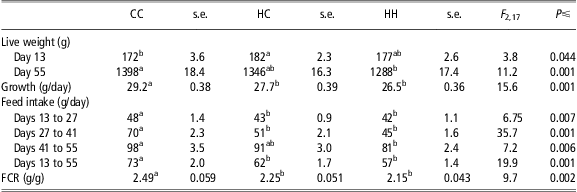
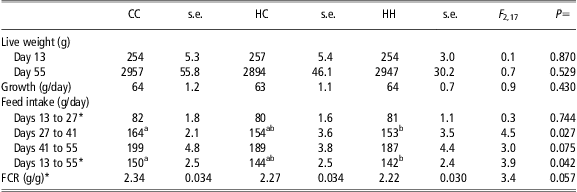
For both strains, open-field response had no significant effect on any of the production parameters measured. Ambient temperature had significant effects on all of the production variables of i657 (Table 3a), with birds on the CC treatment growing faster, eating more and having a higher feed conversion ratio (FCR) than birds on the other two temperature treatments. Ambient temperature did not affect the growth of the Ross 208 strain (Table 3b), but had a significant effect on the feed intake during days 27 to 41, with birds on the CC treatment eating more than birds on the HH treatments, and with birds on HC intermediate. This was also reflected in the overall feed intake and the FCR, although the latter did not differ significantly between ambient temperature treatments for Ross 208 (Table 3b). No effect of strain was found on FCR (F 1,36 = 0.19; P = 0.662).
Least square means and standard errors of production variables for the i657 strain on the three temperature treatments

FCR = feed conversion ratio.
Within rows, values with different superscripts differ significantly (P < 0.01)
Least square means and standard errors of production variables for the Ross 208 strain on the three temperature treatments

FCR = feed conversion ratio.
Within rows, values with different superscripts differ significantly (P < 0.05).
*Degrees of freedom = 2,16 due to food spillage in one pen.
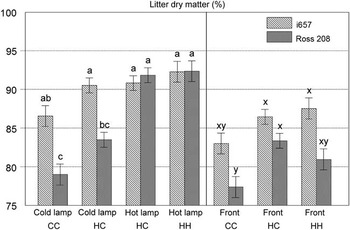
The dry matter of the litter was significantly higher on day 20 than on the subsequent sampling days (92, 85, 84 and 83 (± 0.6)% for days 20, 34, 41 and 48, respectively; F 3,143 = 37.5; P < 0.001). Litter dry matter across days is shown in Figure 2 for all temperature and sample site combinations (F 6,143 = 5.1; P < 0.001). Within strain, the litter dry matter did not differ significantly under the cold lamps and hot lamps, respectively. However, the litter was drier under the cold lamps for the i657 strain. Only small differences were found in litter dry matter in front of the pens (Figure 2).
Litter dry matter percentage (least square means ± s.e.) under the heat lamps and in front of the pen in the different temperature treatments. Within the type of sampling site (lamp or front), bars with different letters differ significantly (P < 0.05).

Behavioural observations
Time samplings
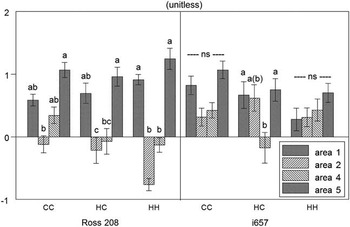
An interaction between strain, area and temperature treatment was found on the distribution of chickens within the pen (F 6,522 = 3.2; P < 0.01), whereas open-field response (active or passive birds) did not affect the distribution of the birds. Figure 3 shows the least square means of the transformed data for each strain and temperature treatment in each of the four areas included in the analyses.
Chickens (least square means ± s.e. of transformed data: ln(na /n 3)-ln(Aa /A 3)) in each area (An ) relative to area 3 (A 3; see also Figure 1). Different superscripts indicate differences within each breed and temperature treatment combination. See text for further comparisons.

Within strain and temperature treatment, no significant differences were found between areas 1 and 5 and between areas 2 and 4, areas that were pairwise of similar size and type. However, for the i657 birds on the HC treatment, there was a tendency (t = −3.5; P = 0.08) for relatively higher number of birds under the hot lamp (area 2) than under the cold lamp (area 4; see Figure 3).
Comparisons within strain between areas 1 and 2 and between areas 5 and 4 showed no significant differences in distribution for temperature treatment CC. For both strains on treatment HC, relatively higher number of birds was observed in area 5 than 4 and for Ross 208 also for area 1 than 2. This difference was further exacerbated for the Ross 208 birds on treatment HH, whereas no differences were found for i657 on this temperature treatment.
A comparison of each area across strains and temperature treatment showed no significant differences for areas 1, 4 and 5. However, significant differences were found for area 2, the area that had an active heat lamp in both treatment HC and HH. For the HC treatment, relatively fewer chickens of the Ross 208 strain were seen in area 2 compared with the i657 birds (t = 3.7; P = 0.045). Ross 208 on the HH treatment were relatively less in area 2 compared with i657 birds on any of the temperature treatments (CC: t = 4.7; P < 0.001; HC: t = 6.1; P < 0.001; HH: t = 4.7; P < 0.001).
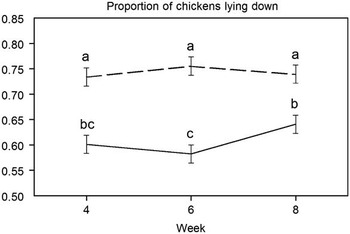
Strain significantly affected the proportion of chickens observed eating during the time samplings, with a higher proportion of Ross 208 eating than i657 (0.041 v. 0.018 (±0.0033), respectively; F 1,43 = 25.8; P < 0.001). A higher proportion of Ross 208 birds were observed lying down across weeks; however, a significant interaction between strain and week was found for this variable (F 2,92 = 3.4; P < 0.05; Figure 4).
Proportion (least square means ± s.e.) of Ross 208 (stippled line) and i657 (solid line) chickens lying down in weeks 4, 6 and 8. Means with different letters differ significantly (P < 0.01). For clarity, the x-axis intersects the y-axis above the origin.

Continuous (focal) observations
No significant interactions were found for any of the variables analysed. Significant differences between strains (Ross 208 and i657, respectively) were found in the proportion of observations spent inactive (0.38 and 0.25 (± 0.037); F 1,105 = 5.9; P = 0.017), lying down (0.64 and 0.43 (± 0.045); F 1,105 = 10.3; P = 0.002), lying close to other birds (0.46 and 0.26 (± 0.046); F 1,105 = 10.3; P = 0.002), in locomotion (0.05 and 0.11 (± 0.011); F 1,105 = 14.5; P < 0.001), exploring (0.014 and 0.044 (± 0.006); F 1,105 = 11.4; P = 0.001) and in the number of behavioural changes (21 and 33 (± 1.8); F 1,105 = 21.5; P < 0.001) and position changes within the pen (4.7 and 9.6 (± 0.83); F 1,105 = 11.0; P = 0.001) per 5-min observation period.
Significant effects of age (4, 6 and 8 weeks, respectively) were also found in the number of behavioural changes (30, 30 and 22 (± 2.2); F 2,105 = 4.2; P = 0.018) and position changes (9.4, 5.2 and 5.4 (± 1.02); F 2,105 = 5.4; P = 0.006) per 5-min observation period. In addition, significant differences between weeks were found in the proportion of observations spent on comfort behaviours (0.10, 0.12 and 0.05 (± 0.018); F 2,105 = 3.8; P = 0.026), and in locomotion (0.12, 0.07 and 0.06 (± 0.013); F 2,105 = 5.6; P = 0.005).
Birds on the HH treatment spent a lower proportion of observations lying close than birds on the HC treatments, whereas CC birds did not differ from the other treatments (0.34, 0.48 and 0.26 (± 0.056), for CC, HC and HH, respectively; F 2,105 = 3.8; P = 0.025). HH birds were also more alert (0.35, 0.35 and 0.44 (± 0.025); F 2,105 = 3.9; P = 0.024) and changed posture more often than birds on the CC treatment (2.8, 3.7 and 4.0 (± 0.31); F 2,105 = 3.7; P = 0.029).
Open-field response (active and passive, respectively) only affected the proportion of observations spent eating (0.04 and 0.10 (± 0.018); F 1,105 = 4.6; P = 0.035).
Drinking and social interactions (aggressive and other) occurred with insufficient frequency or duration to be analysed further.
Social reinstatement test
In the social reinstatement test, 107 of the 144 birds tested left the start box. A significant difference was found between the two strains, with 63% of the Ross 208 birds leaving the start box compared with 86% of the i657 (χ 2 = 10.5; df = 1; P < 0.001). The corresponding odds ratio from the logistic regression of i657 leaving the start box relative to Ross 208 was 3.9 (Z = 3.2; 95% confidence interval: 1.7 to 8.9; P < 0.001). No effects of any of the treatments were found on the latencies of the birds that left the start box (mean ± s.d. = 74 ± 17.6 s). Of these birds, 34% of the Ross 208 strain reached the goal box compared with 74% of the i657 strain (χ 2 = 16.9; df = 1; P < 0.001). Birds of the i657 strain were 6.4 times as likely to reach the goal box once they had started compared with the Ross 208 birds (Z = 4.1; 95% confidence interval: 2.6 to 15.5; P < 0.001), and the censored finishing times (i.e. only birds that reached the goal box are included) were significantly different between the two strains (150 v. 99 s, for Ross 208 and i657, respectively; F 1,45 = 6.3; P = 0.016).
Discussion
To increase spontaneous activity in broilers, two possible options were proposed in the introduction: (1) to select birds that are spontaneously more active and (2) to lower the ambient temperature, thereby removing some of the constraint to heat dissipation. In the following, the effects of strain, early open-field response and ambient temperature are discussed in turn in relation to the general activity and behaviour as well as the feed intake and growth of broilers.
Strain
The genetic differences in growth potential between the two strains were, not surprisingly, reflected in the litter dry matter and production results, with Ross 208 overall growing faster and larger, but not more efficiently than i657. The general behaviour of the fast-growing Ross 208 strain was also much less active than that of the i657 strain as shown in several of the behavioural variables measured. Even the most active Ross 208 birds during the open-field test were less active than the corresponding i657 birds. Such differences in the activity levels between fast- and slow-growing broilers have been frequently demonstrated (Reiter and Bessei, Reference Reiter and Bessei1998; Nielsen et al., Reference Nielsen, Thomsen, Sørensen and Young2003). Arnould and Faure (Reference Arnould and Faure2004) found that fast-growing broilers did not move away from feeders and drinkers when not forced to do so by increasing stocking density. In the present experiment, birds of the fast-growing strain were much less likely to leave the start box and to reach the goal box during the social reinstatement test as were the i657 birds. A social reinstatement test measures both the ability of the chickens to walk as well as their motivation to become socially reinstated (Bokkers and Koene, Reference Bokkers and Koene2004). Although it is not possible to disentangle the two effects in the test used in the present experiment, Ross 208 could be expected to have restricted locomotion caused by their greater BW (Rutten et al., Reference Rutten, Leterrier, Constantin, Reiter and Bessei2002; Bokkers and Koene, Reference Bokkers and Koene2003).
Additional and perhaps more interesting differences between the strains were found in their distribution in the pen according to ambient temperature treatment, and this is discussed subsequently under this heading.
Early open-field response
The attempt to categorise the subsequent activity level of the birds based on their response in an open-field test at 3 days of age proved unsuccessful. The only significant effect of early open-field response was found in feeding behaviour, with passive birds spending more than twice as long eating from the trough. However, as more than 20 behavioural parameters were tested, this could be due to chance. Also, this increased feeding was not reflected in their feed intake as no differences were found in the production parameters between active and passive birds.
The response to the open-field test differed significantly between individuals, with higher activity levels observed among the i657 birds. Activity testing at a young age has in the past been used successfully to select divergently for lines with high and low activity levels in several species (pheasants, Boyer et al., Reference Boyer, Melin and Bourdens1973; quail, Bessei et al., Reference Bessei, Jones and Faure1983; chickens, Faure and Folmer, Reference Faure and Folmer1975; mice, DeFries et al., Reference DeFries, Gervais and Thomas1978). Faure (Reference Faure1977) selected chickens divergently for activity levels in an open-field test at 2 days of age, and found the active line to be less heavy. However, the differences in activity declined when the duration of the test was extended from 12 to 32 min and finally to 23 h (Bessei, Reference Bessei1982). This would indicate that the trait ‘activity in an open-field test’ is not a true reflection of general activity level. This is likely to be due to the response observed in an open-field test being influenced by social motivation and fear (Faure et al., Reference Faure, Jones and Bessei1983).
Bizeray et al. (Reference Bizeray, Leterrier, Constantin, Picard and Faure2000) found a positive correlation between early and later activity, but only in slow-growing broilers. In the present experiment, the social reinstatement test did not reflect the activity of the birds measured earlier in the open-field test for any of the two strains. The use of a social reinstatement test was preferentially chosen over tests involving food as a motivator, as this may have influenced the fast- and slow-growing birds differently. Although the open-field test can be used to quantify social motivation, it is also influenced by fear (Forkman et al., Reference Forkman, Boissy, Meunier-Salauen, Canali and Jones2007), which may have given rise to the differences observed. In addition, the lack of an association between the two tests was not surprising, given that only one difference was found between the active and the passive birds.
It is possible that use of lines selected through several generations for differences in activity levels may have yielded significant effects, most likely with an inverse association between BW and activity (Faure and Ricard, Reference Faure and Ricard1977), which is also present in the between-strain comparison in the present experiment.
Ambient temperature
Out of the three temperature treatments, only the HC treatment was intended to provide the animals with a choice of ambient temperature. However, it was clear from the distribution within pen of the fast-growing strain that the front – and presumably cooler – areas of the pen were preferred in both the treatments where heat lamps were on (HH and HC), with the preference being greatest for the HH treatment. This was not the case for the slow-growing strain, which showed an even distribution within the pen for both the hot and the cold treatments, and a tendency to prefer the hot over the cold heat lamp in treatment HC. For both strains, the distribution in the pen may have been affected by the avoidance of lying close together in the HH treatment and the higher frequency of posture changes. The latter may reflect attempts to dissipate heat, whereas birds in the cold treatment may have remained longer in each posture to preserve heat.
The effect of ambient temperature was reflected in the overall feed intake of both strains, with the difference being 28% higher in the cold compared with the hot environment for the i657 strain, whereas the same figure for Ross 208 was only 6%. Only for the slow-growing strain did this lead to a faster growth and a poorer feed conversion.
A number of possible explanations exist for the smaller effects (i.e. feed intake) and the lack of effects (i.e. growth, feed conversion) of temperature on the production parameters in the fast-growing strain. It may be that the feed intake of these chickens was already constrained, that is, near maximum physical intake capacity of the birds had been reached, and only little further intake could be made in the colder environment. Alternatively, the difference in intake between the extreme ambient temperature environments for the Ross 208 strain may reflect an intake reduction in the hot environment. Cowan and Michie (Reference Cowan and Michie1978) found decreasing food intake in chickens as the ambient temperature increased from 16°C to 31°C. Finally, the ambient temperature difference between the treatments may have been too small to affect the production of the fast-growing strain.
Heat dissipation plays an important role in the feed intake and growth of fast-growing broiler strains, and panting can be seen in these strains when kept under production-like conditions (e.g. Lott et al., Reference Lott, Simmons and May1998). Although slow-growing birds kept at a low ambient temperature have to increase their energy intake to compensate for the heat loss, the fast-growing birds under a high ambient temperature have the option of reducing feed intake (and thus metabolic heat production) or seeking cooler sites. Overall, it appears that the fast-growing strain, to a large extent, used behavioural adaptations to cope with the heat, whereas metabolic adaptations were used by the slow-growing strain to cope with the cooler ambient temperature.
Summary and conclusions
Behavioural and production parameters of fast- and slow-growing broiler strains during the growth period were not affected by their activity level measured at 3 days of age in an open-field test. The usual differences in the growth and overall activity levels were found between the fast- and the slow-growing strains investigated. A cooler ambient environment significantly influenced the growth and FCR of slow-growing broilers, whereas no such effect was found for the faster growing strain. The latter distributed themselves in the pen with a preference for cooler areas in the hottest ambient temperature treatments. In contrast, the behaviour of the slow-growing strain appeared to be relatively unaffected by the ambient temperature, but these birds increased their feed intake relatively more when exposed to cold.
In conclusion, fast-growing broilers use behavioural changes when trying to adapt to warm environments, whereas slow-growing broilers use metabolic changes to adapt to cooler ambient temperatures. Early activity differences of broilers were not detectable during the subsequent growth period. Significant effects of activity levels on growth and behaviour may require studies using lines selected over generations for activity levels.
Acknowledgements
I would like to thank Gert Nielsen and Kurt Jensen for looking after the chickens, Kith Skovgaard and John Misa Obidah for technical assistance, Peter Ravn for advice and loan of equipment for temperature measurements, Sisse L Knudsen, Per Isaksen and Erik Decker for help with video and data handling, and Erik Jørgensen for statistical assistance.