Within the space of three months in 1620, Elizabeth Robesoune appeared before Glasgow commissary court on eight separate occasions alongside her husband, Matthew Bannatyne.Footnote 1 On seven of these occasions, she appeared as a primary litigant to retrieve debts owed to her deceased first husband, William Watson, who had been a flesher (butcher) burgess of Glasgow. In five of these judicial suits, she was successful in recovering debts from a variety of men living in and around Glasgow. On the final occasion, she was compelled by the court to pay her niece Jean Watson a total of 10 merks (10s. 3d. sterling) in completion of a legacy bequeathed by William Watson in his last will and testament.Footnote 2 In this final case, the court clerk noted that Robesoune had failed to appear before the commissar judge despite being “thrice lau[fu]llie callit” to answer the suit.Footnote 3 These eight cases over a short period of time reveal how a woman in seventeenth-century Glasgow interacted with the law to settle outstanding agreements or avoid legal suits that would affect her personal wealth and stock. Court clerks mapped Robesoune's identities within each case, recording her variously as a “spouse,” a “relict” (widow), and an “executrix.” Importantly, these cases disclose how official understandings of women's marital and legal identities before the law were complex, with women's access to the courts depending on numerous intersecting factors. For Robesoune, these included the number of times she had married, her relationship with her deceased husband's kin, and her ability to exert autonomy at law as her deceased husband's executrix. The rights, demands, and interests of her spouses, debtors, and extended kin were inextricably tied up within her multiple identities at law.
The complexity of women's interactions with the burgh (town) and commissary (reformed church) courts of Glasgow during the seventeenth century suggest the inadequacy of traditional identifications of women at law as singlewomen, wives, or widows.Footnote 4 For early modern commentators, these identifications reflected the effects of marriage on women's legal and social status.Footnote 5 English common law treatises, for example, referred to singlewomen, known as feme soles, to married women, known as feme coverts, and to widows.Footnote 6 Such early modern Scottish legal theorists as James Balfour, Thomas Hope, and James Dalrymple (Lord Stair) similarly highlighted women's marital status, contrasting the subjugated legal position of married women with the relative freedoms ascribed to singlewomen and widows.Footnote 7 Writing in the late sixteenth century, Balfour argued that a married woman “beand under the powstie [power] of hir husband, hir voice in law hes na richt, quhairfoir in all his lifetime scho might not nor durst not oppone hir to his will.”Footnote 8 He also noted that a woman who was “fré, and not under subjectioun to ane husband” (that is, a singlewoman or widow) was entitled to dispose of her goods in a will and testament.Footnote 9 Hope reiterated Balfour's assertions in the early seventeenth century, stating, “The husband in all courts may anser for his wyfe, bot the wyfe may not be persewed in no civill cause except her husband be also called to fortifie assist and authorise her.”Footnote 10 Writing at the end of the century, Stair also emphasized the power a husband had over his wife's legal personhood, noting that “during the Marriage she cannot oblige herself [at law].”Footnote 11
The ubiquity of the threefold division of singlewoman, wife, and widow has led most researchers to examine women's access to law in terms of their marital status.Footnote 12 Women's subjugated position within marriage has garnered particular attention, seen most starkly in the English common law doctrine of coverture, under which a husband's legal persona effectively “covered” his wife's.Footnote 13 In Scotland, a married woman was said to be subject to jus mariti, a legal concept derived from Roman law that established a husband's authority over his wife's legal person.Footnote 14 In Scotland as in England, a wife required her husband's consent when appearing before the law, and the rules forbade her from registering contracts or initiating litigation without his permission.Footnote 15 While acknowledging married women's limited status in legal handbooks, Scottish historians now focus on the flexibilities to be found within jus mariti by showing how married women in Scotland routinely accessed their local courts across the early modern period. John Finlay uncovered elite married women acting as procurators (lawyers) for their husbands before the central civil court, the Court of Session, during the early sixteenth century, with such cases raising “a serious question mark” over their subjugated status within Scottish legal handbooks.Footnote 16 Winifred Coutts has also demonstrated the considerable use that married women made of the Court of Session at the turn of the seventeenth century, showing that women appeared in 30 percent of cases, with wives, widows, and remarried widows constituting 75 percent of these litigants.Footnote 17 Coutts's decision to distinguish between married women and remarried widows also shows how clerks in the Court of Session similarly assigned women multiple legal identities within the court record. Margaret Sanderson noted that the burgh and other local courts were “eminently accessible to women” in sixteenth-century Scotland and that married women “frequently” appeared in court to pursue and defend their own legal actions.Footnote 18 Cathryn Spence's study of women and debt litigation in early modern Edinburgh revealed that married women were commonplace in the city's courtrooms, appearing in over one-third of debt cases recorded in Edinburgh's courts between 1590 and 1640.Footnote 19
Recent scholarship has challenged the adequacy of the oft-repeated triad of single, married, and widowed. Rather than dividing women into three distinct categories, Amy Froide suggests a two-part model of “never-married” (singlewomen) and “ever-married” (wives and widows), in order to distinguish singlewomen from their married and widowed counterparts. Froide shows that despite maintaining similar legal identities, widows and singlewomen were treated differently within the community. Widows were often regarded as legally acting as “deputy husbands” when managing the household economy following the deaths of their husbands, while singlewomen were regularly forbidden by town councils from independently heading their own households.Footnote 20 Jennifer McNabb has confirmed this division with the observation that wives and widows were permitted to sit alongside one another when attending Sunday service, while young singlewomen and children were ordered to sit or kneel in the aisles.Footnote 21 Tim Reinke-Williams has also shown how women's clothing changed with their marital status: young unmarried women went bareheaded, while those who had experienced marriage wore distinctive scarves and hoods.Footnote 22 According, Froide has suggested that married women and widows should be classified as “ever-married” women, a term that recognized their social ties through the experience of marriage. However, the judicial system did not treat married women and widows (that is, “ever-married” women) in a similar manner. Wives were always expected to obtain their husband's permission before entering litigation, while widows were entitled to appear before the law without a male guardian. Thus Froide's “never-married” and “ever-married” classification, while helpful in terms of thinking about how the institution of marriage transformed women's social status within the community, does not explain how women navigated their legal status when accessing the law or defending their interests before the courts
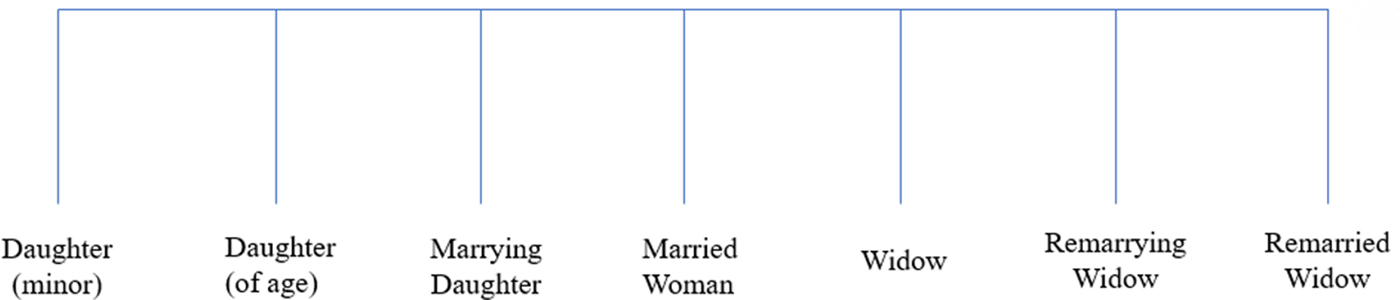
In contrast to simple three- or two-part models, Glasgow's court records reveal a spectrum of female legal roles, including liminal phases prior to the formation of a marital union as well as overlapping phases following remarriage after the death of a spouse (see figure 1). This “marital spectrum” situates women's legal claims in relation to their marital career, allowing for a closer reading of women's legal activities. The three-part model of describing women's use of law as based on their single, married, or widowed status does not neatly correlate to the manner in which women were recorded in the courts of Glasgow. Clerks in Glasgow did not refer to singlewomen as spinsters or maids, and they are therefore difficult to locate within the legal record.Footnote 23 Married women were referred to as “spouses” within the records, while widows were recorded as “relicts.” Court clerks also defined women's interactions with the law on the basis of their family relationships, using labels to encompass a wide range of identities. For instance, clerks would record a married daughter as “daughter of A” and “spouse of B,” capturing both her family relationship and her marital status. A remarried widow would appear as the “relict of A” and “spouse of B,” differentiating her from women who had only experienced marriage once. Court clerks working in Glasgow clearly understood how women's access to legal process was dependent on their multiple identities—as married daughters seeking inheritances after their fathers died, for example, or as remarried widows settling their deceased husbands’ estates. This article show how the recording practices of court clerks in the burgh and commissary courts in seventeenth-century Glasgow involved the assignment of multiple legal identities to women. In doing so, it demonstrates that the three-part model of single/wife/widow is too simplistic to encompass women's interactions with the legal system in Glasgow.
The marital spectrum: range of women's legal identities recorded in Glasgow burgh and commissary courts between 1615 and 1694

The marital spectrum recognizes that women could occupy several positions simultaneously, with their property rights informing their access to law in Glasgow's burgh and commissary courts. For instance, under Scots inheritance law, in the absence of sons, daughters had equal rights to their parents’ landed property.Footnote 24 All children regardless of gender (except the heir) were entitled to an equal share of one-third of their parents’ movable property, commonly recorded as their “bairn's part.”Footnote 25 Court clerks recorded daughters in relation to their access to family inheritance within a broad legal framework. For instance, underage daughters appeared as minors under the governance of legal guardians when receiving their share of inheritance. By contrast, daughters of age independently asserted ownership of their bairn's part before the courts without the presence of male kin. Betrothed women also used their inheritance as a marriage portion when negotiating a marriage for the first time, while married daughters inherited additional family assets upon their death of their parents. Women could therefore appear on multiple points of the spectrum at the same time, with their family relationships and existing rights to property interacting with their marital status at law. McNabb has also recently shown that young married women frequently appeared before consistory courts in early modern England as daughters, revealing how witnesses and litigants “communicated a multifaceted and often flexible conception” of female youth.Footnote 26 These further instances of women simultaneously occupying several positions on the marital spectrum further destabilizes the traditional tripartite legal categories.
In her study of women and the courts in medieval Scottish towns, Elizabeth Ewan urges Scottish historians to “look beyond the formal codes to the actual functioning of the law” when uncovering women's access to the law in premodern Scotland.Footnote 27 The numerous identities that women assumed in Glasgow's burgh and commissary courts indicate that their interactions with the court process cannot be analyzed simply according to the social and legal descriptors attached to the tripartite model. The proposed marital spectrum attempts to provide a more sophisticated interpretive model rooted in Scottish women's use of the law rather than on the basis of their theoretical status in legal handbooks.
The burgh and commissary courts of seventeenth-century Glasgow provide a wealth of evidence about women's access to law in an early modern Scottish town. Glasgow was then an up-and-coming burgh, its population increasing from seven thousand inhabitants at the start of the century to fifteen thousand inhabitants by its end.Footnote 28 Scots law was built on Roman civil law principles, a strong legal tradition that afforded women a certain degree of autonomy in comparison to the strictures of English common law.Footnote 29 Canon law interacted with civil law and was used in the commissary court after the Reformation of 1560 so long as it did not contradict the reformed religion.Footnote 30 Women were able to appear before the burgh and commissary court when registering a contract or initiating litigation and were only legally compelled to revert to the central courts in Edinburgh (the Court of Session and Edinburgh commissary court) when challenging the jurisdiction of the lower courts or attempting to seek a marital separation or a divorce.Footnote 31 The burgh court, situated in the Tolbooth at Glasgow Cross, had a wide civil and criminal jurisdiction and was headed by a provost and the town bailies (magistrates), with a clerk employed to record everyday court business on behalf of court officials. The commissary court, located in the southwest tower of Glasgow Cathedral a short distance from the Tolbooth, was a reformed church court headed by a commissar judge and his deputy and primarily dealt with cases concerning unsettled executory matters, suits for unpaid debt, and aliment (maintenance) for widows and orphaned children.Footnote 32 Glasgow's commissary court primarily dealt with complex legal disputes concerning the ownership and division of property. The lowest church court, the kirk session, headed by church elders and the local minister, dealt primarily with sexual transgressions, slander and defamation, accusations of witchcraft, and church discipline.Footnote 33 Women's use of Glasgow's burgh and commissary courts largely concerned their property rights, their legal activities before these courts broadly resembling the actions and grievances of men living and working in the city.
Based on a systematic sample of approximately 4,500 property contracts and legal cases brought before Glasgow's burgh and commissary courts between 1615 and 1694, this article demonstrates the range of legal identities recorded for the city's female court users. The commissary court records are taken from the Register of Deeds and the Register of Decreets and Decrees Dative. The Register of Deeds recorded property deeds, recognizing ownership of property, and contracts, recognizing individuals’ rights in relation to property.Footnote 34 The latter might include tenants’ rights to brew malt on their property, widows’ rights to receive yearly aliment settlements as part of their terce (dower) rights, or apprentices’ rights to bed and board under indenture agreements. While the Register of Deeds recorded (mostly) agreeable economic relationships, the Register of Decreets and Decrees Dative recorded the breakdown of a wide range of economic and legal relationships, such as outstanding debts often spanning generations, disputed distribution of marital and inherited property following the death of a family member, or the removal of bad tenants by aggrieved landlords.Footnote 35 The records pertaining to Glasgow's burgh court are less standardized and mostly take the form of loose legal papers, including marriage contracts, credit and debt transactions, and “tacks” (leases), as well as leather-bound court books recording disputes arising from broken contracts.Footnote 36 Considering the burgh and the commissary court records alongside one another can show how women navigated and interacted with the legal system in the ever-expanding city.
Scottish wives were easily distinguishable from their husbands and their children, as they retained their natal surnames throughout their lifetime.Footnote 37 This practice makes it possible to trace women's marital careers within the legal record, with Scottish sources providing information that is often hidden in other polities.Footnote 38 Gordon DesBrisay, Karen Sander Thomson, and Cathryn Spence all discovered that a wife's surname would appear in the marginalia of the court book when the debt was contracted by her alone, thereby disentangling a married woman's legal actions from those conducted by her husband in his role as the administrator of the marital economy.Footnote 39 The legal process of placing a wife's name before her husband's in the court record in Scotland makes it possible to identify when the context of the contract or a legal case concerned the married woman alone, with her husband simply cited “for his interest.”Footnote 40
Court officials in Glasgow assigned women a range of legal identities relating to their natal and marital relationships. The social and legal classifications of women in the court records covered an array of possibilities from betrothed daughters negotiating their property rights before marrying to remarried widows acting as executrixes of their late husbands’ movable estates. The above example of Elizabeth Robesoune touches on several key areas that this article examines further: firstly, how the marital spectrum model better describes women's relationship to the law than the simplified tripartite model; and secondly, how married women's multiple identities before the courts of seventeenth-century Glasgow (as married daughters, property-owning wives, and remarried widows) makes the singular legal category of “wife” too simplistic in practice. Focusing on women's everyday use of the legal system in seventeenth-century Glasgow, through the registration of contracts as well as property disputes brought before the city's burgh and commissary courts, this study reveals how women's complex identities as daughters, mothers, sisters, wives, remarried widows, and executrixes all shaped their access to law.Footnote 41
The “Marital Spectrum”: Women's Legal Identities in Seventeenth-Century Glasgow
A woman's position on the marital spectrum intersected with other relevant factors including the wealth of their familial and marital households, the presence of male or female siblings, the frequency of remarriage, and any legal guarantees negotiated during their marital career. Consisting of eight descriptors from girlhood to widowhood, the marital spectrum complicates women's engagement with the law, showing how their interest in specific cases could encompass multiple identities well beyond their legal and marital status as singlewomen, wives, or widows. Married women in particular could occupy several positions on the spectrum at any given time, appearing within the court records in a variety of configurations that the simple category of “wife” fails to uncover.
The recording of women's marital, occupational, and social status in formulaic legal records was not always complete or clear, with various social meanings attached to descriptors such as “Mistress,” “Madam,” or “Lady.” Amy Erickson, by tracing the various meanings attached to the status of “mistress” across history, has highlighted the risks in historians assigning a marital status onto women without the assistance of complementary evidence.Footnote 42 Court clerks in Glasgow also sometimes recorded women's first names and surnames without providing their marital status. Spence has commented on this particular incongruity in the records of Edinburgh's burgh court.Footnote 43 It is tempting to conclude that these women were unmarried, but this assumption risks assigning female court users an incorrect marital status. Women who appeared before the burgh and commissary court without a marital status or natal relationship recorded have therefore been eliminated from this study. Similarly, in instances where clerks indicated only a woman's occupational status, such as “servitrix” (servant), or her residential status, such as “indweller in Paisley,” it can be tempting to assume she was unmarried. Making such assumptions is risky and so is avoided here. Consequently, the marital spectrum in this study traces only those women assigned definite legal identities in the records, such as “daughter of A,” “spouse of A,” and “relict of A and spouse of B.” (“Relict” has been modernized here to “widow” to facilitate comparisons with other European countries.) Tracing how court clerks recorded women in contracts and legal disputes roots the marital spectrum in everyday legal practice rather than in presumptions about their marital and legal status.
The first category on the spectrum, of daughters in their minority, includes young girls who were legally subject to male guardians. Typically, these female users of the court were discussed in relation to their appointed tutors and curators (guardians) following the death of their father. If a father died without appointing a tutor for his children, the commissary court appointed a tutor-dative on his behalf, often choosing an uncle. A daughter could marry at the age of twelve; once married, her husband became her legal guardian. A singlewoman on reaching the age of twelve could choose a curator to act as her legal guardian until she reached the age of twenty-one.Footnote 44 The commissary court also appointed curators usually consisting of one person from each side of the parents’ kin group, such as the father's brother and the mother's brother.Footnote 45 For instance, when Jonet and Agnes Lyburn, minor daughters of the deceased Gabriel Lyburn, appeared before the commissary court in January 1620, the court appointed James Lyburn, their father's brother, and Thomas Pettigrew, their mother's brother, to oversee their financial estate. This procedure enabled kin to enter judicial proceedings on behalf of children, typically to secure their inheritance or to claim unpaid debts or maintenance due to the children following the death of their father or mother.Footnote 46 In October 1629, Jonet Drew, recorded as the “onlie dochter procreat betwixt umquhile [deceased] Johne Drew … and umquhile Margrat Bunteine his second spous,” appeared before Glasgow's burgh court confirming that she had received her due inheritance following her father's death.Footnote 47 The court clerk noted that she was appearing before the town baillies with the consent of her three male curators, revealing that she was still under the age of twenty-one. In addition to receiving £100 Scots (£7 13s. 10d. sterling) from her father's estate, Drew stated, she had received 400 merks (£21 10s. 9d. sterling) from her “mothers pairt of geir”—almost three times the amount she was entitled to inherit from her father's movable estate.Footnote 48 She acknowledged payment from her father's third wife (now widow), Elizabeth Hamilton, and her stepbrother John Drew.
Other daughters were identified in relation to their parents without mention of requiring another person's consent, suggesting that they had reached the age of twenty-one and were capable of managing their own affairs at law. Daughters of age typically appeared in contracts and litigation as independent creditors and debtors engaging in economic transactions. Before the burgh court in February 1628, Ninian Houstoun, a merchant burgess, noted in a legal contract that he had paid Jonet Snodges, the “dochter” of Ronald Snodges, a shoemaker, £30 Scots (£2 6s. 2d.) for cloth she had sold to him in 1627.Footnote 49 In a contract registered with the burgh court in December 1667, Margaret Fairlie, recorded as the “dochter” of Gavin Fairlie, a shoemaker, lent 50 merks (£2 13s. 10d.) to James Simmter, a mason burgess, requiring him to repay the sum of money by the feast of Martinmas (11 November) the following year.Footnote 50
Betrothed daughters also came before Glasgow's courts, primarily when negotiating a marriage for the first time. A marrying daughter would appear with her parents and other members of her kin group to denote their collective interest in the financial terms of the arrangement. An antenuptial marriage contract could be registered at Glasgow's burgh or commissary court and would detail when the father, mother, or other members of the kin would pay the daughter's tocher (dowry), the marrying couple's rights to each other's heritable and movable property, and the amount that the husband-to-be promised to contribute to the marital union. Marion Gardiner, recorded as the “dochter” of Bessie Bryce and “futur spous” to Robert Lambrie, claimed before Glasgow's commissary court in June 1615 that her mother (who appeared as a remarried widow) had promised to pay Gardiner's future husband 100 merks (£5 7s. 8d. sterling) for her tocher by the following Whitsunday.Footnote 51 The fact that Gardiner's mother, Bessie Bryce, and not her stepfather, Gavin Granger, was obliged to pay her tocher reflects how property was divided along blood lines, with biological parents, regardless of their gender or their current marital status, expected to provide for their children.
Marrying women also joined their future husbands when contracting credit and debt transactions, albeit on a lesser scale. For instance, before the burgh court in January 1625, Robert Gibsone, a cordwainer in Glasgow, and Jonet Mitchell, recorded as his “futur spouse,” jointly borrowed £16 Scots (£1 4s. 7d. sterling) from David Clerk, a shoemaker.Footnote 52 As further security on the borrowed sum, the marrying couple placed items of clothing in “wad” (pledge), including a gown of brown cloth with velvet sleeves and a pair of cloaks with silver fastenings. By pledging items of clothing in exchange for credit, the marrying couple were perhaps attempting to establish their joint credit-worthiness within the community prior to their marriage before the kirk. A marrying daughter's legal status before entering marriage was situated within a liminal phase as she was not considered married until her marriage had been solemnized before the kirk door. The women whom clerks recorded as “future spouses” thus warrant a distinct place on the marital spectrum between single and married.
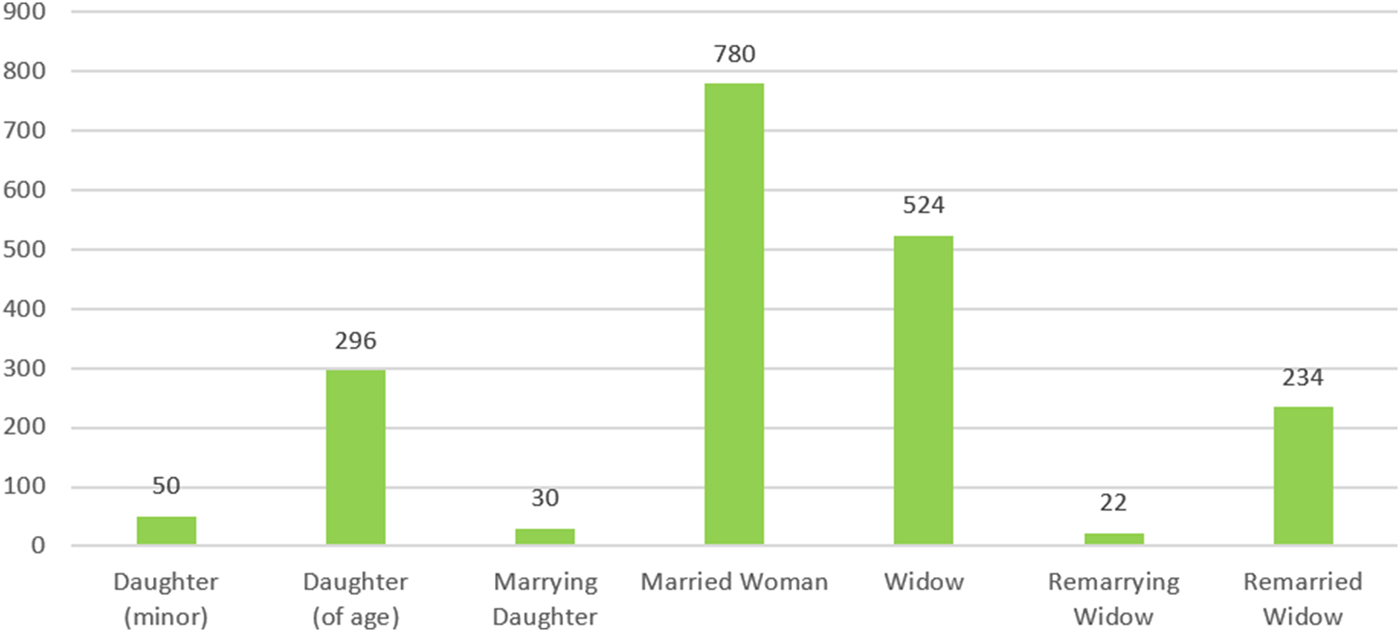
Married women formed the majority of female court users in Glasgow's burgh and commissary courts (see figure 2). An examination of married women's litigation in the city's commissary court reveals that their interactions with the law could be complex, with their legal claims difficult to define in relation to marital status alone. Married women appeared as primary litigants when asserting ownership of their share of inheritance or managing their business affairs, with their husbands named alongside them “for their interest.” Wives also appeared alongside their husbands when managing marital assets before the law, including retrieving unpaid “mail” (rent) from tenants or collecting payments for sold commodities. Remarried widows approached the commissary court when attempting to settle outstanding debts linked to their deceased husbands’ estates, or when receiving care provision from their deceased husbands’ kin when looking after children from their first marriage. Litigation before the Glasgow commissary court shows how the marital classification of “wives” can be further differentiated into three separate categories: wives as primary litigants, husbands and wives together, and remarried widows alongside their new husbands.
The marital status of female court users noted by court clerks operating in the burgh and commissary courts of Glasgow, 1615–1694. Source: Glasgow Commissary Court, Register of Deeds, CC9/14/vols. 4, 11, 12, 19, 20, 27; Register of Decreets and Decrees Dative, CC9/3/vols. 1, 4, 5, 7, 8, 13, 14, 17, 21, 23, 24, 33, NRS; Glasgow Burgh Court, court book, B1/1/5; book of bonds, B10/10/1; warrants of deeds, B10/15/226-706; 1942–1989, GCA.

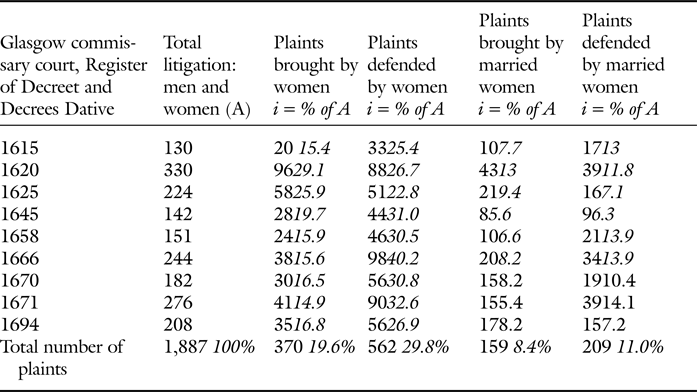
Married women appeared in Glasgow's commissary court to claim or defend their right to own and use property, often in disputes over unpaid debts and the division of property, either following the conclusion of a credit arrangement or upon the death of a family member. Table 1 describes married women's involvement in bringing and defending property suits before the commissar judge in several sample years between 1615 and 1694.Footnote 53 On average, cases initiated by women as plaintiffs or “pursuers” formed between 15 and 30 percent of suits, with plaints defended by women forming between 22 and 40 percent of cases across the seventeenth century (see table 1). These findings largely coincide with statistical analysis undertaken by legal and gender historians elsewhere; Tim Stretton and Laura Gowing also locate women as forming a substantial number of plaintiffs and defendants in the Court of Requests and church courts of London during the late sixteenth and the seventeenth centuries.Footnote 54 Even though Gowing uncovered a significantly larger proportion of female litigants in the church courts in early modern England, her sample cases focused heavily on the presence of women in defamation suits—cases that in Scotland during this period traditionally appeared in kirk sessions.Footnote 55
Cases brought and defended by married women before Glasgow commissary court between 1615 and 1694. Source: Glasgow Commissary Court, Register of Decreets and Decrees Dative, CC9/3/vols. 1, 4, 5, 7, 8, 13, 14, 17, 21, 23, 24, 33, NRS.

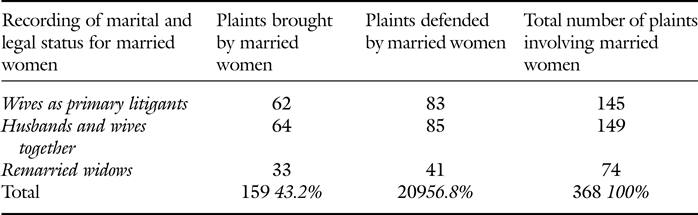
Married women initiated between 5 and 9 percent of cases in Glasgow commissary court across the chosen sample period. When a wife appeared as a primary pursuer in a case, her name always appeared before her husband's in the court record. For instance, in January 1670, Barbara Law, the spouse of James Cothrane, successfully initiated legal proceedings in the commissary court against five different people in an attempt to recover a variety of household debts, including £8 Scots (12s. 4d. sterling) from Issobel Henrie for mail (rent) for a house she owned in liferent (usufruct) and £3 Scots (4s. 7d. sterling) for green cloth she had sold to Margaret Ferguson, wife of John McClyment.Footnote 56 The fact that Barbara's name was recorded before her husband's shows that the context of the dispute concerned her individual rights to the outstanding debts. When wives were named alongside their husbands as pursuers in litigation, the case often concerned their husband's business dealings or their joint household debts, as DesBrisay and Sander Thomson noted in their study of women's participation in Aberdeen baillie court during the seventeenth century.Footnote 57 Remarried widows were named in relation to both their deceased husband and their new spouse when initiating litigation in the commissary court, the context of their suit often referring to debts relating to their previous marital estate. Of the 159 plaints pursued by married women across the selected time frame, approximately 40 percent recorded wives’ names before their husbands’, while 20 percent were initiated by remarried widows (see table 2). These scribal conventions show how commissary court officials understood married women's claims in relation to their multiple identities and existing property rights at law.
Cases brought and defended by married women before Glasgow commissary court between 1615 and 1694 (further tabulated from above sample). Source: Glasgow Commissary Court, Register of Decreets and Decrees Dative, 1615–1694: CC9/3/vols. 1, 4, 5, 7, 8, 13, 14, 17, 21, 23, 24, 33, NRS.

Married women defended between 7 and 14 percent of all suits in the Glasgow commissary court across the chosen sample period (see table 1). Wives were often named as primary defendants in litigation when the case concerned their existing rights to property—as married daughters who were acting as executrixes to their deceased parents’ movable estates, or as remarried widows who had failed to honor their deceased husbands’ credit arrangements. In December 1666, Archibald Maxwell initiated a suit before the commissary court against Bessie Wood, who was simultaneously recorded as the “spouse” of John Pettigrew and “executrix” to John Wood, “hir father.”Footnote 58 Maxwell informed the court that Bessie, as her father's executrix, owed him 100 merks (£5 7s. 8d. sterling) for an outstanding debt made to her father in 1643, revealing that the debt stretched back as far as twenty-three years. In the 209 suits defended by wives across the selected time frame, clerks named wives as primary defendants in 40 percent of suits and remarried widows as primary defendants in 20 percent of suits. Even though married women were more likely to appear as defendants in litigation brought before the commissary court, it seems they were equally likely to be recorded as primary litigants or remarried widows, regardless of whether they were initiating or defending a suit. This suggests that married women's interaction with the commissary court in seventeenth-century Glasgow was understood by court clerks as relational to their existing rights to property and their position on the marital spectrum.
Remarried widows formed a considerable number of married pursuers and defendants in Glasgow's commissary court (see table 2) and were often embroiled in legal suits relating to their previous marital estate, or were seeking aliment for their children from former marriages. Upon remarriage, widows were often unable to retain control of their children's financial estates, having to rely instead on court-appointed tutors or curators to supply money for care of their children.Footnote 59 In March 1670, Margaret Mathie, recorded as the “relict” of James Brocke and the “spouse” of John Crun, appeared before the commissar judge in Glasgow accusing her children's guardians of refusing to provide her with financial compensation for taking care of the children following their father's death.Footnote 60 Mathie argued that she and her new husband had cared for her three children following her previous husband's death and that she was owed 500 merks (£26 18s. 6d. sterling) in compensation for providing them with “meit drink bedding and abulziementis [clothes]” for three years. Rather than simply defining her in relation to her new husband, court clerks recognized her continued financial interests in her deceased husband's property. The court understood property rights as relating to multiple relationships and understood the control and management of property within marriage as being subject to continuous negotiation before the law.
Wives also contracted debts when their husbands were absent from the country due to warfare or merchant seafaring. Spence has suggested that in Edinburgh a married woman might be named alongside her husband in debt litigation to assure creditors that the debt would be paid if her husband were to die or be absent from the city for a protracted period of time.Footnote 61 Male absence could vary from a few days to several decades, with married women left in charge of heading and running the household and raising the children, often with the help of extended kin and neighbors.Footnote 62 Before leaving the country, husbands could transfer significant legal rights to their wives by registering a formal legal instrument in either the burgh or commissary court. In December 1692, George Carruthers, a corporal under the command of Captain George Inestoun in Sir Thomas Livingstone's Regiment of Dragoons, appointed his wife, Jonet Riddick, as his “actrix and factrix” (legal agent) before Glasgow's commissary court, bestowing her with the legal right to collect and contract debts in his name in and around the burgh of Ayr during his absence.Footnote 63 Within the contract, Captain Inestoun even stipulated that Riddick was “to doe every uther thing in the premises as I might doe myself,” reflecting the considerable level of authority a wife could assume during prolonged periods of a husband's absence. Married women also appeared in court on their husbands’ behalf without evidence of a formal instrument. In July 1658, the burgh court noted that Robert Campbell, a traveler between Scotland and Ireland, and John Cumyng, a merchant in Glasgow, owed another merchant a total of £56 13s. Scots (£4 7s. 2d. sterling).Footnote 64 The court clerk then noted that John Cumyng was represented “be his wife,” revealing how she had approached the court to settle her husband's debt when he had failed to do so. Legal officials permitted married women to manage their household's legal affairs in their husband's absence, whether the reason for the absence was desertion, distant employment, or warfare, temporarily placing wives’ legal status on a par with that of singlewomen and widows.
Widows had considerable legal freedom when entering contracts and initiating legal proceedings since they did not require a male guardian to act in their interest. Widows also appeared before Glasgow courts as executrixes following the death of their husbands, a legal office that allowed them to pursue and settle debts linked to their previous marital estate. Spence has shown that widows also appeared before the burgh court of Edinburgh when settling the debts of their late husbands.Footnote 65 When Jonet Or, recorded as the “relict” of William Barclay, appeared before Glasgow's burgh court in November 1657, she stated that she was retrieving £20 Scots (£1 10s. 9d. sterling) from Gavin Listoune, for merchandise her husband had sold two years before; and 7 merks (7s. 6d. sterling) from Jon Woodrow, to whom she had sold onion seeds nine years previously.Footnote 66 Her husband, William Barclay, had died in November 1656, and in his last will and testament he had formally recorded his outstanding debts and appointed Jonet Or as his “onlie exe[cut]rix.”Footnote 67 Only the debt incurred by Gavin Listoune, however, was listed in William Barclay's will, with Jonet Or's pursuit of Jon Woodrow before the burgh court showing that as a widow she was able to pursue debts owed to her alone from the period when she was a married woman. A widow certainly regained a significant level of legal freedom upon her husband's death; however, her legal actions often concerned agreements made during her marriage.
If a widow had chosen to remarry, court clerks might record her as “relict of A” and “future spouse of B.” Antenuptial agreements contracted by women who had been married before differed from those entered into in first-time marriages; remarrying widows represented themselves in prenuptial contracts, while marrying daughters typically relied on their parents and kin for legal support in these circumstances. Remarrying widows used the courts to protect their rights to property from previous marriages. For instance, when Dorothy Dunlop, “relict” of James Stewart, entered into an antenuptial marriage contract with Cuthbert Campbell in November 1647, she stipulated that her new spouse would have “na power to dispose w[i]t[h] hir liferent lands & tenements” that she had acquired through her previous marriage to Stewart.Footnote 68 Likewise, in April 1685, Grissell Wallace, the “relict” of an unnamed merchant traveler between Scotland and England, asserted before the burgh court that her new husband, Walter Buchanan, “shall ever insirt hir name with his awne on all rights and securities to be made and grantit to him” and that he should never enter a contract in “prejudice to hir” during their marriage.Footnote 69 How she could enforce this clause is unclear, but its inclusion in the contract suggests that Wallace was aware of how marriage affected her landed property rights. The antenuptial marriage contracts of remarrying widows disclose their awareness that they could retain some independent wealth as married women, therefore limiting their new husband's power to take ownership of their movable assets or to manage their real estate without their explicit consent.
The marital spectrum reveals how women could occupy multiple identities at law, with court clerks acknowledging complex marital careers and varied family relationships. Women also occupied more than one position on the spectrum within a single record. For instance, when Catherine Craig appeared before Glasgow burgh court in January 1670, asserting her rights to 1,400 merks (£75 7s. 8d. sterling), the court clerk recorded her as the “dochter” of William Craig, the “relict” of John Ralling, and the current “spouse” of Thomas Ferguson; she appears simultaneously within the contract as a daughter and a remarried widow.Footnote 70 Because the contract concerned her conjunct infeftment (jointure) rights from her previous husband's estate, a settlement negotiated by her father in her first antenuptial marriage contract, the court clerk recorded Catherine Craig's multiple identities, with her new husband named “for his interest.” Approximately 8 percent of married women were also recorded as “dochters” by court clerks in Glasgow. When Agnes Fleming leased a portion of land in Kirkintilloch to a married couple in October 1662, the contract identified her as the “dochter” of Robert Fleming and the “spouse” of James Winipester, revealing that the property had formed part of her inheritance after her father's recent death.Footnote 71 Jonet Kirk, described as both the “dochter” of William Kirk and the “spouse” of James Rae, registered a contract with the commissary court in May 1670 denoting her right to inherit the equal half of £400 Scots (£30 15s. 5d. sterling) alongside her younger sister Agnes.Footnote 72 Thus married women's family relationships informed their appearance before the law alongside their marital status, with existing rights to property, enabling wives to assert control of certain types of property within marriage.
Some female court users appeared as married daughters one day and married women the next, their legal identities constructed around the context of the case at hand. When Elizabeth Hunter came before Glasgow's commissary court to register legal contracts over the course of two days in January 1694, the first contract identified her as the “dochter” and “executor-dative” of the deceased Robert Hunter and the “spouse” of Robert Galbraith.Footnote 73 When she reappeared the following day to appoint her brother as legal overseer of her financial affairs in Ayrshire, however, she was simply recorded as the “spouse” of Robert Galbraith, with no mention of her deceased father.Footnote 74 Court clerks clearly understood that women's multiple identities informed their ability to appear before the court and that their legal status was not solely based on a singular identity that neatly corresponded to their marital status.
The process of assigning a woman's legal identity based on her marital status alone clearly fails to map the complexities found in everyday life, in which the interests of spouses, children, parents, kin, debtors, and creditors placed women at the crux of multiple claims to property. Considering women's litigation as complex and varied in relation to their stage in the life cycle, the number of times they had married, and their relative social and financial status provides historians with a detailed picture of their interactions with the legal process based on more than their marital status.
Conclusion: Rethinking Women's Interactions with the Law
This study of women in the burgh and commissary courts of Glasgow across the seventeenth century has shown how court officials utilized a wide range of legal identities for women beyond their single, married, or widowed status. Using the burgh and commissary courts of Glasgow as a case study, this article discloses the full range of marital, familial, and legal identities attributed to women within contracts and litigation. Although Scottish legal writers focused heavily on the legal disabilities of married women, legal practitioners working in Glasgow's courts acknowledged a more complex reality that depended on women's family relationships and their sometimes intricate marital careers. It is possible to locate married women's identities within liminal stages, such as prior to the formation of marriage or in the overlapping stages before a second or third marriage following the death of a previous spouse. The marital spectrum accentuates the rich variety of Scottish women's identities as litigants and offers a more nuanced model rooted in women's interaction with the courts of seventeenth-century Glasgow.
Married women's use of Glasgow's burgh and commissary courts also reflects how court clerks recorded married women as encompassing a wide range of identities at law, including married daughters, property-owning wives, and remarried widows. While all of these women would be simply categorized as “married” within historical discourse, their interaction with Glasgow's courts differed according to their position on the marital spectrum, as well as on the basis of their existing rights to property. Marriage did not necessarily overrule prior claims contingent on other marital, legal, or familial identities; married daughters were still entitled to receive a share of inheritance following the death of a family member, for instance. This case-by-case analysis of contracts and litigation shows that married women's legal identities were multifaceted and intertwined with spouses, children, parents, and other kin.
Moving beyond the prescriptive literature and dominant narratives of three marital identities to reconstruct women's lived experiences at law allows a wider reading of their legal activities, while further supporting the argument that recourse to the law was not solely shaped by married status. Legal officials reacted to the specific context of a suit when deciding whether a woman could appear, understanding that legal rights to property could be complex and defy simple categorization. Rather than understanding women's access to the law as conditional on where they fit within the threefold classification of single, married or widowed, this article has shown that often women's marital status intersected with their existing family networks, responsibilities and rights to property, both within and outside of marriage. The concept of the marital spectrum, by approaching women's marital status as existing in relation to their multiple identities at law, illustrates the importance of asking more analytical questions about the significance of marital status when locating women within early modern courts of law.