1. Introduction
The NIFLAR project aims at enriching and innovating foreign language teaching and learning processes, by creating opportunities for enhancing authentic social interaction between students of foreign languages and native student teachers. For this purpose, interaction tasks were developed for the project languages (Dutch, Portuguese, Russian and Spanish) with a focus on intercultural awareness.
The interaction sessions took place in two digital environments: video-web communication and voice-enabled 3D virtual worlds. The first one facilitates distant spoken and written interaction among dyads or groups of students. They work collaboratively, by sharing files while communicating and seeing each other through the webcam. The interaction sessions were conducted in Adobe-Connect.
In the second environment, voice-enabled 3D virtual worlds, students participate as avatars, can engage in textual and voiced interactions with other avatars while carrying out actions together (walking, dancing, taking and giving objects, even building); avatars can be teleported to different countries, cities or public and private spaces (a house, shops, restaurants, hospitals, hotels, courtroom, parliament, theatre, museum), just by a simple mouse click. These different scenarios, and the possibilities of undertaking action while communicating with others, make 3D virtual worlds a potentially interesting environment for foreign language teaching and learning. In NIFLAR experiences were provided in Second Life (tertiary education) and Open Sim (teenagers).
One of the main objectives of NIFLAR is to find out whether there is an added value in incorporating these new technologies and the possibilities they offer for intensifying interaction in language learning processes, an issue we will be addressing in this paper.
2. Studies on computer mediated communication
Computer mediated communication (CMC) is being increasingly embraced by language teachers, as students can communicate in the target language (a) synchronously through a computer with their teacher, classmates, foreign language learners elsewhere or even with native speakers. Educational practices with different virtual environments have been described pointing at positive (students like it and feel sessions contribute to the learning process) and negative aspects (technical problems, organizational burden and pragmatic misunderstandings leading to irritations) (see Belz & Thorne, Reference Belz and Thorne2006; Guth & Helm, Reference Guth and Helm2010; O'Dowd, Reference O'Dowd2007; Reference O'Dowd2011).
Researchers have tried to show the relevance of CMC in promoting second language acquisition. The initial studies showed that written (mostly asynchronous) CMC contributes to: (1) breaking down barriers and inhibitions when using the target language, helping the L2 learner to become more confident about his/her language use (Kern, Reference Kern1996); (2) stimulating foreign language learners to experiment with and produce more target language (Kelm, Reference Kelm1992; Kern, Reference Kern1996); and (3) enabling a more coherent (Felix & Lawson, Reference Felix and Lawson1996) and lexically and syntactically more complex production of language (Warschauer, Reference Warschauer1996). In recent years the study of intercultural competence in CMC has been a major focus of attention (Belz, Reference Belz2003; Belz & Thorne, Reference Belz and Thorne2006; Liauw, Reference Liauw2006; Müller-Hartmann, Reference Müller-Hartmann2000; O'Dowd, Reference O'Dowd2003, Reference O'Dowd2006, Reference O'Dowd2007; Ware & Kramsch, Reference Ware and Kramsch2005).
As for synchronous CMC, most research has been carried out on chat sessions. Chat sessions are said to be effective communicative tools to enhance language learning at syntactic (Sotillo, Reference Sotillo2000), discourse (Warschauer, Reference Warschauer1996), grammatical (Pellettieri, Reference Pellettieri2000), lexical (Smith, Reference Smith2004), and intercultural levels (Belz & Thorne, Reference Belz and Thorne2006; Toyoda & Harrison, Reference Toyoda and Harrison2002; Tudini, Reference Tudini2007), although Ortega (Reference Ortega2009) has reported that a closer look at text-based SCMC research reveals mixed findings and insufficient evidence (see also Sauro, Reference Sauro2011, for a recent overview).
As far as audio (visual) synchronous environments are concerned, experiences have been reported making use of (1) audiographic conferencing (Lamy, Reference Lamy2004; Ciekanski & Chanier, Reference Ciekanski and Chanier2008; Hampel & Hauck, Reference Hampel and Hauck2004; Hampel, Felix, Hauck & Coleman, Reference Hampel, Felix, Hauck and Coleman2005); (2) videoconferencing (O'Dowd, Reference O'Dowd2000, Reference O'Dowd2006); (3) voiced chats like MSN, Skype, Netmeeting (Develotte, Guichon & Vincent, Reference Develotte, Guichon and Vincent2010, Guth & Maio, Reference Guth and Maio2010, and Wang, Reference Wang2004, Reference Wang2006, Reference Wang2007); and more sophisticated audiovisual web communication platforms like Adobe-Connect, Elluminate or Visu (Guichon, Reference Guichon2010; Jauregi & Bañados, Reference Jauregi and Bañados2008, Reference Jauregi and Bañados2010). Most of these research studies, although they provide interesting information, are explorative and describe experiences as being motivating and contributing to communicative or intercultural development, but do not offer strong empirical evidence for it.
An interesting study analysing the benefits and drawbacks of engaging students in voiced chats is that by Bueno Alastuey (Reference Bueno Alastuey2011). She worked with two condition groups: a control group that interacted face to face with classmates in English on task performance, and the experimental group who carried out the tasks in the target language (English) through Skype with students in Turkey. After triangulating and analyzing different sources of data (general proficiency pre- and post-test scores, oral Powerpoint presentation grades, questionnaires and diaries) she found significantly better achievements for the SCMC group as opposed to the control group and a clear increase of positive factors to language learning in the experimental group: satisfaction, feelings of improvement and decreased speaking anxiety.
In the last few years virtual worlds, such as Second Life, are becoming increasingly popular among language teachers (see Molka-Danielsen & Deutschmann, Reference Molka-Danielsen and Deutschmann2009 and Deutschmann, Panichi & Molka-Danielsen, Reference Deutschmann and Panichi2009 for an overview), particularly as a space where foreign language learners can engage in interaction (Deutschmann et al., Reference Deutschmann, Panichi and Molka Danielsen2009; Peterson, Reference Peterson2010), meet native speakers of the target language (Kuriscak & Luke, Reference Kuriscak and Luke2009) for engaging in meaningful communicative and social interaction (Jauregi, Canto, Graaff, Koenraad & Moonen, Reference Jauregi, Canto, Graaff, Koenraad and Moonen2011) while undertaking joint action. Interactional virtual spaces in virtual worlds have been assessed as beneficial for learning and achieving communicative and intercultural competence (Bryant, Reference Bryant2006; Thorne, Reference Thorne2008) as users can experiment and interact with a variety of norms of social interaction (Steinkuehler, Reference Steinkuehler2006). In these 3-D environments learners can have the opportunity to experience life-like social interaction while at the same time engaging in meaningful learning activities (Cooke-Plagwitz, Reference Cooke-Plagwitz2008). The realistic nature of the environment provides authentic learning conditions that are otherwise difficult to recreate in traditional classroom settings (Dieterle & Clarke, Reference Dieterle and Clarke2008). However, as Peterson reports (Reference Peterson2011), research on virtual worlds remains largely exploratory in nature and is subject to significant limitations. Clearly more research is necessary that analyses whether and how interactions through audiovisual platforms and/or virtual worlds can contribute to foster (intercultural) communicative competence.
3. Research context
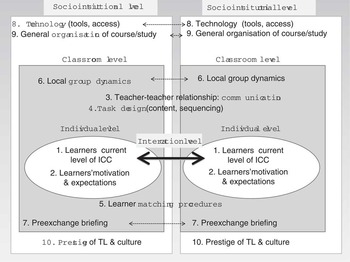
Organising telecollaboration projects can be a complicated endeavour as O'Dowd and Ritter (Reference O'Dowd and Ritter2006) have shown. Problems can arise at individual, classroom and/or socio-institutional levels (see Figure 1). This organizational burden increases when synchronous tools are being used in telecollaboration projects.
Difficulties when trying to organise telecollaborative projects, based on O'Dowd and Ritter (Reference O'Dowd and Ritter2006).

There is a clear need to come to know whether including telecollaboration sessions in language curricula has an added value in language learning processes; and this is the main research question (RQ) we address in this paper: Is there any indication suggesting that learners learn more if they have the opportunity to engage in networked interaction with expert peers according to relevant tasks through video-web communication or Second Life than when they have not? In other words,
RQ1: Is there a significant difference comparing oral communicative growth of experimental groups (those engaged in networked interactions with expert peers though video-web communication and virtual worlds) and a control group (those carrying out the tasks face to face with classmates in the classroom setting) according to pre- and post-oral tests?
RQ2: What are participants’ learning experiences?
(i) Do foreign language learners have the impression they learn in the interaction sessions?
(ii) Do pre-service teachers feel that their foreign language learners’ oral communicative competence increases comparing the first and the last interaction sessions?
In order to answer these questions, this study assessed a group (n = 36) of university students on measures of communicative language competence based on descriptors that were inspired by the scales proposed by the Common European Framework of Reference for languages (CEFR). It then investigated whether there was any relationship between the effectiveness of the three different interaction conditions (1. virtual worlds with native student teachers; 2. video-webcommunication with native student teacher; 3. non native – non native interaction in the classroom) and communicative competence. Finally, information elicited from the post-questionnaire was used in order to answer subquestions 2(i) and 2(ii) and triangulate results.
4. Research method
The study was conducted at the University of Utrecht in The Netherlands, where the first year language learners of this study were enrolled, in collaboration with the University of Valencia in Spain where the fourteen participants followed a pre-service teacher education programme. Language students (n = 36) were randomly assigned to one of three research conditions: video-web communication (VC), Second Life (SL) or Control (C) group and pre-service teachers were assigned to one of the conditions according to their personal preferences. During the period of observation (February–April 2010) the participants carried out five tasks at intervals of once a week. All five tasks were tested in a pilot study beforehand. Previous to the task sessions, language learners and pre-service teachers participated in VC and SL tutorials to become familiarized with the tools.
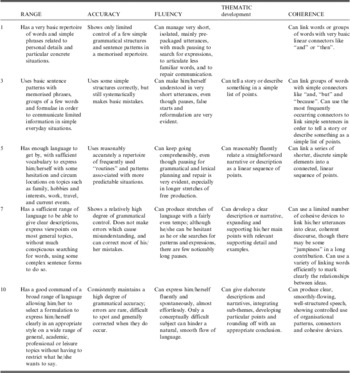
The data collection sources for this study were pre- and post-oral tests, which assessed learners on measures of (a) range of language, (b) grammatical accuracy, (c) fluency, (d) thematic development and (e) coherence in order to measure communicative growth; and post- questionnaires.
4.1 Instructional treatments
Language participants at Utrecht University were enrolled in a Spanish language course estimated at B1 (CEFR). The course for both VC and SL groups was considered blended learning, which meant that each group would meet twice a week face to face with their teacher (the same one for all three groups) whereas the third meeting was computer-mediated with the native speaker to perform an interaction task. Participants in the experimental groups communicated in triads: two language students carried out tasks with one native speaker of Spanish during five task sessions. In the case of the control group, the third weekly session was the performance of the the same interaction tasks as the experimental groups, in groups of four language learners in the language classroom. The type of instruction that the control group followed (without telecollaboration with native speakers) is the one that most closely approximated to the model that the majority of students experience in language courses where they carry out tasks with each other in the classroom setting.
The tasks were designed and aligned with the course content and objectives, as they were linked to units from the task-based syllabus used in the course. Tasks were the same for all three groups; they were only adapted in order to take advantage of the specific affordances of the VC or SL medium. Where participants from the SL group could virtually visit the Spanish city their interlocutor was from, go together on a skiing holiday or play a cultural game, the VC group was able to do the same with a native speaker too through the affordances of the medium via images, video and sharing of information. The control group, on the other hand, had the aid of images and video to contextualize tasks but had no native interlocutors playing the expert role. All task sessions were part of the course syllabus.
The five tasks developedFootnote 2 were the following: In the first task, “Gente genial” (Cool People) participants, as exchange students in an Erasmus program, were asked to (1) visit an apartment they were meant to share, (2) talk about themselves and exchange cultural information triggered by pictures and (3) choose an outing option (go to the cinema, to a museum or to walk in the city). The second task, “Gente y Aventura” (People and Adventure) consisted of planning a holiday and reflecting on past holiday experiences. The third task, “Gente de cine” (Movie Celebrity People), was a selection of different short scenes in which participants had to play different roles given the indications of a brief script. The fourth task, “Gente con corazón” (People with Heart), allowed students to impersonate different characters and experience the reactions of others. Finally the fifth task, “Gente y culturas” (People and Cultures), was designed as a cultural television-game-style contest between a Dutch and a Spanish team.
All tasks had a preparatory phase followed by a performance phase with support materials in the form of documents to guide them through the tasks.
4.2 Instruments
In order to answer the main research question oral pre- and post-tests were taken prior to and after the interaction sessions which would allow us to measure communicative growth. Participants’ experiences were evaluated at the end of the course in a survey and additional interviews were recorded.
4.2.1 Oral tests
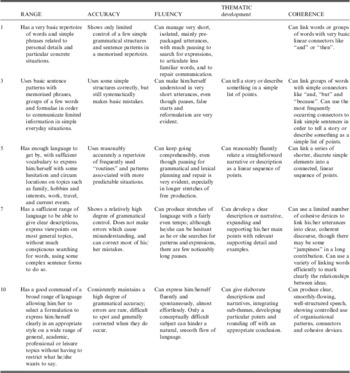
The pre- and post-test were the same for the three research conditions. Language learners were assessed on measures of communicative language competence based on descriptors that were inspired by the scales proposed by the Common European Framework of Reference for languages (CEFR). A 10-point scale was used to assess each of the following five measures: (a) range of language, (b) grammatical accuracy, (c) fluency, (d) thematic development and (e) coherence (see Appendix).
The test consisted of 11 open questions that ranged from personal information and studies (3 items), previous experiences in Spanish-speaking countries (1 item), student life (3 items), weather and gastronomy (2 items), economy (1 item) and recommendations for foreigners visiting their country (1 item). The questions were video recorded by a native student teacher.
The oral tests were administered via a computer in a language lab. Every student sat in front of a computer, activated the video and answered orally the 11 questions. The recording was done automatically. Students could spend as long as they wanted on each answer since they had access to a panel control to pause after each question. All recorded answers were given a code so that when assessing them the researchers would not know beforehand if it was a pre- or a post-test they were assessing.
Two native speakers of Spanish rated the tests separately on five aspects: (a) range of language, (b) grammatical accuracy, (c) fluency, (d) thematic development and (e) coherence. However, since there was a high correlation between all five indicators (0.89 ≤ r ≤ 0.98), they were collapsed into one measure of oral skill. An estimate of inter-rater agreement between both raters was calculated and proved to be high (α = 0.91).
4.3 Surveys
After the conclusion of the project a final survey was digitally distributed to all three groups of language learners and native student teachers in order to evaluate participants’ experiences and triangulate results. The survey for VC and SL groups had 29 items with open and closed questions about the virtual environment (10 items), the tasks (2 items), the speech partner (4 items), the learning potential of the project (4 items), organization (1 item) and global project evaluation (5 items). The control group survey consisted of eight items referring to personal data (2 items), native speaker interactions (2 items), the language course (1 item), learning outcomes from interactions with native speakers (1 item) and preference of interaction styles (2 items). In all three surveys for the closed items a five point Likert scale was used.
4.4 Data analysis
The effect of the virtually mediated interaction with native speakers on communicative growth was analysed in two different ways. First, the mean differences between pre- and post-test scores and conditions were tested by means of analysis of variance for repeated measurements. In this analysis we were primarily interested in the interaction effect between moment of measurement and condition, as this states that the average progress differs between conditions.
In the second analysis, so-called aptitude-treatment (Cronbach, Reference Cronbach1957), interactions were explicitly tested to see whether the regression from post-test on pre-test scores varied between conditions, as one condition might be more effective for lower achieving students, whereas another condition might be better suited for high achievers. These aptitude-treatment interactions are tested by means of multiple regression analysis in which both the intercept and the regression from post- on pre-test scores are allowed to vary between conditions.
Comparing mean scores in pre- and post-tests across conditions allows us to (1) determine if students achieved more on the post-test than on the pre-test, and (2) establish in which of the three groups students’ progress is largest. Comparing pre- and post-test scores of individual students (in a multiple regression) allows for more nuanced conclusions as the effect of a pedagogical treatment might depend on students’ communicative competence level when beginning the course.
5. Results
The results with respect to the added value of implementing synchronous networked interaction with native speakers are presented here.
5.1 Indicators of learning growth
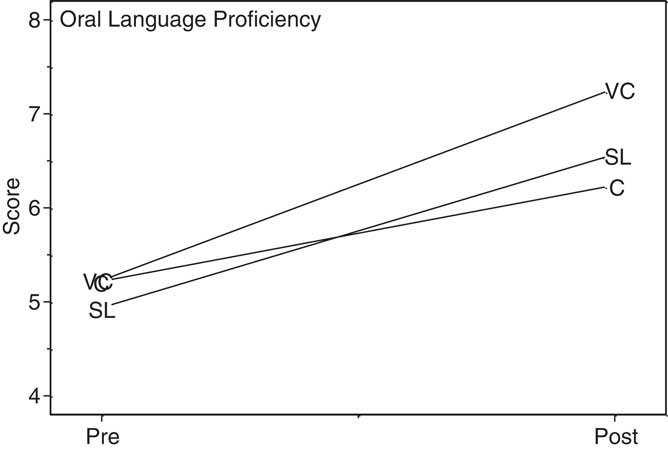
Figure 2 shows that there was a difference between the average score in the pre-test and average score in the post-test in all groups, that is, there was communicative learning growth in both experimental (VC and SL) and control groups.
Mean scores for oral pre- and post-tests of experimental and control groups (VC: video web communication; SL: virtual worlds—Second Life; C: control).
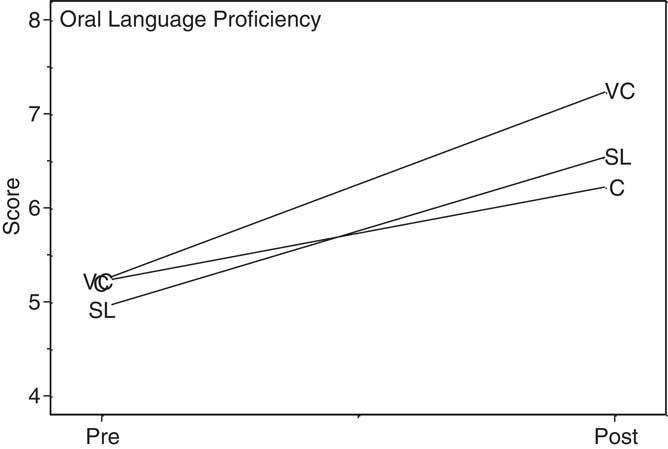
As can be seen in Figure 2 the averages on oral language proficiency increase from pre- to post-test (F (1, 34) = 147.7; p < 0.001). Hence, on average students’ scores on the post-test are higher than the scores on the pre-test. Also the interaction between condition and moment of measurement proved significant (F (2, 34) = 5.01; p = 0.12). This means that the increase in oral skills differs between the three conditions. In the control condition the increase in students’ oral skills is significantly less than in either the VC, or SL condition. So on average both VC and SL are more effective than traditional education in the control condition.
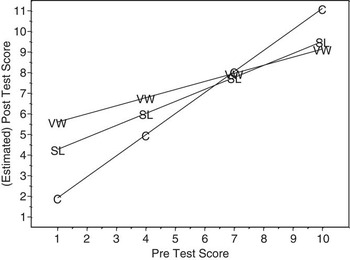
In a second analysis, the increase in scores appears to be dependent on students’ pre-test scores as well (see Figure 3); low achievers in the pre-test are likely to be low achievers on the post-test and high achievers on the pre-test are likely to be high achievers on the post-test as well (t = 12.52; p < 0.001). However, the relation between pre- and post-test scores differs between conditions. In both the VC and SL condition the relation between pre- and post-test scores is less strong as compared to the control condition (t = −4.46; p < 0.001 respectively t = −3.16; p = 0.004). In Figure 3 these effects are graphically illustrated.
Relation between pre-test (x-axis) and post-test scores for the three research conditions: VW, video-webcommunication; SL, Second Life; C, Control group.

From Figure 3 it appears that students with poor oral skills at the start of the experiment learn more in both the VC and SL conditions as compared to the control condition. The high achieving students on the pre-test seem not to profit as much from networked interactions with expert peers.
5.2 Language learners’ experiences
The experiences were very positively evaluated. Tasks were felt to be motivating and useful; interactions with pre-service native teachers contributed considerably to the enhancement of learning processes and motivation, and the environments, in spite of technical problems, were described as being effective in enabling distant native/non-native-speaker interaction. Not only did language learners of all three groups find the tasks useful and motivating, but the pre-service teacher interlocutors in the VC and SL experimental groups also noticed this phenomenon.
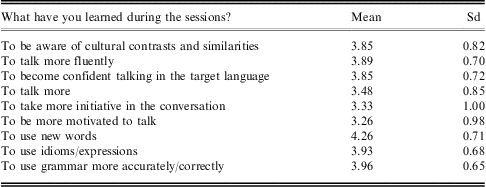
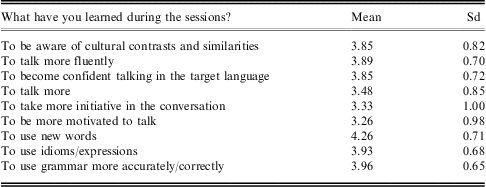
Language learners who had had the opportunity to collaborate with native speakers (VC and SL groups) also reported that the telecollaboration sessions had made them more aware of cultural contrasts and similarities, that they had become more confident, were able to talk more fluently, and took more initiative (Table 1). From a statistical test it appeared that only the question on motivation to talk does not, on average, differ from neutral answer 3 (in all other cases t ≥ 1,71; df = 26; p ≤ 0.049).
VC and SL language learners’ evaluation responses about learning experiences on a 5-point Likert scale (1: diagree; 5: agree; N = 27).
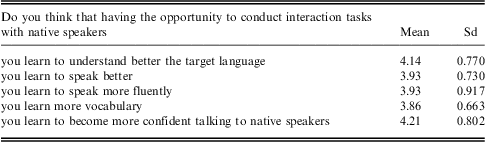
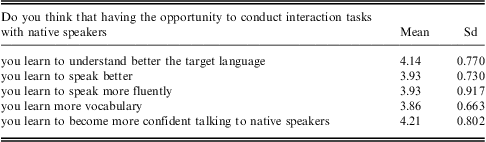
When participants in the control group were asked if they thought that, given the opportunity to interact with a native speaker they would improve their confidence, fluency and knowledge about the target culture; would learn to speak better, would learn more vocabulary and understand more, answers pointed towards an affirmative score. (see Table 2).
Control group language learners’ evaluation responses on a 5-point Likert scale about possible learning experiences when interacting with a native speaker (N = 14).
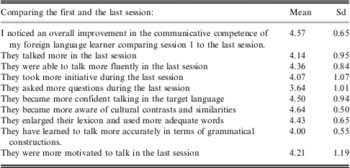
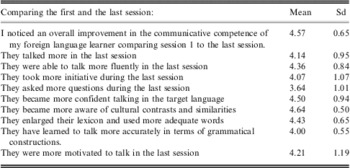
Students’ learning improvements in VC and SL groups were not only perceived by the students themselves, they were also noticed by pre-service teachers when asked to compare the first and last interaction sessions (Table 3).
pre-service teachers’ evaluation responses about language learners’ improvement on a 5-point Likert scale (N = 14).
6. Discussion
Experimental second language acquisition research typically investigates the effectiveness of instruction in terms of overall group gains. That is, the average effectiveness of particular learning conditions is compared. The results of this study suggest that on average participants in VC and SL groups show more improvement in their oral proficiency than students who did not participate in this type of interaction. However, the improvement appears to be dependent on the initial proficiency of language learners. Students with lower oral language skills seem to profit more from VC and SL conditions than the more proficient learners.
For the VC and SL groups task completion took between 60 and 90 minutes but there was no real time limit to the task; we observed that the majority of interactions took 90 minutes or longer. The control group carried out the task during classroom time and spent 30 minutes to perform it. The fact that the control group's interaction sessions were shorter might have influenced the results. On the other hand, the added value of integrating networked interactions is that it intensifies authentic learning, creating more opportunities for spontaneous exchanges, which in turn will increase learning possibilities.
According to Robinson (Reference Robinson2005) the effects of learning contexts, pedagogic interventions and cognitive processes in interaction come together with the patterns of abilities that learners bring to those contexts; that is, some learners may be suited to learn under one condition or from one technique rather than others. Individual differences such as motivation, language aptitude, learning styles and learning strategies may also interact with the characteristics of L2 tasks to systematically affect speech production and learning, so that one type of learner may be systematically more fluent or accurate on one type of task rather than another (Robinson, Reference Robinson2005). Other research (Dörnyei, 2009) also indicates that the interaction between the language learner and the environment matters.
The significant correlations between gain scores for the experimental VC and SL groups, where students with lower pre-test scores did better at the post-test, suggest that they were the ones who benefited more from the instruction method where virtual interactions were included. Previous studies within the NIFLAR project (Jauregi, Graaff, van den Bergh & Kriz, Reference Jauregi, de Graaff, van den Bergh and Kriz2012) analysed whether implementing networked interaction sessions with native speakers had an impact on the motivation of foreign language learners. The results were positive, indicating that that was the case for learners with a lower proficiency level. The results from this current study seem to be in line with those found by Jauregi et al.(Reference Jauregi, Canto, Graaff, Koenraad and Moonen2011).
Positive outcomes such as this study showing the benefits of integrating online exchanges into the foreign language classroom should encourage other language practitioners to integrate this type of collaboration into their foreign language learning programmes. Not only did it show a positive effect on learners’ oral proficiency, these telecollaborations also underlined the important role of culture in learning a foreign language and helped understand what intercultural skills and attitudes are required by speakers of foreign languages (Thorne, Reference Thorne2006). Another contribution, as noted also by O'Dowd (Reference O'Dowd2011), is the way in which it increases the level of authenticity in classroom practices and content: learners are able to engage in authentic interaction with speakers of the target culture while still benefiting from the guidance and support of their tutors and classmates.
Studies carried out by Warschauer and Ware (Reference Warschauer and Ware2008) and O'Dowd (Reference O'Dowd2011), where foreign language instructors were interviewed, suggest that telecollaboration is unfortunately seen as an ‘add-on’ activity and is not considered an integrated part of study programmes. In our research we have found indicators showing that these online exchanges make a positive contribution to foreign language learning processes, and we suggest that they should need to be an integral part of language programmes. As our study shows, we are convinced of the benefits of telecollaboration and think that its potential can be exploited by all teachers and not only be the preserve of a few instructors, as seems to be the case according to O'Dowd's findings (2011).
7. Conclusions
The added value of networked interactions points towards cultural, linguistic, interpersonal and motivational benefits. Within NIFLAR telecollaboration, in spite of the organizational burdens, was experienced as challenging, motivating and innovative. The synchronous learning environments used in conjunction with effective interaction tasks and the opportunities to engage in meaningful interaction with expert peers (native student teachers) contributed to enrich intercultural learning experiences.
There are several factors that need to be taken into consideration when interpreting the results of this study. There is a need for additional research that investigates the relationship between the effectiveness of integrating these virtual interactions and individual differences. The effects measured in this study were short term; further research would need to look into what would happen in the long term. Another aspect that needs further research is to find out how the scores of the high scoring pre-test participants would be affected were they to have more telecollaboration sessions, as learning evolves quickly in the first stages of language acquisition but not at advanced levels. In addition, future research should analyse and compare the effect that interacting with native speakers has on learners’ communicative competence according to the affordances of the specific environment being used: video web communication or Second Life.
Our results show that there is a significant difference in oral communicative growth between experimental groups (engaged in networked interactions with expert peers though video-web communication and virtual worlds) and a control group (carrying out the tasks face to face with classmates in the classroom setting), with those participating in networked interactions outperforming those who did not (RQ1). This type of telecollaboration has a positive impact on language learners’ learning experiences, since they have the impression that they learn from them (RQ2.i) and this is also perceived by pre-service teachers (RQ2.ii). We consider these positive results in answer to our research questions very encouraging.
Assessment grid for pre- and post-tests