

Introduction
Quadrupedal mammals vary the temporal and spatial coordination of their limb movements to perform different gaits. Limb movements are thought to be generated and controlled by central pattern generators, which are intraspinal networks of neurons capable of producing rhythmic flexions and extensions of the joints that result in limb movement and determine the coordination patterns between the left and right, forelimbs and hind limbs that are characteristic of the different gaitsReference Collins and Richmond1. Horses are particularly versatile in the range of gaits they performReference Howell2–Reference Hildebrand4. Most equine gait research has focused on steady-state locomotion in a specific gait. For example, in dressage horses, temporal and spatial kinematics have been described for the walkReference Clayton5, trotReference Deuel and Park6–Reference Holmström, Fredicson and Drevemo9 and canterReference Clayton10. There have been relatively few studies of transitionsReference Argue and Clayton11, Reference Argue and Clayton12. Horses perform transitions between gaits from a very early age in accordance with the need to move at different speeds. The trigger for natural transitions is controversial. Theories include the idea that a transition occurs when a gait reaches its mechanical limitReference Alexander13 or that transitions are used to reduce the metabolic cost of locomotionReference Hoyt and Taylor14 or musculoskeletal loadingReference Farley and Taylor15.
Transitions performed in the sport of dressage differ from transitions performed naturally: the trigger is a learned cue from the rider. Ideally, the gait before and after the transition is performed at steady state, i.e. without changing speed or stride rate in preparation for the transition. Under these conditions, the mechanical or metabolic stimuli that drive natural transitions are overridden by the trained response. Dressage training emphasizes the importance of transitions between and within the gaits both for improving the quality of the overall performance as well as for maximizing scores awarded in competition for the quality and precision of the transitions per se. One of the desirable qualities of a transition between gaits is that the horse moves directly from one gait to the other without the intervention of intermediate steps that are not characteristic of the footfall pattern or limb support sequence of either gaitReference Argue and Clayton11. The expectation of a horse's ability to perform transitions without intermediate steps increases with level of training.
In the early stages of dressage training, transitions are performed between gaits that are adjacent on the speed continuum (halt and walk, walk and trot, trot and canter). As training progresses, horses perform transitions between gaits that are not adjacent on the speed continuum and that have larger speed differentials, such as trot and halt. In the trot, limb movements are synchronized by diagonal pairs, although there is often a small dissociation between diagonal contacts and lift-offsReference Deuel and Park6, Reference Clayton8, Reference Holmström, Fredicson and Drevemo9, Reference Drevemo, Fredricson, Dalin and Bjorne16, with either the forelimb or hind limb contacting the ground earlier.
Transitions from trot to halt (TH) and from halt to trot (HT) are performed at all levels of dressage competition. Ideally, in the TH transition, the diagonal limb synchronization pattern is maintained through the transition, with adjustment of step lengths to bring the contralateral limb pairs into alignment in a square halt. When moving off from HT, the horse should immediately step off with a diagonal limb synchronization pattern. Previous studies have shown that transitions between walk and trot are made with fewer intermediate steps in horses trained to a higher level in dressageReference Argue and Clayton11. Interestingly, the ability to perform direct transitions between trot and canter did not change with level of training, which may reflect the fact that there are fewer limb coordination options when changing between the symmetrical diagonal limb coordination pattern of trot and the asymmetrical pattern of canter in which movements of one of the diagonal limb pairs are synchronizedReference Argue and Clayton12.
This study was designed to describe and compare temporal characteristics of the TH and HT transitions in horses performing in different levels of dressage competitions. The experimental hypothesis is that horses competing at a higher level will perform the transitions more directly, with fewer non-trot steps.
Materials and methods
The experimental protocol was approved by the institutional committee for animal care and use.
Data collection
Video recordings (60 Hz) using a Sony Handycam DCR-HC32 (Sony Corporation, Tokyo, Japan) were made at a dressage show sanctioned by the United States Dressage Federation during competitions at training level in which the halt is approached in working trot (novice; n = 15) and second level in which the halt is approached in collected trot (medium; n = 15). Recordings were made using a Panasonic AG450 Super VHS camcorder (Matsushita Electric Corp. of America, Secaucus, NJ, USA) at the Barcelona Olympic Games during performance of the Grand Prix test in which the halt is approached in collected trot (advanced; n = 15). Each horse was evaluated in one competition only. Riders gave written consent for the use of their videos. During each competition, the camera was set up in an appropriate place to allow good visualization of limb movements in the TH and HT transitions.
Data analysis
The videotapes were viewed in slow motion using TeamPro software v 4.5 (Dartfish, Alpharetta, GA, USA). This software allows frame-by-frame replay forwards and backwards and image magnification. The hard arena base was covered with approximately 6 cm sand at both locations. Contact between the hoof and sand was easily identified, but the presence of the sand prevented visualization of hoof contact with the underlying base. Therefore, as in other studies (e.g. ClaytonReference Clayton8, Reference Clayton10), stance duration was measured according to hoof contact with the sand. For the TH transitions, the last limb to become stationary was noted and the preceding eight diagonal steps (four strides) were analysed. These steps were named TH8–TH1, with TH1 being the step immediately preceding the halt. For the HT transition, the first limb to move forward defined the end of the halt. This limb was noted and the following eight diagonal steps (four strides) were analysed. These steps were named HT1–HT8, with HT1 being the step immediately after the halt. This follows the convention of naming the strides from the event of interest outwards, for example during analysis of jumping when the jump is the event of interestReference Clayton17, Reference Abourachid, Herbin, Hackert, Maes and Martin18.
The temporal analysis was performed on a frame-by-frame basis to determine contact and lift-off times of each hoof. Contact was defined as the first frame in which the hoof had visible contact with the sand footing, and lift-off was the first frame in which there was no visible contact between the hoof and the footing. The following temporal variables were measured:
Duty factor of each limb was calculated as stance duration (time elapsing between contact and lift-off) divided by the sum of the stance and swing durations (time elapsing between lift-off and the subsequent contact) for that limb.
Diagonal dissociation at contact was the time elapsing between contacts of a diagonal pair of hooves, with a positive value being assigned if hind contact preceded fore contact and a negative value being assigned if fore contact preceded hind contact.
Diagonal dissociation at lift-off was the time elapsing between lift-offs of a diagonal pair of hooves, with a positive value being assigned if hind lift-off preceded fore lift-off and a negative value being assigned if fore lift-off preceded hind lift-off.
Suspension was the aerial phase between successive diagonal stance phases, when none of the hooves was in contact with the ground. It was calculated as the time elapsing between lift-off of the last hoof of a diagonal pair until contact of the first hoof of the next diagonal pair.
The steps were classified as trot or non-trot based on the amount of diagonal dissociation at contact. Trotting dressage horses frequently show diagonal dissociation at contact of the order of 0.03 sReference Holmström, Fredicson and Drevemo9, which is below the threshold for perception by the human eye. For this study, steps with absolute diagonal dissociations at contact < 0.1 s were regarded as having a diagonal coordination pattern and were classified as trot steps, whereas steps with absolute values of diagonal dissociations at contact >0.1 s were designated as non-trot steps. On this basis, each diagonal pair of footfalls was categorized as a trot step or a non-trot step. The halt was defined as a period of time during which all of the hooves were in contact with the ground.
Statistical analysis
Descriptive statistics (mean ± SD) were calculated for the measured variables during the eight steps of the TH and HT transitions. Within each type of transition, differences between levels of training (novice, medium and advanced) were sought using the general linear ANOVA model (SAS Institute Inc., Cary, NC, USA). When differences were present, the Tukey B post hoc test was used to determine where the differences lay. Contingency tables and a χ2-test were used to detect differences between levels of training in the number of horses that were trotting in the steps preceding and following the halt. Preferences for initiating and completing the halt with a left or right limb and with a fore- or hind limb were analysed using an χ2-test for equality of distribution. All statistical tests were performed using a probability of P < 0.05.
Results
TH transitions
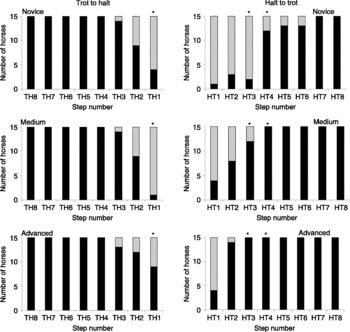
The diagonal synchrony of the limb movements was maintained in all horses through step TH4 (Fig. 1). Within each group, one or two horses lost the diagonal synchrony and showed non-trot steps in step TH3, and by step TH1 the number had increased to 6 horses in the advanced group, 14 horses in the medium group and 11 horses in the novice group. The number of horses that were trotting differed significantly between groups in step TH1.
Number of horses in which the steps are diagonally synchronized defined by having diagonal dissociation at contact < 0.01 s (black shading) and number of horses in which diagonal dissociation at contact is >0.1 s (grey bars) in the eight steps preceding the transition from trot to halt (left panel) and in the eight steps following the transition from halt to trot (right panel) for horses competing at novice (top), medium (middle) and advanced (below) levels of competition. Asterisks indicate values that differ between levels of training

Mean values for the diagonal dissociations at contact and lift-off were slightly positive in all groups during steps TH8–TH6, but became negative in the novice horses in step TH5 and in the medium and advanced horses in step TH2. All groups had negative values for diagonal dissociation at both contact and lift-off in steps TH2 and TH1 (Table 1).
Diagonal dissociation at contact, diagonal dissociation at lift-off and duration of suspension for the last eight steps of a transition from trot to halt for novice, medium- and advanced-level dressage horses

Step 8 is the final step into the halt. A negative value for suspension indicates the amount of overlap between diagonal stance phases. Within each variable, values with the same superscripts across a row do not differ significantly between levels of training (P < 0.05).
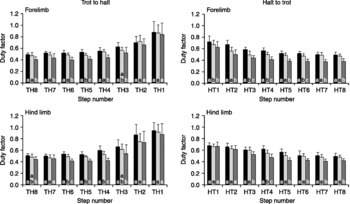
In both the forelimbs and hind limbs duty factors increased with proximity to the halt (Fig. 2). The values were significantly larger in the novice group than in the advanced group from TH8 to TH3 for all except one step. Mean values for the medium group lay between those of the novice and advanced groups. Duty factors increased markedly in steps TH2 and TH1, and there were no differences between groups for these steps.
Duty factors in the eight steps preceding the trot to halt transition (left panel) and the eight steps following the move off from the halt into the trot (right panel). Values are mean and SD for the left and right forelimbs (above) and mean and SD for the left and right hind limbs (below) for horses competing at novice (black bars), medium (light grey bars) and advanced (dark grey bars) levels of competition. Different letters within the bars indicate values that differ significantly for the three levels of training within the same step

In step TH8, only the advanced group had a suspension phase; the mean value for suspension was zero in the medium group and negative in the novice group; a negative value indicates overlap between successive diagonal stance phases (Table 1). In subsequent steps, the amount of overlap increased progressively and more rapidly in the novice group than in the medium group. Horses in the advanced group retained a suspension phase until TH4, after which there was a rapid increase in the amount of overlap in steps TH3–TH1. Duration of the suspension phase differed significantly between the novice and advanced horses in all steps, except TH1 in which all groups showed an overlap of >0.5 s as a consequence of the fact that the limbs of the other diagonal had already halted (Table 1).
For horses in the novice group, the first limb to step into the halt was more often a hind limb and the last limb to step into the halt was more often a forelimb (Table 2). There was no left/right preference in any group with regard to the first or last limb to halt (Table 3).
Fore/hind distribution of first and last hooves to halt from the trot and to move off from the halt

Asterisks indicate pairs of fore/hind values that differ significantly on an χ2-test (P < 0.05).
Left/right distribution of first and last hooves to halt from the trot and to move off from the halt

Asterisks indicate pairs of left/right values that differ significantly on an χ2-test (P < 0.05).
HT transitions
The first limb to step out of the halt was always a forelimb, and preference for using a forelimb was significant in all groups (Table 2). The first limb to step forward was the left forelimb in 14 horses and the right forelimb in 31 horses. Horses in the advanced group showed a significant preference to move off with the right rather than the left forelimb (Table 3).
All horses in the advanced group and 12 horses in the medium group were already trotting by step HT3, compared with only 2 horses in the novice group, and it was not until step HT7 that all novice horses had established the diagonal coordination pattern of the trot. The number of horses that were trotting differed significantly between groups in steps HT3 and HT4.
Diagonal dissociations at contact and lift-off were negative in all groups in steps HT1–HT4 (Table 4). Diagonal dissociation at contact became positive in steps HT3, HT5 and HT7 in the advanced, medium and novice groups, respectively. Values at contact were significantly larger in the advanced group than in the novice group in steps HT2–HT8. Diagonal dissociation at lift-off became positive in the advanced group in step HT5 and in the medium and novice groups in step HT7. Significant between-group differences in diagonal dissociation at lift-off disappeared by step HT6 (Table 4).
Diagonal dissociation at contact, diagonal dissociation at lift-off and duration of suspension during the first eight steps of a transition from halt to trot for novice, medium- and advanced-level dressage horses

Step 1 is the first step out of the halt. A negative value for suspension indicates the amount of overlap between diagonal stance phases. Within each variable, values with the same superscripts across a row do not differ significantly between levels of training (P < 0.05).
Fore and hind duty factors decreased progressively in the steps following the move off from the halt (Fig. 2). The values were significantly larger for horses in the novice group than the advanced group for all steps in the forelimb and for step HT3 onwards in the hind limb.
Suspension was present in the advanced group from step HT4 onwards, but was not present in any step in the other two groups. The values differed significantly between the novice and advanced groups in all eight steps, and there was significantly less overlap in horses in the medium group than in the novice group in steps HT1–HT5 (Table 4).
Discussion
The results of this study support the experimental hypothesis that horses performing at a higher competitive level perform transitions from TH and HT more directly based on the smaller number of non-trot steps during the transitions and on the ability to retain the temporal variables of the trot in the steps approaching the halt and to re-establish them in the steps following the move off from the halt. This finding agrees with the results of a previous study in which the ability of dressage horses to perform direct transitions from walk to trot and from trot to walk without the intervention of intermediate steps improved with the horse's level of trainingReference Argue and Clayton11. The ability to make direct transitions requires the development of both motor coordination and muscular strength. In the early months of training under saddle, sport horses show a reduction in hind limb stance durationReference Back, Hartman, Schamhardt, Bruin and Barneveld19 that is interpreted as being a response to the development of increased strength in the propulsive muscles that allow the necessary impulses to be generated in a shorter stance time. The lower-duty factors recorded in our study for horses in the medium and advanced groups suggest that strength enhancements had continued in these horses through a prolonged period of dressage training. The increase in duty factors in the steps approaching the halt was expected as a consequence of the reduction in speedReference Clayton8.
The method of determining hoof contact and lift-off times affects the values for duty factors and suspension. It is estimated that hoof contact with the sand occurred up to one video field (0.017 s) earlier than contact with the underlying base, and loss of hoof contact with the sand occurred up to 0.017 s later than lift-off from the base. Therefore, using hoof contact with the sand to determine contact and lift-off biases the results such that duty factors tend to be overestimated and suspensions tend to be underestimated. This may explain the apparent lack of a suspension phase in the novice and medium groups. The benefits of using hoof contact with the sand to determine stance are that it is easy to distinguish visually and it facilitates direct comparison with previous kinematic studies of the trot of dressage horses that were based on the same methodologyReference Clayton8.
The suspension phase in the trot occurs as a result of the limbs exerting an average vertical ground reaction force in the stance phase that exceeds the horse's body weight. The larger the vertical impulse, the higher and longer the suspension. In dressage horses a long suspension phase is regarded as a positive attribute, and duration of the suspension increases progressively from collected to working, medium and extended trotsReference Clayton8. Individual horses vary in their ability to generate high vertical forces. For example, trotting Quarter Horses have lower peak vertical forces normalized to body mass than warmbloodsReference Back, MacAllister, van Heel, Pollmeier and Hanson20. Overall, the advanced horses had the longest suspensions that may have been a consequence of the development of greater muscular strength as a corollary of prolonged dressage training. In the steps of the TH transition, duration of suspension decreased, and the suspension was eventually replaced by a period of overlap in the strides preceding the halt. We speculate that this was achieved by modulating the force developed in the fibres of the superficial digital flexor muscle to soften the musculotendinous spring that supports the fetlock, thus reducing elastic recoil in the later part of stance. This is similar to the mechanism by which the biceps brachii regulates speed during locomotion at faster speedsReference Lichtwark, Watson, Mavrommatis and Wilson21. The propulsive force developed by the deep digital flexor muscle may also be reduced as speed decreases.
When trotting at steady state, the amount and type of diagonal dissociation are thought to be related to the horse's balance; positive diagonal dissociation is indicative of greater elevation of the forehand, which is associated with higher scores in all movements. Consequently, dressage horses with relatively large positive dissociations at contact receive high-judged scores for the quality of the trotReference Holmström, Fredricson and Drevemo22 and higher placings in competitionsReference Deuel and Park6. Mean values for diagonal dissociation at contact and lift-off in advanced dressage horses do not differ significantly between collected, working, medium and extended trotReference Clayton8. Thus, we did not expect differences in diagonal dissociation due to the fact that the strides immediately preceding the transition were performed at working trot in the novice horses and at collected trot in the medium and advanced horses.
When quadrupeds change speed, there is a net craniocaudal acceleration that tends to cause the body to rotate around its transverse axis in a pitching motion. For example, when forward speed slows, the tendency to pitch forward onto the forehand is overcome either by strutting the limbs forward or by increasing the vertical force exerted by the forelimbsReference Lee, Bertram and Todhunter23. The diagonal support pattern of trot is inherently stable in that it allows increased craniocaudal forces from a fore- or hind limb to be balanced by an increased vertical force in the other limb of the diagonal pair, so that the resultant ground reaction force maintains its alignment through the centre of massReference Lee, Bertram and Todhunter23. When horses make an abrupt natural transition to halt, the forelimbs are braced forward as struts, but a transition performed in this manner is not appropriate in dressage because the associated forward pitching motion puts the horse's balance onto the forehand. We hypothesize that the more highly trained dressage horses in our study were able to control their balance as speed decreased in the TH transition by increasing the vertical force in the forelimbs and thus maintain the trot rhythm with positive diagonal dissociation and suspension. By comparison, the novice horses showed an earlier change to a negative diagonal dissociation and loss of suspension that may have been a result of not having learned the technique or developed sufficient strength to generate the necessary vertical force with the forelimbs to avoid pitching onto the forehand. Further studies combining kinematic data with ground reaction force data using inverse dynamics or a modelling approach could be used as a next step in understanding the kinetics of the transitions.
At the halt, the combined mass of the mounted horse and rider is distributed among the four limbs, with each forelimb carrying approximately 30% of the combined horse-rider mass and each hind limb carrying about 20%, which represents a slightly greater percentage of weight on the forelimbs than in the unmounted horse (Nauwelaerts, unpublished). All horses moved off from the halt by lifting a forelimb first. This seems counterintuitive given that the forelimbs are bearing more weight than the hind limbs. In people, gait initiation involves shifting the centre of pressure towards the initial swing limb and before it moves forwards and then towards the stance limb, which is responsible for generating momentumReference Brunt, Lafferty, Mckeon, Goode, Mulhausen and Polk24. These authors concluded that gait initiation was centrally programmed. In horses, it is probable that the centre of pressure is shifted laterally and/or caudally away from the forelimb that initiates the move off. AbourachidReference Abourachid25 suggested that activation of the central pattern generators by the brain stem occurs in a craniocaudal sequence, which could offer an explanation for the fact that forelimb activation precedes hind limb activation. The higher frequency of advanced horses moving off with the right forelimb may be an indication of an inherent sidedness pattern originating from the horse or the rider.
A direct transition from HT would require a diagonal pair of limbs to be lifted synchronously, while the grounded pair of limbs generates the vertical and longitudinal forces to propel the horse into trot. Steady-state trotting mechanics makes use of elastic recoil, which would not be present in moving off from the halt and it is unlikely that the muscles would generate sufficient force to initiate the move off from the halt directly into a suspension phase. Thus, it is to be expected that horses would take one or more steps without suspension and that stronger horses would require fewer steps to establish a suspension phase. The advanced horses in this study were moving their limbs in a trotting sequence by step 2 and showed a suspension following step HT3, whereas most novice horses did not establish a trotting sequence until HT4 and did not show a distinct suspension phase, though the amount of overlap decreased as they moved away from the halt. As explained earlier, the lack of suspension may have been related to the method of detecting hoof contact and lift-off.
Conclusions
It is concluded that dressage horses competing at an advanced level perform the TH and HT transitions more directly than horses competing at a novice level. The differences are apparent in terms of taking fewer non-trot steps and the ability to maintain positive diagonal dissociation and a suspension phase in the steps closer to the halt.
Acknowledgements
Erin Tans was supported by undergraduate scholarships from the College of Agriculture and Natural Resources and from Lyman Briggs College, Michigan State University. The authors thank Lyndi Kuyers for assistance during data collection. Conflict of interest statement. None of the authors of this paper has a financial or personal relationship with other people or organizations that could inappropriately influence or bias the content of this paper.