Theories of speech production identify several stages of lexical access (Dell & O'Seaghdha, Reference Dell and O'Seaghdha1991; Levelt, Reference Levelt1989). Of these stages, phonological encoding is thought to involve the generation of phonological form followed by the selection of phonemes that constitute words. This process is hypothesized to be cognitively demanding and influenced by the availability and allocation of resources (Ferreira & Pashler, Reference Ferreira and Pashler2002). The aim of the present study is to investigate how children and adults allocate cognitive resources to performing phonemic encoding and monitoring in a silent picture-naming task while simultaneously performing a second tone decision task.
DUAL-TASK PERFORMANCE: THEORETICAL ACCOUNTS
Dual-task interference occurs when separate tasks that require independent responses are performed together such that speed and accuracy suffer relative to task performance in isolation (Ferreira & Pashler, Reference Ferreira and Pashler2002). Within dual-task paradigms, participants are tested on two tasks (Tasks 1 and 2) where the onset of Task 2 (secondary task) follows the onset of Task 1 (primary task) by a fixed interval (stimulus onset asynchrony [SOA]). The psychological refractory period (PRP; Telford, Reference Telford1931) effect is the varying effect of short versus long SOAs on the response latencies of the primary and secondary tasks. Of the several theoretical accounts of dual-task performance, structural bottleneck (e.g., Pashler, Reference Pashler1994) and central capacity sharing accounts (e.g., Kahneman, Reference Kahneman1973) have received attention. These theories attribute structural or capacity limitations, due to a central structural or capacity bottleneck, created by the response selection processes associated with the primary and secondary tasks when using the same set of processes thereby accounting for the PRP effect.
Based on the structural account, at short SOAs the primary task occupies the bottleneck processor thereby delaying processing of the secondary task. At long SOAs, central bottleneck processing of the primary task is finished well before the time the secondary task is ready to use up the processor, and therefore, processing of the secondary task does not get postponed.
Dual-task performance predictions of the central capacity sharing account mimic that of the structural account for SOA effects. In both cases, response time difference to the primary task at short versus long SOAs is predicted to be negligible if participants are instructed to attend to the primary task such that all capacity is allocated to completing this task before processing the secondary task. However, according to Tombu and Jolicoeur (Reference Tombu and Jolicoeur2003), the central capacity sharing account does make the exception that response time to the primary task will be influenced by SOA and exhibit PRP patterns of central processing other than the typical pattern described above when (a) resource allocation for the primary task is not at unity perhaps because the tasks are more centrally demanding, or (b) more emphasis was placed on the secondary task.
SPEECH PLANNING AND COGNITIVE RESOURCE ALLOCATION
Theories of speech planning have attributed the presence of disfluencies, such as interjections, repetitions, and pauses in speech, to limitations in cognitive resources available for syntactic and phonemic processes (e.g., Levelt, Reference Levelt1989). Thus, a higher rate of disfluencies in younger than older children, and in older children than adults, has been interpreted as indicative of limited structural resources and/or limited capacity to efficiently direct such resources for speech planning (e.g., Bonte & Blomert, 2004; Bortfeld, Leon, Bloom, Schober, & Brennan, Reference Bortfield, Leon, Bloom, Schober and Brennan2001; Wijnen, Reference Wijnen1990; Yaruss, Newman, & Flora, Reference Yaruss, Newman and Flora1999). More recently, paradigms based on both the structural and capacity sharing dual-task accounts have been used in the psycholinguistic literature to investigate resource constraints on the different stages of language planning (e.g., Cook & Meyer, Reference Cook and Meyer2008; Ferreira & Pashler, Reference Ferreira and Pashler2002), although negligible attempts have been made to relate performances in such tasks to the presence of speech disfluencies.
Ferreira and Pashler (Reference Ferreira and Pashler2002) investigated whether lemma and phoneme selection stages of language planning are subjected to a central structural bottleneck in a dual-task paradigm. Forty-eight participants were presented a picture, an auditory word distractor paradigm where the target picture was conceptually (e.g., couch–bed) and/or phonemically (e.g., bell–bed) related or unrelated to the auditory distractor word. At 50, 150, or 900 ms SOAs from picture onset, a tone was presented and participants were required to make a pitch decision. The results showed that conceptually related distractor words slowed both picture-naming and tone decision responses. Phonemically related distractor words facilitated picture naming while having negligible effects on tone decision responses. The findings were interpreted to suggest that lemma selection is subject to central bottleneck processes and results in delayed tone decision responses, while phoneme selection is not. They also found that tone SOAs had negligible effects on picture-naming responses thus supporting the typical PRP effect for the primary task predicted by both the structural bottleneck and central capacity accounts. Cook and Meyer (Reference Cook and Meyer2008) investigated resource allocation for lexical access in a picture–picture and a picture–word interference paradigm in adults. Task 1 was picture naming, and the complexity of the phonological processes associated with picture naming was varied by presenting distracter pictures or words that were either phonologically similar (related, e.g., bed–bell) or not (unrelated, e.g., bed–cap) along with the target pictures. In addition, participants also had to perform a tone decision task (Task 2). Response times to both tasks were measured at short and long SOAs. As predicted, response times to the tone task were much faster at the long than at the short SOA. Furthermore, contrary to Ferreira and Pashler (Reference Ferreira and Pashler2002), they found that when the distracting stimuli were pictures (picture–picture interference), response latencies for both the picture-naming and tone tasks were faster in the related than in the unrelated condition. However, when the distracter stimuli were words (picture–written word interference), the findings were similar to Ferreira and Pashler (Reference Ferreira and Pashler2002), such that response latencies only for the picture-naming task were facilitated in the related than in the unrelated condition. The authors interpreted the findings to suggest that related distracter words (but not pictures) had an additional effect, which delayed the tone responses without affecting the picture-naming latencies. They attributed this additional effect to the direct connection between written words and phonological level processes, and a slowing down of the speech monitoring process that is typically triggered automatically with speech onset in all participants before responding to the tone task.
Of specific relevance to the current investigation of dual-task effects on language planning in children involving phoneme encoding and monitoring is an investigation by Sasisekaran and Weber-Fox (Reference Sasisekaran and Weber-Fox2012) reporting development differences in the ability to perform phoneme and rhyme monitoring in typically fluent children between 7 and 13 years. For the rhyme-monitoring task, the youngest age group (7- and 8-year-olds) was significantly slower, while the two older age groups (10- and 11-year-olds, 12- and 13-year-olds) were comparable in response speed. For the phoneme-monitoring task, significant differences were observed among all three age groups. These findings suggested developmental differences in the ability to perform encoding and/or monitoring that may be related to the speed of activation and retrieval at the phonemic level. It remains to be seen whether such age-related differences between the younger and older children, as well as between children and adults, are retained when encoding and monitoring are performed in a dual task. Presumably, cognitive processing constraints under dual-task conditions alter the extent or automaticity of activation within the phonological networks (for such an example in adults, refer to Madebach, Jescheniak, Oppermann, & Schriefers, Reference Mädebach, Jescheniak, Oppermann and Schriefers2011). Younger children may be more prone to such effects than older children and adults due to inherent limitations in cognitive resources, and in the ability to utilize such resources effectively during dual-task performance.
DEVELOPMENTAL CHANGES IN DUAL-TASK PERFORMANCE AND IMPLICATIONS
In children, improved dual-task performance with age and reduced interference in the secondary task with decreased resource demands of the primary task have been reported in several studies (e.g., Halford, Maybery, & Bain, 1986; Irwin Chase & Burns, Reference Irwin Chase and Burns2000; Pascual Leone, Reference Pascual-Leone1970; Schaefer, Krampe, Lindenberger, & Baltes, Reference Schaefer, Krampe, Lindenberger and Baltes2008), although a majority of such studies have involved cognitive/memory tasks and motor tasks as the primary and the secondary tasks, respectively. Improvements in dual-task performance (in both the primary and the secondary tasks) with age in such studies have been attributed to (a) a limited capacity central processor controlling a number of special-purpose stores in younger children, and (b) improving cognitive resources, such as short-term memory (STM), working memory, and flexible attention allocation, because of the availability of spare cognitive resources.
There are only a few studies of dual-task performance involving speech and language planning and production in children. For instance, Choi, Lotto, Lewis, Hoover, and Stelmachowicz (Reference Choi, Lotto, Lewis, Hoover and Stelmachowicz2008) investigated word recognition in noise (primary) in children between 7 and 14 years, subdivided further into younger and older children, while performing a concurrent digit recall task (secondary). These tasks were chosen to create a bottleneck in phonological STM due to the processing demands on the same set of resources. The results showed that the age-related differences in the primary task observed between the younger and older children in the single-task condition disappeared under the dual-task condition. However, the younger children did show larger dual-task costs in the secondary, digit recall task. The latter finding suggested that younger children may require greater cognitive resources, including STM reserve, to process speech in noise at performance levels comparable to older children.
To summarize, studies investigating phonemic encoding have reported developmental differences in performing encoding and/or monitoring as a single task (e.g., Sasisekaran & Weber-Fox, Reference Sasisekaran and Weber-Fox2012). Studies investigating dual-task costs on speech and language planning in adults (e.g., Cook & Meyer, Reference Cook and Meyer2008; Ferreira & Pashler, Reference Ferreira and Pashler2002) have reported that adults show larger interference effects in a secondary task at short SOAs in a picture–word interference paradigm, thereby offering support to both the central bottleneck and capacity sharing accounts of dual-task performance effects in language planning. Similar investigation of dual-task cost effects on language planning, specifically at the phonemic level in children, have not been undertaken. Such a study would (a) highlight whether the dual-task PRP patterns for the encoding/monitoring and tone decision tasks are similar to those encountered in other dual-task studies, thereby supporting theoretical accounts (structural vs. capacity sharing accounts) of dual-task performance; (b) clarify if phoneme encoding and monitoring are both resource demanding processes as claimed by Cook and Meyer (Reference Cook and Meyer2008); and (c) identify the extent to which children differ from adults in dual-task cost effects while performing such processes.
PURPOSES OF THE PRESENT STUDY
Study of the age-related effects of dual-task performance on the phonemic stages of lexical access in children can identify strategies for resource allocation used by younger and older children during speech planning while revealing the developmental trajectory to achieving adult levels of proficiency. Such an investigation also has the potential to highlight the effects of processing demands on phonemic encoding and monitoring by illustrating the effects of cognitive constraints on the automaticity of these processes. To this end, we used a picture–written word interference paradigm to study phonemic encoding and monitoring in children and adults while performing a secondary tone decision task simultaneously. Performing the primary task requires participants to encode the picture name while monitoring silently for the presence or absence of a target phoneme.
Models of speech monitoring (e.g., Levelt, Reference Levelt1989) postulate that, in addition to monitoring speech overtly through auditory feedback, speakers are capable of silently monitoring the output of phonological encoding both before and while speaking. Thus, speech monitoring is an integral part of the speech planning process and is performed on the output of phonological encoding. The primary aim of this study was to investigate the effects of cognitive constraints on phonemic encoding and monitoring and to identify developmental effects, if any, on such processes under dual-task conditions. Speech monitoring is a capacity demanding central decision process that can influence performance of the secondary task (Cook & Meyer, Reference Cook and Meyer2008). A potential way of testing this assumption is by designing a task that would require participants to perform language planning and speech monitoring in a dual-task paradigm to investigate the effects of short versus long SOAs on performance. Based on the central bottleneck and capacity sharing accounts, it can be hypothesized that such a task would place constraints on the primary task both at short (to perform the early stages of language planning) and at long SOAs (to perform speech monitoring), thereby influencing the primary task to the same extent at both SOAs. Therefore, and if as suggested, speech monitoring is a central capacity sharing process, then slower response times to short than long SOAs for the secondary task and negligible response time differences to short versus long SOAs for the primary task can be expected.
Two variables (SOA and condition) were used to create structural or capacity constraints to performing the primary task of phoneme encoding and monitoring. First, a secondary tone decision task was introduced at short or long SOA from picture onset. Furthermore, participants were asked to first respond verbally with a “yes” or “no” to the primary monitoring task and to then provide a manual button press response to the secondary tone task. Earlier studies of dual-task performance reported that fixing task response in this order resulted in participants allocating all resources initially to the primary task. A similar approach was used in this study to ensure that (a) response time to the encoding and monitoring task will not be influenced by SOA, and (b) at the short more so than the long SOA, response time to the tone decision task will be delayed because processing of two resource demanding processes, encoding and monitoring, have to be completed before proceeding to the secondary task.
Second, a hierarchy of processing complexity was created in the monitoring tasks by manipulating the extent of overlap between the picture and written distractor word such that these were the same (e.g., cat–cat; replica condition), related phonemically (shared onset consonant or consonant–vowel, e.g., cat–cap; rhymed, related), or unrelated (e.g., cat–book). We hypothesized that the competing written word in the related condition (which shares the onset with the picture's name) will create an interference at the phonemic level that might require additional time to resolve before finalizing the monitoring decision (e.g., Mädebach et al., Reference Mädebach, Jescheniak, Oppermann and Schriefers2011). Finally, because conversation is the ultimate dual task, in this study we correlated performances in the primary and secondary tasks during language planning with speech disfluencies in conversational speech in younger and older children, who are likely to exhibit a variety of speech disfluencies.
METHODS
Participants
The participants were 20 children subdivided into two age groups: 7 to 11 years (N = 10; 5 females, mean age = 10.2 years, SD = 1.3) and 12 to 15 years (N = 10; 4 females, mean age = 13.6 years, SD = 1.2), and adults (N = 10, 5 females, mean age = 22.5 years, SD = 4.1). We chose these age groups in order to be able to compare the results to Sasisekaran and Weber-Fox (Reference Sasisekaran and Weber-Fox2012), who reported developmental changes in phoneme and rhyme encoding and monitoring in a single-task condition. All participants spoke English as the primary language. Both children and adult participants were recruited through fliers posted around the University of Minnesota campus and through a preestablished participant database. All procedures were approved by the Institutional Review Board of the University of Minnesota. Based on parental report, all participants had a negative history of (a) neurological deficits; (b) language, speech, and hearing difficulties; (c) current usage of medications likely to affect the outcome of the experiment (e.g., for attention-deficit/hyperactivity disorder and antianxiety); and (d) reported age and grade-appropriate reading skills. All participants passed a hearing screening test performed at 0.5, 1, 2, 4, and 8 kHz (20 dB HL) in both ears. Both children and adults were tested in a quiet room at the Fluency Lab, University of Minnesota.
Disfluency coding
A 5-min conversational sample was obtained from the younger and older children. These samples were transcribed and analyzed by the second author for disfluencies, including sound, syllable, word and phrase repetitions, revisions, interjections, hesitations, and false starts using the SALT software (SALT v. 2012). Interrater reliability ([lower score/higher score] × 100) of the disfluency coding was obtained between the first and the second authors for four of the participants (two younger and two older children) and was found to be 91.5%.
Vocabulary and phonemic awareness skills
Participants were tested for expressive vocabulary and phonemic awareness bcause these skills may have contributed to experimental task performance. Expressive vocabulary was tested using the Expressive Vocabulary Test (EVT; Williams, Reference Williams1997). Segmentation and syllable counting skills were tested using the Lindamood Auditory Conceptualization Test—Third Edition (Lindamood & Lindamood, Reference Lindamood and Lindamood1979).
Stimuli
Primary task
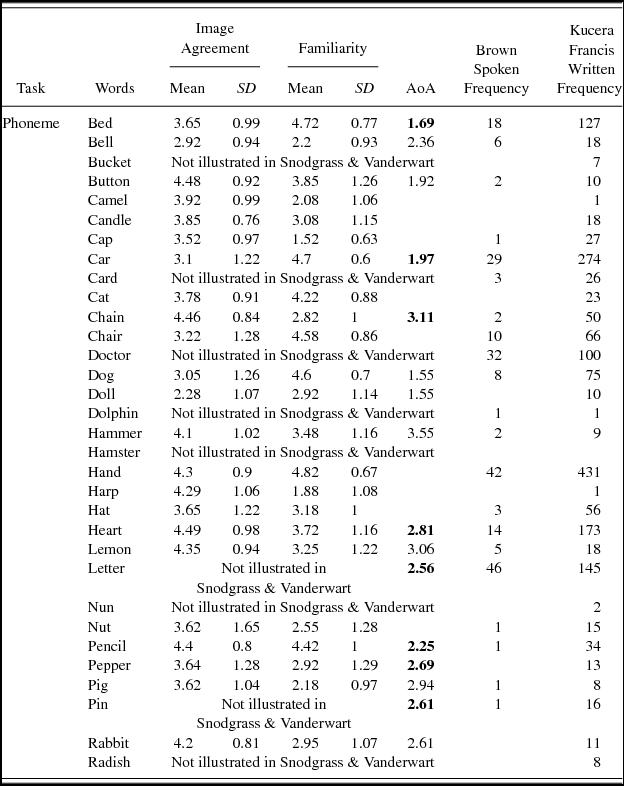
Thirty-two monosyllabic and bisyllabic words were chosen as target items (see Appendix A). These stimuli and the picture–written word pairs were taken from Cook and Meyer (Reference Cook and Meyer2008). Black-and-white line drawings representing the target words were selected from Snodgrass and Vanderwart (Reference Snodgrass and &Vanderwart1980) and used as stimuli for eliciting silent picture-naming responses. Appendix A also shows the image agreement (5-point rating scale, 1 = least, 5 = most), word familiarity, Brown spoken word frequency, and Kucera–Francis written word frequency scores for the target words as reported by Snodgrass and Vanderwart (Reference Snodgrass and &Vanderwart1980) and age of acquisition from both Snodgrass and Vanderwart (Reference Snodgrass and &Vanderwart1980) and Gilhooly and Logie (Reference Gilhooly and Logie1980). For words that did not have corresponding pictures from Snodgrass and Vanderwart (Reference Snodgrass and &Vanderwart1980), the most representative line drawings were identified using the Google search engine. Identical to Cook and Meyer (Reference Cook and Meyer2008), the target words represented by the pictures in each task were paired with competing written words to create three types of pairings: unrelated, related, and replica.
Secondary task
Using MATLAB, auditory tokens of phonemes preceding the target picture on every trial were appended to a low (0.18 kHz), medium (0.5 kHz), or high (8 kHz) pure tone. The appended pure tone (100 ms) was heard either at 100 ms (short SOA) or 900 ms (long SOA; values based on Cook & Meyer, Reference Cook and Meyer2008) after the offset of the phoneme (230 ms). SOA is operationally defined as the time lapse between the onset of the target phoneme or word to be monitored during silent picture naming in the primary task and one of three tones to be monitored to render a tone decision in the secondary task. The differences in response times at the short versus the long SOA for the monitoring and tone decision tasks determined the PRP effect.
Procedures and tasks
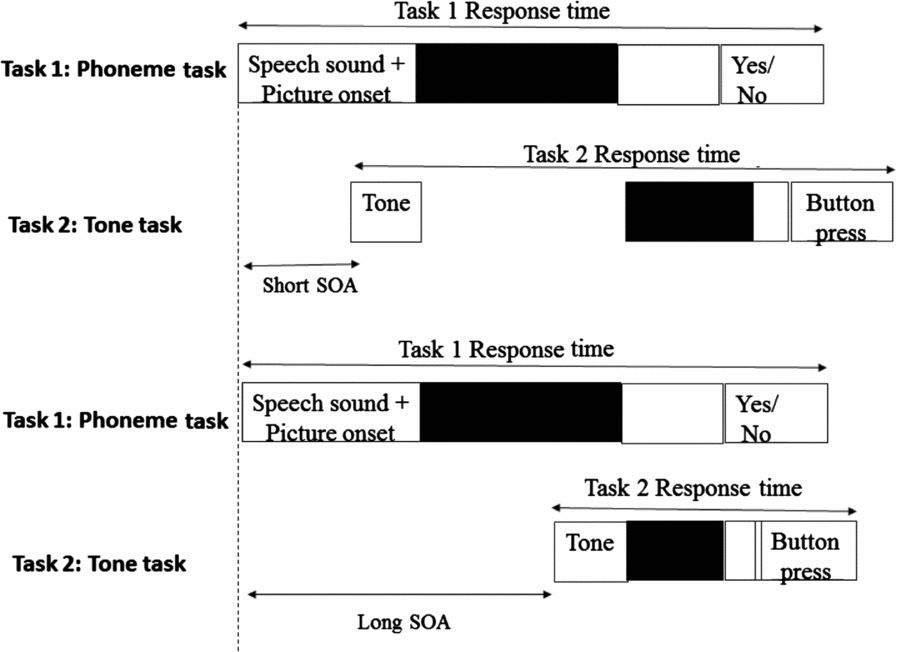
The second author and a trained research assistant administered the entire protocol. The experiment consisted of three tasks: picture naming, phoneme monitoring + tone decision, and a third task not discussed here. These tasks and the block order within each task were counterbalanced in the order of occurrence across participants. The picture-naming task was presented prior to the phoneme task. Figure 1 illustrates the overall design of the phoneme monitoring–tone decision dual task. In the following subsections, each of the tasks is described in detail.
Task design for the phoneme and rhyme dual tasks at short and long stimulus onset asynchronies. Filled spaces indicate resource-demanding processes in each task that cannot be performed simultaneously.

Picture naming
In this task, the 32 target pictures were presented individually on a computer screen and participants were asked to name each picture. The primary purpose of this task was to familiarize participants with the names of the target pictures. Participants were corrected for errors in picture naming at the end of the naming task. Because participants were familiarized with the pictures before the naming task, a majority of participants (children in both groups) had only about five to six errors during first attempt. Following a round of naming and error correction, participants were presented a second time with those pictures that they named incorrectly at first attempt. All participants were able to name all pictures correctly by the end of the second set of trials and before proceeding to the phoneme monitoring–tone decision dual task.
Phoneme monitoring–tone decision dual task
The purpose of this task was to investigate developmental changes in the ability to allocate cognitive resources during phonemic encoding and monitoring. Three groups of participants (younger, older children, and adults) were compared in response times and percentage errors in monitoring the presence or absence of phonemes during silent picture naming while simultaneously providing manual button press responses to a tone decision task at short or long SOA.
Task instructions and design
Participants were seated comfortably in front of a 17-in. computer screen. Prior to the experiment, participants were given the following instructions:
In this task, you will hear a sound, such as, /tə/, /pə/, or /fə/, and this will be followed by one of the pictures that you named earlier. You are required to silently name the picture while looking for the presence or absence of the sound in the picture's name. The written word that you see right above the picture can sometimes help you decide if the sound is there in the picture's name or not, so look both at the picture and the written word. The sound that you are looking for can be present anywhere in the picture's name. Say “yes” as soon as you identify the target sound in the picture's name and “no” if the sound is absent. Immediately after you see the picture on the screen, you will hear a tone that can be of low, medium, or high pitch. After you say “yes” or “no,” press one of the three buttons that you see in the box in front of you to indicate the pitch of the tone. Then you will see the same picture another time after you press the button, and this time you have to name the picture aloud. Wait after you name the picture aloud for the next sound and picture–written word pair.
Following instructions, all participants were familiarized with the three tones that they had to listen to. Following this in a set of five to six trials, the tones were presented in random order and participants had to press the correct button corresponding to the low, medium, or high tone. This was done to ensure that participants in all three age groups were able to perform the tone task. Then three to five practice trials were used to familiarize participants with the task. A trial in each block consisted of the following series of events: (a) an orienting screen for 500 ms; (b) auditory presentation of a prerecorded target phoneme (each target phoneme was always presented along with a schwa vowel although participants were asked to monitor the target phoneme regardless of the sound preceding or following it) coinciding with the onset of a target picture–written word pair; participants said “yes” or “no” as soon as possible to indicate the presence/absence of the target speech sound in the picture's name; and (c) a pure tone of 100 ms was presented at 330 or 1130 ms after phoneme onset. A response to the tone task initiated the presentation of the same picture again, and participants were instructed thereafter to name each picture aloud. This was done to ensure that pictures were named correctly during each trial. Presentation of the next trial in the sequence was initiated by the experimenter after the participant named the picture or automatically after 4 s in adults and 10 s in case of the younger and older children.
Primary task
Participants were presented four blocks of 32 picture stimuli with a distracter word written (18-point Arial font) above each picture. Each target picture occurred four times in one block, once across three conditions (replica, related, and unrelated), and a second time in the unrelated condition. The phonemes to be monitored occurred in word middle or final positions (e.g., the sound /t/ in the picture–written word pair /cat/–/cap/). Each block consisted of 15 to 16 trials from the unrelated, 7 to 8 from the related, and 7 to 8 from the replica conditions, respectively, resulting in approximately comparable number of trials in the three conditions across all four blocks.
Secondary task
In each block, under each of the conditions, an equal number of tone stimuli were presented at the short or the long SOA. The short SOA trials consisted of a 330 ms (230 ms speech sound + 100 ms silence) lapse between the onset of the target phoneme and the tone. The long SOA trials consisted of a 1130 ms (230 ms speech sound + 900 ms silence) lapse between the onset of the phoneme and the tone presentation. Across each block, the frequency of occurrence of the three tones was distributed evenly.
Instrumentation
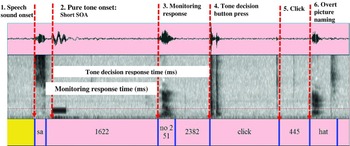
The experimental stimuli were programmed and presented using Super Lab v4.5 software. A Dell desktop was used to present the stimuli for the tasks. Verbal and manual responses from the monitoring and tone decision tasks as well as spoken responses from the overt naming trials were recorded using a Marantz digital recorder PMD620. In addition, the errors from the tone decision task were recorded using the Cedrus response box. Response times and errors from the phoneme task and the tone decision tasks were measured using PRAAT software (Boersma & Weenink, Reference Boersma and Weenink2013). Figure 2 illustrates the events in each trial of the dual task and computation of the response times for the monitoring and tone tasks. Monitoring response time (ms), the time between the onset of the picture in the phoneme task and the participants’ “yes” or “no” monitoring response, was measured. Tone decision response time (ms), the time between the onset of the tone and the participants’ manual button press response from the tone decision task, was also measured.
Events in a single trial of the dual task used in this study identified using PRAAT software. Event 1: onset of speech sound; Event 2: onset of pure tone at short stimulus onset asynchrony; Event 3: participant's yes/no response; Event 4: participant's button press response to the tone decision task; Event 5: click; Event 6: overt picture naming.

Data scoring and analysis
Data scoring
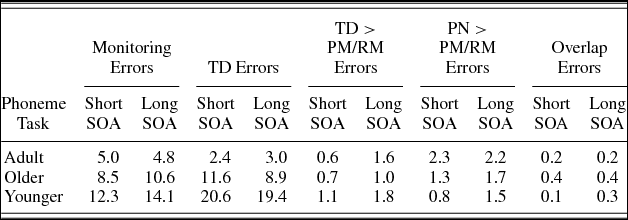
The data were analyzed by the first author and a trained research assistant. Trials in each task were categorized as correct or incorrect. For the phoneme task, correct responses included trials where participants identified correctly the presence or absence of a phoneme match. For the tone decision task, correct responses included trials where participants identified correctly the pitch of the target tone. Correct trials in both tasks were further coded for outlier responses. Outlier responses included trials where the response times for the phoneme and tone decision tasks were two standard deviations (Ratcliffe, 1993) above or below the individual's mean response time specific to condition (unrelated, related, replica) and SOA (short, long). Less than 7% of the trials were excluded as outliers across both the phoneme and tone decision tasks in the three age groups. Only correct responses were included in the monitoring response time analysis. Data from one phoneme block from one child in the younger group and one adult were excluded from analysis because these participants provided manual responses to the tone decision task before providing verbal responses to the phoneme monitoring task throughout the block. Trials where participants (a) named the picture before giving a yes/no response; (b) responded to the tone task first, but provided a correct monitoring response; or (c) responded to both the monitoring and tone decision responses simultaneously such that the onset of these responses were not independently determinable were all excluded from the response time analysis, although such trials were not coded as error responses. In addition, error responses were coded for both the monitoring and tone decision tasks. For the phoneme monitoring task, only incorrect and no responses were coded as errors. Incorrect responses included trials where participants responded with a false positive or a false negative response to the presence or absence of a phoneme match. For the tone decision task, all incorrect and no responses were coded. Table 1 provides a summary of the mean percentage errors in the different error categories.
Mean percent errors across the different error categories in the phoneme–tone dual task in younger, older children, and adults

Note: TD, Tone decision; PM, phoneme monitoring; RM, response monitoring; PN, picture naming; SOA, stimulus onset asynchrony. Mean response time > PM errors are trials where participants made a tone decision response before the monitoring response. PN > PM errors are trials where participants named the picture before the monitoring response. Overlap errors are trials where the onset of the monitoring and TD response overlapped such that response time to the two tasks could not be determined independently.
Reliability
Response time and error data from two participants for both the monitoring and tone decision tasks were recoded in PRAAT by the trained research assistant using the same coding conventions as described earlier. Pearson correlations (r) were computed between the initial data coding done by the first author and subsequent coding done by the research assistant for the two participants for both the phoneme and tone tasks. Significant high positive correlations were obtained between the two coders for both the monitoring time and the error data codings (monitoring response time, r = .98; tone decision response time, r = .93; percentage monitoring errors, r = .82; percentage tone decision errors, r = .96, p < .05).
Statistical analysis
Response times and percentage errors for the monitoring and tone decision tasks and percentage errors were obtained from the three age groups. The percentage error data from both the primary and the secondary tasks were arcsine transformed to reduce the influence of extreme values (e.g., 0, 100%) on the mean values reported, and analyses were performed on the arcsine transformed error data. The following analyses were performed to investigate developmental differences in allocating resources to performing phoneme encoding and monitoring at the short and the long SOAs.
Response time data
The response time data from both the monitoring and the tone decision tasks were analyzed in a joint analysis of variance (ANOVA) in order to investigate if the effects of the condition and SOA manipulations were similar across both the phoneme monitoring and the tone decision tasks. Age group was classified as a categorical between-subjects variable (7–11, 12–15, and 18–30 years), and task (primary, secondary), condition (unrelated, related, replica), and SOA (short, long) were the within-subjects factors. Only correct responses were included in the monitoring response time analysis.
Percentage error data
Similar to the response time data, the arcsine transformed percentage error data from the monitoring and the tone decision tasks were analyzed in a joint ANOVA. Age group was the between-subjects variable (7–11, 12–15, and 18–30 years); and task (primary, secondary), condition (unrelated, related, replica), and SOA (short, long) were the within-subjects factors.
Item analyses were also conducted for both the response time and error data in order to rule out the possibility that only a few of the items were contributing to the obtained results. Age group was the between-subjects variable (7–11, 12–15, and 18–30 years), and task (primary, secondary), condition (unrelated, related, replica), and SOA (short, long) were the within-subjects factors. The data were arranged based on response time and arcsine transformed percentage errors for each item in each group averaged across the subjects within each group.
Finally, Pearson correlations were run to investigate if performances in the primary and secondary tasks in the related condition, which was predicted to pose maximum cognitive constraints, are correlated with the overall percentage of disfluencies obtained from conversational samples of the younger and older children. Huynh–Feldt p values are reported for all effects where sphericity assumptions were violated. All post hoc comparisons were performed using Fisher least significant difference and p values for significant effects are reported.
RESULTS
Vocabulary, working memory, phonemic awareness skills
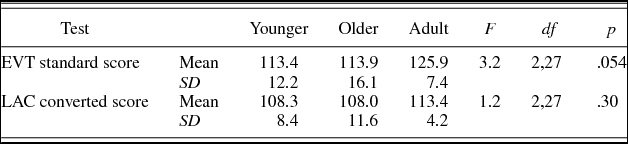
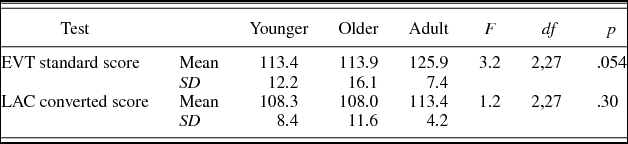
Table 2 provides the mean (standard deviation) scores from the EVT and Lindamood Auditory Conceptualization tests, as well as F and p values from one-way ANOVAs comparing the groups in these tests. These tests were conducted to rule out differences in expressive vocabulary and phoneme awareness skills that may have contributed to performances in the experimental tasks. A trend toward significance was observed for EVT (p = .054) with the adults scoring higher than the older and younger children. Significant group differences were not observed in Lindamood Auditory Conceptualization scores (p = .30).
Mean and standard deviation of expressive vocabulary and phoneme awareness tests in younger and older age groups and adults
Note: EVT, Expressive Vocabulary Test; LAC, Lindamood Auditory Conceptutalization Test.
Response time: Phoneme–tone dual task
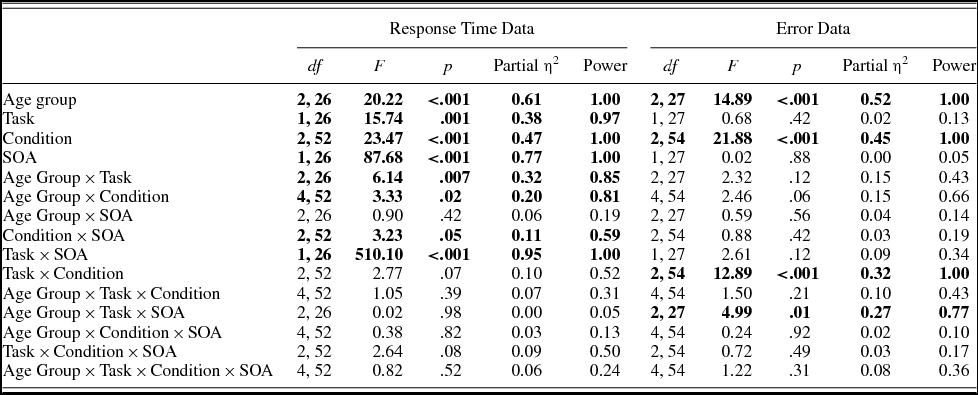
Table 3 contains the F and p values from the joint repeated measures ANOVA of the response time and error data from the primary and secondary tasks. Here we present the results of interest (age, condition, and SOA effects) for the monitoring and tone decision tasks.
Joint analysis of variance results for the response time and error data from the primary and secondary tasks
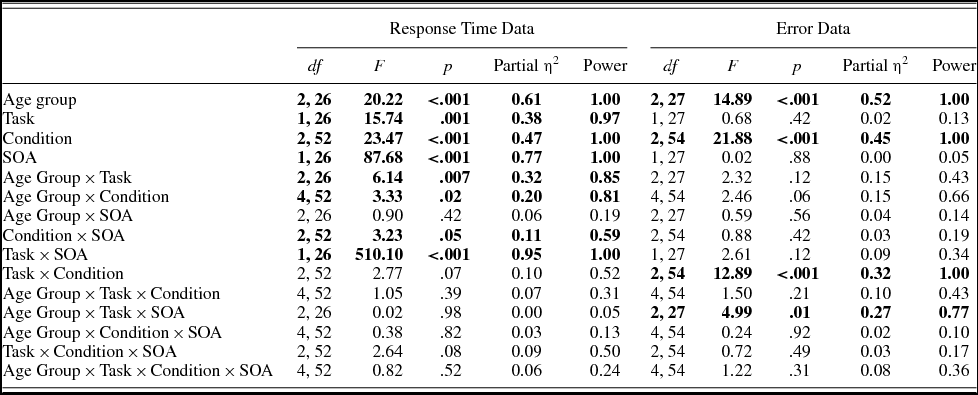
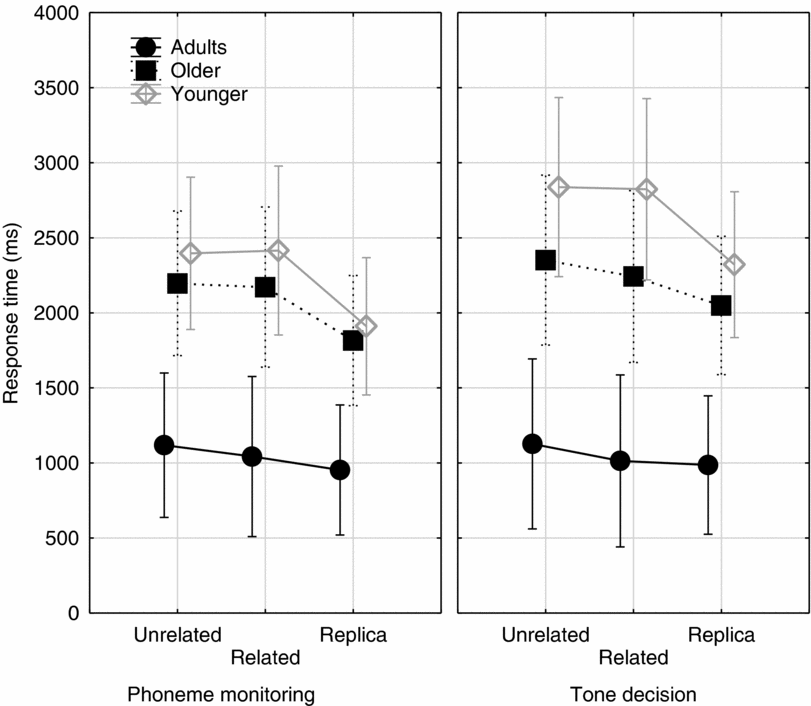
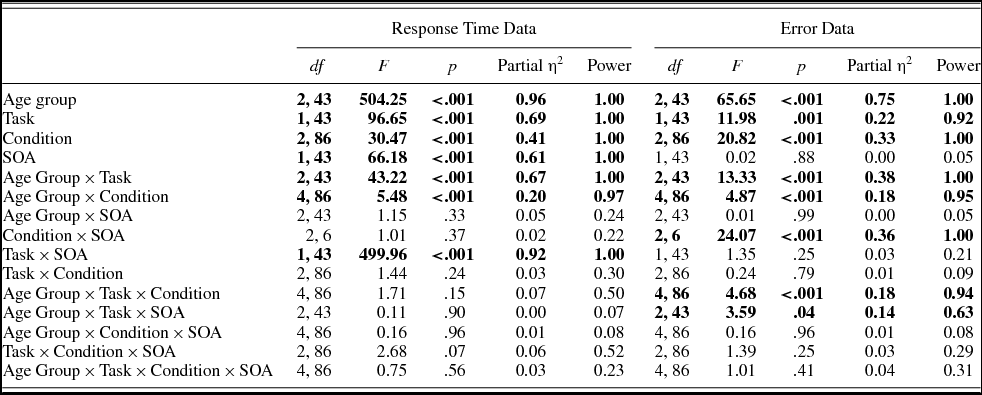
As expected, developmental differences were evident in the primary task (phoneme encoding and monitoring), and the expectation that the related condition in the phoneme task may place more demands on cognitive resources during task performance was confirmed: Age Group × Condition, F (4, 52) = 3.33, p = .02, ηp 2 = 0.20. Adults were significantly faster than the younger and older children (unrelated: adult vs. younger, p < .00001; adult vs. older, p = .00003; related: adult vs. younger, p < .00001; adult vs. older, p = .00002; replica: adult vs. younger, p = .00005; adult vs. older, p = .0003). The younger and older children were comparable in monitoring times across the three conditions. Based on the nonsignificant Age Group × Task × Condition interaction, F (4, 52) = 1.05, p = .39, these effects were similar across both the phoneme monitoring and the tone decision tasks (refer to Figure 3 for Age Group × Condition and Age Group × Condition × Task effects). Item analysis confirmed these results and revealed a significant Age Group × Condition effect, F (4, 86) = 5.48, p < .001, ηp 2 = 0.20.
Response times (95% CI) for the primary and secondary tasks by condition and age group.

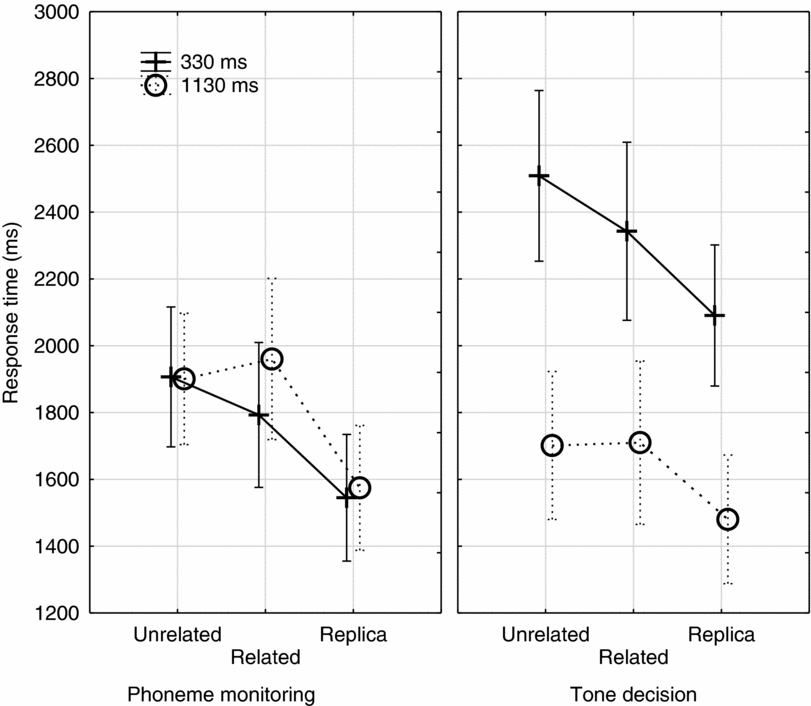
Contrary to the expected PRP pattern of negligible effect of SOA on response times, averaged across the three age groups, participants were significantly slower in phoneme encoding and monitoring at the long than at the short SOA (p = .009). The reverse effect and the typical PRP pattern was observed for the tone decision task with significantly slower response times at the short than at the long SOA, p < .0001; Task × SOA, F (1, 26) = 510.10, p < .001, ηp 2 = 0.95. The interaction of Task × Condition × SOA, however, was nonsignificant, F (2, 52) = 2.64, p = .08, although the trend suggested that the SOA manipulation had varying effects on the phoneme monitoring and tone decision tasks (both interactions are illustrated in Figure 4). Once again, item analysis confirmed the significant Task × SOA interaction, F (1, 43) = 499.90, p = .001, ηp 2 = 0.92, and the nonsignificant Task × Condition × SOA effect, F (2, 86) = 2.68, p = .07. Finally, a significant Age Group × Task effect, F (2, 26) = 6.14, p = .01, ηp 2 = 0.32, confirmed that the developmental effects (younger = older > adult) were similar across both the phoneme monitoring and the tone decision tasks.
Response times (95% CI) for the primary and secondary tasks by stimulus onset asynchrony and condition.

Percentage monitoring errors: Phoneme–tone dual task
Table 4 presents the F and p values from the item analyses for the response time and error data from the primary and secondary tasks. Here we present the results of interest.
Item analysis results for the response time and error data from the primary and secondary tasks
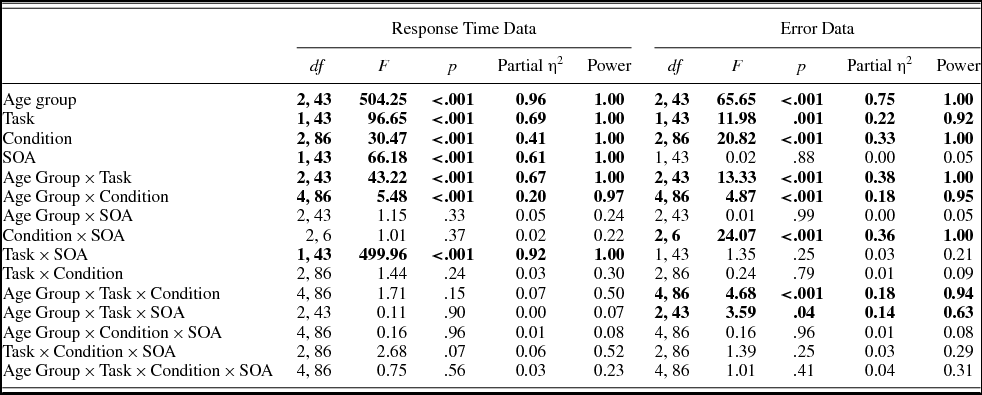
Similar to the response time data, developmental differences were evident in monitoring accuracy. The expectation that the related condition in the phoneme task would place more demands on cognitive resources in children was partially confirmed as a trend toward significance: Age Group × Condition, F (4, 54) = 2.46, p = .06, ηp 2 = 0.15. Averaged across the primary and secondary tasks, adults showed comparable percentage monitoring errors across the three conditions, while both the younger and older children showed a higher percentage of monitoring errors in the related condition (younger, related vs. unrelated, p = .0001; related vs. replica, p = .0002; older, related vs. unrelated, p < .0001; related vs. replica, p = .01). Item analysis confirmed the Age Group × Condition effect, F (4, 86) = 4.87, p = .001, ηp 2 = 0.18, and in addition, a significant Age Group × Condition × Task interaction was also obtained, F (4, 86) = 4.68, p = .001, ηp 2 = 0.18.
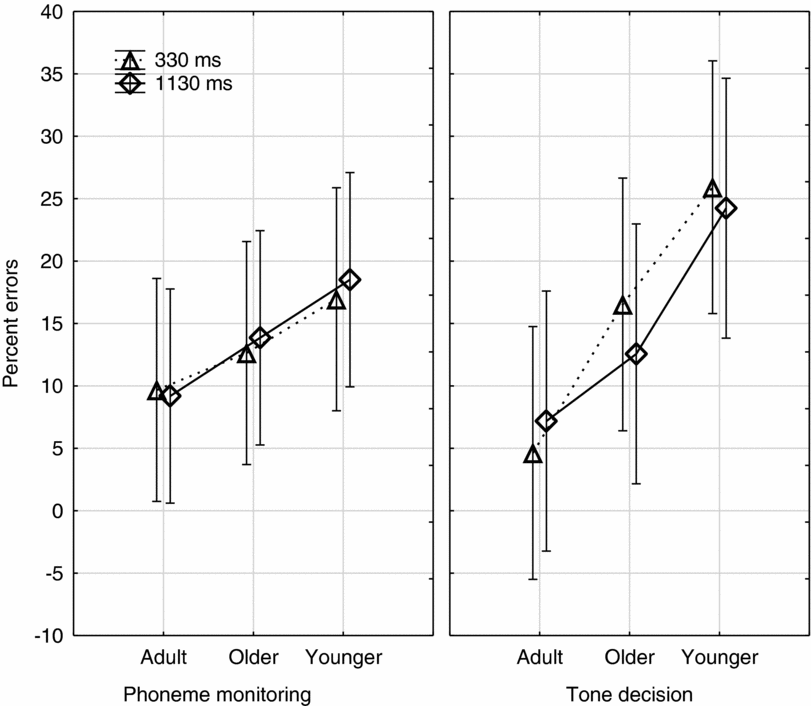
A significant Age Group × Task × SOA effect was obtained, F (2, 27) = 4.99, p = .01, ηp 2 = 0.27 (Figure 5). Contrary to the expectation that the short SOA may place more demands on cognitive resources during task performance, post hoc comparisons showed that the groups were comparable in the percentage errors at the short versus the long SOA for the phoneme task. An opposite effect was evident in the tone decision task. Descriptively higher percentage tone decision errors were seen in both the older and the younger children at the short than at the long SOA, although such differences were significant only in the older group (p = .007). This interaction was also obtained in the item analysis, Age Group × Task × SOA interaction: F (2, 43) = 3.59, p = .04, ηp 2 = 0.14.
Percentage errors (95% CI) for the primary and secondary tasks by age group and stimulus onset asynchrony.

Correlating task performance and percentage disfluencies in conversation
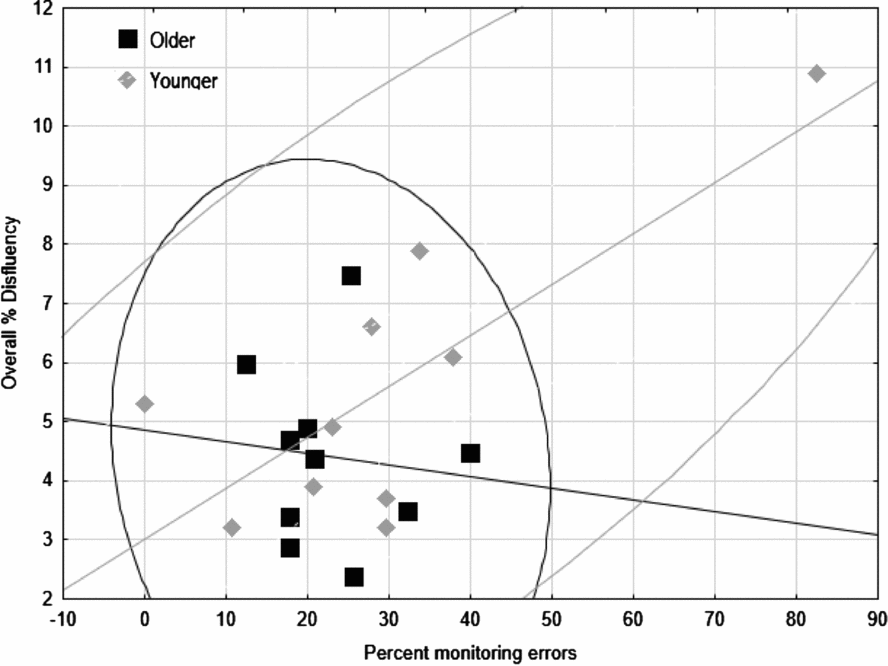
Figure 6 illustrates the overall significant positive correlation (Pearson r = .61) between average phoneme monitoring errors (arcsine transformed) in the related condition across both the short and the long SOA versus overall percentage disfluencies. When grouped by age, the significant positive correlation was evident only for the younger age group (Pearson r = .77). Correlations between monitoring times, tone decision times, percentage tone decision errors averaged across the short and long SOAs versus overall percentage disfluencies were nonsignificant.
Scatterplot of percentage monitoring errors (ellipse at 95% CI) in related condition of phoneme monitoring task (averaged across short and long stimulus onset asynchronies) and overall percentage disfluencies in younger and older age groups.

DISCUSSION
The present study was conducted to investigate developmental changes in speed and accuracy of phonemic encoding and monitoring in a dual task. The aims were to investigate (a) if encoding and monitoring are processes that are constrained by the availability of cognitive resources in children and adults; (b) the age-related dual-task costs in performing a secondary, tone decision task during phoneme encoding and monitoring; and (c) if the pattern of results from the primary and secondary tasks confirm the predictions of the central structural bottleneck or the capacity sharing account of dual-task performance in other domains.
Vocabulary and phoneme awareness
Participants in the three age groups were tested in baseline measures (vocabulary and phoneme awareness) that may have contributed to task performance, and the results revealed that the groups were not significantly different in these measures, although the adults did show elevated scores in expressive vocabulary. This suggested that the observed age-related differences in response times and accuracy in the phoneme encoding and monitoring task that requires participants to name pictures and to monitor for the presence/absence of phonemes cannot be attributed to baseline differences in vocabulary or metaphonemic knowledge.
Phoneme–tone dual task: Response times
Effects of SOA on encoding/monitoring versus tone decision performances
Based on the theoretical accounts, it was predicted that (a) response time to the encoding and monitoring task will not be influenced by SOA, and (b) response time to the tone decision task will be delayed at the short more so than at the long SOA because processing of two resource demanding processes, encoding and monitoring, have to be completed before proceeding to the secondary task. Contrary to expectations, findings from the primary task revealed that across the three age groups, participants demonstrated significantly slower monitoring responses at the long than at the short SOA, although this difference was limited to ~150 ms. This finding did not fit the typical PRP pattern of limited effects of SOA on the primary task as predicted by the structural bottleneck (Pashler, Reference Pashler1994) or the capacity sharing accounts (Kahneman, Reference Kahneman1973). This finding is also different from Cook and Meyer (Reference Cook and Meyer2008), who reported longer response times to the picture-naming task at the short SOA. One crucial difference between the present study and the Cook and Meyer (Reference Cook and Meyer2008) study is that the participants in the latter study were not specifically instructed to attend to the picture-naming or the tone decision task first. However, they did report that all participants responded to the picture-naming task first, thereby accounting for the lack of significant SOA effects on picture naming. The SOA effects from the current study can be explained based on the capacity sharing account that accommodates other PRP pattern results, although participants in this study were instructed to attend to the primary task first and should have shown the typical PRP pattern. For instance, at the long SOA when the tone is presented, participants are mostly likely to have completed phonemic encoding while being actively involved in monitoring. Thus, greater disruption of task performance at the long SOA does support the claim by Cook and Meyer (Reference Cook and Meyer2008) that speech monitoring is a cognitively demanding process. In addition, participants may have started processing the capacity demanding stages of the tone task, thereby dividing attention between the monitoring stages of the primary task and the secondary task. However, contrary to expectations, the absence of an Age Group × SOA interaction in the monitoring task suggests that speech monitoring is a cognitively demanding process across all age groups.
For the tone task, the expected PRP pattern was confirmed, such that tone decision responses were faster at the long than at the short SOA, suggesting that some of the processes involved in the primary task were capacity demanding. At the short SOA, tone decision responses have to be postponed until both encoding and monitoring, two cognitively demanding processes, are completed. At the long SOA, processing of the tone decision task has to be postponed only until monitoring is completed because participants would have already completed the encoding process earlier in the time course. This finding also supports the argument that a shared set of finite resources are allocated and shared between phonemic encoding and monitoring processes.
Effects of condition on monitoring performance
Cook and Meyer (Reference Cook and Meyer2008) hypothesized that related distractor words slowed down the monitoring process that starts after speech onset and before response to the tone decision task. In this study, the related distractor words shared the same onset as the picture name, but differed at offset, thus potentially slowing the monitoring process. Present finding of slower response times in the related than replica condition confirmed this hypothesis. Furthermore, a carryover of the inhibitory influences of the related distractor words to the tone decision responses was not evident, thereby further strengthening the claim that while phonemically related distractor words influenced the monitoring process, such influences did not extend to processing the tone decision responses. These findings support earlier reports (Cook & Meyer, Reference Cook and Meyer2008; Ferreira & Pashler, Reference Ferreira and Pashler2002).
Age effects on encoding/monitoring and tone decision performances
Based on earlier reports, we hypothesized age-dependent differences in response times to encoding and monitoring; several findings confirmed these expectations. Children were much slower in both the monitoring and the tone decision tasks as compared to adults at the long SOA. In addition, significantly slower response times in children compared to adults in the related condition also showed that children required additional time to resolve this interference before finalizing the monitoring decision, thereby suggesting that cognitive constraints delay language planning in children to a greater extent than in adults. Furthermore, the younger (7- to 11-year-olds) and older children (12- to 15-year-olds) were comparable and significantly slower than adults in performing the phoneme monitoring task (younger = older > adults). This latter finding of comparable monitoring response times between the younger and older children is contrary to earlier reports of significantly slower performance in younger compared to older children, at least in picture naming and phoneme monitoring (e.g., Jescheniak, Hahne, Hoffmann, & Wagner, 2006; Sasisekaran & Weber-Fox, Reference Sasisekaran and Weber-Fox2012). However, a crucial difference between such studies and the present study is that participants in this study performed the monitoring task in a dual-task paradigm. Thus, the present findings suggest that the advantages that the older children demonstrate in performing encoding and monitoring in a single task (e.g., Sasisekaran & Weber-Fox, Reference Sasisekaran and Weber-Fox2012) may be limited in dual-task conditions. Similar findings were also reported by Choi et al. (Reference Choi, Lotto, Lewis, Hoover and Stelmachowicz2008), who reported comparable improvements in younger and older children in the primary task (word recognition in noise) in a dual-task condition. While we acknowledge that a potential weakness of this study is that we did not directly compare single- versus dual-task performances using the same set of stimuli, this was not a primary aim of this study, which was designed to compare the age groups in dual-task performance. However, as discussed above, the findings from earlier studies (e.g., Sasisekaran & Weber-Fox, Reference Sasisekaran and Weber-Fox2012) offer the opportunity to compare encoding and monitoring abilities under single- versus dual-talk conditions due to comparable task design.
Similar to developmental differences in response times to the monitoring task, present findings showed that tone decision responses became faster with age (adults < older = younger). We interpret this to suggest larger dual-task costs in children in performing a secondary task during segmental encoding and monitoring. While this finding corroborates other similar reports of age-related dual-task cost effects in other domains (e.g., Choi et al., Reference Choi, Lotto, Lewis, Hoover and Stelmachowicz2008; Schaefer et al., Reference Schaefer, Krampe, Lindenberger and Baltes2008), this study is the first to have specifically tested age-related SOA effects on dual-task performance in children and to report that such effects in children are similar to those reported in adults. The findings also suggest that children require additional cognitive resources, including flexible attentional control, STM, and working-memory processing resources, to perform a secondary task while simultaneously encoding and monitoring phonemes at levels comparable to adults.
Phoneme–tone dual task: Percentage monitoring errors
In the present study, we also investigated the percentage errors in the primary and secondary tasks across the different age groups. The findings revealed that the SOA effect (long > short SOA) observed in the response time data for the primary task was not observed in the error data. However, a trend toward a significantly higher percentage of monitoring errors was observed in the related condition of the phoneme task, and more so in the younger compared to the older children and in the older children compared to adults. These findings suggest that children show reduced efficiency of segmental (phonemic) encoding and monitoring. One mechanism that could account for reduced efficiency of phonemic encoding/monitoring resulting in higher error rates in the related condition is prolonged competing activation or reduced inhibition of cascading activation of both the target picture's name and the distractor (written) word within the phonemic lexicon. Such an effect is likely to be evident at both the short and the long SOAs. The older children had a significantly lower percentage of monitoring errors in the related condition than did the younger children (younger > older > adults). However, neither group was comparable to the adults, thereby suggesting that sublexical inhibition takes a prolonged course of development. Faster monitoring responses and lower errors in adults are interpreted to suggest that adults are capable of strategic control over such automatic processes (e.g., McCann, Remington, & Selst, Reference McCann, Remington and Van Selst2000).
Conclusions and future directions
The present study investigated dual-task costs on language planning in children and adults using a primary encoding and monitoring task and a secondary tone decision task. The finding of slower response times to the monitoring task at the long than at the short SOA while not fitting the typical PRP pattern for dual-task performance requiring participants to pay attention to the primary task first, supported predictions of the central capacity sharing account (Tombu & Jollicaeur, Reference Tombu and Jolicoeur2003). The finding of slower response times to monitoring at the long than at the short SOA and in the related than replica condition suggested that monitoring as well as encoding are cognitively demanding processes that share a finite set of resources. SOA effects on the tone decision task confirmed existing dual-task accounts and offered further support that encoding and monitoring are resource demanding processes. A higher percentage of monitoring errors in the related compared to the unrelated and replica conditions in the phoneme monitoring task in children compared to adults suggested that inhibition within the phonological lexicon takes a prolonged course of development. Furthermore, age-dependent higher error rates and slower tone decision responses at the short than at the long SOA suggested that children exhibit larger dual-task costs in a secondary task when the demands on cognitive resources are higher, and may require additional resources to match adults in dual-task performance involving language planning as the primary task. On a cautionary note, we acknowledge that the secondary task used in this study is a relatively simple tone decision task. Future studies need to consider other types of secondary tasks that share cognitive resources with speech and examine dual-task performance where resources are allocated first to the secondary task or switched between the primary and secondary tasks to investigate the effects of such manipulations on language planning to enable generalization of experimental findings to everyday speech situations.
Considering that conversation is the ultimate dual task, in this study we attempted to relate performance in the dual-task paradigm to disfluencies in conversational speech. A significant positive correlation was obtained between average (short and long SOAs) percentage errors in phoneme monitoring in the related condition and overall percentage disfluencies in conversational speech in the younger age group, thereby suggesting a correlation between sublexical inhibition of activation and the presence of disfluencies in speech. Although the arcsine transformation was performed on the percentage error data to reduce the influence of extreme values, we interpret this finding cautiously due to the presence of an outlier in the younger age group. Aberrant phonemic encoding and speech monitoring have been attributed to disfluencies and speech errors in several communication disorders, including stuttering (e.g., Bernstein Ratner, Reference Bernstein Ratner, Curlee and Seigel1997; Postma & Kolk, 1993; Vasic & Wijnen, Reference Vasic, Wijnen, Hartsuiker, Bastiaanse, Postma and Wijnen2005). Relating phonemic encoding and monitoring performance under dual-task conditions to disfluencies in speech impairments, such as stuttering, can explicate the link between phonological-level processes of lexical access and overt speech disfluencies.
APPENDIX A
Monosyllabic and bisyllabic words chosen as target items
ACKNOWLEDGMENTS
This work was funded by an NIDCD R03 grant (Grant DC010047) and start-up funds from the University of Minnesota to the Principal Investigator. We acknowledge our participants and thank Kristie Gonzalez for assistance with data collection and Dayeong Yang for assistance with data analysis, Dr. Edward Carney for technical assistance, Dr. Christine Weber-Fox for comments on a draft version of this manuscript, and the anonymous reviewers for their helpful comments. The authors do not have any conflict of interest to disclose.