Children growing up in low socioeconomic status (SES) households are at risk for dysfunction of the hypothalamic–pituitary–adrenocortical (HPA) axis, as evidenced by altered levels of the stress hormone cortisol (Blair, Berry, Mills-Koonce, & Granger, Reference Blair, Berry, Mills-Koonce and Granger2013; Desantis, Kuzawa, & Adam, Reference Desantis, Kuzawa and Adam2015; Gray et al., Reference Gray, Dhana, Van Der Vyver, Van Wyk, Khumalo and Stein2018; Lupien, King, Meaney, & McEwen, Reference Lupien, King, Meaney and McEwen2000; Rippe et al., Reference Rippe, Noppe, Windhorst, Tiemeier, van Rossum, Jaddoe and van den Akker2016; Ursache, Merz, Melvin, Meyer, & Noble, Reference Ursache, Merz, Melvin, Meyer and Noble2017). The association of poverty with cortisol dysfunction is well established across a broad age range, from infancy (Saridjan et al., Reference Saridjan, Huizink, Koetsier, Jaddoe, Mackenbach, Hofman and Tiemeier2010) through middle childhood and adolescence (Chen, Cohen, & Miller, Reference Chen, Cohen and Miller2009; White et al., Reference White, Ising, von Kltizing, Sierau, Michael and Klein2017). The HPA axis is maturing over the first few years of life, such that early experiences are particularly formative for later cortisol function (Gunnar & Talge, Reference Gunnar, Talge, Schmidt and Segalowitz2008). Effects of poverty on cortisol function tend to be most pronounced in individuals who experience poverty in infancy and who have the greatest cumulative exposure to poverty (Blair et al., Reference Blair, Berry, Mills-Koonce and Granger2013; Desantis et al., Reference Desantis, Kuzawa and Adam2015).
Ecobiodevelopmental frameworks (Shonkoff, Reference Shonkoff2010; Shonkoff & Garner, Reference Shonkoff and Garner2012) contend that early life environmental stressors, such as poverty, leave an enduring imprint on the child at a biological level, including on the HPA axis, through processes of physiological adaptation or disruption. Thus, a child who experiences chronic hyperactivation of the HPA axis due to the stressor of early poverty is likely to be more vulnerable to biological stress throughout life, and consequently ill equipped to cope with environmental stressors encountered in adulthood. Cortisol dysregulation is posited to be a key pathway through which early life environmental stressors such as poverty result in adult health disparities (Karlén et al., Reference Karlén, Ludvigsson, Hedmark, Faresjö, Theodorsson and Faresjö2015; Vliegenthart et al., Reference Vliegenthart, Noppe, van Rossum, Koper, Raat and van den Akker2016). Over time, cortisol dysregulation can lead to dysregulation of other physiological systems due to the wear and tear on the body of continually needing to restore homeostasis, a phenomenon known as allostatic load (McEwen & Stellar, Reference McEwen and Stellar1993). Here again, early exposure to poverty may be particularly damaging. One study reported that the proportion of time spent in poverty from birth through age 9 years predicted allostatic load in adolescence (Evans & Kim, Reference Evans and Kim2012). Allostatic load predicts adult morbidity and mortality (Danese & McEwen, Reference Danese and McEwen2012; Taylor, Way, & Seeman, Reference Taylor, Way and Seeman2011) and partially accounts for socioeconomic health disparities.
To promote healthy child development and reduce long-term health disparities, it is critical to foster healthy cortisol function in young children growing up in low-SES households. Unfortunately, the frequently reported general association of low SES with cortisol dysfunction is of limited utility toward this objective. Many existing studies have used a single distal measure of SES, most often income or parent education, or assessed several dimensions of SES but then combined them into a composite SES risk index. These simplified measures of SES relate powerfully to child outcomes but obscure underlying mechanisms. Children who are in low-SES households are exposed to a multitude of associated risks at the family and neighborhood levels, such as crowding, noise, food insecurity, toxins, and community violence (Evans & English, Reference Evans and English2002). Thus, income and parent education are proxies for many correlated risk factors, and some of these factors may be particularly important to child cortisol function. For example, several salivary cortisol studies have identified a specific role for household chaos in the context of low income (Blair et al., Reference Blair, Berry, Mills-Koonce and Granger2013; Doom et al., Reference Doom, Cook, Sturza, Kaciroti, Gearhardt, Vazquez and Miller2018) or have found that household chaos contributes to salivary cortisol levels above and beyond income (Chen et al., Reference Chen, Cohen and Miller2009). A recent small study reported initial evidence that food insecurity was linked to higher hair cortisol concentration (HCC), an index of chronic stress, in young children and their mothers (Ling, Robbins, & Xu, Reference Ling, Robbins and Xu2019). Various SES factors may play a role in cortisol function through distinct mechanisms. Parental education may have more indirect effects, whereas household chaos is a proximal factor in that young children more directly experience and are impacted by noise levels, overstimulation, and lack of routines. Further, the mechanism through which an SES factor matters for cortisol function may vary by developmental stage. For instance, several recent studies suggest that within low-income samples, neighborhood risk plays a key role in salivary cortisol levels in toddlers (Finegood, Rarick, Blair, & the Family Life Project Investigators, Reference Finegood, Rarick, Blair and The Family Life Project Investigators2017), preschool children (Roubinov, Hagan, Boyce, Adler, & Bush, Reference Roubinov, Hagan, Boyce, Adler and Bush2018), and adolescents (Brenner, Zimmerman, Bauermeister, & Caldwell, Reference Brenner, Zimmerman, Bauermeister and Caldwell2013). Adolescents are likely to directly experience the neighborhood on their own, and so for them, neighborhood risk may be a proximal factor reflecting their adverse experiences or perception of threat. Toddlers, by contrast, are presumably less aware of neighborhood context, and so for them the effects are likely indirect. A multidimensional assessment of SES, with separate examination of specific SES risks and attention to developmental stage, is needed to develop a nuanced understanding of how SES relates to cortisol. This approach, congruent with a developmental psychopathology perspective, has the potential to elucidate underlying mechanisms.
Further complicating the picture, cortisol function is also multidimensional. In the first year of life, the HPA axis establishes a circadian rhythm, such that cortisol levels peak near waking in the morning as the body prepares for the day (i.e., the cortisol awakening response; CAR) and then drop across the day, reaching their nadir early in nighttime sleep (Born & Fehm, Reference Born and Fehm1998). Salivary cortisol indexes acute cortisol function. Saliva samples collected throughout the day and averaged across several days allow for calculation of the area under the curve with respect to ground (AUCg), indexing total daily cortisol output. These same samples can also be used to calculate diurnal slope, the change in cortisol levels from morning to bedtime, which indexes cortisol regulation. Salivary cortisol concentration (SCC) at specific points in the diurnal rhythm, such as bedtime, can also be examined. In a threatening environment, the HPA axis upregulates, leading to hyperactivity and higher cortisol output. In infants, lower family income is associated with higher daily AUCg (Saridjan et al., Reference Saridjan, Huizink, Koetsier, Jaddoe, Mackenbach, Hofman and Tiemeier2010). In a middle childhood sample, low SES also predicts a greater increase in AUCg across a 2-year period (Chen et al., Reference Chen, Cohen and Miller2009). However, in the face of prolonged stressors such as poverty, the HPA axis may eventually become dysregulated and hypoactive, as indicated by blunted morning SCC and elevated bedtime SCC, and therefore a flattening of diurnal slope (Gunnar & Vazquez, Reference Gunnar, Vazquez, Cicchetti and Cohen2006). Cortisol rhythms in low-SES adults demonstrate this pattern of a blunted CAR and high bedtime SCC (Desantis et al., Reference Desantis, Kuzawa and Adam2015). Using a combined SES index of income and parental education, Zhu et al. (Reference Zhu, Chen, Zhao, Chen, Tian, Liu and Qin2019) recently reported this same pattern of blunted CAR and elevated bedtime SCC in a large sample of children aged 6–15 years. While there is evidence that these distinct indices of salivary cortisol function – AUCg, diurnal slope, CAR, and bedtime SCC – all reflect children's socioeconomic context based on income or composite SES measures, they may vary in their sensitivity to specific SES dimensions. A fuller understanding of how SES is incorporated into HPA function in early childhood requires multidimensional assessment of both SES and cortisol function in the same sample.
In contrast to salivary cortisol, which is an acute measure of cortisol function time-locked to sampling time, HCC is a biomarker of chronic stress, indexing cumulative cortisol output over several months. As hair grows, circulating cortisol is deposited in the hair shaft (Meyer & Novak, Reference Meyer and Novak2012), such that daytime and nighttime basal cortisol levels as well as cortisol elevations in response to stressors all contribute to HCC. Increasing evidence indicates that children from low-SES families have higher HCC (see for review, Gray et al., Reference Gray, Dhana, Van Der Vyver, Van Wyk, Khumalo and Stein2018), which could reflect chronic hyperactivity of the HPA axis as well as frequent or prolonged cortisol responses to acute stressors. However, the optimal index to detect SES effects on child HCC is unclear. Two studies of early elementary school aged children find that parent education, but not income, is inversely associated with HCC (Ursache et al., Reference Ursache, Merz, Melvin, Meyer and Noble2017; Vaghri et al., Reference Vaghri, Guhn, Weinberg, Grunau, Yu and Hertzman2013). By contrast, for the large Generation R cohort in the Netherlands, HCC in 6-year-olds was inversely associated with income and independent of parent education (Rippe et al., Reference Rippe, Noppe, Windhorst, Tiemeier, van Rossum, Jaddoe and van den Akker2016). Finally, White et al. (Reference White, Ising, von Kltizing, Sierau, Michael and Klein2017) reported that both parent education and income were inversely related to child HCC. Parent education and income are distal risk factors, and it is possible that links between SES and HCC are due to unmeasured proximal factors such as food insecurity or household chaos. These proximal factors could co-vary with parent education and income to varying extents in different samples, thereby leading to inconsistent results. Thus, as with salivary cortisol, moving the field forward in our understanding of the relation of HCC and SES requires examination of a range of proximal and distal SES indicators.
Hair sampling is much easier than diurnal saliva sampling, especially in developmental populations, as it places less burden on participants and is not subject to the numerous methodological confounds that plague diurnal salivary cortisol sampling, such as time since waking, inaccuracies in sampling time, respiratory illness, acute stressors, and dairy consumption, to name a few. However, most studies of HCC and SES have not included salivary cortisol, so more research is needed to better understand the interplay of hair and salivary measures with respect to SES. It is also important to consider that there may be developmental differences in the strength or nature of associations between distinct aspects of SES and cortisol function. The HPA axis matures significantly in the first few years of life, and susceptibility to environmental risks may therefore change over developmental time. Further, with increasing cognitive and social development, children interact with their surroundings differently and may become more alert to certain SES-linked risks that may not have been as salient when they were infants.
Parenting is a key mechanism through which SES risks may contribute to dysregulated cortisol function. Seminal work by Megan Gunnar and colleagues has established that the HPA axis is under strong social regulation in early childhood (Gunnar & Donzella, Reference Gunnar and Donzella2002; Gunnar, Brodersen, Nachmias, Buss, & Rigatuso, Reference Gunnar, Brodersen, Nachmias, Buss and Rigatuso1996). This work has its roots in Levine and colleagues’ work on early handling in rat pups, which established that pups briefly separated from their mothers had better regulated HPA axes in adulthood (Levine, Reference Levine1957). Importantly, these brief separations organized and enhanced the rat mother's nurturing behavior upon the pup's return to the nest, and this maternal behavior mediated effects of early handling on adult HPA function (Smotherman, Brown, & Levine, Reference Smotherman, Brown and Levine1977). In humans, as in rats, the HPA axis is immature at birth, such that infants and young children cannot regulate cortisol function independently. Rather, they depend on the presence of sensitive, responsive caregivers to downregulate their physiological stress and arousal, a phenomenon known as social buffering (Gunnar, Reference Gunnar2017). Social buffering does not refer to instrumental actions a caregiver could take to reduce an infant's stress, such as warming up a cold infant or removing the infant from the vicinity of a frightening noise. Rather, the very presence of the caregiver reduces the perception of threat and physiological response to threat or hastens a return to baseline cortisol levels following a stressor (Gunnar, Reference Gunnar2017). However, the quality of the parent–child relationship plays a role in the parent's efficacy in buffering the child from cortisol elevations (Nachmias, Gunnar, Mangelsdorf, Parritz, & Buss, Reference Nachmias, Gunnar, Mangelsdorf, Parritz and Buss1996).
Within low-income families, parenting is related to child cortisol function, as indexed by both saliva and hair. In the Family Life Project cohort, lower positive caregiving behavior was uniquely associated with higher basal SCC in early childhood (Blair, Raver, Granger, Mills-Koonce, & Hibel, Reference Blair, Raver, Granger, Mills-Koonce and Hibel2011). A study of toddlers in low-income households reported that they had higher basal SCC if they were insecurely attached (Johnson, Mliner, Depasquale, Troy, & Gunnar, Reference Johnson, Mliner, Depasquale, Troy and Gunnar2018). In two recent studies of preschool children, lower parent sensitivity was linked to higher child HCC (Kao, Tuladhar, Meyer, & Tarullo, Reference Kao, Tuladhar, Meyer and Tarullo2019; Simmons et al., Reference Simmons, Azpitarte, Roost, Doomers, Allen, Havighurst and Haslam2019). In another study of preschool children, parental negativity mediated the association between poverty and flatter diurnal slope (Zalewski, Lengua, Kiff, & Fisher, Reference Zalewski, Lengua, Kiff and Fisher2012). Thus, chronic exposure to multifaceted poverty-related stressors may interfere with some parents’ ability to provide social buffering in early childhood.
Parent and child cortisol function are related. Parent HCC is consistently associated with child HCC both in infancy (Flom, St. John, Meyer, & Tarullo, Reference Flom, St John, Meyer and Tarullo2017; Karlén, Frostell, Theodorsson, Faresjö, & Ludvigsson, Reference Karlén, Frostell, Theodorsson, Faresjö and Ludvigsson2013) and in the preschool period (Hollenbach et al., Reference Hollenbach, Kuo, Mu, Gerrard, Gherlone, Sylvester and Cloutier2019; Kao, Doan, St. John, Meyer, & Tarullo, Reference Kao, Doan, St. John, Meyer and Tarullo2018). Parent HCC has also been linked to child basal SCC (Tarullo, St. John, & Meyer, Reference Tarullo, St. John and Meyer2017). Intergenerational transmission of biological stress likely reflects a combination of genetic, prenatal, and shared environmental mechanisms, as well as through parenting. Twin studies demonstrate the heritability of basal salivary cortisol (Bartels, de Geus, Kirschbaum, Sluyter, & Boomsma, Reference Bartels, de Geus, Kirschbaum, Sluyter and Boomsma2003; Ouellet-Morin et al., Reference Ouellet-Morin, Dionne, Pérusse, Lupien, Arseneault, Barr and Boivin2009) and of HCC (Tucker-Drob et al., Reference Tucker-Drob, Grotzinger, Briley, Engelhardt, Mann, Patterson and Harden2017). Similarity in cortisol levels may also reflect that parent and child are exposed to shared environmental stressors (Stenius et al., Reference Stenius, Theorell, Lilja, Scheynius, Alm and Lindblad2008), such as crowding or family conflict. Finally, parents who are chronically biologically stressed may have less optimal parent–child interactions. In one study, mothers with higher HCC were more intrusive and less positively engaged in interactions with their infants (Tarullo et al., Reference Tarullo, St. John and Meyer2017). Thus, associations in parent and child cortisol may also occur through the indirect pathway of parenting quality. Interestingly, the degree of synchrony between parent and child cortisol function appears to vary by SES. Low-SES mother–infant dyads had reduced synchrony of diurnal cortisol output compared to high-SES mother–infant dyads (Clearfield, Carter-Rodriguez, Merali, & Shober, Reference Clearfield, Carter-Rodriguez, Merali and Shober2014). In another study, the association of toddler cortisol reactivity with maternal basal SCC was moderated by SES (Braren, Perry, Ursache, & Blair, Reference Braren, Perry, Ursache and Blair2019). Thus, in examining the interplay of SES and child cortisol function, it is important to measure and control for parent cortisol function in order to describe specific associations of SES and child cortisol.
The goals of the current study were (a) to characterize the association of multidimensional SES with diurnal and chronic indices of cortisol function in early childhood and (b) to determine whether parental sensitivity explained these associations. Owing to rapid changes in HPA function in early childhood, these associations may vary across developmental time. Therefore, we included two age groups in our sample – 12-month-old infants and 3.5-year-old children. The sample was socioeconomically diverse to capture variability in our SES measures. The age of 12 months was selected because diurnal salivary rhythms are typically well established by this age, and 3.5 years was selected because of prior literature demonstrating the sensitivity of the HPA axis to SES at this age. In a cross-sectional design, we measured child diurnal salivary cortisol – yielding measures of AUCg, diurnal slope, and bedtime SCC – and child HCC. Parents reported on both proximal and distal indicators of SES: income, parental education, parental occupational prestige, neighborhood risk, household chaos, and food insecurity. Parental sensitivity was coded from a parent–child interaction. Because parent and child biological stress are intertwined, we controlled for parent HCC in our analyses, to examine specific associations of SES with child cortisol measures above and beyond parents’ biological stress. We anticipated that both acute and chronic cortisol function would be most robustly related to proximal SES factors such as household chaos and food insecurity, and that parental sensitivity would mediate these associations.
Method
Participants
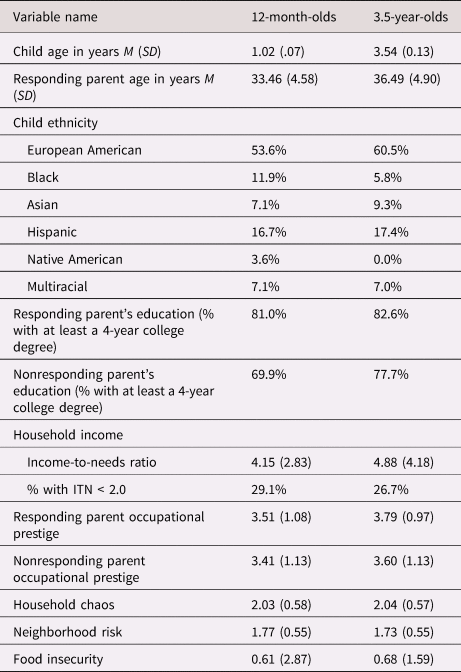
One hundred and eighty-one children (90 children aged 12 months, 91 children aged 3.5 years) were enrolled in the study, but eight children provided no usable hair or salivary cortisol values and were excluded from analysis. This resulted in a final sample of 173 children, including 86 children aged 12 months (43 female, M = 12.24 months, SD=0.82) and 87 children aged 3.5 years (44 female, M = 3.54 years, SD = 0.13 years). Primary caregivers also participated (159 mothers, 14 fathers). Participants were from the greater Boston metropolitan area and were recruited from a department-maintained database of families who had expressed interest in participating in research, from online advertising, and from community recruitment events. All children were born full term (> 37 weeks gestational age) and had no known auditory, visual, neurological, or developmental disorders. Children taking oral steroid medications or using topical steroids were ineligible due to potential effects on cortisol levels. See Table 1 for demographics.
Demographics and socioeconomic risk

Note: Income to needs ratio is calculated by dividing household income by the federal poverty line. Parent occupational prestige is on a 1–5 scale, where 5 is most prestigious.
ITN = income-to-needs ratio
Procedure
This study was approved by the university institutional review board. Laboratory visits were approximately 1.5 hr long. Upon arrival, the parent provided informed consent. For both age groups, hair cortisol samples were collected from the child and parent. The parent filled out questionnaires on SES and child functioning while the child was administered behavioral tasks not included in the current analyses. Parent–child dyads participated in a 12-min interaction that included a 5-min free play, 5-min structured play, and 2-min clean-up. Parents were trained on home collection procedures for salivary cortisol sampling and on how to use an actigraph to measure their child's sleep on the nights prior to cortisol sampling, and they were given sampling supplies and an actigraph to take home. After three days of salivary sampling was complete, a research assistant retrieved the samples and actigraph from the family's home. Hair and salivary cortisol collection methods and all questionnaires used in the current analyses were consistent across age groups.
Measures
Hair cortisol
Hair cortisol measurement procedures followed validated methods (Davenport, Tiefenbacher, Lutz, Novak, & Meyer, Reference Davenport, Tiefenbacher, Lutz, Novak and Meyer2006; Meyer, Novak, Hamel, & Rosenberg, Reference Meyer, Novak, Hamel and Rosenberg2014). Samples of the 3 cm of hair closest to the scalp, weighing ~15–30 mg were cut from the posterior vertex of the head from the child and parent. Samples were weighed immediately so that additional strands of hair could be cut if needed to meet the weight requirements. In a few cases of infants with little hair or very fine hair, samples were assayed if they weighed at least 5 mg. This sample indexed total cortisol output over the past several months. Because washing may affect HCC (Hoffman, Karban, Benitez, Goodteacher, & Laudenslager, Reference Hoffman, Karban, Benitez, Goodteacher and Laudenslager2014), parents were asked about their child's hair history including the frequency that the hair got wet. Hair samples were stored in plastic tubes labeled with subject ID, and were frozen at −20° C until cortisol analysis. Hair samples were weighed, washed twice with isopropanol to remove contaminants, dried, and ground into a fine powder. Cortisol was extracted into methanol, which was then evaporated, and the residue was reconstituted in assay buffer. Reconstituted extracts were analyzed for cortisol using a sensitive and selective commercially available enzyme immunoassay (Salimetrics, LLC; Carlsbad, CA). Assay readout was converted to pg cortisol per mg of dry hair weight. Both intra- and inter-assay coefficients of variation were approximately 10%.
Raw HCC levels for 12-month-old children with useable HCC data (N = 84, M = 138.11, SD = 287.90) and their parents (N = 88, M = 26.58, SD = 67.71) and for 3.5-year-old children (N = 86, M = 35.27, SD = 80.63) and their parents (N = 87, M = 13.57, SD = 24.40) were subjected to a natural log transformation because the data were not normally distributed. Infant HCC was higher than 3.5-year-old HCC, reflecting expected developmental changes in the HPA axis and higher circulating cortisol in infancy, t (168) = 3.19, p = .002. There were six infants without useable HCC samples: four infants had biologically implausible HCC values (greater than 1500 pg/mg) and two did not provide a hair sample. Two parents of infants declined to provide hair samples. Of the five 3.5-year-olds without useable HCC, one sample was excluded due to biologically implausible HCC value, one parent declined child hair cortisol collection and three samples were lost during processing. Four parents of 3.5-year-olds did not have useable HCC values: one parent declined hair cortisol collection and three samples were lost during processing. Parent HCC was unrelated to frequency of washing (parents of infants: Spearman's rho = −.15, p = .172; parents of 3.5-year-olds: Spearman's rho = .05, p = .674), color treatment (parents of infants: t(85) = −.83, p = .406; parents of 3.5-year-olds: t(84) = .24, p = .814), or hair straightening (parents of infants: t(86) = − .647, p = .519; parents of 3.5-year-olds: t(84) = −.20, p = .839). Frequency of washing was also unrelated to HCC in infants (Spearman's rho = .09, p = .438) and in 3.5-year-old children (Spearman's rho = .15, p = .171). Therefore, it was not necessary to correct for variation in hair care habits.
Diurnal salivary cortisol
We trained parents in home cortisol collection techniques during the laboratory visit, and provided parents with a home kit including all collection materials, instructions, and a home diary to record information about time of sampling, bed and wake times, feeding and napping, and other factors that can affect cortisol levels. Sampling times were verified using MEMS TrackCaps, which record a timestamp when the bottle that contains sampling supplies is opened. Parents were instructed to place a synthetic swab in the child's mouth for a total of 60 seconds (Salimetrics, State College, PA). For the 3.5-year-old children, to enhance child compliance, stickers were included in the kit and children were told they could earn sticker rewards for getting the stick “super wet.” No oral stimulants were used. Parents were asked to collect saliva samples in the morning as close as possible to waking, in the early afternoon, and just before bedtime across three days when the parents spent most of their day with the child. Thus, the collection days were often nonconsecutive, particularly for children who attended daycare, as sampling then occurred on weekends. Saliva samplings days were scheduled during the lab visit and text reminders were sent the night before and throughout the sampling day. The experimenter was available via text to respond to parents’ questions at the time of saliva sample collection. Parents were instructed not to collect saliva samples if infants were sick on the prescheduled saliva collection days. In such cases, we rescheduled saliva collection to a week after the onset of the sickness. Parents collected saliva samples within 3 to 87 days (M = 13, SD = 13.69) after the lab visit. Collected samples were frozen at −20° C until they were sent to Trier Laboratories in Germany for cortisol assay. At least two full days of sampling with biologically plausible values was required to be included in analyses. In the infant group, 10 infants had insufficient usable salivary cortisol and six more only had sufficient data for some measures (for instance, some children lacked afternoon samples, so AUCg could not be calculated, but bedtime cortisol could). In the 3.5-year-old group, six children had insufficient usable salivary cortisol and eight more only had sufficient data for some measures. Thus, the infant sample size for salivary cortisol measures range from 70 to 76, and the 3.5-year-old sample size ranged from 73 to 81.
Three variables were calculated to assess salivary cortisol function, averaged across all days of sampling and log transformed: SCC; AUCg; and diurnal slope. Raw morning, afternoon, and bedtime cortisol values were used to calculate AUCg from morning to bedtime as an estimate of diurnal cortisol exposure over the day using the trapezoid formula (Pruessner, Kirschbaum, Meinlschmid, & Hellhammer, Reference Pruessner, Kirschbaum, Meinlschmid and Hellhammer2003). Diurnal slope, indexing diurnal rhythm, was computed using the rise-over-run formula: change across the day in SCC divided by the time elapsed from morning to bedtime sample.
Morning cortisol levels are closely linked to time since waking, due to the CAR. However, parents may not always know or report accurately the moment their child wakes up. Therefore, children wore actigraphs on their ankles on the nights prior to cortisol sampling, so that sleep offset time (wake time) could be objectively measured.
Motion data were recorded to quantify onset and offset of sleep on the three nights preceding the collection of saliva sample. Parents were trained to attach the actigraph to the infant or child's right ankle at bedtime. Sleep offset times were calculated from actigraphy data in MATLAB 9.2.0.556344 (MathWorks Inc., MA, USA) using the algorithms and thresholds put forth by Galland and colleagues to measure sleep–wake states in infants with actigraphy (Galland, Kennedy, Mitchell, & Taylor, Reference Galland, Kennedy, Mitchell and Taylor2012). The actigraphy-based data for sleep offset times were validated by parent report home diaries to ensure that the actigraphy-derived sleep offset occurred before the parent report of child wake. Time since waking when the morning sample was taken was calculated using the MEMS TrackCap timestamp and the actigraphy-derived sleep offset data (Infants: M = 41.39 min, SD = 28.37; 3.5-year-olds: M = 45.96 min, SD = 25.84). When participants were missing actigraphy data, information about sleep offset was obtained from home diary parent reports. To control for variability in the time of sampling relative to the cortisol awakening response that peaks about 30 min after waking, the square of the time since wake was regressed out of slope and AUCg values, and the residual values were used in analyses.
Socioeconomic status (SES) multidimensional assessment
Income-to-needs ratio (ITN)
Parents reported their annual household income and the number of family members currently living in the household. To calculate ITN, we divided total family income by the federal poverty threshold based on the number of household members. For example, an ITN ratio of 3 indicates that household income is three times the federal poverty line for that household size. Three extreme values from 3.5-year-olds’ households were winsorized to within three standard deviations of the mean to meet the assumptions of normality. Our sample, by design, represented a wide range of household income, with the bottom quartile in both age groups qualifying for public assistance.
Parent education
The highest level of education from both parents was coded on a scale from one to ten (1 = no education to 10 = graduate school). Codes were standardized and averaged to create a combined parent education composite.
Occupational prestige
Occupational prestige was coded for each parent using the Job Zone coding scheme from the Occupational Information Network (O*NET, http://www.onetonline.org/help/online/zones), which ranks US Census-based occupational categories on a 1–5 scale based on the education, experience, and training required. Codes were standardized and averaged to create a combined parent occupational prestige composite.
Household chaos
Household chaos was measured using the short version of the Confusion, Hubbub, and Order Scale (CHAOS). It is a widely used six-item scale that assesses the level of chaos in the home environment (Matheny, Wachs, Ludwig, & Phillips, Reference Matheny, Wachs, Ludwig and Phillips1995). Mothers rated the extent to which they agreed with the six statements reflecting chaotic or calm and organized household environment (1 = definitely true and 5 = definitely untrue). Examples of items from this scale are, “it's a real zoo in our home” and “there is usually a television turned on somewhere in our home.”
Neighborhood risk
Parents completed the Neighborhood Organization and Affiliation Scale-Revised (NOAA; Knight, Smith, Martin, & Lewis, Reference Knight, Smith, Martin and Lewis2008). The neighborhood chaos subscale was used, which consists of 14 items in which parents report on neighborhood problems such as vandalism and drug activity, and whether they feel safe (Cronbach's α = .92). Sample items include: “In my neighborhood, I always feel safe” and “In my neighborhood, there is open drug activity.”
Household food insecurity
Parents completed the Household Food Insecurity Access scale (HFIAS), a 9-item questionnaire developed to assess food insecurity that is based on validation studies in eight countries including the United States (Coates, Swindale, & Bilinsky, Reference Coates, Swindale and Bilinsky2007). The questionnaire covers three domains of the experience of food insecurity: anxiety and uncertainty about food supply, insufficient quality and variety of food, and insufficient food intake and its consequences. Eleven extreme values (six infant and five 3.5-year-old) were winsorized to within three standard deviations of the mean to meet the assumptions of normality.
Parental sensitivity
For both age groups, parent–child dyads participated in a 12-min interaction that included a 5-min free play, 5-min structured play, and 2-min clean-up. The dyads were seated on the floor facing the camera. For infants, a Bumbo infant seat was provided and parents had the option of seating the child in the seat or on the floor. Parents were instructed to “play with your child as you normally would,” with an age-appropriate selection of toys provided. After 5 min, the experimenter entered with a structured task. For the infants, this was a shape-sorter toy designed for toddlers, challenging for 12-month-olds, and parents were instructed to play only with the shape-sorter. For the 3.5-year-olds, the experimenter brought in a challenging wooden puzzle (Hammond, Müller, Carpendale, Bibok, & Liebermann-Finestone, Reference Hammond, Müller, Carpendale, Bibok and Liebermann-Finestone2012) with the instruction to “work on the puzzle together.” For both ages, all the free play toys were left in the room during the structured play, making it more difficult for the parent to sustain the child's attention on the difficult toy. Parents were informed that when they heard a knock on the door it was time to clean up, and they were instructed to try their best to get their child to put the toys away in a bin. After 5 min, the experimenter knocked on the door, and 2 min of clean-up were recorded. The structured play and the clean-up task were designed to elicit parental behaviors that occur naturally during everyday parenting challenges but may not be evident in a free play interaction.
Video records of Parent×Child interactions were coded using the sensitivity subscale from the Emotional Availability (EA) Scales (Pipp-Siegel & Biringen, Reference Pipp-Siegel and Biringen1998). The sensitivity subscale captures the parent's ability to read the child's cues and respond to them in a way that is well accepted by the child. This includes clear, accurate perceptions of emotions, responsiveness, ability to handle conflictual situations and awareness of timing (Biringen & Easterbrooks, Reference Biringen and Easterbrooks2012). Higher scores indicate optimal sensitivity while lower scores reflect emotional detachment. Two doctoral students, certified coders who completed the EA training program, coded the videos and 20% of the sample was double coded for reliability. Intraclass correlation coefficients (ICC) were calculated to assess interrater reliability. The ICC for parental sensitivity was .97 for the infant group and .81 for the 3.5-year-old group.
Analysis plan
Pearson correlations were conducted within each age group to test the association of each dimension of SES (ITN, parent education, parent occupational prestige, household chaos, neighborhood risk, food insecurity) with hair and salivary cortisol measures. Linear regressions were then conducted to determine which dimensions of SES uniquely contributed to child HCC and salivary cortisol, controlling for parent HCC. Parent HCC is typically closely associated with child cortisol function, so including parent HCC in the models enabled us to examine unique SES effects on child cortisol above and beyond parent cortisol. Finally, to examine whether links between SES and child cortisol could be explained by parenting, we tested parent sensitivity as a mediator of associations between each of the unique SES predictors and child cortisol variables. Mediation analyses were conducted using ordinary least squares path analysis (Hayes, Reference Hayes2017) where significant effects were estimated using bias-corrected bootstrap confidence intervals at the 95% level and based on 5,000 samples. All variables were entered in the mediation models as continuous variables.
Results
Socioeconomic risk and child cortisol
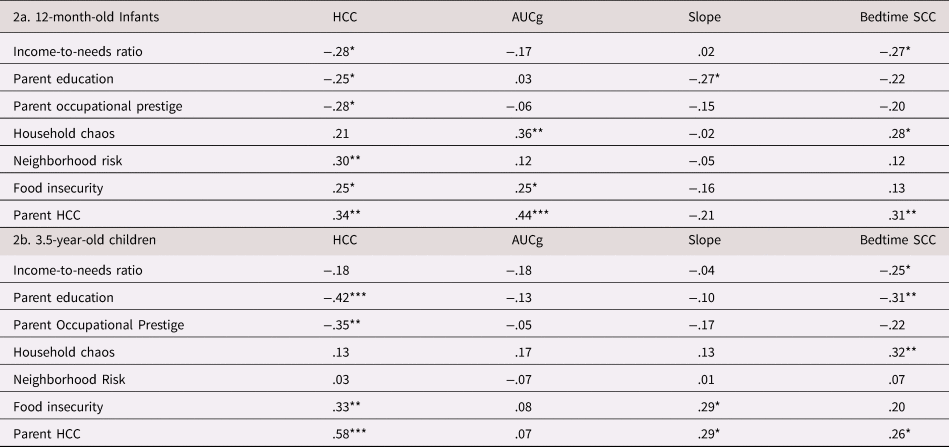
Correlations of the socioeconomic risks and parent HCC with child hair and salivary cortisol measures are presented in Table 2. Parent HCC, indexing parent chronic biological stress, was correlated with most child cortisol measures and consequently was included as a covariate in regression models. Higher child HCC, indexing child chronic biological stress, was correlated with lower parent education, lower parent occupational prestige and greater food insecurity for both 12-month-old infants and 3.5-year-olds. In infants, higher HCC was also related to lower ITN and higher neighborhood risk. For the infants, a stepwise linear regression was conducted to determine unique socioeconomic contributors to infant HCC, controlling for parent HCC. The model was significant, F (3,65) = 12.34, p < .001, accounting for 33.4% of the variance in infant HCC and revealed that in addition to parent HCC, β = .40, p < .001, both parent education, β = −.25, p = .030, and neighborhood risk, β = .23, p = .045, uniquely contributed to infant HCC. In 3.5-year-old children, stepwise linear regression of child HCC on its socioeconomic correlates, F (2,79) = 29.65, p < .001, accounted for 41.4% of the variance in child HCC and found that parent education, β = −.32, p < .001, uniquely contributed to child HCC above and beyond parent HCC, β = .50, p < .001.
Bivariate correlations between socioeconomic risk and child cortisol, by age group

Note: *p < .05, **p < .01 ***p < .001.
AUCg = area under the curve with respect to ground; HCC = hair cortisol concentration; SCC = salivary cortisol concentration
Regarding the salivary cortisol measures, higher AUCg, representing cortisol exposure across the day, was associated with greater household chaos and greater food insecurity in 12-month-old infants. However, only household chaos, β = .34, p = .005, uniquely accounted for infant AUCg above and beyond parent HCC, β = .36, p = .002, together explaining 26.6% of the variance, F (2, 56) = 11.53, p < .001. In 3.5-year-olds, none of the socioeconomic indicators were related to AUCg. A flatter diurnal cortisol slope, indicating dysregulation of circadian rhythms, was associated with lower parent education in infants, but this association did not persist in a partial correlation controlling for parent HCC. Flatter diurnal slope was associated with greater food insecurity in 3.5-year-olds, and this association remained after controlling for parent HCC, partial r = .24, p = .036. Higher bedtime SCC was linked to lower ITN and higher household chaos in both infants and 3.5-year-olds, and also to lower parent education in 3.5-year-olds. For infants, only household chaos uniquely explained variance in bedtime, β = .27, p = .028, after controlling for parent HCC, β = .24, p = .051, accounting for 13.1% of individual differences, F (2,62) = 5.81, p = .005. Similarly, for 3.5-year-olds, the regression model accounted for 12.7% of variance in bedtime SCC, F (2, 75) = 6.59, p = .002, with only household chaos, β = .29, p = .008, uniquely contributing to bedtime SCC after controlling for parent HCC, β = .23, p = .034.
Testing parental sensitivity as a potential mediator
To explore parenting as a potential pathway through which socioeconomic risks may play a role in child cortisol function, we first tested the association of parental sensitivity with infant and child cortisol measures. In infants, parental sensitivity was unrelated to any of the cortisol measures. In 3.5-year-olds, lower parental sensitivity was linked to higher child HCC, r = −.27, p = .01, and to higher bedtime SCC, r = −.23, p = .04. To understand whether parental sensitivity mediated links between socioeconomic risks and HCC in 3.5-year-old children, ordinary least squares path analysis (Hayes, Reference Hayes2017) was conducted using the PROCESS 3.4.1 macro in SPSS (see Table 3 for model coefficients). Education was the independent variable, parental sensitivity was the potential mediator, parent HCC was a covariate, and the dependent variable was child HCC. The model was significant, F (3, 81) = 25.52, p < .001, R2 = .44, and there was a significant pathway from parent education to parental sensitivity. However, the model had no indirect effects, such that parental sensitivity did not mediate the association of parent education with child HCC. Next, ordinary least squares path analysis was used to understand whether parental sensitivity mediated links between socioeconomic risks and bedtime SCC in 3.5-year-old children, with household chaos as the independent variable and parent HCC as a covariate. The model was significant, F (3, 74) = 4.99, p = .003, R2 = .17, but there was no indirect effect of parental sensitivity on bedtime SCC, so parental sensitivity was not a mediator of this association.
Model coefficients testing indirect effects of socioeconomic risk on 3.5-year-old children's cortisol function

Note: DV = dependent variable; IV = independent variable; MV = mediating variable; SE = standard error. * p < .05, **p < .01. Results of both models demonstrate that parental sensitivity does not mediate the effects of socioeconomic risks on 3.5-year-old children's cortisol function.
Discussion
We examined socioeconomic correlates of hair and salivary cortisol measures in 12-month-old infants and 3.5-year-old children and tested parental sensitivity as a potential mediator of these associations. HCC was a sensitive biomarker of multiple SES indicators, above and beyond parent biological stress. For both age groups, parent education was uniquely associated with child chronic biological stress, indexed by child HCC, controlling for parent HCC. In addition, neighborhood risk contributed to infant HCC. For diurnal salivary cortisol, more proximal SES indicators were key to explaining individual differences. Household chaos uniquely accounted for variance in bedtime SCC in both age groups, and total diurnal cortisol output in infants. Flatter slope, indexing diurnal dysregulation, was linked specifically to food insecurity in 3.5-year-olds. Contrary to our expectations, parental sensitivity did not mediate pathways from SES risks to child cortisol. Results demonstrate the specific role of unpredictable and unsafe contexts in dysregulation of biological stress in early childhood and show that diurnal and chronic cortisol indices vary in their susceptibility to proximal and distal SES risks. These findings underscore the need for multidimensional assessments of both SES and cortisol function.
We expand on prior studies showing a relation between SES and child cortisol (e.g., Chen et al., Reference Chen, Cohen and Miller2009; Saridjan et al., Reference Saridjan, Huizink, Koetsier, Jaddoe, Mackenbach, Hofman and Tiemeier2010; Ursache et al., Reference Ursache, Merz, Melvin, Meyer and Noble2017; Vaghri et al., Reference Vaghri, Guhn, Weinberg, Grunau, Yu and Hertzman2013) by examining both hair and diurnal salivary measures in the same sample and by showing specific contributions of multidimensional SES risks above and beyond parent biological stress. Parent HCC is correlated with child hair and diurnal salivary measures, in our study as in prior research (Hollenbach et al., Reference Hollenbach, Kuo, Mu, Gerrard, Gherlone, Sylvester and Cloutier2019; Karlén et al., Reference Karlén, Frostell, Theodorsson, Faresjö and Ludvigsson2013; Tarullo et al., Reference Tarullo, St. John and Meyer2017). Young children depend on parents to help them regulate their immature biological stress systems (Gunnar & Donzella, Reference Gunnar and Donzella2002), and parents may be less effective in doing so when they are themselves biologically stressed by SES-related risks. Thus, one could imagine that the impact of SES on cortisol function in very young children was mainly through dysregulated parent cortisol function. However, for both infants and 3.5-year-olds, while parent HCC was correlated with child cortisol function, SES indicators were associated with child HCC and diurnal salivary cortisol independent of parent HCC. That is, SES has implications for young children's biological stress above and beyond parents’ chronic biological stress. This early emerging sensitivity to SES risks highlights the need to understand the mechanisms through which SES risks interact with the developing HPA axis, to inform effective prevention and intervention approaches to buffer young children in low-SES contexts from hyperactivity and dysregulation of the HPA axis.
Food insecurity, household chaos, and neighborhood risk all were associated with multiple indicators of child cortisol function, and uniquely explained individual differences in child cortisol function independent of the global SES indicators of income and parent education. Results expand on prior studies of young children reporting a role of food insecurity in HCC (Ling et al., Reference Ling, Robbins and Xu2019) and of neighborhood risk (Finegood, Wyman, O'Connor, & Blair, Reference Finegood, Wyman, O'Connor and Blair2017; Roubinov et al., Reference Roubinov, Hagan, Boyce, Adler and Bush2018) and household chaos (Blair et al., Reference Blair, Berry, Mills-Koonce and Granger2013; Chen et al., Reference Chen, Cohen and Miller2009) in diurnal cortisol measures. These three SES risks have in common an element of unpredictability – not knowing when or if food will be available, an absence of household routines, and a perception that the neighborhood is not secure or supportive. Uncertainty and perceived threat upregulate the amygdala, and limbic signals in turn activate the HPA axis (Gunnar, Reference Gunnar2017). In adults and in animal models, unpredictable and unsafe contexts are associated with cortisol dysregulation. For example, a study of Kenyan adults found higher HCC in those who reported feeling unsafe when collecting water or using sanitation facilities (Henley et al., Reference Henley, Lowthers, Koren, Fedha, Russell, Van Uum and Darnell2014). The stress of unpredictability is well studied in the primate literature, in which variable foraging demand paradigms are used to model the effects of resource scarcity and unpredictability (Rosenblum & Paully, Reference Rosenblum and Paully1984). Young children, even infants, experience the unpredictability of household chaos quite directly, as a lack of household routines, variable feeding and sleep schedules, and perhaps variable behavior of family members, so it is not surprising that both infants and 3.5-year-olds had higher bedtime SCC levels in chaotic households, and infants had higher cortisol output across the day. Food insecurity was specifically associated with flatter diurnal slope in 3.5-year-olds. A flattening of diurnal slope is thought to reflect dysregulation of the circadian rhythm of the HPA axis following extended up-regulation due to chronic or repeated stressors (Gunnar & Vazquez, Reference Gunnar, Vazquez, Cicchetti and Cohen2006). In the case of food insecurity, unpredictability of food access is likely a chronic stressor, and hunger, as a threat to homeostasis, could also itself induce repeated HPA responses to restore homeostasis. Thus, it is fairly straightforward to posit mechanisms through which household chaos and food insecurity could disrupt diurnal cortisol function.
It is striking that neighborhood risk uniquely contributed to infant HCC in the current study, distinct both from parent HCC and from the more global SES indicator of parent education. Unlike household chaos and food insecurity, neighborhood risk is not a proximal risk factor, at least for infants. The measure used in the current study assessed the parent's perception of neighborhood risk with questions about vandalism, drug activity, to what extent the parent felt safe in the neighborhood, and to what extent the parent thought neighbors could be counted on to help each other. These are all characteristics beyond a 12-month-old's cognitive capacity to assess. Rather, when the parent perceives the neighborhood to be unsafe or unpredictable, the infant has higher chronic biological stress, again above and beyond the parent's own biological stress. This result parallels a study of nonhuman primate macaques in which after a 4-month variable foraging demand paradigm was administered to the mothers, infant macaques showed elevated cerebrospinal fluid concentrations of corticotropin releasing factor (CRF), a key hormone on the HPA axis that signals the adrenal glands to produce corticosteroids (Coplan et al., Reference Coplan, Altemus, Mathew, Smith, Sharf, Coplan and Rosenblum2005). Thus, in infant macaques, as in the infant humans in the current study, a parent's experience of uncertainty was associated with elevated infant biological stress. While the mechanism cannot be determined from the current data, one could speculate that the infant is reacting to the parent's chronic anxiety or vigilance as a threat signal, and therefore becoming chronically vigilant as well. If this is the case, the parent's perception of threat may be critical to infant cumulative cortisol exposure. It will be important for future studies to attend not only to commonly calculated objective neighborhood indicators, such as mean neighborhood income or percent unemployment, but also to parental perception of neighborhood risk.
Our hypothesis that proximal SES indicators would be more robustly associated with early childhood cortisol than distal indicators was only partially supported. Household chaos and food insecurity, both proximal indicators directly experienced by the child, were the only SES variables to account for unique variance in diurnal salivary cortisol function. However, while most of the SES indicators correlated with child HCC, it was parental education that uniquely explained HCC in both infants and 3.5-year-olds, with the children of less educated parents demonstrating higher HCC. We had expected that income and parent education, the most widely used indices of SES, were proxies for specific SES-linked risk factors which were more important to cortisol function. It is noteworthy that family income did not uniquely explain any of the cortisol variables in either age group – that is, income did not provide additional information about cortisol function beyond the other SES indicators considered. This suggests that using income as a single measure of SES is not the most sensitive approach. However, as mentioned, parent education did uniquely explain child HCC at both ages. This finding corroborates work by Ursache et al. (Reference Ursache, Merz, Melvin, Meyer and Noble2017) and Vaghri et al. (Reference Vaghri, Guhn, Weinberg, Grunau, Yu and Hertzman2013), both of whom reported that parent education was inversely related to child HCC. Parent education is in some sense a summary measure of SES risk, as it is associated with so many proximal risk factors. Interestingly, HCC is also a summary measure, reflecting the cumulative cortisol output over several months. This includes not only basal cortisol levels during the day but also cortisol exposure due to prolonged or repeated stress responses. Both these types of salivary measures are linked to HCC (Flom, St John, Meyer, & Tarullo, Reference Flom, St John, Meyer and Tarullo2017; Kao et al., Reference Kao, Doan, St. John, Meyer and Tarullo2018). HCC also reflects nighttime cortisol output, which is rarely measured directly in developmental studies, and therefore incorporates the effects on cortisol levels of nighttime sleep disruptions. It is possible that all these various aspects of cortisol function are influenced by different combinations of proximal factors. The best indicator of child HCC may be parent education, which stands in for these various proximal factors. It does not necessarily follow that increasing parent education would decrease child HCC, as this association is not evidence of a causal or mechanistic relation.
Overall, results support the sensitivity of HCC to a wide range of SES indicators. HCC was correlated with five out of six SES indicators studied in infants and three out of six indicators in 3.5-year-olds. By contrast, correlations of SES measures with the diurnal salivary measures were more scattered. Among 3.5-year-olds, none of the SES indicators were related to salivary AUCg, one of the most widely used cortisol indices in developmental research. Results suggest that in infancy and early childhood, HCC may be a more reliable index than salivary cortisol of the cumulative impact of SES on cortisol function. This may in large part be a reflection of the challenges of reliably measuring diurnal salivary cortisol in early childhood. That is, it is possible that HCC appeared more robustly related to SES because HCC was more accurately measured. While we took many steps to increase the accuracy of our salivary measures, including correcting for actigraphy-derived time since wake; objectively measuring sampling times; excluding samples when the child was ill; and texting with parents to support accurate and timely sampling, room for error remains. Further, even if perfectly measured, salivary cortisol levels vary widely from day to day and averaging across a few days of sampling will not provide as stable a measure as HCC. Yet HCC and diurnal cortisol appeared to have a different pattern of sensitivity to SES, with household chaos disrupting diurnal rhythms but not playing as much of a role in chronic cortisol output. Results support the utility of including both hair and diurnal salivary cortisol measures in future research.
Our hypothesis that parental sensitivity would explain the effects of SES on child cortisol function was not supported. This expectation was informed by prior research linking lower parental sensitivity to higher child cortisol output, as indexed by both salivary and hair measures (Blair et al., Reference Blair, Raver, Granger, Mills-Koonce and Hibel2011; Johnson et al., Reference Johnson, Mliner, Depasquale, Troy and Gunnar2018; Simmons et al., Reference Simmons, Azpitarte, Roost, Doomers, Allen, Havighurst and Haslam2019; Zalewski et al., Reference Zalewski, Lengua, Kiff and Fisher2012). In our sample, consistent with this prior work, lower parental sensitivity was associated with higher child HCC and higher bedtime SCC. However, parental sensitivity did not mediate links between SES measures and these cortisol indices. It should also be noted that most of the previous research was with toddlers and preschool children, and parental sensitivity was unrelated to cortisol function in our infant sample. One possible explanation for these null results is methodological. Parental sensitivity was assessed during a free play interaction, a structured teaching task, and a brief cleanup task. While the teaching and cleanup tasks were intended to be similar to daily challenges that parent–child dyads encounter and to elicit a wider variety of parental behavior, this did not represent the full range of situations that parents navigate on a daily basis. Given that parents serve as social buffers for their young children to help them regulate HPA activity in the face of challenges (Gunnar, Reference Gunnar2017), parental sensitivity during stressful situations that are likely to activate the HPA axis, such as drop-off at a new daycare or restraining an unwilling child in a car seat, may be most pertinent to the incorporation of SES-related risk into HPA function. For instance, to better understand SES links to bedtime SCC, it may be illuminating to assess parental sensitivity during the evening meal and while getting the child ready for bed, contexts which are likely to elicit parent–child struggles. Unpredictability should also be considered as a potential underlying mechanism. Unpredictability in parenting behavior, in who provides care to the child, and in the child's day-to-day experience could contribute to cortisol dysregulation and will be important to measure in future studies. It is possible that parenting is not a primary mechanism underlying SES associations with child cortisol, but before concluding this, it will be important for future research to observe parents in situations in which social buffering is required.
We tested both 12-month-olds and 3.5-year-olds because we anticipated potential developmental differences in how SES related to cortisol, given developmental change in the HPA axis. There were the expected developmental changes in the HPA axis, such that infant HCC was higher than 3.5-year-old HCC. However, there were not pronounced developmental differences in the ways in which SES related to cortisol function. For both infants and 3.5-year-olds, parent education uniquely related to HCC and household chaos uniquely related to bedtime SCC. Patterns of association were similar, suggesting that sensitivity of the HPA axis to these multidimensional SES risks is relatively stable through early childhood. The cross-sectional design is a limitation of this study, however. Longitudinal studies are needed to characterize developmental pathways of cortisol function in the context of SES, including determining the implications of early SES for later cortisol function and examining whether changes in SES predict changes in cortisol function over time. Further, it will be critical to conduct similar research with diverse populations to determine the generalizability of these associations across developmental time, cultural context, and severity of risks experienced. For example, children in low- and middle-income countries who experience more extreme poverty-related stressors may be more apt to show attenuation of HPA activity in the face of prolonged severe stress, and thus the nature of associations between SES and cortisol may be expected to differ. Our sample was racially and ethnically diverse but did not have sufficient numbers of particular racial/ethnic groups within age bands to allow for disentangling the effects of race and SES. It would be valuable for future studies to recruit a socioeconomically diverse sample within a single racial or ethnic group, or to have a large sample with enough participants of each race tested to allow for statistical comparisons. Finally, the participating parents in the currently study were primarily mothers. Future studies should attempt to recruit equal numbers of mothers and fathers who are primary caregivers, or include both parents, to examine whether the roles of parenting and parent HCC in child cortisol function differ for mothers and fathers.
A strength of this study is that we measured both hair cortisol and three indices of diurnal salivary cortisol. However, it is difficult for any one study to comprehensively assess the HPA axis. We did not measure stress reactivity to challenge. We also took only one morning sample and therefore did not adequately capture the CAR, which prior research has found to be blunted in lower SES children (Zhu et al., Reference Zhu, Chen, Zhao, Chen, Tian, Liu and Qin2019). An extension of this research would be to characterize how cortisol reactivity and the CAR relate to multidimensional SES indicators in early childhood.
For children in low-SES families and any children experiencing upheaval and adversity, empirically supported interventions are needed to reduce the impacts of poverty and establish a safe, predictable context for children and their parents. The current correlational study does not demonstrate causality, and so it will be critical to determine if changing specific SES risks will change child cortisol function. Promisingly, young children whose families had participated in a cash transfer program had lower salivary cortisol levels than those who had not (Fernald & Gunnar, Reference Fernald and Gunnar2009). While our current results suggest that income may be a proxy for associated proximal SES risks, increasing income may well have ripple effects that mitigate those risks. Given the observed association of food insecurity with flattened diurnal slope, it will also be important to determine if changes to food stamp eligibility or to the availability of free school lunch programs impact child cortisol regulation.
Results of the current study highlight the need for multidimensional assessment of SES when examining the physiological impact of poverty on children. Risk factors indexing unsafe or unpredictable environments explained child diurnal and chronic cortisol function above and beyond parent biological stress and global SES indicators like income. This finding has implications even beyond the study of SES. Large-scale events such as the COVID-19 pandemic and its accompanying economic repercussions may represent a risk to children's HPA axis development by pushing more families into poverty and food insecurity. However, even for families with sufficient material resources, pandemics, natural disasters, and other cataclysmic events may greatly increase parents’ experience of their world as unpredictable and unsafe. For young children, this environmental uncertainty may be associated with elevated and dysregulated cortisol, with potential long-term consequences for biological stress vulnerability. Further work is needed to develop a mechanistic understanding of how proximal SES risks relate to the HPA axis and to determine the malleability of cortisol function in response to interventions that address proximal SES risks such as food insecurity and household chaos.
Acknowledgments
The authors are grateful to Ashley St. John and Sophie Schwartz for processing the actigraphy data, to the research assistants who assisted with data collection and coding, and especially to the families who participated in this research.
Funding Statement
The present research was supported by NICHD R03HD082550 to the first author.
Conflicts of Interest
None