Introduction
The parthenium weed Parthenium hysterophorus Linnaeus (Asteraceae: Heliantheae; Withers, Reference Withers1998) is an economically important weed in India (Navie et al., Reference Navie, McFadyen, Panetta and Adkins1998) and Australia. The weed has been found to be resistant to the popular systemic herbicide glyphosate. Its biological control may, however, be achieved using the Mexican beetle Zygogramma bicolorata Pallister (Coleoptera: Chrysomelidae).
To achieve successful augmentation of the beetle for its economical use as a biological control agent (McFadyen, Reference McFadyen1998), knowledge of its reproductive attributes is essential.
Temperature affects many key life events in phytophagous insects, including their reproductive performance, and particularly fecundity (Hentz et al., Reference Hentz, Ellsworth, Naranjo and Watson1998; Ivanovic and Nenadovic, Reference Ivanovic and Nenadovic1999; Sagarra et al., Reference Sagarra, Vincent, Peters and Stewart2000). Carroll and Quiring (1993) found that potential fecundity (number of eggs matured) and realised fecundity (number of eggs laid) are both influenced by temperature.
The age-specific fecundity function of a species is influenced by diet (Omkar et al., Reference Omkar, Singh, Pervez and Mishra2004; Onagbola et al., Reference Onagbola, Fadamiro and Mbata2007; Wäckers et al., Reference Wäckers, Romeis and Rijn2007), photoperiod (Zhou, Reference Zhou2001; Haderspeck and Hoffmann, Reference Haderspeck and Hoffmann2004; Mishra and Omkar, Reference Mishra and Omkar2005), relative humidity (Gillespie et al., Reference Gillespie, Opit and Roitberg2000) and temperature (Sagarra et al., Reference Sagarra, Vincent, Peters and Stewart2000; Omkar and Pervez, Reference Omkar and Pervez2002; Haderspeck and Hoffmann, Reference Haderspeck and Hoffmann2004). Several studies have described the thermal requirements for the development, immature survival (e.g. Jarosik et al., Reference Jarosik, Honek and Dixon2002), and age-specific fecundity of various insects (Dixon and Agarwala, Reference Dixon and Agarwala2002; Omkar and Pervez, Reference Omkar and Pervez2002; Pervez and Omkar, Reference Pervez and Omkar2004).
The effect of temperature on the development and immature survival of Z. bicolorata under field and laboratory conditions has been studied (Jayanth and Bali, Reference Jayanth and Bali1992, Reference Jayanth and Bali1993; Bhoopathi and Gautam, Reference Bhoopathi and Gautam2006; Omkar et al., Reference Omkar, Rastogi and Pandey2008). However, there is little information on the influence of temperature on the beetle's reproductive success.
In this paper, we describe the influence of temperature on a number of reproductive attributes and the age-specific fecundity function of Z. bicolorata.
Materials and methods
Stock culture
Adults of Z. bicolorata were obtained from parthenium plants in the campus of Lucknow University, Lucknow, India. Beetles were reared on excised leaves of parthenium weed at 25 ± 2 °C, 65 ± 5% RH and 14 h light-10 h dark in incubators, with wilted leaves replaced daily with fresh ones. Newly hatched larvae were reared in Petri dishes (9.0 cm diameter × 2.0 cm height) and when fully grown were transferred to glass beakers (9.5 × 6.5 cm) filled with moist sand, for pupation. Freshly emerged adults from the stock culture were isolated for use in experiments.
Experimental set-up
Freshly emerged beetles were sexed and 10 replicates (n = 10) consisting of a male and a female each were placed in plastic Petri dishes (9.0 × 2.0 cm) maintained at 20, 25, 27, 30 and 35 °C. The beetles were allowed to mate and eggs laid each day were counted and transferred to another Petri dish at the same temperature.
Eggs were checked daily for hatching and empty egg shells were counted to assess hatching success. Mating pairs were maintained on Parthenium weed diet, and observed until the last individual died. The following were recorded:
● Pre-oviposition period = no. of days from emergence and first oviposition;
● Oviposition period = no. of days from first to last oviposition;
● Post-oviposition period = no. of days from last oviposition to mortality;
● Daily oviposition = no. of eggs laid per female per day;
● Total fecundity = total no. of eggs laid per female; and
● Per cent egg viability = percentage of eggs hatched.
Data analysis
Data on pre-oviposition, oviposition and post-oviposition periods, fecundity, per cent egg viability, oviposition rate, day of peak and oviposition at peak for the different constant temperatures were subjected to one-way ANOVA followed by Tukey's post hoc comparison of means. The data were also subjected to various regression analyses against temperature to determine the best-fit model to describe each parameter, using χ2 analysis.
Daily oviposition was plotted against mean reproductive age to obtain age-specific fecundity graphs at the five different temperatures. All statistical analyses were performed using the computer software MINITAB-13.1 (2003; Minitab Inc., State College, PA, USA).
Results
Pre-oviposition, oviposition and post-oviposition periods, fecundity and per cent egg viability of Z. bicolorata were significantly affected by the temperature (Table 1). The pre- and post-oviposition periods decreased significantly with increase in temperature from 20 to 27 °C, followed by a slight increase with further increase in temperature. Oviposition period decreased significantly with an increase in temperature from 20 to 35 °C.
Effect of different constant temperatures on certain reproductive attributes of Zygogramma bicolorata

Values are means ± SE.
*Significant at P = 0.0001. Means within a column followed by different letters are significantly different at P < 0.001.
Fecundity and per cent egg viability increased significantly with increase in temperature from 20 to 27 °C, and thereafter declined with further increase in temperature. There was a significant shift in day of peak (F = 35.43; P < 0.001; df = 45) and oviposition at peak (F = 67.86; P < 0.001; df = 45) with increase in temperature.
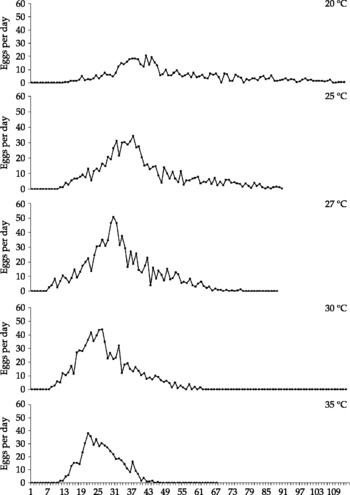
Daily oviposition rate increased with an increase in adult age, reaching a peak and thereafter declining with further advancement in age. The temperature-specific trends of pre- and post-oviposition periods, fecundity, per cent egg viability and peak of oviposition (eggs) were explained best by a second-degree polynomial equation, while oviposition period and day of peak oviposition followed a linear model (Table 2). Figure 1 shows the plots of age-specific fecundity of Z. bicolorata at different constant temperatures. It shows the temperature dependence of the peak oviposition and day of peak oviposition at the five temperatures.
Relationships between reproductive attributes of Zygogramma bicolorata (Y) and temperature (X) expressed in terms of regression equations, significant at P<0.0001

Age-specific fecundity curves of Zygogramma bicolorata at five different constant temperatures

The age-specific fecundity trends (eggs per day vs. age) were triangular at all five constant temperatures. However, the peak in fecundity occurred earlier in adult life at the higher temperatures.
Discussion
Our results on the influence of temperature on the pre-oviposition period of Z. bicolorata corroborate previous studies (e.g. Bind, Reference Bind1998; Pervez and Omkar, Reference Pervez and Omkar2004). The observed decrease in pre-oviposition period with increase in temperature from 20 to 27 °C may be ascribed to increased metabolic activity at higher temperature, resulting in more rapid maturation of the gonads. A linear relationship between temperature and rate of gonadal maturation has been described in previous studies (Phoofolo et al., Reference Phoofolo, Obrycki and Krafsur1995; Nobuhiro, Reference Nobuhiro2002). The delay in pre-oviposition period as temperature increased beyond 27 °C may reflect adverse effects of high temperature on gonadal maturation.
The reduced egg production observed at temperature extremes could be due to the lower number of ovarioles produced at high temperatures, and low rate of oogenesis at low temperatures (Huey et al., 1995). Increased voracity with increase in temperature – the result of higher metabolic rate and the metabolic need (Marinkovic et al., Reference Marinkovic, Milosevic and Milanovic1986; Cluster et al., Reference Cluster, Marinkovic, Allard and Ayala1987; Hoffmann and Parsons, Reference Hoffmann and Parsons1989; Biins and Ratte, Reference Biins and Ratte1991) – could be responsible for the increase in egg production up to 27 °C. However, the decrease in egg output beyond this temperature, despite increased voracity, might be as a result of less efficient utilisation of ingested food at higher temperature (Soares et al., Reference Soares, Coderre and Schanderl2003).
Higher fecundity at 27 °C indicates that temperature directly influences progeny production in Z. bicolorata, which is in close agreement with previous studies in other coleopterans (e.g. Omkar and Pervez, Reference Omkar and Pervez2002).
The movement of the oviposition peak in the age-specific fecundity graphs suggests that a suitable rearing temperature shortens the time between first egg laying and the peak. Similar trends have also been found in other predaceous ladybird beetles (Ponsonby and Copland, Reference Ponsonby and Copland1998; Pervez and Omkar, Reference Pervez and Omkar2004). Omkar and Pervez (Reference Omkar and Pervez2002) suggested early maturation of the gonads at optimal temperature to be the reason for shortening the time between first egg laying and the oviposition peak in the ladybird Micraspis discolor. In Chilocorus nigritus, temperature is a major determinant of oviposition (Gartside, Reference Gartside2000). The observed early arrival of peak oviposition and the high number of eggs laid at the peak strongly suggest 27 °C to be a suitable temperature for Z. bicolorata reproduction.
The tendency of females to invest more in reproduction during the earlier phase of life, even at the cost of reducing their potential longevity, has been discussed by Williams (Reference Williams1996).
The decreased hatching rate at temperatures higher or lower than 27 °C may be the result of increased egg mortality; the lowest per cent egg viability (53.3 ± 2.9%) was recorded at 35 °C, at which temperature the eggs apparently desiccated. Reduced egg viability at low temperatures has also been attributed either to inhibition of spermatogenesis in males or sperm mortality in the spermathecae of females (Ponsonby and Copland, Reference Ponsonby and Copland1998).
Jayanth and Bali (Reference Jayanth and Bali1993) gave a temperature range of 20–30 °C as optimal for rearing Z. bicolorata. Bhoopathi and Gautam (Reference Bhoopathi and Gautam2006) gave 25–30 °C as optimal for various biological attributes of the beetle. Our results are in close agreement with these, and suggest 27 °C to be a suitable temperature for the beetle's multiplication.