


Introduction
The high prevalence of vertigo among the elderly population makes it a significant contributor to disability. Benign paroxysmal positional vertigo (BPPV) represents the most prevalent form of peripheral vertigo, accounting for approximately 20−30 per cent of vestibular vertigo cases.Reference Sfakianaki, Binos, Karkos, Dimas and Psillas1 While canalith repositioning procedures (CRPs) cure more than 90 per cent of patients with this condition, the cumulative recurrence rate within 40 months remains as high as 50 per cent.Reference Nunez, Cass and Furman2 Ding et al. reported that lack of vitamin D resulted in the occurrence and recurrence of BPPV.Reference Ding, Liu, Kong, Chen and Liu3 A large-scale prospective study proved that vitamin D supplementation could reduce the annual recurrence rate by approximately 27 per cent,Reference Jeong, Kim, Kim, Choi, Koo and Choi4 ranked as one of the most valuable findings by JAMA in 2020.5
Studies on patients with moderate traumatic brain injury complicated by BPPV have revealed that the recurrence rate in individuals with abnormal ocular vestibular evoked myogenic potential (oVEMP) is significantly higher than those with normal oVEMP, indicating that otolith dysfunction causes recurrence.Reference Chen, Zhao, Yu, Jian, Li and Xu6 Some studies have also suggested that BPPV patients with an abnormal caloric test exhibit a higher recurrence rate.Reference Bi, Liu, Zhang, Duan and Zhou7 The American Academy of Otolaryngology-Head and Neck Surgery Foundation (AAO-HNSF) clinical guidelines for BPPV 2017 indicated that vestibular function testing is recommended in patients with recurrent BPPV, as well as those whose symptoms cannot be resolved entirely by CRPs.Reference Bhattacharyya, Gubbels, Schwartz, Edlow, El-Kashlan and Fife8
Therefore, vestibular dysfunction and vitamin D deficiency may be the primary factors contributing to recurrence. However, the impact of vitamin D on vestibular function in patients with BPPV is yet to be investigated, and the extent of vitamin D deficiency does not appear to be related to the decline in vestibular function. Consequently, more reliable indicators need to be developed to predict recurrence rates among patients with idiopathic BPPV.
Serum 25-hydroxyvitamin D (25OHD) concentration can accurately reflect the overall nutritional status of individuals with vitamin D.Reference Rhim9 Accordingly, the primary objective of this study was to explore the correlation between vestibular function (VEMP, caloric test) and vitamin D (25OHD) concentration and the potential correlation between vestibular function and recurrence through variations in vitamin D levels.
Materials and methods
Participants
The study participants were patients who visited the vertigo clinic of Shandong Provincial Hospital between March 2017 and February 2019. Patients age 18 years or older with unilateral posterior or horizontal semicircular canal (PSC/HSC) BPPV were recruited. All included patients adhered to the 2017 BPPV Clinical Practice Guideline developed by AAO-HNSFReference Bhattacharyya, Gubbels, Schwartz, Edlow, El-Kashlan and Fife8 and underwent neurological tests to rule out central vertigo.
Study steps and related tests
Timely CRPs were performed after diagnosis, and gender and self-score of the Dizziness Handicap Inventory (DHI) after successful CRPs were recorded. All tests were performed within 2 to 3 days of the presentation.
The Medical Ethics Committee approved the study and retrospectively registered it (Clinical Trial No. SWYX: NO.2022-100).
Collection of medical history and questionnaire survey
CRPs: We performed all treatments with the same operator. The Epley manoeuvre was used for PSC-BPPV, while the Barbecue manoeuvre was used for HSC-BPPV. If nystagmus or vertigo disappeared with immediate assessment, the CRPs were considered practical. We repeated Dix-Hallpike and Roll tests during the follow-up visits and performed CRPs while observing persistent positional nystagmus. In addition, short-term assessments were performed one week apart until positional nystagmus disappeared.
Recurrence criteria: Successful CRPs were defined as the absence of positional nystagmus according to the Lee criteria.Reference Lee, Park, Lee, Lee, Sung and Park10 During this period, patients were instructed to promptly return to the outpatient clinic for a comprehensive evaluation of positional nystagmus and affected SC if they exhibited symptoms of vertigo. The term “recurrence” refers to the reappearance of idiopathic positional nystagmus after an interval longer than one month from the initial diagnosis.Reference Kim, Han, Kim and Park11 In comparison, reappearance within one month is considered part of the initial onset.
DHI: The DHI evaluates self-perception disorders arising from vestibular dysfunction and their impact on quality of life.Reference Dobbels, Lucieer, Mertens, Gilles, Moyaert and van de Heyning12 In this study, total DHI scores were recorded. Patients with DHI scores ≥ 30 were classified as experiencing residual dizziness (RD), while those with scores less than 30 were categorised as non-RD individuals.Reference Poon, Chow, Au, Hui and Leung13
Related inspections and results evaluation
Caloric testing: We used the American MMT Visual Eyes nystagmus and ATMOS hot and cold stimulators to conduct the caloric test at a room temperature of less than 25 °C. The slow phase velocity (SPV) parameter was used to evaluate one-sided semicircular canal paresis (CP). The calculation of the Jongkees group is given as follows:
CP=[(RW+RC)–(LW+LC)]/(RW+RC+LW+LC)×100 per cent.
(RC: right ear cold air; LC: left ear cold air; RW: right ear warm air; LW: left ear warm air)
CP greater than or equal to 25 per cent indicates a weakened response of the unilateral HSC. Bilateral weakening (BW) or unilateral weakening (UW) is shown when the sum of the ipsilateral SPVs is less than 12°/s; that is, RW + RC less than 12°/s or LW + LC less than 12°/s, both are considered abnormal.
cVEMP testing: The Intelligent Hearing System (IHS, Miami, FL, USA) recorded VEMPs. During the examination, subjects lay supine on a bed with their heads rotated 60–70° away from the ear, receiving acoustic stimulation. When muscle contraction reached a stable level (50–200 mV), the sternocleidomastoid muscle's amplified electromyography (EMG) signals were automatically recorded. The first positive–negative peaks (P13–N23) were observed, with P13 latencies ranging from 13 to 18 ms and N23 latencies ranging from 19 to 26 ms. The peak values of P13 and N23 were recorded, along with the latency, wave interval (P13–N23) and amplitude (expressed as AL and AS; AL represents the higher amplitude ear, AS represents the lower amplitude ear). The asymmetry ratio (AR) between ears was compared. AR less than 36 per cent was considered normal.Reference Rauch14 The calculation formula is as follows:${\rm AR\;} = {\rm \;}{{{\rm AL}-{\rm AS}} \over {{\rm AL} + {\rm AS}}}{\rm \;} \times {\rm \;}$ 100 per cent.Reference Papathanasiou, Murofushi, Akin and Colebatch15
oVEMP testing: Briefly, subjects lay supine on a bed with their face up and were instructed to maintain a gaze back upward on a target marker during the detection. EMG and average waveform were displayed simultaneously, repeated several times and spaced 3–5 minutes apart during the test to reduce error. The initial negative peak N10 and positive peak P16 were recorded, and the latency at each peak was 8.1−12.7 ms and 6.5−20.1 ms, respectively.Reference Todd, Rosengren, Aw and Colebatch16 The measurement and calculation methods were the same as cVEMP. AR less than 29 per cent was considered normal.
The criteria for classifying abnormal VEMP results are as follows: (1) non-reproducible or lack of meaningful responses in unilateral or bilateral waveforms; (2) abnormal symmetry based on AR values of cVEMP and oVEMP; (3) additionally, abnormalities such as prolonged latency or wave interval, as well as low amplitude of P13–N23 and N10–P16, were considered.
The test results were classified as bilateral abnormality (BA), unilateral abnormality (UA) and bilateral normality (BN).
Vitamin D (serum 25OHD): A fully automated electrochemiluminescence immunoassay system, the Cobas modular E170 (Roche, Mannheim, Germany), was utilised for detection. Fasting venous blood was collected in the morning to measure vitamin D levels. According to the latest international classification standard, the normal range for vitamin D level is serum 25OHD greater than or equal to 20 ng/ml, levels between 10 and 20 ng/ml are insufficient, and levels less than 10 ng/ml are deficient.Reference Sümbül, Sezer, Kavvasoğlu, Batmaci, Yengil and Yağiz17
Statistical analysis
We used IBM SPSS Statistics software (version 19.0; IBM, Armonk, NY, USA) for Statistical analysis. All images were analysed using GraphPad Prism 9 software. We used one-way analysis of variance (ANOVA), chi-squared test, and Mann–Whitney U test for nonparametric rank. The dependent variables were the caloric test results, cVEMP, oVEMP and recurrence. Binary logistic regression analysis was used to determine the predictive power of each factor for both vestibular function and recurrence.
Results and analysis
This is a cross-sectional study. A total of 138 patients (36 males and 102 females) were included after the screening; 90 patients with idiopathic BPPV were included in the initial onset group, while 48 patients in the relapse group visited for the first time (Figure 1). The levels of vitamin D were observed in 35 participants (25.4 per cent) as usual (25OHD greater than or equal to 20 ng/ml), in 87 participants (63 per cent) as insufficiency (10 less than or equal to 25OHD less than 20 ng/ml), and in 16 participants (11.6 per cent) as deficiency (25 OHD less than 10 ng/ml). The age range of patients was 18–76 years. Table 1 shows sample characteristics and differences between patients in the different vitamin D levels. Gender, recurrence and RD are statistically significant among the three groups (p = 0.004, 0.000 and 0.001). The vitamin D distribution is unrelated to the side involving SC and age.
Flow chart of the included and excluded population in this study

Distribution of serum vitamin D in 138 patients with idiopathic BPPV

*p < 0.05.
BPPV = benign paroxysmal positional vertigo; DHI = Dizziness Handicap Inventory; HSC = horizontal semicircular canal; PSC = posterior semicircular canal; RD = residual dizziness; SC = semicircular canal.
The study included 138 cases (276 ears) comprising healthy and affected ears. Among them, 27 cases (54 ears), 15 cases (30 ears) and 51 cases (102 ears) showed abnormal results in the caloric test, cVEMP and oVEMP tests, respectively, in both ears. Specifically, UAs were observed either in the regular or affected ear for the caloric test (62 ears), cVEMP (68 ears) and oVEMP (48 ears). The overall otolith and vestibular dysfunction rates were 42.2 per cent, 35.5 per cent and 54.3 per cent for caloric test, cVEMP and oVEMP, respectively.
Serum vitamin D affects the vestibular function
Initially, the results of the caloric test, cVEMP and oVEMP were combined into two groups: the abnormal group (UA and BA) and the BN group. The mean vitamin D levels, age, gender and involved SC were compared in the two groups (Table 2). No significant differences were found in age, gender or the involved SC; however, there was a significant difference in mean vitamin D level between the two groups. Additionally, across all three tests, there was a statistically significant difference (p < 0.01) in mean vitamin D levels between the BN and BA groups – lowest for the BA group and highest for the BN group. However, no significant differences were observed between the UA and the other two groups based on the caloric and cVEMP tests. Nevertheless, a notable distinction existed between the UA and BA groups based on the oVEMP tests (Figure 2).
Characteristics between patients with normal vestibular function and those with abnormal vestibular function
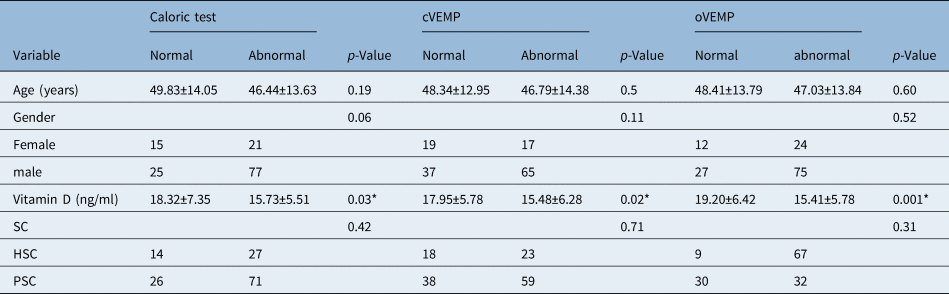
*p < 0.05.
cVEMP = cervical vestibular evoked myogenic potentials; HSC = horizontal semicircular canal; oVEMP = ocular vestibular evoked myogenic potentials; PSC = posterior semicircular canal; SC = semicircular canal.
The distribution of serum vitamin D in the caloric test, cVEMP and oVEMP.

When the caloric test, cVEMP, oVEMP and vitamin D were treated as ordered rank categorical variables, Mantel-Haenszel linear trend test revealed a significant linear association between the degree of vitamin D deficiency and decline in vestibular and otolith function (χ2 caloric test = 12.54; χ2 cVEMP = 17.16; χ2 oVEMP = 16.46; p < 0.05). Pearson correlation results indicated that R values for the caloric test, cVEMP and oVEMP were 0.23, 0.33 and 0.3, respectively. The results of further regression analysis revealed that the impact of vitamin D level on the caloric test, cVEMP and oVEMP is demonstrated in Table 3. Statistically significant results were observed for the caloric test (χ2 = 12.77, p = 0.03), cVEMP (χ2 = 15.14, p = 0.01) and oVEMP (χ2 = 16.73, p = 0.01). The model accurately classified 72.5 per cent, 60.9 per cent and 71.7 per cent of the subjects for the caloric test, cVEMP and oVEMP, respectively.
Binary logistic regression analysis to study the relationship between the caloric test, cVEMP, oVEMP and vitamin D grade classification, gender, age and involved semicircular canals in patients with idiopathic BPPV

*p < 0.05.
CI = confidence interval; cVEMP, cervical vestibular evoked myogenic potentials; HSC = horizontal semicircular canal; oVEMP, ocular vestibular evoked myogenic potentials; OR = odds ratio; PSC = posterior semicircular canal; SC = semicircular canal;
Drawn receiver operating characteristic curve and calculate the area under the curve.
The optimal critical point corresponding to the Youden index in the caloric test regression equation was determined to be 0.35, with a sensitivity of approximately 47.5 per cent and a specificity of about 87.8 per cent. The area under the curve (AUC) was calculated as 0.69, with a 95 per cent confidence interval (CI) ranging from 0.59 to 0.79 (p < 0.001). The Youden index for the cVEMP regression equation was 0.22, with a sensitivity of 66.7 per cent and a specificity of 55.4 per cent. The AUC obtained was measured at 0.62, with a corresponding CI range of 0.53−0.72 (p < 0.05). Similarly, in the oVEMP regression equation, the Youden index yielded a value of 0.33, with a sensitivity of 43.4 per cent and specificity of 89.7 per cent. The AUC was calculated as 0.71, with a 95 per cent CI ranging from 0.61 to 0.8 (p < 0.001). Figure 3 displays the receiver operating characteristic (ROC) prediction curves for each model. Notably, the ROC curve for oVEMP approached closer to (0,1), indicating that the vitamin D level was more accurate in distinguishing oVEMP compared to cVEMP and caloric test.
ROC curve of vitamin D for predicting vestibular function.

Serum vitamin D affects recurrence and residual dizziness
A comparison of the characteristics between the recurrent and initial onset groups is presented in Table 4. Recurrence was associated with age, vitamin D levels, RD and oVEMP, respectively (p = 0.02, 0.00, 0.001 and 0.004). Variables with a p-value more significant than 0.5 were included in the regression analysis. The linear correlations among these variables are displayed in Table 5. Specifically, a positive correlation was found between vitamin D and oVEMP (r = 0.32, p = 0.000) and the caloric test (r = 0.38, p = 0.02). Additionally, there was a positive correlation between oVEMP and the caloric test (r = 0.17, p = 0.03). Conversely, a negative correlation was observed between RD and vitamin D (r = −0.18, p = 0.000) and the caloric test (r = −0.20, p = 0.008).
Characteristics between patients in the recurrence group and those in the initial onset group

*p < 0.05, **p < 0.01.
cVEMP = cervical vestibular evoked myogenic potentials; HSC = horizontal semicircular canal; oVEMP = ocular vestibular evoked myogenic potentials; PSC = posterior semicircular canal; SC = semicircular canal.
Correlations between independent variables of the logistic regression analysis that predicts the recurrence in patients with idiopathic BPPV

*p < 0.05, **p < 0.01.
BPPV = benign paroxysmal positional vertigo; cVEMP = cervical vestibular evoked myogenic potentials; oVEMP = ocular vestibular evoked myogenic potentials; RD = residual dizziness; SC = semicircular canal.
The prediction of recurrence was regressed using binary regression analysis, with gender and age and SC, caloric test and oVEMP as independent variables. The regression equation was determined using forwards stepwise regression. The final regression model demonstrates statistical significance. (χ2 = 15.85, p = 0.000, Table 6). Consequently, it can be inferred that only vitamin D is a predictive factor for recurrence among patients with BPPV. The reference variable for this study was the normal vitamin D group, while the three-category variables were treated as dummy variables. Compared to patients with normal serum vitamin D levels, those with serum vitamin D deficiency (25OHD < 10 ng/ml) had a significantly higher risk of recurrence (12.92 times), whereas those with serum vitamin D insufficiency (10 ng/ml ≤ 25OHD < 20 ng/ml) had a moderately increased risk of recurrence (4.97 times). oVEMP did not demonstrate any predictive significance for recurrence in the regression equation.
Logistic regression analysing factors that independently predict the recurrence in patients with idiopathic BPPV

Note: As the vitamin D, caloric test, RD and oVEMP were correlated, the variables were forwards stepwise into the regression analyses.
*p < 0.05.
BPPV = benign paroxysmal positional vertigo; CI = confidence interval; OR = odds ratio.
Discussion
We conducted patient assessments following CRPs and observed that decreased vitamin D levels were associated with an increased incidence of RD. Therefore, we concluded that vitamin D deficiency and insufficiency adversely affect the efficacy of BPPV treatment during its early stages. The study included bilateral vestibular and otolith functions based on the understanding that vitamin D decline affects bilateral functions. Ultimately, the total abnormal rate of vestibular and otolith functions in 138 patients (276 ears) corresponded to previous studies' findings.Reference Yang, Kim, Lee and Lee18,Reference Yetişer and İnce19 When comparing the mean values of vitamin D among different groups based on vestibular function, only the oVEMP with UA and BN group exhibited statistically significant differences (Figure 2). Therefore, it can be inferred that oVEMP is more sensitive to early decline in vitamin D concentration. Hossam et al. investigated the otolith function in vertigo patients and categorised them into abnormal and normal groups based on vitamin D levels. The study revealed significantly prolonged P13 and N10 latencies for cVEMP and oVEMP in the abnormal group compared to the normal group.Reference Sanyelbhaa and Sanyelbhaa20 The linear trend analysis revealed substantially higher correlation coefficients between vitamin D and cVEMP (0.33) as well as oVEMP (0.3) in comparison to the caloric test (0.23).
BPPV primarily pertains to the loss of utricle otolithic particles, and oVEMP predominantly reflects the function of the utricle and superior vestibular nerve among BPPV patients.Reference Zucca, Valli, Valli, Perin and Mira21 Therefore, we postulate that a decrease in vitamin D levels leads to greater susceptibility of otolithic organs and their innervated nerves compared to SC and their corresponding nerves. Our regression analysis further supports this hypothesis by demonstrating an initial impact on utricle functioning and its associated nerves when the level of vitamin D drops below 2 0ng/ml, followed by potential effects on saccule and SC functionality when decreasing from 10 to 20 ng/ml to less than 10 ng/ml. The correlation between vitamin D levels and vestibular function was quantified, revealing that the likelihood of abnormal oVEMP was 0.25 times lower in patients with normal vitamin D levels compared to those with insufficient vitamin D levels (10–20 ng/ml). Additionally, the likelihood of abnormal cVEMP, caloric test and oVEMP was 0.06, 0.33 and 0.06 times lower in patients with normal vitamin D levels compared to those with deficient vitamin D levels (<10 ng/ml). ROC curve analysis further demonstrated that serum vitamin D levels exhibited superior accuracy in assessing oVEMP compared to cVEMP and caloric test.
The VD molecule plays a crucial role in immune regulation by controlling cellular proliferation and differentiation.Reference Li, Wang, Yan, Guo and Yang22 Martens et al. demonstrated that vitamin D [1,25-dihydroxyvitamin D3] could act directly on the endothelial cells, maintaining their stability at physiological concentrations and thereby preventing an increase in vascular permeability.Reference Martens, Gysemans, Verstuyf and Mathieu23 Meanwhile, the inflammatory response of the inner ear is associated with increased blood–brain barrier permeability and microvascular circulation.Reference Tohari, Zhou and Shu24 The potential protective effects of vitamin D on hair cells and spiral ganglia may be attributed to its ability to enhance antioxidant reactionsReference Büki, Jünger, Zhang and Lundberg25 and mitigate cell death.Reference Zou, Minasyan, Keisala, Zhang, Wang and Lou26 Studies have confirmed that the correction of vitamin D deficiency can lead to an improvement in hearing, as evidenced by both animal experiments and clinical practice.Reference Yetiser, Ince and Gul27,Reference Jeong, Kim, Shin, Kim, Lee and Lee28 The pathophysiology of BPPV involves the degeneration of vestibular neurons, confirmed by multiple series of temporal bones (TBs), which have shown a loss of ganglion cells in the superior vestibular and abnormal saccular ganglion cells.Reference Yamauchi, Nakaya, Raveendran, Harbidge, Singh and Wangemann29 However, vitamin D deficiency worsens demyelinating changes.Reference Büki, Jünger, Zhang and Lundberg25 Therefore, we postulate that the compromised immune regulation resulting from diminished vitamin D levels and impairment to the saccule, utricle, SC and neural functionality may not be promptly restored, ultimately leading to a decline in vestibular function. These findings may also account for the decreased otolith function in the asymptomatic ear of BPPV patients compared to that of the normal control group.Reference Yetiser, Ince and Gul27 VDR-knockout mice exhibited loss of vestibular spiral ganglion cells, reduced numbers of hair cells and degenerative changes in the otolith membrane in the inner ear,Reference Büki, Jünger, Zhang and Lundberg25,Reference Jeong, Kim, Shin, Kim, Lee and Lee28 supporting the conclusions drawn from this study.
Simultaneously, we focused on the classical regulatory function of vitamin D in calcium ion regulation. The concentration of calcium ions in the endolymph (23 μmol/l in the cochlea and 280 μmol/l in the vestibule) is much lower than that in the perilymph (1100 μmol/l). This concentration gradient is crucial for transmitting sound and maintaining homeostasis in the otolith.Reference Jeong, Kim, Shin, Kim, Lee and Lee28,Reference Yamauchi, Nakaya, Raveendran, Harbidge, Singh and Wangemann29 This study provides additional evidence that the vestibular function of idiopathic BPPV patients with serum vitamin D levels below 20 ng/ml decreases exponentially compared to that of patients with normal vitamin D levels. This can result in an aberrant flow of endolymphatic fluid within the ampullary crest. Consequently, changes in the potential of hair cells result in abnormal nerve impulses being generated through either or both the upper and lower vestibular nerves to the vestibular nucleus, ultimately causing unilateral or bilateral vestibular dysfunction. The theory that 1,25-dihydroxyvitamin D3 could upregulate the expression of ECaC1 mRNA in SCReference Yamauchi, Raveendran, Pondugula, Kampalli, Sanneman and Harbidge30 supports our view.
The present study provides the first evidence that vitamin D levels can serve as a predictive factor for both vestibular function and recurrence of BPPV patients, highlighting a significant correlation between abnormal vestibular function and recurrence. Meanwhile, our study further demonstrated that recurrent BPPV patients have a higher prevalence of abnormal oVEMP than those with initial onset, suggesting a potential association between impaired vestibular nerve integrity and recurrence, consistent with Xu et al.'s findings.Reference Xu, Liang, Chen, Song, Tong and Thong31 In conclusion, our inference is that the impact of vitamin D on recurrence and RD may be attributed to vestibular nerve impairment.
Our result verified that low levels of vitamin D were one of the contributing factors to BPPV recurrence, consistent with the findings of Lee et al.Reference Lee, Hassannia, Bergin, Al Zaabi, Misale and Rutka32 Furthermore, the vitamin D level in patients with multiple recurrences was significantly lower than at the initial stage.Reference Büki, Ecker, Jünger and Lundberg33 Multiple linear regression of recurrence showed that only vitamin D had predictive significance for the equation. Compared to patients with normal vitamin D levels, those with insufficient and deficient levels were, respectively, 4.97 times and 12.92 times more likely to experience recurrence, indicating the importance of supplementing with vitamin D in reducing the recurrence rate. Talaat et al. observed similar findings in their subsequent study on patients with unilateral, idiopathic and PSC-BPPV, suggesting that the odds ratio (OR) for patients with 25-OHD3 levels below 10 ng/ml was 4.54 compared to those with higher levels of 10 ng/ml.Reference Talaat, Kabel, Khaliel, Abuhadied, El-Naga and Talaat34 We posit that the disparity can be attributed primarily to two factors: firstly, the comparison of recurrence rates in this study exclusively with BPPV patients with normal vitamin D levels, and secondly, this study encompassed patients with HSC and included individuals with vitamin D levels ranging from 10 to 20 ng/ml to make the study more comprehensive. Although BPPV patients with abnormal oVEMP are more prone to relapse, the oVEMP cannot accurately predict the likelihood of recurrence. This may be attributed to the fact that the oVEMP solely assesses a fraction of utricle and superior vestibular nerve functionality while disregarding the contribution of the saccule and SC.
In conclusion, diminished serum vitamin D levels directly impact vestibular functions and contribute to an elevated recurrence rate among patients with unilateral idiopathic BPPV. Based on these findings, we recommend continuously monitoring patients with abnormal vitamin D levels until normalisation. The limitation of our study was the potential selection bias due to a higher proportion of female patients and the short follow-up period. In future studies, we will enhance data collection and broaden the scope of investigation.
• There was a correlation observed between the level of vitamin D and gender, as well as RD. Furthermore, a significant difference in mean vitamin D levels was found between the normal and abnormal groups of the caloric test, cervical vestibular evoked myogenic potentials (cVEMP) and ocular vestibular evoked myogenic potentials (oVEMP).
• Patients with normal vitamin D levels exhibited a decreased likelihood of presenting with abnormal oVEMP compared to those with insufficient vitamin D levels (< 20 ng/ml). Similarly, the probability of abnormal caloric test, cVEMP and oVEMP was lower in patients with normal vitamin D levels than in those with deficient vitamin D levels (< 10 ng/ml).
• Recurrence was found to be associated with factors such as age, vitamin D levels, RD and oVEMP. However, among patients with BPPV, only vitamin D levels were identified as a predictive factor for recurrence.
• The interplay between deficient vitamin D levels and vestibular function may contribute to the recurrence.
Competing interests and financial disclosure
The authors declare none. This research received no specific grant from funding agencies in the public, commercial, or not-for-profit sectors.
Author contributions
Tao Lin and Changzhen Wu are equal first authors.
Acknowledgements
We thank Editage (www.editage.com) for the English language editing.



