Introduction
Cannabis consumption has been widely accepted as a modest contributory cause of psychosis (Henquet et al. Reference Henquet, Di Forti, Morrison, Kuepper and Murray2008), and consensus regarding this hypothesis has relied on consistent findings from several lines of enquiry. First, research evidence has indicated that consumption in the general population has been associated with elevated levels of psychosis symptoms and diagnosis (van Os et al. Reference van Os, Bak, Hanssen, Bijl, de Graaf and Verdoux2002). In fact, meta-analyses findings have indicated that consumption of cannabis in the general population doubles the risk of developing later psychosis (Arseneault et al. Reference Arseneault, Cannon, Witton and Murray2004; Henquet et al. Reference Henquet, Murray, Linszen and van Os2005). Second, the association between cannabis and psychosis has been more clearly manifest in clinical settings. For example, the prevalence of cannabis consumption recorded among in-patients with a psychosis diagnosis has been significantly greater than in the general population (Regier et al. Reference Regier, Farmer, Rae, Locke, Keith, Judd and Goodwin1990; Mueser et al. Reference Mueser, Yarnold and Levinson1990). Third, cannabis consumption has been shown to both exacerbate psychosis symptomatology (Corcoran et al. Reference Corcoran, Kimhy, Stanford, Khan, Walsh, Thompson, Schobel, Harkavy-Friedman, Goetz, Colibazzi, Cressman and Malaspina2008; Hall & Degenhardt, Reference Hall and Degenhardt2000) and to attenuate it (Dixon et al. Reference Dixon, Haas, Weiden, Sweeney and Frances1991; Peralta & Cuesta, Reference Peralta and Cuesta1992; Compton et al. Reference Compton, Furman and Kaslow2004), exacerbate problems with psychosocial functioning (Caspari, Reference Caspari1999) and increase the rate and amount of psychotic relapses (Grech et al. Reference Grech, Van Os, Jones, Lewis and Murray2005). Fourth, evidence that cannabis constitutes an independent risk factor for psychosis has emerged from studies which controlled for a range of (although importantly, not exhaustive) alternative risk factors, such as, age, sex, ethnicity, socio-economic status, urbanicity and use of other drugs (Moore et al. Reference Moore, Zammit, Lingford-Hughes, Barnes, Jones, Burke and Lewis2007). Popular theoretical perspectives invoking gene–environment explanations that focus primarily on inherent susceptibility have also reinforced consensus regarding the association between cannabis and psychosis (Murray et al. Reference Murray, Morrison, Henquet and Di Forti2007; Henquet et al. Reference Henquet, Di Forti, Morrison, Kuepper and Murray2008). Evidence has indicated that the risk of psychosis onset or psychosis symptom development was elevated in cannabis users who possessed a predisposition to psychosis, either due to a previous psychotic episode or disorder, a previous experience of psychosis or paranoid symptoms at baseline, or due to familial history (van Os et al. Reference van Os, Bak, Hanssen, Bijl, de Graaf and Verdoux2002; Henquet et al. Reference Henquet, Murray, Linszen and van Os2005). In fact Caspi et al. (Reference Caspi, Moffitt, Cannon, McClay, Murray, Harrington, Taylor, Arseneault, Williams, Braithwaite, Poulton and Craig2005) reported that a genetic predisposition to psychosis was stronger in individuals possessing the Val/Val variant of the catechol-O-methyltransferase gene following cannabis use. However, in a review, Arseneault et al. (Reference Arseneault, Cannon, Witton and Murray2004) concluded that while cannabis consumption was likely to play a causal role with regard to psychosis, its use alone was neither necessary nor sufficient to cause psychosis. From a causal perspective, two findings in particular have questioned the validity of the cannabis–psychosis association. First, not all individuals experiencing psychosis have used cannabis, and the vast majority of people who have used cannabis do not go on to develop psychosis. Second, and more importantly in the context of the current study, recent findings have indicated that childhood psychological trauma may moderate the cannabis–psychosis relationship.
Cannabis, psychosis and childhood trauma
Houston et al. (Reference Houston, Murphy, Adamson, Stringer and Shevlin2008) assessed the cannabis–psychosis association using data from the National Comorbidity Survey (NCS). The authors found that cannabis consumption did not increase the likelihood of a psychosis diagnosis when estimated in a model that included childhood sexual trauma. However, a significant interaction between early exposure to cannabis (age less than 16 years) and childhood sexual trauma was identified. The authors reported a significant increase in risk of psychosis diagnosis in respondents who had experienced childhood sexual trauma (i.e. before the age of 16 years), but, importantly, this was evident only in those who had also used cannabis under the age of 16 years. Combined exposure to early sexual trauma and early cannabis use increased the likelihood of a diagnosis of psychosis by almost 12 times. Similarly, Harley et al. (Reference Harley, Kelleher, Clarke, Lynch, Arseneault, Connor, Fitzpatrick and Cannon2010) analysed predictors of psychotic symptoms in a sample of Irish adolescents and reported main effects for both childhood trauma and cannabis use. Notably, however, whilst examining an additive model of risk these authors reported an increase in psychotic symptom experience ‘… to a much greater extent than would be expected if each risk factor were working independently’. In addition to this, Cougnard et al. (Reference Cougnard, Marcelis, Myin-Germeys, De Graaf, Volleburgh, Krabbendam, Leb, Wittchen, Henquiet, Spauwen and van Os2007) reported an additive interaction between cannabis use, childhood trauma, urbanicity and baseline psychotic experiences in an explanatory model predicting persistence of psychotic experiences in two large European cohort studies. The authors suggested that these factors, in combination, played a role in the abnormal persistence of psychotic symptoms. A final example by Compton et al. (Reference Compton, Furman and Kaslow2004) also demonstrated that African-American, socially disadvantaged, first-episode schizophrenia-spectrum patients reported significantly greater childhood physical and sexual abuse compared with those patients without co-morbid cannabis dependence.
The cannabis–psychosis link and statistical control
Much evidence has suggested that the experience of childhood trauma is a risk factor for the development of psychosis, and that some individuals' vulnerability for the onset of psychosis may be directly attributable to their experienced trauma (Read et al. Reference Read, van Os, Morrison and Ross2005; Shevlin et al. Reference Shevlin, Dorahy and Adamson2007). The high rates of childhood trauma reported in psychotic populations seem to support this hypothesis (Friedman & Harrison, Reference Friedman and Harrison1984; Beck & van der Kolk, Reference Beck and van der Kolk1987; Cloiter et al. Reference Cloiter, Tardiff, Marzuk, Leon and Portera2001; Friedman et al. Reference Friedman, Smith, Fogel, Paradis, Viswanathan, Ackerman and Trappler2002; Bebbington, Reference Bebbington2009; Read et al. Reference Read, Bentall and Fosse2009) and a number of recent studies have supported a casual relationship (Bebbington et al. Reference Bebbington, Bhugra, Brugha, Singleton, Farrell, Jenkins, Lewis and Meltzer2004; Janssen et al. Reference Janssen, Krabbendam, Bak, Hanssen, Vollebergh, de Graaf and van Os2004; Whitfield et al. Reference Whitfield, Dube, Felitti and Anda2005). Moreover, trauma has also been shown to predict cannabis use (Cornelius et al. Reference Cornelius, Kirisci, Reynolds, Clark, Hayes and Tarter2010). Research has shown high rates of childhood physical and sexual abuse in cannabis-dependent populations (Compton et al. Reference Compton, Furman and Kaslow2004). In fact, data from the NCS demonstrated that adults with post-traumatic stress disorder (PTSD) were three times more likely to have cannabis dependence as compared with those without PTSD (Kessler et al. Reference Kessler, Sonnega, Bromet, Hughers and Nelson1995; Agosti et al. Reference Agosti, Nunes and Levin2002). It is notable, given this evidence, that few studies investigating the role of cannabis in the onset and development of psychosis have included variables representing psychological trauma in their analyses. If findings have indicated that the ‘cannabis effect’ has: (i) been attenuated because of the inclusion of another causal agent, (ii) been subsumed under the effect of a more dominant causal agent or, (iii) been enhanced due to the interaction of another causal agent, it would seem both methodologically and theoretically prudent to adjust future analyses, where possible, in order to control for such agents.
This study aimed to further examine the relationship between cannabis use and psychosis diagnosis in a large nationally representative population-based sample in England. A series of hypotheses was tested. First, it was predicted that the likelihood of psychosis diagnosis would be significantly associated, independently, with measures of both cannabis use and sexual trauma. Second, it was predicted that associations between cannabis use and psychosis diagnosis would no longer be significant when estimated within a model that controlled for childhood trauma history. Third, it was predicted that a series of childhood trauma×cannabis use interactions would also be significantly associated with psychosis diagnosis. Finally, it was predicted that these associations would be statistically significant after controlling for a range of demographic and clinical variables expected to contribute to psychosis diagnosis.
Method
Sample
The data for the current study were based on the Adult Psychiatric Morbidity Survey (APMS) conducted in England in 2007. The APMS was designed to be representative of the population living in private households in England. Using the small users postcode address file, the National Centre for Social Research adopted a multi-stage stratified probability sampling design. The survey consisted of a phase one and a phase two (clinical) interview. For phase one of the survey 13 214 potentially eligible private households were identified. Within each household one adult aged 16 years or over was selected for interview. Where there was more than one person aged 16 years or over, one adult was chosen randomly in order to ensure that all eligible members of any household had the same chance of being selected. Of those who were eligible, 57% agreed to take part in an interview that resulted in the completion of 7403 successful interviews (3197 males and 4206 females). The mean age of the sample was 51.12 (s.d.=18.59) years. After accounting for missing data and applying the appropriate sampling weight, a sample of 7394 was used in all analyses. The phase one interview contained a section on demographic variables and the assessment of a range of common mental disorders and alcohol and drug use using standardized instruments. The probability of selection for a phase two assessment was based on responses to screening questions in phase one. The probability was calculated as the greatest of the specific probabilities of four disorders: psychosis, Asperger's syndrome, borderline personality disorder and antisocial personality disorder. From the first phase interview 849 respondents were selected for phase two, and phase two interviews were successfully conducted with 630 of these (74%). Details of the survey methods can be found in McManus et al. (Reference McManus, Meltzer, Brugha, Bebbington and Jenkins2007).
Measures
Psychosis
A two-phase procedure was used in the survey to assess psychosis. Phase one involved interviews that included questions about: (1) anti-psychotic medication; (2) admissions to hospital for mental health reasons; (3) self-reported diagnosis or symptoms of psychosis; and (4) endorsement of the probe and secondary item relating to auditory hallucinations in the Psychosis Screening Questionnaire (Bebbington & Nayani, Reference Bebbington and Nayani1995). Of the 630 participants who were screened into phase two, 313 met one or more of the psychosis criteria and were therefore eligible for a clinical assessment of psychosis. This involved the administration of the Schedule for Assessment in Neuropsychiatry (SCAN; World Health Organization, 1999) by trained clinical interviewers. Due to initial (n=64, 20%) and subsequent (n=59, 24%) refusals to take part in phase two there were 190 participants who completed the SCAN assessment. Identification of a psychotic disorder was based on the results of the SCAN. Subsequently, weighting was used for those who met the phase one criteria for SCAN assessment but did not take part in the assessment to adjust for non-response. The psychosis variable represented a diagnosis of schizophrenia or affective psychosis in the year prior to the interview based on International Classification of Diseases, 10th revision (ICD-10) criteria.
Sexual trauma
Questions about sexual trauma were taken from the ‘Domestic Violence and Abuse’ section of the questionnaire. Participants were informed that this section of the interview could potentially cause upset. They were also assured that all answers would be completely confidential. This section of the interview was self-completed on the computer so that the interviewer could not see the responses. There were six questions about sexual trauma that related to experiences before and after the age of 16 years. The questions about childhood sexual trauma were prefixed by ‘The next few questions are about events you may or may not have experienced BEFORE the age of 16.’ The following questions were then presented:
(1) Before the age of 16, did anyone talk to you in a sexual way that made you feel uncomfortable?
(2) Before the age of 16, did anyone touch you, or get you to touch them, in a sexual way without your consent?
(3) Before the age of 16, did anyone have sexual intercourse with you without your consent?
Possible response categories were ‘yes’, ‘no’, and ‘don't understand/does not apply’. The responses were recoded as 1=‘yes’ and 0=‘no’ or ‘don't understand/does not apply’. The same questions about talking, touching and sex were also asked with the stem ‘Since the age of 16…’. These scores were answered and coded in the same way as the questions that related to abuse before the age of 16 years. The scores were summed to create a variable that represented cumulative sexual trauma since the age of 16 years with possible scores ranging from 0 to 3. A similar summed variable was created to represent cumulative sexual trauma before the age of 16 years.
Cannabis use
Information about cannabis use was taken from the ‘Drugs’ section of the questionnaire. This section of the interview was self-completed on the computer so that the interviewer could not see the responses. The questions about drug use were prefixed by ‘Have you EVER taken any of the drugs listed below even if it was a long time ago?’ The first option was ‘cannabis (marijuana, grass, hash, ganja, blow, draw, skunk, weed, spliff)’. Answers to this question were coded as 1=‘yes’ and 0=‘no’.
Background variables
A range of demographic and clinical variables that have been identified as potential risk factors for psychosis was also used in the analysis. These variables were:
(1) Education: A variable assessing educational achievement in the survey captured qualifications ranging from no qualifications to degree level and above. This variable was recoded into a dichotomous variable, which identified respondents as either having attained an educational qualification (1) or not (0).
(2) Ethnicity: Ethnic background was recoded into a dichotomous variable, which identified respondents as being of white ethnic origin (1) or of non-white ethnic origin (0).
(3) Employment: Participants were asked if they were in paid employment at the time of interview. This variable identified respondents as either unemployed (1) or employed (0) at the time of interview.
(4) Depression: The Clinical Interview Schedule (CIS-R: reference) was used to produce specific ICD-10 diagnoses of neurotic disorders. This study used the ‘depressive episode’ variable that represented diagnoses of mild (F32.00/01), moderate (F32.10/11) or severe (F32.2) depression.
(5) Alcohol: Identification of hazardous alcohol use was based on a score greater than 8 on the Alcohol Use Disorders Identification Test (Saunders et al. Reference Saunders, Aasland, Babor, De La Fuente and Grant1993).
Results
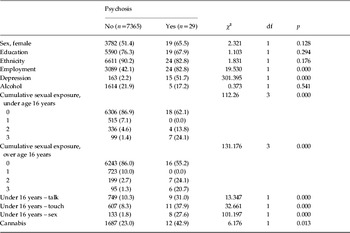
The overall weighted prevalence of psychosis was 0.4% (n=29). There were no sex differences [65.5% female: χ2=2.321, degrees of freedom (df)=1, p=0.13] and the mean age of those with [40.43 (s.d.=10.28) years] and without a diagnosis [46.38 (s.d.=18.62)] differed significantly [unequal variance t(29)=3.09, p<0.01]. Cross-tabulations between the psychosis variable and demographic, clinical, trauma and cannabis variables are presented in Table 1.
Bivariate (χ2) analysis of trauma, cannabis, background and psychosis variables

df, Degrees of freedom.
Data are given as number of participants (percentage).
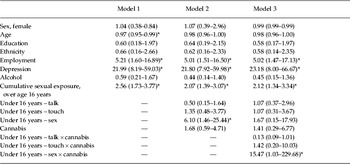
The χ2 tests show that psychosis was significantly related to unemployment, depression and the number of sexual traumas since 16 years. Significantly higher rates of all types of childhood sexual trauma and cannabis use were also found in the psychosis group. A series of hierarchical multivariate logistic regression models was specified and estimated. Mplus 5.21 (Muthén & Muthén, Reference Muthén and Muthén1998–2009; Muthén & Muthén, USA) was used to estimate the model parameters using the robust full information maximum likelihood method. This method allowed parameters to be estimated using all available information and has been found to be superior to alternative methods such as listwise deletion (Enders, Reference Enders2001; Schafer & Graham, Reference Schafer and Graham2002). Model 1 included the demographic variables, depression, alcohol use and the variable representing cumulative sexual trauma since the age of 16 years as predictors. The psychosis variable was the dependent variable. Model 2 added the three under-16 years sexual trauma variables and the cannabis-use variable in the second block. Model 3 added the variables representing the interaction between cannabis use and each of the childhood sexual traumas in the third block. The results of the analyses are reported in Table 2.
Results from hierarchical binary logistic regression models

Data are given as odds ratio (95% confidence interval).
* Statistically significant (p<0.05).
The likelihood ratio χ2 for the model 1 was significant (χ2=112.28, df=8, p<0.01) and the addition of the second block (model 2) resulted in an improved model (Δχ2=14.14, Δdf=4, p<0.01). The addition of the third block (model 3) did not significantly improve the model (Δχ2=0.40, Δdf=3, p>0.05). This indicated that the interactions did not significantly improve the model. Despite the third block not being statistically significant the under-16 sex×cannabis interaction was significant. In order to interpret the interaction the model was re-estimated separately for those who used and did not use cannabis (after replacing the interaction terms with only the variable for unwanted sex under 16 years). The effect for unwanted sex under 16 years was significant for cannabis users [odds ratio (OR) 7.84, 95% confidence interval (CI) 1.63–37.67] but not for non-cannabis users (OR 2.69; 95% CI 0.39–18.35).
A final model was estimated to test for the possible interaction between early cannabis use and cumulative sexual trauma under the age of 16 years. This model included the following variables as predictors: demographic variables, depression, alcohol use, cumulative sexual trauma since the age of 16 years, cumulative sexual trauma before the age of 16 years, cannabis use, and the interaction between cumulative sexual trauma before the age of 16 years and cannabis use. The results showed no significant effects for cumulative sexual trauma before the age of 16 years (OR 1.45, 95% CI 0.99–2.12), cannabis use (OR 1.69, 95% CI 0.70–4.11), or the interaction between cumulative sexual trauma before the age of 16 years and cannabis use (OR 1.11, 95% CI 0.34–3.66).
Discussion
Cannabis consumption has been identified as a modest contributory cause of psychosis; however, evidence supporting this finding has remained equivocal. This may be, in part, due to limitations of exclusivity regarding current theoretical conceptualisations of the cannabis–psychosis link. A recurrent finding of particular significance, which has had an impact on interpretations regarding the relationship between cannabis consumption and psychosis, is the effect of childhood traumatic experience; however, few researchers have acknowledged this finding within their explanatory frameworks, statistical models or theoretical perspectives.
In the current study we first sought to examine the unique impact of cannabis consumption on psychosis diagnosis while adjusting for childhood traumatic experiences in a large English population-based sample. To begin, bivariate relationships between potential risk factors, cannabis consumption, sexual trauma and psychosis were estimated. The results showed, as predicted, that cannabis consumption was significantly associated with psychosis diagnosis. Next, the relationship between cannabis consumption and psychosis diagnosis was estimated in a multivariate model (model 2) that also included a series of childhood sexually based traumatic experiences, post-16 cumulative sexual trauma experiences and a range of clinical and demographic variables evidenced to be potentially predictive of psychosis. This analysis indicated that the experience of non-consensual sex before the age of 16 years was independently predictive of psychosis diagnosis. Those individuals who had experienced non-consensual sex in childhood were over six times (OR 6.10) more likely to have had a diagnosis of psychosis compared with those who had not experienced this trauma. The multivariate analysis also indicated that individuals who were unemployed, depressed and who experienced sexual trauma(s) after the age of 16 years were more likely to have had a diagnosis of psychosis (ORs 5.01, 21.80 and 2.07, respectively). Notably, however, no effect was found in this multivariate model for cannabis consumption. The preliminary bivariate effect of cannabis consumption on psychosis diagnosis did not remain significant when estimated in the presence of alternative risk factors.
Next, interactions between each of the childhood trauma variables and the cannabis consumption variable were estimated in the third block of the model (model 3). While the addition of this third block did not significantly improve the overall model, there was a significant interaction between the experience of non-consensual sex and cannabis consumption on psychosis diagnosis. This finding must obviously be interpreted with caution, as it emerged within an overall analytical step that was non-significant. However, further analysis of this interaction revealed that individuals with a history of non-consensual sexual experience and cannabis consumption were over seven times more likely (OR 7.84) to have been diagnosed with psychosis compared with those without these experiences.
Consistent with cannabis–psychosis studies that did control for childhood trauma (e.g. Houston et al. Reference Houston, Murphy, Adamson, Stringer and Shevlin2008), the findings of the current study have indicated that the ‘cannabis effect’ may possibly be interpreted as a proxy for other more dominant causal agents. If cannabis consumption, statistically, does not maintain an independent effect on psychosis diagnosis when controlling for childhood trauma, it would seem that childhood trauma (with other predictive variables) may be one of the more prevailing environmental agents in psychosis onset and development. These findings therefore seem to suggest that cannabis consumption among individuals diagnosed with psychosis, in some cases, may be attributable to their experiences of childhood trauma. A possible explanation for this may be that those who have been diagnosed with psychosis and who have been traumatised self-medicate using cannabis to alleviate stress associated with their traumatic experience(s). Shevlin et al. (Reference Shevlin, Murphy, Houston and Adamson2009) found in a large population sample from the United States that those who had experienced childhood sexual abuse but who had not used cannabis were more than twice as likely to receive a psychosis diagnosis compared with those who had not reported childhood sexual abuse or ever used cannabis. In contrast, non-abused individuals who used cannabis displayed no significant association with a psychosis diagnosis. Additionally, those individuals who experienced both childhood sexual abuse and cannabis use, but who experienced their abuse before they began using cannabis, were over four times more likely to have a diagnosis of psychosis.
Alternatively, victims of childhood trauma may simply initiate and continue to use cannabis in a similar way to non-victims but experience psychosis because an existing emotional, physical and/or psychological vulnerability, potentially attributable to their trauma, has been exacerbated. While these findings obviously challenge our understanding concerning the role of cannabis in psychosis onset and development they may also contribute to existing gene–environment interaction (GEI) models which dominate the literature in their attempt to delineate the cannabis–psychosis link.
GEI, cannabis, psychosis and childhood trauma
Evidence suggests that mechanisms of GEI are likely to underlie the associations between cannabis consumption and psychosis (Murray et al. Reference Murray, Morrison, Henquet and Di Forti2007; Henquet et al. Reference Henquet, Di Forti, Morrison, Kuepper and Murray2008). The plausibility of the GEI hypothesis and its application to psychopathology in particular, and to human behaviour in general, is widely acknowledged and advocated and is also unlikely to be disputed. The conceptualisation and application, however, of the GEI model as an explanatory framework for delineating the interplay between cannabis consumption and psychosis has possibly, to date (partly due to the omission of alternative agents of risk), been somewhat constrained. Until recently, authors, in their attempts to conceptualise the environmental component of the cannabis–psychosis GEI model, have given precedence to the pharmacological effects of the substance in question. Measures of environmental impact, for example, have included substance-specific markers such as the amount of cannabis consumed, the duration of consumption and also the strength of the cannabis being used (Andreasson et al. Reference Andreasson, Engstrom, Allebeck and Rydberg1987; Linszen et al. Reference Linszen, Dingemans and Lenior1994; Tanda et al. Reference Tanda, Pontieri and Di Chiara1997; van Os et al. Reference van Os, Bak, Hanssen, Bijl, de Graaf and Verdoux2002; Zammit et al. Reference Zammit, Allebeck, Andreasson, Lundberg and Lewis2002; Murray et al. Reference Murray, Morrison, Henquet and Di Forti2007; Peters et al. Reference Peters, de Koning, Dingemans, Becker, Linszen and de Haan2009). Moreover, authors seem to have invested exclusively in a genetic diathesis framework for the onset of psychosis among cannabis users, ensuring that a genetic component contained in a GEI model assumes maximum responsibility and explanatory power for capturing individual vulnerability, susceptibility and ‘risk’.
While extensive research certainly indicates a strong genetic component involved in cannabis-related psychosis and while much evidence also indicates variation in psychotic experiences attributable to cannabis strength, frequency and duration of consumption, both components, alone, may be insufficient to fully account for both vulnerability and environmental impact in the context of psychotic disorder. Read et al. (Reference Read, Perry, Moskowitz and Connolly2001) asserted that a major factor conferring liability for the onset of psychosis was early childhood psychological trauma. The traumagenic neurodevelopmental model of schizophrenia suggests that there are similarities between the effects of early traumatic events on the developing brain and the biological abnormalities found in persons diagnosed with schizophrenia. This model also proposes potential explanations for other findings in schizophrenia research beyond oversensitivity to stress, including cognitive impairment, pathways to positive and negative symptoms, and the relationship between psychotic and dissociative symptomatology. The evidence presented by Read et al. (Reference Read, Perry, Moskowitz and Connolly2001) has since been substantiated and supplemented by a growing body of research (e.g. Janssen et al. Reference Janssen, Krabbendam, Bak, Hanssen, Vollebergh, de Graaf and van Os2004; Kilcommons & Morrison, Reference Kilcommons and Morrison2005; Berry et al. Reference Berry, Barrowclough and Wearden2008; Moskowitz et al. Reference Moskowitz, Schafer and Dorahy2009) and would seem to suggest that genetic liability may not be alone in predisposing some individuals to psychotic experience. The association between substance and disorder on the basis of the current findings, and on those of previous research, seems to be, therefore, much more complex. For example, according to Read et al. (Reference Read, Bentall and Fosse2009) GEIs will be more fully understood with the investigation of epigenetic processes, and in particular those related to the experience of stress and function of the hypothalamic–pituitary–adrenal axis, as well as the psychological mechanisms involved in the relationship between environmental risk factors and psychosis.
However, whilst the current findings suggest that cannabis use and the experience of childhood sexual abuse interact in psychosis diagnosis, findings should not be over interpreted. The interaction between cannabis use and childhood trauma suggests that being exposed to these two risk factors acts synergistically in the onset of psychosis. Caution in the interpretation of this finding, however, is required as this may not necessarily mean that the vulnerability to psychosis upon which cannabis exerts its effects is instantiated by exposure to the trauma. A number of limitations to the current study further warrant this caution. For example, respondents were asked if they ‘had ever taken any of the drugs listed …’. This was problematic because: (a) a single-use measure of cannabis consumption, which was treated statistically as homogeneous, may have actually represented extreme diversity in relation to cannabis-use behaviour; and (b) there was also no information on the timing of cannabis use. Cannabis use may have occurred during childhood, or, alternatively, cannabis use may have been more recent.
A further limitation of the current study was that information pertaining to the frequency and severity of the sexual traumas was not available to include in the analysis. In addition to this, information pertaining to the strength, frequency and amount of cannabis used was also not available to include in the analysis. These limitations are salient, as it has been found in previous research that different types of childhood trauma were associated with different types of psychotic symptoms (Shevlin et al. Reference Shevlin, Dorahy and Adamson2007) and dose–response relationships between cannabis use and psychosis risk have also been reported (Fergusson et al. Reference Fergusson, Poulton, Smith and Boden2006). High refusal rates are a further limitation in the current study; however, this issue remains consistent across epidemiological studies in general according to Galea & Tracy (Reference Galea and Tracy2007). These authors further suggest that any reduction in participation should not make a substantial impact on reported relationships between exposure and disease. Additionally, the current research used retrospective accounts of childhood trauma, which, must again, be treated with some caution. Methodological issues, however, associated with the reliability of retrospective self-report accounts of traumatic experiences have been investigated and findings have indicated that such reports are ‘surprisingly reliable’ (Read et al. Reference Read, van Os, Morrison and Ross2005).
In conclusion, these findings suggest the need for public health prevention programmes to reduce the prevalence of sexual traumas (Molnar et al. Reference Molnar, Buka and Kessler2001), as these events were predictive of psychosis in isolation from cannabis use in the current study but exhibited higher risks when observed in combination with cannabis use. At a clinical level the results support the need for attaining a comprehensive abuse history from individuals presenting with psychosis, something that is often ignored during clinical assessment (Read & Fraser, Reference Read and Fraser1998). With specific regard to research methodology, current findings outline the need for future research in the area of cannabis use and psychosis to consider the role of childhood trauma.
Acknowledgements
None.
Declaration of Interest
None.