In a survey of registered voters conducted in anticipation of the U.S. congressional vote on the Central American Free Trade Agreement (CAFTA),Footnote 1 opponents outweighed supporters by 51 to 32 percent.Footnote 2 Yet in summer 2005, CAFTA passed by a 55 to 45 margin on the Senate floorFootnote 3 and by a 217 to 215 margin on the House floor. Members of Congress who go against the wishes of their constituents are generally assumed to face electoral punishment. If so, why is there such a large discrepancy between constituent preferences and trade policy outcomes?
The existing literature on the political economy of trade makes tacit—and untested—assumptions about voters and the voting process. In some studies, voters and the voting process simply do not matter: the relatively diffuse, unorganized interests of a frequently ill-informed mass public allow trade policy to be determined outside the voting framework. Instead, trade policy is determined by competition between vocal and deep-pocketed industrial lobbies or by state-to-state interactions.Footnote 4 In contrast, bottom-up models of trade policy assume that politicians reflect voter preferences, or that, at the very least, voters serve as a check on special interests. In what have been called “adding machine” models,Footnote 5 politicians seeking re-election vie for voters in environments characterized by different industrial geographies and electoral institutions.Footnote 6 These models agree that voters matter, but diverge on which voters matter. In majority voting models, characterizations by economic interest of the voter may differ, but once preferences and institutional rules are defined, aggregation is as simple as counting. Alternatively, influential voter models focus on variations in saliency—generally characterized by diffuse versus specific interests—which may lead some voters to care more about the issue, to be more knowledgeable, and thus to hold politicians accountable for their policy decisions.
This paper analyzes a pre- and postelection survey of 36,501 voters in the 2006 U.S. midterm elections to answer three questions: First, how do potential voters rate the importance of trade policy? Second, do voters know the trade policy decisions of their elected representatives in the House and Senate? Third, and most importantly for the aggregation process, to what extent do voters award or punish incumbents for voting in line or counter to the voters' preferences?
A finding of low salience in terms of knowledge or importance combined with low accountability of politicians on trade policy issues would suggest the need to re-evaluate voter-inclusive models of trade policy, especially those with a generic call to the voter. Similarly, low variation in salience across groups would bring into question models focusing on the role of concentrated interests in shaping trade policy when such interests groups are primarily characterized as voters. Likewise, if trade policy were found to be highly salient and voters held incumbents accountable for votes on trade, then prior work would have mistakenly ignored the influence of the voting process in trade policy formation.
Results from the 2006 election suggest that in the U.S. trade policy is a low salience issue in terms of voters' stated importance, knowledge of policy outcomes, and holding politicians accountable for their decisions. In contrast to the predictions of many economic models, trade policy salience does not vary substantially across groups, even among union members and others directly affected by trade policy. This conclusion leaves one at a crossroads. While recent survey-driven, empirical research on individual preference formation has provided more information than ever about what voters want in terms of trade policy, this knowledge may reveal little about what policies voters will receive.
Testing Salience
The past decade has seen a proliferation of empirical tests of individuals' trade policy preferences using survey data, both in the United States and internationally. Much of the research is driven by attempts to close the continuing theoretical divide on whether individual preferences are determined by a Stolper-Samuelson-based factor classification or Ricardo-Viner-based sectoral (industrial) identification.Footnote 7 However, survey data has not tested the second component of individual preferences, aggregation.
The election of representatives is a commonly assumed mechanism for preference aggregation in democratic societies. Politicians with an interest in re-election are expected to enact policies in line with their constituents' preferences. Although early research on voting behavior questioned the U.S. electorate's ability and interest in holding representatives accountable for their actions in office,Footnote 8 later research has suggested that both branches of Congress respond to constituent preferences.Footnote 9 However, all policy issue areas are not necessarily equally salient to the electorate, possibly allowing congressional representatives more leeway for deviations from constituent preferences.
In the political behavior literature, the term salience is frequently used but seldom defined.Footnote 10 For the purpose of individual preference aggregation through democratic elections of representatives, salience is the extent to which a voter's utility for a candidate is affected by a candidate's position on an issue. Thus, salience embraces two concepts: knowledge of deviations of the candidate's position from the voter's preferred policy and the relative importance the voter places on this deviation. Both of these concepts are central to the multidimensional voting model developed from Downs' Median Voter Theory.Footnote 11
In standard single-issue voting models, a voter's utility for a candidate (U i) is a function of the proximity of the individual's position (P i) to the candidate's position (P c). It is generally assumed that the larger the distance between P i and P c, the lower the utility, U i. In a multiple-issue voting model, a voter's utility for a candidate (U i) is a function of the sum of the weighted distance P i − P c across multiple issue areas (j). Formally:

where a 0 represents a constant, B is the multiplier effect of these summed difference (assumed to be negative), x (assumed to be 1 or 2) allows for nonlinear effects of the distance, and u i is a randomly distributed disturbance term. w ij is the weight that an individual attaches to each issue (j); the sum of weights across all issue areas equal one: ∑j=1mw ij = 1.
While it is standard for the weighting w ij to be referred to as a salience weight, the weight denotes only one portion of salience: the importance of an issue.Footnote 12 The traditional model ignores the second component—knowledge—by assuming voters have full information about the proximity of the politician's position relative to the voter's own, |P ij − P cj|. However, whether the electorate is aware of the distance depends on a number of factors in addition to how important they consider the issue. Determining one's issue preference, P ij, might be difficult, time consuming, or costly. Furthermore, political actors may wish to obscure their policy preference, P cj. Obfuscation can be aided by omnibus bills and amendments that complicate the policy implications of any given bill making it difficult for voters to link politicians' voting behavior to politicians' preferences. Relaxing the assumption of perfect information over policy proximity requires the addition of the knowledge component (k) to the traditional multidimension model presented in equation (1):

where k ij (0 ≤ k ij ≤ 1) represents the individual's knowledge of the distance for any given issue between that individual's policy preference and that of the candidate under consideration. k ij = 1 corresponds to the traditional assumption of perfect information. As k ij approaches 0, the relative importance of policy differences becomes muted, providing politicians greater leeway in policymaking. At k ij = 0, all policy differences are unobserved, providing politicians complete leeway in policymaking on the specific issue.
Together, issue weighting (w ij) and preference knowledge (k ij) determine the degree to which an issue affects a voter's calculation of the value of voting for a candidate, or in other words, the salience of the issue. In turn, salience determines both the extent to which individual trade policy preference aggregation occurs through the voting mechanism and the extent to which certain voters' preferences may matter more than others.
Traditional Measures of Salience
The traditional measure of salience has been the “most important problem” (MIP) question on election surveys. However, WlezienFootnote 13 notes that interpretation problems with the MIP may conflate a respondent's general sense of issue importance with the extent to which this issue is currently seen as problematic, or differs from the voter's preference. That is, a voter may support current policy and thus may not see an issue as problematic, all while still viewing the issue as important. Additionally the focus on the single most important problem serves to hide the potential effects of important but perhaps second-order issues such as trade policy.
As a practical matter, the answer to the question “Is trade salient?” using the MIP measure would be concise: no. Of the 36,501 respondents asked “What is the most important problem facing the country today?”, only one offered a specifically trade-oriented answer: “Jobs lost because of free trade agreements.”Footnote 14 Ultimately, the MIP measure does not provide information on how voters act at the polls and to what extent politicians value policies conforming to the preferences of their constituents.
Measuring Salience: Importance, Knowledge, and Behavior at the Polls
This article explores salience by asking three questions about trade policy relative to other issues: How important is the issue of trade policy (weight, w ij)? How well does the electorate know candidate trade-related positions (knowledge, k ij)? To what extent does a candidate's trade-related voting record matter in determining the voter's choice? The first two questions focus on subcomponents of salience and allow for the distinction between importance and knowledge. The third question directly measures the effect of salience on voting behavior. Since only incumbents have a record of policy positions—as measured by congressional roll call votes—for the latter two questions, the analysis concentrates on voters' knowledge of incumbents' positions and their support of incumbents' re-election efforts.
The data comes from the 2006 Cooperative Congressional Election Survey conducted by Polimetrix both before and after the 2006 U.S. midterm election.Footnote 15 Starting from a pool of more than 150,000 “opt-in” respondents, a panel of 36,501 adults was selected using proximity matching to a stratified subsampleFootnote 16 drawn from the U.S. Bureau of the Census, the 2004 American Community Study (ACS).Footnote 17 A smaller module posed additional questions to a randomly selected subsample of 1,000 respondents.Footnote 18
Estimating Trade Policy Salience
CAFTA is an excellent test case for measuring trade policy salience. While many trade issues are debated outside of the public view, CAFTA received significant media coverage and was referenced in a number of electoral campaigns. The economic impact of CAFTA itself is relatively low: CAFTA countries' combined exports are only about $17 billion a year and 80 percent of the trade is already effectively duty-free. However, CAFTA was frequently associated with the North American Free Trade Agreement (NAFTA), made permanent previously temporary tariff reductions, and was linked to plans for the expansion of free trade both in the Americas and more widely. CAFTA attracted a politically wide spectrum of opponents: liberal presidential candidate Ralph Nader,Footnote 19 conservative presidential candidate Pat Buchanan,Footnote 20 and the Nobel Prize-winning economist Joseph Stiglitz,Footnote 21 among others, all spoke out against CAFTA. Unlike many other bills that mix together multiple policy areas, the CAFTA legislation focused almost exclusively on trade issues, making interpretation of politicians' vote choice easier for voters. If voters do not hold politicians accountable over a recent, high-profile piece of trade legislation such as CAFTA, they are unlikely to do so for more typical bills.
Importance
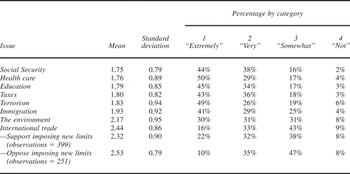
How does trade policy fare in comparison to other issues of the day? The first subcomponent of salience is the weight (w ij) voters place on an issue relative to other issues. In place of the MIP question, 1,000 respondents were asked to rate in terms of importance (1 “Extremely”; 2 “Very”; 3 “Somewhat”; and 4 “Not”) the following randomly ordered issues: education, the environment, health care, immigration, international trade, social security, taxes, and terrorism. With the exception of international trade, these categories are similar to those frequently raised in the MIP question.
In comparison to the other categories, international trade not only garnered the lowest average rating (2.44) but was also the only category for which the modal response was “somewhat” important (Table 1). In fact, almost 10 percent considered international trade “not” important.” The bar graph presented in Figure 1 illustrates the distribution of respondents and clearly highlights international trade's relatively lowly position compared to the most salient issues (social security, health care, education, taxes, and terrorism) and the less salient issues of immigration and the environment. In contrast with all other issue areas, the majority of responses for international trade fall below the “very” important category.
“In determining whom you vote for, how important are the following issues?”

Notes: Observations: minimum = 988; maximum = 992.
“In determining whom you vote for, how important are the following issues?”
Notes: Observations minimum = 998; maximum = 992.

Salience in terms of importance might differ across different voter types. In particular, individuals may have a heightened response to losses than to gains.Footnote 22 Recent U.S. trade policy has moved to increase free trade so respondents preferring protection might rank international trade more highly. In fact those who claim to “Support new limits on imports” do rank international trade significantly higher than those who oppose such limits; however, the substantial difference is minimal. Even those who favor protection, and thus can be viewed as having “lost” during previous waves of liberalization, still rank international trade well below other issues, including the environment (Table 1). Such evidence supports neither an assumption that the salience of trade is a function of the impact of trade on individuals (or, in other words, that salience is heterogeneous) nor the assumption that trade policy receives a high weight (w ij) when individuals face multidimensional voting decisions, as is the case when constituents cast votes for their representatives.
Knowledge
Importance is only one component of salience. Trade may not rank highly, but if at least some set of voters are well-informed, trade may still be salient on election day. How well do voters know incumbents' positions relative to their own (k ij)?
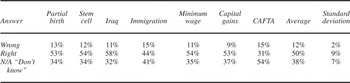
To gauge voter knowledge on issues that recently came before Congress, respondents were provided background information on a spectrum of news-making proposals that arose during the last congressional session. After each proposal description, they were asked to identify first how they would have voted if given the choice (“For,” “Against,” and “Don't know”) and second how they thought each of their representatives voted (“For,” “Against,” and “Don't know”).Footnote 23 Respondents were surveyed on seven proposals, all of which received a roll call (recorded) vote during the 109th Congress (3 January 2005 to 3 January 2007): banning “late-term” abortion (partial birth), federal funding for stem cell research (stem cell), a timetable to withdraw from Iraq (Iraq), citizenship for illegal immigrants (immigration), increasing the federal minimum wage (minimum wage), extending capital gains tax cuts passed in 2001 (capital gains), and ratifying a new free trade agreement between the U.S. and countries in Central America (CAFTA).
Half of the respondents correctly identified their senators' positions on these issues, as measured by congressional vote records (see Table 2). Although more than a third of respondents admitted to not knowing their senators' positions, relatively few respondents—12 percent across all issues—incorrectly identified their senators' positions. However, the issue of CAFTA exhibited a clear knowledge gap for respondents. CAFTA was the only issue for which the majority (54 percent) of voters responded “Don't know” when asked their senators' positions. Only 31 percent correctly identified their senators' positions. Remarkably, more respondents (15 percent) provided an incorrect answer for CAFTA than on any other issue.Footnote 24 In each case, the difference between trade policy and all other issues was statistically significant.
Respondent identification of senator's vote record on recent roll call votes

Notes: Observations: minimum = 63,115; maximum = 72,464; two observations per respondent.
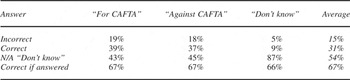
As with importance, knowledge might differ across groups, with those perceiving themselves as losers being more cognizant of their representatives' policy decisions. Using the respondents' self-reported preferences, Table 3 partitions respondents into three categories—those supporting CAFTA, those against CAFTA, and those stating no opinion (“Don't know”). While those not stating an opinion on CAFTA were clearly less knowledgeable about their Senators' positions, those stating a preference “for” or “against” CAFTA differed little in their answers. Additionally, within the population of respondents offering an identification of their Senators' positions, the percentage answering correctly (66 to 67 percent) was equivalent for all three groups. Thus, contrary to the Kahneman and Tversky-based assumption that losers from international trade liberalization would pay more attention to trade policy, initial evidence supports the contention that stated preferences over the outcome of the CAFTA vote are unrelated to salience in terms of knowledge of representatives' policy positions.
Respondent's identification of senator's CAFTA vote conditional on own preference

Notes: Observations = 71,285; two observations per respondent possible.
Simple descriptions might hide the true relationship if the underlying factors that lead some individuals and groups to be more protectionist than others also cause some individuals to have greater knowledge about their representatives' policy positions. Differences in gender, skill level, and class have all been linked to preferences over trade policy and could conceivably be linked to general policy knowledge. Additionally, organizations affected by trade policy—such as unions—are assumed to provide information to their members, especially at election time. Although in the United States unions are increasingly divided over the benefits of greater trade openness, the debate within unions should offer members additional opportunities to learn about their representatives' policies and to identify the members' own.
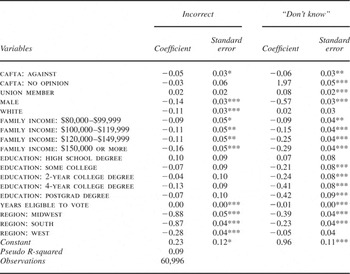
Regression analysis allows for the factors associated with policy knowledge to be considered simultaneously. While correct and incorrect answers to the question of how senators voted create a scale, respondents who reply “Don't know” cannot be placed neatly on the same continuum. To account for this nonlinearity, a multinomial logistic regression model is used. Individual-level characteristics such as gender, skill level, and union membership are used to predict the likelihood of a respondent to provide an incorrect answer or reply “Don't know” compared to the baseline of providing the correct answer. The model is flexible and allows people answering incorrectly to differ from people replying “Don't know.”Footnote 25 Since each respondent could provide two observations (one per senator), the standard errors were clustered by respondent.Footnote 26
Two important findings emerge from the multinomial results (see Table 4). First, in contrast with the descriptive statistics, once controlling for other characteristics, the self-described anti-CAFTA respondents are significantly less likely to provide an incorrect answer and to answer “Don't know,” as would be expected by conventional theory. However, the substantive effect is, to say the least, minimal: anti-CAFTA sentiments decrease the propensity to provide the wrong answer from 14.8 percent to 14.6 percent and the propensity of stating “Don't know” from 56.2 percent to 55.2 percent. In contrast, the effect of being male decreases the propensity to answer incorrectly from 16.0 percent to 13.2 percent, a full order of magnitude more than the effect of having anti-CAFTA sentiments. Those with no opinion are no more likely to be correct than incorrect in their answers, although they are more likely to state “Don't know” than to provide a correct answer. Thus, while the survey does detect statistical differences, these differences are so minimal as to strengthen the arguments that knowledge is relatively constant across trade preferences. Second and unexpectedly, given the usefulness of union organizations for information distribution, union membership increases the likelihood of not providing an answer, even after controlling for factors such as education. While the substantive effect is again small (2 percentage points), the finding runs directly counter to the frequent assertion that interest groups are powerful because of their ability to inform and organize members.Footnote 27 At least in the case of trade policy, this finding calls into question any causal mechanism dependent on interest groups leading to more informed voters. Given the direct link between increasing international trade and labor conditions in the U.S., labor unions, of all interest groups, should have served to increase the trade policy knowledge of their members.
Multinomial logit regression on identification of senator's policy position by respondent characteristics

Notes: Coefficients are multinomial logit estimates of the probability of answering incorrectly versus answering correctly and answering “Don't know” versus answering correctly, respectively. The excluded independent variable categories are cafta: pro, family income: < $30,000, education: < high school degree, and region: northeast.” Standard errors are robust and are adjusted for clusters by respondent as there are two possible observations per respondent. *p < .10; **p < .05; ***p < .01.
Additionally, higher levels of education, a proxy for high-skilled workers and thus voters with theoretically predicted free-trading preferences, are linked with a higher propensity to provide an answer. However, there is not a significant difference between the likelihood of the answers being correct or incorrect. Regionally, those in the Midwest and the South are far more likely to both offer an answer and provide a correct answer. Consequences of regional differences are explored in the next section.
In summary, relative to other issues, trade has low salience in terms of the electorate being aware of the decisions of policymakers (k ij). Furthermore, individual characteristics linked to preferences over trade policy are not linked with substantial variations in trade policy knowledge across voters. In particular, among those for whom trade is salient—as defined by the knowledge component—there is no strong protrade or antitrade bias.Footnote 28
A Direct Measure of Salience: Voting Behavior and Trade Policy
Neither subcomponent of salience—importance nor knowledge—definitively provides evidence against trade policy salience within the U.S. electorate. Despite a failure of the electorate to follow trade policy directly or deem it an important issue, trade might still be considered salient—and thus interests aggregated—if politicians feared that they could be held accountable at the polls for their trade-policy-related decisions.
One possibility is that the electorate may use other cues such as party affiliation, knowledge of nontrade-related economic policy decisions, or statements in the media to gauge a candidates' trade policy preferences.Footnote 29 Despite not “knowing” a politician's voting record directly, the electorate might vote “correctly” on the issue, allowing for their trade policy preferences to be accurately aggregated.
A second possibility is that trade is salient in electoral terms if the select few who follow trade issues are observed to significantly adjust their voting behavior according to the candidates' policy decisions and thus create a small but easily won or lost voting bloc. However, in this case, the aggregation process would be skewed toward those who are more informed about trade policy and those who rank it more highly. If one opinion predominates among the attentive electorate, then politicians may need to be responsive to this minority.Footnote 30
A third possibility—suggested generally by Stimson and colleaguesFootnote 31 and specifically in regards to trade by BaileyFootnote 32—is that rational (forward-thinking) politicians select policy to match the majority preferences of their district, preventing rivals, the media, and political entrepreneurs from making an issue salient during an election. The process is “silent” in that the electorate need not rank trade as an important issue or be particularly well-informed. Bailey argues that such prospective positioning allows for the aggregation of the diffuse interests of skilled (protrade) workers, despite collective action problems. However, for such an aggregation mechanism to work, the electorate must still match their preferences to their voting, punishing or rewarding politicians accordingly. If not, politicians have little incentive to adjust policy away from their preferences.
The analysis below tests to see, first, whether voters unconsciously hold candidates accountable for trade-related policy decisions and, second, whether the few who do know their representatives' trade vote history substantially adjust their vote accordingly. The benefits of “anticipatory reaction” by politicians should be apparent in at least one if not both versions of the analysis. Voters should be observed to either unknowingly or knowingly support incumbent politicians whose prior trade-related policy decisions match the voters' preferences. The electorate's vote for incumbents is the empirical focus for both theoretical and practical reasons. Incumbents alone have a clear vote history. Furthermore, research by Erikson and WrightFootnote 33 shows that only the positions of incumbent candidates and not those of nonincumbent candidates influence U.S. congressional electoral outcomes. Thus, in this analysis, the respondent's self-reported vote in the 2006 senatorial elections is called as a vote for (1) or against (0) the incumbent. Respondents who did not answer or did not vote in the election were excluded from the sample. To test the importance of a candidate's position relative to the voter's own for a series of issue areas, two dummy variables (“issue”:match and “issue”:no opinion) were created to account for the three possibilities: the incumbent candidate's vote record did not match the self-reported preference of the respondent (the excluded category), the record did match the self-reported preference of the respondent (“issue”:match = 1), and the respondent did not have a stated preference on the issue (“issue”:no opinion = 1). The issue areas included were the same as those used above: banning “late-term” abortion (partial birth), federal funding for stem cell research (stem cell), a timetable to withdraw from Iraq (iraq), citizenship for illegal immigrants (immigration), increasing the federal minimum wage (minimum wage), extending the capital gains tax cuts (capital gains), and ratifying a new free trade agreement between the U.S. and countries in Central America (cafta). To test the importance of consciously knowing the candidate's relative position, a further set of variables were created for the same issues. First, respondents were coded as having identified their Senator's position correctly or not, “issue”:answered correctly. This variable was then interacted with whether the respondent's position matched with the candidates to create the variable “issue”:know match. A weak test that incumbents are rewarded for matching constituents' preferences on an issue would find a positive relationship between “issue”:match and a vote for the incumbent; a more stringent test would require that “issue”:know match show a significant positive relationship with a vote for the incumbent.
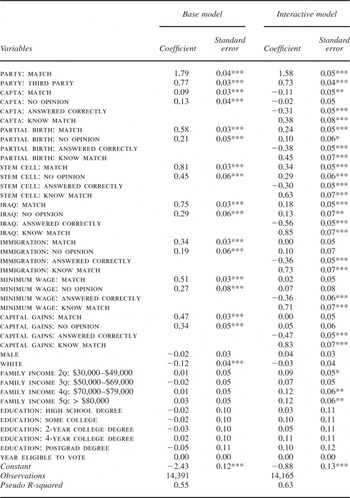
Table 5 presents two probit regression results: a base model testing the relationship between an incumbent's position relative to the voter's, and an interactive model that includes a test of the importance of the voter “knowing” the incumbent's relative position. In each, whether the respondent's self-identified party preference matches the incumbent's serves as an important control.Footnote 34 Additional controls for gender,Footnote 35 race,Footnote 36 income, education, and years eligible to vote appear in both models.
Probit regression on voting for the incumbent

Notes: Coefficients are probit estimates of the probability of voting for the incumbent. Q = quartile. *p < .10; **p < .05; ***p < .01.
At first glance, the base model of Table 5 presents some support for trade policy being salient in congressional elections: the coefficient for cafta: match is positive (0.09) and significant. However, the coefficient size relative to other issues is small, roughly 25 percent of the next largest issue match (immigration: match). For interpretation purposes, Figure 2 illustrates the predicted shift in the probability of voting for an incumbent. Given a 60 percent baseline probability of voting for the incumbent, matching on CAFTA has only a projected 5 percent shift, less than half as much as other economic policies such as increasing minimum wage (14 percent), extending capital gains taxes (13 percent), and citizenship for illegal immigrants (12 percent). The difference is even greater between trade and more ideological debates such as “late-term” abortion (19 percent), stem cell research funding (27 percent), and a scheduled withdrawal from Iraq (30 percent). Even more surprisingly, matching on trade policy preference is smaller (albeit statistically indistinguishable) from the effect of not having a stated opinion on CAFTA (cafta: no opinion).
Effect of issue match on probability of voting for the incumbent
Note: The upper and lower bars represent the 95 percent confidence level for the estimated shift in vote for the incumbent. The baseline vote share for the incumbent is 60 percent.

If trade policy divided representatives clearly along party lines, the limited effect of cafta: match could be considered a result of cafta: match being indistinguishable to party: match. However, in recent years trade policy has cut across party lines. On CAFTA, more than 25 percent of Democratic senators voted for increased liberalization, while 22 percent of Republicans voted against it. However, these deviations from party lines neither gain nor lose incumbents many votes, suggesting little need for incumbents to anticipate the reaction of the electorate on trade policy issues. This lack of change in voting behavior suggests that politicians have little incentive to clarify the costs and benefits of trade policy for their constituents. An unopinionated voter offers the same benefit as conforming to the voter's preference, whereas an opinionated voter might be turned off by the incumbent's trade policy record.
The results of the interactive model (column 2, Table 5) further bring into question the efficacy of politicians educating voters and the idea that small but knowledgeable groups of voters for whom trade is salient might bias the aggregation of voters' preferences. For each issue area in the interactive model, voters are coded on four characteristics: whether they have a preference (“issue”:no opinion), whether their preference matches the incumbent's prior policy positions (“issue”:match); whether they can correctly identify the incumbent's prior policy position (“issue”:answered correctly); and finally whether they know their preferences match with the incumbent's prior policy position (“issue”:know match, an interaction term of “issue”:match and “issue”:answered correctly). For each issue area other than CAFTA, know match has the largest, positive coefficient, suggesting that knowledgeable voters reward or punish representatives for their prior policy votes. However, the numerous interaction terms make interpretation difficult, especially in the case of CAFTA where the other CAFTA-specific terms have negative estimated coefficients.
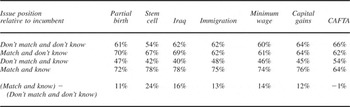
For interpretation purposes, Table 6 offers simulated probabilities of voting for the incumbent based on four types of individuals characterized by whether their preferences match the policies of the incumbent and by whether they are aware of the fact: “Don't match and don't know,” “Match and don't know,” “Don't match and know,” and “Match and know.” For each simulated probability presented, all other factors are held at the mean. Unsurprisingly, voters who know their preferences differ from the incumbent's policy votes are the least likely to vote for the incumbent, but the difference in the probability of voting for the incumbent between voters who “Match and know” and those who “Don't match and know” is one-third the size for CAFTA (10 percent) as compared to other economic issues such as capital gains (31 percent), minimum wage (28 percent), and immigration (27 percent). The gap is just as large for salient social issues such as stem cell research funding (36 percent) and partial birth abortion (25 percent), as well as the withdrawal time table for Iraq (38 percent).
Probability vote for incumbent contingent on preference relative to incumbent position

Notes: Simulated results using Clarify (see Tomz, Wittenberg, and King Reference Tomz, Wittenberg and King2001; and King, Tomz, and Wittenberg Reference King, Tomz and Wittenberg2000). All other factors kept at mean.
In all cases other than CAFTA, voters who know they match are far more likely to vote for the incumbent than voters who aren't aware that they do not match. In the case of CAFTA, voters who “Don't match and don't know” are actually slightly more likely to vote for the incumbent than those who “Match and know,” even after controlling for party identification and agreement on a number of other issues.
In summary, voters do not appear to hold politicians accountable for their trade-related policy positions, suggesting trade issues are not salient. While the lack of accountability could be due to both lack of interest and lack of knowledge, the analysis suggests that accountability is not higher among the relatively few who are knowledgeable about their representatives' trade policy decisions. Senators who match a voter's trade policy preference can expect to see only a minimal boost in the probability of re-election; while those who do not pay a minimal cost in votes. Thus the process does not seem to be biased toward the relatively few who follow trade policy nor does the analysis support the underpinning assumption of an “anticipatory reaction” that voters in upcoming elections will punish or reward incumbents for their policy decisions.
Subsample Analysis
The national scope of the survey, aggregating across states and individuals, arguably might bias results against the salience of trade policy by numerically swamping the small, economically-defined subsamples of the nation for whom foreign trade policy is particularly salient. As discussed above, such individuals can be defined by industry classification (as in the Ricardo-Viner model) or by factor classification (as in the Stolper-Samuelson model). Although recent empirical work finds more support for the latter,Footnote 37 for robustness subsamples across this spectrum are used.
According to the United States International Trade Commission, CAFTA most directly affects the sugar and textile industries.Footnote 38 While responses from a large sample of individuals from these groups would be ideal, survey expenses precluded such sampling. Instead, the analysis focused on a subsample of individuals in directly affected states, defined as the top four producing states in three areas—sugar cane, sugar beet, and textiles.Footnote 39 Unfortunately for the purposes of this study, not one senator from a top textile-producing state was up for re-election, so I redefined the sample of directly affected states as “sugar states.” Voting results from the sugar-state Florida were deemed unusual enough to bias the finding in favor of limited saliency and were thus removed and presented separately (see Table 7).Footnote 40 Assuming a positive level of factor mobility, I defined a set of indirectly affected states—those with a high-concentration of low-skilled workers whose wages are theoretically affected by an influx of labor-intensive goods—namely Ohio, Michigan, and Pennsylvania. A second set of subsamples breaks the national results by region. Finally, assuming a high degree of factor mobility, I split the national sample according to skill set, with unskilled labor defined as individuals with less than a two-year college degree. As an alternative specification, I used the respondent's self-declared position on CAFTA.
Comparison of coefficients and predicted probabilities by subsample

Notes: * Excludes Florida.
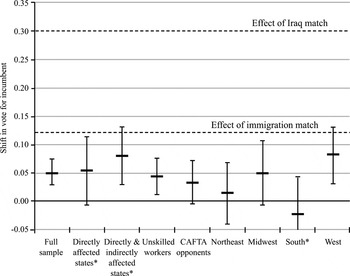
Table 7 offers a summary by subsample of the regression output for the variable cafta: match from the base accountability model (as originally presented in Table 5). Comparing across subsample coefficients, salience does appear to be significantly higher in directly affected states, the Midwest, and the West. However, when the effect size is measured by the shift in probability of voting for the incumbent contingent on cafta: match, the substantive difference is again negligible. When looking at differences in the predicted vote shift, only the subsamples with lower levels of saliency (Florida and the South) are significantly different from the full-sample-predicted vote shift. Specifically, within directly affected states, the predicted vote shift contingent on matched CAFTA support is almost identical (0.053) to that of the full sample (0.050). While the analysis does identify variations across groups, these variations are remarkable for their small size, especially in comparison to the other issue areas. As in Figure 2, Figure 3 displays predicted mean shifts in voting for the incumbent (with 95 percent confidence intervals) but displays the results specifically on cafta: match for the various subsamples. As a point of comparison, the graph also includes the predicted vote shift from matching on the highest and second to lowest ranked issue areas (effect of iraq: match and effect of immigration: match respectively). The mean and (with a couple of exceptions) even the upper bounds of the predicted shift by cafta: match remain below the mean predicted shift for immigration: match and well below that of iraq: match. Thus, trade policy appears to influence voting behavior very little, even for the subsamples where the largest effects are expected.
Effect of CAFTA match on probability of voting for the incumbent
Notes: The upper and lower bars represent the 95 percent confidence level for the estimated shift in vote for the incumbent. The estimates are based on results from subsamples. *Excludes Florida.

Conclusion
When measured in terms of the effect on voting for a candidate, trade policy lacks salience. Voters do not rate trade as an important issue. The majority of voters are unaware of their politicians' positions on trade. Other political cues do not lead voters to naively support or punish politicians who share or differ from those voters' views on trade. Even individuals within specific pro-protection groups, for whom trade would seem to be particularly salient, are unaware of their representatives' policies. Furthermore, those voters who do know a candidate's position vis-à-vis their own only slightly adjust their voting behavior given this knowledge.
These findings cut broadly across the literature on endogenous trade policy, which generally relies on previously untested assumptions about voter behavior. The critique is most obvious for models that employ the direct democracy approach proposed by Mayer, or the alternative political support function proposed by Hillman for representative democracies.Footnote 41 In both cases, the assumption that trade policy follows the underlying distribution of trade preferences (determined by economic interest) depends on fully informed voters. For alternative models relying on the role of interest group contributions and/or political endorsementsFootnote 42 in determining policy, the results offer real-world data for the typically unspecified parameters hidden in the details, such as the assumed difference in the behavior of informed and uninformed voters, and the relative importance of other issue areas. Perhaps most surprising is the finding of low salience among union members, undercutting assumptions that interest groups gain power via their ability to deliver the votes of their rank-and-file members.Footnote 43 Members of special interest groups are frequently described as having greater access to information about candidates and policy issues, but the characterization is not supported in this data. Members of special interests groups are often assumed to have higher than average turnout levels, but an increased propensity to vote does not equate with additional influence on trade policy if voters are uninformed or uninterested.
The recent explorations of the observed correlation between rapid trade liberalization in developing countries and the expansion of democratic rule illustrate the importance of assumptions about voter behavior. At the heart of a number of explanatory modelsFootnote 44 is the assumption that the preferences of the median voter directly affect policy: as suffrage expands, the median voter is more likely to fall into the class of unskilled workers who would theoretically benefit from increased international trade and thus demand trade liberalization. However, without evidence from a more direct test of the causal mechanism, low salience for trade policy belies the assumption that changes in voter preferences are responsible for the widespread shift toward trade liberalization in the developing world. Indeed, recent survey data suggests that unskilled workers are less likely to support free trade than skilled workers.Footnote 45 Low salience can help explain why trade protection has declined in spite of, rather than because of, expanded suffrage.
How valid is the extrapolation of U.S.-based results to developing countries or even other developed countries? Many characteristics of the U.S. electoral system suggest that the results might in fact overstate the propensity of the electorate to hold representatives accountable for trade policy. Divided government, a weak party system, and growing numbers of self-declared independent voters all help voters to hold their representatives accountable in the United States. Additionally, in contrast to the trade policymaking process for the European Union member states, the decision makers in the United States are still the directly elected representatives. On the other hand, as a large economy, the United States is theoretically less affected by the volatility that comes from increased openness to world markets or the costs from increased protection. To the extent that economic size dampens the salience of trade policy, the data from the U.S. elections may not serve as a good estimate for small, highly trade-dependent countries such as Singapore. However, large developed and developing countries such as Australia, Brazil, India, and Japan may exhibit similar or weaker saliency.
Even if the results are valid for the United States alone, these findings are meaningful more broadly. Before the demise of the Doha Round of the World Trade Organization, the U.S. was criticized by multilateralists for its strategy of focusing more on bilateral and regional trade agreements such as CAFTA rather than large-scale multilateral agreements. Now with no WTO-led trade negotiations in the foreseeable future, it is likely that subsequent treaties will be closer in scale to CAFTA. If so, the American voter poses little resistance to their ratification.