Introduction
The elderly population size is increasing worldwide (Shah and Mackenzie, Reference Shah, MacKenzie, Bhugra and Bhui2007). A recent cross-national study of 62 countries reported an increase in suicide rates with aging in males and females in 25 and 27 countries respectively (Shah, Reference Shah2007a). An overlap between attempted and completed suicide in the elderly has been proposed because socio-demographic and clinical risk factors in the elderly for both are similar (Shulman, Reference Shulman1978; Lindesay and Murphy, Reference Lindesay and Murphy1987; Draper, Reference Draper1996; Chan et al., Reference Chan, Draper and Banerjee2007), suicidal intent among elderly suicide attempters is high (Pierce, Reference Pierce1987; Upadhyaya et al., Reference Upadhyaya, Warburton and Jenkins1989; Merrill and Owens, Reference Merrill and Owens1990; Nowers, Reference Nowers1993; Draper, Reference Draper1994; Hawton and Harriss, Reference Hawton and Harriss2006), attempted suicides are less common and completed suicides more common in the elderly (Draper, Reference Draper1996; De Leo et al., Reference De Leo2001; Chan et al., Reference Chan, Draper and Banerjee2007), and the risk of suicide after attempted suicide is very high in the elderly (Hawton and Fagg, Reference Hawton and Fagg1990; Merrill and Owens, Reference Merrill and Owens1990; Nowers, Reference Nowers1993; Dennis and Lindesay, Reference Dennis and Lindesay1995; Hepple and Quinton, Reference Hepple and Quinton1997; De Leo et al., Reference De Leo2001; Hawton and Harriss, Reference Hawton and Harriss2006). Attempted suicide in the elderly may represent an “unsuccessful” bid for suicide where the individual has fortuitiously survived (Shah and De, Reference Shah and De1998). Thus, critical study of attempted suicides may allow greater understanding of completed suicides (Draper, Reference Draper1996; Shah and De, Reference Shah and De1998; Chan et al., Reference Chan, Draper and Banerjee2007).
Rates of attempted suicide in a 16-centre European study, including Oxford in England, between 1989 and 1992 were generally lower in the 55+ year age-band compared to younger age-bands (Schmidtke et al., Reference Schmidtke1996). The rate of attempted suicide in the 65+ years age-band in Oxford in the same European study between 1989 and 1993 was 82.4 per 100,000 population (De Leo et al., Reference De Leo2001). The rates of attempted suicide in the 55–64 and 65+ years age-bands in those referred to a general hospital in Oxford between 1976 and 1987 were 108 and 61 per 100,000 population respectively (Hawton and Fagg, Reference Hawton and Fagg1990); rates were even higher in younger age-bands. A third of those in the 65+ years age-band attempting suicide were 75 years or older (Nowers, Reference Nowers1993).
Rates of attempted suicide in the 55+ years age-band in a 16-centre European study increased between 1989 and 1992, but declined in younger age-bands (Schmidtke et al., Reference Schmidtke1996). The rate of attempted suicide in the 65+ years age-band in the same European study declined between 1989 and 1993 in the whole sample and in 11 of the 16 centres (De Leo et al., Reference De Leo2001); there was a decline of 24% in males in Oxford. However, there was no significant change in the rates of attempted suicide in the 55–64 and 65+ years age-bands between 1976 and 1987 in another study in Oxford (Hawton and Fagg, Reference Hawton and Fagg1990). Moreover, rates of attempted suicide increased in males in the 55+ years age-band between 1990 and 2000 in a further study in Oxford (Hawton et al., Reference Hawton2003).
Self-poisoning has been reported as the most common method of attempted suicide in the elderly in England (Hawton and Fagg, Reference Hawton and Fagg1990; Nowers, Reference Nowers1993; Hepple and Quinton, Reference Hepple and Quinton1997; De Leo et al., Reference De Leo2001; Marriot et al., Reference Marriott, Horrocks, House and Owens2003; Ruths et al., Reference Ruths, Tobiansky and Blanchard2005; Hawton and Harriss, Reference Hawton and Harriss2006). Drugs commonly used include minor tranquilizers, hypnotics, antidepressants and non-opiate analgesics (Hawton and Fagg, Reference Hawton and Fagg1990; Nowers, Reference Nowers1993; De Leo et al., Reference De Leo2001; Hawton and Harriss, Reference Hawton and Harriss2006; Hawton et al., Reference Hawton2007). Barbiturate poisoning declined between 1976 and 1987 with a concommitant increase in the use of non-opiate analgesics and “other prescribed drugs” (Hawton and Fagg, Reference Hawton and Fagg1990). Self-injury methods including wrist-cutting, injury with sharp objects, shooting, attempted drowning, jumping from heights and attempted asphyxiation were more common in men (Hawton and Fagg, Reference Hawton and Fagg1990; De Leo et al., Reference De Leo2001; Osvath et al., Reference Osvath, Fekete and Voros2002) and self-poisoning was more common in women (Hawton and Fagg, Reference Hawton and Fagg1990; De Leo et al., Reference De Leo2001). Those in the 75+ years age-band were more likely to use violent methods (De Leo et al., Reference De Leo2001).
Most studies of attempted suicide in the elderly in England report on data that are over a decade old and refer to either single or multiple local centres. Thus, a study using recently collected national data was undertaken to examine age-associated rates, trends over time and methods of attempted suicide in the elderly in England.
Methods
Data on attempted suicides
Data on the number of admissions for all intentional self-harm (ICD-10 codes X60–X84) and for each of the 25 separate methods of intentional self-harm for both sexes combined, in the 60–74 and 75+ years age-band, in England were obtained from nationally collected data (Hospital Episode Statistics: www.hesonline.nhs.uk/Ease/servlet/ContentServer?siteID=1937&categoryID=210).
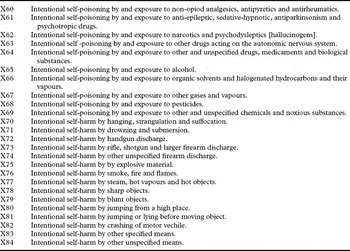
These national data were gathered centrally via the patient administration systems in nearly 400 hospitals in England. Data were only available for the nine financial years (1 April to 31 March) 1998/1999 to 2006/2007. Table 1 lists the 25 separate methods of attempted suicide with their ICD-10 codes.

Demographic data
Data on the number of people in the general population in the 60–74 and 75+ years age-bands for both sexes combined in England for the nine calendar years 1998 to 2006 were obtained from the Office of National Statistics (http://www.statistics.gov.uk/statbase/Product.asp?vlnk=618).
Data analysis
Age-specific rates for all attempted suicides combined and for each of the 25 separate methods of attempted suicides, in the 60–74 and 75+ year age-bands, were calculated for each of the nine study years. The numerator was the total number of attempted suicides or the number of attempted suicides for each of the 25 separate methods of attempted suicide in England. The denominator was the number of people in the general population for the relevant elderly age-band and year of study in England.
Wilcoxon's Matched-Pair Signed-Ranked Test was used to compare the rates of all attempted suicides combined and each of the 25 separate methods of attempted suicide between the 60–74 and 75+ years age-bands. This approach has been successfully used with elderly suicide rates (Shah et al., Reference Shah, Bhat, MacKenzie and Koen2007).
The relationship between study years and the rates of all attempted suicides combined and each of the 25 separate methods of attempted suicide, in both the elderly age-bands, was examined using Spearman's correlation coefficient. This allowed examination of trends in rates of attempted suicide over time. This approach has been successfully used with elderly suicide rates (Hoxey and Shah, Reference Hoxey and Shah2000; Shah et al., Reference Shah, Elanchanny and Collinge2001; Reference Shah, Bhat, MacKenzie and Koen2008; Shah, Reference Shah2007a; Shah and Coupe, Reference Shah and Coupe2009).
The number of attempted suicides within each of the 25 separate methods of attempted suicide for the 60–74 and 75+ years age-bands were calculated for the entire nine-year study period. The χ2 test (corrected for continuity) was used to examine the differences in frequency of the methods of attempted suicide between the 60–74 and 75+ years age-bands.
Results
Rates of attempted suicide
The mean (standard deviation) and median (range) for the rates of all attempted suicides combined for the nine study years in the 60–74 years age-band were 49.9 (+/− 3.7) and 50.8 (42.0–54.0) per 100,000 population respectively. The mean (standard deviation) and median (range) for the rates of all attempted suicides combined for the nine study years in the 75+ years age-band were 46.3 (+/− 7.0) and 44.2 (41.0–58.0) per 100,000 population respectively.
Comparison of rates of attempted suicide between the two age-bands
There was no significant difference in the rate of all attempted suicides combined between the two elderly age-bands. Rates of intentional self-poisoning by and exposure to non-opiod analgesics, antipyretics and antirheumatics (Z = −2.66, P = 0.008), intentional self-harm by sharp objects (Z = −2.55, P = 0.011) and intentional self-harm by other specified means (Z = −1.96, P = 0.051) were higher in the 75+ years age-band compared to the 60–74 years age-band. Rates of intentional self-poisoning by and exposure to other drugs acting on the autonomic nervous system (Z = −2.66, P = 0.008), intentional self-poisoning by and exposure to alcohol (Z = −2.43, P = 0.015) and intentional self-harm by smoke, fire and flames (Z = −2.2, P = 0.028) were higher in the 60–74 years age-band compared to the 75+ years age-band. There were no differences between the two age-bands in the rates of all other specific methods of attempted suicide.
Time trends
The rate of all attempted suicides combined in the 60–74 years age-band increased over the nine-year study period (ρ = +0.73, P = 0.025). Rates of intentional self-poisoning by and exposure to non-opiod analgesics, antipyretics and antirheumatics (ρ = +0.78, P = 0.013), intentional self-poisoning by and exposure to narcotics and psychodysleptics (ρ = +0.9, P = 0.001), intentional self-poisoning by and exposure to other drugs acting on the autonomic nervous system (ρ = +0.82, P = 0.007), intentional self-poisoning by and exposure to other and unspecified drugs, medicaments and biological substances (ρ = +0.87, P = 0.007) and intentional self-harm by sharp objects (ρ = +0.83, P = 0.005) increased over the nine-year study period in this age-band.
The rate of all attempted suicides combined in the 75+ years age-band did not change over the study period. Rates of intentional self-poisoning by and exposure to non-opiod analgesics, antipyretics and antirheumatics (ρ = +0.7, P = 0.036), intentional self-poisoning by and exposure to narcotics and psychodysleptics (ρ = +0.73, P = 0.025) and intentional self-poisoning by and exposure to other drugs acting on the autonomic nervous system (ρ = +0.61, P = 0.042) increased over the nine-year study period in this age-band. Rates for all other specific methods of attempted suicide did not change over the nine-year study period in both elderly age-bands.
Methods of attempted suicide and comparison between the two age-bands
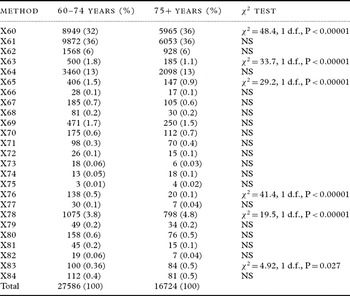
Table 2 illustrates the frequency of methods of attempted suicide used in both elderly age-bands. The five most frequent methods used were the same: intentional self-poisoning by and exposure to non-opiod analgesics, antipyretics and antirheumatics; intentional self-poisoning by and exposure to anti-epileptic, sedative-hypnotic, antiparkinsonism and psychotropic drugs; intentional self-poisoning by and exposure to other and unspecified drugs, medicaments and biological substances; intentional self-poisoning by and exposure to narcotics and psychodysleptics; and intentional self-harm by sharp objects.

The frequency of attempted suicides was higher in the 75+ years age-band compared to the 60–74 years age-band for: intentional self-poisoning by and exposure to non-opiod analgesics; antipyretics and antirheumatics (χ2 = 48.4, 1 d.f., P < 0.00001); intentional self-harm by sharp objects (χ2 = 19.5, 1 d.f., P < 0.00001); and intentional self-harm by other specified means (χ2 = 4.92, 1 d.f., P = 0.027). The frequency of attempted suicides was higher in the 60–74 years age-band compared to the 75+ years age-bands for: intentional self-poisoning by and exposure to other drugs acting on the autonomic nervous system (χ2 = 33.7, 1 d.f., P < 0.00001); intentional self-poisoning by and exposure to alcohol (χ2 = 29.2, 1 d.f., P < 0.00001); and intentional self-harm by smoke, fire and flames (χ2 = 41.4, 1 d.f., P < 0.00001).
Discussion
Before discussing the results some methodological issues require consideration. Data from the hospital episode statistics collected nationally from nearly 400 hospitals may be of variable quality (Shah, Reference Shah2007b). The hospital episode statistics did not include individuals with attempted suicide who had not consulted a healthcare professional, were medically resuscitated by their general practitioner or were in the accident and emergency unit but not admitted into hospital, and may have been directly admitted to mental health units and given a diagnosis of mental disorder rather than intentional self-harm. However, older people with attempted suicide attending accident and emergency departments are very likely to be admitted into general hospitals in England (Dennis et al., Reference Dennis1997; Marriott et al., Reference Marriott, Horrocks, House and Owens2003). There were only nine data points in terms of study years and this small number may lead to type 1 or type 2 statistical errors. The refined impact of gender and narrower age-bands on attempted suicides was not possible because data were only available for both sexes combined for the broad age-bands 60–74 years and 75+ years. Comparison between the current study and earlier studies may be problematic because earlier studies used data from either single or multiple local centres rather than national or population-based data (Scocco and De Leo, 2001; Chan et al., Reference Chan, Draper and Banerjee2007), used differing definitions of attempted suicide and methods of case ascertainment (De Leo et al., Reference De Leo2001) and were generally of 55–64 and/or 65+ years age-bands whereas the current study was of 60–74 and 75+ years age-bands. Additionally, the time period and study duration for the current and earlier studies were significantly different.
The increase in the overall rate of attempted suicides in the 60–74 years age-band over the nine-year study period was previously observed in males in the 55+ years age-band in Oxford between 1990 and 2000 (Hawton et al., Reference Hawton2003), but was inconsistent with reports of a decline in rates of attempted suicide in the 65+ years age-band between 1989 and 1993 (De Leo et al., Reference De Leo2001) and no change in the 55–64 and 65+ years age-bands between 1976 and 1987 (Hawton and Fagg, Reference Hawton and Fagg1990) in Oxford. Although these discrepancies may be an artifact of the methodological issues described above, the current findings may be genuine because the observed increase in the rate of intentional self-poisoning by and exposure to non-opiod analgesics, antipyretics and antirheumatics and intentional self-poisoning by and exposure to other and unspecified drugs, medicaments and biological substances were consistent with earlier findings from Oxford (Hawton and Fagg, Reference Hawton and Fagg1990).
An increase in the rates of intentional self-poisoning by and exposure to narcotics and psychodysleptics and intentional self-poisoning by and exposure to other drugs acting on the autonomic nervous system in both the elderly age-bands over the nine-year study period has not been reported before. This is of concern because drugs other than the traditionally reported minor tranquillizers, hypnotics, antidepressants and non-opiate analgesics (Hawton and Fagg, Reference Hawton and Fagg1990; Nowers, Reference Nowers1993; De Leo et al., Reference De Leo2001; Hawton and Harriss, Reference Hawton and Harriss2006; Hawton et al., Reference Hawton2007) are now increasingly being used. An increase in the rate of intentional self-harm by sharp objects in the 60–74 years age-band has not been observed before and is of concern because intervention by restricting access to this method of attempted suicide is not practically feasible.
The five most frequent methods used in both the elderly age-bands were: intentional self-poisoning by and exposure to non-opiod analgesics, antipyretics and antirheumatics; intentional self-poisoning by and exposure to anti-epileptic, sedative-hypnotic, antiparkinsonism and psychotropic drugs; intentional self-poisoning by and exposure to other and unspecified drugs, medicaments and biological substances; intentional self-poisoning by and exposure to narcotics and psychodysleptics; and intentional self-harm by sharp objects. These are similar to those previously reported in England (Hawton and Fagg, Reference Hawton and Fagg1990; Nowers, Reference Nowers1993; Hepple and Quinton, Reference Hepple and Quinton1997; De Leo et al., Reference De Leo2001; Marriot et al., Reference Marriott, Horrocks, House and Owens2003; Ruths et al., Reference Ruths, Tobiansky and Blanchard2005; Hawton and Harriss, Reference Hawton and Harriss2006). The rates and the frequency of intentional self-poisoning by and exposure to non-opiod analgesics, antipyretics and antirheumatics and intentional self-harm by sharp objects were higher in the 75+ years age-band compared to the 60–74 years age-band. The latter is consistent with violent methods being more frequent in the 75+ year age-band (De Leo et al., Reference De Leo2001).
Although various national public health initiatives have, in part, been credited with the continuing decline of elderly suicide rates in England and Wales (Hoxey and Shah, Reference Hoxey and Shah2000; Shah et al., Reference Shah, Elanchanny and Collinge2001; Pritchard and Hansen, Reference Pritchard and Hansen2005; Shah, Reference Shah2007c; National Institute for Mental Health England, 2007), the observed increase in the overall rate of attempted suicides in the 60–74 year age-band over the study period suggests that these public health initiatives may not be influencing the rate of attempted suicides in the elderly. This is of concern because all suicide prevention initiatives should ideally aim not only to reduce suicide rates but also to reduce rates of attempted suicide. There is, therefore, a need to develop strategies to reduce access to methods of attempted suicide in elderly people that are most prevalent and increasing over time. This is possible because there is good evidence that reducing access to methods of suicide, including detoxification of domestic gas, restricted prescribing of barbiturates, time limited prescribing of drugs to those at risk, and limiting the size of packs of paracetamol and salicylates for “over the counter” purchase, can reduce suicide rates and that this reduction can be sustained over time (Lindesay, Reference Lindesay1991; Dennis and Lindesay, Reference Dennis and Lindesay1995; Hawton et al., Reference Hawton2004). The observed differences in the rates and frequency of individual methods of attempted suicide between the two elderly age-bands in the current study can inform refined targeting of these preventative strategies.
Conflict of interest
None.