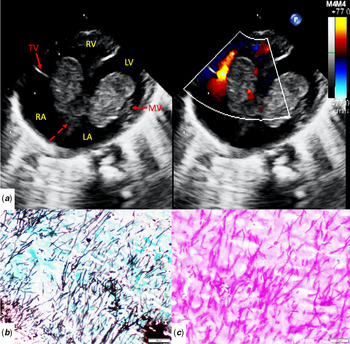
A 45-day old male infant – born at 29 weeks of gestation – was referred with an incidentally detected cardiac mass. The baby had a prolonged stay in a neonatal intensive care unit and received broad-spectrum antibiotics for gram-negative sepsis. Echocardiography showed a large bi-atrial mass attached to the interatrial septum. The left and the right atrial component of the mass measured 12 × 6 mm and 19 × 16 mm, respectively (Fig 1a). The mass was moving in and out of both mitral and tricuspid valves, albeit with unobstructed flow (videos 1 and 2). The location and typical appearance of the mass with attachment to the atrial septum prompted a diagnosis of bi-atrial myxoma.Reference Uzun, Wilson and Vujanic1 There was no change in size of the mass in the following three weeks. However, its large size and the extreme mobility of the masses mandated a surgical excision during which a large friable mass straddling across the foramen ovale was excised. Microscopic examination (Fig 1b and c) established it to be a fungal mass. The fungal colonies with characteristic septate hyphae branching at acute angles confirmed it to be Aspergillus sp. Though the cardiac mass in this case resembled atrial myxoma, the clinical setting of prematurity and prolonged antibiotics administration should prompt a diagnosis of a fungal mass in such cases. This case highlights that fungal cardiac mass in preterm neonates may remain asymptomatic and may masquerade as atrial myxoma on echocardiography.
(a) Two dimensional and colour Doppler echocardiography images showing two large pedunculated masses one in right atrium (RA) and the other in left atrium (LA) that are seen prolapsing through the tricuspid valve (TV) and mitral valve (MV), respectively. The masses are seen attaching to the interatrial septum (red dashed arrow). Histopathologic examination of this mass stained with (b) Grocott’s silver methanamine and (c) Periodic acid Schiff stain shows colonies of acute angle branching, thin septate fungal hyphae morphologically resembling Aspergillus sp.

Acknowledgements
The authors would like to thank Dr. Palleti Rajashekar, Department of Cardio-thoracic and Vascular Surgery, All India Institute of Medical Sciences, New Delhi for performing surgery and obtaining the surgical specimen.
Financial support
This research received no specific grant from any funding agency, commercial or not-for-profit sectors.
Conflicts of interest
None.
Ethical standards
This is an individual case report. Appropriate consent was obtained from the patients’ family.