Ma Ying-jeou's reelection on 14 January 2012 was immediately and widely heralded as an endorsement of the Kuomintang's (KMT) ‘pro-China’ policies. Bloomberg claimed in the opening lines of its election story that ‘President Ma Ying-jeou was elected to a second four-year term as Taiwan's president, giving him a renewed mandate to press for closer ties with China’. The article was even entitled, ‘Ma Wins Second Term as Taiwan Voters Back His Push for Closer China Ties’.Footnote 1 Taiwan's China Post declared in a commentary that ‘Now that President Ma Ying-jeou has been reelected, Taiwan must try to conclude a peace accord with the People's Republic of China’.Footnote 2 Beijing eagerly agreed. Xinhua declared that ‘Cross–Strait Policies Help Ma’, and a spokesperson for the PRC's Taiwan Affairs Office asserted that ‘a majority of Taiwan compatriots . . . oppose “Taiwan independence” and [embrace] the “1992 Consensus” [on the “One China” principle]’.Footnote 3
Is this interpretation of Ma's reelection warranted? What cross–Strait policy do the Taiwanese people want? Relatively little is known about the causes and consequences of Taiwanese views of China. Instead, analysts have focused their attention on Beijing and Washington. The Preamble to the 1982 Constitution of the People's Republic of China states Beijing's position succinctly: ‘Taiwan is part of the sacred territory of the People's Republic of China. It is the lofty duty of the entire Chinese people, including our compatriots in Taiwan, to accomplish the great task of reunifying the motherland.’Footnote 4 Following the Sino-Japanese Jiawu War of 1894–5, China ceded Taiwan to Japan in the Treaty of Shimonoseki. This event is seen by many Chinese today as the nadir of the ‘Century of Humiliation’ at the hands of Western and Japanese imperialism. Following Hong Kong and Macao's return to PRC sovereignty in the late 1990s, Taiwan became the final symbol of that imperialist insult. From this predominant Chinese perspective, US support for Taiwan is an intentional assault on Chinese dignity, and those Taiwanese perceived as opposed to reunification are viewed as traitors. Little legitimacy is accorded to the ideas that Americans may support Taiwanese democracy or that Taiwanese may desire de jure independence. Indeed, the Chinese authorities so demonized former ROC President Chen Shui-bian (陳 水 扁) and the Democratic Progressive Party (DPP) that the PRC government was unable to have any constructive relations across the Taiwan Strait until Chen left office in 2008. But even today under Kuomintang (KMT) rule, mainland Chinese do not have sustained contacts with DPP elites. Their understanding of Taiwanese views of cross–Straits relations is thus dangerously one sided, largely limited to self-affirming contacts with pro-China politicians like the KMT's Lien Chan (連 戰). They thus lack a balanced view of how Taiwanese view China and cross–Strait relations.
US approaches to the Taiwan issue also tend to disregard the Taiwanese perspective. International relations (IR) theorists frequently use Taiwan to illustrate their theories, or let their theories blind them to Taiwanese realities. In 2010, Bruce Gilley argued in Foreign Affairs that it would be in the US interest to abandon arms sales to Taiwan, allowing Taiwan to fall into China's ‘strategic orbit’, much as Finland did with the Soviet Union during the Cold War. This ‘liberal’ IR logic, he argues, will serve the US by ‘pacifying China’.Footnote 5 In 2011, Charles Glasser made the same argument that the ‘United States should consider backing away from its commitment to Taiwan’ to avoid conflict with China. Also writing in Foreign Affairs, Glasser argued that this ‘uncomfortable concession’ represented true ‘realist’ IR wisdom.Footnote 6 Both liberal and realist IR, it appears, can be used to advocate abandoning Taiwan. Many US politicians, for their part, trumpet the Taiwan issue as a way to burnish their patriotic anti-Communist credentials and win votes, or to sell US arms to Taiwan and earn campaign contributions from the defense industry. In short, US academics and politicians tend to disregard what the Taiwanese themselves want.
Myopia in both Beijing and Washington thus tends to blind Chinese and Americans to the Taiwanese perspective. This is dangerous. We should seek to understand the Taiwanese perspective for both other-regarding and self-regarding reasons. Normatively, the Taiwanese people should not simply be treated as pawns in the game of great power politics. The Taiwanese labored long and hard for their democracy, and deserve to be treated as the subjects of their own future, and not simply as the objects of other countries’ policies. And from a self-interested perspective, the 23 million people who live in Taiwan will doubtless play a major role in determining whether Taiwan becomes the spark for a future US–China conflict. Both Chinese and Americans would be wise, therefore, to pay closer attention to what the Taiwanese people themselves actually want when it comes to cross–Strait relations.
Unfortunately, while there are substantial literatures on both Taiwanese politics and cross–Strait relations, less is known about the causes and consequences of Taiwanese views of China.Footnote 7 One reason for this omission has to do with two limitations inherent in current Taiwanese survey research. The first is that, like much survey research in the US and elsewhere, the field is dominated by political scientists and sociologists more concerned with representative sampling than with measurement. Thus ‘national identity’ is operationalized as a categorical choice between identifying as ‘Taiwanese’, ‘Chinese’, or ‘both’. This approach has some use for tracking changes in self-identification over time, revealing that over the past 20 years there has been a substantial increase in those identifying themselves as exclusively Taiwanese and a decline in those identifying themselves as exclusively Chinese. But the resulting categorical variable is of little to no use in understanding how ethnic identities are related to other individual-level variables, such as views of China or cross–Strait relations. Similarly, the standard question used in many surveys conducted in Taiwan for measuring cross–Strait relations confuses the issues of goals (‘independence’, ‘status quo’, ‘unification’) and timeframes (‘now’, ‘in the future’, ‘forever’), producing a categorical variable that again is of little use to those seeking to understand the interrelationships among variables, for which continuous variables of greater internal validity are needed.Footnote 8 Meanwhile, psychologists who tend to be more careful about measurement usually conduct non-representative student sample surveys that are limited in what they can tell us about the views of the Taiwanese people as a whole.
In addition to problems of measurement, existing Taiwanese surveys lack sufficient questions about other countries, making it difficult to assess the meaning of responses to questions about China. For instance, the 2010 Asian Barometer Survey conducted in Taiwan included a question about whether China does more harm than good in the region. Absent systematic parallel questions about the roles of other countries in the region, it is impossible to know how responses to this question should be interpreted. The Chicago Council for Global Affairs (CCGA) has long used a multiple country feeling thermometer to contextualize US attitudes towards foreign countries. Similar Taiwanese data are needed.
Why study Taiwanese attitudes towards China and the world? US–China relations are the most important bilateral relationship of the twenty-first century, and a crisis in the Taiwan Strait is one of the most likely scenarios for another US–China conflict. For normative reasons, therefore, this paper's primary commitment is not to theory but to a better empirical understanding of Taiwanese public opinion. Our research question, ‘How do the Taiwanese people view China and cross–Strait relations?’ is not a theoretical question. It is an empirical question. We aim to use the methods of applied political psychology to answer it, inductively exploring the messy and complicated reality of Taiwanese politics and identities.
Survey methods
To better understand Taiwanese attitudes towards China and the world, we designed and implemented our own Taiwan survey in the fall of 2011. From 17 to 28 November, 556 Taiwanese took an online Chinese language Internet survey hosted by the Palo Alto, US-based survey company, YouGov. Utilizing 2009 ROC Ministry of Interior (MOI) statistics, the sample was first matched to the full Taiwanese population on the basis of age, gender, region, and education level, leaving a sample size of 500. The sample was then weighted on the basis of age, gender (49.78% male), education, and ethnicity (75% Minnanese, 12% Hakka, 11% Mainlander, and 2% Aborigine).Footnote 9 To our knowledge, our survey is the first to use ‘sample matching’ Internet survey methodology for international relations research in Taiwan.Footnote 10
We chose to conduct our survey on the Internet for three primary reasons, all having to do with measurement. First, completing a survey in the privacy of one's home on a personal computer reduces response biases common to telephone and face-to-face interviews. For instance, all major pollsters in Taiwan are partisan, so it is likely that they encounter higher refusal rates from respondents of the other political camp, perhaps explaining why ‘green’ camp (i.e., DPP) polls tend to paint a rosy picture of support for their candidates, while ‘blue’ camp (i.e., the KMT and the People's First Party [PFP]) polls tend to favor blue candidates.
Second, self-presentation effects, whereby respondents adjust their responses depending upon how they wish to be seen by others (and themselves), are also likely greater in face-to-face and telephone interviews than in Internet surveys. For example, in the 2010 Taiwan Election and Democratization Study (TEDS) conducted in Taipei, when interviewed in person by a woman, Taiwanese men reported greater coolness towards Chen Shuibian, the former president recently jailed on corruption charges, than when interviewed by a man.Footnote 11 Perhaps these male interviewees wished to convey an image of uprightness more before women than before men. Presumably, such self-presentation effects are reduced when answering survey questions in the privacy of one's home computer.
Third, the computer interface allows for easier use of Likert-type rating scales. Most of our survey questions were on seven-point agree-to-disagree scales, 11-point cool-to-warm feeling thermometers, and even 101-point ‘placement rulers’, whereby respondents placed items on anchored but unnumbered rulers. Such Likert scales are much more time consuming and difficult to use over the telephone or even in person than on the Internet. That is one reason why telephone surveys so often use ‘yes/no’ or ‘agree/disagree’ questions, producing binary variables of limited use in correlational research. By using the Internet and increasing the variability of our variables, we are able to reduce measurement error and raise the odds that the true associations among our variables can become apparent.
Taiwanese views of foreign countries
How do Taiwanese view the world? One of our rating scales asked participants, ‘How do you feel about the following countries?’ (您 對 下 列 國 家 的 感 受如 何 ?) This question is similar but not identical to the question that the Chicago Council has been using in its US surveys for decades: ‘How do you feel about the following countries and peoples?’ Since attitudes towards countries and peoples are potentially separate attitude objects, we decided to remove ‘peoples’ from our question. Nineteen countries were randomly sequenced within rating grids across two consecutive web pages. The 11-point response grid ranged from ‘–5 = very negative, dislike very much’ (非 常 負 面 、 非 常 不 喜 歡) to ‘0 = neutral’ (中 性) to ‘5 = very positive, like very much’ (非 常 正 向 、 非 常 喜 歡).
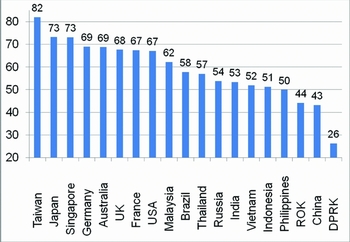
Figure 1 displays the results, converted to a 0-to-100 degree scale.Footnote 12 Because Taiwanese attitudes towards China are best understood in the context of their attitudes towards other countries, and, to our knowledge, this is the first survey to ask Taiwanese their attitudes towards so many countries at once, the results are worthy of close examination. On average Taiwanese felt the warmest towards Taiwan itself (82°). Also unsurprisingly, Taiwanese felt the coolest (26°) towards North Korea, its troublesome Northeast Asian neighbor. After Taiwan itself, the Taiwanese felt warmest towards Singapore and Japan, both at 73°. Taiwanese warmth towards Singapore, which is seen as a fellow member of the Chinese cultural world and an advanced economy, is not surprising. But Taiwanese warmth towards Japan is a more surprising case for two reasons. First, many mainland Chinese extremely dislike Japan. A recent large-scale survey of young mainland Chinese netizens revealed that they ranked Japan along with Vietnam as the least liked foreign countries.Footnote 13
Taiwanese feelings towards 19 countries
Note: Bars represent weighted mean scores for the full Taiwanese sample.

Second, Japan colonized Taiwan from 1895 to 1945. It appears, however, that on average Taiwanese held a positive view of their Japanese colonial legacy. Our survey included two statements, ‘Japan colonized Taiwan for 50 years, and this contributed to Taiwan's economic development’ (日 本 統 治 了 台 灣 五 十 年 , 而 這 對 台 灣 的 經 濟 發 展 有 所 貢 獻) and ‘We should thank Japan for its contributions to Taiwan's modernization’ (我 們 該 感 謝 日 本 對 台 灣 現 代 化 的 貢 獻), that were rated on a 1–7 ‘strongly disagree’ (非 常 不 同 意) to ‘strongly agree’ (非 常 同 意) Likert scale.Footnote 14 The averaged scale had a good internal reliability (α = 0.83) and a mean score of 4.82, well above the scale midpoint of four.
Popular culture also appears to contribute to Taiwanese warmth towards Japan, especially among younger Taiwanese. Our survey included four items asking participants how much they liked US, Japanese, South Korean, and mainland Chinese popular culture (流 行 文 化). US and Japanese popular cultures were the most admired, tied at 4.6 on a 1–7 scale; mainland Chinese popular culture was the least liked, at 3.4. And liking Japanese popular culture fully accounted for the slightly greater warmth that younger people and those with higher incomes felt towards Japan.Footnote 15
After North Korea, Taiwanese felt the coolest towards China (43°) and South Korea (44°). That Taiwanese felt so cool towards China, both in absolute and especially in relative terms (ranking 18th out of 19 countries), is striking. It should be a wake-up call for those mainland Chinese who maintain a Manichean view of Taiwan politics, pitting a good blue against an evil green. The reality, as we will explore in greater detail below, is that even blue partisans were highly ambivalent about China, and on average did not desire reunification with mainland China.
That the Taiwanese, on average, felt so cool towards South Korea is also surprising. South Korean culinary and popular cultures are thought to be well-liked in Taiwan today. So what accounts for this coolness? First, our survey revealed that Korean popular culture or ‘K-pop’ (韓 流) was not nearly as popular in late 2011 Taiwan as Japanese and US popular cultures were.Footnote 16 Second, negative stereotypes about South Koreans as ruthless competitors offset any overall positive effect of K-pop. Our survey included a single item rated on a 1–7 scale to tap a widespread Taiwanese prejudice, ‘Koreans will do anything for money’ (韓 國 人 為 了 賺 錢 不 擇 手 段). Together, our K-pop (β = 0.36) and prejudice (β = −0.35) items accounted for a remarkable 30% of the variance in Taiwanese feelings towards South Korea, but worked in opposite directions, with some individuals liking South Korea more because of K-pop, and others disliking South Korea more because of prejudice.Footnote 17 At the aggregate level, prejudice and pop offset each other.
Figure 1 also reveals that four Western countries − Germany (69°), Australia (69°), the UK (68°), France (67°) − and the US (67°) were all comparably admired. All boast advanced economies worthy of Taiwan's emulation, and all are predominantly Caucasian.Footnote 18
Finally, Figure 1 reveals that the Taiwanese were ambivalent about their Southeast Asian neighbors Vietnam (52°), Indonesia (51°), and the Philippines (50°). While these mean scores sit near the scale midpoint, they collectively rank in the third lowest group, 14–16 of our 19 countries. What best accounts for this relative coolness? One topic that has been widely covered in the Taiwanese press in recent years is the influx of Southeast Asian immigrants into Taiwan. Do attitudes towards foreign workers (外 勞) and foreign brides (外 籍 新 娘) from SE Asia relate to feelings towards Southeast Asian countries? We included two items in our survey to find out: ‘Foreign workers from Southeast Asia are uncouth’ (來 自 東 南 亞 的 外 勞 沒 有 水 準) and ‘Foreign brides from Southeast Asia do not count as Taiwanese’ (來 自 東 南 亞 的 外 籍 新 娘 不 算 是 台 灣 人). Averaged together, the resulting scale (α = 0.70) predicted warmth towards Vietnam (β = −0.26, p < 0.001) and Indonesia (β = −0.17, p < 0.001), but not towards the Philippines (β = −0.05, p = 0.32) in regressions controlling for the standard demographics. So the answer is a partial yes: prejudices against Southeast Asians in Taiwan is related to warmth towards their home countries of Vietnam and Indonesia, but not towards the Philippines.Footnote 19
In sum, the data presented in figure 1 demonstrate that Taiwanese, on average, felt cool towards China in both absolute (43°) and relative terms (18th of 19 countries). Taiwanese only felt cooler towards North Korea. And, despite prejudices against Southeast Asian immigrants in Taiwan, on average Taiwanese felt warmer towards Southeast Asian nations than China, even though 98% of Taiwanese are themselves ethnic Han Chinese.
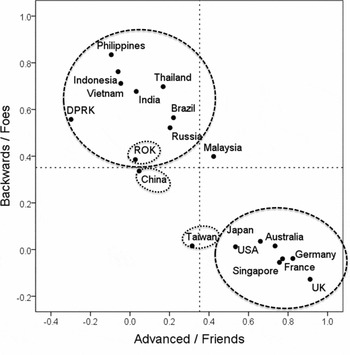
Where figure 1 presents mean scores for the full Taiwan sample at the group level, figure 2 shifts to the individual level, presenting the results of an exploratory factor analysis (EFA) of all 19 countries. EFA is a statistical technique used to discover the latent dimensions (‘factors’) that undergird a larger number of observed variables (such as our 19 countries). It thus allowed us to investigate how, for the average Taiwanese, feelings towards the different countries relate to one another.
The Taiwanese worldview
Note: Scatter plot of pattern matrix loadings in a two factor solution to a principle axis factor analysis with Promax rotation. In a five factor solution, China, Taiwan, and ROK are separate factors.

Figure 2 is the scatterplot of a two-factor solution to the EFA. A country cleanly belonged to a factor if it loaded onto that factor and that factor only at greater than 0.35, the conventional cutoff, represented by the dotted vertical and horizontal lines in the figure. Only Malaysia, China, and Taiwan itself did not load cleanly onto either factor. At the bottom right, Japan, the US, Australia, Singapore, Germany, France, and the UK all loaded cleanly onto the first factor, labeled ‘Advanced/Friends’. They are all advanced industrial countries to be emulated, and, as we know from figure 1, all are countries that the Taiwanese felt the most warmly towards, hence ‘friends’.
At the top left of figure 2, Brazil, Russia, South Korea, Thailand, India, North Korea, Vietnam, Indonesia, and the Philippines all loaded cleanly onto the second factor, labeled ‘Backward /Foes’. These are mostly undeveloped or developing countries seen as backwards economically. And as we know from figure 1, the Taiwanese felt cooler towards this group, hence ‘foes’.Footnote 20
Three countries did not load cleanly onto either factor in a two-factor solution. Malaysia cross-loaded too strongly onto both factors, perhaps reflecting its perceived Asian, but not quite advanced economic status. China was close to being factored together with backward foes, and definitely not close to advanced friends. Taiwan itself, interestingly, was seen as distant from its backwards and mostly Asian neighbors, but perhaps not quite developed enough to load cleanly onto the advanced friends factor. In a five factor solution to the EFA, Taiwan, China, and South Korea loaded cleanly onto their own factors (and are separately circled in figure 2), reinforcing the interpretation that each was distinct from the core of the two-factor solution.Footnote 21
‘Blue’ and ‘green’ views of China and the world
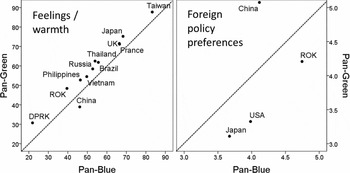
Were there partisan differences in pan-blue and pan-green feelings and foreign policy preferences towards foreign countries? Figure 3 displays two scatterplots of countries for which our survey revealed statistically significant partisan differences.Footnote 22 Dots represent mean scores for green and blue party identifiers, after weighing and controlling for standard demographics. The dotted diagonal lines represent the location of no partisan differences.
Partisan Taiwanese feelings and foreign policy preferences towards foreign countries
Note: Dots represent mean scores for green (DPP) and blue (KMT and PFP) party identifiers, after weighing and controlling for age, gender, income, and education. Dotted lines represent locations of no partisan differences.

The feeling thermometer data to the left displays partisan differences on 12 countries: Taiwan, Japan, the UK, France, Thailand, Brazil, Russia, Vietnam, the Philippines, South Korea, China, and North Korea. There were no partisan differences on seven countries, Indonesia, India, US, Malaysia, Singapore, Germany, and Australia, which are not displayed. The most immediately noticeable finding is that pan-green felt warmer towards 11 of the 12 countries displayed. The only country that pan-blue felt warmer towards is China. Given their relative importance for Taiwan, here we limit ourselves to discussing partisan differences on feelings towards Taiwan, Japan, and China.
Green supporters felt warmer towards Taiwan itself than did pan-blue.Footnote 23 Why? Our survey included the item ‘I am proud of Taiwan's democracy’ (我 以 台 灣 的 民 主 為 傲). Green endorsed this statement substantially more than blue.Footnote 24 This partisan difference in pride in Taiwan's democracy completely accounted for the overall difference in warmth towards Taiwan.Footnote 25 However, there were no partisan differences on measures of democratic values in our survey, such as support for the freedoms of speech and the press. Greater green pride in Taiwan's democracy may therefore have to do with the fact that the history of the democracy movement in Taiwan was largely a green struggle against the KMT.
Green (75°) identifiers also felt 7° warmer towards Japan than blue party (68°) supporters did. This partisan difference is partially explained by differing beliefs about the Japanese colonial past discussed above: green partisans had an even more benign view of Japanese colonialism than their blue counterparts.Footnote 26 A mediation analysis revealed that the two-item scale of beliefs about Japanese colonialism partially mediated the relationship between partisanship and feelings towards Japan.Footnote 27
Finally, blue supporters (48°) felt warmer than green supporters (38°) towards just one country, China. The surprise may be that the 10° gap was not larger.Footnote 28 Could blue partisans have been hesitant to disclose (even to themselves) the full extent of their warmth towards China? Because China is a sensitive issue, in addition to asking direct questions about feelings and policy preferences towards China, we also asked questions about other topics that we thought might indirectly reveal participants’ attitudes towards China, avoiding any possible self-presentation biases. One question asked, ‘Of the mainland Chinese tourists who come to Taiwan, what percentage are spies?’ (來 臺 的 大 陸 遊 客 中 , 有 百 分 之 多 少 會 是 間 諜 ?) Given that there are no reliable figures on this issue, we reasoned that answers to this question would indirectly reveal subconscious attitudes towards China: those who fear China might guess a higher percentage, while those with a more benign view of China might estimate a lower figure. The results were largely consistent with our explicit China feelings measure: on average, green partisans (m = 42%) guessed 8% higher than blue supporters (m = 34%), a small but statistically significant difference.Footnote 29 So it seems unlikely that a self-presentation effect was inhibiting blue partisans from fully disclosing their warmth towards China on the explicit feeling thermometer measure. Instead, this indirect measure provides further evidence that the Taiwanese on average held negative attitudes towards China. Remarkably, the average estimate for the full Taiwan sample was that 36% of Chinese tourists in Taiwan were actually spies. Given a total of 213,000 Chinese tourists in November 2011, that comes to close to 77,000 Chinese spies per month, or an average estimate of nearly a million Chinese spies a year in Taiwan.
We were interested not just in how Taiwanese feel about the world, but also what kinds of foreign policies they would prefer towards specific countries. Our survey therefore included the rating scale, ‘Should the Taiwan government adopt a “friendlier” or “tougher” policy towards the following countries?’ (對 於 以 下 國 家 , 您 希 望 台 灣 政 府 對 其 採 取 ⌜更 友 好⌟ 還 是 ⌜更 強 硬⌟ 的 外 交 政 策 ?) Seven countries were listed in random order, and the response options were on a 1 ‘much friendlier’ (更 友 好 許 多) to 7 ‘much tougher’ (更 強 硬 許 多) Likert scale. The scatterplot on the right of figure 3 displays the blue and green means for the four countries for which there were statistically significant partisan differences. There were no differences on three countries: the Philippines, Australia, and North Korea (DPRK).
While pan-blue partisans preferred moderately tougher foreign policies towards South Korea, the United States, and Japan than pan-green did,Footnote 30 the biggest difference on policy preferences was on China. Pan-blue supporters were on average neutral on the issue, preferring neither a friendlier nor a tougher China policy, with a mean score of 4.1, where 4 was the scale midpoint. Green partisans (m = 5.1), by contrast, preferred a decidedly tougher policy towards China, a medium-large difference statistically.Footnote 31
Did China policy preferences drive policy preferences towards Taiwan's alliance partners? In other words, did policy preferences towards the US, Japan, and South Korea reflect what international relations theorists call ‘external balancing’, whereby Taiwanese sought closer relationships with powerful alliance partners to the degree to which they sought to balance against Chinese power?
Our survey included the specific foreign policy item ‘The Taiwan authorities should improve diplomatic relations with the USA’ (台 灣 當 局 應 改 善 與 美 國 的 外 交 關 係), which we used as the dependent variable in a pair of two-step hierarchical regressions. For each regression, in the first step we entered the standard demographic controls, and in the second step a two-item measure of China policy preferences, coded so that higher scores indicated desires for a ‘tougher’ (更 強 硬) and ‘more severe’ (更 嚴 厲) China policy. The first regression included only self-identified DPP supporters (N = 97), and revealed that desires for a tougher China policy were indeed strongly and positively associated (β = 0.35, p = 0.001) with desires to improve diplomatic relations with the US, alone accounting for 11% of its variance. By contrast, the second regression included only self-identified KMT supporters (N = 170) and revealed that China policy preferences were not associated (β = 0.10, p = 0.25) with US policy preferences. In other words, party identification (PID) moderated the impact of China policy preferences on US policy preferences.Footnote 32 DPP supporters engaged in external balancing, seeking improved relations with the US to the extent that they desired tougher China policies; KMT identifiers did not. It is noteworthy that during the recent Taiwanese elections, DPP presidential candidate Tsai Ing-wen ran on a foreign policy platform that stressed strengthening the ‘strategic partnership with the US’ and ‘cooperation with Asia-Pacific countries, Japan in particular’.Footnote 33 Green partisans supported external balancing to counter China's rise.
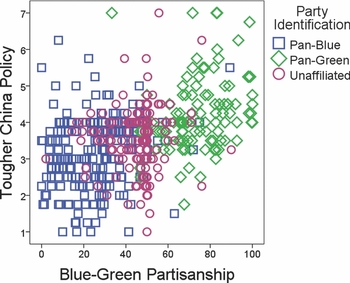
The difference between partisan and non-partisan Taiwanese on China policy is dramatically illustrated in figure 4. The horizontal axis of the scatterplot represents a participant's score on a three-item 0 to 100 scale (α = 0.74) of Taiwanese partisanship. It averages scores on a direct blue-green self-placement scale with scores of warmth towards the DPP and the KMT (reverse coded for consistency). The vertical axis represents scores on a four-item 1–7 scale (α = 0.65) of China policy preferences, averaging the single ‘friendlier’-‘tougher’ policy item discussed above with three more specific items that all began with the same stem, ‘The Taiwan authorities should. . .’ (台 灣 當 局 應 . . .): (1) ‘adopt a stricter policy towards mainland China’ (採 取 更 嚴 厲 的 政 策 來 對 付 中 國 大 陸), (2) ‘improve diplomatic relations with mainland China’ (改 善 與 中 國 大 陸 的 外 交 關 係), and (3) ‘increase free trade with mainland China’ (增 加 和 中 國 大 陸 的 自 由 貿 易). Responses to the latter two items were reverse coded prior to averaging so that higher scores on the resulting scale represent a preference for a tougher China policy.
Partisanship and China policy preferences

Figure 4 clearly reveals that blue partisans (the squares) preferred a friendlier China policy, clustered in the bottom left corner, while green partisans (the diamonds) overwhelmingly preferred a tougher China policy, clustered in the top right corner. Indeed, among blue and green party identifiers, partisanship and China policy preferences correlate at a substantial r = 0.42 (p < 0.001). But figure 4 also reveals that unaffiliated non-partisan Taiwanese (the circles) were all over the scatterplot. Among unaffiliated Taiwanese, who tend to be younger and more female than partisan voters, there was no relationship at all between partisanship and China policy preferences (r = 0.04, p = 0.63). This may help explain the peculiar role that China plays in Taiwanese elections: while each side may privately use the China issue to rally their bases, they seek to downplay it in their more public contest to win over the non-partisan center. In the absence of a major China event, bread-and-butter issues like the economy and social welfare tend to dominate Taiwanese election campaigns.
Party identification and cross–Strait relations
How did party identification impact Taiwanese preferences regarding cross–Strait relations? As noted above, existing surveys ask a single question with a range of response categories that confuse the issues of end-state (e.g. independence, unification) and time frame (e.g. immediately, in the future), providing a discontinuous variable of limited use for correlational analysis. We therefore decided to measure cross–Strait policy preferences in two separate ways in the hope of overcoming these problems. The first was to have participants ‘drag and drop’ themselves and the three 2012 presidential candidates (Ma, Tsai, and Soong) onto a ‘complete unification’ (完 全 統 一) to ‘complete independence’ (完 全 獨 立) 0–100 placement ruler. By removing timeframe from the question, and allowing for substantial variation, we hoped to create a more useful unidimensional measure of cross–Strait policy preferences.
But are the Taiwanese people's preferences on cross–Straits relations unidimensional? Is support for independence and unification necessarily zero-sum? And are these concepts too abstract? What exactly do the Taiwanese have in mind when they think about cross–Strait policy? To address these questions, we also asked participants to rate the degree of their opposition or support for six concrete policy proposals:
1. Independence. Taiwan will become a legally independent state (獨 立。台灣成 為 一個 法 律 上 獨 立 的 國 家).
2. Maintain the status quo. Taiwan's position would remain unchanged (保 持現狀。台 灣 的 地 位 堅 持 不 變).
3. Unification. Taiwan would unify with mainland China, becoming a part of China (統 一。台 灣 跟 中 國 大 陸 統 一, 成 為 中 國 的 一份 子).
4. Confederation. Under the large umbrella of Chinese culture, China, Taiwan, Hong Kong, Singapore, and others would form a ‘Greater China Confederation’. Taiwan would have the right to state governance and sovereignty, and maintain brotherly relations with mainland China on the international stage (聯 邦。 在 中 華 文 化 的 大 傘 下 , 中 國 、 台 灣 、 香 港 、 新 加 坡 等 會 形 成 ⌜大 中 華 聯 邦 ⌟ 。 台 灣 會有 國 家 治 理 權 與 自 主 性 , 與 中 國 大 陸 就 像 兄 弟 一樣 地 在 國 際 上 進 行 各 種交 流).
5. One China, two constitutions. On the basis of the ‘One China’ principle, the governments on the two sides of the Strait would govern themselves on the basis of their own constitutions, ‘the Constitution of the Republic of China’ and ‘the Constitution of the People's Republic of China’. They would be equal political entities, and Taiwan could participate in various international organizations (一中 兩 憲 。兩 岸 政 府 公 開 承 認 各 在 其 有 效 統治 範 圍 內 , 各 行 使 ⌜中 華 民 國 憲 法 ⌟ 及 ⌜中 華 人 民 共 和 國 憲 法 ⌟ , 兩 部 憲 法 都 建 立 在 ⌜一個 中 國 ⌟ 的 前 提 上 , 雙 方 為 對 等 政 治 實 體 , 臺 灣 並 得 以 參 與 各 種 國 際 組 織).
6. One country, two systems. Taiwan would follow the ‘Kong Kong model’, applying the ‘Special Autonomous Zones Law’ of the ‘Constitution of the People's Republic of China’. It would use the ‘One Country, Two Systems’ policy rather than implementing a socialist system under the ‘Basic Law of Special Administrative Regions’. (一國 兩 制。台 灣 依 循 ⌜香 港 模 式 ⌟ , 根 據 ⌜中 華 人 民 共和 國 憲 法 ⌟ 中 的 ⌜特 別 行 政 區 基 本 法 ⌟ , 以 ⌜一個 國 家 , 兩 種 制 度 ⌟ 方 針 , 不 在 ⌜特 別行 政 區 ⌟ 內 實 行 社 會 主 義 的 制 度 和 政 策).
The proposals were presented in random order to avoid any sequencing effect.
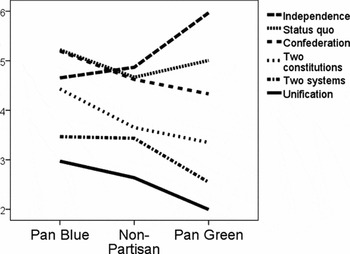
Overall, Taiwanese most supported independence (m = 5.0), the status quo (m = 5.0), and confederation (m = 4.9), followed by two constitutions (m = 4.0), two systems (m = 3.3), and unification (m = 2.6). Figure 5 breaks down support for these six policy proposals by party identification. As the top and bottom lines in the figure make clear, blue and green partisans differed dramatically in their support for independence and unification.Footnote 34 The other proposals fell in between. And unaffiliated voters generally fell between the blue and green positions on these cross–Strait proposals.
Party identification and support for specific cross–Strait policies

Blue and green supporters, however, shared similar levels of support for the status quo.Footnote 35 Moreover, their mean levels of support for the status quo were substantially above the scale midpoint of four, at 5.3 and 5.0 respectively. Given their highly divergent preferences regarding cross–Strait relations, what made both camps so supportive of the status quo?
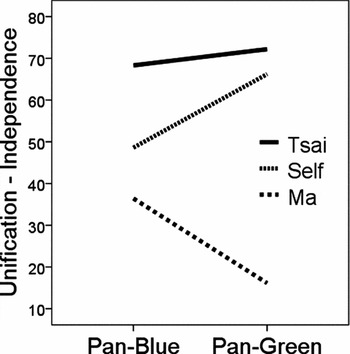
We suggest that the perceived radicalism of the other party on cross–Strait relations may have led both groups to embrace the status quo defensively. Figure 6 presents some of the data from our unidimensional and continuous ‘unification-independence’ scale mentioned above. It reveals that partisanship polarized perceptions of Tsai and Ma's positions on cross–Strait relations. On average, pan-Blue identifiers saw themselves as neutral (48/100) on unification-independence and closest to Ma's perceived position (37/100). However, they viewed Tsai as quite pro-independence (69/100). Pan-green identifiers, for their part, viewed themselves (66/100) as closer to Tsai (79/100), but viewed Ma as extremely pro-unification (15/100). As the sharp slope of the bottom line in figure 5 reveals, views of Ma's intentions were particularly polarized, with pan-blue viewing him as only slightly pro-unification (37/100), while pan-green viewed him as extremely pro-unification (15/100), a huge 22% difference.Footnote 36 These data suggest that exaggerated fears of what the other side may do on cross–Strait relations contributed to a defensive bipartisan support for the status quo.
Partisanship polarizes politicians’ perceived positions on Taiwan Strait policy
Note: Question prompt: Cross-Straits policy. What is your position on unification-independence? What do you think the positions of the following three presidential candidates are? Please drag and drop yourself and the three presidential candidates onto the ruler. 兩 岸 政 策 。您 在 兩 岸 統 獨 問 題 上 的 立 場 為 何 ? 您 認 為 以 下 三 位 台 灣 總 統 候 選 人 的 立 場 又 是 什 麼 ? 請 依 據 您 的 看 法 , 將 您 自己 與 這 三 位 候 選 人 拖 曳 到 量 尺 上 。

Ethnicity, parental socialization, and national identity
Thus far, this paper has argued that while party identification had some effect on feelings and foreign policy preferences towards other countries, its biggest impact was on feelings and especially policy preferences towards China. And on cross–Strait relations, although they shared support for the status quo, blue and green partisans differed substantially on specific policy proposals from independence to unification.
So what drove party identification? How do different Taiwanese become blue, green, or unaffiliated? While this question demands separate and more extensive treatment, a few points are warranted here.
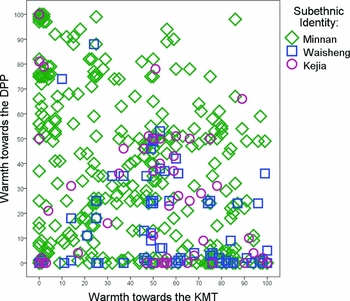
A common explanation for partisanship in Taiwan is subethnic identity. Mainlanders, this argument runs, are KMT supporters, while Minnanese are green supporters. This seems unlikely, however, since over 70% of the Taiwanese population is Minnanese, and yet green politicians do not dominate Taiwanese elections. Indeed, our data challenge the subethnic identity explanation for Taiwanese partisanship. Figure 7 is a scatterplot of warmth towards the KMT and the DPP by subethnic group. While Mainlanders (the squares) did indeed cluster towards the bottom and right, disliking the DPP and largely favoring the KMT, Minnanese (the diamonds) were scattered all over the plot. This raises the question: what drove some Minnanese to favor the KMT, while other Minnanese favor the DPP?
Subethnic groups and warmth towards the two major parties

The first and most direct answer is parental socialization. In Taiwan as elsewhere, parents' partisanship is a strong predictor of an individual's partisanship. In our full Taiwan sample, a two-step hierarchical regression revealed that while the standard demographics had some predictive power (R 2 = 0.04), parents’ perceived partisanship accounted for much more (R 2 = 0.26) of the variance in a respondent's partisanship. Limiting ourselves to the 73% of our sample who considered themselves pure Minnanese (excluding the 7% who considered themselves a mix of Minnanese and another ethnic group), the figures were largely consistent (R2 = 0.04 and 0.25). So Minnanese parents indeed seemed to play a major role in determining their children's partisanship.
Just how did this parental socialization transform into partisanship? We suggest that both language use at home and the ways that Minnanese parents talked with their children about past discrimination against Benshengren had a big effect on subsequent partisanship. Among Minnanese, those who reported greater use of Mandarin (as opposed to Minnanhua) at home reported more warmth towards the KMT (r = 0.13, p = 0.02), and substantially greater coolness towards the DPP (r = –0.24, p < 0.001).
Our survey also included two items tapping parental socialization about discrimination. Participants were asked ‘How often did your parents do the following things?’ (過 去 您 的 父 母 有 多 常 做 下 列 事 情?) (1) ‘speak with you about the February 28th Incident or other insults that Benshengren suffered’ (跟 您 講 有 關 二 二 八 事 件 或 當 時 本 省 人 收 到 的 委 屈), and (2) ‘speak about discrimination against Benshengren in your presence’ (在 您 面 前 提 過 對 本 省 人 的 歧 視). They were averaged to form a scale of robust internal reliability (α = 0.80).
Again limiting ourselves to Minnanese, and using this parental socialization about discrimination scale as our dependent variable, we ran a hierarchical linear regression with our demographic controls entered in the first stage, age and KMT-DPP party identification (PID) entered in the second stage, and an age-PID interaction term in the third stage. The demographic variables (gender, education, income, and five of our six region dummy variables – but not age) accounted for 10% of the variance in our dependent measure, with education doing the most work (β = –0.33). In other words, more educated people were less likely to report parental socialization about discrimination. In the second stage, age (β = 0.21) and PID (β = 0.26) together added an additional 7% of explanatory power. Finally, in the third stage, our age-PID interaction term added 7% more explanatory power, bringing the total R 2 to 0.24.Footnote 37 Secondary analysis of the interaction revealed that among Minnanese, older DPP identifiers reported their parents speaking to them more about discrimination against Minnanese than did older KMT identifiers.
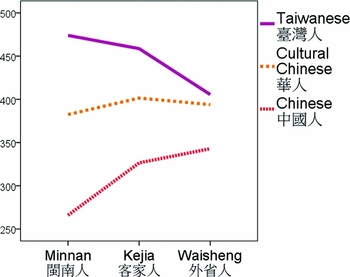
An alternative to the subethnic identity explanation, and one consistent with parental socialization approaches, is to focus instead on ethnic/national identification. Figure 8 reveals the different patterns of identification (namely, Taiwanese [台 灣 人 ], Cultural Chinese [ 華 人 ], and Chinese [ 中 國 人 ]) among Taiwan's subethnic groups (that is, Minnanese, Hakka, and Mainlanders). While all Taiwanese identified the most as ‘Taiwanese’ and the least as ‘Chinese’, the gap was substantially greater for Minnanese than it was for Mainlanders.Footnote 38 Hakka lay in between.
Identity profiles of Taiwan's subethnic groups

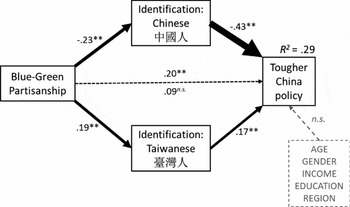
Among the majority Minnanese, identification as ‘Taiwanese’ and ‘Chinese’ completely accounted for the relationship between partisanship and China policy preferences. Figure 9 is a multiple mediation model in which the direct relationship between partisanship and China policy preferences (β = 0.20, p < 0.001) became statistically insignificant when indirect paths via Chinese and Taiwanese identification were added.Footnote 39 In other words, ethnic/national identification fully accounted for the relationship between partisanship and China policy preferences among Minnanese in Taiwan: identifying more as ‘Chinese’ was associated with desires for friendlier China policies, while identifying more as ‘Taiwanese’ accounted for desires for tougher China policies.
Among Minnanese, ethnic identity fully mediates the impact of partisanship on China policy preferences
Note: Multiple mediation analysis controlling for age, gender, income, education, and region. Both indirect effects were statistically significant. See the appendix for details.

Conclusion: bipartisan opposition to reunification
The survey evidence presented in this article suggests that Ma Ying-jeou's reelection in January 2012 did not signify that the Taiwanese people supported reunification with China. While pan-blue supporters were clearly less negative towards China than pan-green partisans, they were by no means ‘pro-China.’ Figure 1 revealed that on average in late November 2011 Taiwanese felt coolly towards China in both absolute (43°) and relative terms (the second coolest of 19 countries), while figure 3 showed that even pan-blue supporters were not warm towards China (46°) and the third coolest after the two Koreas.
On cross–Strait policy, the evidence is even stronger: all Taiwanese – including pan-blue partisans – supported independence and opposed reunification (see figure 5). The difference between the two camps was simply that green partisans supported independence and opposed reunification more than blue supporters. Only 7% of all Taiwanese ‘supported’ or ‘strongly supported’ reunification. Among pan-blue supporters, the figure only rose to 11%.
Beijing would be wise, therefore, not to push the second Ma administration too hard on reunification. And the KMT would be wise not to act too quickly on the issue either, since the Taiwanese people are likely to oppose such initiatives. Additionally, because Taiwanese on both sides of the partisan divide viewed the other side's cross–Strait policies as extreme (see figure 6), many appeared to defensively embrace the status quo (see figure 5), acting as a stabilizing force in Taiwan's cross–Strait policy.
Washington would be wise, for its part, to start paying closer attention to the China attitudes of the Taiwanese, which will surely impact any US policy shifts on cross–Strait relations, whether they involve strengthening the US alliance with Taiwan or ‘abandoning Taiwan’. US policymakers need to be aware of the role that partisanship plays in the relationship between Taiwanese policy preferences towards China and the US. While there was no relationship between policy preferences towards China and the US among pan-blue supporters, there was a substantial relationship between the two among green partisans. Green supporters appear, in other words, to support friendlier policies towards the US to balance against the threat that they perceive in China. ‘External balancing’ against China also appeared to drive green preferences for friendlier policies towards Japan and South Korea.
In short, on average Taiwanese did not desire reunification with China, and while most (and especially green partisans) preferred de jure independence, they accepted the status quo of de facto independence.
Policy implications: the tragedy of cross–Strait relations
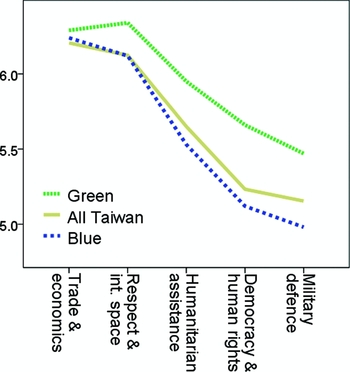
What else did the Taiwanese want from their diplomats? In addition to the two items measuring military defense discussed above, our survey also included eight items tapping the relative importance of four other foreign policy goals: (1) trade and economics (‘推 動 與 主 要 國 際 貿 易 夥 伴 洽 簽 經 濟 合 作 協 議’ and ‘為 台 灣 的 經 濟 發 展 營 造 一個 良 好 的 環 境’), (2) respect and international space (‘提 升 台 灣 的 國 際 尊 嚴 與 地 位 , 絕 不 接 受 任 何 歧 視 待 遇’ and ‘增 加 在 國 際 組 織 的 參 與 及 活 動 , 以 拓 展 台 灣 的 國 際 空 間’), (3) humanitarian assistance (‘對 抗 發 展 中 國 家 的 飢 餓 與 疾 病 , 如 愛 滋 病 和 瘧 疾’ and ‘在 世 界 各 地 進 行 救 災’), and (4) democracy and human rights (‘幫 助 其 他 國 家 引 進 民 主 政 治’ and ‘促 進 和 維 護 其 他 國 家 的 人 權’). Each pair of items were averaged together to create scales of good internal reliability.Footnote 40
Figure 10 displays mean scores on these five diplomatic goals for all Taiwanese as well as the blue and green subpopulations. It clearly reveals that all Taiwanese prioritized two goals: (1) trade and economics and (2) respect and international space, with only a very small preference for economics over respect.Footnote 41 This should not be surprising, since all human beings seek both material and psychological wellbeing. More surprising is that there was no partisan difference on the priority of economics and trade and only a small partisan difference on desire for respect and international space.Footnote 42 Despite the KMT's reputation as the party of established business interests, green partisans desired material prosperity just as much as blue supporters did. And despite green's constant public criticisms of the KMT for degrading and humiliating Taiwan before China, blue partisans desired respect and international space for Taiwan almost as much as green supporters did. Beijing will alienate blue supporters if the ‘diplomatic ceasefire’ ends and Beijing and Taipei resume their competition for international recognition. And if the Ma administration pursues a peace treaty with China perceived to compromise Taiwan's sovereignty and subjectivity, most Taiwanese will respond with the anger of those who feel insulted.
Party identification and diplomatic goals: all Taiwanese desire material and psychological well being, but differ on the importance of humanitarianism, democracy promotion, and defense

Figure 10 also reveals that although humanitarian assistance, democracy promotion, and military defense were all lesser priorities than material and psychological security, all were supported well above the scale midpoint of four. The largest partisan differences were on military defense and democracy promotion,Footnote 43 likely reflecting greater green wariness of China and greater desires to distinguish a democratic Taiwan from a non-democratic China. However, it is noteworthy that even green partisans ranked military defense as their lowest diplomatic priority, perhaps reflecting recognition that internal balancing (an arms buildup) can never ensure Taiwanese security against a neighboring China that is so massive. Instead, as noted above, green supporters sought friendlier policies towards the US, Japan, and South Korea than their blue counterparts (see figure 3), suggesting a desire to engage in external balancing (alliances) against China.
While this paper has been about Taiwanese attitudes towards China and the world, it is worth noting a striking parallel with Chinese attitudes towards Taiwan and the world. As noted in the introduction above, most Chinese view the Taiwan issue through the lens of the ‘Century of Humiliation’, a narrative central to Chinese understandings of who they are at the dawn of the twenty-first century. In this national narrative, Japan humiliated China with the 1895 Treaty of Shimonoseki, stealing Taiwan from China. And with US intervention in the Taiwan Strait with the outbreak of the Korean War in 1950, and continuing arms sales to Taiwan today, the US is blamed for preventing reunification. Given that Hong Kong and Macao have already returned to de jure Chinese sovereignty, many Chinese perceive Taiwan as the one remaining legacy of the ‘Century of Humiliation’, an ongoing US and DPP insult to Chinese dignity.
Herein lies the tragedy of cross–Strait relations today. Both mainland Chinese and Taiwanese alike experience the Taiwan issue as one of sovereignty and self-respect. And yet they fail to see or acknowledge these benign motives in each other. Most Mainland Chinese blame the Taiwan problem on Taiwanese ‘traitors’ like former President Chen and the DPP, failing to see that all Taiwanese view the sovereignty issue as one of respect and dignity. Meanwhile, few Taiwanese acknowledge that for mainland Chinese the Taiwan issue is also one of sovereignty and self-respect, instead blaming the problem on Chinese arrogance and bullying.
The danger is that such hostile attribution contributes to the possibility of a security dilemma, whereby policies designed to protect sovereignty and dignity, such as arms buildups and strengthened alliances, are perceived by the other as threats, leading to further arms and alliance buildups and an insecurity spiral. To avoid this outcome, Chinese, Taiwanese, and Americans alike must do a better job of perspective taking, standing in the shoes of the other and seeing the issue from their perspective. Truly understanding the other's position does not require condoning or agreeing with it, but it can mitigate against the hostile attribution of the other's motives so central to the insecurity spirals that can lead to war.
About the authors
Peter Hays Gries is the Harold J. and Ruth Newman Chair and director of the Institute for US–China Issues at the University of Oklahoma. He is the author of China's New Nationalism (2004) and coeditor of Chinese Politics (2010) and State and Society in 21st-Century China (2004). He has also written dozens of academic journal articles and book chapters. His work focuses on the political psychology of US–China relations.
Jenny C. Su is an assistant professor in the Department of Psychology at National Taiwan University. She has written a dozen academic journal articles focusing on the influence of culture and society on social behavior. She is particularly interested in how human emotion and motivation vary by cultural and societal contexts. She takes a multi-method perspective on her research, using laboratory experiments, survey studies, and psychophysiological measures in her work.
Appendix: Indirect effect statistics for mediation analyses