


Introduction
Most European streams, rivers and their banks have been altered either by river margin modification with groynes or with stone embankments, or by the construction of weirs and dykes resulting in river bed modification. Human impact has been posing threat to streams and to rivers, e.g. by causing organic pollution (Zamora-Munoz et al., Reference Zamora-Munoz, Sanchez-Ortega and Alba-Tercedor1993; Kłonowska-Olejnik & Skalski, Reference Kłonowska-Olejnik and Skalski2014), stream regulation and channel degradation (Bunn & Arthington, Reference Bunn and Arthington2002), as well as channel and bank degradation (Lenzi & Comiti, Reference Lenzi and Comiti2003). However, some smaller rivers, and especially streams, have undergone only minor alterations or remained unaltered by human activity.
A direction and intensity of changes in floodplain habitats can be evaluated with the help of bioindicators, e.g. epigeic carabids (Coleoptera: Carabidae), often used to evaluate the condition of the environment and changes taking place in it (Szyszko, Reference Szyszko1983; Niemelä et al., Reference Niemelä, Langor and Spence1993; Lövei & Sunderland, Reference Lövei and Sunderland1996; Koivula et al., Reference Koivula, Punttila, Haila and Niemelä1999; Magura et al., Reference Magura, Ködöböcz and Tóthmérész2001, Reference Magura, Bogyó, Mizser, Nagy and Tóthmérész2015; Schwerk & Szyszko, Reference Schwerk and Szyszko2007; Koivula, Reference Koivula2011; Pizzolotto et al., Reference Pizzolotto, Cairns and Barbante2013; Kosewska et al., Reference Kosewska, Skalaski and Nietupski2014). Epigeic carabids are frequently used for zooindication and environmental monitoring because they respond to disturbances much faster than plants. Ground beetle assemblages respond not only to flood regimes (Bonn et al., Reference Bonn, Hagn and Wohlgemuth-Von Reiche2002) and bank management (Gerken et al., Reference Gerken, Drfer, Buschmann, Kamps-Schwob, Berthelmann and Gertenbach1991) but also to riparian vegetation (Greenwood et al., Reference Greenwood, Bickerton and Petts1995) and riparian habitat heterogeneity (Eyre et al., Reference Eyre, Lott and Luff2001).
When the riparian areas are flooded, sediment erosion and deposition set back succession to pioneer stages (Januschke et al., Reference Januschke, Jähnig, Lorenz and Bering2014). Therefore, in temporary habitats flooded by the river, many carabid species are highly mobile and able to fly as an adaptation to fluctuations in habitat availability (Schrimel et al., Reference Schrimel, Blindow and Buchholz2012). Periodical flooding of river margins does not provide suitable conditions for development of stable carabid assemblages. Hence, frequency of occurrence of rapid colonisation of river margins by long-winged carabid species grows with the diminishing distance from the riverside (Bonn & Kleinwächter, Reference Bonn and Kleinwächter1999). The carabids that inhabit more seriously disturbed river banks have better developed wings than those occurring along less disturbed banks (Desender, Reference Desender, Wouters and Baert1989). The flooding of meadows on river banks may result in an increase in the number of individuals due to rapid re-colonisation of the meadows by individuals from adjacent areas (Sienkiewicz & Żmichorski, Reference Sienkiewicz and Żmichorski2013).
Pioneer carabid species often inhabit disturbed, unvegetated patches along the shoreline, but in habitats placed farther from the river, the ongoing succession of floodplain vegetation initiates successional processes in carabid beetle assemblages consisting in the appearance of late-successional species (large and often wingless species). More advanced stages of habitat succession are represented by more heterogeneous habitats than streamside meadows, and therefore offer broader niche ranges than the meadows do. This might enhance carabid diversity and might lead to the development of assemblages with a more complex species structure (Schrimel et al., Reference Schrimel, Blindow and Buchholz2012). Therefore, with increasing distance from the waterside across the habitat gradient, from grey dunes and dwarf-shrub heath towards a birch forest, a gradual increase can be observed with regard to carabid diversity, mean body size, and the percentage of both large species and flightless species in assemblages (Schrimel et al., Reference Schrimel, Blindow and Buchholz2012). What is more, the alluvial broadleaved forests situated farther from the river bank can host rare and endangered carabid species (Bonn et al., Reference Bonn, Hagn and Wohlgemuth-Von Reiche2002).
An important aspect of studies conducted in such changeable river bank habitats is the length of observation series. Although many studies have been conducted on floodplain carabid assemblages, the observation periods were comparatively short, lasting for 1 year (Elek et al., Reference Elek, Dauffy-Richard and Gosselin2010; Skalski et al., Reference Skalski, Kędzior and Radecki-Pawlik2012), 2 springs (Jähnig et al., Reference Jähnig, Brunzel, Gacek, Lorens and Bering2009), 2 years (Lambeets et al., Reference Lambeets, Vandegehuchte, Maelfait and Bonte2008), 3 years (Bonn et al., Reference Bonn, Hagn and Wohlgemuth-Von Reiche2002) or 5 years (Kleinwächter & Rickfelder, Reference Kleinwächter and Rickfelder2007). However, in the latter case the studies were conducted in two different locations for 2 and 3 years, respectively. No studies have been conducted involving long-term observations carried out for many years. The observations conducted by Januschke et al. (Reference Januschke, Jähnig, Lorenz and Bering2014) took place in two separate years, divided by a 5-year break. Thus, a question arises whether results of observations carried out within such short time spans have been sufficient to fully investigate the structure and diversity of carabid assemblages. For instance, Skłodowski & Garbalińska (Reference Skłodowski and Garbalińska2011), tracking changes in carabid fauna of tree stands disturbed by windthrow, observed considerable changes in composition and structure of carabid assemblages over the period of 6 years. Changeability of riparian habitats, especially regarding water table levels, may affect species composition, resulting in classifying different species as characteristic ones for particular habitats in respective years.
A 16-year monitoring study period was initiated in 1999 and concluded in 2014, in order to gain insight into long-term changes of carabid fauna in floodplain habitats of a small natural watershed that had not been affected by human activity. A small watershed called ‘Pożary’ located in the western part of the Kampinos National Park (near Warsaw, Poland), where no human activity had taken place for 50 years, was chosen as study area. The study area featured vast floodplain meadows on the streamside, clumps of birches and willows scattered higher up the slope, as well as birch stands and pine stands on the dunes, located still farther away from the stream. The following hypotheses (h) have been formulated: (h1) in habitats that were more stable (advanced in their successive development) and located farther away from the stream, species diversity of carabids and a proportion of large, wingless (late-succession) species should be higher than on more dynamic meadow habitats beside the stream; (h2) both species diversity and the proportion of species representing various life traits should depend on ground water level; (h3) changeability of riparian environment allowed for identification of species characteristic for particular habitats only in particular years of the study and not during the whole study period.
Materials and methods
Study area and carabid beetle sampling
The studies were conducted in the southeastern part of Kampinos National Park bordering the city of Warsaw in the west. The study area consisted of a watershed called ‘Pożary’, featuring a 5 m wide stream. The sequence of habitats surrounding the stream was the following:
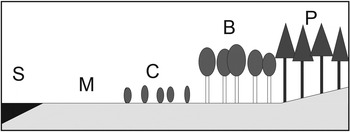
M – marsh meadows (from 5 to 30 m away from the stream); C – wet meadows with isolated clumps of birches and willows (from 30 to 60 m away from the stream); B – 30-year-old birch forest (50–80 m away from the stream), and P – 40-year-old pine forest growing on the slopes of low dunes (60+ m away from the stream) (fig. 1).
An outline of research plot location in four habitats beside the stream and a cross-section of the habitat gradient; S – stream; M – marsh meadows (up to 5 m away from the stream); C – isolated birch clumps (30–60 m away from the stream); B – 30-year-old birch forest (50–80 m away from the stream), and P – 40-year-old pine forest (60+ m away from the stream).

Three study plots were established in each of the four habitats. They were not situated along a straight line but scattered randomly around the stream. A pitfall trap and a piezometer facilitating automated measurements of ground water level were installed in each plot. Air temperature was measured and vegetation within a 10 m radius was catalogued.
Carabid sampling was carried out in the years 1999–2014 with one pitfall trap per plot. The traps were made of 330-ml glass jars with a plastic funnel, 12 cm in diameter, containing 100 ml of 70% ethylene glycol. Each year the plots were functioning from 3 May till 3 October and every 5 weeks the jars containing the catch were replaced by empty ones containing glycol. The sampling period lasting from May to October was chosen in order to facilitate registering spring and autumn carabid fauna.
Carabid classification for analysis
After species identification, carabids were further classified according to their life traits on the basis of the biology and ecology of respective species. The classification relied both on literature (Szyszko, Reference Szyszko1983; Hůrka, Reference Hůrka1996; Turin, Reference Turin2000) and on many years of the author's experience. The following life traits were differentiated: type of development (development group), dietary strategy (trophic group), habitat preferences (environmental group), the capacity for dispersal (dispersal group) and humidity preferences (after Szyszko, Reference Szyszko1983; Hůrka, Reference Hůrka1996; Turin, Reference Turin2000).
The development group included species representing spring and autumn breeders, depending on whether they hibernated as imagoes (spring breeders) or as eggs or larvae (autumn breeders).
The group of species classified on the basis of a dietary strategy comprised small zoophages (predatory species with body length not exceeding 15 mm), large zoophages (predatory species, exceeding 15 mm) and hemizoophages (species feeding both on other animals and on plants, often on seeds – mainly early successional species).
In the environmental group, classifying species on the basis of their environmental preferences, the following species were differentiated: open area species, habitat generalists and forest species.
The dispersal group, based on mobility of the studied carabids, included species depending on the presence of wing muscles and wing length, classifying them into: wingless – having no wings, wing-polymorphic – having wings but no wing muscles that would render them functional, and long-winged – capable of flying considerable distances.
The humidity group, based on the humidity of habitats where the species were most often observed, included xerophilous species, preferring dried-out and dry habitats, mesophilous species – preferring moderately damp habitats, and hygrophilous species – preferring marshy habitats.
Data analysis
In order to verify hypotheses h1 and h2 during the 16-year observation series, Generalised Linear Mixed Models (GLMM) was used to analyse: Chao2 index and life traits, including: the percentage of autumn and spring breeders (development group); large and small zoophages, and hemizoophages (trophic group); forest, generalist and open area species (environmental group); long-winged, wing-polymorphic and wingless species (dispersal group), and xerophilous, mesophilous and hygrophilous species (humidity group) in the assemblages. Chao2, as a non-parametric sample-based richness estimator allowed us to assess true species richness and yielded reliable estimates even from relatively small sample sizes. The Chao2 estimator used data on the rare species (singletons and doubletons) collected in samples to estimate the number of additional species present at the site (Colwell, Reference Colwell2013). The response variables (Chao2 and life traits) were defined as following a Poisson distribution (with a log link function). The year of carabid observation was analysed as a random effect, while a fixed effect included a comparison of respective plots and environmental variables: ground water levels and air temperature. The analysis was conducted using Statistica 10.0 software (StatSoft Inc, 2011).
In order to show change over time in carabid assemblages in the four studied habitats (Meadow, Clumps, Birch and Pine), principal response curve (PRC) was deployed, calculated and illustrated using CANOCO 5.0 (Ter Braak & Šmilauer, Reference Ter Braak and Šmilauer2003, Reference Ter Braak and Šmilauer2012). The PRC analysis achieved its aim by performing a redundancy analysis (RDA) and introducing the interdependence between sampling date and treatment (carabid assemblages in four different habitats) as a set of explanatory variables, and the sampling dates as a set of covariables. Assemblages from the pine forest growing on dunes served as a source of reference data. The PRC method made it possible to contrast the time series of the Meadow, Clumps and Birch with the time series of the reference stands (Pine). In the PRC diagram, the first principal component of the variance explained by treatment differences in time was displayed on the y-axis, while time (sampling data) was shown on the x-axis. The additional axis on the right side showed the species scores and the affinity of different species with the response shown in the diagram, i.e. how similar the actual response of the species was to the response indicated (van der Brink et al., Reference Van den Brink and Ter Braak1999, Reference Van den Brink, den Besten, bij de Vaate and Ter Braak2009). The PRC curve was plotted for three variants: Meadow, Clumps and Birch; the reference variants formed the horizontal axis of the upper part of the PRC diagram. The significance of the interaction between the different habitat types and time was tested by the Monte Carlo permutation test. The obtained PRC diagram was helpful in distinguishing differences among carabid assemblages in respective habitats over the 16-year period.
According to the PRC diagram, the differences among carabid assemblages were the smallest in 2000 and the largest in 2009. In order to further illustrate those differences in the chosen years, non-metric multidimensional scaling (NMDS) was calculated in PAST software (Hammer et al., Reference Hammer, Harperm and Ryan2001) on the Bray–Curtis similarity matrix.
The third hypothesis regarding little chance of identifying carabid species characteristic for riparian habitats was verified using the IndVal (Indicator Value) procedure (Dufrêne & Legendre, Reference Dufrêne and Legendre1997). This was an excellent method for finding indicator species characterising groups of samples collected from various habitats. The indicator attained the maximum value (1.00) when all individuals of a species were found in a single group of sites (high specificity) and when the species occurred in all sites of that group (high fidelity). The statistical significance of the species indicator values was evaluated by the Monte-Carlo procedure. The IndVal computations were performed using R Statistic (R Core Team, 2014).
Results
Life traits of carabids
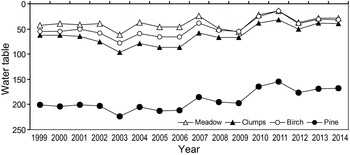
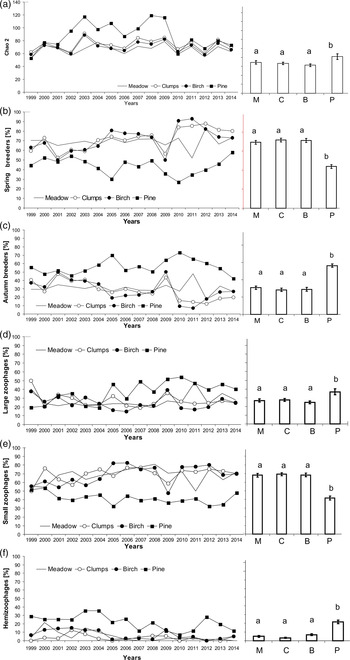
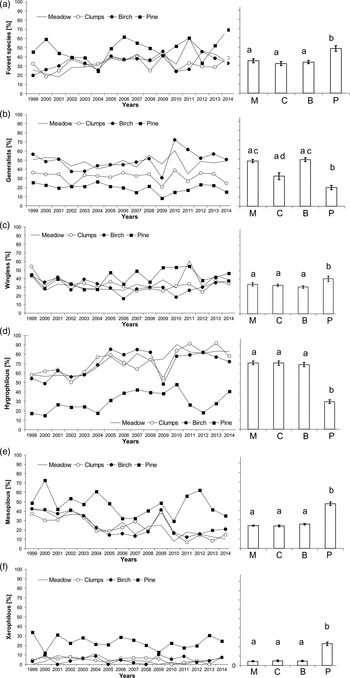
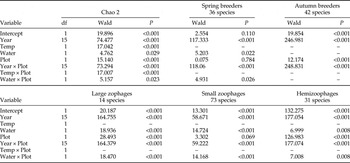
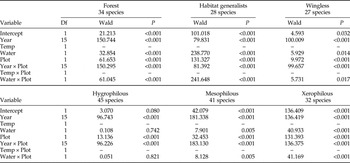
In the years 1999–2014, 14,216 individuals representing 118 carabid species were collected. Ground water levels (fig. 2) differed significantly in the four respective habitat types (Umann–Whitney test; Z = from 2.979 to 8.438; P from 0.002 to <0.001). The lowest ground water level was observed in the pine forest. The value of the Chao2 estimator was affected by air temperature and ground water level (fig. 3). Generally, the highest values of the Chao2 estimator were achieved in the pine stand growing on dunes. Life traits of carabids were not affected by air temperature but only by ground water level (tables 1 and 2 features only significant results). The proportions of autumn and forest species, hemizoophages, large zoophages, as well as mesophilous, xerophilous and wingless species were all larger in carabid assemblages in the pine forest growing on dunes than in carabid assemblages in the three remaining habitats (tables 1 and 2, figs 3 and 4). On the other hand, the proportions of spring species, generalists, small zoophages and hygrophiles in carabid assemblages in the pine forest growing on dunes were smaller in comparison with the other habitats. Out of the three groups of species comprising the dispersal group only the proportions of the wingless group differed significantly among respective habitats.
Ground water levels during 16 years of observation; M – marsh meadows; C – isolated birch clumps; B – birch forest; P –pine forest.

Chao2 values (a), proportions of spring (b), and autumn breeders (c), small zoophages (d), large zoophages (e) and hemizoophages (f) in carabid assemblages in four different habitats during 16 years of study (left side), including mean values ± SE for the whole study period obtained by applying Mann–Whitney U test as a post-hoc test. Late-successional species (autumn breeders, large zoophages and hemizoophages) reached higher proportions in carabid assemblages of the P habitat located further from the stream, while early-successional species (spring breeders and small zoophages) reached higher proportions in carabid assemblages of damp habitats close to the stream. Hemizoophages reached higher proportions in assemblages of the P habitat, which could result from their retreat from damper and more dynamic M and C habitats located close to the stream.

Proportions of forest species (a), generalists (b), wingless species (c) and higrophilous (d), mesophilous (e) and xerophilous (f) species in carabid assemblages in four different habitats during 16 years of study (left side), including mean values ± SE for the whole study period obtained by applying Mann–Whitney U test as a post-hoc test. Forest, wingless and mesophilous species, characteristic for late succession stages, reached higher proportions in carabid assemblages of the P habitat, located the farthest from the stream, while generalist species characteristic for early succession stages reached higher proportions in carabid assemblages of damp habitats located close to the stream. The proportion of xerophilous species was higher in assemblages of the P habitat, which could result from their retreat from damper and more dynamic M and C habitats located close to the stream.

The GLMM analysis for the Chao2 and proportions of species representing different types of development cycle (spring and autumn breeders) and different types of preferences regarding environment trophy (hemizoophages, small zoophages, large zoophages). Plots were compared during the years 1999–2014; year (Year) was a random factor; plot (Plot), temperature (Temp), ground water level (Water) were fixed factors.

The GLMM analysis for proportions of species representing different types of preferences regarding environment (forest, habitat generalists and open area species) and humidity (xerophilous, mesophilous and higrophilous species). Plots were compared during the years 1999–2014; year (Year) was a random factor; plot (Plot), temperature (Temp), ground water level (Water) were fixed factors.

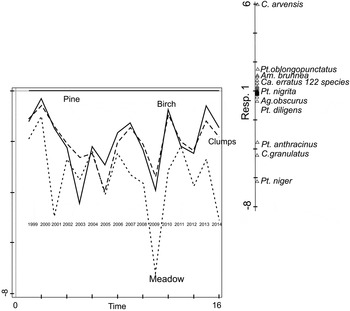
Differences among carabid assemblages in the four habitats studied in the years 1999–2014 (diagram PRC – fig. 5) were significant (Monte Carlo test; F = 29.1, P = 0.002). Carabid assemblages in pine stands growing on dunes were treated referentially in calculations, and shown as a horizontal line in the diagram (Pine). Carabid assemblages in the remaining habitats (Birch, Clumps and Meadow) were shown as polygonal chains. The farther a polygonal chain was situated from the horizontal line of Pine, the more significant was the difference between the assemblage it represented and the reference Pine assemblages. The most significant difference was identified between the reference assemblages (Pine) and the assemblages from the areas beside the stream (Meadow). The dynamics of changes in carabid assemblages from the two remaining habitats (Clumps and Birch) was very similar (fig. 5). For a greater part of the 16-year study period, Clumps and Birch assemblages differed from both reference assemblages (Pine) and streamside assemblages (Meadow).
PRC curve of the response of carabid assemblages in four different plots (Pine, Meadow, Clumps and Birch), together with the most important species reacting to the disturbance (axis Resp.1 – negative values – below zero) and species associated with the control stands (axis Resp.1 – positive values – above zero). (The horizontal line indicates Pine plot – control assemblages and the three variable trajectories situated above it indicate carabid assemblages inhabiting assemblages inhabiting plots: Meadow, Clumps and Birch.) The further the distances between them, the larger are the differences between the assemblages. The response of assemblages in the Meadow habitat, the closest to the stream, differed considerably from assemblages in Birch and Clumps habitats, whose responses were similar. An especially strong response of Meadow assemblages was observed in 2009, just after beavers had settled in the area and built a dam.

An additional, vertical line on the right side of the PRC diagram (Resp. 1) (fig. 5) indicated species characteristic for respective habitats. The species featured in the upper part of the axis, above the zero value, represented carabid assemblages living in the pine forest: Carabus arvensis, Pterostichus oblongopunctatus, Amara brunnea and Calathus erratus. The species featured in the lower part of the additional axis, below the zero value (negative part of the diagram) were associated with wet ecosystems: Meadow, Clumps and Birch.
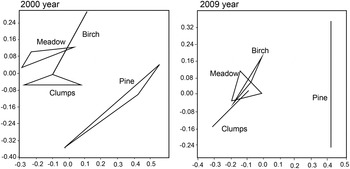
PRC analysis indicated the smallest differences among carabid assemblages in 2000, and the largest ones in 2009. For both years the NMDS analysis was performed (fig. 6) (2000, stress = 0.15; 2009, stress = 0.08). In contrast to the NMDS diagram for the year 2009, the NMDS diagram for the year 2000 showed a smaller difference between carabid assemblages from Meadow, Clumps and Birch habitats on the one hand and the assemblages from the Pine habitat on the other. At the same time, differences among Meadow, Clumps and Birch assemblages were smaller in 2009 than in 2000, i.e. in the year when the difference between that group of assemblages and the Pine assemblages was larger.
NMDS of the data from 2000 (left side) and for 2009 (right side) for carabids inhabiting plots Meadow, Clumps, Birch and Pine. According to the NMDS diagram, the distances among carabid assemblages of Meadow, Clumps and Birch habitats located close to the stream were larger in the ‘dry’ 2000 than in 2009, when the water level increased. Simultaneously, the distance between assemblages of the Pine habitat and the assemblages of damp Meadow, Clumps and Birch habitats grew in 2009.

Species
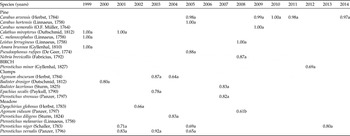
The IndVal analysis of carabid assemblages in 1999–2014 revealed nine characteristic species of carabid assemblages encountered in pine stands growing on dunes (Pine); they were mainly xerophilous and mesophilous species. Most species were indicated by the IndVal analysis only once within the 16-year study period. There were two exceptions, namely a large xerophilous zoophage C. arvensis, which was a differential species for 5 years, and a small zoophage C. micropterus, which was a differential species in the Pine assemblages for 2 years. The IndVal analysis revealed only one characteristic species in birch stands (Birch), namely the small zoophage Pterostichus minor. According to the IndVal analysis, carabid assemblages from meadows covered with birch and willow clumps (Clumps) comprised five differential species, and the assemblages from the streamside (Meadow) comprised six characteristic species (table 3).
The IndVal (Indicator value) values and their statistical significance (a–c) for the carabid species characteristic of control stands and disturbed stands; explanation: a – P = 0.05; b – P = 0.01.

Discussion
Life traits of carabids
The four habitats where carabid assemblages were studied stretched along a humidity gradient running from the dampest meadows (Meadow) on the streamside, through damp habitats scattered with tree clumps (Clumps) situated farther from the river, through birch stands (Birch) situated still farther, to small dunes covered with a pine forest (Pine). The habitats were located in a lowland area, not a mountainous one, so they had never been subject to violent floodings. Since 2010, mild floodings took place at the break of winter and spring every year, affecting Meadow, Clumps and partly also Birch habitats. The floodings resulted from the activities of beavers which settled down in the area in 2007.
The Meadow, Clumps, Birch and Pine plots were situated not only along a humidity gradient but also along a succession gradient, where the Meadow plot represented an early stage of ecosystem development and Birch and Pine plots represented advanced stages of ecosystem development. Therefore, Pine and Birch plots ought to be inhabited by carabid fauna characteristic of advanced stages, while Meadow and Clumps plots ought to be inhabited by carabid fauna characteristic of early stages.
The flooding regime of the floodplain appeared to be a major determinant of the community structure of ground beetles in habitats across a gradient stretching from open water to terrestrial environments (Boscaini et al., Reference Boscaini, Franceschini and Maiolini2000). The structure of carabid beetle assemblages was primarily determined by differences in flood regimes (Bonn et al., Reference Bonn, Hagn and Wohlgemuth-Von Reiche2002). As the intensity of disturbance in the environment grew, the body size of carabids decreased, showing a correlation with forest disturbance (Szyszko, Reference Szyszko1983) or flood frequency (Lambeets et al., Reference Lambeets, Vandegehuchte, Maelfait and Bonte2008; Gerisch, Reference Gerisch2011; Skalski et al., Reference Skalski, Kędzior and Radecki-Pawlik2012). There was a smaller proportion of large species in carabid assemblages in the plots closer to the stream (Medow, Clumps and Birch), while the opposite was true for assemblages situated at the higher level farther from the stream (Pine). The ongoing succession of floodplain vegetation also initiated successional processes in carabid beetle assemblages (Januschke et al., Reference Januschke, Jähnig, Lorenz and Bering2014). Successional processes in habitats facilitated colonisation and settlement of species characteristic for late succession stages in carabid assemblages (Szyszko, Reference Szyszko1983; Schwerk & Abs, Reference Schwerk and Abs1995). As a consequence of ecological succession, a larger proportion of such species was present in the Pine habitat, i.e. autumn breeders, forest species, large zoophages, mezophiles and wingless species, in comparison with damper habitats closer to the stream. A similar observation had been made by Schrimel et al. (Reference Schrimel, Blindow and Buchholz2012), who noted that along the successional gradient of a coastal heathland, the farther the habitat at the respective succession stage was located from the river, the larger was the carabid diversity, and the higher the proportions of large species and flightless species.
In carabid assemblages in the Pine plots, alongside late-succession species there was observed a large proportion of pioneer species: xerophilous and hemizoophageous ones. Xerophilous species had been often classified as hemizoophagous ones. Their proportion ought to be the highest not in pine stands but in assemblages inhabiting open areas (Szyszko, Reference Szyszko1983; Schwerk & Abs, Reference Schwerk and Abs1995). However, xerophilous species tended to be discouraged by increased flooding disturbance (Lambeets et al., Reference Lambeets, Vandegehuchte, Maelfait and Bonte2009). Therefore, stream flooding and excessively high ground water level, increasing soil dampness, might force xerophiles to seek some dry habitats, even in pine stands, which might temporarily play the role of life boats for them.
On the other hand, in habitats adjacent to the stream (Meadow and Clumps), hygrophilous and early-succession species such as spring breeders, generalists and small zoophages prevailed in carabid assemblages. Hygrophilous species found good living conditions in areas close to the stream. It seemed that a high proportion of spring breeders hibernating as imagoes might result from natural selection which was part of a development and survival strategy under the conditions of excessive humidity and the necessity to avoid flood disturbance (Thiele, Reference Thiele1977). Early reproduction enabled the larvae to develop during summer, which was usually a period of low hydrological disturbance and thus could decrease larval mortality and increase reproductive success (Gerisch, Reference Gerisch2011). It had been observed before that hibernation of the flood-resistant adult stage in the floodplain and recolonisation of the floodplain after the water level dropped were helpful strategies facilitating species survival in such unstable habitats (Rothenbücher & Schaefer, Reference Rothenbücher and Schaefer2006).
Apart from reproductive traits, Gerisch (Reference Gerisch2011) pointed out body size as a key trait of species living in floodplain ecosystems. A large proportion of small zoophages in assemblages studied in Meadow, Clumps and Birch plots might also be an element of a survival strategy (Radecki-Pawlik & Skalski, Reference Radecki-Pawlik and Skalski2008a , Reference Radecki-Pawlik and Skalski b ). It had been noted that as an adaption to unstable conditions, species in more disturbed habitats often had a high turnover rate and therefore a smaller body size (Meadow, Clumps and Birch plots), while species in undisturbed habitats (such as Pine) often had a low turnover rate and therefore were able to fill larger ecological niches (Ribera et al., Reference Ribera, Doledec, Downie and Foster2001; Schrimel et al., Reference Schrimel, Blindow and Buchholz2012). Many alluvial ground beetles were not stenotopic ones but habitat generalists, which facilitated their survival and their search for new, more livable habitats (Weigmann & Wohlgemutfh-von-Reiche, Reference Weigmann, Wohlgemutfh-von-Reiche, Dohle, Bornkamm and Weigmann1999). Generalist strategies were more efficient for coping with unpredictable and variable ecological constraints (Pizzolotto, Reference Pizzolotto2009).
Long-winged species had usually achieved a larger share in assemblages in the closest proximity to the waterline (Bonn & Kleinwächter, Reference Bonn and Kleinwächter1999). Thus, it was surprising to observe no significantly large proportion of long-winged species in assemblages immediately beside the stream and in its close proximity (Meadow, Clumps) in comparison with assemblages in the pine forest (Pine). However, it was caused by fluctuating proportions of long-winged and wing-polymorphic species in carabid assemblages, which complemented each other.
The highest value of the Chao2 indicator was noted in carabid assemblages in pine stands (Pine), as opposed to the remaining three habitat types. Elek et al. (Reference Elek, Dauffy-Richard and Gosselin2010) had suggested that open habitats collected a higher amount of carabid species as compared to closed ones. The older successional stages, e.g. the pine forest, represented more heterogeneous and complex habitats than the meadow or the tree clumps on the streamside, and therefore offered broader niche ranges, which could enhance carabid diversity. Thus, species diversity of assemblages in Meadow and Clumps habitats might be related to a lower number of available niches (Schrimel et al., Reference Schrimel, Blindow and Buchholz2012). The Chao2 indicator provided an important piece of information by suggesting the prevalence of singletons over doubletons. That might mean that in comparison with the other habitats, the pine stand (Pine) was more frequently visited by individual representatives of particular species. It might also indicate that carabids were looking for a vicarious habitat located higher than the excessively wet Meadow and Clumps habitats, and found it in the Pine habitat.
The proportions of particular groups of species, especially late-succession ones, did not depend on air temperature but on the ground water level. The effect of temperature as an important factor affecting carabids (Thiele, Reference Thiele1977), e.g. by modifying the pace of their larval development, had been well documented (Saska & Honěk, Reference Saska and Honěk2003), therefore the finding that it was not air temperature but the ground water level that turned out to be crucial, should be tested while studying other habitat types. The effect of soil moisture on carabid assemblages had rarely been studied, but had been viewed as an important factor modifying the structure of assemblages (Thiele, Reference Thiele1977; Skłodowski, Reference Skłodowski2014). In 2000, characterised by dry weather and no spring flooding, the NMDS analysis indicated a larger difference between carabid assemblages from the Pine plots and assemblages from Birch, Clumps and Meadow plots in comparison with the previous year, when the spring flooding had duly taken place. On the other hand, in 2000, differences among Meadow, Clumps and Birch assemblages, all of them within the floodplain, were larger than in 2009, suggesting a limited diversity of assemblages in the flooded zone. At the same time, the importance of the Pine habitat was highlighted in its role of a vicarious ecosystem providing shelter in case of a stream flooding until the previously inhabited areas would dry up and be fit for recolonisation (Andersen & Hanssen, Reference Andersen and Hanssen2005).
A confirmation of the h1 hypothesis was obtained by observing that in a habitat at a more advanced stage of ecological succession (Pine), located the farthest from the stream, both species diversity of carabids and the proportion of late-succession carabid species were higher than in assemblages from areas directly adjacent to the stream (Meadow) and close to the stream (Clumps). Also the h2 hypothesis about the effect of ground water level on life traits of carabids was confirmed.
Species
The IndVal analysis showed the most, i.e. as many as nine, characteristic carabid species in pine forest (Pine) assemblages, which might be due to micro-diversification of that habitat and its lack of similarity to the other studied habitats. It had been observed that the more diversified a habitat, the more the species richness and species diversity were enhanced in it (Jähnig et al., Reference Jähnig, Brunzel, Gacek, Lorens and Bering2009). Among the nine species there were xerophiles, mesophiles, generalists, and forest species: C. arvensis, Carabus nemoralis, Carabus hortensis Calathus micropterus, Calathus melanocephalus, Leistus ferrugineus, A. brunnea, Pseudoophonus rufipes and Nebria brevicollis. The presence of the xerophilous C. arvensis (indicated five times as a characteristic species) and P. rufipes reflected a dry character of the Pine habitat, i.e. it being unaffected by stream floodings.
In carabid assemblages of birch stand (Birch), the IndVal analysis indicated only one characteristic species, namely the hygrophilous P. minor (Turin, Reference Turin2000). It might suggest that carabid assemblages in that habitat had an intermediary character between those living in neighbouring habitats (Pine and Clumps). Five characteristic mesophilous and hygrophilous species were indicated for carabid assemblages in the Clumps habitat: A. obscurum, P. strennus and E. secalis, as well as two representing the genus Badister. Turin (Reference Turin2000) had classified A. obscurum as a hygrophilous forest species, so its presence among characteristic species in those assemblages was well justified. On the other hand, P. strennus had been classified as a differentiating species in forest sites found in meadows and river margins (Bonn et al., Reference Bonn, Hagn and Wohlgemuth-Von Reiche2002), so it seemed that in the Clumps habitat the carabids found living conditions similar to those existing in a forest. Furthermore, the presence of E. secalis suggested an occasional inundation of the area by a flooding stream (Sienkiewicz & Żmichorski, Reference Sienkiewicz and Żmichorski2013).
According to Bonn et al. (Reference Bonn, Hagn and Wohlgemuth-Von Reiche2002) the river margins hosted a specialised carabid fauna. In carabid assemblages living in the Meadow habitat on the streamside, the IndVal analysis identified six characteristic species. The presence of hygrophilous Agonum viduum, Pterostichus diligens and Dysychirius globosus in that group – the latter being the smallest species encountered during the studies – was justified. The presence of another species characteristic for that habitat type, namely the hygrophilous forest species Pterostichus niger might be less obvious. In Central Europe it had rather preferred forest ecosystems and was very numerous in Białowieża Primeval Forest (Skłodowski, Reference Skłodowski2014). Thus, the presence of P. niger in a completely open area with no nearby forest suggested a strong correlation of its occurrence with habitat humidity, which encouraged the species to penetrate the Meadow habitat in spite of the absence of forest litter and the cover provided by trees.
Most of the above discussed species were identified by the IndVal analysis as characteristic species only in individual years, suggesting a considerable level of habitat changeability from 1 year to another. Thus the h3 hypothesis regarding the possibilities of identifying characteristic species on the basis of 1-year observations was not confirmed, because different species might become characteristic in the successive years. For instance, species that had not been recorded previously might occur, as it happened in the last 2 years of the study, with two new species recorded each respective year. Actual diversity is impossible to estimate with accuracy in a dynamic ecosystem due to strong fluctuations of environmental parameters. Therefore, studies of fauna, especially studies devoted to the occurrence of particular carabid species in changeable habitats surrounding a lowland stream should not be limited to a 1-year period, since every such study period would bring in different results. Seemingly, that reservation referred to a lesser degree to studies on carabid life traits and assemblage diversity, where the life traits resulted from a combination of the occurrence, disappearance and reoccurrence of particular species in a particular year.
In summary, the 16-year study period yielded the collection of 14,216 carabid specimens representing 118 species. The proportion of late-successional carabids (large zoophages, autumn breeders, forest species and wingless species) was higher in the Pine habitat in comparison with damper habitats, where the proportion of some early-successional species, such as spring breeders and small zoophages, was higher. The proportions of other early-successional species, such as xeophilous and hemizoophages, were larger in the Pine habitat – an untypical habitat for them. For that reason the value of Chao2 indicator was the highest in the Pine habitat. A large proportion of spring breeders in damp habitats by the stream might be a survival strategy of the imago stage in an area subjected to spring flooding. During the 16-year study period carabid species characteristic for specific habitat types were identified, but in most cases different species were identified as characteristic for the same habitat type in respective years. That fact, combined with a considerable dynamics of changes observed in analysed ecological traits, leads to a conclusion that the study period of carabids in such dynamic habitats should be far longer than just 1–2 years.
Supplementary material
The supplementary material for this article can be found at http://dx.doi.org/10.1017/S0007485316000389.
Acknowledgements
I would like to express my gratitude to the employees of Kampinos National Park for facilitating and supporting the studies and to Mr Stanisław Perliński for his invaluable help with fieldwork. I would also like to thank Ms Joanna Jabłońska, Ph.D., Visiting Academic to University of Southampton, for translating the manuscript into English.