Published in 1849, Joshua V. H. Clark's Onondaga; or Reminiscences of Earlier and Later Times is an American antiquarian classic. Onondaga County in Central New York State is rich in Native American archaeological remains, especially those of the Iroquois. Because the Onondaga Nation Reservation is nearby, indigenous culture is a part of the region's social fabric. In recent decades, the Onondagas have taken legal action seeking the return of burial items housed in university and museum collections. Racial tensions have resurfaced over native land claims.
Clark's work explores the county's prehistory and history. Onondaga has been cited by historians and archaeologists; however, the book is not being examined here for its contributions to these fields. Instead, I contend that Onondaga deserves recognition due to its use of regional lore, a narrative of place, and themes found in nineteenth-century fiction and poetry. Most important, Clark contributed to the effort in his era to construct a narrative of United States prehistory, which has significant ideological implications. In broader terms, I hope to make a convincing argument that antiquarian writing in the US, especially prior to the Civil War era, is a subgenre of literary Romanticism and makes use of the Gothic mode to advance its ideology. Before delving into Onondaga, an overview of antiquarian activities in the Americas will provide a useful context.
I. ANTIQUARIAN IDEOLOGY
Soon after Columbus visited the New World, theories emerged to explain the existence of the indigenous peoples explorers encountered. Beginning in the sixteenth century, books and treatises on the subject appeared; most were Spanish and grounded their explanations in a Christian context. They were preoccupied with issues concerning racial and ethnic origin, and thus their work had significant ideological ramifications. For instance, European authors debated whether or not indigenous peoples had souls, which contributed to shifting political stances on slavery. This racial emphasis persisted in nineteenth-century antiquarian writing. The obsession with the creation of racial stratification systems in the US is explored in William Stanton's perennial classic The Leopard's Spots: Scientific Attitudes toward Race in America 1815–59, which examines the interplay between biblical, scholarly, and antiquarian views.
Fanciful theories proliferated as the Americas were colonized and more indigenous cultures encountered. Among early New England clergy, the notion that Native Americans were descendants of the Lost Tribes of Israel was popular. This theory has been traced to mid-seventeenth-century antiquarian writing (Boewe, xii). The evolution of narratives about Old World colonization pertaining to Mesoamerica (especially in the eighteenth century) and their relation to similar narratives later in the US are traced in R. Tripp Evans's Romancing the Maya. Through analysis of writings on, and accompanying visual representations of, prehistoric architecture, the author reveals how modes borrowed from European cultures were employed in antiquarian texts across several centuries to advance colonial interests and later the national identities of Mexico and the US. Of particular importance to this essay, Evans demonstrates convincingly how elements taken from Romantic painting were used in eighteenth-century antiquarian texts to suggest ties between Old World civilizations and Mesoamerica.
II. ROMANTIC ANTIQUARIANS
At the beginning of the nineteenth century, factors converged that ignited scholarly and public interest in US prehistory, including the conscious formation of a national identity, the persistent problem of Euro-American–Native relations, and the westward push. The entrepreneurs, settlers, and soldiers streaming west carried with them a genocidal process which had been refined to machine-like precision. In this milieu, with the degraded condition of the conquered advertised as evidence of inferiority, an ideology was propagated claiming Euro-American superiority over the indigenous population. Yet also in the westward push, evidence to the contrary came to light. Reports of massive earthworks and curious artifacts in the area encompassing the states of Kentucky, New York, Ohio, Pennsylvania, and Wisconsin flowed back east, fascinating and puzzling the public.
A core group of writers in the US, whom I call Romantic Antiquarians, most influential between the approximate dates of 1800 and 1870, sought to explain the origin of these discoveries. Many made connections between the antiquities of North, Central, and South America that, as Evans points out, mirror rising US expansionism. While appearing to use the tools of reason, Romantic Antiquarian discourse is profoundly irrational, relies heavily upon imaginative reveries, and borrows from European and American romanticism. Understanding widespread public acceptance of antiquarian views in the nineteenth century offers insight into the complex relationship between Native and Euro-American cultures.
The US Romantic Antiquarians shared the belief that Native Americans were incapable of attaining a high level of civilization. They speculated that civilization was brought to prehistoric America by explorers and colonists from a staggering array of sources. Alleged visitors included the Lost Tribes of Israel, Romans, Egyptians, Polynesians, Phoenicians, Celts, Vikings, and disciples of the Hindu faith. Some of the writers invoked the lost civilization of Atlantis; others specialized in biblical interpretations, which reinforced the belief it was God's will that the chosen spread forth and claim the New World. In many Romantic Antiquarian narratives, the Iroquois were identified as the descendants of barbaric nomads who gained their territory by brutally slaughtering the more civilized race(s) that preceded them. This discourse effectively penetrated the realms of oral lore, popular culture, scholarly writing, and religion. Psychoanalytic perspectives further illuminate the phenomenon.
Gesa Mackenthun, having examined cultural representations and political rhetoric associated with Andrew Jackson's removal policies, identifies the displacement and attempted extermination of Indians as a collective trauma in the American psyche producing cultural manifestations that have persisted to the present moment: “The symbolic and ‘scientific’ preoccupation with Indian graves and remains suggests that the Indian exodus had produced a greater psychological instability within U.S. society than is generally assumed” (97). Based on the concept of occlusion originally articulated by Freud and adapted to broader cultural models by later authors, Mackenthun traces the persistence and permutations of this trauma in America's dominant and marginal cultural productions.
Romantic Antiquarian literature has a unique place in the occlusive evolution. Some influential writers in the group I am defining are De Witt Clinton, politician, champion of the Erie Canal, proud Freemason, and author of A Memoir of the Antiquities of the Western Parts of the State of New York (1818); Constantine Rafinesque, a maverick naturalist and itinerant scholar with Mediterranean roots who wrote Ancient History, or Annals of Kentucky; with a Survey of the Ancient Monuments of North America (1824); and Josiah Priest, weaver of sensational frontier yarns, pro-slavery advocate, and New York saddle-maker whose American Antiquities, and Discoveries in the West (1833) was a bestseller.
Most antiquarian writers accumulated huge collections of artifacts. Disinterring Indian graves to obtain skeletons and burial offerings was a popular pastime. Prehistoric remains were considered part of the spoils of national expansion and commodified. Reviewing the nineteenth century, archaeologist Arthur C. Parker wrote,
Indian relics became a passion and a considerable traffic sprang up. The great firm of Tiffany and Company had its small beginnings in the sale of Indian implements and became a jewelry company only after a partner named Young added a watch repairer's table to the shop and began to sell inexpensive jewelry. (244)
When Onondaga was published, a new wave of rationalist writing was emerging, This was the foundation of US archaeology, and would in a matter of decades debunk Romantic Antiquarian narratives. At the core of the new narrative is the contention, familiar to us, that Native American culture evolved in isolation over thousands of years. Joshua Clark is one of the more interesting transitional figures, anticipating modern archaeology but unable to discard the near-mysticism of the Romantic Antiquarians.
III. IN THE JEFFERSONIAN GRAIN
Onondaga has been out of print for over 150 years. Clark was recognized in the nineteenth century for his frontier scholarship but received little attention in the twentieth. The Onondaga County Historical Association in Syracuse, New York has biographical material in its archives about his life. I am indebted to that organization for giving me access to this scarce material, from which I have been able to assemble the following profile.
Joshua V. H. Clark was born in Cazenovia, New York (now a Syracuse suburb) on 6 February 1803 and spent his life in that locale. Clark's biographers are in agreement that as a child he displayed a fascination with regional lore and the Iroquois. He was educated in district schools and did not pursue higher education. He lived with his parents on their farm until 1828, when he moved to nearby Manlius and presumably engaged in agriculture. Around 1840 he purchased a farm that he occupied for the rest of his life. He was also a self-educated scholar, lecturer, and author.
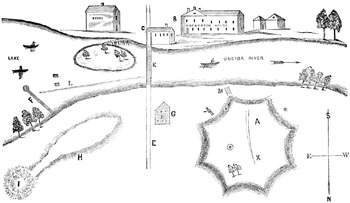
Illustration from Onondaga (vol. 2, 181) of earthworks in the Fort Brewerton (New York) area.

A later local antiquarian, William M. Beauchamp, wrote an unpaginated tribute to Clark, published in 1896 by the Onondaga Historical Association, in which he related that around 1840 Manlius was a village “then noted for literary culture.” Specifically, it had an active lyceum where Clark delivered a series of local history lectures in the winter of 1841–42. The positive response apparently inspired him to undertake the composition of Onondaga, which consumed the next seven years of his life.
Sadly, the public reception of Onondaga (in 1849) was a bitter disappointment. His publisher in Syracuse had not previously undertaken a project of that magnitude and grossly underestimated the resources required to produce two exhaustive volumes. Sales were dismal; only several hundred copies were properly bound. Subsequently, additional books were assembled haphazardly and sold at bargain prices. As if this were not enough, the printer's headquarters burned several years later and the plates were destroyed. Clark estimated he lost $3,000 on the project, a sizable sum even for a prosperous farmer. On the positive side, he published widely in periodicals and had access to a small but influential audience through his involvement in many scholarly organizations. In 1848 Geneva College (now Hobart College) awarded him an honorary AM in recognition of his work. As a representative in the New York State Legislature in 1855 he was praised for his service as chairman of the Committee on Indian Affairs. He died on 18 June 1869, a few months before the famed Cardiff Giant's discovery in a nearby village – a sensational hoax that generated widespread public curiosity and for all intents and purposes ended the Romantic Antiquarian movement.
Given Clark's lack of formal education and his geographic isolation, and the constraints of his profession, his research for Onondaga is remarkable. He visited the libraries of Cambridge, Massachusetts; Brown University; the New York State Historical Society; and the State Library at Albany. According to Beauchamp, Clark “advertised for a year in all the papers of the county for information on the subject, and personally visited all the old settlers that he could.” Moreover, Onondaga offers a unique ideological stance bridging the unknown past and unfolding nineteenth-century events. Ultimately it presents a complex vision of America that has been overlooked because it has been relegated to the genre of county histories.
IV. CLARK AND THE IROQUOIS
Reports on the discovery of antiquities run as a subnarrative throughout Onondaga; much history is also included. Clark traces the evolution of the salt industry in Syracuse from the days when explorers boiled brine in kettles on the shore of Onondaga Lake to the rise of massive processing yards. This enterprise led to one of the first US environmental disasters: the industrial poisoning of the lake, the geographic and spiritual center of the Onondaga Nation.
Clark's panoramic, fast-forward narrative recounts the rapid disappearance of primeval forest, the rise of a city and prosperous townships, and the accumulation of new wealth generated by rapid natural-resource consumption. The county's prehistory seems intrinsically connected to the narrative of industrial progress. He wrote,
In viewing the ancient fortifications, burying grounds and relics, so numerous in this county, and becoming satisfied that the history of these works was imperfectly understood, and that the materials for bringing it to light, were widely scattered – although unqualified, in many respects, to do justice to so important a subject, nevertheless, the author felt it a duty to proceed. (vol. 1, iii)
Being a lifelong friend of the Onondaga Nation and having spent much time with Indians, Clark was more sympathetic to their plight than many of his contemporaries. In fact, the Onondagas named him an honorary civil chief in 1850. He gathered materials for the “Indian mythology” section of Onondaga through interviews conducted with Indians in 1845. While flawed, his documentation of Iroquois oral lore is a significant contribution to knowledge. This investigation led him to conclude that Iroquois oral history was a mix of fable and fact that might shed some light on prehistory.
On the basis of native sources, he theorized that the Iroquois came as invaders from the north and seized control of central and western New York, conquering the indigenous Algonkian tribes. This view is not unique. The northern-invasion theory is advanced in both antiquarian and archaeological literature. Cadwallader Colden's The History of the Five Nations of Canada, first published in 1727, was influential in disseminating the theory (2–4). More recent archaeological evidence indicates Iroquois culture evolved in situ over several centuries (Tuck, 15–17).
Clark's research indirectly inspired Henry Wadsworth Longfellow to make a misguided attempt at uniting prehistory and history. Further, in Notes on the Iroquois, published in 1846, Henry Rowe Schoolcraft included a garbled misreading of Clark's Iroquois lore. On the former, Barbara Graymont wrote, “Longfellow's fanciful poem, ‘The Song of Hiawatha,’ though a moving and beautiful literary creation, had nothing whatsoever to do with the noted Iroquois chieftain and only served to obscure and confuse this leader's very great achievements” (27). On the subject of the latter, adding insult to injury, Schoolcraft not only confused Ojibwa and Iroquois legends, he also plagiarized Clark's writing. Beauchamp wrote that Clark
first gave prominence to the tale of Hiawatha, and the name of that great chief was utterly unknown to whites before. Schoolcraft took this bodily and all the credit which belonged to it. In his report on the Iroquois he made allusion to this among other legends but in his own later “Notes on the Iroquois” he appropriated the whole story. Clark called attention to the fact that he himself had previously furnished this for the New York Commercial Advertiser, and exposed Schoolcraft's unfairness afterwards.
V. SQUIER AND NEW YORK PREHISTORY
Unquestionably, Clark was influenced by Onondaga County's folklore that fuelled and drew support from antiquarian writing. In adulthood, however, through scholarly associations, he was exposed to rationalist approaches that were establishing modern archaeology. In particular, he corresponded with Ephraim George Squier (1821–88), whose Ancient Monuments of the Mississippi Valley (co-authored with E. H. Davis) was published in 1848 as the first volume in the influential Smithsonian Contributions to Knowledge series. While their work's rigor and precision earned them a place in the history of US archaeology, Squier and Davis ultimately reconfirmed Romantic Antiquarian theories. They concluded that the earthworks and artifacts they studied (most associated with the Hopewell and Adena cultures – the Mound Builders) displayed refinement beyond Native American capabilities.
Parting company with Davis, Squier penned the second volume in the Smithsonian series, which appeared in 1849: Aboriginal Monuments of the State of New York. He wrote,
In full view of the facts before presented, I am driven to a conclusion little anticipated when I started upon my trip of exploration, that the earth-works of Western New York were erected by the Iroquois or their western neighbors, and do not possess an antiquity going very far back of the discovery. (83)
Squier's pronouncement carried great weight. He essentially ended the Romantic Antiquarian debate pertaining to New York State, yet his conclusion in no way negates the possibility of a very different situation in the Ohio region.
In his chapter about Onondaga County, Squier praised Clark and includes a lengthy update in an appendix to Aboriginal Monuments of the State of New York with this introduction:
Since the foregoing pages were printed, a work on the early history of what is called the ‘Onondaga Country,’ has been published by Mr. J. V. H. Clark, of Manlius, Onondaga county. Mr. Clark's attention having been specially directed to the subject, he has collected with great industry, a large amount of information respecting the antiquities of that interesting region, which are embodied in his work; and from this are condensed the subjoined facts, additional to those heretofore presented. (169)
Seeking to keep pace with theoretical developments, Clark overlaid Onondaga with a veneer of rationality. He seldom indulges in wild speculation about the origin of antiquities. His wall of impartiality, however, has many gaps. A close reading reveals a conflicted allegiance to the Romantic Antiquarians, a belief in regional lore, and a vision running counter to the rational. He acknowledges European contact with the Iroquois in protohistoric and historic times but also proposes another earlier migration. These prehistoric emigrants were not annihilated by the Iroquois; they were their ancestors.
In Onondaga's fourth chapter, “Pagan Rites and Ceremonies,” Clark discusses views on Native American origins. While claiming impartiality, he focuses the reader on comparisons between Native American and Jewish traditions. He wrote, “It may be possible, and if we admit, (and we must) the testimony of divine revelation, it must be true that they and their institutions originated in a more enlightened ancestry than they themselves exhibit” (vol. 1, 69). This sentence indicates Clark believed Native American culture had its origins in another civilization. He was likely a believer in the Lost Tribes of Israel theory. The culture they brought with them, however, gradually degenerated.
VI. ANTIQUARIAN GOTHIC
At the same time Clark was writing Onondaga, Edgar Allan Poe's writing presented a strikingly similar perception of the American landscape. In turn, Poe was aided by prototypes established in Charles Brockden Brown's stories, most notably Edgar Huntly or Memoirs of a Sleep Walker (1799), widely considered the first true US novel to include Indians in the plot. A compelling articulation of the Romantic Antiquarian vision is found in Poe's “The Tale of the Ragged Mountains,” published in 1844.
Explained as a story of reincarnation, key events take place near Charlottesville, Virginia during the autumn of 1827 (Indian summer, according to Poe). A first-person narrator recounts the incidents surrounding the death of his friend Augustus Bedloe, who suffers from persistent “neuralgic attacks” (578). Bedloe is treated by Dr. Templeton, a practitioner of Mesmer's doctrines, who eases some of his patient's suffering through hypnosis. However, Bedloe also resorts to “habitual use of morphine, which he swallowed in great quantity, and without which he would have found it impossible to exist” (579).
Bedloe frequently walks in the nearby forested mountains, a setting no doubt inspired by Poe's recollections of his University of Virginia days. Yet it is worth noting that Bedloe wanders in the same area in which Thomas Jefferson conducted his famous Indian mound excavations recounted in Notes on the State of Virginia. Bedloe returns late from an excursion to find the narrator and Dr. Templeton anxiously waiting. He then recounts a curious experience he had that day, insisting it was neither dream nor hallucination. He entered a secluded ravine that was shrouded in mist. After hearing a mysterious drumbeat, he was startled by the sight of a man being chased by a hyena. The mist cleared, and Bedloe saw a fantastic city on a plain below:
The streets seemed innumerable, and crossed each other irregularly in all directions, but were rather long winding alleys than streets, and absolutely swarmed with inhabitants. The houses were wildly picturesque. On every hand was a wilderness of balconies, of verandas, of minarets, of shrines, and fantastically carved oriels. (581)
Poe juxtaposes images of the landscape's “dreary desolation” (579) with exotic images of a teeming city, locating precisely the essence of Romantic Antiquarian reveries: complex civilizations that once flourished in the wilderness. The primacy of non-rational, associative processes over the rational is signified by morphine intoxication – the opium reverie – another stock Romantic device employed by Poe. Bedloe's magnificent vision is accompanied by the disintegration of his identity. His health declines rapidly thereafter, and he dies from a poisonous leach bite accidentally administered by Dr. Templeton. Perceptions of the wilderness and various manifestations of the theme of disintegration and decay are preoccupations shared by American Romantic writers and antiquarians.
Clark's connection to the Romantic Antiquarians is evident in the better-known sections of Onondaga. Like Jefferson, whose clinical account of wantonly disinterring native graves is exceptionally gruesome, Clark dwells on the morbid and aberrant prehistoric discoveries while attempting to maintain a rationalist stance. This characteristic shows his affinity with the Gothic mode in Romanticism. Across Onondaga County, he is preoccupied with the disinterment of graves, skeletal abnormalities, and anomalies that seem to defy explanation and which are intrinsically related to the vision of a doomed landscape.
He makes little attempt to address what he presents as inexplicable and the silence disrupts his overall project, creating a cohesive narrative that encompasses Onondaga's past, present, and future. The discontinuities in Onondaga are the doors through which one gains access to its true vision, apparent once the façade of rationality and nationalistic optimism has been penetrated. Below is an example of one such place in the text, a passage recounting an unusual discovery found, poetically, where the city of Syracuse now stands:
The dark, gloomy and almost impenetrable swamp, now occupied by the city, was then a favorite resort for wolves, bears, wild-cats, mud-turtles, and swamp rattlesnakes …
Near the west bank of the creek [Onondaga Creek], was an extensive Indian burying-ground, where skeletons have frequently been disinterred, and are occasionally to this day – two having been exhumed during the past year. At the time the west locks were constructed at Syracuse, in 1819, over one hundred were taken up. In excavating the canal for the red mill, on the east bank of the creek, several skeletons were found. In 1843, one of extraordinary size was disinterred; one of the lower bones of the leg being set beside the limb of a tall man, reached far above his knee. The skull was comparatively large, and the jaws were surrounded with a full set of double teeth, all around. They were perfectly sound, covered with a beautiful enamel of the most perfect whiteness. (vol. 2, 83–84)
In his seminal interpretations of eighteenth- and nineteenth-century American Gothic fiction, Leslie A. Fiedler contends that the specters that haunt the Gothic forest constructed by eighteenth- and nineteenth-century Euro-American writers represent hatred and fear of Native Americans, accompanied by guilt. Before relating the account of the opened graves, Clark describes his perception of the natural landscape that existed before Syracuse replaced it. Far from idyllic, he paints a dismal portrait of a “dark, gloomy and almost impenetrable swamp” inhabited by menacing beasts. The Gothic coloring is readily apparent in Onondaga and expresses ambivalence concerning fierce struggles between Europeans and the Iroquois.
A haunted America built upon Indian burial grounds is a pervasive and persistent image explained insightfully by Gesa Mackenthun, who establishes how “bad places” represented in horror narratives are associated frequently with Indian burials. Mackenthun also shows how, through the occlusive process, guilt and unresolved concerns related to Indians have been transformed into narratives about disintegrating, dysfunctional families (in which certain conditions of signification are present). Clark's description of the giant skeleton with its double row of gleaming teeth is associated with the haunted landscape from which the Gothic-industrial city of Syracuse rises. Rather than focus upon family disintegration, impractical in Onondaga, Clark projects the Indian crisis on the city; rising from a bad place, it is presented as uniformly decaying, dark, and sinister. In Onondaga the transition from a sepulchral forest to the grey, inorganic industrial city of Syracuse is an unbroken progression.
The largest concentration of antiquarian writing in Onondaga occurs in the second volume, which is a compendium of township histories, including reports of local earthworks and artifacts. His documentation is formulaic, presenting information about his observation of the terrain, numerical estimates (such as the site's acreage, height of earthen walls, and depth of ditches), listings of artifacts and unique discoveries, and reminiscences of various inhabitants. Below is a representative site report:
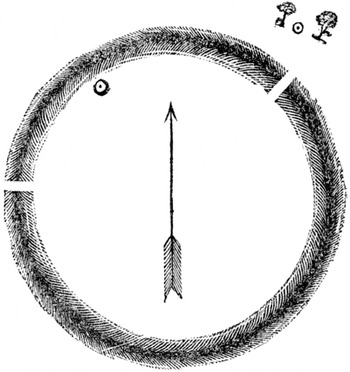
On lot eighty-four, on the farm now owned by Caleb Brown, Esq., about forty rods south of the road, was a circular fort which covered over three acres of ground. Around this was an embankment, about two feet higher than the interior area of the fort, and outside the embankment, was a ditch four or five feet deep. There was a wide gateway on the west side, and a smaller one on the north-east, which gave communication to a spring a short distance from the fort. In digging about the western gateway, were found several pieces of timber, having the marks of iron tools upon them. In a well which was some fourteen feet deep, and had probably at some previous time been timbered up, was found a quantity of charred corn, of the variety called Virginia corn. Bushels of fragments of earthen ware have been picked up on this ground, and even to this day, there are multitudes of shells and fragments of shells lying around. This locality, which is at this time (1848) under the plow, can be easily traced by the almost black appearance of the soil. Skeletons and human bones, some of them of extraordinary size, were frequently turned up by the plow in former years. All these localities were convenient to durable springs of excellent running water. (vol. 2, 326–27)
The circular “fort” reveals evidence of occupation by people familiar with the use of metal tools. The implication, although not stated outright, is that Native Americans did not build or inhabit the earthworks. Inside the enclosure is a dry well (most likely a storage pit for corn) that offers a view into the depths of the ring of black earth but no insight into its past. The passage includes yet another report of the discovery of human remains of “extraordinary size.” This narrative field is a mosaic of discrete fragments: bits of local lore mixed with personal observation like the shattered vessels, pieces of shell, and skeletal remains, further dispersed with each turning of the earth. Temptingly, like a poetic metaphor, the spring bubbles up outside the earthwork, suggesting clarity, reason, and renewal against decay and confusion within.
Illustration from Onondaga (vol. 2, 327) of the circular earthwork at Elbridge.

VII. THE RUINS OF POMPEY
The antiquarian masterpiece contained in Onondaga is a section entitled “Antiquities of the Township of Pompey.” Clark describes this part of the county's large glacial drumlins, which were an ideal location for the hilltop fortresses of the Iroquois during their nascence; his descriptions of the area's antiquities are a museum of Romantic/Gothic elements. Many Pompey sites are protohistoric and historic, showing much evidence of contact between the Iroquois and European visitors. In the blackened earth beneath the pastoral beauty, Clark reveals a wasteland of prehistoric remains.
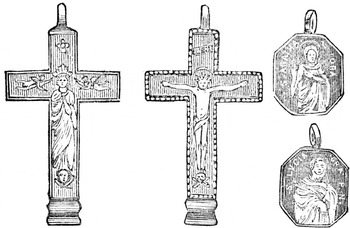
Illustration from Onondaga (vol. 2, 280) of metal trade items found in the vicinity of Pompey.

Pompey, more than any other township in the book, was haunted by the past that arose from the underworld as the Euro-American settlers sought to harness the land. Clark wrote, “At every plowing something new is brought to light” (vol. 2, 256). He identifies no less than fifteen archaeological sites in this township. Earthworks, human skeletons, and artifacts of every variety were abundant; unusual finds are chronicled page after page. He describes the unearthing of a human skeleton, which had a complete set of surgical instruments at its side, and the discovery of a vise: “It was beautifully engraved all over, with representations of dogs, bears, deer, squirrels, fishes, birds, and was altogether a beautiful specimen of workmanship” (vol. 2, 260). The rapid juxtaposition of pastoral imagery with strange artifacts adds a surreal element to the descriptions. His report on an earthen enclosure located at “Indian Hill” is a representative example:
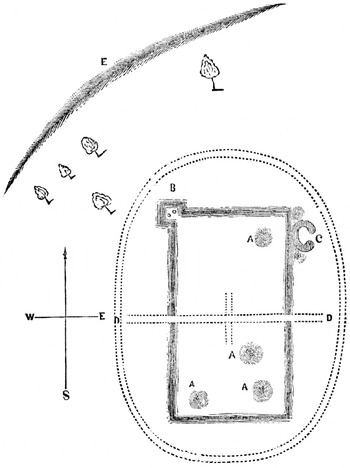
When the first settlers came here in 1791, '92, '93, this ground was covered with thorns, wild plumtrees and other shrubs, indicating that it had been cleared and cultivated at some previous time. When it was first cultivated in these latter times, gun barrels, sword blades, hatchets, knives, axes, clay pipes, copper kettles, brass chains, beads of glass, pewter plates, rings for the fingers, ear and nose jewels, lead balls, iron gate hangings, copper coins, tools for working wood and iron, and other articles used by civilized men and unknown to savages, together with human bones, were frequently found on or near the earth's surface. Many of our early settlers, now living, distinctly recollect the appearance of the enclosure entitled “the fort,” upon and about which, trees had grown to a considerable size. Its earthen walls were then some four or five feet high, having evidently been considerably lessened by the ravages of time. It was circular, and from three hundred to three hundred and fifty feet in diameter. There was but one gateway, and that quite narrow. (vol. 2, 255–56).
Clark identified most of the metallic artifacts he examined as being of French, English, and Dutch origin and does not indulge in antiquarian reverie. He describes a brass medal found near Indian Hill in 1821: “It was without date, on one side of it was a figure of Louis XIV, king of France and Navarre” (vol. 2, 255). He finds evidence of exchange between the Iroquois and Europeans at most Pompey sites, but his assessment of the earthworks is inaccurate, according to archaeological discoveries. Clark contends that the Pompey earthworks had been forts and trading posts built by Europeans. In actuality, most of the Pompey sites showing evidence of trade relations with Europeans were strongholds of the Onondaga Nation. The residents had acquired a wealth of goods.
Illustration from Onondaga (vol. 2, 277) showing an earthwork outline (probably historic Iroquois) at Pompey.

The Gothic mode is apparent throughout “Antiquities of the Township of Pompey.” In the description of the burial ground at Indian Hill, the mode moves to the forefront. He claims all the skeletons unearthed were found in a sitting position, facing east, and accompanied by burial offerings; trees at least two hundred years old had grown over them. Many of these burials were opened by grave robbers, and Clark includes a cautionary tale as well as an emotional plea:
This and all the other burying places have been resorted to by antiquaries and others, more curious than considerate, for the purpose of obtaining Indian skeletons. To so great an extent has this rude practice been carried, that perhaps at this time it would be difficult to find one by seeking – as if it could be no harm to rob an Indian's grave. These noble men have gone; their generations sleep in our cultivated fields; our harvests wave upon their hills; we have robbed them of all else, and we should at least spare their places of sepulchre. Many years ago, when the settlements were first made, a man, whose name deserves not to be remembered, made a regular business of disinterring the bones contained in the Indian graves, taking whatever was found in them to himself. Hundreds of skeletons have been removed for anatomical purposes, and to enlarge the cabinets of the curious. In this unhallowed business he amassed several hundred dollars' worth of property. The Indians, who are remarkable for their regard for the dead, who, though Pagan in their worship, are shining examples for Christians to follow, in respect to the violation of these sacred deposits, were at one time on the point of unceremoniously chastising him in a most summary manner. He eluded their vengeance and never dared visit the country afterwards. (vol. 2, 257–58).
His view on the desecration of Native American graves is easily understood in our time but was less so in his – an era when thousands of Indian graves were disinterred for scientific study, agricultural progress, industry, and myriad private collectors. In this passage, antiquarians are cast into the Gothic realm of grave robbers and body snatchers: dark characters clandestinely extracting commodities from the realm of decay.
Near “the castle,” another site one mile from “Indian Hill,” Clark reports,
A mortar dug out of solid rock may be seen at the brook near by, holding nearly a peck. In the steep banks of this brook are numerous evidences of its having been the scene of a hard fought battle. Articles of war, such as gun-barrels and bullets, have been found, and also knives, axes, &c., upon this particular spot. (vol. 2, 258–59)
Along with European items were found stone implements such as arrowheads, gouges, and pestles. He describes a gun barrel that had become firmly embedded in a tree, only a third of its total length protruding. In these descriptions is found yet another variation upon the antiquarian myth of an apocalyptic battle. Owing to the fact that some Pompey sites were places of Iroquois–European contact, Clark's contentions have a stronger connection to fact than others who claimed that Roman legions once battled barbarians in Ohio.
For Clark, the past is essentially untranslatable, unknowable, and non-rational. Onondaga is not a chronicle of great men (certainly not women) building a nation. It is a landscape portrait, preoccupied with a particular dark view of nature and human nature echoed in other literary work of that time, a world that is essentially doomed by its past. Even in the face of evidence, Clark eludes fully committing to a single explanation of Pompey's antiquities and instead retreats into ambiguity. What endures is the afterimage of carnage. He emphasizes the unsolvable mysteries presented by the sites and provides a little leeway for antiquarian theories:
When, or by what civilized men these fortifications were built, it were in vain for us to inquire; obscurity draws her doubtful veil over the whole, and we dimly see in the faded traditions and chronicles of the past, that these were the works of architects not barbarian, at a period not exceedingly remote. Indian tradition still keeps alive the fact that these grounds have been the theatre of blood; and such is their abhorrence of scenes once enacted here, that except in a few very rare instances, they do not visit the regions near the ancient forts and burying grounds. “Ote-queh-sa-he-eh” is their exclamation – “Tis the field of blood.” (vol. 2, 262–63).