Introduction
Family carers of people with dementia experience high levels of anxiety and depression (Pinquart and Sorensen, Reference Pinquart and Sorensen2003; Crespo et al., Reference Crespo, Lopez and Zarit2005; Cooper et al., Reference Cooper, Balamurali, Selwood and Livingston2007). We would expect “better” coping strategies to reduce psychological morbidity, because coping is the intervening factor between stressor and distress according to the Transactional Model of Stress and Coping (Lazarus and Folkman, Reference Lazarus and Folkman1984). In addition, there has been consistent observational evidence that coping and morbidity are strongly linked in dementia carers (Cooper et al., Reference Cooper, Katona, Orrell and Livingston2008b; Li et al., Reference Li, Cooper, Bradley, Shulman and Livingston2012). Carer coping, therefore, appears an important and theoretically modifiable determinant of concurrent carer anxiety and depression, and there is preliminary evidence to suggest coping predicts such morbidity over time. Our recent systematic review and meta-analysis of observational studies found family carer dysfunctional coping behaviors to be strongly associated with greater psychological morbidity, while coping strategies based on acceptance and seeking emotional support were associated with less morbidity (Li et al., Reference Li, Cooper, Bradley, Shulman and Livingston2012). Solution-focused coping was not significantly associated with concurrent morbidity, yet it was associated with increased morbidity longitudinally, perhaps because dementia is a progressive illness, which becomes less amenable to problem solving over time (Cooper et al., Reference Cooper, Katona, Orrell and Livingston2008b; Li et al., Reference Li, Cooper, Bradley, Shulman and Livingston2012). Furthermore, coping styles have been shown to remain stable in the absence of targeted intervention (Goode et al., Reference Goode, Haley, Roth and Ford1998; Cooper et al., Reference Cooper, Katona and Livingston2008a). Therefore, coping is an important target for clinical intervention.
Several reviews of family carer interventions have included coping as an outcome measure of interest, but none have systematically explored intervention effects on different types of coping, or coping as a potential mediator of treatment effects on psychological morbidity (Schulz et al., Reference Schulz2002; Sorensen et al., Reference Sorensen, Pinquart and Duberstein2002; Selwood et al., Reference Selwood, Johnston, Katona, Lyketsos and Livingston2007; Vernooij-Dassen et al., Reference Vernooij-Dassen, Draskovic, McCleery and Downs2011). For example, the recent Cochrane review of cognitive-reframing interventions for family carers found no treatment effects on coping (Vernooij-Dassen et al., Reference Vernooij-Dassen, Draskovic, McCleery and Downs2011), but the authors treated “coping” as a unitary outcome measure rather than recognizing the different types of coping strategies.
In the current study, we systematically reviewed all randomized controlled trials (RCTs) of interventions measuring family carer coping and psychological morbidity as outcomes. We investigated whether interventions changed coping, and how this related to changes in psychological morbidity. We tested our hypothesis that interventions successful in decreasing carer depression or anxiety symptoms would also decrease dysfunctional coping, or increase emotional support and acceptance-based coping.
Methods
Search strategy
We searched EMBASE, MEDLINE, PsycINFO, Web of Science, Cochrane Library, CINAHL, and AMED up to July 2011 using search terms: carer or caregiver or caring or relative or supporter or family; dementia or Alzheimer or cognitive impairment; cope or coping; and randomized or controlled or clinical trial. We hand searched relevant reviews and the references of included studies. We also asked authors of included studies whether they were aware of any further studies.
Inclusion and exclusion criteria
We included peer-reviewed, RCTs of any intervention, published in English that reported baseline and follow-up quantitative outcomes for anxiety or depression, and coping in family carers of people with any form of dementia. We included only studies that used standardized, quantitative measures of coping. Studies that reported data on carers of people without dementia were excluded, unless they reported the results for dementia carers separately.
Quality assessment
Two authors (Ryan Li and Allana Austin) independently rated the quality of each study, blind to each other's ratings, using a checklist for RCTs adapted from the Critical Appraisal Skills Programme (Public Health Resource Unit, 2006). For any given study, one point was awarded where there was sufficient reporting to provide a “yes” answer to each of the following questions, where necessary we retrieved source studies for coping measures to determine their validity and reliability:
• Were participants appropriately allocated to intervention and control groups?
• Were study personnel “blind” to participants’ study group?
• Were all of the participants who entered the trial accounted for at its conclusion?
• Were the participants in all groups followed up and data collected in the same way?
• Was there a power calculation with sufficient power and people included (>80%) to detect an effect on the primary outcome?
• Was a valid and reliable measure of coping used?
Disagreements were resolved through discussion with Gill Livingston. As well as giving a total rating for each study, we labeled a study as “higher quality” if it met all three criteria that we judged were the most important: using a valid and reliable measure of coping, blinding of study personnel, and sufficient accounting of all participants at trial conclusion.
Data extraction
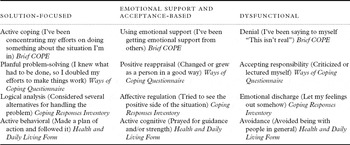
We categorized interventions based on the content of intervention, group- or individual- or dyad-based, and the number of sessions. For each study, we extracted endpoint and follow-up data for treatment and control as well as any reported effects on carer anxiety, depression, and coping (categorized as solution-focused, emotional support and acceptance-based, or dysfunctional; see Table 1). We also reported relevant mediator, moderator or subgroup analyses relating to coping and psychological morbidity. Where relevant outcome data were measured but not sufficiently reported for our purposes, we wrote to the authors to request such data (means and standard deviations).
Classification of coping strategies, from Li et al. (Reference Li, Cooper, Bradley, Shulman and Livingston2012). Selected coping subscales or factors shown with exemplar items in (brackets) and source coping measure

To test our hypothesis, we reported the coping changes for studies where intervention significantly decreased depression or anxiety, where intervention did not significantly improve morbidity, and for each type of intervention (including meta-analyses where sufficient data were available).
Meta-analysis
We conducted fixed-effect meta-analyses of intervention effects on each outcome measure, using Review Manager 5 software (The Cochrane Collaboration, 2008). We employed a fixed-effect model because our meta-analyses were of similar interventions for similar populations (family carers of people with dementia), and a random-effects model is likely to be imprecise when there are few studies (Borenstein et al., Reference Borenstein, Hedges, Higgins and Rothstein2010). For trials with multiple arms, we took treatment-as-usual or waitlist as the comparator. We calculated standardized mean differences (SMDs) for continuous outcomes, and relative risk (RR) for binary outcomes. We used intent-to-treat (ITT) data where available for continuous outcomes, and by using the number of participants initially randomized as the denominator for dichotomous outcomes.
Results
Description of studies
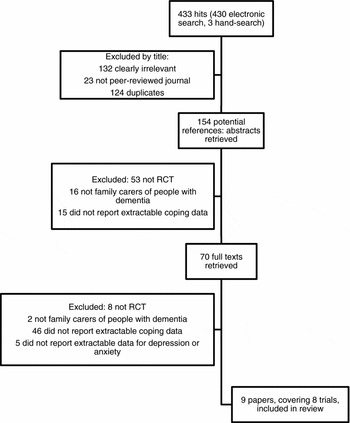
We identified 433 publications from our search (Figure 1 shows flow of papers from search to selection). We retrieved 154 abstracts of potentially relevant papers, of which eight trials (published in nine papers) met inclusion criteria. The most common reasons for excluding a study were not being an RCT, and not reporting coping outcomes.
Flowchart of included/excluded studies.

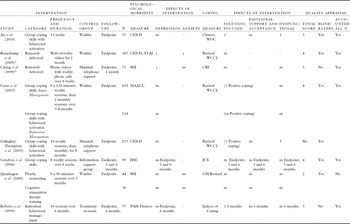
Table 2 summarizes the included studies. We obtained unpublished data for one study (Beauchamp et al., Reference Beauchamp, Irvine, Seeley and Johnson2005). All studies used valid and reliable coping measures, and the four studies with the highest quality ratings also blinded study assessors and accounted for all participants (Chang, Reference Chang1999; Roberts et al., Reference Roberts1999; Beauchamp et al., Reference Beauchamp, Irvine, Seeley and Johnson2005; Au et al., Reference Au2010). All studies were of psychological interventions involving family carers, all were conducted in North America with the exception of Au and colleagues (Reference Au2010), which was of Chinese carers in Hong Kong. Most carers were female, with four of eight trials including only women. Coon et al. (Reference Coon, Thompson, Steffen, Sorocco and Gallagher-Thompson2003) reported results for two treatment arms in addition to their waiting list control group. These were labeled as Depression Management and Anger Management and we categorized them respectively as group coping skills training with and without behavioral activation.
Summary of study characteristics and findings

*Study found significant treatment effect of decreasing depression or anxiety. N indicates number of carers randomized into intervention and control. Effects of intervention versus control reported for endpoint (or months post-intervention as specified): ↓ = significant decrease; ↑ = significant increase; ns = no significant change; – = not measured. All studies used valid and reliable measures of coping.
BSI = Brief Symptom Inventory; CRI = Coping Resources Inventory; CSI = Coping Strategies Inventory; CES-D = Centre for Epidemiologic Studies Depression Scale; HSC = Hopkins Symptoms Checklist; JCS = Jalowiec Coping Scale; MAACL = Multiple Affect Adjective Checklist; PAIS = Psychosocial Adjustment to Illness Scale; STAI = State-Trait Anxiety Index; WCCL = Ways of Coping Checklist; WOC = Ways of Coping.
Coping changes in interventions that significantly improved psychological morbidity
All eight studies reported depressive symptoms as an outcome measure. To test our hypothesis that interventions may decrease depression or anxiety through changing coping style, we identified the two studies in which depressive symptoms significantly decreased (Chang, Reference Chang1999; Beauchamp et al., Reference Beauchamp, Irvine, Seeley and Johnson2005). Only one of the three studies reporting anxiety symptoms found they were decreased in the intervention group (Beauchamp et al., Reference Beauchamp, Irvine, Seeley and Johnson2005).
Neither study measured emotional support and acceptance-based coping. The smaller study (N = 71) found that both intervention and control used less dysfunctional coping over time but this reduction did not differ significantly between groups (Chang, Reference Chang1999). Chang (Reference Chang1999) also found no differences between groups in solution-focused coping at end of intervention and one-month post-intervention. The larger study did not measure dysfunctional coping, and found no significant treatment effects on solution-focused coping (N = 299, repeated measures ANOVA, F = 0.36, p = 0.547) (Beauchamp et al., Reference Beauchamp, Irvine, Seeley and Johnson2005).
Summary
There was not much evidence, but that which existed found that neither dysfunctional nor solution-focused coping changed when depression or anxiety improved.
Coping changes in interventions that did not improve psychological morbidity
Four studies found that depression or anxiety were not significantly reduced, and reported a significant intervention effect on coping. All four interventions focused on coping or behavioral management skills using cognitive-behavioral principles. One study reported increased solution-focused and dysfunctional coping (Au et al., Reference Au2010), one reported increased solution-focused coping only (Roberts et al., Reference Roberts1999), and two reported increased positive coping (Coon et al., Reference Coon, Thompson, Steffen, Sorocco and Gallagher-Thompson2003; Gallagher-Thompson et al., Reference Gallagher-Thompson, Coon, Solano, Ambler, Rabinowitz and Thompson2003). Positive coping is a mixture of solution-focused with emotional support and acceptance-based strategies.
Positive coping
In both studies reporting a significant treatment effect on positive coping, Coon et al. (Reference Coon, Thompson, Steffen, Sorocco and Gallagher-Thompson2003) (Anger Management arm, N = 89, F = 3.0, p < 0.05) and Gallagher-Thompson et al. (Reference Gallagher-Thompson, Coon, Solano, Ambler, Rabinowitz and Thompson2003) (N = 213, F = 6.77, p < 0.05), the reduction in depressive symptoms versus control approached significance (F = 2.9, p = 0.06, Coon et al. (Reference Coon, Thompson, Steffen, Sorocco and Gallagher-Thompson2003); F = 4.96, p = 0.06; Gallagher-Thompson et al. (Reference Gallagher-Thompson, Coon, Solano, Ambler, Rabinowitz and Thompson2003)).
Dysfunctional coping
Seven studies measured dysfunctional coping, and no intervention significantly decreased its use. Among the three studies in which the decrease in depression approached significance, one found a trend toward decreased dysfunctional coping versus control (N = 213, F = 2.86, p = 0.06) (Gallagher-Thompson et al., Reference Gallagher-Thompson, Coon, Solano, Ambler, Rabinowitz and Thompson2003), one found no difference between groups (N = 130, F = 2.0, p = 0.14) (Coon et al., Reference Coon, Thompson, Steffen, Sorocco and Gallagher-Thompson2003), and one found significantly increased dysfunctional coping in the treatment group (N = 27, F = 5.65, p = 0.03) (Au et al., Reference Au2010).
Emotional support and acceptance-based coping
The four studies measuring emotional support and acceptance-based coping found no differences in its use between intervention and control at endpoint, but neither did they find a significant difference in psychological symptoms (Gendron et al., Reference Gendron, Poitras, Dastoor and Perodeau1996; Roberts et al., Reference Roberts1999; Quayhagen et al., Reference Quayhagen2000; Au et al., Reference Au2010).
Summary
No intervention significantly decreased dysfunctional coping, including studies where there were trends toward decreased depression after intervention. No intervention increased emotional support and acceptance-based coping, but it was not measured in the successful interventions. Interventions that increased solution-focused coping did not significantly decrease depressive symptoms.
Types of intervention
Two categories of interventions, group coping skills interventions with and without behavioral activation, provided sufficient outcome data for meta-analysis of depression and coping outcomes.
Group coping skills interventions (without behavioral activation)
Two studies delivered eight to ten sessions of group-based interventions for family carers, designed to teach coping skills, problem solving, and stress management, alongside provision of information on dementia and care planning, and mutual support (Gendron et al., Reference Gendron, Poitras, Dastoor and Perodeau1996; Coon et al., Reference Coon, Thompson, Steffen, Sorocco and Gallagher-Thompson2003). Both interventions used cognitive-behavioral techniques including behavior modification, cognitive reframing, assertive communication, and relaxation.
Coon and colleagues (Reference Coon, Thompson, Steffen, Sorocco and Gallagher-Thompson2003) showed that those in the intervention group used more positive coping strategies after intervention, and a trend toward fewer depressive symptoms compared with the waitlist control post-intervention. Dysfunctional coping did not significantly differ between groups (Coon et al., Reference Coon, Thompson, Steffen, Sorocco and Gallagher-Thompson2003). Gendron and colleagues (Reference Gendron, Poitras, Dastoor and Perodeau1996) found no significant intervention effects on depression or coping style (emotional support and acceptance-based, dysfunctional and solution-focused) up to six months after the intervention.
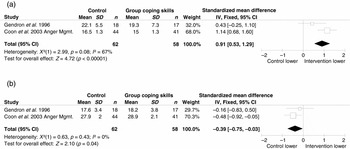
We found on meta-analysis of these two studies that depressive symptoms were significantly reduced immediately after the interventions (N = 120, SMD = 0.91, 95% CI = 0.53–1.29, p < 0.00001; Figure 2a), and dysfunctional coping was increased compared with the control groups (SMD = −0.39, 95% CI = −0.75 to −0.03, p = 0.04; Figure 2b).
Fixed-effect meta-analyses for group coping skills interventions, showing a significant effect of fewer depressive symptoms and a significant effect of more dysfunctional coping versus control, at endpoint of intervention (not adjusted for baseline). Effects right of midline indicate favorable outcomes for intervention group. (a) Depression and (b) Dysfunctional coping.

Group coping skills interventions with behavioral activation
Three studies delivered 10–13 sessions of group-based, cognitive-behavioral coping skills interventions with the additional component of behavioral activation that is encouraging family carers to develop pleasant activities as a means to improving mood (Coon et al., Reference Coon, Thompson, Steffen, Sorocco and Gallagher-Thompson2003; Gallagher-Thompson et al., Reference Gallagher-Thompson, Coon, Solano, Ambler, Rabinowitz and Thompson2003; Au et al., Reference Au2010). All were based on the Coping with Caregiving treatment manual (Gallagher-Thompson et al., Reference Gallagher-Thompson2002).
Au and colleagues (Reference Au2010) found that in 37 family carers in Hong Kong, both dysfunctional coping and solution-focused significantly increased in the treatment group after accounting for baseline data, while there was a trend toward fewer depressive symptoms versus control. Gallagher-Thompson and colleagues (Reference Gallagher-Thompson, Coon, Solano, Ambler, Rabinowitz and Thompson2003) found that positive coping was significantly increased in the treatment group versus minimal telephone support, but decreases in dysfunctional coping and depression only approached significance. The Depression Management group in the Coon and colleagues (Reference Coon, Thompson, Steffen, Sorocco and Gallagher-Thompson2003) study showed a trend toward decreased depressive symptoms versus waitlist, and no significant effects on positive coping or dysfunctional coping.
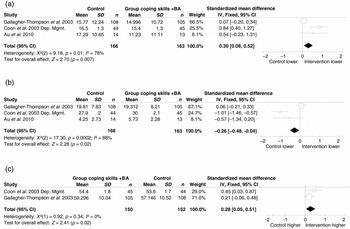
Meta-analysis found significantly fewer depressive symptoms (three studies, N = 329, SMD = 0.30, 95% CI = 0.08–0.52, p = 0.007; Figure 3a), more positive coping (two studies, N = 302, SMD = 0.28, 95% CI = 0.05–0.51, p = 0.02; Figure 3c), as well as more dysfunctional coping (3 studies, N = 329, SMD = −0.26, 95% CI = −0.48 to −0.04, p = 0.02; Figure 3b) in the intervention group versus control at endpoint.
Fixed-effect meta-analyses for group coping skills interventions with behavioral activation, showing significant effects of fewer depressive symptoms, more positive coping and more dysfunctional coping versus control, at endpoint of intervention (not adjusted for baseline). Effects right of midline indicate favorable outcomes for intervention group. (a) Depression, (b) Dysfunctional coping, and (c) Positive coping.

Remotely delivered interventions
Two studies tested the efficacy of delivering coping and behavioral management strategies through videos (Chang, Reference Chang1999; Beauchamp et al., Reference Beauchamp, Irvine, Seeley and Johnson2005).
Beauchamp and colleagues (Reference Beauchamp, Irvine, Seeley and Johnson2005) provided family carers with Web-based videos, containing information on common caregiving issues alongside cognitive-behavioral coping skills; there was no further therapist input. The intervention showed a small significant effect in decreasing both depressive and anxiety symptoms versus waitlist. There were no significant effects on solution-focused coping.
Chang (Reference Chang1999) provided family carers with video demonstrations of dressing and eating, communication and behavioral activation. Nurses made weekly telephone calls to provide support on cognitive reframing and problem solving as well as specific advice on managing behavioral symptoms. The study found depression significantly decreased in the treatment group versus control over the 12 weeks of follow-up, but no significant treatment effect on anxiety. There were no significant treatment effects on dysfunctional or solution-focused coping.
Individual behavioral management
One study delivered ten sessions of problem-solving therapy to individual family carers, based on cognitive-behavioral principles (Roberts et al., Reference Roberts1999). There were no significant differences between treatment and control for depression and our hypothesized coping changes at endpoint and six-month follow-up. The only significant effect was that solution-focused coping increased in the treatment group versus control at six-month follow-up. A subgroup analysis found that solution-focused coping interacted significantly with treatment: carers who began with low use of solution-focused coping became less depressed after counseling, while carers who began with high use of solution-focused coping became less depressed in the control group.
Dyadic interventions
One study involved the spousal carer together with the care recipient in eight sessions of dyadic counseling aimed at promoting conflict resolution, anger and stress management, and improving communication (Quayhagen et al., Reference Quayhagen2000). There were no significant changes in the treatment group versus waitlist on depression or any of the three measures of coping.
Cognitive stimulation therapy training
One study trained family carers to deliver an intensive cognitive stimulation program to person with dementia (Quayhagen et al., Reference Quayhagen2000). This small study showed no significant effect on any outcome measure versus waitlist control.
Summary
Most studies were of group coping skills interventions alone, or with a behavioral activation component. Meta-analysis found both interventions efficacious in reducing depressive symptoms, while increasing dysfunctional coping. The latter showed a trend toward reducing depression, positive coping increased yet dysfunctional coping did not decrease.
The two different remotely delivered interventions were also shown to improve psychological morbidity, yet neither resulted in any change in measured coping.
Discussion
Many psychological interventions targeting coping style have been developed to reduce the high psychological morbidity in family carers of people with dementia. Despite this, we found only eight of these evaluated in RCTs measuring the impact of the proposed treatments on coping strategies. Our most striking finding from meta-analysis was that group coping skills interventions, whether or not they included a behavioral activation component, were efficacious in decreasing depression, and also increased dysfunctional coping immediately post-intervention. Our hypothesis that interventions successful in decreasing carer depression would also decrease dysfunctional coping was not supported.
There was some evidence to suggest that increasing positive coping strategies was helpful, and good evidence to suggest that improvement in depressive or anxiety symptoms was not related to change in the use of solution-focused strategies. As positive coping is a mixture of emotional support and acceptance-based and solution-focused strategies, this gives preliminary support to our hypothesis that increasing emotional support and acceptance-based coping is associated with improvement in depression and anxiety. Nonetheless, there was no direct evidence for this. Neither of the two studies reporting a positive treatment effect on depression nor anxiety specifically measured emotional support and acceptance-based coping (Beauchamp et al., Reference Beauchamp, Irvine, Seeley and Johnson2005).
In the only two studies where the intervention significantly decreased depression or anxiety, there were no significant effects on solution-focused coping (Chang, Reference Chang1999; Beauchamp et al., Reference Beauchamp, Irvine, Seeley and Johnson2005). One of those studies was among the most rigorous in the review and also the largest, with nearly 300 participants (Beauchamp et al., Reference Beauchamp, Irvine, Seeley and Johnson2005). Correspondingly, the two studies showing significantly increased solution-focused coping found no treatment effect on depression (Roberts et al., Reference Roberts1999; Au et al., Reference Au2010) or anxiety (Roberts et al., Reference Roberts1999). These findings are in line with our recent meta-analysis of cross-sectional studies that found no significant association between solution-focused coping and psychiatric morbidity (Li et al., Reference Li, Cooper, Bradley, Shulman and Livingston2012).
A possible explanation of our findings is that interventions effective in promoting coping strategies may work by initially increasing carers’ coping attempts in all domains, including those they are using already, so dysfunctional coping is initially reinforced. Strategies such as denial or disengagement may serve as protective mechanisms against stress in the short term (Lazarus, Reference Lazarus and Brenitz1983; Au et al., Reference Au2010). More proactive attempts at coping would also increase the likelihood of failures, resulting in self-blame (Curry et al., Reference Curry, Marlatt and Gordon1987). In consideration of our previous and current findings, we would expect an intervention effective in improving psychological morbidity to increase emotional support and acceptance-based coping over a longer period of follow-up, even if dysfunctional coping may not decrease initially. No such study has yet been reported.
Four of eight trials in the current review showed a treatment effect on coping immediately after intervention (Roberts et al., Reference Roberts1999; Coon et al., Reference Coon, Thompson, Steffen, Sorocco and Gallagher-Thompson2003; Gallagher-Thompson et al., Reference Gallagher-Thompson, Coon, Solano, Ambler, Rabinowitz and Thompson2003; Au et al., Reference Au2010). This is noteworthy because family carers’ coping styles have generally been shown to remain stable over six months to two years in the absence of a targeted intervention (Goode et al., Reference Goode, Haley, Roth and Ford1998; Powers et al., Reference Powers, Gallagher-Thompson and Kraemer2002; Cooper et al., Reference Cooper, Katona and Livingston2008a). All four interventions delivered coping or behavioral management skills using cognitive-behavioral principles, providing preliminary evidence that family carer coping is modifiable given the right kind of intervention. This is supported by a larger evidence base in other populations, for example, among HIV patients for whom RCTs of cognitive-behavioral and stress management interventions have shown efficacy in increasing emotional support and acceptance-based coping (Harding et al., Reference Harding, Liu, Catalan and Sherr2011). An RCT that has shown a significant treatment effect on emotional support and acceptance-based coping (cognitive reframing) also delivered coping skills training to carers of people with dementia using cognitive-behavioral principles, but did not measure carer mental health (Ducharme et al., Reference Ducharme, Levesque, Giroux and Lachance2005).
The conclusions of our review are limited by the relatively small evidence base, and many of the studies were small. Meta-analysis was useful in this respect as it allowed us to pool studies, many of which were by the same research team following similar protocols, to increase effective statistical power. Nonetheless, we could not conduct meta-analyses for all outcome measures and interventions. The absence of statistically significant treatment effects on coping strategies could reflect a lack of statistical power in some studies, including possible ceiling and floor effects (Zarit and Leitsch, Reference Zarit and Leitsch2001). Several studies reported coping skills-based interventions or described them as based on the Transaction Model of Stress and Coping (Lazarus and Folkman, Reference Lazarus and Folkman1984), yet did not measure coping strategies as an outcome (for example, (Burgio et al., Reference Burgio, Stevens, Guy, Roth and Haley2003; Hebert et al., Reference Hebert2003; Akkerman and Ostwald, Reference Akkerman and Ostwald2004). We were therefore unable to include them in the review. Finally, no study reported relevant mediator or moderator analyses, which could have allowed us to draw more direct conclusions regarding coping as a treatment mechanism for psychological morbidity.
Conclusion
Group coping skills interventions increased dysfunctional coping in the short term but this did not prevent psychological morbidity from improving. We found consistent evidence that change in solution-focused coping was unrelated to change in carers’ psychological morbidity. There was a lack of evidence about whether interventions can change carers’ emotional support and acceptance-based coping, whether this is helpful to them, and a general lack of studies with long-term follow-up. Given the anticipated increases in family carers of people with dementia, the high prevalence of anxiety and depression in this population (Mahoney et al., Reference Mahoney, Regan, Katona and Livingston2005), and the relative lack of effective interventions (Selwood et al., Reference Selwood, Johnston, Katona, Lyketsos and Livingston2007), we need to develop the evidence base on reducing their morbidity and identifying the components of effective interventions. Studies that specifically targeted coping style did appear to change the coping strategies carers used, suggesting coping to be a viable target for clinical intervention. RCTs of coping skills interventions focused on increasing family carers’ use of emotional support and acceptance-based coping strategies, with adequate power, follow-up, and appropriate mediation analyses, would be a promising and clinically important area for further research.
Conflict of interest
None.
Description of authors' roles
Ryan Li, Claudia Cooper, and Gill Livingston devised the review protocol and study inclusion criteria, and analyzed the study findings. Ryan Li and Allana Austin conducted the literature searches, data extraction, and study quality appraisal, and resolved any disagreements in the latter with Gill Livingston. All authors took part in writing and approving the paper.
Acknowledgments
We thank Tasha Beauchamp and colleagues for providing unpublished outcome data from their study.