The rural household became the basic unit of agricultural production in China when the Household Responsibility Systems (HRS) was implemented in the 1980s and land was allocated to individual households to manage instead of to the collective. During the collective era before the HRS, China had established a top-down agricultural technology extension system. In the early HRS period the system proved to be successful in increasing farmland productivity.Footnote 1 Grain output grew by 4.8 per cent per yearFootnote 2 and improved farming technology contributed to around 47 per cent of overall productivity increments in China.Footnote 3 With only 8 per cent of global arable farmland, China could feed 21 per cent of the global population. With increasing liberation of rural labour, freedom of rural economic activities, industrialization and seasonal and permanent migration from rural to urban areas, Chinese rural society transformed into a more dynamic and complex society in terms of economic and social development. Rural households became more diverse with regard to human capital, physical resources, natural resources and social capital.
After 1990, China experienced two periods of decline in grain production. The first, in the early 1990s, gave rise to a global concern: who would feed China's population? The second, in the early 2000s, resulted in severe inflation and increased social tensions because of the negative impacts on the low-income population of increased food prices. As a reflection of these setbacks, the agricultural technology extension system was blamed as an important contributing factor and reform of the system was made a priority. Even though no clear consensus was reached in terms of strategic orientation, institutional arrangements and incentive policies, officials and academics realized that the top-down extension system needed reform to meet farmers’ agricultural extension needs.Footnote 4
China's agricultural technological extension system faces many additional challenges, including heterogeneity of regions and households and feminization of agriculture.Footnote 5 In Guizhou, where the first author worked during the past ten years, rice yields differed in this period by a factor that diversified household livelihood portfolios. Farmers’ perspectives on new varieties and technologies are very important for their acceptance. Factors such as age, education, experience, labour availability, income, landholding, channels of information, marketing, technology extension methods and local culture are important in the farming household's decision-making on the use of new technologies.Footnote 6 Younger and older couples have different levels of knowledge and experience which will influence their adoption behaviour. Men and women also have different perspectives. Migration has a profound impact on rural society, causing labour shortages and declining interest in agriculture, but it may also lead to new, less labour-intensive technologies, such as using small agricultural machinery. When the extension services do not take these changes into account they cannot be effective.
This article addresses the questions of whether the agricultural technology extension process matches the needs of the villagers, whether in using extension services and adopting technologies there are differences between older and younger cohorts of farming households, and what the influence of migration is. The assumption is that extension services do not match farmers’ needs very well and that older cohorts are always neglected even though they are the main agricultural producers in the migration context. The research was carried out in Kaizuo 凯佐 township, Changshun 长顺 county of Qiannan 黔南 prefecture in Guizhou province.
Guizhou is a mountainous province located in the south-west of China. It is one of the poorest provinces in China and there is a lot of migration to urban areas and industrial centres. In 2007, the total remittances from migrants amounted to 4.8 billion yuan (6.8 yuan = $1). The total population in 2007 was 39.76 million, of whom 28.52 million (71.8 per cent) are rural people. Some 38 per cent of the people belong to different ethnic minorities. From 1949 to 2008, the annual rice yield in China increased to 262.4 kg per hectare, while in Guizhou it was only 157 kg.Footnote 7 Changshun county is classified as a poverty-stricken county and 80 per cent of the population is engaged in agriculture. Tobacco is a major revenue source but can only be grown in some areas, and is mainly produced in two villages, while it is the tobacco company which is responsible for the technology extension. Kaizuo township has 37 villages and 2,127 households. The total population is 9,620 and average income (farming and non-farming) per capita is 2,168 yuan. This places the township economically at the top in the county but mid-range in the province. Arable land in Kaizuo is 17,800 mu (15 mu = 1 ha), including paddy fields (11,680 mu) and upland (6,000 mu). Rice and maize are the main agricultural products villagers sell when they need cash. Migration has become very important and only a few unmarried young people stay in the village to work in agriculture. This study was conducted in villages belonging to two kinds of agro-ecological systems. Of the seven villages selected, four are rice-based paddy field villages and three are maize-based upland villages.
Methods of data collection included household survey (sample 160), focus group discussions (FGDs), case study (cases about agricultural technology extension) and key informant interviews. Cohort analysis was used to insert a temporal perspective. “A cohort may be defined as the aggregate of individuals (within some population definition) who experienced the same event within the same time interval.”Footnote 8 There were four cohorts, defined based on the year of the founding of the household. The households of the oldest (1970s cohort) were founded at the end of the collective era. The youngest was the 2000s cohort, in which the households had only known the HRS. The 160 households were first selected based on agro-ecological zone, then by cohort. Half were from rice-based villages and half from maize-based upland villages. The sample contained 49, 41, 41 and 29 households from the 1970s, 1980s, 1990s and 2000s cohorts, respectively. Four FGDs were conducted per cohort and one FGD included participants from different cohorts. One FGD was done with extension workers. There were four to eight participants per FGD.
The Extension Structure
Extension bureaus
At county level, several bureaus are involved in agriculture and animal husbandry extension activities. The two main bureaus that have projects in this township are the County Agricultural Bureau (CAB) and the County Agriculture and Poverty Alleviation Office (CAPAO).
The CAB is mainly responsible for agricultural technology and new varieties extension. There are ten sections at county level. The bureau has stations in each township responsible for implementation of its activities. The station in Kaizuo township contains four staff, two male and two female, and has two bosses, CAB and the township government. The staff are often involved in helping the township government to finish urgent and important tasks, such as tobacco production, at the expense of the time they can spend on agricultural technology extension.
CAPAO is responsible for managing poverty-alleviation projects, in the past mainly for poverty-alleviation projects relating to building of infrastructure (roads, electricity and water), but for several years the focus has shifted to agricultural technology and animal husbandry. CAPAO has no station at township level and it carries out projects itself or asks for the help of the township government.
Management and procedure
Management is usually quite top-down in China. At least four administrative levels can be distinguished: central, provincial, prefectural (city) and county. Some bureaus have representatives at the township level as well. The township agricultural station is dual-managed by the county bureau and by the township government and the CAPAO, which has no representative in the township. Recently, the Chinese government has discouraged the township government from managing the agricultural station to make management more efficient. During key informant interviews in June 2008, the station director said: “The efficiency of extension activities is expected to increase because their energy will be spent on extension activities and not on other government affairs.”
The two county bureaus apply for projects at the provincial level. The provincial government decides to allocate money for projects or programmes, which may come from the central or the provincial government. The county formulates the proposal to apply for project money which it formerly submitted to the prefecture level first and the prefecture level would apply to the provincial bureau. For the past three years, however, the county bureaus usually apply for project money directly to the provincial bureaus. Sometimes, the county bureaus ask each township to submit a proposal and only send the best ones to the higher levels. But mostly, the bureaus prepare the proposal themselves.
Money allocation is also multi-layered. In the past, the provincial bureaus allocated money to the prefecture bureau first, then the prefectural bureau allocated it to the county bureaus. The prefecture bureaus may or may not have managed the money. If not, they still had administrative responsibilities for the implementation of the projects. For the past three years, the money has been allocated to county level directly and the prefectural bureaus have less power. The township stations have limited opportunities to get money for their own plans and normally implement the projects that the county bureaus require them to do. CAPAO has no township station and needs the help of the township government to assist in project implementation.
Project application is a long process and there is usually little time for proposal preparation. It is the staff in the bureaus who write the proposals without consulting the villagers. It is also difficult to get the projects. The main thing is to get the project, even if it is not well suited to the local situation. Often the project money is received several months after the planned start of the project. This shortens the implementation period and quality is not well guaranteed.
Extension Activities and Interventions
Since the implementation of HRS, agricultural production has increased significantly in China. The total factor productivity in China's agricultural sector grew by 2 per cent per year between 1985 and 1995 and above 3 per cent per year between 1995 and 2005,Footnote 9 thereby surpassing total factor productivity growth of any other country in the world. In the province of Guizhou, such growth in the agricultural sector grew by above 2 per cent per year between 1978 and 1997; the quickest growing period was from 1978 to 1985 and it decreased between 1985 and 1993.Footnote 10 Agricultural production in Guizhou lags behind and the gap with other provinces is increasing, even though its achievements are significant and agricultural technology contributed to agricultural production from 20 per cent in 1978 to 40 per cent in 2008.Footnote 11 In Kaizuo township, while government extension agencies were fairly successful in getting farming households to adopt hybrid crops to improve their food security, they were less successful with regard to other extension activities. Below, three important extension initiatives recently introduced in the township are discussed.
The hybrid maize project
The traditional maize is intercropped with sunflower seeds and beans in one village in this township. The farming households began to try hybrid maize in 1998 when the agricultural bureau promoted it, mainly because of its high yield. At the beginning, it was very difficult for the local people to accept it because of the intensive labour required for raising seedlings, as well as being unfamiliar. Ninety per cent of the households only did a trial. When they got higher yields in 2000, they were motivated to expand the cultivation area to 50 per cent of maize cultivation land. In 2001, there was an increase of migration in this village and the villagers also found many shortcomings with the hybrid maize (see below). Now, hybrid maize only accounts for one-quarter of total maize cultivation in this village, even though 60 per cent of households still use it. Most households only allocate a small parcel of land to hybrid maize.
The hybrid rapeseed extension
In 1997, the CAB began to promote hybrid rapeseed in Kaizuo township. Rapeseed is a cash crop and in Guizhou province is mainly used for making edible oil. The government put a lot of effort into promoting hybrid rapeseed. It acquired fields near the main road for the use of hybrid varieties and made free fertilizer and seeds available. In the first year, those households with fields located in the designated areas planted the hybrid rapeseed. One year later, the villagers encountered problems with managing the crop because of labour shortages, serious pests and other factors (see below). Three years later, there were few households that still planted hybrid seeds. Now, there is no hybrid rapeseed in the township any more; the rural households still cultivate their local varieties.
The orchard project
In 2003, approximately 25 ha of orchards were established on villagers’ wasteland to help them increase their income. In the beginning, the villagers wanted to plant different kinds of fruit trees and talked to the CAPAO. The CAPAO could not find the desired species in time. The planting period was only in winter and the bureau could not wait for another year because the orchard project was required to finish that year. The bureau designed the orchard and did not listen to villagers’ ideas even though it was their land. So, the villagers had no choice but to plant the pear and raspberry trees that the bureau provided, because they had already dug the planting holes and put manure in. In the planting and the implementation, the CAPAO also could not provide all the necessary services to the villagers because it did not have the required technicians and expertise, while the villagers did not master the pruning technique. But some households did benefit from the project.
Farming Household's Adoption Behaviour and Initiatives
Farming households have diversified needs for agricultural technologies.Footnote 12 Risk is regarded as an important factor in technology adoption.Footnote 13 Miao and Lu found that farming households select diversified inputs which entail diversified technology needs. For farming households, agricultural production technologies tend to be more important than post-harvesting technologies.Footnote 14 Farming households also have different ways to access technologies.
Household's technology adoption channels
In the survey, 91 respondents (56.9 per cent) knew that there had been government projects in the past year. Only 40 (25 per cent) paid attention to the projects and only six (3.8 per cent) knew the extension workers. Six respondents (3.8 per cent) went to the extension station, but they did so for a chat or township meetings, not for getting information on agriculture. In the FGDs, a few villagers said that they knew one extension worker, but they did not know what his work was about. They only knew that he is a township official.
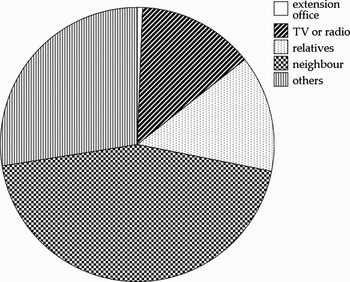
Farming households mainly get information on agricultural technologies from neighbours, relatives, television and radio. Only few households get information from extension workers (Figure 1). They also get it from other sources, such as shops selling agricultural materials, reading journals and seeing technologies in other places. One woman in the FGDs said: “I do not know which seeds are good and how to use them. When I see what the others [neighbours, friends, relatives] buy, I buy that too. Sometimes, I just want to get suggestions from the shopkeeper.” There are some farming households that carry out experiments themselves, even though not in a strictly scientific way. One household mentioned having obtained information from a migrant member who worked in agriculture in the migration area. Six households told us that they do not need extension services because they plan to migrate and do not have much trust in the extension workers. In the mixed FGD, the following was said:
Township technology extension workers rarely come. When the extension workers do not come, how can we go to ask them? They only invite one person to attend training each time. We do not go to the station to ask for help. We know that even if we go, they will not take our ideas into consideration. The staff also changes very quickly in the station. We knew one former staff and do not know any new staff.
Main Channels for Acquiring Technology

In the mixed FGDs it was said several times that people saw good technologies on the television but did not know how to get more information. They would like to learn about these and see their implementation, but it would be too expensive for them to go there.
In the interviews and FGD the extension workers mentioned that the extension office does not have enough staff and is often asked to help the township government with other activities. They said that they only rarely organize large-scale activities, and that training is still small-scale. Sometimes, the seed companies and the seedling providers give some training, but there is almost no agricultural extension. They also mentioned lack of money to implement activities. So, normally they do what the township government asks them to do, which is not related to agricultural extension. Some villagers know that they are officials, but not that they are agricultural extension workers.
Cohort and technology access
The villagers rarely go to the agricultural station. It seems that younger households go more often and know extension workers better than the older ones do. Farmers in the older cohorts are experienced in agriculture and have doubts about the expertise of the extension workers. One of them said: “The extension workers have knowledge from books but not from practice. We have a lot of practical experience and we know the land very well.” In the youngest cohort there is less interest in agricultural extension because of the importance of migration as an alternative to agriculture.
Different cohorts get information on technologies in different ways. While the 1970s cohort mainly gets the information from neighbours, the younger cohorts have more sources. In the 2000s cohort there is one household head who has a good relationship with the extension workers because he graduated from agricultural school and is interested in talking to them about technologies and varieties. There is one household in the 1980s cohort that gets information from the migrated husband who worked in agriculture in another province and used the knowledge he acquired there when he returned. The 1970s cohort likes to get the technology through self practice and the younger people like to read. A man from the 1970s said:
I know how to prepare the paddy field well enough so that it contains more water. Every year, the first time you prepare the field and irrigate it is very important. If you do this well the first time, the field can contain good water the whole year round. But the younger people do not put an effort into learning agricultural technologies by practice.
The younger cohorts put more effort in non-farming activities. When they do work in agriculture, they have their own ways of acquiring information and mastering new technologies. A 26-year-old wife said in an interview: “My husband often reads agricultural technology materials and I sometimes do the same. We want to try out some new technologies. But it is not easy to persuade my parents-in-law to accept them.” In the FGDs in the 1970s and 1980s cohorts the participants said that they mainly learned the technologies they apply from their parents. The FGD with the 2000s cohort showed that many younger husbands and wives did not know how to do agriculture because they migrated after graduation from school. But they began to learn after getting married when they returned to the village. They also said that agriculture technologies are not difficult to learn and that for them income from farming is not as important as it is for their parents. They farm for meeting minimum daily needs and have cash to buy the products they do not produce.
Gender issues in agricultural technology extension
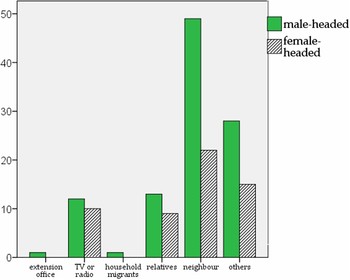
Usually men and women attend the government projects jointly. Only in four households is it only men who attend, and in seven households only women. Female-headed households seem to be less familiar with the extension worker and also get less help. The gender of the household head has a significant effect on the main channel of access to information about technologies. For male-headed households the ways to access information about technology, in order of importance, are through a neighbour, others, relatives, television or radio, migrants and the extension office; while for female-headed households, migrants and the extension office are not important (see Figure 2). Women like to learn from the television or radio. Neighbours are always very important for sharing technologies because they meet almost every day. Women in particular discuss agricultural technologies when they get together. Then they share experiences and compare household varieties, yields and farming methods. The women have few possibilities to learn from relatives because their own relatives live far away and they may not have a good relationship with their in-laws. One wife told: “I do not talk with my brother-in-law and his wife because they got more dowry than I got. But my husband still talks to them.”
Technology Channels for Different Household Type

More women than men are illiterate. Even if the younger women can read, they do not like technical magazines. Their focus is on child care. A younger wife said:
I read recreation magazines while my husband reads technical stuff. My main responsibility is taking care of my four-year-old son and my husband does not blame me for not taking care of the field very well. We hope that our son can have a good future and my husband can earn enough money to give our son a better education than we had.
For men, it is different. One 53-year-old man is always trying to find a way to make manure transportation and spreading easier. He uses a new way to spread manure in the field after he transports it by tractor. A 52-year-old man mentioned that he had found a good way to plough the corner of the field. Vegetable production being a woman's task, a 45-year-old woman had good ideas about growing more cucumber and tomatoes.
Villagers’ experimentation and innovation
In several FGDs, farmers explained that they do experiments themselves: “We compare the varieties of rice and maize every year, we compare density of different seedlings and we know which one is better. We do not just follow the government's extension technologies.” They did density experiments on rice and found that it is better to plant hybrid rice sparsely. They use their own results instead of following the instructions on the rice seed packages.
Cases Illustrating Local Perspectives and Experiences
The following three cases illustrate household agency and initiative in adopting agricultural technologies, indicating the factors influencing technology adoption and the adjustment to the household situation.
Case 1: Hybrid maize
The hybrid maize project was not very successful in one village, even though maize was the main crop there. The village concerned is remote and cannot be reached by public transport. Most unmarried young adults are engaged in migration and are not at home. Twenty villagers commute daily to work in the coal mine. All households except one have pigs, and maize is used mainly for feeding them. The villagers use hybrid maize depending on their household's situation. A 47-year-old woman said:
I have three working people at home, but my son does few agricultural activities. We do not have enough time to grow hybrid maize on all land even though it is high yielding, because it requires the seedlings to be grown separately and that takes time. The hybrid seeds are also very expensive, which we cannot afford. We want to spread risks by growing hybrid maize on half of the land and plant local varieties on the other half. According to extension instruction one should not intercrop hybrid maize, but we have the tradition to intercrop with sunflower and beans, which is a good way of spreading risk as well. We change maize varieties every year because the seed shops change the varieties every year. I do not know the names of the varieties because I am illiterate. The pigs like to eat the local varieties and we need different quantities and qualities of maize every year, because the number of pigs we raise varies.
A female villager who graduated from high school said:
I know the name of the varieties because I can read the instructions. I plant more varieties in order to pay for expenses at different times of the year, especially to pay the education fee for my son who is studying in professional school. Hybrid maize can be harvested earlier, so I plant some to get cash at that time, but I do not want to plant more because of shortage of labour.
A 26-year-old wife intends to plant hybrid maize on half of the land because of its high yields. She can buy the seeds from her husband's earnings. A male interviewee said that he does not like to plant too much because he does not like to do the weeding that hybrid maize requires.
Case 2: Hybrid rapeseed
Hybrid rapeseed production is very labour-intensive, especially during the transplanting period. This conflicts with the traditionally busy period in November–December. During these months, households are busy with sowing winter crops. The harvest time of these hybrid varieties also conflicts with sowing the main crops of maize and rice. Local varieties of rapeseed do not need transplanting. Shortage of labour soon made the villagers give up this technology. A former village leader said: “We could not plant the hybrid rapeseed because we could not make time for it. We have to grow our main crops first, which is the most important for us. It is suitable for households with little land. Most households in our village have too much land to cultivate because of labour shortages.” Another factor is that according to the locals, oil from local rapeseed varieties is tastier.
Case 3: Watermelon
In 1994, two men from Anhui province came to rent land to cultivate watermelon in two villages in Kaizuo township. At the beginning, local people only provided labour. During the process, they learned to cultivate watermelon and mastered the technology. In 1997, the two men left, but local villagers began to cultivate watermelon themselves. Watermelon cultivation is now one of the main income-generating activities. There are now about 43 (50 per cent) households that cultivate watermelon in these two villages and the average income per household is about 2000 yuan. A man from the 1980s cohort said:
I learned a lot from the two men because we saw what they did and I was able to grow watermelon after they left. Now, I even do experiments myself. I try to dig the sowing hole bigger and put more organic fertilizer in because we have enough manure, which those two men did not have. Our watermelon has good taste and the consumers like to buy it once they know it is our product.
Discussion and Conclusion
It can be concluded from the above that although the government is investing in extension activities, farming households mainly get their information from neighbours, relatives and friends, and only to a limited degree from the government. Most people do not know the government extension workers. Shops are also an important source of information, the shopkeeper playing the role of agricultural extension worker. The villagers also do experiments themselves and try to adjust the technologies to their own situation.
The government aims at large-scale and standardized extension services to increase yields. However, there are a lot of mismatches between government extension and villagers’ needs. High yield is not the only criterion for farming households to adopt the technology that the extension services promote. Their demands of technologies are much more diversified and the dominating high-yielding technologies are not always acceptable to them.Footnote 15 There are many factors, such as labour constraints, age, gender, marketing options, traditional cropping systems, livelihood strategies and risk avoidance, which influence farming household decision making on the adoption of new technologies. In the research area, migration is very popular and the diversified livelihood strategies divert labour to non-farm activities, so that labour shortages are common. Hence, labour-saving technologies are important for farming households. Younger cohorts are more involved in non-farm activities. They need money for their children's education and do not value agricultural production very much. The younger migrants know the importance of good education and would like to invest more in their children's growth and development. As is often the case throughout the world, women get less help from extension workers than men.Footnote 16 In Nigeria, for example, female farmers have more problems in getting information than male farmers.Footnote 17 For Kenya it was observed that farmers’ diversity in assets and activities should shape agricultural technology policy.Footnote 18 In our case, small agricultural machines could help the villagers solve labour-shortage problems. Farming households’ needs for different varieties should provide the basis for the work of plant breeders,Footnote 19 which also would increase the efficiency of technology transfer.Footnote 20
Traditional sources of information still play an important role in technology extension. The adoption of new technologies mainly depends on a neighbour's demonstration, or reading books and newspapers.Footnote 21 It is necessary to set up new extension mechanisms that include farmers’ participation, new extension services and an evaluation system of the extension workers.Footnote 22 Comparison of the central source of innovation model and the multiple sources of innovation model shows the significance of the latter. In this model, the farmer is one of the innovation sources. The model places agricultural research and diffusion processes in a context where many factors – for example, historical, political and economic factors – play a role.Footnote 23 The results from this study show that the dominating top-down technology extension approach, which amounts to a central source of innovation model, should be reconsidered. A multiple source of innovation model involves farmers in solving the problems. This research indicates that farmers are key actors in spreading innovations through their experience and practices. Farming households themselves do research and experiment, while new technologies are introduced. The innovative technologies they develop are better suited to their context and reflect the diversity of actors in farming in a context of migration and social change. It is necessary to have more interaction and communication between extension workers and farming households and to combine the government's formal extension with the farming household's networking extension.Footnote 24
The farmer field school which is better adapted to the needs of farmersFootnote 25 can be integrated into the existing extension system because it is good for farmers (especially aged women) who have little formal schooling.