1 Introduction
Despite the widespread accessibility and portability of high-quality audio recorders and tools for acoustic analysis, phonetic analysis is generally not a topic of focus in grammatical descriptions. Phonological descriptions of under-documented languages remain largely perception-based (Maddieson Reference Maddieson2002). Researchers’ judgments – which are generally based on results of word elicitation and the identification of minimal pairs among segments – have been the primary means employed by field linguists for determining phonemic segments and their allophones.Footnote 1 Sketches largely describe regular phonological patterns and only briefly mention areas of uncertainty, if at all; yet, these areas of uncertainty have revealed intermediate phonological relationships in even well-described languages (Hall Reference Hall2013). Quasi-phonemesFootnote 2 – the term that this paper has adopted to describe segments in intermediate phonological relationships – behave like both phonemes and allophones; sometimes they contrast, and sometimes they have different realizations dependent on context. Quantitative analysis of acoustic data is particularly valuable to identify and understand such gradient phenomena, and it can also be an essential tool for understanding phonological patterns in general. By minimizing the unavoidable subjectivity of researchers’ perceptual impressions, acoustic analysis is useful in distinguishing patterns between perceptually-similar segments whose relationship may be difficult to disentangle when relying on traditional elicitation methods. This paper identifies quasi-phonemic patterns in Ampenan Sasak, an under-documented language of Indonesia, and describes them in detail through the use of acoustic analysis.
To contextualize this study, Ampenan Sasak and previous phonetic and phonological study on Sasak more broadly are first introduced before further investigation into its vowel system is undertaken.
1.1 Ampenan Sasak and its segmental system
The Sasak language is spoken by approximately three million people on the eastern Indonesian island of Lombok (Eberhard, Simons & Fennig Reference Eberhard, Simons and Fennig2019). The language is closely related to Balinese and Sumbawan and is part of a proposed Malayo-Sumbawan subgrouping of the Western Malayo-Polynesian branch of Austronesian (Adelaar Reference Adelaar, Alexander Adelaar and Himmelmann2005). While Sasak has a still-thriving population, fewer children are learning the language as the Sasak-speaking population becomes a globally-oriented populace (Djenar, Ewing & Manns Reference Djenar, Ewing and Manns2018). Sasak as a whole has received much academic attention in the form of dictionaries (Thoir Reference Thoir1985, Staff Reference Staff1995), grammars (Thoir, Reoni & Karyawan Reference Thoir1985-Reference Thoir, Reoni and Ketut Karyawan1986), and targeted grammatical and phonological analysis (e.g. Austin & Sallabank Reference Austin and Julia2010, Archangeli et al. Reference Archangeli, Yip, Qin and Lee2017); however, Ampenan Sasak has not yet been studied by researchers.
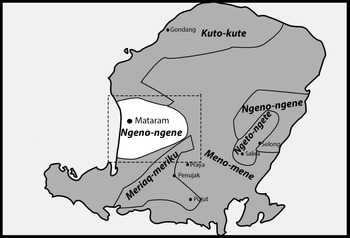
Ampenan Sasak is a Sasak variety spoken in Ampenan, an urban sub-district of Lombok’s capital city, Mataram. Traditionally, researchers have distinguished dialects by their deictic terms for ‘like this’ and ‘like that’. The five major dialects are called Ngeno-ngene, Ngeto-ngete, Meno-mene, Kuto-kute, and Meriaq-meriku; their distribution is illustrated in Figure 1, originally presented in Jacq (Reference Jacq1998). Yet, whether this is the most appropriate categorization of Sasak dialects is still contested (Jacq Reference Jacq1998, Austin Reference Austin2012). Researchers have observed phonetic and sometimes phonological variation within the Meno-mene variety, spoken in central Lombok (Teeuw Reference Teeuw1958, Chahal Reference Chahal1998, Jacq Reference Jacq1998, Archangeli, Tanashur & Yip Reference Archangeli, Tanashur and Yip2018).
The geographic distribution of Sasak dialects adapted from Jacq (Reference Jacq1998: 68). Ampenan Sasak is a Ngeno-ngene variety spoken west of Mataram. The box around Mataram indicates the area depicted in Figure 2.

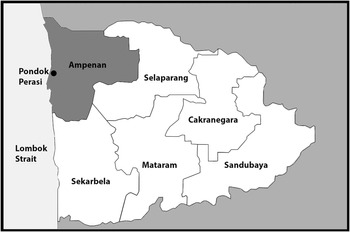
Ampenan Sasak seems to be another testament of this variation. Geographically, Ampenan Sasak falls within the Ngeno-ngene dialect region. However, people living in Ampenan have identified that their Sasak is different – both phonetically and grammatically – from that spoken in other parts of the city, and even within Ampenan, there is linguistic variation. While Ampenan Sasak has not been previously recognized by researchers, Ampenan Sasak was named as such to delineate that the dialect is different from other urban Sasak varieties, which remain little-understood themselves. These data are from Pondok Perasi – marked in Figure 2 – which is a coastal suburban neighborhood that is defined by its fishing economy. Because of the evident yet little-understood linguistic variation in the area, this paper does not make claims about the Ngeno-ngene dialect of Sasak as a whole.
The districts of Mataram with Ampenan indicated in dark gray. Pondok Perasi is located along the central western coast of Ampenan.

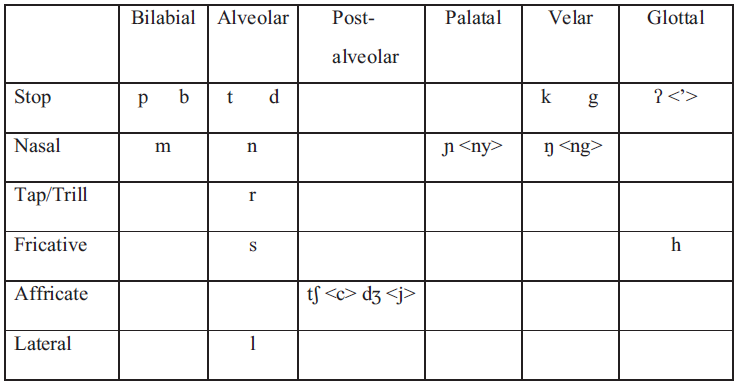
Ampenan Sasak has a typical phoneme inventory of an Indonesian language. Table 1 shows the consonant inventory of Ampenan Sasak.
Ampenan Sasak consonant inventory based on elicitation with a native speaker. In the few cases where the phonetic symbol differs from the symbol used orthographically, the standard orthography is included in brackets <>.

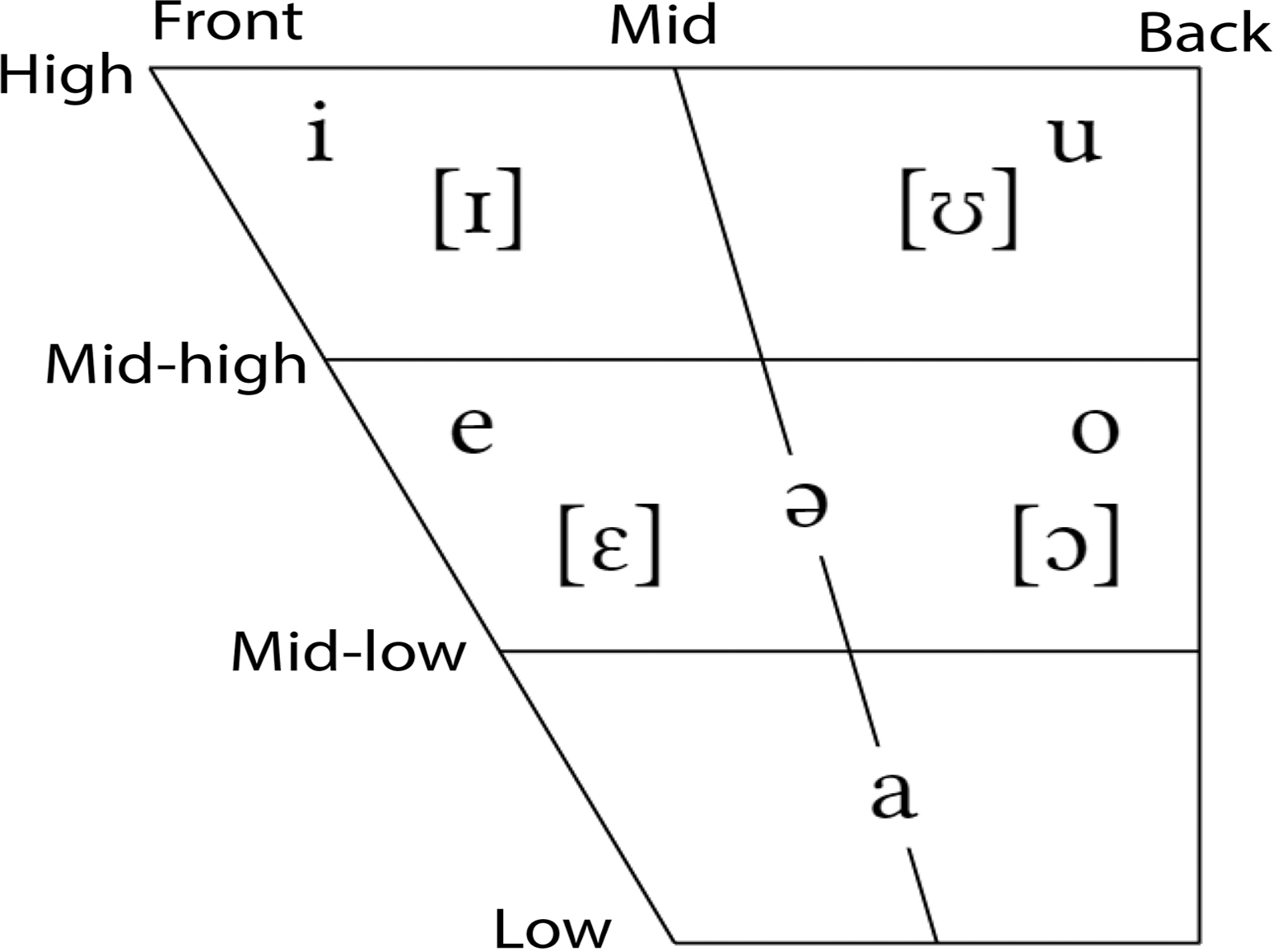
Ampenan Sasak’s vowel system, shown in Figure 3, is also quite typical of the languages of Indonesia. [a] patterns as neither a front nor back vowel; it is centralized. Based on the author’s judgments during elicitation, the lax vowels shown in brackets are analyzed to be allophones of the corresponding tense vowels.Footnote 3 Mid-vowels are in gray to indicate their unclear phonemic status. The distribution of tense/lax vowels in the final syllable depends on whether the syllable may be considered open or closed. Tense vowels tend to occur in open final syllables or those with a glottal stop coda (for terminological convenience, both of these are henceforth considered open syllables).Footnote 4 Lax vowels tend to occur in final syllables with any coda excluding the glottal stop (henceforth closed syllables).Footnote 5 Features other than tense/lax are not restricted. The tense/lax allophonic variation based on syllable structure is clear with high vowels and significantly less clear with mid-vowels. However, the following examples illustrate the general relationship between the height of the mid-vowel and the openness of the final syllable: [sere] ‘lemongrass’, [tabeʔ] ‘excuse me’, [durɛn] ‘durian’, [jɛŋgɛr] ‘rooster comb’, [rebo] ‘Wednesday’, [bisoʔ] ‘wash’, [jagɔŋ] ‘corn’, [gubɔk] ‘village.’
Ampenan Sasak vowel inventory based on elicitation with a native speaker.

Further, the openness of the final syllable may also serve as a predictor of height among pre-final mid-vowels. It appears that when two mid-vowels are in a word, they both have the same height, indicating that there may be a correlation. In [bembeʔ] ‘goat’, although the pre-final syllable is closed, and thus one may expect a low mid-vowel [ɛ], it contains the high mid-vowel [e]. Similarly, in the word [gɔɾɛŋ] ‘fried’, although the pre-final syllable is open, the pre-final vowel is low mid like the vowel in the final syllable. As these examples illustrate, this is possible when the mid-vowels are identical and when they are different. Several other examples include [ɛpɛn] ‘owner’, [tɔkɔl] ‘sit’, [jonjoʔ] ’give by hand’, and [cendeʔ] ‘short.’ One may thus observe a correlation between the realization of each mid-vowel that may be a result of anticipatory coarticulation between pre-final and final vowels.
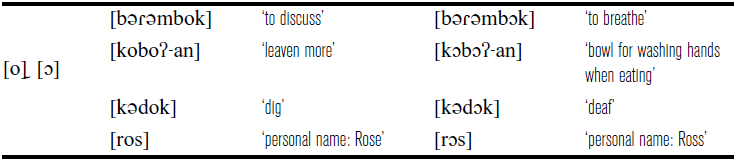
However, despite these broad patterns, there are a few minimal pairs between back mid-vowels which a number of the participants for this study identified as words in Ampenan Sasak. These are presented in Table 2. These minimal pairs suggest that back mid-vowels could be considered phonemes, as they differentiate otherwise identical (or nearly identical) words. Minimal pairs between front mid-vowels have yet to be identified. However, perceptually, the vowel quality of front vowels is difficult to determine using traditional auditory analysis, particularly before nasal codas. For instance, based on the author’s perceptual impressions, kepeng ‘money’ was initially transcribed as [kepeŋ], but goreng ‘fried’ has always clearly been pronounced [gɔɾɛŋ]. Whether these words are near-minimal pairs or not is unclear.
Minimal pairs among back mid-vowels seem to deviate from allophonic patterns seen elsewhere in the language.

Evidently, those minimal pairs that are not borrowed personal names occur before unreleased [k] or [ʔ], which are phonetically quite similar in Ampenan Sasak. This raised questions as to whether there is simply allophonic variation between word-final [k] and [ʔ] in these instances. However, this was tested by adding the multifunctional suffix -an – seen in the minimal pairs [koboʔ-an] ‘leaven more’ and [kɔbɔʔ-an] ‘bowl for washing hands while eating’ – to the end of each word. In doing so, [k] is released, clearly indicating the tongue’s contact with the velum. This testing revealed that codas are consistent while the vowels vary.
While the pair of names in Table 2 are likely borrowings, they may represent how borrowings are shaping Ampenan Sasak’s phonemic inventory. In addition to the minimal pair distinction between [ros] and [rɔs], borrowed terms, such as [gədoŋ] ‘building’ and [agostos] ‘August’ provide clear exceptions to predictable allophonic patterns among mid-vowels. The word [gədoŋ] ‘building’, which is apparently borrowed from Indonesian gedung with the same meaning, is a near-minimal pair with [kədɔŋ] ‘traditional reservoir’. While [kədɔŋ] contains a low mid-vowel in its closed final syllable, [gədoŋ] contains a high mid-vowel. Similarly, [agostos] ‘August’, borrowed from Dutch augustus, most likely with Indonesian as an intermediary, contains two high mid-vowels despite the closed final syllable. Regardless of the word form in the source language, the current Ampenan Sasak words serve as exceptions to the predictability of [o] and [ɔ].
In addition, many studies have emphasized the importance of acknowledging speaker intuitions in determining whether segments are allophones or phonemes (Hualde Reference Hualde2005, Scobbie & Stuart-Smith Reference Scobbie, Jane, Avery, Elan and Keren2008). Ampenan Sasak speakers’ perceptions of mid-vowel distinctions are variable. In writing, Sasak speech communities do not distinguish [ə], [e], and [ɛ], nor do they distinguish [o] from [ɔ]. The vowels [e], [ɛ], and [ə] are all represented by the letter e, and [o] and [ɔ] are both represented by o. In perception, sometimes speakers have very clear intuitions as to which mid-vowel variant is appropriate, and other times, they do not. For example, the primary consultant for this study and a Ph.D. student in linguistics,Footnote 6 has stated several times that bembeq ‘goat’ is pronounced [bembeʔ], not [bɛmbɛʔ]. She notes that the latter is how the word would be spoken in central Sasak dialects, and this is consistent with the analysis in Chahal (Reference Chahal1998). However, such intuitions seem to be lexically specific and are not always consistent both within and across speakers.
1.2 Previous work
Studies on Sasak varieties have come to varying conclusions about the relationship between mid-vowels. Chahal (Reference Chahal1998: 5) analyzes a Meno-mene variety of Sasak and finds that the vowel phonemes include /i e a ə o u/. Two factors influence where lax variants appear: openness (whether the syllable has a coda segment) and stress. Lax vowels appear in heavy syllables (syllables with a CVC structure) and tense vowels occur in light syllables (syllables with no coda). Chahal also claims that stress falls on the final syllable of this dialect of Sasak, and in stressed syllables, there is more variation in the pronunciation of the vowel. Finally, Chahal determines that this dialect of Sasak appears to have ‘bi-directional gradient vowel height harmony’ whereby the realization of a vowel in final syllable may affect that of a vowel in pre-final syllables and vice versa (Chahal Reference Chahal1998: 11–12).
While both Chahal (Reference Chahal1998) and Archangeli et al. (Reference Archangeli, Tanashur and Yip2018) conclude that the Meno-mene dialect of Sasak has a six-vowel system (/i e a ə u o/), the interpretations reached by Archangeli et al. (Reference Archangeli, Tanashur and Yip2018) pertaining to the distribution of tense and lax vowel segments are not in accordance with those of Chahal (Reference Chahal1998). Archangeli et al. (Reference Archangeli, Tanashur and Yip2018) find no influence of syllable openness at all, nor do the authors observe vowel harmony. Rather, all influence on vowel quality derives from the stress on the syllable in which it occurs, which according to the authors falls largely on the final syllable. Like Chahal (Reference Chahal1998), Archangeli et al. (Reference Archangeli, Tanashur and Yip2018) find that vowels occupy a smaller acoustic space in unstressed (i.e. pre-final) syllables than they do in stressed (i.e. final) ones.
In consideration of both previous studies, which grapple with the challenge that tense and lax vowels pose to phonetic and phonological analysis, and of the elicitation data which exhibit several minimal pairs between [o] and [ɔ], mid-vowels are the focus of this study. The study analyzes the production of vowels in systematically elicited sentential contexts and measures their F1 and F2 to target their quality based on environmental factors in order to answer one primary question and, in doing so, two further, secondary questions:
To what extent do mid-vowels in Ampenan Sasak have phonemic or allophonic status?
(i) Can variations in mid-vowels in final position be explained by differences in syllable openness?
(ii) Are pre-final vowels also sensitive to syllable openness, and to what extent are they sensitive to the quality of the vowel in the final syllable?
The next section details the experimental design and analytical methods of this study.
2 Analytical methods
2.1 Materials
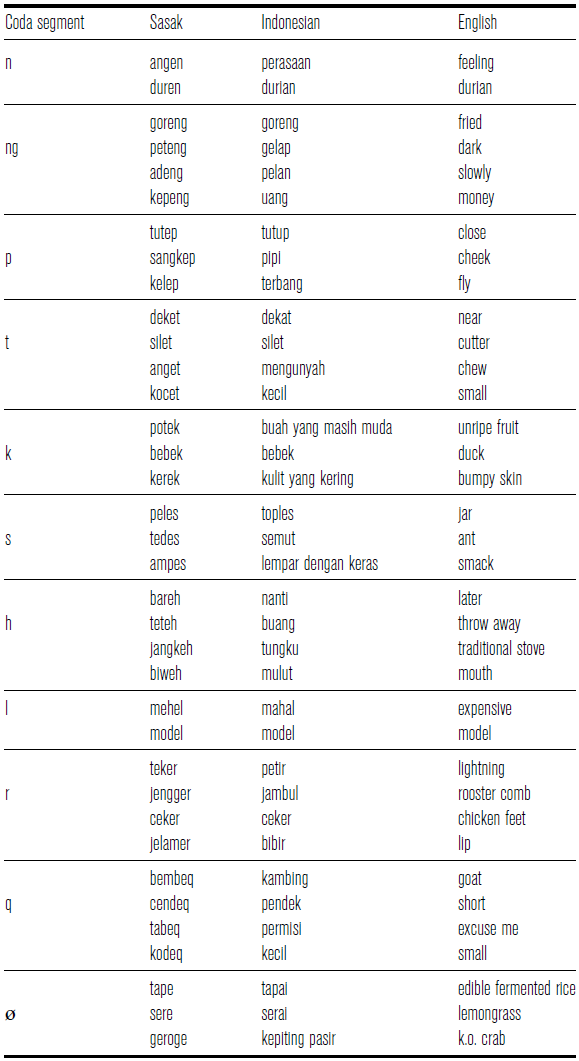
Data for this acoustic study were gathered through the elicitation of a measured wordlist that controlled for the syllable and surrounding segments of each mid-vowel. The wordlist contained 81 critical items that did not appear to be loanwords or recent borrowings. They are shared in the Appendix. Items were chosen based on the phonological environment of the vowel in the final syllable including: (i) syllable openness, (ii) coda segment, and (iii) height of preceding vowel (low, mid, high, schwa). These factors were balanced to the greatest extent possible. When possible, four instances of each final syllable mid-vowel before every possible coda segment were included. Fifteen filler words were also included to assure that the data contained all vowels in the phoneme inventory in both pre-final and final position.
Because of the limitations of the data and, more broadly, Ampenan Sasak phonotactics, for the purposes of investigating vowel coarticulation, pre-final mid-vowels could not occur before every vowel in final position. In this dataset o only occurred before a when a was in a closed syllable while e only occurred before a when a was in an open syllable.Footnote 7 There were no instances of mid-vowels preceding a schwa or a high vowel, and schwa only occurred in closed final syllables.
2.2 Procedure
Words in this wordlist were presented via a slideshow on a laptop computer. Figure 4 provides an example of the format of each slide. The Ampenan Sasak word appeared in the center of the screen. Practical Sasak orthography as used by speakers does not have diacritics. As a result, the pronunciation of a word may be ambiguous since the vowels [e], [ɛ], and [ə] are all represented by the letter e, and [o] and [ɔ] are both represented by o. To eliminate any ambiguity, each slide also included the Indonesian translation below the Sasak word. Since all speakers were bilingual in Sasak and Indonesian, the Indonesian translation effectively disambiguated any Sasak homographs. At the suggestion of the primary consultant for this study, slides were one of three colors: red (beaq), green (ijo), and yellow (kuning). For the example in Figure 4, speakers were instructed to say ‘‘kemos’ is red’, or kemos warna beaq, in Sasak. This presentation format captured each critical word in a sentence, leading to a more natural pronunciation of the word. The order of the words and the colors associated with each word were entirely random. Each word was repeated once, resulting in a total of 162 word productions for each participant. Speakers could proceed through the task at their own pace. They were able to repeat the word or response if they wanted.
Example of experimental slide: The large word kemos is the Sasak word. The smaller word beneath is the Indonesian translation. The background is red. The expected response is Kemos warna beaq ‘Kemos is red’.

Throughout the task, participants wore a lapel microphone that recorded a digital.wav file at 44.1 kHz/16 bit on a Zoom H2 solid state recorder in order to capture high-quality acoustic data. Participants were additionally filmed with a FullHD Panasonic video camera and the internal cardioid microphone of the Zoom H2 recorder in order to capture the environment as well as the participants’ facial movements and gestures as they completed the task. Recordings were completed at the speaker’s home or at that of their neighbors. Often several women completed the task in the same session.
2.3 Participants
Seven female speakers of Ampenan Sasak aged 18–45 participated in this study. All speakers grew up speaking Ampenan Sasak and were bilingual in Indonesian.
2.4 Acoustic measurements
Each critical word and vowel were segmented using Praat (Boersma & Weenink Reference Boersma and David2019). Based on segmentation strategies suggested in Turk, Nakai & Sugahara (Reference Turk, Nakai and Sugahara2006), vowel onset and offset were identified based on the presence of a continuous F2. The F1 and F2 were then measured at the mid-point of the vowel. Vowel spaces were normalized across speakers using the vowel-extrinsic formula presented by the Lobanov method of vowel normalization. This method was chosen because it is a well-attested method for factoring out physiological differences between speakers. Further, the Lobanov method works well with datasets that measure the entire vowel space within a single dialect. Finally, plots depicting vowels normalized by the Lobanov method closely resemble regular F1–F2 plots, facilitating presentation and analysis (Adank, Smits & van Hout Reference Adank, Smits and van Hout2004).
2.5 Statistical analysis
The lme4 package in R was used to fit linear mixed-effects models (LMEM) to the data (Bates et al. Reference Bates, Mächler, Bolker and Walker2014). In total, four models were fitted to the data which addressed two primary questions:
-
1. Are mid-vowels in final position sensitive to syllable openness?
-
2. Are pre-final vowels affected by their own syllable openness, and to what extent are they sensitive to the quality of the vowel in the following syllable?
The models investigating the effect of syllable openness on vowel quality had either the F1 or F2 of the final-syllable vowel as the dependent variable, with fixed effects of vowel and syllable openness.
Models used to investigate coarticulation effects were fitted to the F1 and F2 values of pre-final syllable vowels respectively with two interactions as independent variables – pre-final vowel × openness of the pre-final syllable and pre-final vowel × height of the final syllable vowel. These two interactions were included to answer two pertinent questions:
-
1. Does the openness of the pre-final syllable have an effect on the F1 or F2 of the vowel?
-
2. Does the height of the final syllable vowel affect the F1 or F2 of the pre-final vowel (e.g. does a low mid-vowel in the final syllable cause the F1 of the pre-final vowel to increase)?
All models also included vowel duration as a simple effect with no interactions (Moon & Lindblom Reference Lindblom1994). Further, random intercepts of speaker and word were included in all models. Due to data sparsity, none of the models included random slopes as they did not converge. With the recommendations of Barr et al. (Reference Barr, Roger, Christoph and Tily2013) the models were as detailed as possible while still being able to converge.
Section 3.1 presents results that address syllable openness effects on final syllable vowels, and Section 3.2 presents results that address whether coarticulation is occurring between pre-final and final vowels.
3 Results
3.1 F1 and F2 by final syllable openness
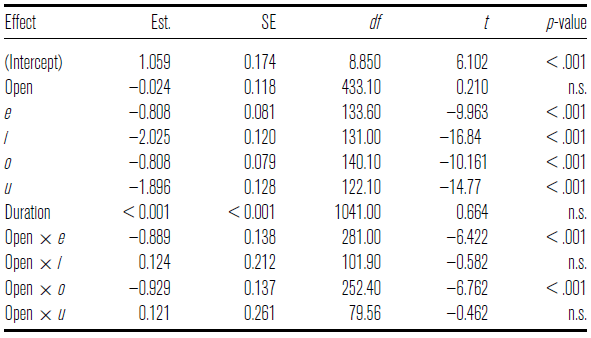
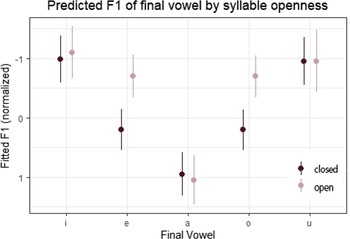
Table 3 displays the table of coefficients from the LMEM fitted to the F1 values of vowels in final syllables. This model includes the normalized F1 as the dependent variable and syllable openness, vowel, and duration as independent variables. The results reveal significant interactions between e and syllable openness and between o and syllable openness. When the syllable is open (i.e. no-coda or glottal stop coda), the F1 is significantly lower than that of a vowel in a closed syllable for both e (t = −6.422, p < .001) and o (t = −6.762, p < .001). i, u and a do not show the same effect of syllable openness on F1. Figure 5 visualizes this effect. Notable in this figure is the stark difference between mid-vowels e and o in closed and open syllables. Duration is not significant in this nor any of the following models.
The table of coefficients for F1 of final syllable vowels. Independent variables include vowel, syllable openness, and duration. Random intercepts include speaker and word. Mid-vowels show highest variation due to syllable openness.

Model outputs of the F1 of final vowel segments as influenced by final syllable openness. Mid-vowels show the greatest effects.

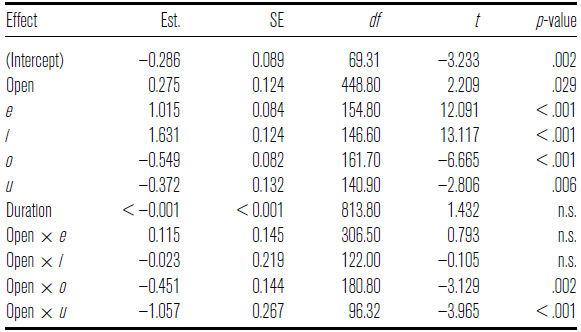
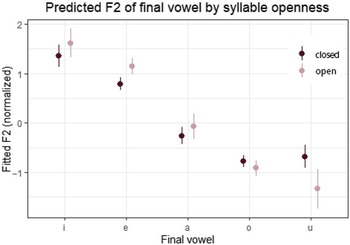
Table 4 displays the table of coefficients from a second LMEM fitted to the F2 values of vowels in final syllables. This model is identical to the first model except that the dependent variable is the normalized F2 values. This model shows that F2 is only distinctly different as a result of syllable openness among the back vowels u (t = −3.965, p = .000) and o (t = −3.129, p = .002). a also shows this distinction (t = 2.28, p = .029), but it shows the reverse trend than is seen among back vowels. a in open syllables tends to have a higher F2 than in closed syllables while the F2 of back vowels in open syllables tends to be lower than in closed syllables. While there is not a significant interaction between openness and vowel among front vowels, they show the same pattern as a in which F2 is slightly higher in open syllables than in closed syllables. Figure 6 presents the results of this model. u and somewhat less so o show a visually-distinct difference based on syllable openness.
The table of coefficients for F2 of final syllable vowels. Independent variables include vowel, syllable openness, and duration. Random intercepts include speaker and word. Back vowels show highest variation due to syllable openness.

Model outputs of the F2 of final vowel segments as influenced by final syllable openness. Back vowels show the greatest variation due to syllable openness.

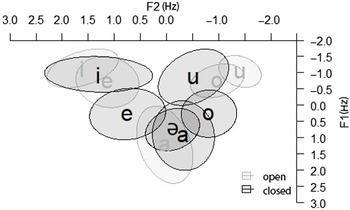
Figure 7 is a visualization of the normalized F1 and F2 of final-syllable vowels. The plot illustrates the general vowel space of each vowel in final syllable based on the openness of the syllable in which it appears. Ellipses are an output of phonR Footnote 8 (McCloy Reference McCloy2016) depicting the level of confidence in the location of the mean of each vowel, and they vary in color by syllable openness. One may note that in general, the space each vowel occupies based on openness reflects the model output. Overall, vowels in closed syllables tend to be more centralized while those in open syllables are more peripheral. The most dramatic distinction resulting from syllable openness is among mid-vowels. While other vowels show little sensitivity to syllable openness, mid-vowels in open syllables have a distinctly lower F1 and occupy a smaller acoustic space than those of mid-vowels occurring in closed syllables. High mid-vowels are so distinct from low mid-vowels that high mid-vowels occupy roughly the same F1 space as high vowels.
Mean F1xF2 of final syllable vowels of all speakers. Ellipses show the degree of confidence in the mean F1 and F2 of each. Black ellipses represent vowels in closed syllables. Gray ellipses represent vowels in open syllables.

The next section details the modeling and outputs regarding the coarticulation of pre-final vowels and final vowels, its cause and directionality.
3.2 Coarticulation
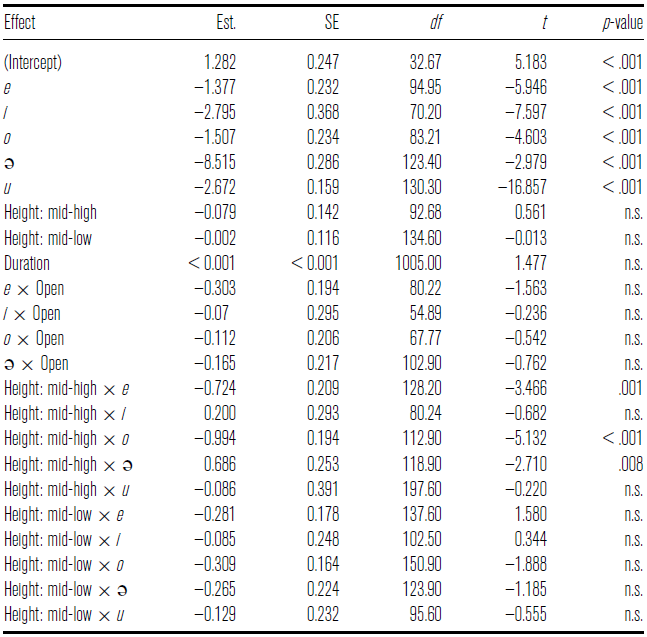
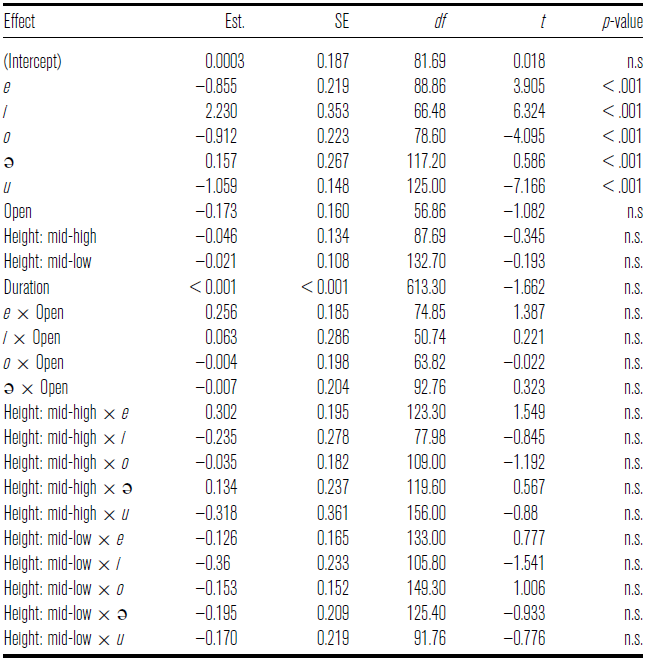
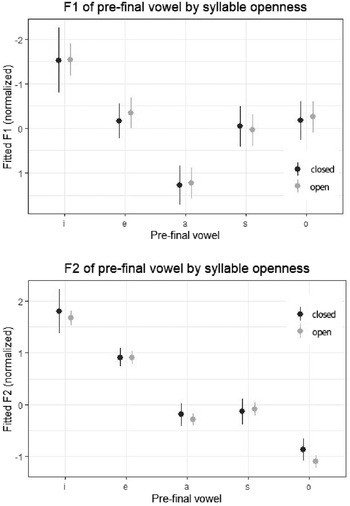
Tables 5 and 6 display the table of coefficients for the third and fourth LMEM that were employed to observe patterns of coarticulation in the pre-final syllable. Only the final vowel heights that follow a pre-final mid-vowel were included in the model, thus the absence of high vowels and schwa. The model results confirm that the openness of the pre-final syllable has very little effect on the F1 and the F2 of the pre-final vowel; the interaction between vowel and syllable openness in final syllable is not evident in the pre-final syllable (i: t = −0.236, p = n.s.; e: t = −1.563, p = n.s.; a: t = 0.250, p = n.s.; o: t = −0.542, p = n.s.; ə: t = −0.762, p = n.s.).Footnote 9 Figure 8 illustrates the F1 and F2 of vowels in pre-final syllables as a result of syllable openness. When compared to Figures 5 and 6, one may notice that the visual distinction of F1 in mid-vowels and F2 in back vowels is no longer present.
The table of coefficients for F1 of pre-final syllable vowels. Independent variables include vowel, pre-final syllable openness, final syllable vowel height, and duration. There is no effect of syllable openness, and mid-vowels and schwa show most variation as a result of final vowel height.

The table of coefficients for F2 of pre-final syllable vowels. Dependent variables include vowel, pre-final syllable openness, final syllable vowel height, and duration. There is no effect of syllable openness, and F2 is not influenced by that of the final vowel.

F1 and F2 model outputs of pre-final vowels as influenced by pre-final syllable openness. Vowels no longer show sensitivity to syllable openness.

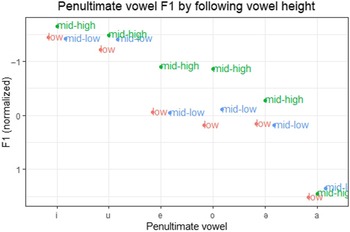
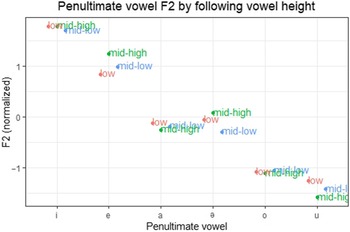
Model results also reveal that the height of the vowel in the final syllable influences the formant values of pre-final mid-vowel segments. Figures 9 and 10 exhibit the mean formant values for each pre-final vowel based on the height of the following vowel. The patterns in these figures are similar to those in Figures 5 and 6 above in that there is a visible difference between mid-vowels that precede a high mid-vowel and mid-vowels that precede a low mid-vowel or a. The model output demonstrates that both front mid-vowels and back mid-vowels are significantly different (e × mid-high vowel: t = −3.466, p = .001; o × mid-vowel: t = −5.132, p = < .001). Schwa shows the same pattern as front mid-vowels (t = −2.710, p = .008). Although duration is included as a factor in the model, conclusions about schwa should still be regarded with skepticism. The average length of schwa in pre-final syllables is 76 ms in contrast to the 156 ms average of other vowels. Such a short voicing duration causes more variability in the pronunciation of the utterance because it takes on more of the properties of the adjacent consonant (Lindblom Reference Lindblom1963). Formant values of low and high vowels do not appear to rely on the height of the following vowel.
F1 of pre-final vowels as influenced by final syllable vowel height. Labels ‘mid-high’, ‘mid-low’ and ‘low’ refer to the height of the final vowel. ‘Mid-high’ refers to [e] and [o] in final syllable while ‘mid-low’ refers to [ɛ] and [ɔ] in final syllable. While F1 of i, u, and a show little sensitivity to final syllable vowel height, the F1 of mid-vowels including schwa is lower when preceding high mid-vowels.

F2 of pre-final vowels as influenced by final syllable height. Labels ‘mid-high’, ‘mid-low’ and ‘low’ refer to the height of the final vowel. ‘Mid- high’ refers to [e] and [o] in final syllable while ‘mid-low’ refers to [ɛ] and [ɔ] in final syllable. The F2 of all pre-final vowels does not vary as a result of final syllable height.

4 Discussion
This study aimed to determine the phonemic or allophonic status of Ampenan Sasak mid-vowels by answering two pertinent questions:
-
1. Can variations in mid-vowels in final position be explained by differences in syllable openness?
-
2. Are pre-final vowels also sensitive to syllable openness, and to what extent are they sensitive to the quality of the vowel in the final syllable?
The presented results address the first question by demonstrating that in final syllables, syllable openness drives vowel quality. Results show that final syllable mid-vowels were higher in open syllables than in closed syllables. Word-final back vowels were more back in open syllables than in closed syllables. In response to the second question, syllable openness does not influence the vowel in pre-final syllables. Results revealed no variation among vowels in closed vs. open pre-final syllables. Instead, the quality of pre-final mid-vowels is driven by the quality of the final vowel. Pre-final mid-vowels were higher when preceding high mid-vowels. They were lower when preceding low mid-vowels or a.
These results suggest that variation between Ampenan Sasak front mid-vowels [e] and [ɛ] and back mid-vowels [o] and [ɔ] is largely predictable. In final syllables, the openness of the syllable affects the realization of the vowel. In syllables with a non-glottal stop coda e and o are produced as [ɛ] and [ɔ]. The results also indicate that coarticulation is occurring among mid-vowels in pre-final syllable. The openness of the pre-final syllable does not have the same effect on the F1 and F2 of the pre-final vowel as it does in the final syllable. Rather, it is the F1 of the vowel in the final syllable that influences the realization of the pre-final syllable vowel. These effects are strongest among mid-vowels including schwa. Mid-vowels e and o and schwa lower when the following mid-vowel lowers in a closed syllable or when preceding a low vowel.
These results indicate that the vowel in the final syllable can influence the pre-final syllable vowel in Ampenan Sasak, but not vice versa. Because there were no effects of pre-final syllable openness on the pre-final vowel, it is implausible that the features of the pre-final vowel would spread rightward. Thus, it appears that Ampenan Sasak has anticipatory coarticulation, which most robustly affects mid-vowels including schwa. This type of coarticulation in Ampenan Sasak does not appear to be unusual among the languages of this region. Javanese has nearly the same phenomenon (Adisasmito-Smith Reference Adisasmito-Smith1999). In Javanese, vowels in final syllable are generally tense in open syllables and lax in closed syllables. In eastern Javanese, when vowels are the same height and backness, a vowel in a light pre-final syllable laxes to match the lax vowel in the final syllable. In central Javanese, this only occurs among mid and low vowels.
From this data alone, Sasak high and low mid-vowels appear to be in an allophonic relationship. However, back mid-vowels deviate because of several clear minimal pairs between [o] and [ɔ] shown in Table 2. For many language documenters, these few minimal pairs would be enough to declare [o] and [ɔ] phonemes. For instance, in the context of Sasak, Jacq (Reference Jacq1998) concludes that the front vowel pairs /i/ and /ɪ/ and /e/ and /ɛ/ in the Sasak variety spoken in Suralaga must be phonemes based on only a few exceptions to allophonic patterns. Yet, it is clear that the label ‘phoneme’ does not adequately describe the relationship between the vowels, and the same can be said about Ampenan Sasak back mid-vowels. If labeling is necessary, it may be more appropriate to say that Ampenan Sasak back mid-vowels are in a ‘just barely contrastive’ relationship; they are almost entirely predictable with some exceptions (Goldsmith Reference Goldsmith and Goldsmith1995: 10).
The ‘just barely contrastive’ relationship between Ampenan Sasak [o] and [ɔ] is most similar to Canadian raising. In Canadian English as well as varieties of English outside of Canada, such as Philadelphia English, the diphthongs [ɑɪ], [ɑʊ], [ʌɪ], and [ʌʊ] are largely predictable with a few exceptions. Generally, [ʌɪ] and [ʌʊ] occur before voiceless segments while [ɑɪ] and [ɑʊ] occur in other environments. As a result, predictable minimal pairs such as ‘tight’ and ‘tide’ exist. However, there are several near-minimal pairs between the two sets of diphthongs that break this paradigm and are otherwise unexplainable. These include ‘spider’ [spʌɪɾɚ] versus ‘cider’ [sɑɪɾɚ] and ‘espouse’ [ɛspʌʊz] versus ‘houses’ [haʊzəz] (Myers Reference Myers1993). Similarly, in Pulaar, mid-vowels [e] and [o] are retracted to [ɛ] and [ɔ] unless they occur before an advanced vowel, in which case they also become advanced. But there are a few inexplicable suffixes containing [e] and [o] which do not precede an advanced vowel. The patterns in these languages compare to Ampenan Sasak in that all have a regular allophonic rule with some sporadic lexical exceptions which cannot be neatly explained (e.g. Paradis 1986).
While some authors would conclude that Ampenan Sasak back mid-vowels are necessarily phonemes as a result of their marginal yet notable minimal and near-minimal pairs, this study follows Scobbie & Stuart-Smith (2008: 15) who, in their analysis of Scottish English diphthongs, state:
We thus do not offer a solution to the question of whether /ai/ is one member of the inventory of [Scottish Standard English] or two. One reason for this is that we hope to leave the reader with the same sense of unease which we feel about the requirement to adopt one ill-fitting and rigid phonological analysis over another.
Echoing these closing sentiments, this paper does not present a definitive conclusion as to whether Ampenan Sasak back mid-vowels are phonemes or allophones. In fact, considering the data, categorizing them as such is impossible. As more studies identify the probabilistic nature of many phonemic contrasts, it is becoming clear that ‘phonemes’ and ‘allophones’ should not be the only possible categorizations for segments in a language’s inventory. One possible approach to this issue may be to regard the notions of ‘phoneme’ and ‘allophone’ as two ends of a cline. While some segments may clearly behave like phonemes or allophones, others may have properties of both. In this sense, though Sasak back mid-vowels have phonemic properties, they may exist closer to the allophonic end of the continuum.
Such an approach parallels recent advances in phonological theory in which theories of discrete symbols have been altered or replaced by those that acknowledge the variability and the gradience within the phoneme and the phonological inventory as a whole. Smolensky & Goldrick (Reference Smolensky and Matthew2016) in their recent development of Gradient Symbolic Representations propose gradience within the discrete phoneme. Others, such as Hall (Reference Hall2009, Reference Hall2012, Reference Hall2013), propose ways to categorically account for gradience within the phonological inventory. Additionally, Exemplar Theory is built upon the idea that both speech and representations are continuous and highly variable (Goldinger 1998, Johnson 2005) thus allowing ‘messy and ambiguous facts to percolate into analyses better than many [other theories]’ (Scobbie & Stuart-Smith Reference Scobbie, Jane, Avery, Elan and Keren2008: 16). Each theory has been born of instances in which a phonological theory of discrete phonemes does not suffice and an incorporation of gradience is necessary to describe real-world phenomena. As these theories progress and near-universally call for a recognition of gradience within phonology, it suggests that for instances such as that described in this paper, it is unnecessary to categorize all segments as phonemes or allophones.
Because of the observed relationship between stress and vowel quality in Meno-mene Sasak it is necessary to explore stress’s potential relationship to the current data (Chahal Reference Chahal1998, Archangeli et al. Reference Archangeli, Tanashur and Yip2018). Yet, this is not a straightforward discussion; stress has been an engaged area of investigation among Indonesian languages due to its high degree of variability within the region (Goedemans & van Zanten 2007). Several patterns have been observed: fixed word-level stress, fixed phrase level stress, and variable stress (e.g Goedemans & van Zanten 2014, Maskikit-Essed & Gussenhoven 2016, McDonnell Reference McDonnell2016). Mid-vowels in particular in some Malayo-Polynesian languages seem to affect stress patterns (Kaland, Himmelmann & Kluge 2019), and thus, one cannot dismiss the possibility that mid-vowels interact with stress in Ampenan Sasak.
A preliminary attempt to identify stress in the context of this study suggests fixed pre-final stress in target words. Using the R package lme4 (see Section 2 for more information about the target words and statistical methods) vowel duration, intensity of the vowel midpoint, and f0 of the vowel midpoint were measured in the target words of this study (see appendix Tables A1–A3 for wordlists). In each LMEM, duration, intensity, and f0 were respectively the dependent variable with syllable position and syllable openness as independent variables. Random intercepts of both speaker and word were included. Results suggest that in the context of the target words for this study, the prominent syllable is fixed. While duration and intensity show no significant differences across syllables (duration: t = −1.04, p = .299; intensity: t = −1.809, p = .071), f0 measurements suggest that pre-final syllables have higher f0 values than final syllables (final: 219.19 Hz, pre-final: 232.13 Hz, t = 3.022, p = .003). The distribution of f0 peaks were also the indicator of stress in the Meno-mene dialect (Archangeli et al. Reference Archangeli, Tanashur and Yip2018). Native speaker perceptions support this finding. As evidenced by a tapping test in which a speaker of Ampenan Sasak consistently tapped on the pre-final syllable, speakers also perceive fixed pre-final stress. These findings show that, at least for the context of the target words used in this study, the pre-final syllable consistently has a greater prosodic prominence than the final syllable. Fixed pre-final stress would not influence the results of this study as unstressed (final) syllables are only compared to other unstressed syllables and likewise with stressed (pre-final) syllables. However, as this study is not intended to shed light on the stress system of Ampenan Sasak as a whole, I refrain from any further assertions regarding the prosodic system of Ampenan Sasak. A more detailed study specifically designed to investigate stress in Ampenan Sasak is clearly warranted to fully understand the language’s phonological and typological contributions.
In addition, it must be noted that there are several limitations to this study. Firstly, Sasak is an under-documented language, and the data are limited. It is probable that researchers have not yet identified all vowel contexts. It is also quite likely that researchers have not yet identified all minimal or near-minimal pairs between mid-vowels. Further, this study focuses on the distribution of mid-vowels in Ampenan Sasak. As a result, the administered wordlist does not identify or include exhaustive environments of i, u, a, or schwa. Any claims made about the distribution and patterns observed among high vowels in particular require more data to be confirmed. Finally, this study only focuses on pre-final and final syllables. It does not explore whether the height of the final vowel influences qualities of vowels in preceding syllables. While roots with more than two syllables are rare in Sasak, it would be an interesting follow-up to see if the observed coarticulation effects extend beyond the pre-final syllable.
Quasi-phonemes have been identified in enough languages – such as Scottish English (Scobbie & Stuart-Smith Reference Scobbie, Jane, Avery, Elan and Keren2008), Canadian English (e.g. Myers Reference Myers1993), Spanish (Hualde Reference Hualde2005), Texhuacan (Hill Reference Hill1998), and Pulaar (Paradis 1986) – to suggest that intermediate segments are widespread throughout the world’s languages. This paper does not necessarily suggest that quasi-phonemes be integrated into grammars; categorization can be useful for language description purposes. However, a recognition that some segments cannot be categorized may help researchers who are trying to adequately account for idiosyncratic aspects of an under-documented – or even a well-documented – language’s phonemic inventory. If indeed, quasi-phonemes are a common occurrence, a simple recognition of their existence may help further future research in phonological theory.
In the context of Ampenan Sasak, the conclusions of this paper suggest that the distribution of Ampenan Sasak mid-vowels is distinct from previous acoustic studies on other dialects of Sasak. Not only are the predictable environments different from those observed by Chahal (Reference Chahal1998) and Archangeli et al. (Reference Archangeli, Tanashur and Yip2018), but the fact that [ʔ] coda patterns as an open syllable is also distinct. Further study of Ampenan Sasak mid-vowels may also reveal information about the nature of borrowed words or about a current phoneme inventory shift in Ampenan Sasak.
Finally, the acoustic data examined in this study provide quantitative evidence that the distribution of [o] and [ɔ] in Ampenan Sasak is not only phonemic but is also allophonic, a finding that further exemplifies the probabilistic or continuous nature of many phonemic contrasts and demonstrates the importance of phonetic research in analysing phonological patterns.
Acknowledgements
This work was supported by the Bilinski Foundation. The content is entirely the author’s responsibility and does not necessarily represent the official views of the Bilinski Foundation. The author would like to sincerely thank Khairunnisa and the seven women who participated in this study for sharing their knowledge and their language. The author would also like to thank Bradley McDonnell, Rory Turnbull, the editors, the two anonymous reviewers, and the participants of the 176th meeting of ASA and APLL11 for their helpful comments.
Appendix. Wordlists of target and filler items
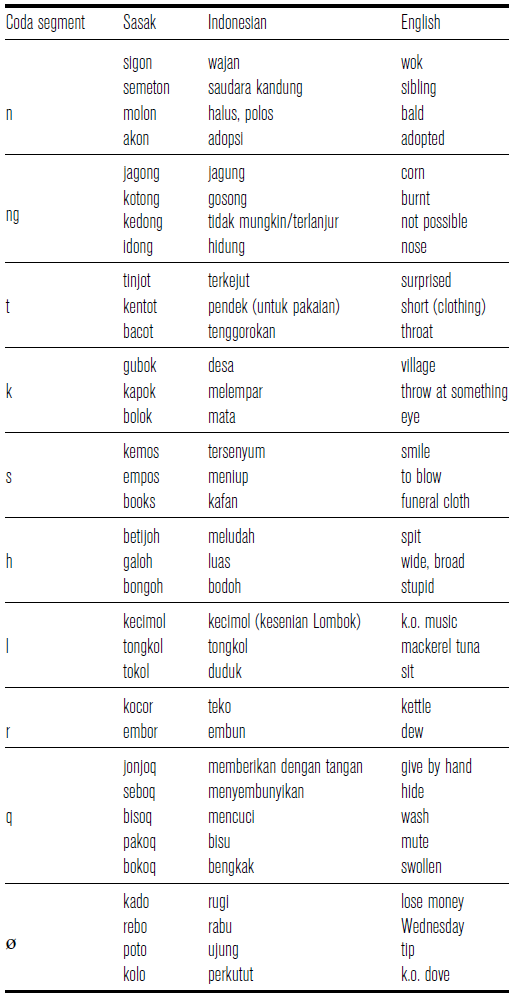
Words with final syllable e.

Words with final syllable o.

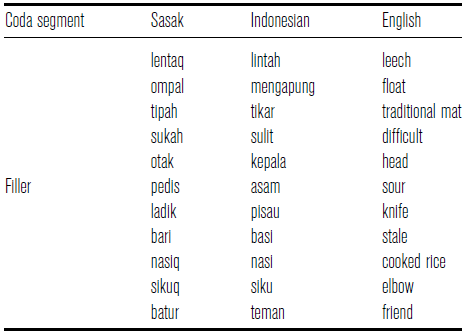
Filler words.