Introduction
Various lenses have been used to discuss the post-revolutionary Iranian art film in relation to nation, modernity, and the appeal to foreign festival audiences. In this essay, I take two related ideas—peripherality and technology—focusing on how they have been used to comic effect in combination with costume and frame composition in a range of films in the twenty-first century. I argue that these films commonly figure a relationship between a frequently self-reflexive humor and a geographic, social, or technological peripherality, and that this sense of humor is a largely unacknowledged element in their film festival appeal. I conclude by briefly considering recent parodies of art films set on the peripheries of the country, before turning to the impact of digital technology and recent developments in Iranian cinema and its art market.
Throughout both the Pahlavi and Islamic Republic eras Iranian authorities have attempted to maintain a strict—though inconsistent and at times incoherent—control over images of the nation and its peoples, especially those who live on the peripheries of modern society, and of peripheral regions and practices. Autocratic rule has promoted a desirable central image—of the shah, the crown jewels, the supreme leader, the capital, modern industry, wife and mother, and (variously indicated) culture. Straying too far from such imagery in Iranian cinema has been officially discouraged but often celebrated in various oppositional contexts including film festivals. Reza Shah in 1938 forbade visualizing “anything that is inconsistent with the interests, prestige and dignity of the nation.”Footnote 1 Upon his return to the country, Khomeini famously proclaimed that it was the misuse of cinema’s spectacle in order to corrupt its viewers, rather than cinema per se, that he opposed, and that, like other modern media technologies, it could and should be used to educate.Footnote 2 More recently, Javad Shamaghdari, deputy minister for cinema at the Ministry for Culture and Islamic Guidance, declared in 2010 that by “identifying and aggrandizing dark points of society” in order to receive film awards at festivals, filmmakers were doing something “worse than spying.”Footnote 3 Abbas Kiarostami, speaking before the election of President Rouhani, claimed that the situation in Iran has “never been this dark.”Footnote 4 The visual metaphors are telling—unlit areas inappropriately revealed, closed areas surreptitiously viewed: a cinema too dark or in need of darkening because it throws too much light, making the peripheral central.
If peripheral in one context, Iranian cinema, at least in its art film manifestation, has been mainstream in another, having been front-and-center at many film festivals around the globe since the late 1990s. The notion of the festival film or festival cinema evidently overlaps that of the art film or art cinema but in different ways and to differing degrees in different geographical and political contexts and at different times. Usually the former more prominently signifies a transnational context, although such festival cinema can of course play in domestic festivals. Art cinema, like festival cinema, is usually seen as distinct from genre cinema whilst remaining strongly associated with auteurist study. Arguably festival films are less personal because their appearance at festivals has been more fully mediated by the requirements of the festival circuit. Thus, festival films, as in Roxanne Varzi’s schema detailed below, build upon previous such films, especially those from the same country or region, in challenging or reinforcing an international audience’s perception of that part of the world. Marijke de Valck argues that “[a] side effect of [the] institutionalization [of film festivals] was that festivals’ programming models became self-referential, responding to what people had come to expect of festivals.”Footnote 5 More popular, commercial or genre films do of course appear at some festivals, as do art films that more substantially challenge audience comfort levels, whether formally or thematically. Such “difficult” art films however, often screening in sidebar selections, are not typical of festival cinema as the term is usually applied and as I apply it here. It has also been argued that such a cinema is more usefully referred to as avant-garde, once more pushing the terms art and festival films closer together. De Valck discerns “three main labels for framing and understanding festival films”: national cinemas, auteur cinema, and art cinema.Footnote 6 Many of the films I discuss here are, I believe, framed by all three of these terms. In any case, there is evidently room for considerably more work on this subject, in both general and specific contexts including individual festivals and their audiences, individual countries such as Iran, different genres, and specific continuing relations between one festival or festival programmer and a country or other global region.Footnote 7 In the case of Iran, with a few star-driven exceptions, the majority of these films, despite some domestic screenings and surreptitious distribution, remain largely peripheral to most domestic cinema-goers, albeit still of concern for the authorities.
In what follows I illustrate the complexity of peripherality, of comedy, and of relations between the two in the Iranian art or festival-oriented film. I treat these tropes as devices that appeal to festival audiences, while their instability points to different ways of appropriating modernity in Iran. For example, the Islamic government continues many of the projects associated with the top-down modernizing of the Pahlavis whilst adapting or condemning others. Both governmental and civic actors, including filmmakers and artists, have rejected elements of a western or transnational modernity perceived as damaging to the fabric of society, continually reconfiguring and recontesting the idea of what constitutes Iranian modernity. The variously peripheral and comic juxtapositions of the Iranian art film and its international reception, by offering relief or revealing discomfort with aspects of Iranian modernity, participate in the public discourse on this process, and offer a venue for reflecting on it.
Peripherality has been commonly depicted in contemporary Iranian art films through the regionally or geographically remote, specifically those films shot in parts of the country distant from Tehran (the city which has persisted as the location for most Iranian cinema and often served as an alternative polarity in those films set far away) and other major cities, yet marketed to a geographically dispersed but perhaps relatively homogenous film-festival audience.Footnote 8 It has been argued that the rural setting characteristic of most of the earliest post-revolutionary Iranian films that succeeded at foreign festivals in the 1990s—and that has continued as a less dominant presence in this century—was a response to an orientalist desire amongst foreign audiences for images of colorful populations largely untouched by technology and resistant to the modernizing project. This “village” cinema has been especially associated with Kiarostami, who has been the most central figure in Iranian cinema internationally, and who has periodically been criticized for such an emphasis both inside and outside Iran, whilst also being vehemently defended.Footnote 9 Negar Mottahedeh, for example, argues that through an averted gaze, and attention drawn to the apparatus, “Kiarostami’s camera frames and fabulates peripheral movement as the object of its fascination,” thus challenging the strategies of voyeurism that Hamid Dabashi and others have accused him of maintaining, especially in The Wind Will Carry Us (Bad Mara Ba Khahad Bord, 1999).Footnote 10 Like Mottahedeh, Gayatri Devi draws attention to the repeated movements of that film’s protagonist, who functions, she suggests, like an automaton on a comic journey to sublime renewal.Footnote 11 For Khatereh Sheibani, on the other hand, the rural landscape reminds us of Kiarostami’s connection to poets such as Sepehri.Footnote 12
Roxanne VarziFootnote 13 argues that this politically disengaged rural village phase of Iranian festival cinema was succeeded by an equally problematic one, also catering to festival audiences, who wanted to witness films explicitly or implicitly critical of government repression, thus visualizing another form of peripherality. Mehrnaz Saeed-Vafa characterizes these two phases of Iranian art film as respectively confirming “pre-existing images or fantasies of place as an exotic land of mystery (ancient mythical Persia) and misery (terrorism and poverty).”Footnote 14 Varzi postulates that more recently a third phase of non-orientalist art cinema that presents Iranians as “people” has been heralded by the success of Asghar Farhadi’s work.Footnote 15 Whilst both the second and third phases have an urban focus, the latter, she contends, places the protagonists at the center of a web of social influences that effectively counters the myth that life in Iran is inevitably and persistently damaged by the state. As a broad division, this makes some sense, and evidently financial imperatives must influence the kinds of films made, yet the implication that, say, Kiarostami (taken as key to the first group of films), and Jafar Panahi (representative of the second), have been making films to buttress exoticist perceptions, and that the films made were dictated by the likelihood of success overseas, remains unproven.Footnote 16
Indeed, as Varzi acknowledges, Kiarostami confronts the nodal issue of colorful local costume in Through the Olive Trees (Zir-e Derakhtan-e Zeitoon, 1994) when the actress, Tahereh, refuses to wear a peasant dress. Mottahedeh also discusses this scene, seeing it as representative of Kiarostami’s knowing, self-reflexive, approach and concluding that it is “one of many examples that illustrate how the modest and veiled female body breaks through to mark the site of enunciation … .”Footnote 17 Panahi’s work meanwhile, since his being banned from making films for twenty years in December 2010, has performed and allegorized his personal circumstances. His films explicitly decry government control and the restriction of his identity as a filmmaker through his paradoxically becoming a central on-camera figure in his own cinema. Clandestinely smuggled to audiences in Cannes and Berlin, such films are evidently film festival fodder but their nature is determined primarily by his desire to continue to make the films he wants to make in the new circumstances, and thus to refuse self-censorship. As Sheldon Lu has argued regarding underground film in China, such marginality or peripherality “transforms into mainstream cinema in the circuits of international film festivals.”Footnote 18
In the same journal issue in which Varzi’s essay appears, Niklaus Reichle argues that Farhadi’s work has met with government approval because the issues he raises are couched in the language of melodrama, but a melodrama not characterized by the clear delineation of right and wrong.Footnote 19 Varzi’s contention is that it is only in this third phase of recent Iranian festival cinema, as opposed to those supposedly created for foreign consumption, that we see real people living their lives. This would seem to be a reflection of a sense of moral complexity, characteristic of Farhadi’s work, which presents problems without arguing for specific answers. However, this seems to me to also frequently be true of Varzi’s first phase (rural, village, peripheral) films, especially those of Kiarostami. Although it is harder to see in the more confrontational second phase films, which detail instead how people are made peripheral to government dictates, such ambiguity is not entirely absent. Complex “people” are often the protagonists, as, for example, in Panahi’s Kiarostami-scripted Crimson Gold (Talaye Sorkh) and in Offside (Afsayd), to which I will turn shortly. Unsurprisingly, then, one can find instances of more complex, socially or self-aware films in each of these phases; although ambiguity may more often be a factor of self-reflexivity in the first and second phases. In any case, peripherality does not exclude complexity.
In this context, then, in what ways does humor interrelate with depictions of the marginal/peripheral and how does humor contribute to their difference from the central, officially sanctioned or establishment image? Of course, there are many Iranian comedies in the popular, commercial cinema though a greater reliance on puns and visual/verbal allusions to specific national circumstances has meant that fewer such films are distributed internationally, at least outside the diasporic and exilic market. Recent commercial comedies include remakes of Hollywood crowd-pleasers Marriage Iranian Style (Ezdevaj beh Sankeh Irani, My Big Fat Greek Wedding) and Left Handed (Chap Dast, 50 First Dates), for example, both 2006. Adapted for Iranian consumption, the plot lines and mise-en-scene of such films have been Islamized. On the other hand there are certainly examples of films that poke gentle fun at the power-structure—Maxx (2005), for instance, contains a very funny parody of Iranian conspiracy theories, while Kamal Tabrizi’s comedy, The Lizard (Marmulak, 2004), about a burglar disguised as a cleric, challenged some established pieties and religious strictures, primarily through costume and performance. The Outcasts (Ekhrajiha, 2007), was another box-office phenomenon within Iran critiquing the clerical elite, this time primarily through reinterpretation of melodramatic norms and from a more conservative perspective. Tahmineh Milani, until then best known for melodramas highly critical of the treatment of women in Iran, including Hidden Half (Nimeye Penha), after which she was briefly jailed in 2001, also turned to comedy with Ceasefire (Atash Bas, 2006), which she has recently followed up with Ceasefire II (2015). Again, however, these films, despite their tremendous domestic success, have received less attention on the festival circuit than her earlier work. Indeed Iranian comedies have, as both Nacim Pak-Shiraz and Somy Kim point out, been little discussedFootnote 20 and may themselves be considered a peripheral genre in terms of serious study.Footnote 21 Similarly, there is a perception that audiences at the most prestigious film festivals are less receptive to popular comedies.Footnote 22 Directors we associate primarily with the art film have rarely made them—and again, humor has implicitly been peripheral in this area, though Dariush Mehrjui’s The Tenants (Ejar-e Neshinha, 1986) was another longtime leader at the domestic box office.Footnote 23
In this paper, I am using the concept of humor broadly and am not referring primarily to films that fall within the genre of comedy. In fact comedy crosses genres in cinema and, as Geoff King has suggested, is best thought of as a mode that might appear within any genre.Footnote 24 Thus many films that we would not call comedies include comic interludes. (King uses Ford’s The Searchers as an example.) What is true of comedy is still more clearly the case when we discuss the broader concept of humor. It can appear in a wide variety of films in the form of in-your-face critical or wryly self-effacing satire, absurdity, or verbal or visual wit. The dominant theories of humor currently are those that emphasize violation of our expectations through an incongruous juxtaposition: in short, theories of incongruity. They are developed in the work of James Beattie, Kant, Schopenhauer, and most extensively, at the beginning of the twentieth century, Henri Bergson.Footnote 25 In its simplest form, the joke, this theory implies a set-up that leads us to expect one thing and a punch-line that defies that expectation. In cinema, the juxtaposition is usually temporal, as it is in a verbal joke: we cut to a new incongruous image or the camera moves to reveal the surprising continuation, repetition or result of an action. However, it could also be purely spatial, through the visual juxtaposition of incongruous elements of the same scenario in a single shot. Incongruity as a key element in an audience’s appreciation of comedy is explicated in relation to film at least as early as 1918 in Victor Freeburg’s The Art of Photoplay Making, where he contends that we laugh when “we compare the fitness of a thing with what we know should be its fitness,”Footnote 26 and the concept has been frequently used to describe the work of silent comics in the tradition of Keaton and Chaplin.Footnote 27
One situation that leads to possibilities of incongruous mismatches, one commonly adopted throughout the world by comic stars from the silent era on, is that of the outsider in a social or geographic setting to which the character is patently unsuited. Thus, the bumpkin in the city or the city-slicker in the country are incongruous figures that also open up possibilities for questioning norms. In Iran, the Samad films of the 1960s are representative of the former, whilst the rural village films of Varzi’s first phase offer examples of the latter. These tend less often to be comedies per se. In both instances, however, Tehran commonly represents the urban pole. Cyrus Ali Zargar describes how Mehran Modiri’s television sitcoms, for example, “typically involve places that are somehow non-urban, non-central, or, more specifically, non-Tehran” in order to elucidate the theme of Tehran as “a consciously modernizing city” that represents contemporary Iran.Footnote 28 In them, “a figure leaves one space, enters the other, and endures the comical estrangement of an outsider.”Footnote 29 For most film festival audiences, association with the out-of-place cosmopolitan figure at large on the periphery is presumably easier, though specific aspects of the peripheral experience might also be celebrated by film and audience and the outsider’s unfitness for the circumstances mocked, often humorously. Thus humor, in Simon Critchley’s formulation, “views the world awry, bringing us back to the everyday by estranging us from it.”Footnote 30 It reminds us of our physicality and of our locality.Footnote 31
Peripherality and Humor in the Iranian Comedy Film
Although the Iranian art films that I will discuss later in this essay are quite apparently not comedies by any usual definition of the term, I begin with two films that do fit the label, as they use disguise for comic purposes and to critique dress codes, and by implication social roles, in twenty-first century Iran. One film is Tehran-set, although its focus is explicitly on the relationship between center and periphery; the other, featuring a major star, begins in the city, but takes the viewer on a journey to a remote village. While the first, Panahi’s Offside (2007), aimed primarily at a foreign festival audience, perhaps more forcefully challenges social mores, The Lizard, directed by Tabrizi, who came to fame making comedies that were also part of the Sacred Defense genre of films, broke new ground, succeeding both domestically and internationally. Both films pit Tehranis against an image of the geographically peripheral and suggest the different values each hold, although this divide is overlaid by, respectively, the divisions between male and female and the clergy and the non-clergy/criminal. And in both instances, these divisions are presented in such a way as to reflect the complexity of such relationships in contemporary Iran. Whilst The Lizard is evidently a comedy, Offside, though undeniably comic, is perhaps more commonly seen as a social drama, marked by the kind of wry humor that is likely to appeal to international art-house and festival audiences—although broader, less reticent, humor does creep in.
Offside uses the central space of the Azadi national stadium in Tehran to frame both the female soccer fans denied entry and the soldiers who must guard them. Several teenage girls, unable to access the World Cup final qualifying game against Bahrain in 2005, are in fact penned up inside the stadium but on the outside of the shell in which the fans sit, thus invisible to the male spectators—unless they lose their way—and unable to see the game, their capture and control being an addendum to the main event. Ironically, incongruously, the soldiers who keep them there are provincials, whilst the girls are predominantly hip Tehranis whose language sometimes baffles the farm-raised Azeri lad who is in charge and who wishes he was with his cows. Thus verbal comedy is rife, and verbal and visual are combined as we watch the somewhat more approachable—and more urban—Mashhadi soldier commentate enthusiastically on the game that remains invisible to both the diegetic audience of the girls, hanging on his every word, and to the audience in the theater.
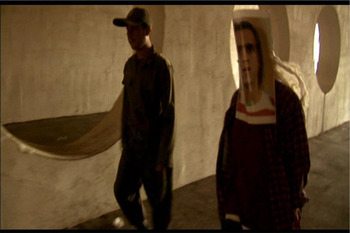
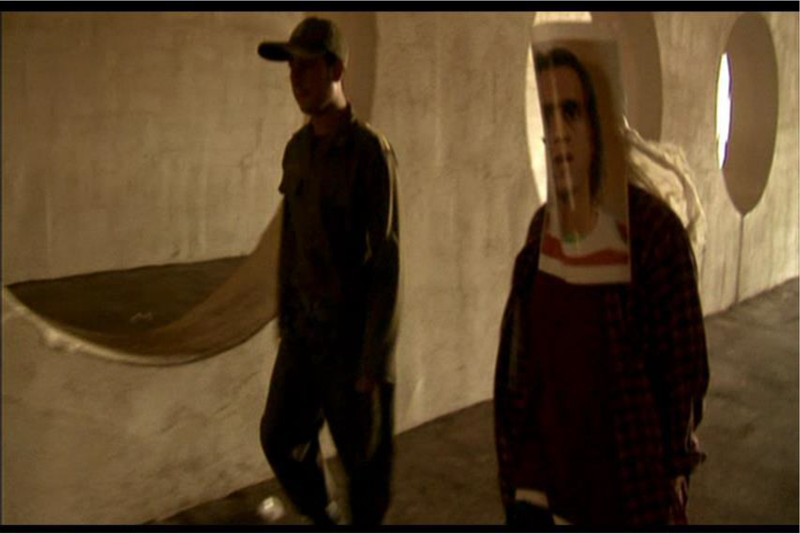
Offside focuses on a series of different, somewhat interchangeable girls in a stylistic technique that Panahi favors, allowing for a play of repetition and variation that some critics have linked with artistic patterns in Persianate art but that is also characteristic of genre movies.Footnote 32 The taboo that separates women from men is here not only severed literally by women wanting to be at an all-male event but also by the necessity of disguise in order to achieve this—which muddies the supposedly clear division of genders. Just before half-time the soldiers allow one desperate prisoner to go to pee. Since only male facilities are available, the guard must go with her to ensure propriety. Thus, he re-disguises the girl, who like all the others had tried to sneak in dressed as a man—but in preposterous fashion. She is required to wear a poster of star player Ali Karimi over her face—and the soldier obligingly makes two holes in the eyes of the face on the poster so that its wearer, unseen, can, in a fashion, look out. Thus the woman disguised as a man, revealed as a woman, must become a man once again. Stumbling along, she is a comic figure, whose incongruous situation points up the ludicrous nature of the circumstances that have forced this new disguise upon her (see Figure 1).
A girl, her face hidden by a poster, is accompanied to the male toilets by her guard in Jafar Panahi's Offside.
This humorous querying of gender difference is further reinforced by both the wide variety of masculinities on display in the toilet and also by the androgynous appearance of one captive girl in particular. As the most confident of the group, she early on engages her reluctant Azeri farm-kid guard in debate, asking why it is that men and woman can go to the cinema together but not to the game. His response is that they cannot even do the former in Tabriz, his closest big city, to which she replies that she has done it. “Looking like that?” he responds incredulously. “No of course not,” she tells him: in other words, she can dress as a girl or a boy, according to which role will allow her to fulfill her objectives. Her guard, on the other hand is nonplussed by such adaptations and humorously unable to recognize the technique that is being used by the girls in order to be able to watch the game. Later he gets a somewhat less androgynous new arrival’s gender wrong, his inquiry “Why’s he handcuffed?” receiving the response “He’s a she.”
It is interesting in this light to consider the image on the front of the DVD that also serves as the screen-saver for the menu on the North American edition of Offside. The woman depicted does not appear in the film. She would not, indeed, get into the stadium because there is clearly no attempt to disguise her femininity; in fact, it is emphasized by her eyeliner, manicured brows and lashes, lipstick and pink nails. Furthermore, she looks straight at the camera/audience, breaking the taboo on such looks that exists in post-revolutionary Iranian society and cinema. She exudes self-confidence and control, as further suggested by her apparent balancing of a football on one finger. Evidently, she is in charge as the girls in the film aren’t—front and center, onside. Presumably this image has been constructed by Sony Classics, the film’s US distributor, in order to represent a western notion of the paradox of women with covered hair who nevertheless assert their power and foreground their sexuality, the partial covering thus adding to the allure whilst the confident look and gesture invite engagement: the opposite of the girls in the film who are not stereotypically feminine and would not want to be since their goal is to blend in with the (male) crowd. The image evidently misrepresents the film it advertises as it attempts to extend its audience somewhat beyond the festival set not by emphasizing the comic aspects of the use of costume and disguise in the film but rather by suggesting female agency in a more stereotypical, perhaps more easily consumable, manner.Footnote 33
The traditional and officially encouraged covering of the female form in the shapeless black chador (further enwrapped in the net of a goal) features on the back cover of the DVD. Here the body is hidden whilst its gender is emphasized.Footnote 34 This paradox is showcased a little later in the film when an elderly man, with whose search for his daughter on the way to the stadium the film began, reappears and recognizes one of the prisoners as her friend. Shame-facedly, in front of a man she knows but to whom she is not related, she produces a chador to preserve propriety. The action shows the uncertainty and precariousness of the girls’ position, and indeed of humor as a device for satire in the film.Footnote 35
The Lizard also uses disguise and costume to produce comedy, but this time in a broader, more explicit manner, indicative of a film that, despite its other claims, is unquestionably a comedy. Tabrizi’s film played in commercial theaters in Iran to considerable acclaim for almost a month before it was banned, adding to its cachet and its popularity in the country (where it continued to circulate clandestinely) and probably increasing its appeal abroad. It is a religious film but one filled with satirical jabs aimed at elements of the clergy, skewering them for being more concerned about surface impressions—how things (including themselves) look; arcane, theoretical interpretations of Islamic law; rote learning—than about helping people and living a good life in God’s service. Unlike Panahi, now under house-arrest in Tehran, banned from making films yet still finding ways to do so, Tabrizi comes from a religious family and has pursued projects more coincident with government desires. This may explain how the film came to be made and acknowledged at the Fajr film festival with an award for best screenplay. Mansoor Behnam, explaining how it “camouflages itself in the mainstream cinema,” suggests that certain topics proscribed for directors who have traditionally produced critical work have at times been allowed, even encouraged, in the work of more establishment filmmakers so as to be used “both for the circulation of capital and, also, as a security valve in order to release social pressure.”Footnote 36 On the other hand, Sony Kim, contrasting The Lizard with Masud Dehnamaki’s The Outcasts, suggests that “while The Lizard did secure popular appeal, it did not provide enough ambiguity in its narrative to ensure its longevity in theaters.”Footnote 37 Still it remains likely that, despite their renewed popularity in Iran in the first decade of the new century, comedies are also allowed to provide critiques inadmissible in some other genres.
The Lizard’s protagonist, Reza (Parviz Parastui), is a thief with morals. He eschews violence and is successful mainly because of his amazing ability to scale walls: hence his nickname, lizard. Nevertheless, at the beginning of the film, he has been arrested for a violent crime he did not commit. His appeals exhausted, he thinks of killing himself but has already abandoned the idea—a sign of his good moral judgment—when another prisoner, thinking to save him, attempts to wrest a bottle of pills away only to break it and cut Reza badly with the glass. In the hospital, Reza meets a mullah, also named Reza, whose clothes he steals, walking out dressed as a cleric. He immediately gets a dose of what ordinary Tehranis think of the clergy when he waits a long time before he can get a ride only to be picked up by a man who uses his presence to gain access to private roads and get special treatment from the police. Finally reaching a friend, Reza arranges for a fake passport that he must pick up at the border and heads there on the train. Upon arrival, he is mistaken for the new mosque prayer leader for whom the rural village has been waiting. And, in a way, he turns out to be just that.
Reza’s clerical garb garners him both respect and disdain. He is the subject of some teenagers’ jibes, for example, as he prepares to board the train. Reza quickly turns the tables on the irreverent teens, however, shocking them into silence with his caustic retort. Boarding the train, he is treated with great respect by the guard, who asks him to lead a prayer. Settled into his seat, he looks quizzically at his robes, which soon prove a factor in another interaction when a narcoleptic woman and her attractive daughter are assigned to his compartment. Reza’s lascivious intent once the mother has fallen asleep is thwarted when, in closing the window, he catches his cloak, necessitating the guard’s having to come and free him. The guard also moves the women to a newly free family compartment before installing a police chief and a bureaucrat in with the dismayed Reza. Later, however, he gets another chance when he travels with the women in the back of a pick-up truck, but the voluminous clerical outfit has the same effect, tripping him up as he attempts to “make a move” on the daughter. Thus, the relationship between the role of the mullah and Reza himself cuts both ways—in general each helps the other be better. Just as Reza’s inherent humanity shows us what the clergy should be doing, his new-found role limits his own potential transgressions. Indeed, once a peripheral figure, he is now the center of attention, a position from which he reinterprets religious values in humorous ways, based upon perceived human needs. Reza assimilates much of what he has heard from the few clerics he has previously encountered as he is asked to sermonize. His influences include not only the original mullah, whose clothes he wears and who has provided him with a central piece of wisdom by saying that there are as many paths to God as there are people, but also a television preacher he briefly watches after his escape who discusses Tarantino’s Pulp Fiction (1994), inspiring Reza to ask what “brother Tarantino” has to teach us.
Reza’s common sense—which the film allies to large extent with wisdom—also asserts itself in his response to the barrage of inquiries he receives about religious protocol. How should Muslims behave at the North Pole or in Space? He side-steps the question by advising against going to either place.Footnote 38 When Reza changes into civilian dress at night to seek out his passport, he is forced to visit many doors before finding the right one. His actions are mistaken by the villagers for a humble gesture of secretly visiting and helping the poor and the next night many of them join him to give out food and otherwise help the needy. This action is juxtaposed to the efforts of the young men of the village to learn the Koran by heart. One father praises his son for helping others but reminds him that learning by rote is more important—an approach the film patently rejects. Thus, the incongruous notion of the thief posing as the mullah reveals the additional incongruity that he is in many ways fit for the position. The heart of religion lies beneath, beyond such surface mastery of rituals and rules. And here it takes a peripheral figure, imitating a respected one, and a rural border village to reveal that truth.
Peripherality and Humor in the Art Film
In contrast to The Lizard, the broadly realist, humanist, self-reflexive Iranian art film is not funny — at least by repute. In his Social History of Iranian Cinema, Hamid Naficy reprints a cartoon by Mahmoud M (of the popular and influential US-based online magazine The Iranian) that parodies the impact of international film festivals on the genrification of art cinema from Iran. A figure whose hair and sunglasses indicate Abbas Kiarostami uses a pointer to note nine features of the typical Iranian festival film. Naficy translates them as:
[1] presence of the film crew in film; [2] misery, misfortune, poverty; [3] yearning for a pair of shoes, a balloon, an apple, a pear, a fish … ; [4] exploitation of women and children; [5] suicide due to anomie and boredom; [6] nonprofessional actors; [7] wild nature in villages and countryside; [8] having the film censored; [9] earthquake, flooding, plague, Taliban.Footnote 39
This list attends, amongst other things, to Iranian art films’ emphasis on the marginal, whether apparently ordinary and insignificant (a balloon, a pear, boredom) or peripheral (wild nature, poverty). In addition, it encapsulates with an effective combination of word and image the notion of an arcane cinema, foregrounding self-reflexivity, that teaches rather than entertains, and suggests that Kiarostami and his ilk will use whatever misfortune comes to hand in order to remain at the center of western attention.Footnote 40
Although Mahmoud’s list might make us laugh—especially if we appreciate the thrust of its satire on certain common elements that have constituted the genre of the Iranian art film—this is evidently not a list of things liable to make us laugh in the theater. It bears some resemblance to a list, published in the first issue of the 2014 Fajr film festival daily newsletter, Jashnvareh, of the characteristics and iconography of the “spiritual” film which notably adds a reference to the technology used to capture such stories: “rain, wind, child, apple, Afghan, camcorder.”Footnote 41 And yet it does seem to me that the meta-message of the satirical cartoon is that humor is present in the festival film, an idea that has not been much developed in scholarship on the Iranian, or indeed other, art cinema. What seems to characterize this humor in the Iranian art film—and I would say in several other national and transnational sub-genres—is that it is understated, deadpan, restrained, mostly unremarked by the characters and not drawn attention to by the aesthetic of the film: it is not as if there is going to be a laugh-track. These films do not foreground distinctive costume to produce either comic effect or social critique; rather, in the examples from the geographically peripheral art film to which I now turn, compositional relationships that leave more to the viewer’s discretion are prevalent and provide a different kind of humor. In addition, the self-reflexivity foregrounded in Mahmoud’s list to suggest a self-centered filmmaker and implicit in Jashnavareh’s inclusion of the camcorder is commonly a cause of humor in such films for film aficionados anywhere.
In Laughter (1911), Henri Bergson writes of “an absence of feeling” that accompanies laughter, thus tying it not to expansiveness but to indifference and inexpressiveness.Footnote 42 This notion has been used to discuss the work of Buster Keaton, and has been extended by Najat Rahman, for example, to Elia Suleiman’s cinema.Footnote 43 Suleiman, in his turn has been an obvious reference point for another festival favorite, Moroccan Faouzi Bensaïdi, who, like Keaton and Suleiman, challenges the status quo by not speaking and by maintaining a stone-faced in response to all the things that go wrong, all the malfunctions of society and machinery he encounters. This incongruous absence of facial reaction—taken to an extreme degree by the poster-as-face instance from Offside—is characteristic of much Iranian art cinema. A simple example comes from Kiarostami’s early short for the Institute for the Intellectual Development of Children and Young Adults (Kanun-e Parvaresh), “Two Solutions to One Problem” (Do Rah-e Hal Baray-e Yek Masaleh, 1975), a school-set version of the standard comedy gag in which two silent, unexpressive adversaries take turns to damage or destroy each other’s things.
Bergson argues that incongruity is especially evident and liable to cause us to laugh when a human being begins to behave like a machine, thereby betraying an inhuman “mechanical inelasticity” rather than a “wideawake adaptability.”Footnote 44 If human beings start repeating themselves like machines, they have malfunctioned, lost the human element. On the other hand, the machine that goes wrong is one that has stopped behaving in repetitive, predictable ways—most famously instanced in cinema perhaps by the feeding machine in Chaplin’s Modern Times (1936). This polarity is evident in much Iranian art cinema, and nowhere more so than in the work of Kiarostami, which simultaneously represents human inelasticity and emphasizes the individual human experience: in the actor Hossein’s inability or refusal to number the dead as requested by the diegetic director in Through the Olive Trees, for example, and in Tahereh’s similar failure to respond in the same scene. In the Tehran-set Close-Up (Nema-ye Nazdik, 1990), the film pretends a failure in the sound equipment in order to achieve a modicum of privacy, indicative of human empathy, for the characters on the motorbike: Mohsen Makhmalbaf and his impersonator Sabzian, a man previously peripheral to his city, who has unexpectedly got to meet his hero and now acts in conjunction with him. This self-reflexive touch at the film’s conclusion produces humor through the knowing use of unavailable or unreliable technology as a justification for not allowing us to witness as much as we thought we would—and is prefigured earlier in the film by an ill-prepared journalist scampering door-to-door in search of a tape-recorder.
Peripheral Technologies and Humor
A lack of technological savvy within the diegesis is reflected in post-revolutionary actress Fatemeh Motamed Aria’s comment on Iran’s art cinema that “[i]t is our plea for compassion that is capturing the world, not our advanced technique or our high technology.”Footnote 45 My focus in this section is on understated versions of the humorous relationship between technology and humanity in what I have been calling the peripheral films. Unsurprisingly, it is in these films that the failure of technology is most pronounced. Saeed-Vafa argues that the absence of “advanced technology” and a big budget is part of the success of such films in festival settings, that these circumstances emphasize the location, and that, consequently: “[a]ccess to the psychology of characters is possible mainly through an examination of their exterior environments.”Footnote 46 These are the antithesis of places that the Pahlavis and to some extent the Islamic Republic have often preferred to appear in exported films since they create the wrong image of the country as undeveloped and insufficiently modern, one diametrically opposed to the ubiquitous images of the shahs—and now the ayatollahs—that punctuate urban spaces. Such village locations, though harking back to Mehrjui’s The Cow (Gav, 1968), Golestan’s The Secret Treasure of the Jinn Valley (Asrar Ganj Darehye Jenni, 1974), and to Beyzai’s counter-hegemonic Bashu: The Little Stranger (Bashu: Gharibe-ye Koochak, 1987), became increasingly common at the end of the 1990s.
In Kiarostami’s The Wind Will Carry Us (1999), Behzad, the protagonist, must continuously—we see it five times—drive to the graveyard at the top of the hill above the village in order to get reception on his cell-phone, thus providing an instance of repetition and gentle humor due to the technological limitations of the location. Behzad is in the village of Siah Dareh in Iranian Kurdistan to film the scarification rites subsequent to the death of an elderly woman; however, she does not die and his bored crew threaten to abandon the project, justifying their action by saying that her nephew has returned to Kermanshah—which, as Behzad points out, is not far away, whilst they must travel almost 500 miles to return to Tehran. Thus, attention is drawn to the exotic and remote nature of the location as a place where things might not work in the intended way.
Upon arrival, the Tehranis’ car has broken down, instigating a punning conversation in which Behzad compares his own getting “hot under the collar” at his young guide’s stream of questions to the car’s overheating.Footnote 47 If Kiaroastami is famed for shooting in cars, it is also true that in his films and in others that he has more or less influenced, these cars are constantly breaking down.Footnote 48 Certainly this happens in town, for example in the pre-revolutionary The Report (Gozaresh, 1977) in which the husband is told to push his broken-down vehicle out of the street whilst we cross-cut to hand-held footage of his wife wandering around in the traffic looking for him, a metaphor for the confusion and struggle of their lives together. The breakdown is, however, also a convenient plot device, stranding sophisticated urbanites in remote rural locations. In the Kiarostami-scripted Deserted Station (Istgah-Matrouk, 2002), for example, a married couple, en route to Mashhad take a short cut on a dirt track, at which point the car breaks down. In both instances the protagonists’ priorities are questioned and their authority comically undermined. In Mourning (Soog, 2011), a film that has been described as “blackly comic” on the festival circuit,Footnote 49 it is a road accident that forces the deaf couple and their nephew, Arshia—whose parents we assume have died in that accident—to head off across country back to Tehran. The car breaks down and the arrival of help provides the opportunity for us to discover that Arshia can read lips and thus knows about the tragedy that has befallen his parents.
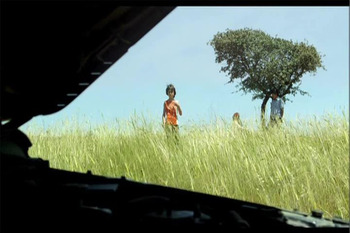
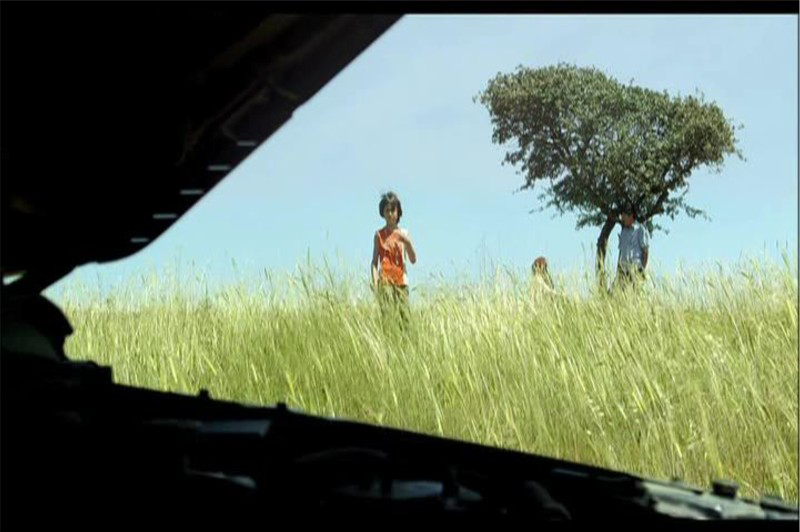
Mourning is directed by Kiarostami-influenced Morteza Farshbaf, who has set his film in rural northeastern Iran. Indeed, the visual syntax of his work is fairly typical of the Iranian provincial festival film. In the shot in which we discover Arshia’s ability, rather than juxtaposing mechanical/technological failure and character response through editing, the use of long takes and depth of field place the broken-down vehicle in the foreground and display the human reaction (or absence thereof) in the same shot. The archetypical instance of this is perhaps the extremely long shot of the car that eventually makes it up the hill at the end of Kiarostami’s Life and Nothing More (Zendegi va Digar Hich, 1992), facilitating a final gesture of human connection. Here, on the other hand, the malfunction of the vehicle reflects the breakdown in understanding and communication between the main characters and the uncertainty of visual and audible information. Through the open hood of the vehicle in the foreground we see uncle and aunt debating what to do (see Figure 2). Subtitles tell us what they are saying. Meanwhile Arshia humorously repeats to the mechanics his relatives’ supposedly private conversation about the trustworthiness of those same mechanics. However, he then violates the expectation that he will tell everything by failing to translate the comment that he is “spaced out.” In a sense the scene is payback since his uncle’s originally comic remark that Arshia “feels like pissing every time he sees a tree” is a misreading which fails to discern the boy’s need to escape the car periodically to mourn his dead parents. A second assertion of his own needs comes later, when, acting on information from the tow-truck driver who tows their car into town to be fixed, Arshia—who has no desire to reach Tehran and begin his future—brings the car to a halt once more by putting cola in the gas tank.
Arshia viewed through the open car bonnet [or hood], in Morteza Farshbaf's Mourning.
Such technological and mechanical failures often serve as metaphors for the breakdown of social relations and may be taken by festival audiences as symbolic of a broken society, elliptically critiqued by the filmmaker using allegory and humor. To the extent such a reading is warranted, it reflects a hidden or indirect meaning, a complement on a semantic level to what Naficy has called “indirection” in such films and Sheibani “disintegrated aesthetics.”Footnote 50 Somewhat similarly, Kiarostami has described his films as “half-made” or incomplete; elements of plot and perhaps of meaning must be supplied by the audience acting like helpful mechanics, so that the apparently simple is interpretable and interpreted—and humor often aids in this transition.Footnote 51 At the end of Mourning visual and verbal duplicity converge as Arshia walks into a train tunnel as if to become invisible, making his relatives effectively blind as well as deaf, denying them the ability to “speak,” and returning the film to the darkness with which it began; its meaning is thus appropriately “obscured,” at the same time that it is made central in a blackly humorous rejection of cinematic signification.
The work of Abolfazl Jalili, which favors long takes and episodic narratives, provides an especially clear example of this aesthetic of ellipsis and indirection—and its potential for humor. His films follow broadly neo-realist lines and are commonly set amongst the dispossessed on the periphery of the city—Scabies (Gal, 1987) in a reformatory—or the wilderness, as in Delbaran (2001), which provides vignettes in the life of undocumented teenage Afghan refugee, Kaim. If Aisha wants to remain on the periphery, Kaim has no choice but to be there; he survives on the margins of Iranian society, employed as a jack-of-all-trades by Khan, who runs a road-house and subsidizes his income by smuggling Afghans across the border. Typical of Jalili’s work, there is a more or less coherent narrative expressed by visual details and by differences in repeated but varied events.
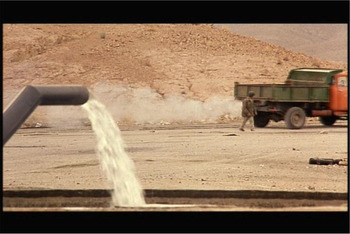
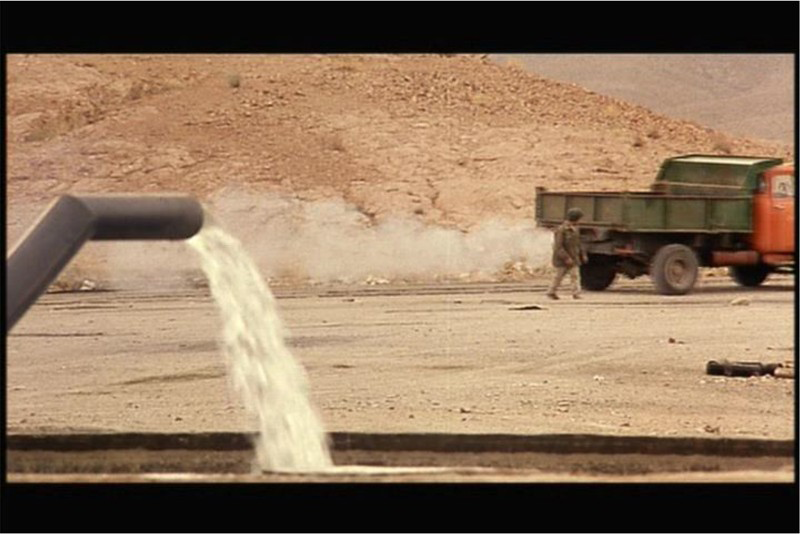
In Delbaran, that old vehicles are constantly breaking down becomes not only a comment on the failings of technology at the periphery but also an opportunity for presenting comedy within everyday life, via the incongruities inherent in the difficulties of satisfying the need to move from one place to another. The film begins with the fixing of a flat tire—without the advantage of a jack: instead Kaim crawls underneath and lodges a rock in place. Much of the film is occupied with attempting to fix things and a running joke revolves around Kaim’s repeated visits to the mechanic, whom he scolds for his reluctance to hurry, comically chastising him for taking so long to gather his tools. Early in the film, the generator, which runs a water-pump crucial to Khan’s Delbaran establishment, fails. Kaim collects the mechanic, and a bird’s-eye view shot of the three of them surrounding the generator ends with the mechanic signaling his success. Cut to an exterior shot with the water-pipe centered in the foreground, water flowing. Kaim and the mechanic walk into shot from behind the camera to the mechanic’s truck in the background. As the mechanic drives off, Kaim walks back towards the pipe—and camera (see Figure 3). But the flow slows and eventually peters out. Whilst the camera remains unmoved, the pipe in the foreground a mocking commentary on the characters’ attempts to control the water, Kaim rushes off in a vain effort to arrest the mechanic’s departure. Whilst cutting between the pipe, Kaim, and the mechanic likely has the potential to be funnier, the dependence on the still camera, mise-en-scene, and composition of the shot is key to a more sardonically humorous interpretation of the moment. The pump’s lack of movement is echoed by the camera and counterpointed by the suddenly activated ‘tricked’ character that pump and person have seemingly collaborated to outmaneuver. Jalili’s reliance on a single shot allows the audience to survey the aspects of the situation that produce humor—as soon as the mechanic leaves, the water stops and Kaim starts.
Kaim returning after the (temporary) fixing of the water pipe in Abolfazl Jalili's Delbaran.
Kaim’s body is often in motion: he runs back-and-forth in order to keep things running. Returning from an errand in town, he spots a pick-up that has gone off the road. First, we see the tarmac littered with books that we soon conclude to be the pick-up’s dispersed load; next the camera slowly tracks up the back of the vehicle that lies on its side in a ditch. After tending to its driver, Khan, Kaim and two other locals attempt to right it, using a long rope—and again makeshift technology produces visual humor. We first see the four of them arrayed on the road, connected by the rope; the camera tracks along it—seemingly for far too long—over a barricade and down to eventually reach the bumper of the pick-up, its driver pushing from the other side. Here it is camera movement that gradually converts a reasonable activity into a seemingly absurd one. Time after time the rope fails, sending those pulling flailing across the road. The physical humor combined with the pleasure the men express, laughing at their repeated misadventures, simultaneously emphasizes their peripheral status far from a putatively cosmopolitan, ‘film-festival’ society audience, and links them to such an audience with whom they share the joke.
Such instances reflect the use of humor and laughter as coping mechanisms for characters who must make the most of limited resources and worn, outmoded equipment. At the end of the film Khan is dead, and Delbaran has been by-passed by a new road. Both Kaim and the place where he has lived and worked are rendered redundant, peripheral. It matters no longer whether the pump works or cars break down. Before he departs, however, Kaim takes action, scattering the nails we have seen Khan order on the new road, presumably so as to cause flat tires in the passing trucks. We probably assume that this had been Khan’s plan too—but perhaps in order to get more work, whilst Kaim’s action is now presumably motivated by his anger and lack of purpose. It will likely achieve little. We see no newly disabled trucks; there is no punch-line and no humor at the end of the film. In the final shot, Kaim’s backward glances indicate that he is leaving Delbaran, but even this is ambiguous.Footnote 52
Parody and Digital Futures
Parallel with Mahmoud M’s cartoon’s satiric list, occasional, highly self-reflexive films have parodied the Iranian festival feature, picking on some of the same traits in an attempt to provoke a self-conscious humor. Such films thus both draw out the possibilities for seeing humor in certain festival favorites—laughing with them so to speak—and make humor at the expense of those films by suggesting their ignorance of the latent humor in conventional tropes: they treat them as the “straight” man. I would mention two: London-based Babak Jalili’s Frontier Blues (2009), which is once again set on the periphery (on the border with Turkmenistan), and The Iranian Film (2013), directed by Moroccan Yassine El Idrissi, a student in Holland, who returned home to shoot it. Jalili has described his film, a first feature, as being easier to make in and around Gorgan where he grew up because of its remoteness from Tehran, and adds that this distance also enables the film’s comic approach to provincial life:
[i]t was important to make my first film in my hometown because I always found it, in many ways, an absurd place. The place is forgotten about or ignored, there were these characters hanging around and the longings they had. So the humor came naturally.Footnote 53
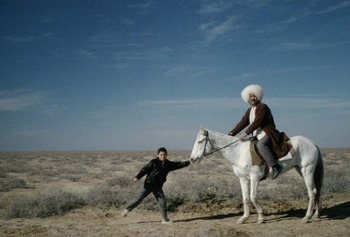
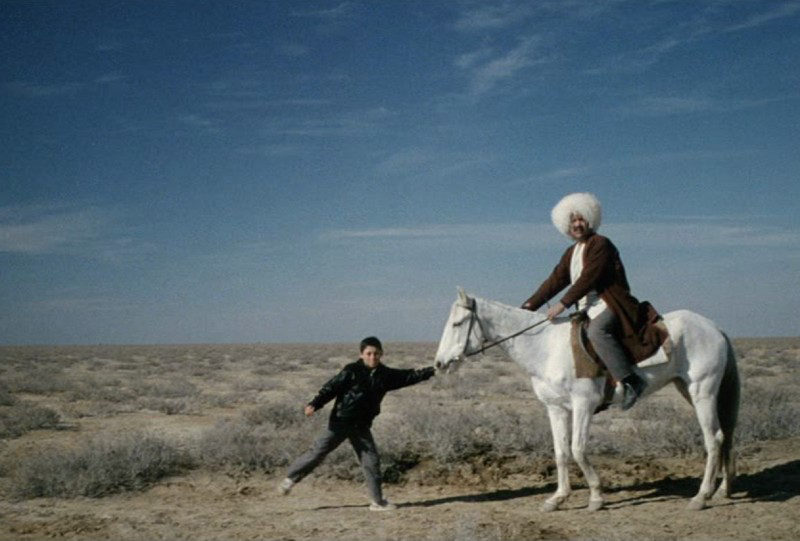
Beginning with a shot of a broken-down car, Frontier Blues follows a photographer from Tehran for whom a local guide attempts to provide suitably exotic material, assuring his acquaintances at one point, “he loves this crap; just dress up and wrestle a bit.” In a swipe at The Wind Will Carry Us, the photographer is especially eager to find a funeral to shoot. In this he fails, but he appreciates other spectacles staged by or for him, exclaiming, for example, “A Turkoman on a white horse on the steppes—that’s what people want to see,” as we witness his guide, in traditional dress, balanced photogenically on a horse held by one of his young assistants (see Figure 4).
A Turkoman on a white horse on the steppes—that’s what people want to see” (Babak Jalili's Frontier Blues).
In The Iranian Film, the director, played by El Idrissi himself, is told by an actor friend to whom he goes for advice that his movie sounds like “a foreign-made folkloric film about Morocco.”Footnote 54 Indeed the director looks for a suitably picturesque village in which to shoot his drama about the lack of flags necessary to celebrate an unspecified national holiday. We see him meet up with various locals as he searches for his location and with industry-related professionals as he seeks funding. Their reactions to the promise of a role in the film or to the request for assistance become the film itself much in the manner of Makhmalbaf’s Salaam Cinema (1995), from which we see a clip near the end of The Iranian Film. We also see Kiarostami’s first Kanun short, “Bread and Alley” (Nan-o Kucheh, 1970), which El Idrissi screens in his chosen village in order to explain the kind of film he wants to make and to get the villagers on board. The sense of mise-en-abyme is strongest however when we see Crimson Gold on a television screen, an image that actually turns out to be a clip from Panahi’s This is Not a Film (In Film Nist, 2011), in which he shows and discusses the excerpt from his own earlier film. An Iranian Film’s continuous evocation of Iranian films as templates, framed by its diegetic director’s admiration, inevitably satirizes the insularity of such films—they are talking to one another—at the same time as it comically imitates and celebrates them. When El Idrissi talks to the village elders, he is assured that his camera won’t work there because nothing else does. Metaphorically, this turns out to be true since no villagers show up for his audition despite their enjoyment of his free film screenings the night before. Forced to abandon the film, the director then creates a new one, fashioning a story out of the footage he has shot trying to locate and fund his project. The shot of a truck, not moving because he has never got permission to use it, now serves as the broken-down vehicle that instigates his story and links it to the Iranian village-set, technology-challenged, edge-of-modernity stories he so much admires.
The relationship between car, whether working or not, and camera has been foregrounded by Kiarostami’s work from at least Life and Nothing More onwards. In his documentary follow-up to the all-vehicle set, Ten (Dah, 2002), entitled 10 on Ten (2004), he discusses the freedom he feels he has been given as a filmmaker by small, portable, digital cameras. Thus, they were originally to serve as visual notebooks on an exploratory trip to Uganda to prepare for ABC Africa (2001), but eventually provided the footage that became the film, functioning as a medium of expression that Kiarostami compares to pens in their ease of use. For Ten, they were a necessary part of the project from its conception, mounted in the vehicle rather than held by the director sitting next to the driver or passenger, as in Taste of Cherry (Ta’ame Gilas, 1997).Footnote 55 Kiarostami explains that the removal of the director from the scene paradoxically increases the sense of an informing auteurist presence, since the small camera spares the filmmaker many of the headaches of traditional production, ameliorating the pressures of funding and of censorship, as well as technical problems. Thus, filmmaking is now “not much different from writing, painting or sculpting.”Footnote 56 This assertion recalls Samira Makhmalbaf’s remarks at Cannes in 2000 (where she shared the jury prize for her second feature, the Kurdistan-set, Kurdish-language, Blackboards [Takhté Siah]), in which she celebrates the camera as prosthetic, extending the filmmaker’s capabilities.Footnote 57
Many recent writers have enumerated how the new technology has allowed independent and underground filmmakers in Iran to fly under the radar, thus producing a peripheral cinema of another kind.Footnote 58 Najmeh Moradiyan Rizi, for example, notes that “[n]ew media technologies have.. … provided easier ways for filmmaking, film exhibition, and film distribution that are now more self-governed… … through a covert process of film production.”Footnote 59 Accordingly, Iranian officials have argued that the state’s enemies, internal and external, are taking advantage of new media technologies to weaken the revolution in a “soft war” that threatens Islamic values.Footnote 60 Moradiyan Rizi cites well-known examples of such variously clandestine cinema, My Tehran for Sale (2009) and No One Knows about Persian Cats (Kasi Az Gorbehay Irani Khabar Nadare 2009), adding Tehran Without Permission (Tehran Bedoune Mojavez 2009), recorded with a cell-phone.Footnote 61 Parviz Jahed also discusses what he refers to as the “digital liberation” of contemporary underground film in Iran, citing several more examples including Orion (Uriyan, 2010) and 20 Fingers (20 Angosht, 2004).Footnote 62 Such marginalized productions continue to provoke interest from abroad. Jahed argues that such films are “very appealing to media distributors and film festivals from around the world” and suggests that this circumstance may indeed lead underground filmmakers in Iran “astray in their aim to please the western audience.”Footnote 63
Comedies unsurprisingly do not feature in these descriptions of digital, covert filmmaking and, although odd humorous elements appear in some of the films, the struggles upon which they focus have not proven conducive to the inclusion of much humor of any kind. Although the day of the dark, digital, humorous film may be yet to come, perhaps the best-known example of such clandestine or underground cinema in Iran—the post-arrest works of Panahi—offers a wry, satiric, self-reflexive humor that also characterizes his earlier work. This is Not a Film, made whilst he was awaiting a verdict from the appeals court on his twenty-year ban on writing and directing, shows him, along with collaborator Mojtaba Mirtahmasb, using an iPhone, simple digital camera, and a monitor to explore Panahi’s ideas about his films, past and present. Shot almost entirely inside his apartment and latterly in the crowded confines of the building’s elevator, the film visually comments on its subject’s restricted condition, as he enacts a film in his living room, watches clips from his earlier work, discusses his plight over the phone, and punningly denies through its title that his film is a film. Although the film’s subject invites little humor, some is introduced by Panahi playing with his daughter’s pet iguana, Iggy, which crawls around incongruously between bookcase and wall whilst he discusses his plight over the phone with fellow filmmaker, Raksheed Bani-Etemad.Footnote 64 This is Not a Film was makeable and marketable only because of miniaturized digital technology; indeed the finished film was apparently smuggled out of the country to Cannes on a USB stick in a cake.Footnote 65
Recent Films and Final Thoughts
Two other films, Closed Curtain (Pardé, 2013) and Taxi (aka Jafar Panahi’s Taxi, 2015), have followed, both premiering at Berlin, both highly self-reflexive, and both keeping the marginalized Panahi on screen and at the center of the international film festival circuit’s attention. While Closed Curtain is the more radical interrogation of identity and of attempts to displace the artist to the periphery of the national experience, Taxi, winner of the 2015 Golden Bear, returns us to the moving room of the car and to the association of vehicle and camera. Balanced on the edge of parody, Taxi infuses the mundane with the metaphysical. Panahi gives a subtly comic turn as a taxi-driver, recognized by some of his passengers as someone of significance, a constant presence who has refused displacement from his central role in Iranian cinema. Taxi offers a satirical commentary on filmmaking in Iran and Panahi’s own situation, especially in the humorous episode in which his niece, hoping to shoot a scene that will satisfy her teacher’s moral and religious strictures, earnestly attempts to persuade a boy to return some money found on the street so as to preclude the possibility of “sordid realism.”
A quick glance at festival favorites in 2014 and 2015 reveals some common themes and settings as well as some new variations. Panahi’s film is not the only one to depict a taxi-driver. The idea of the driver who is able to listen to his passengers and whose reactions or lack of them explicitly or implicitly comment on their views or circumstances is also central to Reza Mirkarimi’s Today (Emrouz, 2014). Here Parviz Parastui is the driver-star: after picking up a woman who struggles to exist on the margins of society and is about to give birth, he eventually chooses to look after the baby. The comedy stems from the general assumption at the hospital that he is a relation. Atomic Heart (Madare Ghalb Atomi, Ali Ahmadzadeh, 2015), a Berlin Forum presentation, is another film much of which takes place in cars—on the streets of a Tehran that one of the characters refers to as Atomic Heart Mother. Irreverent and oneiric, the film is at times highly comic, as for example in the debate about the Iranian origins of the western toilet, a cultural first displaced by the Mongol invasion. Intensely postmodern in its constant references to other genres, movies and transnational cultural motifs, whilst highly cross-generic itself, Atom Heart Mother’s appeal cannot be subsumed within the kind of classifications discussed at the start of this essay. Its variation in tone and appropriation of different kinds of humor are a part of the film’s rejection of fixed definitions: not only of comedy but of both Iran and modernity.
As elsewhere, the cinema in Iran has been both constitutive of modernity and has reflected some of its consequences, whilst its global exhibition and reception instances a transnational representation of locality. The battle for control of the country’s modern image is today waged through numerous social media technologies in addition to the cinema, as variously marginalized forces contest centrally dictated images.Footnote 66 Kamran Talattof calls Iranian society, “modernoid,” resembling a modern one in some ways but remaining firmly traditional in others, so that it “lacks other essential modern structures”—of which sexual freedoms are, for him, the most significant.Footnote 67 This has been tragic for many artists—certainly for Shahrzad, the film farsi actress and dancer, and would-be poet, who is the subject of Talattof’s analysis. However this notion of an inferior, imitative modernity implies a fixed sense of what modernity must be—of its temporal movement past/beyond traditional practices and its spatial movement outward from Europe—that is hard to sustain in today’s transnational world.Footnote 68 As Atomic Heart suggests and as Sheibani states in her summary of the poetics of Iranian cinema: “[m]odernity as a philosophy and ethos is a diverse and global phenomenon with many possible ontological representations.”Footnote 69 It has multiple origins and flows. Inevitably it has also called forth a range of clever, witty, perhaps allegorical, and often humorous retorts from artists.
Such humor and tragedy are intertwined, for example in Mitra Farahani’s film of exiled Iranian artist Bahman Mohassess—indeed they are present in its very title (taken from a Mohassess painting) Fifi Howls for Happiness (Fifi az Khoshhali Zooze Mikeshad, 2013). Tracking the iconic but “lost” artist down to a residential hotel in Rome, the director collaborates with him in making a documentary on his life and methods. Much of the film is set in his small, crowded apartment, a non-moving room with illuminating parallels to Panahi’s in This is Not a Film . Like Panahi, Mohassess comments on his earlier work and advises how the film should look, providing his own wry commentary on his life and its art. He is despondent at his lack of financial success, but Farahani’s fruitful attempts to persuade an art-collector couple to purchase his work precedes Mohassess’ death. Since the film was made, there has been something of a resurgence in Iranian fine art; like the collectors in the film, the art market has recognized a mostly untapped potential in Iran’s under-collected, relatively “under-priced” contemporary art world. Two of its representatives are the Dubai-based Haerizadeh brothers, Ramin and Rokni, who are in fact the buyers of Mohassess’ work at the end of Farahani’s film. The Haerizadeh brothers, often working with their childhood friend Hesam Rahmanian, apply a frivolous humor as part of their critique of contemporary Iranian society. In their installation “The Birthday Party,” for example, which opened at Boston’s Institute of Contemporary Art at the end of 2015, they incorporate Mohassess’ painting into a carnivalesque display that mixes their own work with work from their personal collection and that of the museum. The broad scope of the installation often invites laughter, the humor achieved both through the overall environment established and the juxtaposition of incongruous objects and artworks. In an interview about the exhibit, Rokni Haerizadeh suggests that their artistic process of accretion began as a joke in which each artist piled new work on top of old.Footnote 70 Many other contemporary Iranian artists, mostly living outside the country, have turned to humor, often for satirical purposes in work that is fiercely critical of the Islamic Republic. This combination of caricature and critique characterizes the work of Tala Madani and Shadi Ghadirian. The Slavs and Tatars artistic collective’s resurrection of the Azeri satirical magazine Molla Nassredin, published between 1906 and 1930, provides some historical context for such an approach. Nevertheless, Payam Sharifi, co-founder of the group, whilst arguing that humor is a “complex and effective way to deliver commentary, critique,” emphasizes that he advocates a “generous” and “inclusive” humor that opens up debate.Footnote 71
Meanwhile, in Tehran, the 2015 edition of the annual auction of modern and contemporary art held in May attracted what the Guardian described as “astonishing [bids] for a country still struggling with international sanctions,” at prices almost twice those expected, confirming a growing interest amongst both domestic and international buyers. It may also reflect renewed official support for the visual arts in some quarters, as highlighted by the use of municipal billboards in Tehran to show local and international paintings, and perhaps also a desire to accommodate some significant modern artists such as Nicky Nodjoumi, whose work has previously been controversial but who was allowed to sell a piece in 2015. (He expressed cautious approval of the event as well as shock at the “staggering amounts” raised.Footnote 72) If the goal of sanctions has been to remove Iran from the central currents of world affairs amidst fears of its potential nuclear technology, powerful financial interests abroad and at home have seen peripherality as opportunity—and humor as a means. Such activity is bringing Iranian fine art to the attention of a world in which its cinema has in recent years been much more visible in contesting and creating the constantly fluctuating relationship between the central and peripheral image of Iran and Iranians.
Humor, often touted as universal, is of course also chronically unstable and highly contextual. It is relative and negotiated. How humor works in cinema is complex and open to reinterpretation by audiences that will find certain things funny or appropriate or fitting, and others not. Current conventions and determinants of middle-brow taste may have directed festival funding and screening opportunities away from films that can be identified primarily as comedies. Nevertheless, film festival audiences are not homogenous, perhaps increasingly less so, whilst taste in Pierre Bourdieu’s sense of the term can change.Footnote 73 In the meantime, humor, especially in alliance with representations of the peripheral and of new technologies, constitutes a key element in much festival-oriented cinema, nowhere more clearly so than in the case of Iran. The incongruities of the humorous apparently facilitate our abilities to assess, understand, critique and tolerate life. In a world of global trade and exchange, one in which periphery and center are being constantly redefined, filmmakers will surely continue to use the latest technologies alongside the oldest touches of humor as survival strategies and as mechanisms to extend traditions of Persianate art within and beyond today’s ever shifting boundaries.