Introduction
The vast majority of community residents have experienced traumatic events. Only a small minority of victims (<10%), though, developed post-traumatic stress disorder (PTSD) (Kessler et al. Reference Kessler, Sonnega, Bromet, Hughes and Nelson1995, Reference Kessler, Berglund, Demler, Jin, Merikangas and Walters2005; Breslau et al. Reference Breslau, Kessler, Chilcoat, Schultz, Davis and Andreski1998b, Reference Breslau, Wilcox, Storr, Lucia and Anthony2004b), suggesting that victims vary in risk factors for the disorder (Breslau et al. Reference Breslau, Davis, Andreski and Peterson1991; Yehuda & McFarlane, Reference Yehuda and McFarlane1995; Bowman & Yehuda, Reference Bowman, Yehuda and Rosen2004). Risk factors modify the probability of PTSD following traumatic experiences, enhancing or diminishing the likelihood of the disorder. Two categories that modify the risk of PTSD have been delineated: trauma characteristics, chiefly trauma severity (Green et al. Reference Green, Lindy and Grace1985; Kulka et al. Reference Kulka, Schlenger, Fairbank, Hough, Jordan, Marmar, Weiss and Grady1990), and well-established predispositions, that is, prior psychiatric disorders and family history of disorders (for a meta-analysis, see Brewin et al. Reference Brewin, Andrews and Valentine2000). It is generally assumed that the influence of predispositions is inversely related to trauma severity: when traumas are extreme, predispositions are assumed to play a secondary etiological role (McNally, Reference McNally2009). This assumption has been articulated in the context of a general stress–disease model (e.g. Rabkin & Struening, Reference Rabkin and Struening1976). Although the assumption has a compelling intuitive appeal, it has never been directly tested.
We use data from a large epidemiological study to examine the influence of selected predispositions on PTSD induced by an extreme trauma – sexual assault – relative to their influence when events are of lower magnitude. Six predispositions are examined: pre-existing major depression (MDD), generalized anxiety disorder (GAD), alcohol-use disorder (AUD), and parental history of alcohol problems, drug problems and incarceration. The classification of sexual assault as an extreme trauma is based on the consistent epidemiological findings of high PTSD risk associated with it (e.g. Kessler et al. Reference Kessler, Sonnega, Bromet, Hughes and Nelson1995; Breslau et al. Reference Breslau, Kessler, Chilcoat, Schultz, Davis and Andreski1998b, Reference Breslau, Wilcox, Storr, Lucia and Anthony2004b). Three event types of lower magnitude were selected for comparison: accidents, disaster and unexpected death of a close friend/relative. Epidemiological evidence on the conditional risk of PTSD supports the classification of these as lower-magnitude events (Kessler et al. Reference Kessler, Sonnega, Bromet, Hughes and Nelson1995; Breslau et al. Reference Breslau, Kessler and Peterson1998, 2004). We compare the influence of each predisposition on the PTSD risk associated with sexual assault relative to accidents, disaster and unexpected death of someone close, in this order.
Method
Sample
The National Epidemiologic Survey on Alcohol and Related Conditions (NESARC) is a two-wave face-to-face survey conducted by the National Institute on Alcohol Abuse and Alcoholism. Wave 1 was conducted from August 2001 to September 2003 and included 43 093 respondents, aged 18 years or older. The sample represented the civilian, non-institutionalized adult population of the USA. The sample has been described previously by Grant et al. (Reference Grant, Moore, Shepard and Kaplan2003) . Of these, 39 959 were eligible for follow-up in wave 2 and 34 653 completed wave 2 interviews from August 2004 to September 2005. PTSD was assessed only in wave 2. The wave 2 response rate was 86.7% (Grant et al. Reference Grant, Kaplan and Stinson2005).
Assessment of pre-existing disorders and PTSD
The National Institute on Alcohol Abuse and Alcoholism, Alcohol Use Disorder and Associated Disabilities Interview Schedule DSM-IV version was used in NESARC to assess psychiatric and substance-use disorders (Grant et al. Reference Grant, Dawson and Hasin2001). Pre-existing MDD, GAD and AUD were coded ‘yes’ if age of onset was lower than age at index event. The assessment of lifetime PTSD begins with a comprehensive list of traumatic events. Respondents who reported more than one event were asked to single out ‘the worst stressful event’ they had ever experienced. The worst event (for respondents with multiple events) or the single event reported by respondents with only one event was the index event for diagnosing PTSD. The groupings of respondents by index events are mutually exclusive: there is one index event per respondent. A distribution of all the index events in NESARC appears elsewhere (Breslau et al. Reference Breslau, Bohnert and Koenen2010). The following questions were used to ascertain exposure to the traumatic events included in this analysis: (1) ‘Were you EVER in a serious or life threatening accident?’; (2) ‘Were you EVER in a serious fire, tornado, flood, earthquake or hurricane?’; (3) ‘Were you EVER sexually assaulted, molested or raped or did you EVER experience unwanted sexual activity?’; (4) ‘Not counting a terrorist attack, did someone very close to you EVER die unexpectedly, for example, they were killed in an accident, murdered, committed suicide or had a fatal heart attack?’
The NESARC PTSD module covers the DSM-IV criteria and includes additional questions that are not required for diagnosis; some criterion symptoms are covered by more than one item. We used the NESARC interview data to diagnose PTSD, applying the DSM-IV criteria. When two items are used in the interview to ascertain a single symptom, replies were combined as one item rather than counted as two symptoms. The PTSD module in NESARC is closely modeled on the National Institute of Mental Health's Diagnostic Interview Schedule and the World Health Organization Composite International Diagnostic Interview (CIDI). High concordance was reported between the ascertainment of CIDI/PTSD by lay interviewers and independent clinical interviews, using the Clinician Administered PTSD Scale. The positive predictive value was 0.75, the negative predictive value was 0.97, and the odds ratio was 94.8 (Breslau et al. Reference Breslau, Kessler and Peterson1998a).
Assessment of parental history
Replies to the following NESARC wave 1 questions were used to measure parental history of alcohol, drug problems and incarceration:
A. Before you were 18 years old, was a parent or other adult living in your home a problem drinker or alcoholic? (By alcoholic or problem drinker, I mean a person who had physical or emotional problems because of drinking; problems with a spouse, family, or friends because of drinking; problems at work or school because of drinking; problems with the police because of drinking – like drunk driving; or a person who seemed to spend a lot of time drinking or being hung over.)
B. Before you were 18 years old, did a parent or adult living in your home have some similar problems with drugs?
C. Before you were 18 years old, did a parent or other adult living in your home go to jail or prison?'
Statistical analysis
We evaluated the influence of predispositions on PTSD following an extreme event – sexual assault – versus each of three events of lower magnitude: accidents, disaster and unexpected death of someone close. Six predisposing factors were examined: pre-existing MDD, GAD and AUD and parental history of alcohol abuse, drug abuse and incarceration. For each of the three comparison series, we estimated six weighted multinomial logistic regressions, one per predisposing factor. In each of the series, we used subgroups of the sample with the two index events being compared.
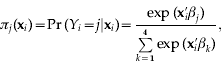
We considered using logistic regression, with PTSD as the outcome, and predisposition, event type and their interaction, as independent variables. However, doing so is akin to adjusting for an intermediate variable (here, exposure to trauma type that might be influenced by predispositions), which can introduce a bias (Robins & Greenland, Reference Robins and Greenland1992). To circumvent this potential bias, we modeled PTSD and trauma type jointly by multinomial logistic regressions. The outcome (Y) in each regression has four categories. For example, in the comparisons between sexual assault (the severe event in this analysis) and accidents (a lower-magnitude event), the categories are: Y = 1 if the respondent (R) developed PTSD after a sexual assault; Y = 2 if R experienced sexual assault but did not develop PTSD; Y = 3 if R developed PTSD after an accident; and Y = 4 if R experienced an accident but did not develop PTSD. The model specifies the probability of outcome Y=j (j = 1, 2, 3, 4), as a function of predisposition and potential confounders as follows:
 $$\pi _{j} \lpar {\bf x}_{i} \rpar \equals {\rm Pr}\, \lpar Y_{i} \equals j\vert {\bf x}_{i} \rpar \equals {{\exp \lpar {\bf x}\prime_{{\hskip-2pt i}} \beta _{j} \rpar } \over {\sum\limits_{k \equals \setnum{1}}^{\setnum{4}} {\exp \lpar {\bf x\prime}_{\hskip-2pt i} \beta _{k} \rpar } }},$$
where xi is a vector of independent variables including predispositions and sex; and βj is the vector of corresponding coefficients for outcome j. For identification, the coefficients for the fourth outcome are set to zero, β4 = 0. The ratio of probabilities for outcome Y = 1 and Y = 3, i.e. PTSD after a sexual assault versus PTSD after an event of lower magnitude, for respondents with independent variable xi is therefore:
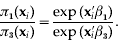 $${{\pi _{\setnum{1}} \lpar {\bf x}_{i} \rpar } \over {\pi _{\setnum{3}} \lpar {\bf x}_{i} \rpar }} \equals {{\exp \lpar {\bf x\prime}_{\hskip-2pt i} \beta _{\setnum{1}} \rpar } \over {\exp \lpar {\bf x\prime}_{\hskip-2pt i} \beta _{\setnum{3}} \rpar }}.$$
We test if this ratio is the same when a predisposition is present versus when it is absent. Using MDD as an example, when MDD = 1, controlling for sex, the above ratio is:
 $${{\pi _{\setnum{1}} \lpar {\bf x}_{i} \rpar } \over {\pi _{\setnum{3}} \lpar {\bf x}_{i} \rpar }}\vert _{{\rm MDD} \equals \setnum{1}} \equals {{\exp \lpar \beta _{\setnum{10}} \plus \beta _{\setnum{11}} \plus \beta _{\setnum{12}} {\rm SEX}\rpar } \over {\exp \lpar \beta _{\setnum{30}} \plus \beta _{\setnum{31}} \plus \beta _{\setnum{32}} {\rm SEX}\rpar }},$$
whereas when MDD = 0, the ratio is:
 $${{\pi _{\setnum{1}} \lpar {\bf x}_{i} \rpar } \over {\pi _{\setnum{3}} \lpar {\bf x}_{i} \rpar }}\vert _{{\rm MDD} \equals \setnum{0}} \equals {{\exp \lpar \beta _{\setnum{10}} \plus \beta _{\setnum{12}} {\rm SEX}\rpar } \over {\exp \lpar \beta _{\setnum{30}} \plus \beta _{\setnum{32}} {\rm SEX}\rpar }}.$$
The ratio of the above two expressions is exp(β11)/exp(β31), which is conventionally called a relative risk ratio (RRR) or odds ratio (although neither term is strictly accurate). The assumption that predispositions have a stronger influence on the risk of PTSD when events are less severe can be expressed mathematically by 0 < β11 < β31. If the results point in the opposite direction or if the two coefficients are equal, then the assumption, as stated above, is rejected.
The results are displayed in Table 3. The first three columns contain estimates of RRRs of predispositions, exp(βj1), for j = 1, 2, and 3 (β4 = 0, the fourth column). The fifth column gives the ratio of the estimates in column 1 (PTSD following sexual assault) and column 3 (PTSD following comparison trauma), i.e. exp(β11)/exp(β31) and its 95% confidence interval; the p value is in the sixth column. The last two columns together address the research question.
The second and third series of multinomial logistic regressions substitute disaster and unexpected death of someone close, in this order, for accidents, as the comparison event. N's in tables and in the text are unweighted. Weighted percentages and RRRs from multinomial logistic regressions were estimated using Stata 11.0 (StataCorp LP, USA). The ‘mlogit’ command was used for the multinomial logistic regressions. Taylor series linearization was used to take into account the complex survey design. Models are adjusted for sex, given the consistent finding of a sex difference in the conditional risk of PTSD. Evidence of the association of PTSD with other sociodemographic variables, such as indicators of SES and race/ethnicity, is inconsistent (and when found, the associations are far weaker). Estimating these models with education and race as additional covariates did not alter the results depicted below.
Results
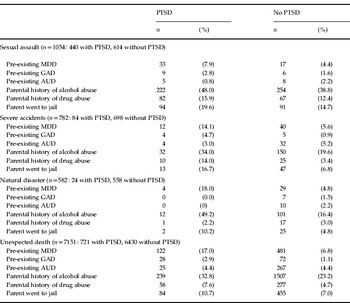
Of the total NESARC wave 2 (when PTSD was assessed) (n = 34 653), 8.7% experienced sexual assault, 16.5%, severe accidents, 15.7%, disaster and 41.6%, unexpected death of someone close. Table 1 presents the numbers of persons exposed to each of these events and the numbers in each index event on which the conditional percentages of PTSD are based. The probability of PTSD associated with sexual assault was 40.2%, markedly higher than the PTSD probability associated with each of the comparison events (Table 1) or any other traumatic event in NESARC (Breslau et al. Reference Breslau, Bohnert and Koenen2010). For sexual assault and for each of the three comparison events, females' PTSD risk was higher than males'.
Cumulative occurrence of four traumatic events used in the analysis, distribution of index events and number (%) of PTSD (total and sex-specific) from NESARC wave 2

PTSD, Post-traumatic stress disorder; NESARC, National Epidemiologic Survey on Alcohol and Related Conditions.
a Respondents who experienced more than one of these events appear in multiple categories.
b The index event was the worst event for respondents with ⩾2 events or the event reported by respondents with only one event. cχ2 (overall) = 214, p ⩽ 0.001; χ2 (males) = 7.3, p ⩽ 0.001; χ2 (females) = 130, p ⩽ 0.001.
Within event types, persons with PTSD had higher percentages of all six predispositions than persons with trauma alone without PTSD (Table 2). Results also show that among victims of sexual assault who did not develop PTSD, percentages of parental problems were considerably higher than among victims of the comparison events who did not develop PTSD. (see last column in Table 2 under parental problems). This suggests that parental problems predicted exposure to sexual assault, apart from their effect on PTSD following exposure to sexual assault. This pattern was specific to sexual assault and was not observed in relation to the other three events.
Pre-existing disorders and parental drug, alcohol and jail among respondents with and without PTSD related to sexual assault, accidents, disaster and unexpected death of someone close from NESARC wave 2

PTSD, Post-traumatic stress disorder; NESARC, National Epidemiologic Survey on Alcohol and Related Conditions; MDD, major depression; GAD, generalized anxiety disorder; AUD, alcohol-use disorder.
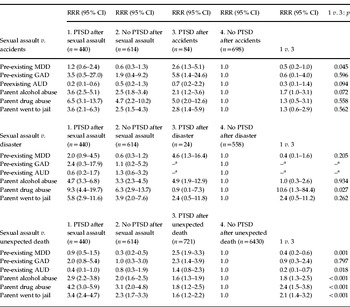
Table 3 presents results from three series of multinomial logistic regressions, estimating the effects of predispositions on the PTSD risk associated with sexual assault versus each of the comparison events. In the first four columns appear sex-adjusted RRRs for the four outcomes: (1) sexual assault followed by PTSD; (2) sexual assault alone, not followed by PTSD; (3) comparison event followed by PTSD; with (4) comparison event alone not followed by PTSD, as reference. Columns 5 and 6 present the RRRs of 1 v. 3 and their pair-wise significance tests, which together address the research question concerning the influence of predispositions on PTSD following severe trauma versus trauma of lower magnitude.
Estimates from multinomial logistic regressions of PTSD due to sexual assault versus three comparison events (accidents, disaster, unexpected death) from NESARC wave 2

PTSD, Post-traumatic stress disorder; NESARC, National Epidemiologic Survey on Alcohol and Related Conditions; RRR, sex-adjusted relative risk ratio; CI, confidence interval; MDD, major depression; GAD, generalized anxiety disorder; AUD, alcohol-use disorder.
a Not available due to an empty outcome cell.
Examination of columns 5 and 6 shows that, of the 18 analyses, only three yielded estimates consistent with the assumption that the influence of predispositions on the risk of PTSD is weaker for sexual assault than lower-magnitude traumas, showing RRR <1.00 and p < 0.05. They are: pre-existing MDD in the comparison of sexual assault versus accidents and unexpected death of someone close, and pre-existing AUD in the comparison of sexual assault versus unexpected death. No other comparison supports a significantly weaker influence of predispositions on the risk of PTSD among victims of sexual assault, relative to victims of comparison traumas. Further, in regard to the parental variables, the evidence runs directly counter to the expectation of a weaker role of predispositions in relation to sexual assault in four analyses, showing RRR >1.00 and p < 0.05. They are: parental drug abuse in the comparison of sexual assault versus disaster and all three parental variables in the comparison of sexual assault versus unexpected death of someone close (Table 3). Because of the small number of PTSD cases among victims of disaster, two regressions could not be fully calculated (Table 3). We include disaster as one of the comparison events and display the partial results, because disaster has been an emblematic traumatic event in the PTSD literature.
Additional analysis
Comparison of age at trauma across the four index events used in this analysis revealed that sexual assault typically occurred before the age of 18 years, whereas only a minority of each comparison event occurred before the age of 18 years. Specifically, 81.9% of sexual assaults occurred before the age of 18 years, in contrast with 27.0% of accidents, 31.7% of disasters, and 24.6% of unexpected deaths of someone close. The age disparity across events would artificially reduce the probability that persons whose index event was sexual assault had experienced MDD, GAD or AUD before the index event, relative to each of the comparison events.
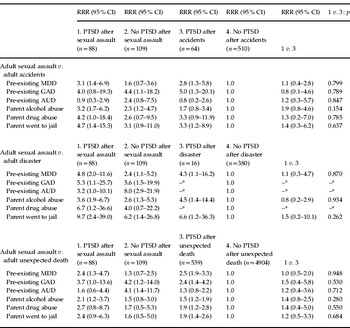
To address this potential bias, we repeated the analyses in Table 3, focusing on adult sexual assault versus accidents, disaster and unexpected death of someone close occurring in adulthood. Given the large sample size of NESARC, there were 197 index cases with sexual assault occurring at or above the age of 18 years. (Note that the PTSD risk associated with sexual assault in adulthood was approximately the same as in childhood, 43.2% and 40.1%, respectively.)
Results appear in Table 4. No significant difference was detected between the RRRs for PTSD among those with sexual assault versus a comparison event in any of these analyses (column 6).
Estimates from multinomial logistic regressions of PTSD due to sexual assault versus three comparison events (accidents, disaster, unexpected death) in adulthood (age ⩾18 years) from NESARC wave 2

PTSD, Post-traumatic stress disorder; NESARC, National Epidemiologic Survey on Alcohol and Related Conditions; RRR, sex-adjusted relative risk ratio; CI, confidence interval; MDD, major depression; GAD, generalized anxiety disorder; AUD, alcohol-use disorder.
a Not available due to an empty outcome cell.
Discussion
The role of predispositions and trauma severity in previous research
The assumption that the influence of predispositions on PTSD varies inversely according to trauma severity has received no direct empirical test in which the effects of specific predispositions are compared between event types in the same study. Clues that this core assumption might not survive a standard scientific test, reported in a frequently cited meta-analysis by Ozer et al. (Reference Ozer, Best, Lipsey and Weiss2003), have gone unnoticed, to our knowledge. The goal of the meta-analysis was to estimate the effect size of seven risk factors for PTSD and symptoms of PTSD. Trauma type (severity) was not one of them. Instead, trauma type was a modifier of the effect of risk factors on PTSD. Ozer et al. (Reference Ozer, Best, Lipsey and Weiss2003) estimated the effects of antecedent risk factors according to two event types: (1) interpersonal violence (i.e. human-perpetrated violence that occurred in a civilian context, e.g. assault, rape, domestic violence); and (2) accidents. (Combat was a third event type but is not included in this summary.) Three antecedent risk factors were considered: (1) prior trauma; (2) prior psychological adjustment; and (3) family history of psychopathology. (Other risk factors were not antecedents, e.g. peritraumatic dissociation, post-trauma social support.) This organization of the meta-analysis – i.e. event type as modifier of risk factors – allows us to see whether pre-existing vulnerability factors were less important in explaining the PTSD effect of severe trauma – interpersonal violence – than a trauma of lower magnitude – accidents.
Data on prior trauma as a risk factor came from 23 studies (n = 5308), prior psychological adjustment, from 23 studies (n = 6797) and family history of psychopathology, from nine studies (n = 667). Ozer et al. (Reference Ozer, Best, Lipsey and Weiss2003) found no evidence that these predispositions were less important in the etiology of PTSD among victims of interpersonal violence than victims of accidents. To the extent that differences in effect size were detected, they were in the reverse direction. Effect size associated with prior trauma was 0.27 for interpersonal violence and 0.12 for accidents (p = 0.05). Effect size associated with prior psychological adjustment was 0.31 for interpersonal violence and 0.28 for accidents (not significant). Effect size associated with psychopathology in family of origin was 0.31 for interpersonal violence and 0.08 for accidents (p = 0.01).
It is unclear whether the observed differences in effect size between interpersonal violence and accidents would make a material difference to understanding the ways in which predispositions work. The inescapable conclusion is that there is no empirical support in this meta-analysis for the notion that pre-existing predispositions play a weaker role in PTSD when trauma is extreme (versus lower magnitude). (The issue of the modifying effect of trauma type was not an explicit goal of the meta-analysis. The authors' conclusions were about the importance of peritraumatic experiences as risk factors. It was cited subsequently in relation to these conclusions.)
Summary of key findings
We compared the PTSD effects of established predispositions – pre-existing disorders and parental psychopathology – among victims of sexual assault versus victims of each of three traumatic events of lower magnitude. The PTSD effects of these predispositions, in 15 of the 18 comparisons in the total sample (Table 3, last 2 columns) and in all the 18 comparisons in the subset aged 18 years and over (Table 4, last two columns) were not significantly weaker among victims of sexual assault, a severe trauma, as indicated by its high PTSD risk, than among victims of less severe traumas. The analysis in Table 4 was conducted to address the potential bias in Table 3 concerning the comparisons on pre-existing disorders, due to the age of trauma disparity between victims of sexual assault (majority before the age of 18 years) and victims of comparison events, as summarized above under ‘Additional analysis’.
Predispositions predicted elevated PTSD risk among victims of sexual assault as they did among victims of accidents, disaster, and unexpected death of someone close, confirming previous evidence that these variables enhance the PTSD risk across a wide range of traumatic events.
Limitations
Several limitations warrant discussion. First, the NESARC data on PTSD are retrospective, potentially decreasing the accuracy of recall, a limitation characteristic of the literature on large-scale epidemiological studies that cover a comprehensive list of psychiatric disorders and predispositions. An ideal study would begin in early adolescence, with multiple follow-up assessments well into adulthood.
Second, NESARC, like other epidemiological studies of its kind, measured PTSD in reference to one traumatic event. A majority of community residents report multiple events; a complete assessment of PTSD for each event would impose too heavy a respondent burden. The standard shortcut for respondents reporting multiple events is to ask the respondent to single out the worst event out of the list of traumatic events they had experienced. This approach was applied in NESARC. The worst event method identifies nearly all PTSD cases (Breslau et al. Reference Breslau, Davis, Andreski, Peterson and Schultz1997). A study that compared the PTSD risk based on the worst events with the PTSD risk based on a representative sample of events, selected randomly from the pool of traumatic events reported by each respondent, revealed only minor differences in the PTSD risk within the same event type (Breslau et al. 2004). Clearly, information on the PTSD effects of all traumatic events would be preferred over a shortcut. However, the standard shortcut introduces little bias in evaluating the conditional probability of PTSD across individual event types, according to the empirical evidence. [The moderately higher conditional probability of PTSD yielded by the worst event method compared with the random event (0.136 v. 0.092) was due almost entirely to the deviation of the distribution of the worst events from expected values, if all event types had equal prior selection probabilities (Breslau et al. Reference Breslau, Peterson, Poisson, Schultz and Lucia2004a).]
It should be noted that adding prior trauma(s) to the equation is unwarranted. Evidence from prospective data shows that prior trauma increased the risk of experiencing a subsequent trauma (Breslau et al. Reference Breslau, Peterson and Schultz2008). Additionally, the prospective data show that prior trauma increased the PTSD risk of a subsequent trauma only among those who had suffered PTSD following the prior trauma (Breslau et al. Reference Breslau, Peterson and Schultz2008). Similar results were published earlier on acute combat stress reaction (Solomon et al. Reference Solomon, Mikulincer and Jakob1987). The two variables – PTSD (the dependent variable) and prior trauma (a covariate) – are intertwined. Previous research on prior trauma had no information on the PTSD effect of the prior trauma.
Third, judging the relative severity of traumatic events is problematic. An implicit assumption since 1980, when DSM-III was published, has been that the risk of PTSD is uniformly high across the distinct set of stressors bracketed in criterion A. However, the DSM-III text introduced another principle when it noted that ‘Some stressors frequently produce the disorder (e.g. torture) and others produce it only occasionally (e.g. car accident)’ (APA, 1980, p. 236). In other words, etiological stressors are heterogeneous; severity can be surmised from the frequency with which they cause PTSD, their pathogenicity (Tolin & Foa, Reference Tolin and Foa2006). This is the approach we take here when we define sexual assault as a severe trauma, relative to accidents, disaster and sudden unexpected death of someone close. Notably, this is the strategy adopted by the DSM-5 committee responsible for revising PTSD toward the goal of improving diagnostic validity. The committee has sought evidence on the potency of specific event types to cause PTSD in order ‘to make a better distinction between traumatic and events that are distressing but which do not exceed the “traumatic” threshold’ (APA, 2011).
Sexual assault has been found consistently to be the most pathogenic stressor among participants of general population surveys (Breslau et al. Reference Breslau, Davis, Andreski and Peterson1991, Reference Breslau, Kessler, Chilcoat, Schultz, Davis and Andreski1998b; Kessler et al. Reference Kessler, Sonnega, Bromet, Hughes and Nelson1995). The PTSD risk associated with sexual assault in NESARC, the sample used in this analysis, was much higher than the PTSD risk associated with accidents, disaster, or unexpected death of someone close, despite variability within event types (Table 1). Individual experiences within event types are heterogeneous. NESARC, like other epidemiological studies, did not gather detailed accounts that could be used to test subgroups within event types in terms of their pathogenicity.
Fourth, we tested six predispositions, representing two key classes: pre-existing disorders and parental history of psychopathology. Prior research has supported the role of these antecedent factors in PTSD (Brewin et al. Reference Brewin, Andrews and Valentine2000) and the results of this study confirm that observation. Other predispositions for PTSD have been identified, including specific genes (Binder et al. Reference Binder, Bradley, Liu, Epstein, Deveau, Mercer, Tang, Gillespie, Heim, Nemeroff, Schwartz, Cubells and Ressler2008; Koenen et al. Reference Koenen, Amstadter and Nugent2009; Cornelis et al. Reference Cornelis, Nugent, Amstadter and Koenen2010), intelligence (Macklin et al. Reference Macklin, Metzger, Litz, McNally, Lasko, Orr and Pitman1998; Breslau et al. Reference Breslau, Lucia and Alvarado2006; Gilbertson et al. Reference Gilbertson, Paulus, Williston, Gurvits, Lasko, Pitman and Orr2006; Kremen et al. Reference Kremen, Koenen, Boake, Purcell, Eisen, Franz, Tsuang and Lyons2007) and neuroticism (Casella & Motta, Reference Casella and Motta1990; Hyer et al. Reference Hyer, Braswell, Albrecht, Boyd, Boudewyns and Talbert1994; Engelhard et al. Reference Engelhard, van den Hout and Kindt2003; Parslow et al. Reference Parslow, Jorm and Christensen2006). Research on these predispositions in relation to the putative inverse relationship of predispositions according to trauma severity would be informative.
Analytic approach
This study brought to our attention a methodological issue in evaluating the relationship between trauma severity and the role of predispositions that deserves mention. The issue concerns the influence of predispositions on exposure to specific trauma types. Our analysis revealed that parental psychopathology predicted increased risk of experiencing sexual assault, quite apart from enhancing the PTSD effects of sexual assault. This was not the case for accidents, disaster or unexpected death of someone close; occurrence of parental psychopathology among those who were exposed to these events but did not develop PTSD was similar to their occurrence in NESARC as a whole. An analytic approach that would compare the strength of two separate measures of associations between parental psychopathology and PTSD – one among victims of sexual assault and the other among victims of a comparison event – might conclude wrongly that the PTSD effect of parental psychopathology was weaker among victims of sexual assault. Our analytic approach – multinomial logistic regression – avoids this pitfall, as we outline under the section ‘Statistical analysis’. The approach takes into account the relative strength of the role of predispositions on trauma exposure. It models the joint distribution of exposure and PTSD, instead of the marginal distribution of PTSD within certain exposure groups.
Conclusions
The role of predispositions as factors influencing the response to stressors has been debated for decades. This study sheds new light on the issue through epidemiological data from a large representative community sample. The results do not support the assumption that important predispositions play a lesser role when stressors are extreme. Research on other predispositions and alternative event classifications would be illuminating. Given the consistent epidemiological findings that even extreme stressors do not culminate in PTSD in the majority of cases, it should not surprise us to find that predispositions influence the PTSD outcome of a wide range of stressors (Yehuda & McFarlane, Reference Yehuda and McFarlane1995). This study suggests, furthermore, that these predispositions influence the outcome of an extreme stressor no less than they do the outcome of less severe stressors.
Acknowledgements
This study was supported by grants no. MH44586 (N.B.), no. MH071395 (N.B.) and no. MH092737 (Z.L.) from the National Institutes of Health, in Bethesda, MD.
Declaration of Interest
None.