Introduction
Obesity is a leading cause of death in the United States and is associated with the incidence of various chronic health conditions including hypertension, type 2 diabetes, coronary heart disease, stroke, asthma and certain cancers (Mokdad et al., Reference Mokdad, Marks, Stroup and Gerberding2004; Guh et al., Reference Guh, Zhang, Bansback, Amarsi, Birmingham and Anis2009). Evidence suggests that abdominal obesity predicts some chronic health conditions independently of overall obesity (Janssen et al., Reference Janssen, Katzmarzyk and Ross2002; Ardern et al., Reference Ardern, Katzmarzyk, Janssen and Ross2003). Additionally, abdominal obesity, as indicated by waist circumference, has been reported to be a better predictor of cardio-metabolic diseases, especially type 2 diabetes and coronary heart disease, as compared with obesity defined by body mass index (BMI) (Iwao et al., Reference Iwao, Iwao, Muller, Elahi, Shimokata and Andres2001; Zhu et al., Reference Zhu, Wang, Heshka, Heo, Faith and Heymsfield2002; Ardern et al., Reference Ardern, Katzmarzyk, Janssen and Ross2003). According to nationally representative data from the National Health and Nutrition Examination Surveys, both abdominal and overall obesity are on the rise among all in the United States, but increases over time in the prevalence of obesity are consistently higher in Blacks as compared with Whites (Flegal et al., Reference Flegal, Carroll, Kuczmarski and Johnson1998, Reference Flegal, Carroll, Ogden and Johnson2002; Okosun et al., Reference Okosun, Chandra, Boev, Boltri, Choi, Parish and Dever2004).
An important determinant of racial/ethnic disparities in population health in the United States and elsewhere is racial/ethnic discrimination (Paradies, Reference Paradies2006; Williams & Mohammed, Reference Williams and Mohammed2009). In particular, self-reported experiences of racial/ethnic discrimination have been repeatedly associated with increased waist circumference and BMI across different racial/ethnic groups and at various stages of the life course (Tull et al., Reference Tull, Wickramasuriya, Taylor, Smith-Burns, Brown and Champagnie1999; Chambers et al., Reference Chambers, Tull, Fraser, Mutunhu, Sobers and Niles2004; Vines et al., Reference Vines, Baird, Stevens, Hertz-Picciotto, Light and McNeilly2007; Gee et al., Reference Gee, Ro, Gavin and Takeuchi2008; Cozier et al., Reference Cozier, Wise, Palmer and Rosenberg2009; Hunte & Williams, Reference Hunte and Williams2009). Experiences of racial/ethnic discrimination may result in toxic stress, which could lead to the pathogenesis of obesity through physiological responses to include the dysregulation of the hypothalamic–pituitary–adrenal (HPA) axis (Clark et al., Reference Clark, Anderson, Clark and Williams1999; Bjorntorp, Reference Bjorntorp2001), or through behavioural responses, such as stress-induced eating (Sims et al., Reference Sims, Gordon, Garcia, Clark, Monye, Callender and Campbell2008). Activation of the HPA axis leads to a cascade of hormones, including hypothalamic corticotrophin-releasing hormone, pituitary adrenocorticotrophin, and finally glucocorticoids. Cortisol, a key glucocorticoid produced by the adrenal cortex, is associated with increases in appetite (Epel et al., Reference Epel, Lapidus, McEwen and Brownell2001) and increased abdominal obesity (Rosmond et al., Reference Rosmond, Dallman and Bjorntorp1998; Epel et al., Reference Epel, McEwen, Seeman, Matthews, Castellazzo, Brownell, Bell and Ickovics2000). Given this complicated network of feedback loops, the question arises as to the causal nature of the association of stressors and waist circumference and BMI.
Previous studies examining the association between self-reported experiences of racial/ethnic discrimination and waist circumference and BMI have been mainly cross-sectional (Tull et al., Reference Tull, Wickramasuriya, Taylor, Smith-Burns, Brown and Champagnie1999; Chambers et al., Reference Chambers, Tull, Fraser, Mutunhu, Sobers and Niles2004; Vines et al., Reference Vines, Baird, Stevens, Hertz-Picciotto, Light and McNeilly2007; Gee et al., Reference Gee, Ro, Gavin and Takeuchi2008; Hunte & Williams, Reference Hunte and Williams2009; Shelton et al., Reference Shelton, Puleo, Bennett, McNeill, Sorensen and Emmons2009), and thus are especially susceptible to confounding bias and cannot establish the temporal sequence of events. Two published studies have relied upon longitudinal data to examine the association between self-reported experiences of racial/ethnic discrimination and obesity-related outcomes (Cozier et al., Reference Cozier, Wise, Palmer and Rosenberg2009; Hunte, Reference Hunte2011). Cozier et al. examined whether self-reported experiences of racial/ethnic discrimination at baseline predicted weight gain over eight years and Hunte et al. examined whether decreasing, increasing and high-stable self-reported experiences of racial/ethnic discrimination groups predicted gains in waist circumference over nine year. Even so, it remains unknown whether an increase in self-reported experiences of racial/ethnic discrimination predicts gains in waist circumference and BMI over time.
This prospective analysis of the Coronary Artery Risk and Development in Young Adults (CARDIA) study tests the hypothesis that an increase in self-reported experiences of racial/ethnic discrimination predicts increases in waist circumference and BMI among Black women and men over eight years using panel data and a fixed-effects regression approach (Allison, Reference Allison2005, Reference Allison2009). This analysis also examined this association in White women and men. By modelling these associations with two or more measurement occasions for the exposure and outcomes, fixed-effects regression allows control over both measured and unmeasured potential confounders. This approach with multiple measurement occasions is regarded as a powerful tool for making causal inferences from non-experimental data.
Methods
Sample
CARDIA is multicentre study of cardiovascular risk development in young adulthood. In 1985–86, 5115 individuals, including 1491 Black women and 1153 Black men, were recruited from four communities: Birmingham, AL, Chicago, IL, Minneapolis, MN, and Oakland, CA. A stratified random sampling procedure was used to achieve balance at each centre by gender, race/ethnicity (Black, White), age (18–24, 25–30 years) and educational attainment (high school degree or less, more than high school degree). Of eligible participants, 50% enrolled in the study. Additional details about study design, eligibility requirements and recruitment are available elsewhere (Friedman et al., Reference Friedman, Cutter, Donahue, Hughes, Hulley and Jacobs1988). This analysis uses data collected in years 7 (1992–93) and 15 (2000–01). The follow-up rates for these years were 81% and 74%, respectively. The sample was limited to participants with complete data for self-reported experiences of racial/ethnic discrimination, waist circumference, BMI and other covariates for those years. The Institutional Review Board at each centre approved the CARDIA study protocol, and informed consent was obtained from each participant.
Waist circumference and body mass index
Waist circumference was twice measured by trained observers at the narrowest point of the waist during each of the examinations in years 7 and 15. The final measure for each year was the average value of these two assessments, rounded to the nearest half centimetre. Body mass index was also measured by trained observers during both examinations. All measurements were rounded to the nearest half centimetre. Weight was rounded to the nearest half pound. To calculate BMI, pounds were converted to kilograms, and BMI was calculated to equal weight (kilograms) divided by height squared (metres).
Self-reported experiences of racial/ethnic discrimination
To measure self-reported experiences of racial/ethnic discrimination, the Experiences of Discrimination (EOD) index was used, which is a psychometrically validated instrument with evidence of good construct validity, high internal consistency reliability and test–retest reliability (Krieger et al., Reference Krieger, Smith, Naishadham, Hartman and Barbeau2005). During the examinations in years 7 and 15, participants completed seven-item, situation versions of the EOD index. In the year-7 examination, participants were asked if they had ‘ever experienced discrimination, been prevented from doing something or been hassled or made to feel inferior … because of their race or colour,’ in any of seven domains: ‘at school, getting a job, at work, getting housing, getting medical care, on the street or in a public setting, and from the police or in the courts’. In the year-15 examination, the phrase ‘been prevented from doing something’ was dropped from the discrimination question, and the domain ‘from the police or in the courts’ was replaced with ‘at home’. Accordingly, the EOD index was examined as a six-item index using the same six domains in both years. At the year-7 examination, the Cronbach's alpha (a measure of inter-item consistency, which ranges from 0 to 1) for this six-item index was 0.77 (Black women), 0.53 (White women), 0.76 (Black men) and 0.54 (White men). In that same order, at the year-15 examination, the Cronbach's alpha was 0.78 (Black women), 0.60 (White women), 0.77 (Black men) and 0.57 (White men). Similar to a previous prospective analysis (Schulz et al., Reference Schulz, Gravlee, Williams, Israel, Mentz and Rowe2006), responses were combined into a dichotomous variable pertaining to experiences of racial/ethnic discrimination (0=no and 1=yes).
Covariates
Race/ethnicity, gender and age were measured at baseline by an interviewer-administered questionnaire. Geographic differences in obesity prevalence are well-established (Wang & Beydoun, Reference Wang and Beydoun2007). Therefore, geographic region was defined based on the four centres included in the study: South (Birmingham, AL) and non-South (Chicago, IL; Minneapolis, MN; and Oakland, CA). Social desirability bias refers to a respondent's tendency to respond in a manner that aligns with expected social norms, although responses may not be true. It was measured during year 15 with a 20-item version of the Crowne–Marlowe Social Desirability Scale, a commonly used assessment of social desirability bias (Crowne & Marlowe, Reference Crowne and Marlowe1960). Items included: ‘I have never intensely disliked anyone’; ‘I like to gossip at times’. Affirmative responses were summed. The range is 0–20, with higher scores signifying more social desirability bias. The Cronbach's alpha for this scale was 0.72 (Black women), 0.76 (White women), 0.72 (Black men) and 0.76 (White men). Education was measured by self-report during the examinations in years 7 and 15 and assessed as a continuous variable based on the years of completed school. Because childbearing is associated with increases in waist circumference and BMI that may vary by race/ethnicity (Gunderson et al., Reference Gunderson, Murtaugh, Lewis, Quesenberry, West and Sidney2004), parity group was measured by self-report of a previous pregnancy during the examinations in years 7 and 15 and assessed among women only.
Statistics
In race/ethnicity- and gender-stratified models, associations between change in self-reported experiences of racial/ethnic discrimination and changes in waist circumference (Model A) and BMI (Model B) were analysed using the fixed-effects regression approach in SAS 9.2 (Allison, Reference Allison2005). Fixed-effects regression models were adjusted for baseline age, geographic region, social desirability bias in year 15 and change variables for education, parity group (women only) and self-reported experiences of racial/ethnic discrimination. Demonstrating that change in the exposure variable predicts change in the outcome provides stronger evidence for a causal association compared with predictions involving the exposure variable collected at one measurement occasion (Shadish et al., Reference Shadish, Cook and Campbell2001). Of note, fixed-effects analyses permit the estimation of a fixed effect for each study participant and controls for both measured and unmeasured time-invariant covariates (Allison, Reference Allison2009).
According to Allison (Reference Allison2009), the equation for the fixed-effects regression is:
 $$y_{it}=\mu_t+\beta x_{it}+\gamma z_i+\alpha_i+\varepsilon_{it}\quad i=1,\ldots, n;\ t=1,\ldots, T$$
, where yi=waist circumference for individual i on occasion; μt=intercept that is allowed to vary with time; β and γ=row vectors of coefficients; xit=column vector of variables that vary both over individuals and over time (such as self-reported experiences of racial/ethnic discrimination); zi=column vector of variables that describe individual but do not vary over time; αi=all differences between individuals that are stable over time and not otherwise accounted for by the γzi; εi1=random disturbance term.
In the case of two measurement occasions, difference scores are produced by subtracting the first equation from the second, thus removing time-invariant components γzi and αi and creating the following equation:
 $$(y_{i2}-y_{i1})=(\mu_2-\mu_1)+\beta (x_{i2}-x_{i1})+(\varepsilon_{i2}-\varepsilon_{i1})$$
.
Regression using the above difference scores will produce unbiased coefficients. These coefficients are interpreted as average within-individual associations between change in an exposure and change in an outcome.
Results
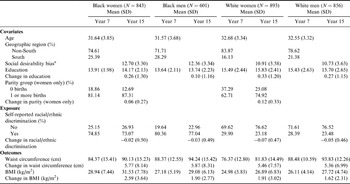
Characteristics of the study participants are shown in Table 1. Mean age was nearly 33 years for all CARDIA participants in year 7 and 16% to 28% lived in the South. For 843 Black women and 601 Black men, 75% reported any experiences of racial/ethnic discrimination in years 7 and 15. Black women and men were more than twice as likely to report any experiences of racial/ethnic discrimination compared with White women and men. Social desirability was higher among Black women and men, while education for years 7 and 15 was higher among White women and men. Among Black and White women and men, mean levels of waist circumference and BMI increased from year 7 to year 15.
Characteristics of participants at years 7 and 15, race/ethnicity–gender group: the CARDIA study (1992–2001)

a The measure of social desirability bias was a 20-item version of the Crowne–Marlowe Social Desirability Scale. Higher scores indicate more social desirability bias.
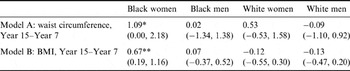
Results from the fixed-effects regression models are shown in Table 2. Estimates of the coefficients in Model A for Black women show a positive association between change in self-reported experiences of racial/ethnic discrimination and increase in waist circumference (β=1.09, 95% confidence interval [CI]: 0.00–2.19, p=0.05). That is, an increase in self-reported experiences of racial/ethnic discrimination was associated with an expected 1.09 increase in waist circumference over time, controlling for all time-invariant covariates. Similarly, estimates of the coefficients in Model B for Black women show a positive association between change in self-reported experiences of racial/ethnic discrimination and an increase in BMI (β=0.67, 95% CI: 0.19–1.16, p=0.007). More specifically, an increase in self-reported experiences of racial/ethnic discrimination was associated with an expected 0.67 increase in BMI over time, controlling for all time-invariant covariates.
β-Coefficients (95% confidence intervals) for change in waist circumference and BMI regressed on change in self-reported experiences of racial/ethnic discrimination, by race/ethnicity–gender group: the CARDIA study (1992–2001)a

a Fixed-effects regression models adjusted for baseline age, geographic region, social desirability bias and change variables for education, parity (women only) and self-reported experiences of racial/ethnic discrimination.
*p<0.05; **p<0.01.
Estimates of the coefficients in Model A for Black men and White women and men show no statistically significant association between change in self-reported experiences of racial/ethnic discrimination and a change in waist circumference over time. Likewise, estimates of the coefficients in Model B for Black men and White women and men show no statistically significant association between change in self-reported experiences of racial/ethnic discrimination and a change in BMI over time.
Discussion
This is the first epidemiologic study to prospectively examine whether a change in self-reported experiences of racial/ethnic discrimination was associated with changes in both waist circumference and BMI in Black and White women and men. As hypothesized, an increase in self-reported experiences of racial/ethnic discrimination was associated with increases in waist circumference and BMI over time. However, these associations were only observed among Black women. Surprisingly, there was no evidence to demonstrate these associations among Black men.
In general, these findings are consistent with most other published studies, which typically report positive associations with obesity-related outcomes, such as increased weight change, waist circumference and BMI. For example, Cozier et al. (Reference Cozier, Wise, Palmer and Rosenberg2009), in a sample of Black women from the nationwide Black Women's Health Study, found that weight gain was higher for higher baseline levels of self-reported experiences of racial/ethnic discrimination. Likewise, Gee et al. (Reference Gee, Ro, Gavin and Takeuchi2008) observed that self-reported experiences of racial/ethnic discrimination were associated with higher levels of BMI in a cross-sectional sample of Asian Americans from the National Latino and Asian American Study. Additionally, among Black women in Barbados, Tull et al. (Reference Tull, Wickramasuriya, Taylor, Smith-Burns, Brown and Champagnie1999) observed that self-reported internalized racism was associated with waist circumference and waist-to-hip ratio.
Of note, these observations differ from at least three other studies. Vines et al. (Reference Vines, Baird, Stevens, Hertz-Picciotto, Light and McNeilly2007) found an inverse association between self-reported experiences of racial/ethnic discrimination and abdominal obesity among Black women. Shelton et al. (Reference Shelton, Puleo, Bennett, McNeill, Sorensen and Emmons2009) did not observe an association between self-reported experiences of racial/ethnic discrimination and BMI among Blacks and Hispanics. Hunte & Williams (Reference Hunte and Williams2009) observed that self-reported experiences of discrimination were associated with higher levels of abdominal obesity among ethnic Whites, but not other Whites, Blacks or Hispanics from the Chicago Community Adult Health Study. Quite the opposite, this study found a positive association between change in self-reported experiences of racial/ethnic discrimination and change in waist circumference among Black women and did not observe any associations among White women and men. Variation in psychometric instruments used in these studies is one possible explanation for these contradictory findings. Every one of these three studies used a different psychometric instrument to assess self-reported experiences of racial/ethnic discrimination. Therefore, some of the observed differences may be due to measurement artifact. Hunte & Williams used a version of the Williams Everyday Discrimination Scale and Vines et al. used the Telephone-Administered Perceived Racism Scale. Unlike the EOD index, which explicitly measures self-reported experiences of racial/ethnic discrimination in specified domains or institutions, utilized by Shelton et al. and in this study, both of these scales focus more on psychosocial aspects of racial/ethnic discrimination.
Unexpectedly, change in self-reported experiences of racial/ethnic discrimination was not statistically associated with changes in waist circumference and in BMI among Black men over time. A definitive explanation for the observed gender differences is not readily available. One possible explanation for the observed gender differences relates to threat perception. Previous experimental and observational studies have observed that gender modifies the perception of threatening experiences and as a consequence the activation of the HPA axis (Stroud et al., Reference Stroud, Salovey and Epel2002; McClure et al., Reference McClure, Monk, Nelson, Zarahn, Leibenluft and Bilder2004; Dedovic et al., Reference Dedovic, Wadiwalla, Engert and Pruessner2009). For example, Stroud et al. (Reference Stroud, Salovey and Epel2002) demonstrated that women had higher HPA axis activation as reflected by more cortisol released in response to negative interpersonal events as compared with men. Alternatively, the authors found that men responded more physiologically to achievement-oriented stress. This has implications for these findings because experiences of racial/ethnic discrimination are a form of interpersonal rejection (Richman & Leary, Reference Richman and Leary2009). Another plausible explanation is variation in coping response styles. Gender and gender identity appear to be associated with development and utilization of different types of coping response styles. Higher levels of masculinity are shown to be associated with higher levels of problem-focused coping, whereas higher levels of femininity are associated with higher levels of emotion-focused coping (Brems & Johnson, Reference Brems and Johnson1989; Renk & Creasey, Reference Renk and Creasey2003). Accordingly, the null findings among Black men may be due to greater use of problem-focused coping in response to experiences of racial/ethnic discrimination. In a previous study, problem-focused coping was shown to buffer against the adverse health consequences associated with self-reported experiences of racial/ethnic discrimination, while emotion-focused coping intensified those negative consequences (Noh & Kaspar, Reference Noh and Kaspar2003). These possible mechanisms deserve further exploration in future studies.
The use of panel data allowed us to investigate whether a change in self-reported experiences of racial/ethnic discrimination was associated with changes in waist circumference and BMI over time controlling for all time-invariant covariates, social desirability bias and changes in education and parity (women only). Fixed-effects regression models rely upon within-individual variation and not between-individual variation (Allison, Reference Allison2009). By doing so, these models reduce bias by providing control for both measured and unmeasured time-invariant covariates because each individual serves as her or his own control. Since the random assignment of experiences of racial/ethnic discrimination in experimental studies would be unethical, fixed-effects regression may offer the strongest evidence available supporting the causal nature of the association of self-reported experiences of racial/ethnic discrimination and changes in waist circumference and BMI. This represents a noteworthy advance over the methods used in prior studies, which have been primarily cross-sectional.
In addition to the use of a fixed-effects regression approach, other strengths of this study warrant consideration. The population-based nature of the CARDIA study, the use of objective measures of waist circumference and BMI, and the inclusion of Black and White women and men in stratified analyses are also key strengths. Several limitations merit highlighting in the interpretation of these results as well. Since observational data are used in this analysis, causality cannot be established. Furthermore, sufficient power to observe a statistically significant association is often influenced by the precision with which data are measured. Since the Cronbach's alpha for the EOD index was especially low for White women and men, this may have prohibited detection of associations between self-reported experiences of racial/ethnic discrimination and waist circumference and BMI. The EOD index may be too short or the items included in the index could have very little relevance for these groups (Nunnally & Bernstein, Reference Nunnally and Bernstein1994). In addition, the ability to detect an association among White women and men as well as Black men in this study may have been hampered by non-differential misclassification attributable to under-reporting of self-reported experiences of racial/ethnic discrimination or recall bias. Non-differential misclassification of dichotomous exposures results in bias toward the null (Szklo & Nieto, Reference Szklo and Nieto2007).
In sum, these findings support the idea that there is an important prospective association between changes in self-reported experiences of racial/ethnic discrimination and changes in waist circumference and BMI among Black women. These results contribute a great deal to discussions implicating toxic stress in the development and progression of obesity. Given the unanticipated gender differences in the association observed among Black women and men, it is clear that more research is needed on racial/ethnic discrimination to understand how both Black women and men experience, perceive, and cope with it.
Acknowledgments
This work was supported by the US National Institutes of Health (contracts N01-HC-05187, N01-HC-45134, N01-HC-45204, N01-HC-45205, N01-HC-48047, N01-HC-48048, N01-HC-48049, N01-HC-48050, and N01-HC-95095 from the National Heart, Lung, and Blood Institute (NHLBI)). The NHLBI had input into the design and conduct of the CARDIA study. This work was partially supported by the Work, Family, and Health Network and the National Institute of Aging and National Institute of Child Health and Human Development under grant U01-5186989-01 and by the John D. and Catherine T. MacArthur Foundation Research Network on Socioeconomic Status and Health. Dr Timothy J. Cunningham was supported by the Association of Schools of Public Health and Centers for Disease Control and Prevention (CDC) Prevention Research Center Fellowship Program. The findings and conclusions in this report are those of the authors and do not necessarily represent the official position of the CDC.