INTRODUCTION
The key to a successful nutritional programme for dairy cows is a balance between the needs for ruminally available protein and carbohydrates that will optimize microbial growth and metabolism in the rumen (Hoover et al. Reference Hoover and Stokes1991; Harris Reference Harris1992, Reference Harris2003). A ration is nutritionally balanced and efficiently utilized if it is formulated with an optimum amount of both structural and non-structural carbohydrates and if appropriate protein fractions are provided with these various carbohydrate fractions. NRC (2001) suggested that the goals of ruminant protein nutrition are to provide both the adequate amount of ruminal degradable protein (RDP) to maximize ruminal microbial protein synthesis and the right type of ruminal undegradable protein (RUP) that will optimize the profile and amount of absorbed amino acids. In a grass sample, the RDP and RUP can be estimated from protein fractions that are associated with fibre fractions (NRC 2001; Fox et al. Reference Fox, Tylutki, Tedeschi, Amburgh, Chase, Pell, Overton and Russell2003). As a consequence, measurement of these fractions would help improve fibre and protein efficiency in ruminant nutrition.
Different methods have been developed to determine these fractions in grasses, including chemical, in situ, in vitro enzymatic and in vitro chemical methods (Fortina et al. Reference Fortina, Malfatto, Mimosi, Guo and Tartari2003; Elwakeel et al. Reference Elwakeel, Titgemeyer, Drouillard and Armendariz2007; Tham et al. Reference Tham, Man and Preston2008). These methods, however, have limited use for dealing with large amounts of samples due to cost, technical skills, labour and time consumption (Stuth et al. Reference Stuth, Jama and Tolleson2003). In contrast, near infrared reflectance spectroscopy (NIRS), a physical procedure that provides a well-proven low-cost method for quantifying different chemical components in grasses in a short period of time could be appropriate to access these fractions in grasses during the year. Some studies have been successful in quantifying the neutral detergent fibre (NDF), acid detergent fibre (ADF) and protein fractions such as NDF insoluble protein (NDF-IP) and ADF insoluble protein (ADF-IP) using the technique (Sinnaeve et al. Reference Sinnaeve, Dardenne, Agneessens and Biston1994; Castro Reference Castro and Fisher1997; Park et al. Reference Park, Gordon, Agnew, Barnes and Steen1997, Reference Park, Agnew, Gordon and Steen1998; Valdés et al. Reference Valdés, Andres, Giraldez, García and Calleja2006).
It is well known that the fibre and protein content in grasses varies among categories of species and according to plant maturity and ecological and fertilizing conditions for growth (Reid et al. Reference Reid, Jung and Thayne1988; Jarrige et al. Reference Jarrige, Ruckebusch, Demarquilly, Farce and Journet1995; Bruinenberg et al. Reference Bruinenberg, Valk, Korevaar and Struik2001; Johnson et al. Reference Johnson, Reiling, Mislevy and Hall2001; Miller et al. Reference Miller, Ffrench, McDonald and Jennings2004). Few studies have demonstrated that the fibre and protein associated with the component were affected by species (Trlica Reference Trlica1999; Tedeschi et al. Reference Tedeschi, Pell, Fox and Llames2001), fertilization (Juarez Lagunes et al. Reference Juarez Lagunes, Fox, Blake and Pell1999; Johnson et al. Reference Johnson, Reiling, Mislevy and Hall2001), or water availability (Seguin et al. Reference Seguin, Mustafa and Sheaffer2002). However, information relative to the effect of these factors on fibre and protein–fibre complexes in both temperate and tropical grasses is limited in the literature.
Therefore, the objectives of the present study were: (1) to develop a fast and non-destructive screening method by NIRS for estimating fibre and protein fractions in grasses and (2) to apply it to the evaluation of main factors influencing these fractions across the predominant temperate and tropical grasses on La Reunion Island (France).
MATERIALS AND METHODS
Field experimental conditions
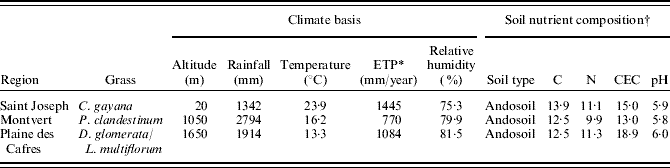
Field experiments were conducted in three stations representative of the main agro-ecological conditions (Table 1). Each species/mixture was trialled on one suitable station: tropical low altitude grassland (20 m; Chloris gayana, a C4 species adapted to hot and humid conditions), tropical intermediate altitude grassland (1050 m); Pennisetum clandestinum (a C4 species adapted to altitude), and temperate grassland (1650 m; a mixed sward comprising Dactylis glomerata and Lolium multiflorum sown in a proportion of 0·7/0·3 by weight, both C3 grasses from temperate regions). The experimental design on each station was a split-plot in a randomized complete block with three replicates (three blocks). The main plot treatment in each block was ten different levels of total N/year of organic and/or mineral fertilization (0, 200 (liquid manure), 200 (compost), 350 (liquid manure), 350 (compost), 350 (mineral), 350 (200 liquid manure+150 mineral), 350 (200 compost+150 mineral), 600 (350 compost+250 mineral) and 600 (mineral) kg N/ha/year).
Main characteristics of experimental designs in La Reunion Island
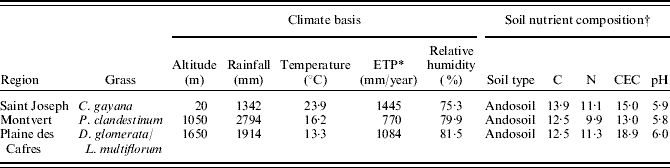
* Evapotranspiration potential.
† C, carbon concentration (g/100 g soil); N, nitrogen concentration (g/kg soil); CEC, cation exchange capacity (meq/100 g soil).
Sample collection, spectral pre-treatment and chemical analysis
During the 3 years of the study, plots were harvested at intervals of 45–60 days at ‘heading’ stage of the vegetation. Fresh matter weights were recorded and sampled to estimate grass productivity. Composite samples were produced by pooling 500 g from each replicate of the same treatments from the three blocks, and were then dried in a forced-air oven at 70°C for 48 h to determine dry matter (DM) content. All samples (490) were ground (1 mm) in a CYCLOTEC mill (FOSS, 1093) and scanned twice at 2 nm intervals over the 1100–2500 nm wavelengths by a Foss NIRsystem 5000 monochromator. The samples were scanned using closed cells and NIR absorbency data were recorded as log 1/Reflectance values (log 1/R). Mathematical analysis of the spectral data was performed using WinISI III 1.61 software version (Infrasoft International; Shenk & Westerhaus Reference Shenk and Westerhaus1993). After performing a principal component analysis (PCA), 12 samples that were outliers in terms of Mahalanobis distance (H>3) were eliminated. To characterize fibre and protein fractions along reference methods, 187 samples that were the most representative of the spectral variability were selected according to the Mahalanobis distance (WinISI software, SELECT procedure).
Samples were analysed for crude protein (CP), NDF, ADF, NDF-IP and ADF-IP. CP was determined by a CN-2000 elementary analyser (LECO 2003). NDF and ADF were determined by the procedure of the Association for Official and Analytical Chemists (AOAC) (Van Soest et al. Reference Van Soest, Roberson and Lewis1991) and all NDF and ADF residues were then analysed for insoluble protein (NDF-IP and ADF-IP) using a CN-2000 elementary analyser (LECO 2002). Duplicate measurements were made for each procedure and sample.
Finally, the protein fractions proposed by the Cornel Net Carbohydrate and Protein System (CNCPS; Sniffen et al. Reference Sniffen, O'Connor, Van Soest, Fox and Russell1992; Schwab et al. Reference Schwab, Tylutki, Ordway, Sheaffer and Stern2003) were expressed as follows: CP (g/kg DM)=g N in DM×6·25; NDF-IP=g N in NDF×6·25/CP; ADF-IP=g N in ADF×6·25/CP; Fraction B3=NDF-IP−ADF-IP; and soluble and fast degradable proteins (A+B1+B2)=1−NDF-IP.
NIRS measurements, spectral treatments and calibration
To reinforce the predictive capacity of the calibration, 57 equivalent references on grasses shared by Gembloux University (Belgium) in a previously developed collaborative work (Bindelle et al. Reference Bindelle, Sinnaeve, Dardenne, Leterme, Buldgen, O'Mara, Wilkins, Mannetje, Lovett, Rogers and Boland2005) were selected according to mahalanobis distance (<3) and were added to enlarge the NIR and reference matrix to a total of 244 samples. Before calibration and validation, mathematical pre-treatments, standard normal variate and detrend (SNV-D) and different derivative pre-treatments were applied to the spectral data. The best derivative for each component was kept for the final calibration. Equations were then developed for predicting CP, NDF, ADF, NDF-IP and ADF-IP by using the modified partial least squares (MPLS) procedure, as this technique was proven in earlier research (Shenk & Westerhaus Reference Shenk and Westerhaus1993) to be superior to any others. Cross validation, based on splitting the sample population into four groups, was used to select the optimum number of terms without over-fitting. Statistical parameters to evaluate equations were standard error of calibration (SEc), standard error of cross-validation (SEcv), coefficient of determination of calibration (R 2c) and coefficient of determination of cross-validation (R 2cv). These equations were then used to predict fibre and protein fractions of the remaining grass samples.
Classification of variation sources on fibre and protein fractions
Species, water stress and fertilization are some of the main factors that were considered as variation sources for fibre and protein fractions of grasses.
Species
This factor was considered as an important source of variation for fibre and protein fractions of different grasses, as the same experimental designs and the same experimental factors were used in all three regions. Further, the geological characteristics of these stations are similar (Table 1). It is recognized that species are completely confounded with factors related to differences among the test sites (e.g. altitude, rainfall and temperature), so the term ‘species’ is meant, in this context, to represent all of the factors (biological and physical) that differ between sites.
Water stress
Based on water availability, two levels of water availability (dry and wet) were considered to measure the effect of climate conditions on fibre and protein fractions of grasses. The water availability was classified by the difference between rainfall and evapotranspiration potential (P-ETP) level during the growth period. Rain and P-ETP were calculated from the daily data retrieved from the 30-station local meteorological Gesmet network. Different values between rainfall and P-ETP ‘less than’ or ‘equal to’ 0 are considered as dry conditions.
Fertilization
To test the effect of N mineral fertilization, only three levels of mineral fertilization (0, 350 and 600 kg mineral N/ha) at each station were extracted from the database. Because each experimental station had the same water availability over time, the extracted data were analysed globally without seasonal differentiation by a specific model that eliminated the effect of water stress.
Growth rate
To summarize water and fertilization effects into a simple visual indicator, data were classified into three classes of growth rate: low, normal and fast. The classification was based on the means and standard deviation (s.d.) of the whole data. The normal growth level was defined as data ranging within means±s.d., whereas values that were lower or higher were considered as slow or fast growth level, respectively.
Statistical analysis
The statistical analysis of the experimental results was performed using SAS system (SAS Institute 2000). The PROC GLM procedure was used to obtain the statistical descriptive parameter estimates, and PROC analysis of variance (ANOVA) was used to perform Tukey studentized range-test for paired comparison. According to the factor/indicators to be analysed, two different statistical models were used.
A general model to analyse the effects of species, water stress and growth classes:

where Y αt is value of the response variable for plot α and time t; μ is the overall mean; S αti: effect of species (i=C. gayana, P. clandestinum, D. glomerata/L. multiflorum); W αtj: effect of water stress (j=dry, wet); G αtk: effect of growth (k=low, normal, fast) and ∊αt is the residual.
A specific model was implemented to analyse the specific effect of fertilization:

where Y αt is value of the response variable for plot α and time t; μ is the overall mean; S αti: effect of species (i=C. gayana, P. clandestinum, D. glomerata/L. multiflorum); F αtl: effect of fertilization (l=0, 350 and 600 kg N/ha) and ∊αt is the residual. Correlations between successive measures (response) obtained for successive cuts were not significant, which justified the assumption that they were independent of ANOVA models.
RESULTS
Development of NIRS equation and component predictions of grasses
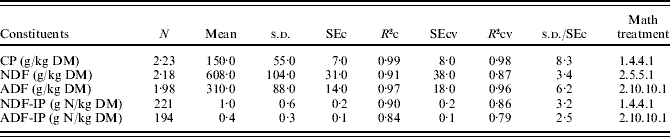
The calibration and validation statistics of the prediction equations are shown in Table 2. The results show that CP was the most accurately predicted parameter (R 2cv=0·98, SEc and SEcv corresponding to 0·007 and 0·008 DM, respectively). Similarly, high prediction accuracies were found for both NDF and ADF equations with high R 2cv (0·87 and 0·96) and low SEc (0·031 and 0·014 DM, respectively) and SEcv (0·038 and 0·018 DM, respectively). Concerning protein associated with cell wall, the prediction equation for NDF-IP and ADF-IP also resulted in acceptable SEc (0·002 and 0·001) and SEcv (0·002 and 0·001 DM, respectively) and R 2cv (0·86 and 0·79, respectively). The ratio s.d./SEc, which evaluates the consistency of calibration, was good (>3) for NDF, ADF, CP and NDF-IP equations and acceptable (2·5) for ADF-IP.
Calibration and validation statistics of NIRS prediction equations
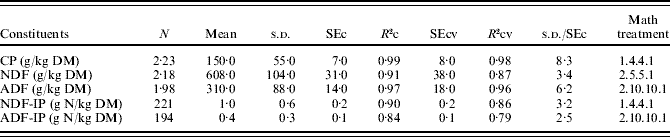
CP, crude protein; NDF, neutral detergent fibre; ADF, acid detergent fibre; NDF-IP, neutral detergent fibre insoluble protein; ADF-IP, acid detergent fibre insoluble protein.
N, number of samples used for calibration; s.d., standard deviation; SEc, standard error of calibration; R 2c, coefficient of determination of calibration; SEcv, standard error of cross-validation; R 2cv, coefficient of determination of cross-validation.
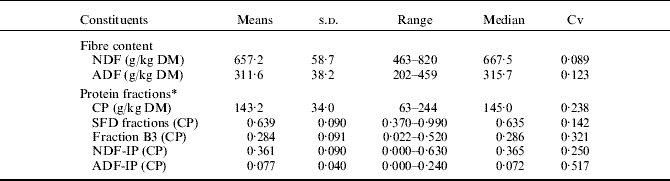
Fibre and protein contents of all NIRS-scanned grass samples (n=490) are shown in Table 3. The range of each component varied considerably and the variation coefficient for these components differed from 0·089 for NDF to 0·517 for ADF-IP. The variation for protein fractions (NDF-IP and ADF-IP) was larger than for fibre fractions (Table 3).
Variation of fibre and protein fractions of forages (N=490)
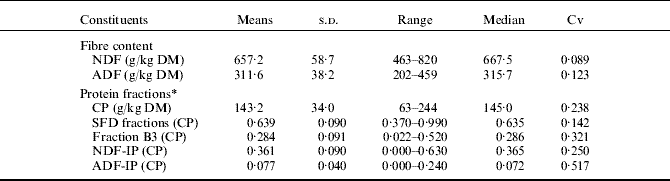
* CP, crude protein; SFD fractions, soluble and fast degradable fractions (fraction A, non-protein nitrogen; fraction B1, true protein; fraction B2, neutral detergent soluble protein); NDF-IP, neutral detergent fibre insoluble protein (fraction B3+C); ADF-IP, acid detergent fibre insoluble protein (fraction C).
Sources of variation for fibre and protein content
Main grass species effect
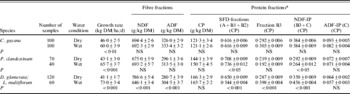
The growth rate and the variation of fibre and protein contents of tropical and temperate grasses are shown in Table 4. Growth rate was not significantly different among grass species. On average, the growth rate was 52 kg DM/ha/day. The fibre contents (NDF and ADF) of the temperate grasses (D. glomerata/L. multiflorum) were about 10% lower than those of tropical grasses (P<0·001). For tropical grasses, the NDF contents were not significantly different while the ADF content of C. gayana was about 10% higher than that of P. clandestinum.
Variation of growth rate, fibre and protein fractions among forage species (mean±s.e.m.)

* CP, crude protein; SFD fractions, soluble and fast degradable fractions (fraction A, non-protein nitrogen; fraction B1, true protein; fraction B2, neutral detergent soluble protein); NDF-IP, neutral detergent fibre insoluble protein (fraction B3+C); ADF-IP, acid detergent fibre insoluble protein (fraction C).
Protein fractions varied widely between tropical and temperate grasses. The CP content in D. glomerata/L. multiflorum was about 25% higher than that of tropical grasses (P<0·001). CP content was also significantly different between C. gayana and P. clandestinum; CP of P. clandestinum was 17% higher than that of C. gayana. The NDF-IP (CP) of tropical grasses varied strongly, being 27% higher in C. gayana than in P. clandestinum. However, this fraction in C. gayana and D. glomerata/L. multiflorum grasses did not differ significantly. A significant difference was found for ADF-IP among all grass species, the lowest proportion was observed in D. glomerata/L. multiflorum and the highest one in C. gayana.
Water stress effect
The water stress effects on growth rate, fibre and protein fractions are shown in Table 5. An increase in water availability from dry to wet conditions strongly increased the growth rate (kg DM/ha/d) of both tropical and temperate grasses (30, 52 and 78%, for C. gayana, P. clandestinum and D. glomerata/L. multiflorum, respectively). The wet conditions significantly increased (c. 10%) the fibre contents of D. glomerata/L. multiflorum. However, no climatic effect was observed on fibre contents for either of the tropical grasses. The CP content and ADF-IP fraction were not affected by water availability in any of the grasses (P>0·05). However, there were opposite effects on NDF-IP between P. clandestinum and D. glomerata/L. multiflorum; water availability reduced NDF-IP of P. clandestinum (by 10%) but increased NDF-IP of D. glomerata/L. multiflorum (by 30%).
Water stress effects on growth rate, fibre and protein fractions of temperate and tropical grasses (mean±s.e.m.)

* CP, crude protein; SFD fractions, soluble and fast degradable fractions (fraction A, non-protein nitrogen; fraction B1, true protein; fraction B2, neutral detergent soluble protein); NDF-IP, neutral detergent fibre insoluble protein (fraction B3+C); ADF-IP, acid detergent fibre insoluble protein (fraction C).
Fertilization effect
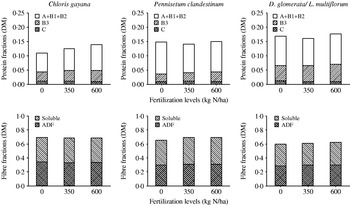
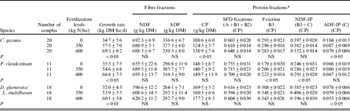
The results of the fertilization effect are shown in Table 6 and Fig. 1. The fertilization significantly increased the growth rate of both tropical and temperate grasses. When the fertilizer amount increased from 0 to 350 kg N/ha and to 600 kg N/ha, the growth rate of C. gayana and P. clandestinum increased on average by 60 and 21%, respectively. Similarly, with the same levels of fertilization, the growth rate of D. glomerata/L. multiflorum increased by 68 and 12%, respectively. Fertilization levels had no significant effect on fibre fractions (NDF and ADF) of tropical and temperate grasses (Table 6).
Fertilization effects on fibre and protein fractions of temperate and tropical grasses. Soluble, fibre fraction solubilized in the acid detergent process; Fraction A, non-protein nitrogen; Fraction B1, true protein; Fraction B2, neutral detergent soluble protein; Fraction B3, NDF-IP but soluble in acid detergent process; Fraction C, ADF-IP.

Fertilization effects on growth rate, fibre and protein fractions of temperate and tropical grasses (mean±s.e.m.)

* CP, crude protein; SFD fractions, soluble and fast degradable fractions (fraction A, non-protein nitrogen; fraction B1, true protein; fraction B2, neutral detergent soluble protein); NDF-IP, neutral detergent fibre insoluble protein (fraction B3+C); ADF-IP, acid detergent fibre insoluble protein (fraction C).
The fertilization level affected only the CP content of C. gayana (P<0·05, Fig. 1). The CP content of C. gayana increased c. 30% when the fertilization level increased from 0 to 600 kg N/ha. Concerning the NDF-IP fraction, the effect of fertilization level was observed only with P. clandestinum. The nitrogen supply (350 or 600 kg/ha) increased the NDF-IP fraction by 17% compared with no fertilization conditions. Otherwise, the highest fertilization level (600 kg N/ha) decreased the ADF-IP fraction of C. gayana and D. glomerata/L. multiflorum by 33 and 31%, respectively.
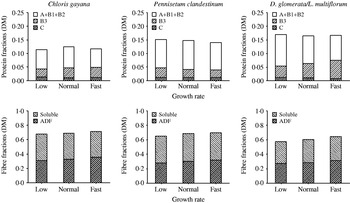
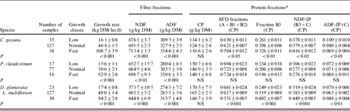
Relation between growth classes and fibre and protein fractions
The effects of growth rate on fibre and protein fractions are shown in Table 7 and Fig. 2. Globally, the increase from low to fast growth rate increased significantly the content of fibre fractions (NDF and ADF) of both tropical and temperate grasses. When the growth rate varied from low to fast, the NDF content of C. gayana, P. clandestinum and D. glomerata/L. multiflorum increased by 5, 7 and 12%, respectively. Similarly, the ADF content of grasses increased on average by 14%.
Relation between growth classes and fibre and protein fractions of temperate and tropical grasses. Soluble, fibre fraction solubilized in the acid detergent process; Fraction A, non-protein nitrogen; Fraction B1, true protein; Fraction B2, neutral detergent soluble protein; Fraction B3, NDF-IP but soluble in acid detergent process; Fraction C, ADF-IP.

Growth classes and fibre and protein fractions of temperate and tropical grasses (mean±s.e.m.)

* CP, crude protein; SFD fractions, soluble and fast degradable fractions (fraction A, non-protein nitrogen; fraction B1, true protein; fraction B2, neutral detergent soluble protein); NDF-IP, neutral detergent fibre insoluble protein (fraction B3+C); ADF-IP, acid detergent fibre insoluble protein (fraction C).
Mean CP contents did not differ significantly between the three growth rates for tropical and temperate grasses. However, the high growth rate increased NDF-IP for C. gayana and D. glomerata/L. multiflorum (average of 12 and 41%) and decreased ADF-IP (c. 25%) compared with the low growth rate. As a result, the fast growth rate decreased the soluble and fast degradable fractions (A+B1+B2) by 7 and 19% but increased fraction B3 by 25 and 61%, respectively. Fraction B3, also called NDF-IP, is a protein fraction that is not solubilized in neutral detergent solution but is solubilized in acid detergent solution. This fraction is slowly degraded in the rumen (0·06–0·55%/h; NRC, 2001). There appeared to be no significant difference between growth rate and protein fractions of P. clandestinum.
DISCUSSION
NIRS equation development
NIRS has proven to be a reliable and rapid method for assessing the quality of feed and grass samples. In terms of chemical composition, most studies report that the best accuracy of the prediction equation was for CP (Reeves Reference Reeves1997; Hoffman et al. Reference Hoffman, Brehm, Bauman, Peters and Undersander1999; Valdés et al. Reference Valdés, Andres, Giraldez, García and Calleja2006). The coefficient R 2 of the CP prediction equation is high in almost all studies since strong absorptions in the NIR region of –N–H linkage cause good relations between absorbance and protein value (Stuth et al. Reference Stuth, Jama and Tolleson2003). In the present study, even when analysing temperate and tropical species grown in varying ecological conditions, a similar accuracy of CP prediction equation was observed (R 2=0·98 and SEcv=0·8).
Although fibre fractions are formed by a complex of structural carbohydrates and are not a chemically pure entity, they can be estimated through variations in –C–H and –O–H bonds (Stuth et al. Reference Stuth, Jama and Tolleson2003). In the present study, the precision of NIRS equations for NDF and ADF were high (R 2cv=0·87 and 0·96, respectively) and similar to those reported by other authors (Sinnaeve et al. Reference Sinnaeve, Dardenne, Agneessens and Biston1994; Castro Reference Castro and Fisher1997).
In spite of the high NIRS accuracy in N and fibre fraction determination, the prediction of the different N fractions associated with fibre (NDF-IP and ADF-IP) is usually less precise. The accuracy of the equation for NDF-IP in the present study (R 2cv=0·86) was slightly lower than that reported by Valdés (R 2cv=0·91; Valdés et al. Reference Valdés, Andres, Giraldez, García and Calleja2006) but higher than reported by Hoffman (R 2=0·72; Hoffman et al. Reference Hoffman, Brehm, Bauman, Peters and Undersander1999). The SEcv for NDF-IP and ADF-IP equations in the present study were better than those of Valdés et al. (Reference Valdés, Andres, Giraldez, García and Calleja2006), due to a larger calibration dataset in the present study (244 compared with 104 samples in Valdés et al. Reference Valdés, Andres, Giraldez, García and Calleja2006), which allows the number of MPLS terms to be increased in the calibration model. The slightly lower accuracy observed for N-fibre prediction equations could be explained by chemical characteristics of N-fibre linkage. It could hence be expected that the vibrational bond signatures of proteins joining different constituents of the cell wall are partially modified as a consequence of this linkage, thus decreasing the estimation accuracy of the different protein fractions (Valdés et al. Reference Valdés, Andres, Giraldez, García and Calleja2006). Those authors also reported that the errors inherent to the two-stage process procedure (determination of DM precipitated with trichloroacetic acid (TCA) precipitated matter or insoluble in borate–phosphate buffer (BPB), NDF, or ADF followed by the Kjeldahl) caused a lower repeatability between duplicates for the laboratory N fractions and, consequently, a lower accuracy of prediction by NIRS. In addition, the lignification process could modify the structure of protein associated with fibre fractions (mainly ADF) and this could explain the lower accuracy of the ADF-IP equation relative to the NDF-IP equation. Moreover, the indirect determination of NDF-IP and ADF-IP through the estimation of N in NDF and ADF residues could lessen the precision of the NIRS prediction equation.
Grass fibre and protein variations
In the present study, different factors were considered as explanations for fibre and protein variations in grasses. Grass species, climate conditions and fertilization levels had significant effects on fibre and protein components, as did the rate of growth, which was considered as an important and visible indicator to recognize the change of fibre and protein fraction in grasses.
Grass species
Tropical grasses develop a relatively higher fibre content, which allows these plants to resist wilting associated with high temperatures (Lyons et al. Reference Lyons, Machen and Forbes1997). This additional fibre content tends to dilute the cell soluble components in these plants and also to reduce levels of non-structural carbohydrate, thus decreasing their nutritive value relative to temperate grasses (Poppi et al. Reference Poppi, McLennan, Bediye, de Vega, Zorrilla-Rios, Buchanan-Smith, Bailey and McCaughey1999). In the present study, the lower content in fibre and higher content in CP components conferred a higher nutritive value to D. glomerata/L. multiflorum (temperate grass mixture) compared with tropical grasses (C. gayana and P. clandestinum). The main components (fibre and CP) of D. glomerata/L. multiflorum in the present experiment were different from those reported by other authors (Tedeschi et al. Reference Tedeschi, Pell, Fox and Llames2001). They found lower NDF and higher CP contents in D. glomerata/L. multiflorum (565 g NDF and 258 g CP/kg DM). This difference was probably due to the plant maturity, which differed between the present study (heading stage) and Tedeschi's (early stage). The fibre and protein contents of both C. gayana and P. clandestinum were in the range of the FAO database (Göhl et al. Reference Göhl, Speedy and Waltham1998).
Protein fractions are modified due to the linkage between protein and cell wall components, which reduces the degradability of protein. Therefore, it would be interesting for researchers to determine the total quantity of N present in grass samples and to identify their protein fractions. The recent ruminant feeding model from the Cornel University (CNCPS) has proposed further subdivision of feed CP into different fractions of which NDF-IP and ADF-IP are the most important for estimating RDP and RUP (Fox et al. Reference Fox, Tylutki, Tedeschi, Amburgh, Chase, Pell, Overton and Russell2003; Schroeder Reference Schroeder2004). In the present study, although there was no significant difference in NDF-IP between C. gayana and D. glomerata/L. multiflorum, the D. glomerata/L. multiflorum provides more RDP than does C. gayana due to its higher CP content with lower ADF-IP proportion.
A particular trait of P. clandestinum is that the NDF-IP proportion is about 10% lower than that of C. gayana and D. glomerata/L. multiflorum; this fraction does not change according to the growth rate. As a consequence, P. clandestinum provides a larger source of rapidly degradable protein in the rumen (0·72 compared with 0·62 and 0·61 CP proportion) for C. gayana and D. glomerata/L. multiflorum, respectively). When it is not rapidly metabolized by the microbial population due to lack of soluble carbohydrate, nitrogen can be in excess. This aspect could be one cause for the higher concentration of nitrogen in the blood (uraemia) found frequently in cows fed with P. clandestinum rather than with other temperate grasses cultivated in La Reunion Island (Tillard Reference Tillard2007). This problem is more frequent in wet and unfertilized conditions (Tables 5 and 6).
Water stress
In general, an adequate climate promotes vegetative growth but leads to early maturity of grass (Buxton Reference Buxton and Kenelly1995). It is also well known that rapid growth is negatively correlated with grass quality due to the lignification process (Mueller & Orloff Reference Mueller and Orloff1994; Coleman & Henry Reference Coleman, Henry, Freer and Dove2002). In the present study, increased water availability increased the growth rate of both tropical and temperate grasses, particularly for temperate grass. In addition, for D. glomerata/L. multiflorum, water availability increased the fibre content. However, water availability had no effect on the fibre components of tropical grasses, which were probably affected by other climatic factors. Water is generally available in the hot and rainy season and high temperature has a direct effect on the concentration of chemical constituents. Heat usually promotes fibre growth and also causes more rapid metabolic activity, which decreases the pool size of the cell content (Coleman & Henry Reference Coleman, Henry, Freer and Dove2002). In contrast, the high light intensity usually decreases the fibre contents by increasing the water-soluble carbohydrate concentration (De Peters Reference De Peters1994). In fact, Ford et al. (Reference Ford, Morrison and Wilson1979) reported that, as temperature increased, the fibre content of C3 grasses increased and that of C4 grasses decreased. Coleman & Henry (Reference Coleman, Henry, Freer and Dove2002) found that the NDF, ADF and ADL contents of L. multiflorum (C3) increased markedly with increasing temperature while these components in Thinopyrum ponticum (C4) did not change with temperature.
In the present study, the CP content of all grasses was not significantly affected by water availability. Curiously, NDF-IP fraction of P. clandestinum and D. glomerata/L. multiflorum were affected by water availability but in different ways. As water availability increased, the NDF-IP of P. clandestinum decreased while that of D. glomerata/L. multiflorum increased. For D. glomerata/L. multiflorum, the increase in NDF-IP was associated with the increase in NDF (r=0·54). However, the NDF-IP of P. clandestinum decreased markedly as water availability increased although NDF content did not change. This may be linked with the fact that the nitrogen fixation limitation in P. clandestinum, a C4 grass that is normally well adapted to warm climatic conditions, may be caused by low temperature at high altitude. De Peters (Reference De Peters1994) reported that a low temperature tends to promote non-structural carbohydrate mobilization.
Fertilizer application
Fertilizer application improves plant growth and development. Plants utilize nitrogen to manufacture biomass and an adequate quantity of nitrogen often substantially increases yield and also generally increases CP content in the plant (Ball et al. Reference Ball, Collins, Lacefield, Martin, Mertens, Olson, Putnam, Undersander and Wolf2001). In the present study, fertilization increased considerably the growth rate of both tropical and temperate grasses. However, there was no effect of fertilization on fibre content. Buxton (Reference Buxton and Kenelly1995) reported that nitrogen fertilization promotes growth by stimulating both leaf and stem development. Previous research showed that increased N fertilization had little to no effect on NDF in Bermuda grass (Cynodon dactylon, C4) and native warm-season grasses (Cuomo & Anderson Reference Cuomo and Anderson1996; Rogers et al. Reference Rogers, Harvey, Poore, Mueller and Barker1996). However, the effect of fertilization on fibre content was found on some other grasses (Bahia grass (Paspalum notatum), Bermuda grass (C. dactylon) and Star grass (Cynodon nlemfluensis); Johnson et al. Reference Johnson, Reiling, Mislevy and Hall2001). Those authors also reported that the fertilization increased the NDF content but had a minimal effect on the ADF content of these grasses. Alternatively, the nitrogen supply in the present study improved the nutritive value both of C. gayana due to the increase in CP content (c. 30%) and of D. glomerata/L. multiflorum due to the decline in ADF-IP fraction. Similarly, the quality of protein in P. clandestinum could be improved by fertilization because of the increase in B3 fraction and the decline in soluble fractions (A+B1+B2) (Table 6 and Fig. 1). Johnson et al. (Reference Johnson, Reiling, Mislevy and Hall2001) reported that the fraction C (ADF-IP and CP) of some tropical grasses decreased slightly as N fertilization rates increased, while fraction B3 (NDF-IP minus ADF-IP) increased as nitrogen fertilization increased. They suggested that these relative changes may be due to increased leaf:stem ratios of the plant, increased cell size within the digestible portion of the plant, or increased percentage of soluble proteins within the cell due to greater N fertilization rates. The nitrogen supply in the present study increased the NDF-IP content of P. clandestinum, decreased that of C. gayana and D. glomerata/L. multiflorum and increased fraction B3 of all grasses. The fraction B3 provides an important source of digestible protein.
Growth indicator
As plants mature, they lose nutritive value because their non-structural carbohydrates and CPs are lowered (Coleman & Henry Reference Coleman, Henry, Freer and Dove2002). In the present study, growth rate was considered as hastening the maturity and lignification since the NDF and ADF contents increased significantly from low to fast growth rate. The protein availability in grass species and consequent potential degradability in the rumen appear in the present study to be changed according to the growth rate. For C. gayana and D. glomerata/L. multiflorum, an increase in NDF-IP and a decrease in ADF-IP was observed when the growth rate increased. As a consequence, the fraction B3 (NDF-IP minus ADF-IP) increased while the soluble fractions (A+B1+B3) of both grasses (C. gayana and D. glomerata/L. multiflorum) decreased according to the increase in growth rate, except for P. clandestinum (Fig. 2). These results provide important information on ruminant feeding because the protein use efficiency depends on protein sources and their degradation rates. A rapidly degradable protein could be underutilized because the rumen microbes could not, at the same time, depose enough energy issued from the carbohydrate fermentation process. Hence, the exceeded nitrogen could provoke some metabolism troubles (uraemia) and/or reduce microbial activities considerably (Faverdin et al. Reference Faverdin, M'hamed, Rico-Gomez and Vérité2003). The protein associated with the acid detergent soluble fibre (fraction B3) is thus an important source of protein because this fraction provides the nitrogen source to microbes at the same time as the carbohydrates are fermented. In addition, the lower proportion of ADF-IP (fraction C) enhanced the protein quality because this fraction was unavailable to microbes. For that reason, the rapid growth improved the protein quality of C. gayana and D. glomerata-Lm.
In conclusion, it is confirmed that the use of NIRS plays an important role in evaluating grass nutritive values due to its rapidity, accuracy, low cost and easy implementation. The present study provides original information on the variation of fibre and protein fractions in grasses. The temperate grass mixture (D. glomerata/L. multiflorum) provided higher nutritive value than tropical grasses (C. gayana or P. clandestinum) due to its higher CP content and lower fibre content. Water availability decreased nutritive value of P. clandestinum (increase in fibre content and decrease in B3 fractions) but increased in protein quality of D. glomerata/L. multiflorum (increase in B3 fraction). The protein quality of grasses was improved by fertilization due to the increase in B3 fraction of P. clandestinum and the decrease in ADF-IP of both C. gayana and D. glomerata/L. multiflorum. In addition, the present study also showed that the growth rate could be a good and visible indicator of fibre and protein variation in grasses.
This research was supported by Pole ELEVAGE, CIRAD in La Reunion. We thank CIRAD for financial support. Our thanks are also to the technicians of CIRAD laboratories for assistance with the experiments. We also thank Dr Emmanuel Bourdon, Tran Hiep's supervisor, for supervision of the research work.