Introduction
Over the past five decades, significant changes have occurred in the Fontan procedure for treating single ventricle conditions, with both clinical criteria and surgical techniques evolving substantially. Initially, strict criteria, known as the “Ten Commandments, Reference Choussat, Fontan, Besse, Vallot, Chauve, Anderson and Shinebourne1 ” guided patient selection, but over time, these criteria have become more inclusive, encompassing higher-risk patients and those with complex anatomies, such as single lung cases. Reference Fontan and Baudet2
Since its initial description in 1971 as an atriopulmonary connection (the first-generation Fontan), the Fontan procedure has undergone several significant modifications aimed at enhancing haemodynamics and long-term outcomes. The lateral tunnel technique and, subsequently, the extracardiac conduit approach (the second- and third-generation Fontan, respectively) were introduced to mitigate atrial dilation and arrhythmias. Reference Jonas3 The “fourth generation” of the Fontan procedure refers to recent, advanced surgical strategies designed to address the long-term, chronic failures associated with previous Fontan iterations, often termed “upsizing” or tackling the failing Fontan, as explored in cases from 2021 to 2023. Reference Kutty, Jacobs, Thompson and Danford4 In conjunction with these technical refinements, patient selection criteria have also evolved. Fenestration was proposed as an adjunct to decompress the Fontan circuit during the early postoperative period, although its routine application remains a topic of debate.
The use of Fontan fenestrations, small openings created during the procedure to connect the Fontan circuit to the atrium, has also evolved. Reference Corno, Becker and Bulterijs5–Reference Laks, Haas and Pearl8 Initially reserved for high-risk cases, their benefits in reducing postoperative complications and hospital stays have led to their more widespread adoption. The introduction of the concept of an “adjustable atrial septal defect” has further improved outcomes by managing systemic venous pressure. Reference Laks, Haas and Pearl8 Overall, there’s been a shift towards more liberal use of Fontan fenestrations, reflecting their recognised benefits across a broader range of patients undergoing the Fontan procedure.
As patients undergoing the Fontan procedure become more complex, surgical centres are re-evaluating the use of fenestration. In certain centres, particularly those dealing with the most challenging cases, fenestration is now applied more frequently. However, the inconsistent adoption of fenestration reflects a significant dearth of robust scientific evidence supporting its therapeutic benefits. Furthermore, while the Fontan circulation is primarily utilised in patients with functional single-ventricle physiology, it is also applied in select cases involving anatomically biventricular hearts that exhibit non-separable ventricular physiology, where biventricular repair is not feasible, like certain types of double outlet right ventricle with a remote ventricular septal defect. Consequently, in clinical settings, decisions regarding fenestration and its size rely heavily on the collective experience of individual surgeons and institutions, considering the unique morphological and pathophysiological aspects of each patient. Reference Kuhn, Jarmakani and Laks9–Reference Lemler, Scott, Leonard, Stromberg and Ramaciotti14
There are some studies comparing the outcomes of fenestrated versus non-fenestrated Fontan with a view to seeing if adding a fenestration routinely does reduce the morbidity, especially reduced pleural drainage and length of hospital stay, with equivocal results. Reference Kuhn, Jarmakani and Laks9–Reference Lemler, Scott, Leonard, Stromberg and Ramaciotti14 This study evaluated the same and is an attempt to add more to the body of current literature.
Patients and methods
Between March 2024 and November 2025, 52 patients underwent Fontan completion at our institution. Forty patients met the inclusion criteria and were included in the study after giving informed consent. All patients underwent a third-generation extracardiac Fontan procedure with Gore-Tex expanded polytetrafluoroethylene tube (W. L. Gore & Assoc, Flagstaff) of sizes 18–22, depending on the weight of the patient. In all patients undergoing fenestration, a standardised fenestration size of 4 mm was used. Fenestration was done after completion of the conduit anastomosis with a side-to-side connection of the conduit with the atrial mass. All patients underwent an extracardiac Fontan operation on standard normothermic cardiopulmonary bypass with low inferior vena cava cannulation. Aortic cross-clamping and cardioplegic arrest were avoided.
Prospective data were collected from hospital medical records. The Institutional Ethics Committee gave approval for this study after due diligence (NSH-EC/AP/2024/015 dated 20 th June 2024). All the demographic data, type of surgery (fenestrated or non-fenestrated), Bidirectional Glenn to Fontan completion duration, in-hospital mortality, ventilation duration, inotropes duration, total drainage, drain duration, saturation on discharge, and length of postoperative hospital stay were collected.
Exclusion criteria
-
1. Primary Fontan
-
2. High pulmonary vascular resistance: PVR > 2.5 Woods unit
-
3. Elevated transpulmonary gradient >5 mmHg
-
4. The branch PA distortion needs an additional procedure
All the above criteria are based on the identification of “high-risk” Fontan candidates in published literature. Reference Van Puyvelde, Rega and Budts15
These patients, if selected for the Fontan procedure, underwent a fenestrated Fontan in all cases and were not a part of the study. Forty patients out of 52 were included in the study based on the above-mentioned criteria. The rest of the 12 patients underwent an elective fenestrated Fontan procedure and were not part of the study. Once included in the study, allocation to the fenestrated or non-fenestrated group was as per surgeon preference, with one surgeon in the institution doing all the fenestrated Fontan procedures. Both groups were demographically similar, making them comparable.
Postoperative protocol
All patients were admitted to the ICU after the operation. The elective inotropic support consisted of milrinone (0.5μg/kg/min) and norepinephrine (0.05 μg/kg/min). Inotropes were gradually tapered off over a duration of 24–48 h.
All patients were weaned off ventilatory support as soon as possible if they were haemodynamically stable and there was no bleeding.
Patients received standard aspirin as antiplatelet medication and warfarin as anticoagulant with a target international normalised ratio of 2.5. Patients with fenestrated Fontan received warfarin long term along with aspirin, whereas warfarin was stopped after 6 months in non-fenestrated Fontan patients as per institutional protocol.
Statistical methods
All continuous variables were expressed as mean ± SD, as well as median and interquartile range. Qualitative variables were expressed as numbers and percentages. Continuous variables were assessed for normality using the Shapiro–Wilk test; normally distributed variables are reported as mean ± SD, while non-normally distributed variables are presented as median with interquartile range. All p value < 0.05 was considered as statistically significant.
The sample size was calculated a priori to detect a clinically meaningful difference in the primary outcome between groups, with a two-sided α of 0.05 and a power of 80%. Based on expected effect sizes derived from prior literature, a minimum of 20 patients per group was required. The final study cohort exceeded this requirement, ensuring adequate statistical power.
Results
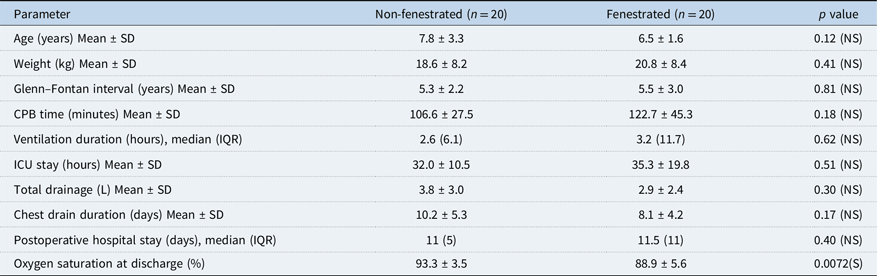
A total of 40 patients underwent Fontan completion, with 20 patients each in the non-fenestrated and fenestrated groups (Table 1). The mean age was 7.8 ± 3.3 years in the non-fenestrated group and 6.5 ± 1.6 years in the fenestrated group (p = 0.12; not significant). The mean weight was 18.6 ± 8.2 kg versus 20.8 ± 8.4 kg, respectively (p = 0.4072; not significant). The interval between Glenn and Fontan procedures was comparable between groups (5.3 ± 2.2 years versus 5.5 ± 3.0 years; p = 0.8113; not significant). Cardiopulmonary bypass time was similar in the non-fenestrated and fenestrated groups (106.6 ± 27.5 min versus 122.7 ± 45.3 min; p = 0.1823; not significant). The pre-operative variables in cardiac catheterisation data between the two groups were comparable (Table 2). There were no significant differences in ventilation duration (median 2.6 h, IQR 6.1 versus median 3.2 h, IQR 11.7; p = 0.6241) or ICU stay (32.0 ± 10.5 h versus 35.3 ± 19.8 h; p = 0.5142).
Patient characteristics and outcomes

Table 1 Long description
The table presents a comparison of patient characteristics and outcomes between non-fenestrated and fenestrated groups, with 20 patients in each group. It includes parameters such as age, weight, Glenn-Fontan interval, cardiopulmonary bypass time, ventilation duration, ICU stay, total drainage, chest drain duration, postoperative hospital stay, and oxygen saturation at discharge. The table shows mean values, standard deviations, medians, interquartile ranges, and p-values for each parameter. Notable comparisons include age with a mean of 7.8 years for non-fenestrated and 6.5 years for fenestrated, weight with a mean of 18.6 kilograms for non-fenestrated and 20.8 kilograms for fenestrated, and oxygen saturation at discharge with 93.3 percentage for non-fenestrated and 88.9 percentage for fenestrated.
Values are presented as mean ± standard deviation (SD) or median (interquartile range: IQR), as appropriate. NS = not significant.
CPB = cardiopulmonary bypass.
Pre-operative variables

Table 2 Long description
A table with four rows and seven columns compares pre-operative variables between non-fenestrated and fenestrated groups. The columns include pre-operative variables, non-fenestrated group values, fenestrated group values, and p values. The variables measured are mean arterial pressure, pulmonary artery pressure, transpulmonary gradient, pulmonary vascular resistance index, end-diastolic pressure, and pulmonary artery size. Each variable is presented with its mean and standard deviation. Notable trends include higher mean arterial pressure and pulmonary artery size in the fenestrated group, though none of the differences are statistically significant as indicated by the p values.
MAP = mean arterial pressure; PAP = pulmonary artery pressure; TPG = transpulmonary gradient; PVRI = pulmonary vascular resistance index; EDP = end diastolic pressure; PA = pulmonary artery.
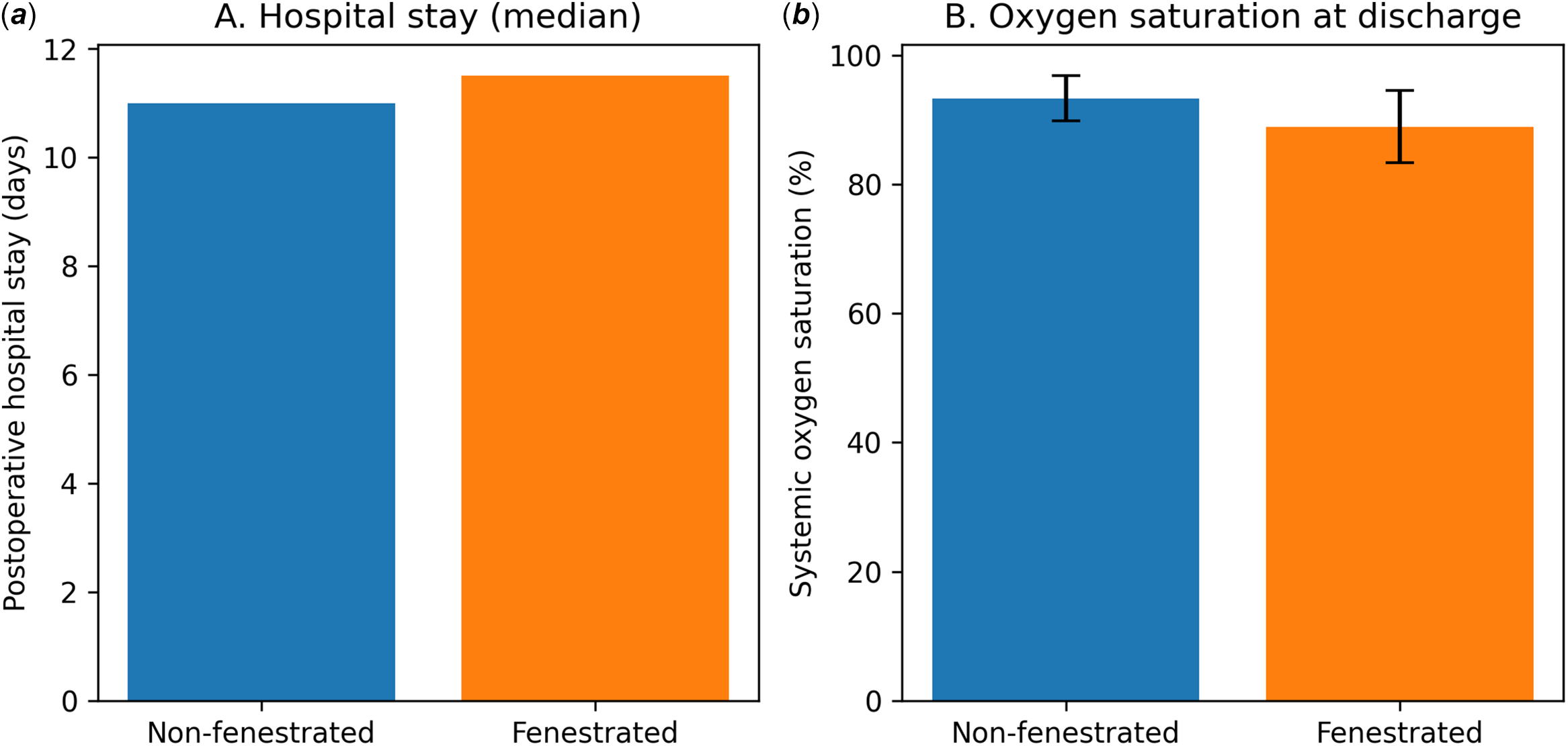
Postoperative outcomes were largely comparable between the two groups (Figures 1 a , b , c and 2 a , b ). Total chest drainage did not differ significantly between the non-fenestrated and fenestrated groups (3.8 ± 3.0 L vs. 2.9 ± 2.4 L; p = 0.3014) (Figure 1 a ). Although the fenestrated group demonstrated a shorter duration of chest drainage compared with the non-fenestrated group (8.1 ± 4.2 days vs. 10.2 ± 5.3 days), this difference did not reach statistical significance (p = 0.173) (Figure 1 b ). The modest reduction in drain duration did not translate into a shorter postoperative hospital stay; the median hospital stay was 11.5 days (IQR 11) in the fenestrated group and 11 days (IQR 5) in the non-fenestrated group (p = 0.3953) (Figure 2 a ). At discharge, systemic oxygen saturation was significantly lower in the fenestrated group compared with the non-fenestrated group (88.9 ± 5.6% vs. 93.3 ± 3.5%; p = 0.0072) (Figure 2 b ). There was no mortality in either of the groups.
( a , b , c ) Comparison of postoperative outcomes between non-fenestrated and fenestrated Fontan groups: ( a ) total chest drainage, ( b ) duration of chest drainage, and (c) ICU stay.

Figure 1 Long description
The bar graph compares postoperative outcomes between non-fenestrated and fenestrated Fontan groups across three metrics: total chest drainage, duration of chest drainage, and ICU stay. The x-axis categorizes the data into non-fenestrated and fenestrated groups, while the y-axis measures total chest drainage in liters, drain duration in days, and ICU stay in hours. The first set of bars shows total chest drainage, with non-fenestrated patients having a higher average drainage volume compared to fenestrated patients. The second set of bars illustrates the duration of chest drainage, indicating that non-fenestrated patients tend to have a longer drainage duration. The third set of bars represents ICU stay, showing a slightly longer stay for fenestrated patients. Each bar includes error bars representing variability in the data. The color scheme uses blue for non-fenestrated and orange for fenestrated groups. All values are approximated.
( a , b ) Comparison of postoperative hospital stay and systemic oxygen saturation at discharge between non-fenestrated and fenestrated Fontan groups.

Figure 2 Long description
The bar graph compares postoperative hospital stay and systemic oxygen saturation at discharge between non-fenestrated and fenestrated Fontan groups. The x-axis represents the two groups: non-fenestrated and fenestrated. The y-axis for the first set of bars measures postoperative hospital stay in days, ranging from 0 to 12 days. The y-axis for the second set of bars measures systemic oxygen saturation percentage, ranging from 0 to 100 percentage. The non-fenestrated group has a postoperative hospital stay of approximately 10 days, while the fenestrated group has a slightly longer stay of around 11 days. For systemic oxygen saturation at discharge, the non-fenestrated group shows a higher saturation level of about 95 percentage, compared to the fenestrated group, which is around 90 percentage. Error bars are present on the oxygen saturation bars, indicating variability in the data. The color scheme uses blue for the non-fenestrated group and orange for the fenestrated group. All values are approximated.
Discussion
In the last five decades, the Fontan procedure has undergone considerable modifications. The initially proposed “Ten Commandments” by Choussat et al., which acted as indications for performing the Fontan completion, Reference Choussat, Fontan, Besse, Vallot, Chauve, Anderson and Shinebourne1,Reference Fontan and Baudet2 have expanded to a more liberal selection criteria, including high-risk patients with a functionally univentricular heart, as well as children with a single lung. Reference Corno, Becker and Bulterijs5–Reference Zachary, Jacobs, Apostolopoulou and Fogel7 Fontan completion is done nowadays mostly by extra cardiac approach or a novel intra-extra cardiac approach, and rarely lateral tunnel Fontan.
Another important modification in the Fontan completion procedure was proposed by Laks et al. in 1988, in the form of an adjustable interatrial communication, for high-risk patients with complex anatomy, high pulmonary vascular resistance, or decreased ventricular function. Reference Laks, Haas and Pearl8 This created a right-to-left shunt at the atrial level. A similar modification was proposed by Bridges et al. in 1990, where they created a fenestration in the intraatrial baffle, the size of which depended on the patient’s body weight. Reference Bridges, Lock and Castaneda10 The simple strategy of creating a fenestration in the baffle allows an adequate cardiac output to be maintained. Reference Bridges, Lock and Castaneda10 It is well known that ventricular dysfunction is the greatest in the early postoperative period of patients who have undergone a Fontan completion. The treatment of circulatory failure and ventricular dysfunction in patients with a Fontan procedure relies on the identification of the underlying cause of the failure. However, there is a lack of evidence-based recommendations for treatment, leading to significant variability in management across different centres. When appropriate, surgical and catheter-based interventions generally yield better outcomes than medical therapy, although the results can vary based on the specific intervention and its indication. Reference Kamsheh, O’Connor and Rossano11 Further, this fenestration theoretically reduces events of increased right atrial pressure, thus reducing systemic venous congestion, which in turn reduces the amount of pleural effusion postoperatively, which is an important concern for patients undergoing Fontan completion. The evidence in the literature is equivocal to support routine fenestration during Fontan completion. In a study by Lemler et al., authors have concluded that the creation of a fenestration was associated with significant benefits, including shorter hospital stay, decreased pleural drainage and fewer additional procedures. Reference Lemler, Scott, Leonard, Stromberg and Ramaciotti14 Airan et al. showed in study of 348 Fontan procedures that elective fenestration of the intraatrial baffle was associated with decreased Fontan failure rate and decreased occurrence of significant postoperative pleural effusions. Reference Airan, Sharma and Choudhary16 They advocated routine elective fenestration of the atrial baffle may, therefore, be justified in all univentricular repairs.
However, a meta-analysis by Li et al. came to a conclusion that outcomes in terms of ventilation time, stay in the ICU, hospital stay, and chest tube duration had no significant difference with a fenestration. Reference Li, Li, Zhou and An17 Schreiber et al. concluded in a study of 84 consecutive cases that a total cavopulmonary connection with an extracardiac tube can be performed without fenestration, even if the patients are deemed to be at increased risk. Reference Schreiber, Kostolny and Hörer18 Harada et al. demonstrated in a study of 72 consecutive Fontan procedures that in two-staged total cavopulmonary connection using an extracardiac conduit without fenestration, fenestration in the Fontan circuit was not necessary when performing the Fontan completion. Reference Harada, Uchita and Sakamoto19
In our study, postoperatively, the fenestrated group demonstrated a shorter duration (8.1 ± 4.2 days vs. 10.2 ± 5.3 days, p = 0.173) and amount of chest drainage (3.8 ± 3.0 L vs. 2.9 ± 2.4 L; p = 0.3014) compared with the non-fenestrated group; however, this difference did not reach statistical significance (Figure 1). The shorter duration of drains did not translate into any shorter postoperative hospital stay (Median 11.5 days in the fenestrated group and 11 days in the non-fenestrated group (p = 0.3953) (Figure 2 a ).
These early benefits of Fontan fenestration often come at the cost of lower systemic oxygen saturation with cyanosis, risk of systemic thromboembolism and there might be a need to address this in the long run. Reference Corno, Koerner and Salazar12 The patient may be taken up for a transcatheter closure of the fenestration in these cases, though the patient selection criteria for the closure of the fenestration is not well defined. In the study by Goff et al., they have found a persistent rise in the oxygen saturation after fenestration closure, with a significant growth improvement and a reduced need for anti-congestive medications. Reference Goff, Blume, Gauvreau, Mayer, Lock and Jenkins13 A study by Fiore et al. also revealed that fenestration was associated with lower systemic oxygen saturation, however, late outcomes in the fenestrated and non-fenestrated patients were equivalent. Reference Fiore, Tan and Armbrecht20 Another study by Meadows et al. suggested that Fontan fenestration closure has no acute effect on exercise capacity but improves ventilatory response to exercise. Reference Meadows, Lang, Marx and Rhodes21 In our study, at discharge, systemic oxygen saturation was lower in the fenestrated group compared with the non-fenestrated group (88.9 ± 5.6% vs. 93.3 ± 3.5%; p = 0.0072), which was statistically significant. (Figure 2 b )
In our institution, primary Fontan procedures, patients with high pulmonary vascular resistance > 2.5 Woods unit, patients with elevated Transpulmonary gradient > 5 mmHg and those with branch PA distortion needing additional procedure undergo fenestrated Fontan as a protocol, as these form the high-risk subgroup. Reference Van Puyvelde, Rega and Budts15 These patients were not a part of the study. In this study, we wanted to see if adding a fenestration in the low-risk subgroup added any advantage of a lesser pleural effusion, a shorter number of days with a drain, or a shorter hospital stay. We also analysed whether there was any significant difference in the saturations of the two subgroups. Although the total duration of drain days was lower in the fenestrated group, it was not statistically significant. It also did not translate into any difference in the postoperative hospital stay. The saturation in the fenestrated group at discharge, however, was lower than that of the fenestrated group, which was statistically significant. The fenestration, in the low-risk subgroup, thus, conferred no significant perioperative advantage in patients undergoing a Fontan completion.
Limitations
This study is limited by its small sample size, single-centre design, and lack of randomisation (although the demographic profile in the two groups was similar), which may introduce selection bias. In spite of a priori power calculation, a cohort of 20 patients in each group is modest in terms of numbers to detect meaningful differences in the perioperative outcomes. The authors plan to expand the cohort in a future study with ongoing surgical cases. The study focused only on early perioperative outcomes, and long-term results could not be assessed.
Conclusion
In the present cohort, fenestration was not associated with a statistically significant improvement in most early perioperative outcomes, including pleural drain volume and duration, ICU stay, and hospital stay. Although the fenestrated group demonstrated a shorter duration of chest drainage, this difference did not reach statistical significance and did not translate into reduced hospital stay. Systemic oxygen saturation at discharge was significantly lower in the fenestrated group, consistent with the expected physiological effect of fenestration. Given the relatively small sample size and observational design, these findings should be interpreted with caution and in the context of existing literature, which remains mixed regarding the routine use of fenestration. Larger studies with longer-term follow-up are needed to better define its role in Fontan completion.
Financial support
Nil.
Competing interests
There are no conflicts of interest.
Ethical standard
The Institutional Ethics Committee gave approval for this study after due diligence (NSH-EC/AP/2024/015 dated 20 th June 2024).
Informed consent
Informed consent was duly taken from parents for participation in the study.
Author declaration
All authors whose names appear on the submission have made substantial contributions to the conception or design of the work, or the acquisition, analysis, or interpretation of data.