





1 Introduction
1.1 Background
In the study of the special fibres of Shimura varieties, affine Deligne-Lusztig varieties show up naturally. In his seminal expository article [Reference Rapoport29], Rapoport introduced affine Deligne-Lusztig variety over a mixed characteristic local field as an important piece in the description of
$\overline {\mathbb {F}}_p$
 -points of the special fibre of a certain Shimura variety with hyperspecial level structure or Iwahori level structure. This was motivated by the Langlands-Rapoport conjecture in that the p-part of the conjecture is the affine Deligne-Lusztig variety. Since then, affine Deligne-Lusztig varieties have been exploited in the study of Shimura varieties, Rapoport-Zink spaces, local Shimura varieties and moduli spaces of local shtukas.
Many questions arise naturally including the geometric (or scheme) structure, the nonemptiness, the dimension formula and the set of connected components. These basic questions are not only interesting on their own but useful in the study of the aforementioned objects. For example, the set of connected components computed in [Reference Chen, Kisin and Viehmann4] is used to prove the Langlands-Rapoport conjecture in [Reference Kisin16]. It (resp. the dimension formula) can also be used to describe the set of connected components (resp. the dimension) of Rapoport-Zink spaces ([Reference Shen32, Reference Bourbaki3], [Reference Zhu35, 3.2]). In this paper, we focus on the nonemptiness question and the dimension formula.
1.1.1 Mazur’s inequality
Let G be a connected reductive group over
$\mathbb {Z}_p$
 with a maximal torus T and let
$\breve {\mathbb {Q}}_p$
 be the fraction field of the ring of Witt vectors
$W(\overline {\mathbb {F}}_p) =: breve{\mathbb {Z}}_p$
 . The Frobenius morphism on
$\overline {\mathbb {F}}_p$
 lifts uniquely to
$\breve {\mathbb {Z}}_p$
 by the universal property of the ring of Witt vectors and then extends to a bijective map (denoted by
$\sigma $
 ) on
$\breve {\mathbb {Q}}_p$
 . Now, fix
$b\in G(\breve {\mathbb {Q}}_p)$
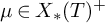
 and a dominant cocharacter
$\mu \in X_*(T)^+$
 . The affine Deligne-Lusztig variety is defined as

where
$p^\mu $
 is the image of p under the cocharacter
$\mu $
 .
The very first result on the nonemptiness is due to Rapoport-Richartz ([Reference Rapoport and Richartz27, Theorem 4.2]). They showed that, when G is unramified, if
$X_\mu (b)$
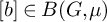
 is nonempty then Mazur’s inequality, that is,
$[b]\in B(G,\mu )$
 (see Definition 2.1) holds. Thanks to [Reference Kottwitz20], [Reference Gashi5] and [Reference He11], it is now a theorem that
$X_\mu (b)\neq \emptyset $
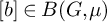
 if and only if
$[b]\in B(G,\mu )$
 for a general reductive group G.
Similarly, for G a connected reductive group over
$\mathbb {Q}_p$
 , one can consider affine Deligne-Lusztig varieties with an arbitrary parahoric level structure K as follows using Bruhat-Tits theory.

where
$W_K$
 is the group generated by the simple reflections of K and
$ {\mathrm{Adm}}(\mu )$
 is the
$\mu $
 -admissible set ([Reference Kottwitz and Rapoport17]). Still, Mazur’s inequality is the necessary and sufficient condition for
$X(\mu ,b)_K\neq \emptyset $
 (see [Reference Kottwitz and Rapoport18], [Reference Wintenberger34] and [Reference He12]).
Meanwhile,
$X(\mu ,b)_K$
 is, from the definition, a disjoint union of several pieces (where x varies over
$W_K\backslash \! {\mathrm{Adm}}(\mu )/W_K$
 ). These pieces, therefore, can be thought of as more refined objects or building blocks, which we call single (This is the terminology used in the literature occasionally. See [Reference He11] for example) affine Deligne-Lusztig varieties. One can study their nonemptiness problem and, to get to the point first, it has a considerably different flavor.
We remark that, among parahoric level structures, the Iwahori level structure contains the finest information via the natural projection map from the affine flag variety (Iwahori level) to the affine partial flag variety (parahoric level) or the affine Grassmannian (hyperspecial level). From now on, we restrict ourselves to the Iwahori level.
1.2 Single affine Deligne-Lusztig variety at Iwahori level
Along with the notations from Section 1.1.1, let I be a
$\sigma $
 -stable Iwahori subgroup of
$G(\breve {\mathbb {Q}}_p)$
 stabilizing a base alcove,
$\widetilde {W}$
 be the Iwahori-Weyl group and
$W_0$
 be the relative Weyl group (see Section 2.1). For
$x\in \widetilde {W}$
 and
$b\in G(\breve {\mathbb {Q}}_p)$
 , the single affine Deligne-Lusztig variety (at Iwahori level) is defined by

where
$\dot {x}$
 is an element in a subgroup of
$G(\breve {\mathbb {Q}}_p)$
 which is a lift of
$x\in \widetilde {W}$
 .
The question on the nonemptiness criterion (and the dimension formula) for
$X_x(b)$
 first appeared in [Reference Rapoport28, Problem 4.5] and some cases when
$G= {\mathrm{GL}}_2$
 were studied in [Reference Rapoport29, Example 4.3]. For a more general setting, the first partial conjecture was posed by Reuman ([Reference Reuman30, Conjecture 7.1]) where he detected an element in
$W_0$
 , now called
$\eta _\sigma (x)$
 (see Definition 2.10), that gives a good amount of information on the nonemptiness (and even on the dimension formula). The conjecture was reformulated and proved partially in [Reference Görtz, Haines, Kottwitz and Reuman6] and then completely by [Reference Görtz, He and Nie7, Theorem B] in the basic case. For convenience, let us name the theorem GHN B.
We note first that there is an obvious obstruction to the nonemptiness. Recall the Kottwitz map (cf. Definition 2.1) defined in [Reference Kottwitz19, 4.5]. Then,

because the Kottwitz map applied to the condition
$g^{-1}b\sigma (g)\!\in \! I\dot {x}I$
 results in
$\kappa _G(b)\!=\!\kappa _G(\dot {x})\!=\!\kappa _G(x)$
 . Geometrically, this means simply ‘x and b are in the same connected component of the loop group
$G(\breve {\mathbb {Q}}_p)$
 ’.
We may and will reduce to the case where G is simple, quasi-split and adjoint (Section 2.2). Then, GHN B tells us that, under the condition called shrunken Weyl chambers (Definition 2.5), there is only one interesting obstruction (
${\mathrm{supp}_\sigma} (\eta _\sigma (x))=\mathbb {S}$
 ) other than the obvious one (
$\kappa _G(x)=\kappa _G(b)$
 ).
GHN B. Let b be basic. If x lies in the shrunken Weyl chambers then

Here,
$\mathbb {S}$
 is the set of simple reflections of
$W_0$
 and
${\mathrm{supp}_\sigma} $
 is the map sending
$w\in W_0$
 to the minimal
$\sigma $
 -stable subset of
$\mathbb {S}$
 containing all simple reflections from any reduced expression of w (Definition 2.11). Shrunken Weyl chambers are, intuitively, the complement of the red strips (called critical strips) in Figure 1 and the critical strips are defined to be the strips passing through the base alcove (the black triangle).
An apartment of the Bruhat–Tits building of
$\mathrm {PGL}_3$
 .

1.2.1 A side remark on explicit criteria
Here, we clarify the term ‘explicit criterion’ mentioned in [Reference Görtz, He and Nie7, 1.2] and will be used in this paper at times. As this is not related to the rest of the paper, one may skip this remark.
In loc.cit., we have the following theorem (name it GHN A).
GHN A. Let b be basic. Then,
$X_x(b)\neq \emptyset $
 if and only if, for all pairs
$(J,w)$
 such that x is a
$(J,w,\delta )$
 -alcove, the following holds:

The Levi subgroup of G corresponding to
$J\subset \mathbb {S}$
 is denoted by
$M_J$
 and
$\kappa _{M_J}$
 is its Kottwitz map. We refer to Definition 2.9 for the term
$(J,w,\delta )$
 -alcove.
Practically, GHN B is used often in applications (See, for example, [Reference He13, Theorem 1.1] and [Reference Milićević and Viehmann22, Remark 3.18]. Using our new explicit criterion, we will give more applications) while GHN A is not. However, they solve the same problem and, actually, GHN B is more restrictive. Taking that into account, we can see that GHN B is more applicable and explicit already. Let us now see an example explaining this more clearly.
For the sake of simplicity, let G be split or residually split for a moment. Let x be a translation element
$t^\mu $
 . Then, GHN B directly implies that, if
$t^\mu $
 lies in the shrunken Weyl chambers then
$X_{t^\mu }(b)=\emptyset $
 always (This is because
$\eta _\sigma (x)$
 is the identity element
$ {\mathrm{id}}_{W_0}$
 . See Definition 2.10 for
$\eta _\sigma (x)$
 ). Moreover, our new (explicit) criterion will show that
$X_{t^\mu }(b)\neq \emptyset $
 if and only if
$[t^\mu ]=[b]\in B(G)$
 . This recovers [Reference Görtz, Haines, Kottwitz and Reuman6, Corollary 9.2.1] for b basic.
On the other hand, it is not easy to find all possible pairs
$(J,w)$
 such that x is a
$(J,w,\delta )$
 -alcove (especially Definition 2.9 (2) is not easily manageable) even when
$x=t^\mu $
 , which is a necessary step to apply GHN A. In addition, it is not an easy task to compute the values in
$\kappa _{M_J}([b]\cap M_J(\breve {\mathbb {Q}}_p))$
 afterwards.
1.3 Main conjecture
Our goal is to remove the shrunken Weyl chambers condition. We will suggest a general conjecture on an explicit nonemptiness criterion in the basic case and prove it for all but finitely many x’s and specify some classes of elements satisfying the conjecture. Let b be basic.
There is a new assumption in our conjecture that the following example can justify. Let
$x= {\mathrm{id}}_{\widetilde {W}}$
 , the identity element in
$\widetilde {W}$
 , and
$b=1$
 . Then, directly from the definition,
$X_x(b)\neq \emptyset $
 . However,
${\mathrm{supp}_\sigma} (\eta _\sigma (x))=\emptyset $
 as
$\eta _\sigma (x)= {\mathrm{id}}_{W_0}$
 . Hence, there are some exceptional x’s not having the
${\mathrm{supp}_\sigma} $
 -obstruction.
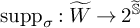
In the following, we denote by
$\widetilde{\mathrm{supp}_\sigma}$
 the
$\sigma $
 -support function on
$\widetilde {W}$
 (We found that it may cause confusion to use the same notations for two
$\sigma $
 -support functions each defined on
$W_0$
 and
$\widetilde {W}$
 and decided to use
$\widetilde {\mathrm{supp}_\sigma }$
 instead of
$\mathrm{supp}_\sigma :\widetilde {W}\to 2^{\widetilde {\mathbb {S}}}$
 ).
Lemma 1.1. Assume that
$\kappa _G(x)=\kappa _G(b)$
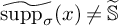
 . If
$\widetilde{\mathrm{supp}_\sigma}(x)\neq \widetilde {\mathbb {S}}$
 then
$X_x(b)\neq \emptyset $
 .
Proof. Let
$\nu _x$
 be the image of x under the Newton map. The condition
$\widetilde{\mathrm{supp}_\sigma}(x)\neq \widetilde {\mathbb {S}}$
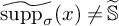 implies that
$\nu _x$
 is central because the group
$W_{\widetilde{\mathrm{supp}_\sigma}(x)}$
 generated by the elements of
$\widetilde{\mathrm{supp}_\sigma}(x)$
 is finite in such a case. However, if
$\nu _x$
 is central, for a representative
$\dot {x}$
 , we have
$\kappa (\dot {x})=\kappa (b)$
 and
$\bar {\nu }_{\dot {x}}=0=\bar {\nu }_b$
 so that
$[\dot {x}]=[b]\in B(G)$
 . Hence,
$X_x(b)\neq \emptyset $
 .
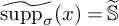
Lemma 1.1 shows that we only need to consider the case
$\widetilde{\mathrm{supp}_\sigma}(x)=\widetilde {\mathbb {S}}$
 . Our main conjecture is the following: (we follow the notations from Section 2)
Conjecture 1.2. Let G be a simple and quasi-split reductive group of adjoint type. Let x be an element of the Iwahori-Weyl group
$\widetilde {W}$
 and
$b\in \breve {G}$
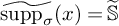
 be basic. Assume that
$\kappa _G(b)=\kappa _G(x)$
 and
$\widetilde{\mathrm{supp}_\sigma}(x)=\widetilde {\mathbb {S}}$
 . Then,

where
$W_x$
 is the subset of
$W_0$
 defined in Definition 3.5.
Conjecture 1.2 claims that, except for the Lemma 1.1 cases, the critical obstruction to the nonemptiness is whether or not the
$\sigma $
 -supports of certain
$\sigma $
 -conjugates of
$\eta _\sigma (x)$
 are all full. For convenience, we label by
$\Leftarrow $
 (resp.
$\Rightarrow $
 ) the ‘if’ (resp. ‘only if’) direction. Our main theorem is the following.
Theorem 1.3. Let G be a reductive group as in Conjecture 1.2. Then, the conjecture holds for all but finitely many x. More precisely,
$\Leftarrow $
 holds for all x and
$\Rightarrow $
 holds for all but finitely many cases. In addition,
$\Rightarrow $
 holds for


Note that GHN B takes care of infinitely many x’s, but it does not apply to infinitely many cases as well. We prove
$\Leftarrow $
 in Corollary 3.10 in full generality and prove
$\Rightarrow $
 in Proposition 3.12 for x such that
$\ell (x)\gg 0$
 . An effective bound for the length can be computed and we do so for type
$A_n$
 in Proposition 5.1.
Let us discuss Theorem 1.3 (3) in more detail. For simplicity, let
$G= {\mathrm{PGL}}_n$
 . There are two assumptions in Proposition 5.1. The first assumption is that
$\kappa _G(x)=0\in \mathbb {Z}/n\simeq X^*(Z(\hat {G})^\Gamma )$
 . It means that x can be written as
$t^\lambda w$
 where
$\lambda =(\lambda _1,\cdots ,\lambda _n)\in \mathbb {Z}^n_{\text {sum}=0}$
 and
$w\in S_n$
 (symmetric group). And then the second assumption is that ‘
$\max _i{\lambda _i}>1$
 and
$\min _i{\lambda _i}<-1$
 ’.
On the other hand, any element
$x=t^\lambda w$
 satisfying
$\widetilde{\mathrm{supp}_\sigma}(x)\neq \widetilde {\mathbb {S}}$
 (cf. Lemma 1.1) has the property ‘
$\max _i\lambda _i=1$
 and
$\min _i\lambda _i=-1$
 ’. Hence, there is only a small gap left in the conjecture under the assumption that
$\kappa _G(x)=0$
 . This way, we can view Theorem 1.3 (3) as an evidence for Conjecture 1.2 in the sense that elements in Lemma 1.1 are the only exceptions.
Remark 1.4. It is worth pointing out that GHN B and Theorem 1.3 for x lying in the shrunken Weyl chambers are almost the same, but there is a subtle difference. For example, when
$x=w_0$
 (the longest element of
$W_0$
 ) as an element of
$\widetilde {W}$
 , we apply GHN B to get
$X_x(1)\neq \emptyset $
 . However, x does not fit into Theorem 1.3 as
$\widetilde{\mathrm{supp}_\sigma}(x)\neq \widetilde {\mathbb {S}}$
 , so we should apply Lemma 1.1 to get
$X_x(1)\neq \emptyset $
 here.
Remark 1.5. One might wonder what the condition ‘
$\widetilde{\mathrm{supp}_\sigma}(x)=\widetilde {\mathbb {S}}$
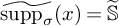 ’ means. Surprisingly, a simple concrete picture exists for this condition in the sense that ‘
$\widetilde {\mathrm{supp}_\sigma }(x)\neq \widetilde {\mathbb {S}}$
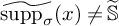 if and only if the action of
$x\circ \sigma $
 fixes a point in the closure of the base alcove’. Moreover, under the obvious obstruction (that is,
$\kappa _G(x)=\kappa _G(b)$
 ) when b is basic, it is equivalent to
$I\dot {x}I\subset [b]$
 . ([Reference Görtz, He and Nie8, Proposition 5.6 and Lemma 5.8])
Surprisingly, our result says that the abstract criterion (GHN A) can be made much stronger as follows. This was observed by Sian Nie.
Theorem 1.6 (Stronger GHN A)
Let b be basic and suppose that
$\widetilde {\mathrm{supp}_\sigma }(x)=\widetilde {\mathbb {S}}$
 with
$\ell (x)\gg 0$
 . Then,
$X_x(b)\neq \emptyset $
 if and only if x is not a
$(J,w)_\sigma $
 -alcove for any proper
$J\subsetneq \mathbb {S}$
 .
We note that the condition ‘
$\ell (x)\gg 0$
 ’ can be removed once Conjecture 1.2 is fully proved. In short, for x not intersecting with the base alcove,
$X_x(b)\neq \emptyset $
 if and only if x is not ‘coming from a proper Levi subgroup’.
1.4 New ideas and sketch of proof
The novelty of our work lies in the introduction of the set
$W_x$
 which arises naturally in the following sense.
The idea is that a critical strip behaves as if it belongs to the shrunken Weyl chambers adjacent to the strip. Hence, if x lies in a critical strip, we can ‘embed’ x into each shrunken Weyl chamber adjacent to the strip. Noting that, when x lies in a shrunken Weyl chamber, the rule for
$X_x(b)\neq \emptyset $
 is
$\mathrm{supp}_\sigma (\eta _\sigma (x))=\mathbb {S}$
 , we can presuppose that, in general, the rule for
$X_x(b)\neq \emptyset $
 would be
$\mathrm{supp}_\sigma (\eta _\sigma (x'))=\mathbb {S}$
 for each embedding
$x'$
 of x into each shrunken Weyl chamber adjacent to the strips.
The set
$W_x$
 is defined to be the set of elements in
$W_0$
 that, intuitively, embed x into those shrunken Weyl chambers. Practically, for x in the shrunken Weyl chambers, we get
$W_x=\{ {\mathrm{id}}_{W_0}\}$
 and, for x in one critical strip (cf. Theorem 1.3 (1)), we have
$W_x=\{ {\mathrm{id}}_{W_0},s\}$
 where s is the simple reflection related to the critical strip containing x.
In order to define
$W_x$
 , we make a new observation on a certain structure of the set of critical strips containing x (Proposition 3.4). More precisely, let
$\Phi $
 be the set of (relative) roots of G and, for simplicity, x lie in the dominant Weyl chamber. Next, denote by
$\Phi _x$
 the set of positive roots whose critical strip contains x. Then,
$\Phi _x$
 is ‘anti-closed’ in the sense that if
$\alpha +\beta \in \Phi _x$
 for two positive roots
$\alpha $
 and
$\beta $
 then
$\alpha \in \Phi _x$
 or
$\beta \in \Phi _x$
 . Alternatively, it is equivalent to that the complement of
$\Phi _x$
 in the set of positive roots is closed.
Using this, we show that the set
$W_x$
 is well-defined (Proposition 3.3) and that
$W_x$
 contains exactly the elements needed for the ‘
$\sigma $
 -support test’ (cf. Lemma 3.9). After that, we follow the strategy of [Reference Görtz, He and Nie7] as explained in Section 2.4 with more careful study on the
$W_x$
 -action on dominant cocharacters. We also use the positivity of the coroot-coefficients of dominant cocharacters (see Lemma 2.20) and work with the exact (positive) coefficients in the proof of Theorem 1.3 (1) and (3).
Remark 1.7. There has been an interesting coincidence happening while we have been working on this problem. Felix Schremmer [Reference Schremmer31] recently defined a set called ‘length-positive’ in his work on the generic Newton point. Our work and Schremmer’s work do not overlap, that is, the results are rather complementary. However, the length-positive set of Schremmer
$LP(x)$
 is closely related to the set
$W_x$
 of ours. (See Lemma 3.8.)
1.5 Applications and future works
1.5.1 The set
$B(G)_x$
 and cordial elements

The question of whether
$X_x(b)$
 is nonempty is equivalent to the question of whether
$I\dot {x}I\cap [b]$
 is nonempty. From this perspective, we can denote the set of
$[b]\in B(G)$
 such that
$I\dot {x}I\cap [b]\neq \emptyset $
 by
$B(G)_x$
 and ask to describe it. This approach first appeared in [Reference Beazley1].
Remark 1.8. For clarification, we remark that the main difference between the approach using
$B(G)_x$
 and ours is which variable is fixed. In our approach, we fix b and study the nonemptiness, but the study of
$B(G)_x$
 fixes x. As we will see in a moment, these two approaches are complementary.
When x is cordial (see Definition 5.2), the set
$B(G)_x$
 has the property called saturated (see Lemma 5.3), which makes the complete description of
$B(G)_x$
 easier. Combining this with Theorem 1.3 (3), we obtain a full description of
$B(G)_x$
 in some special cases as follows.
Theorem 1.9. Let
$x=vt^\mu $
 for a dominant non-central (If
$\mu $
 is central, it is obvious that
$B(G)_x=\{[t^\mu ]\}=B(G,\mu )$
 via Lemma 1.1)
$\mu $
 and
$v\in W_0$
 , and let
$W_0(\mu )$
 be the stabilizer subgroup of
$W_0$
 fixing
$\mu $
 . Then,

Now, if
$\mathrm{supp}_\sigma (\sigma ^{-1}(r)\eta _\sigma (x)r^{-1})=\mathbb {S}$
 for all
$r\in W_x$
 then
$B(G)_x=B(G,\mu )$
 .
1.5.2 Future works on new dimension formulas
The following dimension formula [Reference He11] is known for x lying in the shrunken Weyl chambers:

On the contrary, outside of the shrunken Weyl chambers, even a conjectural formula for
$\dim X_x(b)$
 is still mysterious. However, if more nonemptiness results are found, we can approach this problem with the following recursive formula ([Reference He11, Proposition 4.2]): For
$s\in \mathbb {S}$
 satisfying
$\ell (sx\sigma (s))=\ell (x)-2$
 ,

Typically, this is a bottom-up formula for length reasons (that is,
$\ell (x)=\ell (sx)+1=\ell (sx\sigma (s))+2$
 ). However, for example, if
$X_{sx\sigma (s)}(b)$
 is empty then we can also compute
$\dim X_{sx}(b)$
 from
$\dim X_x(b)$
 , which is top-down.
In future work, using Theorem 1.3 (2), we will show the following dimension formula which is new even in the rank two case:
Theorem 1.10. Let G be residually split with
$ {\mathrm{rk}}\! G_{\text {sc}}=2$
 and b be basic. For
$x\in \widetilde {W}$
 lying in only one critical strip (associated to
$v\alpha $
 ), if
$X_x(b)\neq \emptyset $
 then

where
$\epsilon =1$
 if
$\eta _\sigma (x)=w_0$
 and
$\epsilon =0$
 otherwise.
1.6 Organization
We describe the organization here.
§2 is a preliminary section. We recall the setup of [Reference Görtz, He and Nie7] and note down some computations related to critical strips. Following loc.cit., we summarize the proof of GHN B and collect the lemmas subject to be generalized.
In §3, we introduce the set
$W_x$
 . Then, we discuss some properties of closed subsets of a root system ([Reference Doković, Check and Hée24]). Then we prove Theorem 1.3 and Theorem 1.3 (2).
In §4, we prove Theorem 1.3 (1) by handling some possibly exceptional cases. We study in detail using the exact positive coefficients from [Reference Onishchik and Vinberg25].
In §5, we wrap up some tedious computations postponed in §3 and §4 proving Theorem 1.3 (3). In the application part, we recall some facts from [Reference Milićević and Viehmann22] and [Reference He13] and then prove Theorem 1.9.
2 Basics on single affine Deligne-Lusztig varieties
Let F be a nonarchimedean local field with a uniformizer t and G be a connected reductive group over F. Denote by
$\breve {F} := \widehat {F^{ {\mathrm{nr}}}}$
 the completion of the maximal unramified extension of F and by
$\breve {G}$
 the
$\breve {F}$
 -points of G. The Frobenius map on the residue field of
$\breve {F}$
 lifts to that of
$\breve {F}$
 which we denote by
$\sigma $
 again. The induced map on
$\breve {G}$
 will be denoted the same. Finally, we denote the set of
$\sigma $
 -conjugacy classes of
$\breve {G}$
 by
$B(G)$
 .
2.1 Iwahori-Weyl group and
$B(G)$

Let S be a maximal
$\breve {F}$
 -split torus of G defined over F and T be the centralizer of S. Note that T is a maximal torus of G as G becomes quasi-split over
$\breve {F}$
 by Steinberg’s Theorem.
2.1.1 Iwahori-Weyl group
$\widetilde {W}$

The Iwahori-Weyl group associated to S is defined as

where
$T(\breve{F})_1$
 is the unique parahoric subgroup of
$T(\breve{F})$
 . We can fit
$\widetilde {W}$
 into the following short exact sequence of groups ([Reference Haines and Rapoport10] Definition 7)

where
${\Gamma _0}$
 is the absolute Galois group of
$\breve {F}$
 and
$W_0$
 is the relative Weyl group

Now, we fix a
$\sigma $
 -invariant base alcove
$\mathbf {a}$
 in the apartment of S and let I be the Iwahori subgroup of G corresponding to
$\mathbf {a}$
 . By fixing a special vertex in the closure of
$\mathbf {a}$
 , we get a section
$W_0\to \widetilde {W}$
 (not necessarily
$\sigma $
 -equivariant) which allows us to identify
$\widetilde {W}$
 with
$X_*(T)_{\Gamma _0}\rtimes W_0$
 .
The Newton map
$\nu :\widetilde {W}\to X_*(T)_{\Gamma _0,\mathbb {Q}}^\sigma $
 is defined as follows. The action of
$\sigma $
 on
$\widetilde {W}$
 is of finite order and so, given
$x\in \widetilde {W}$
 , there exists a positive integer N such that
$\mu _N := \prod _{i=0}^{N-1}\sigma ^i(x)$
 belongs to
$X_*(T)_{\Gamma _0}^\sigma $
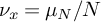
 . The Newton map sends x to
$\nu _x = \mu _N/ N$
 for any such N and it does not depend on the choice of N.
Let
$G_{\text {sc}}$
 be the simply connected cover of the derived subgroup of G and
$T_{\text {sc}}$
 the inverse image of T via
$G_{\text {sc}}\to G_{\text {der}}\to G$
 . The Iwahori-Weyl group of
$G_{\text {sc}}$
 is the affine Weyl group
$W_a$
 and gives rise to the following short exact sequence ([Reference Haines and Rapoport10] Lemma 14):

Denoting by
$\Omega \subset \widetilde {W}$
 the stabilizer of the base alcove, we have an isomorphism
$X^*(Z(\hat {G})^{\Gamma _0})\simeq \Omega $
 which gives a section of
$\tilde {\kappa }_G$
 . This presents
$\widetilde {W}$
 as
$W_a\rtimes X^*(Z(\hat {G})^{\Gamma _0})$
 . Now, the Bruhat order on
$W_a$
 extends to
$\widetilde {W}$
 by making two elements be comparable when their projections to
$X^*(Z(\hat {G})^{\Gamma _0})$
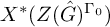 agree.
Note that
$W_a$
 is the affine Weyl group generated by orthogonal reflections with respect to the hyperplanes in
$X_*(T_{\text {sc}})_{\Gamma _0}\otimes \mathbb {R}$
 . Hence, by [Reference Bourbaki3, Ch.VI, §2.5. Proposition 8], there exists a reduced root system
$\Sigma $
 whose affine Weyl group is canonically isomorphic to
$W_a$
 . We denote by
$Q^\vee $
 the coroot lattice of
$\Sigma $
 and
$P^\vee $
 its coweight lattice. Lastly, let
$\mathbb {S}$
 be the set of simple reflections of the finite Weyl group of
$\Sigma $
 (that is,
$W_0$
 ) through the section
$W_0 \to \widetilde {W}$
 defined above and
$\widetilde {\mathbb {S}}$
 the set of affine simple reflections containing
$\mathbb {S}$
 .
The map
$\sigma $
 on
$\breve {G}$
 induces an action on
$\mathbb {S}$
 which we will denote by
$\sigma $
 again. We call
$J\subset \mathbb {S}$
 a
$\sigma $
 -stable subset if
$\sigma (J)=J$
 . For any
$\sigma $
 -stable subset J, we denote
$X_*(T)_{\Gamma _0}\rtimes W_J$
 by
$\widetilde {W}_J$
 where
$W_J$
 is the subgroup of
$W_0$
 generated by the simple reflections of J.
A comment on the notation: we will use the notation
$v\cdot \mu $
 when considering the
$W_0$
 -action on
$X_*(T)_{\Gamma _0}$
 . So, for example,
$vt^\mu \in \widetilde {W}$
 can also be written as
$t^{v\cdot \mu }v$
 .
2.1.2
$B(G)$
with Newton map and Kottwitz map

Recall the Newton map and the Kottwitz map from [Reference Kottwitz19, 4.5] that give an injective homomorphism
$(\bar {\nu },\kappa _G):B(G)\to X_*(T)_{\mathbb {Q}}^{\Gamma ,+} \times X^*(Z(\hat {G})^{\Gamma })$
 where
$\Gamma $
 is the absolute Galois group of F.
Definition 2.1 (
$B(G,\mu )$
)

Let
$\mu \in X_*(T)^+$
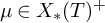 be a dominant cocharacter of G. We define
$B(G,\mu )$
 as the subset of
$B(G)$
 consisting of
$[b]\in B(G)$
 such that

where
$\mu ^\diamond $
 is the
$\Gamma $
 -average (To be precise, this is true only when G is quasi-split. In general, it is the average of the dominant representatives of Galois orbits. For a more detailed explanation, see [Reference He and Nie14, 2.4]) of
$\mu $
 and
$t^\mu $
 is the image of t under
$\mu :\mathbb {G}_m\to T$
 . Mazur’s inequality mentioned in Section 1.1.1 refers to
$\bar {\nu }_b\le \mu ^\diamond $
 .
We note that the map
$\tilde {\kappa }_G$
 in Equation (3) followed by the projection
$X^*(Z(\hat {G})^{\Gamma _0})\to X^*(Z(\hat {G})^\Gamma )$
 gives
$\kappa _G:\widetilde {W}\to X^*(Z(\hat {G})^\Gamma )$
 and it is compatible with
$\kappa _G$
 on
$B(G)$
 via the lifting from
$\widetilde {W}$
 to
$N_S(G)(\breve {F})\subset \breve {G}$
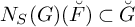 .
2.2 Single affine Deligne-Lusztig variety
The Iwahori-Bruhat decomposition says

where
$\dot {x}\in N_S(G)(\breve {F})$
 is a representative of
$x\in \widetilde {W}$
 .
Definition 2.2 (affine Deligne-Lusztig ‘variety’)
For
$x\in \widetilde {W}$
 and
$b\in B(G)$
 , the single affine Deligne-Lusztig variety associated to x and b is

A priori, it is an affine Deligne-Lusztig set and we do not have a natural scheme structure on it. In fact, in the case of an equal characteristic local field F, it is not difficult to identify
$X_x(b)$
 as the
$\overline {\mathbb {F}}_q$
 -points of a (locally of finite type) locally closed subscheme in the affine flag variety over
$\overline {\mathbb {F}}_q$
 . It is the mixed characteristic case where we need distinguished works of [Reference Zhu35] and [Reference Bhatt and Scholze2] to give a perfect scheme structure on
$X_x(b)$
 .
In order to study the nonemptiness pattern, it is more convenient to do some reductions. By [Reference He and Zhou15, Corollary 4.4 and Section 4.3], we can reduce the nonemptiness problem to the case when G is the quasi-split inner form of an adjoint group. Finally, if
$G=G_1\times G_2$
 then
$B(G)=B(G_1)\times B(G_2)$
 and
$\widetilde {W}_G=\widetilde {W}_{G_1}\times \widetilde {W}_{G_2}$
 . Hence,
$X_x(b)= X_{x_1}(b_1)\times X_{x_2}(b_2)$
 where
$x_i$
 ’s are the projections of x onto
$\widetilde {W}_{G_i}$
 and
$b_i$
 ’s are those of b onto
$B(G_i)$
 . Now, we may assume that G is a simple quasi-split reductive group of adjoint type.
Remark 2.3. In loc.cit., it is assumed that G is tamely ramified over F and
$p\nmid \!\pi _1(G_{\text {ad}})$
 in the equal characteristic case. They refer to [Reference Görtz, He and Nie7] Proposition 2.2.1 which assumes, however, only that p does not divide
$\pi _1(G_{\text {ad}})$
 . Hence, we do not need to assume the tameness condition.
We can remove the
$p\nmid \! \pi _1(G_{\text {ad}})$
 condition as well because we do not need the isomorphism in Proposition 2.2.1 of loc.cit. to study the nonemptiness. Note that they use [Reference Pappas and Rapoport26] 6.a.1 to show that the corresponding connected components of affine flag varieties of G and
$G_{\text {ad}}$
 are isomorphic through the affine flag variety of
$G_{\text {sc}}$
 when
$p\nmid \! \pi _1(G_{\text {ad}})$
 . However, a similar argument to Remark 6.4 of loc.cit. actually shows that they still admit universal homeomorphisms from the affine flag variety of
$G_{\text {sc}}$
 without the assumption. This is enough for us to reduce to the case when G is of adjoint type.
2.3 Terminologies on positions of alcoves
From now on, we assume that G is a simple quasi-split reductive group of adjoint type. For simplicity, we use x abusively to denote the alcove
$x\mathbf {a}$
 , the resulting alcove by the action of
$x\in \widetilde {W}$
 on the base alcove
$\mathbf {a}$
 , discussed in Section 2.1.
Let
$\Phi $
 be the set
$\Phi (G,S)$
 of relative roots and
$\Phi ^+$
 (resp.
$\Phi ^-$
 ) be the subset of positive (resp. negative) roots. Let
$V := X_*(T)_{\Gamma _0}\otimes \mathbb {R}$
 which is isomorphic to
$X_*(T_{\text {sc}})_{\Gamma _0}\otimes \mathbb {R}$
 as G is semisimple. For
$\alpha \in \Phi $
 , the hyperplane
$H_\alpha $
 in V is defined by
$\{\mathbf {v}\in V:\langle \alpha ,\mathbf {v}\rangle =0\}$
 and, more generally, for any integer k, we define
$H_\alpha (k) := \{\mathbf {v}\in V:\langle \alpha ,\mathbf {v}\rangle =k\}$
 . Note that
$H_\alpha (k)=H_{-\alpha }(-k)$
 .
Definition 2.4 ([Reference Görtz, Haines, Kottwitz and Reuman6, Section 2.1], k-value of an alcove with respect to a root)
For
$\alpha \in \Phi $
 and
$x\in \widetilde {W}$
 , let us denote the integer k such that x is located in between the hyperplanes
$H_\alpha (k)$
 and
$H_\alpha (k+1)$
 by
$k(\alpha ,x)$
 .
Definition 2.5 (The critical strips and shrunken Weyl chambers)
For each positive root
$\alpha $
 , we call the set of alcoves between
$H_\alpha (0)$
 and
$H_\alpha (1)$
 the critical strip associated to
$\alpha $
 and denote it by
$CS_\alpha $
 (One can define the critical strip of a negative root
$\alpha $
 to be the set of alcoves between
$H_\alpha (0)$
 and
$H_\alpha (-1)$
 and also denote by
$CS_\alpha $
 . This convention will be used). The set of alcoves which do not lie in any critical strip is called the shrunken Weyl chambers.
The following computes the k-values explicitly. Here, the expression
$t^\mu w$
 is always an alcove in the dominant Weyl chamber and v is an element of
$W_0$
 .
Lemma 2.6. For any root
$\alpha \in \Phi $
 ,

Proof. We only need to consider the case where the alcove is represented by a finite Weyl group element and, in this case, the value
$\delta _{w^{-1}\alpha }$
 decides whether w is in the
$\alpha $
 -direction or
$-\alpha $
 -direction.
In general,
$k(\alpha ,vt^\mu w)=\langle \alpha , v\mu \rangle + \delta _{w^{-1}v^{-1}\alpha }$
 where
$\delta _\beta =0$
 if
$\beta \in \Phi ^+$
 and
$\delta _\beta =-1$
 otherwise.
Corollary 2.7. Let
$\alpha $
 be a root in (1) and
$\alpha $
 ,
$\beta $
 and
$\alpha +\beta $
 be roots in (2).
-
(1) $k(\alpha ,t^\mu w)+k(-\alpha ,t^\mu w)=-1$
. -
(2) $k(\alpha +\beta ,t^\mu w)=k(\alpha ,t^\mu w)+k(\beta ,t^\mu w)$
or
$k(\alpha +\beta ,t^\mu w) = k(\alpha ,t^\mu w)+k(\beta ,t^\mu w)+1$
.



Proof. (1):
$w^{-1}\alpha>0$
 implies
$w^{-1}(-\alpha )<0$
 and vice versa. (2): Apply Lemma 2.6 noting that the cases where both
$w^{-1}\alpha $
 and
$w^{-1}\beta $
 are positive (resp. negative) but
$w^{-1}(\alpha +\beta )$
 is negative (resp. positive) are not possible.
From Lemma 2.6,
$vt^\mu w\in CS_{v\alpha }$
 for some
$\alpha \in \Phi ^+$
 if and only if
$\langle \alpha ,\mu \rangle +\delta _{w^{-1}\alpha }-\delta _{v\alpha }=0$
 . Noting that
$k(\alpha ,t^\mu w)\ge 0$
 when
$\alpha \in \Phi ^+$
 , we have the following corollary easily:
Corollary 2.8. Let
$\alpha \in \Phi ^+$
 and suppose
$vt^\mu w\in CS_{v\alpha }$
 . Then
$v\alpha \in \Phi ^+$
 and one of the following holds:
-
(1) $\langle \alpha ,\mu \rangle =0$
and
$w^{-1}\alpha \in \Phi ^+$
, -
(2) $\langle \alpha ,\mu \rangle =1$
and
$w^{-1}\alpha \in \Phi ^-$
.




When
$vt^\mu w\not \in CS_{v\alpha }$
 , if
$\langle \alpha ,\mu \rangle =0$
 then
$v\alpha \in \Phi ^-$
 and
$w^{-1}\alpha \in \Phi ^+$
 .
Now, we recall the definition of a
$(J,w)_\sigma $
 -alcove (In [Reference Görtz, He and Nie7], this is denoted by
$(J,w,\delta )$
 -alcove. We choose to use the notation ‘
$(J,w)_\sigma $
 -alcove’ in this paper not just for the sake of simplicity. In fact, the induced action
$\delta $
 on
$\mathbb {S}$
 by
$\sigma $
 is a fixed map. It is not varying, unlike J or w in the notation) from [Reference Görtz, He and Nie7, 3.3].
Definition 2.9 (
$(J,w)_\sigma $
-alcove)

Let J be a
$\sigma $
 -stable subset of
$\mathbb {S}$
 and w be an element of
$W_0$
 . We say that
$x\in \widetilde {W}$
 is a
$(J,w)_\sigma $
 -alcove if
-
(1) $w^{-1}x\sigma (w)\in \widetilde {W}_J$
and, -
(2) for any $\alpha \in w(\Phi ^+\setminus \Phi _J^+)$
,
$k(\alpha ,x)\ge k(\alpha , {\mathrm{id}})$
.



Next, the ‘essential’ finite part
$\eta _\sigma (x)$
 of x observed by Reuman is defined as follows.
Definition 2.10 (
$\eta _\sigma (x)$
, [Reference Görtz, He and Nie7, 3.6])

For
$x\in \widetilde {W}$
 , let
$v_x\in W_0$
 be the unique element such that
$v_x^{-1}x$
 is in the dominant Weyl chamber and
$v_x^{-1}x=t^{\mu _x}w_x$
 for
$\mu _x\in X_*(T)_{\Gamma _0}^+$
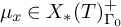 and
$w_x\in W_0$
 . We define

Finally, we recall the following from [Reference Bourbaki3, Ch.IV, §1.8. Proposition 7].
Definition 2.11 (support and
$\sigma $
-support)

Given a Coxeter system
$(W,S)$
 and
$w\in W$
 , the support of w is defined to be the set of
$s\in S$
 appearing in some (equivalently each) reduced expression of w and denoted by
$ {\mathrm{supp}}(w)$
 . When
$(W,S)$
 is equipped with an action by
$\xi $
 , the minimal
$\xi $
 -stable set containing
$ {\mathrm{supp}}(w)$
 is called the
$\xi $
 -support of w and denoted by
$ {\mathrm{supp}}_\xi (w)$
 .
Remark 2.12. There are two Coxeter systems
$(W_0,\mathbb {S})$
 and
$(W_a,\widetilde {\mathbb {S}})$
 in this paper. We have
$\xi =\sigma $
 for
$(W_0,\mathbb {S})$
 and
$\xi =\omega \sigma $
 for
$(W_a,\widetilde {\mathbb {S}})$
 where
$\omega $
 is an element of
$\Omega $
 defined in Equation (3). For
$x\in W_a\rtimes \Omega $
 whose projection to
$\Omega $
 is
$\omega _x$
 , we use the notation
$\widetilde {\mathrm{supp}_\sigma }(x)$
 instead of
$ {\mathrm{supp}}_{\omega _x\sigma }(x)$
 for simplicity.
2.4 On the known result GHN B
Now we recall:
Theorem 2.13 (GHN B)
Let
$b\in B(G)$
 be basic and
$x\in \widetilde {W}$
 lie in the shrunken Weyl chambers with
$\kappa (b)=\kappa (x)$
 . Then,

Sketch of proof
The proof is a combination of the following lemmas.
Lemma 2.14 [Reference Görtz, He and Nie7, Proposition 3.6.4 and Proposition 3.6.5]
Let b be basic. Under the following two assumptions, we have
$X_x(b)=\emptyset $
 .
-
(1) $\nu _{\mu _x}\neq \nu _{b}$
and -
(2) $\mathrm{supp}_\sigma (\eta _\sigma (x))\neq \mathbb {S}$
,


If we assume that x lies in shrunken Weyl chambers, (2) implies (1).
This proves that if
$X_x(b)\neq \emptyset $
 then
$\mathrm{supp}_\sigma (\eta _\sigma (x))=\mathbb {S}$
 (However, note that the proof of Lemma 2.14 uses [Reference Görtz, He and Nie7, Proposition 3.5.1] (‘
$\sigma $
 -conjugacy classes never fuse’) which was stated without the assumption that b is basic but in fact needs that assumption. See [Reference Görtz, He and Nie9]). For the reverse direction, we need the following theorem:
Proposition 2.15 [Reference Görtz, He and Nie7, Theorem 4.4.7]
Let b be basic. If x satisfies no Levi obstruction (NLO), then
$X_x(b)\neq \emptyset $
 . Precisely, ‘no Levi obstruction’ means the following: for every pair
$(J,w)$
 with
$\sigma $
 -stable J and
$w\in W_0$
 such that
$x\in \widetilde {W}$
 is a
$(J,w)_\sigma $
 -alcove, there exists
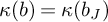
$b_J\in w\widetilde {W}_J\sigma (w)^{-1}$
 such that
-
(1) $\kappa (b)=\kappa (b_J)$
-
(2) $\nu _{b_J}=\nu _b$
-
(3) $\kappa _J(w^{-1}b_J\sigma (w))=\kappa _J(w^{-1}x\sigma (w))$


If x lies in the shrunken Weyl chamber and
$\mathrm{supp}_\sigma (\eta _\sigma (x))=\mathbb {S}$
 , by Lemma 2.16 below, the only J such that x is a
$(J,w)_\sigma $
 -alcove is
$J=\mathbb {S}$
 . For
$J=\mathbb {S}$
 , we can let
$b_J$
 be any element in the
$\sigma $
 -straight conjugacy class of
$\widetilde {W}$
 corresponding to
$[b]\in B(G)$
 ([Reference He11, 3.3]) so that x satisfies NLO and
$X_x(b)\neq \emptyset $
 by Proposition 2.15.
Lemma 2.16 [Reference Görtz, He and Nie7, Proposition 4.1.1]
Let
$x\in \widetilde {W}$
 lie in the shrunken Weyl chambers. If x is a
$(J,w)_\sigma $
 -alcove for a
$\sigma $
 -stable subset J of
$\mathbb {S}$
 , then
$\mathrm{supp}_\sigma (\eta _\sigma (x))\subset J$
 .
Finally, we have the following lemmas on the properties of dominant cocharacters and the Weyl group action on roots. For a subset J of
$\mathbb {S}$
 , we denote the lattice generated by the coroots
$\alpha _i^\vee $
 such that
$s_i\in J$
 by
$Q_J^\vee $
 .
Lemma 2.17. Let
$\mu $
 be a cocharacter and
$w\in W_0$
 . Then,
$\mu -w\cdot \mu \in Q_{ {\mathrm{supp}}(w)}^\vee $
 .
Proof. For any simple reflection
$s_i$
 , the formula
$s_i\cdot \mu =\mu -\langle \alpha _i,\mu \rangle \alpha _i^\vee $
 tells us that
$\mu -s_i\cdot \mu \in Q_{\{s_i\}}^\vee $
 . Note that w is a product of simple reflections and so we can think inductively on
$\ell (w)$
 . Considering
$\mu -ws_i\cdot \mu =\mu -s_i\cdot \mu + s_i\cdot \mu -w\cdot (s_i\cdot \mu )\in Q_{\{s_i\}}^\vee + Q_{ {\mathrm{supp}}(w)}^\vee $
 , it is straightforward.
The following corollary is stated in [Reference Görtz, He and Nie7, 3.5 (1)] without a proof. For completeness, we give a proof of this.
Corollary 2.18. Let J be a
$\sigma $
 -stable subset of
$\mathbb {S}$
 . If
$x\in \widetilde {W}_J$
 , then
$\nu _{v_x\cdot \mu _x}-\nu _x\in Q_{J,\mathbb {Q}}^\vee $
 .
Proof. The difference is a
$\mathbb {Q}$
 -multiple of
$\sum _{i}(\sigma ^i(v_x\cdot \mu _x)-(v_xw_x\sigma )^i(v_x\cdot \mu _x))$
 . Noting that
$\prod _{0\le j\le i-1}\sigma ^j(v_xw_x)\in W_J$
 , apply Lemma 2.17 to get the conclusion.
Lastly, we prove:
Lemma 2.19. Suppose that the Dynkin diagram of G is
$\sigma $
 -connected. Let J be a proper
$\sigma $
 -stable subset of
$\mathbb {S}$
 . If
$\mu \in Q^\vee _{J,\mathbb {Q}}$
 is dominant, then
$\mu =0$
 .
Proof.
$Q^\vee _{J,\mathbb {Q}}\subset Q^\vee _{\mathbb {Q}}=P^\vee _{\mathbb {Q}}$
 , hence
$\mu $
 is a
$\mathbb {Q}$
 -linear combination of fundamental coweights. As it is dominant, all the coefficients are non-negative. If
$\mu \neq 0$
 , then at least one coefficient is positive so that it is a positive linear combination of coroots of a connected component by Lemma 2.20. Hence, J contains some connected component completely. As the Dynkin diagram is
$\sigma $
 -connected, we must have
$J=\mathbb {S}$
 which is a contradiction.
The following Lemma 2.20 has probably been known to experts for a long time. However, to the best of our knowledge, a reference for this lemma is hard to locate. So, following Michael Rapoport’s suggestion, we record it here. In this paper, this is particularly needed to remedy some argument in [Reference Görtz, He and Nie7] using loc.cit. 3.5. (2) which is not correct. See Proposition 4.5.
Lemma 2.20. (The letter C will be used in this lemma to follow the historical notations. The letter C appearing in this paper is always referring to the critical strip, except here. We believe there would be no confusion occurring) Let
$\bar {C}$
 be the closed Weyl chamber defined as
$\{\mu \in V: \langle \mu ,\alpha \rangle \ge 0\text { for all }\alpha \in \Delta \}$
 and
$C^\vee $
 be the obtuse Weyl chamber defined as
$\{\mu \in V:\mu =\sum _{i\in \mathbb {S}}c_i\alpha _i^\vee ,~c_i\ge 0\}$
 . Then
$\bar {C}\setminus \! \{\vec {0}\}$
 is contained in the interior of
$C^\vee $
 . In other words, a fundamental coweight is a positive linear combination of simple coroots.
Proof. The fundamental coweights
$\varpi _i^\vee $
 form a basis of V and they satisfy
$\langle \varpi _i^\vee ,\alpha _j\rangle =\delta _{ij}$
 . Hence,
$\bar {C}\setminus \{\vec {0}\}=\{\sum _{i\in \mathbb {S}}d_i\varpi _i^\vee :\text { not all }d_i\text {'s are }0\}$
 . Hence, it is enough to show that
$\langle \varpi _i^\vee ,\varpi _j\rangle =: \pi _{ij}$
 , the coefficient of
$\alpha _j^\vee $
 in the expression of
$\varpi _i^\vee $
 , is positive.
First of all, the coefficients from [Reference Bourbaki3, Ch.VI, §4.5-§4.13, (VI)] prove the dual version. For our version, recall the Cartan matrix A whose entries are
$A_{ij}=\langle \alpha _i^\vee ,\alpha _j\rangle $
 . Then,
$\delta _{ik}=\langle \varpi _i^\vee ,\alpha _k\rangle =\langle \sum _j\pi _{ij}\alpha _j^\vee ,\alpha _k\rangle = \sum _j\pi _{ij}A_{jk}$
 . Therefore,
$\pi _{ij}$
 ’s are the entries of the inverse of A, which we know to be positive by [Reference Onishchik and Vinberg25, Reference Chapter. §2. Table 2] (note that one should take their transpose). For a more general situation, see [Reference Lusztig and Tits21, Reference Gashi5.].
3 Proof of main theorems
3.1 Closed subsets of a root system
Definition 3.1. A subset
$\Psi $
 of the set of roots
$\Phi $
 is called (The terms closed and parabolic are from [Reference Bourbaki3, Ch.VI, §1.7. Définition 4.] and the term radical is from [Reference Doković, Check and Hée24, 1.])
-
(1) closed if $\alpha ,\beta \in \Psi $
implies
$\{\alpha +\beta \}\cap \Phi \subset \Psi $
, -
(2) radical if $\Psi \cap -\Psi =\emptyset $
, and -
(3) parabolic if $\Psi \cup -\Psi =\Phi $
.




Being closed or radical is invariant under any
$W_0$
 -action. An example of a radical closed subset is any subset of all positive roots or a
$W_0$
 -conjugate of that. In fact, this is essentially the only example.
Lemma 3.2. For a radical closed subset
$\Psi $
 , there exists
$w\in W_0$
 such that
$\Psi \subset w\Phi ^+$
 .
Proof. [Reference Sopkina33, Proposition 3] (cf. [Reference Bourbaki3, Ch.VI, §1.7. Proposition 22])
The following proposition is stronger than Lemma 3.2 and crucial to generalize our work to the multiple critical strips case. The proof relies on the classification of parabolic subsets.
Proposition 3.3. Let
$\Psi _r\subset \Psi _p$
 be two closed subsets of
$\Phi $
 such that
$\Psi _r$
 is radical and
$\Psi _p$
 is parabolic. Then, there exists
$w\in W_0$
 such that

Proof. We call a closed subset invertible if the complement (in the full
$\Phi $
 ) is also closed. A parabolic subset is an invertible subset and all invertible subsets are
$W_0$
 -conjugate to
$\Phi _J \cup (\Phi ^+\setminus \Phi _{J'}^+)$
 where
$J\subset J'\subset \mathbb {S}$
 and
$J\bot (J'\setminus J)$
 by [Reference Doković, Check and Hée24, Lemma 1 and Theorem 4]. Only when
$J=J'$
 , it is parabolic.
Hence,
$\Psi _p=w_0 (\Phi ^+\cup \Phi _J^-$
 ) for some
$w_0\in W_0$
 and
$J\subset \mathbb {S}$
 . Now, consider
$w_0^{-1}\Psi _r\cap \Phi _J$
 which is radical because it belongs to a radical subset
$w_0^{-1}\Psi _r$
 and closed because it is the intersection of two closed subsets. Hence, there exists
$w_1\in W_J$
 such that
$w_0^{-1}\Psi _r\cap \Phi _J\subset w_1 \Phi _J^+$
 by Lemma 3.2.
Note that
$\Psi _r\subset \Psi _p=w_0(\Phi ^+\cup \Phi _J^-)$
 so that

But from above the first part belongs to
$W_J^+$
 . The second set belongs to
$w_1^{-1}(\Phi ^+\setminus \Phi _J^+)$
 which belongs to
$\Phi ^+$
 as
$w_1\in W_J$
 . Obviously,
$w_1^{-1}w_0^{-1}\Psi _p=w_1^{-1}(\Phi ^+\cup \Phi _J^-)\supset \Phi ^+$
 .
Recall the notation
$x= v_x t^{\mu _x}w_x $
 from Definition 2.10 and let
$\Phi _x$
 be the set of positive roots
$\alpha $
 such that
$x\in CS_{v_x\alpha }$
 . The following is the most important observation towards our main theorem.
Proposition 3.4.
$\Phi ^+\setminus \Phi _x$
 is a radical closed subset.
Proof. It is enough to prove that
$\Psi _x$
 satisfies the following:

However, for a positive root
$\gamma $
 ,
$\gamma \in \Psi _x$
 is equivalent to
$k(\gamma ,t^{\mu _x}w_x)=k(v_x\gamma , {\mathrm{id}})=0$
 . Applied to
$\gamma =\alpha +\beta $
 , we get
$k(\alpha +\beta ,t^{\mu _x}w_x)=k(v_x\alpha +v_x\beta , {\mathrm{id}})=0$
 . Using Corollary 2.7 (2) and that
$t^{\mu _x}w_x$
 lies in the dominant Weyl chamber, we get
$k(\alpha ,t^{\mu _x}w_x)=k(\beta ,t^{\mu _x}w_x)=0$
 . Moreover, by Corollary 2.7 (2) again,
$0=\delta _{v_x\alpha }+\delta _{v_x\beta }+1$
 or
$0=\delta _{v_x\alpha }+\delta _{v_x\beta }$
 . Hence,
$\delta _{v_x\alpha }=0$
 or
$\delta _{v_x\beta }=0$
 , that is,
$\alpha \in \Psi _x$
 or
$\beta \in \Psi _x$
 .
3.2 The set
$W_x$

We define
$W_x$
 mentioned in Conjecture 1.2.
Definition 3.5. Given
$x\in \widetilde {W}$
 , the subset
$W_x\subset W_0$
 is the set of
$r\in W_0$
 such that

or equivalently, by taking the negation and the complement,
$r^{-1}\Phi ^+\subset \Phi ^+\cup -\Phi _x$
 .
Remark 3.6. If x lies in a shrunken Weyl chamber then
$\Phi _x=\emptyset $
 , so
$W_x=\{ {\mathrm{id}}_{W_0}\}$
 . For x lying in exactly one critical strip, we have
$\Phi _x=\{\alpha _x\}$
 for some unique
$\alpha _x\in \Phi ^+$
 . In fact, it should be a simple root by Theorem 4.1. Hence,

where
$s_x$
 is the simple reflection corresponding to
$\alpha _x$
 .
We note that
$W_x$
 is not necessarily a subgroup, but the following lemma suggests some structure on
$W_x$
 .
Lemma 3.7. The set
$W_x$
 is left-closed in the sense that if
$w\in W_x$
 and
$\ell (sw)<\ell (w)$
 for a simple reflection s, then
$sw\in W_x$
 .
Proof. We know that w can be written as
$sw'$
 where
$\ell (sw')=\ell (w')+1$
 . Then
$w^{\prime -1}\Phi ^+=w^{-1}s(\Phi ^+)=w^{-1}(\Phi ^+\cup \{-\alpha _s\}\setminus \{\alpha _s\})=w^{-1}\Phi ^+\cup \{-w\alpha _s\}\setminus \{w\alpha _s\}$
 . However, as
$w^{-1}s<w^{-1}$
 ,
$-w^{-1}\alpha _s\in \Phi ^+$
 so that
$w^{-1}\Phi ^+\cup \{-w\alpha _s\}\setminus \{w\alpha _s\}\subset w^{-1}\Phi ^+\cup \Phi ^+\subset \Phi ^+\cup -\Phi _x$
 as
$w\in W_x$
 .
As promised previously, we show that
$LP(x)$
 from [Reference Schremmer31] is closely related to
$W_x$
 .
Lemma 3.8. We have

where
$LP(x)^{-1} = \{v \in W_0:v^{-1} \in LP(x)\}$
 .
Proof. For
$v\in W_0$
 , we have
$v \in LP(x)$
 if and only if, for all
$\alpha \in \Phi ^+$
 , we have
$k(v\alpha , x) \ge k(v\alpha , {\mathrm{id}})$
 . If
$v_x^{-1}v\alpha $
 is a negative root, we have
$k(v\alpha , x) = k(v_x v_x^{-1}v\alpha , v_xt^{\mu _x}w_x) = k(v_x^{-1}v\alpha , t^{\mu _x}w_x) < 0$
 . However,
$k(v\alpha , {\mathrm{id}})$
 is always
$0$
 or
$-1$
 , which means that
$k(v\alpha , x) = k(v\alpha , {\mathrm{id}}) = -1$
 and so x is in
$CS_{v\alpha } = CS_{-v\alpha } = CS_{v_x{(-v_x^{-1}v\alpha )}}$
 and, by definition,
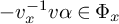
$-v_x^{-1}v\alpha \in \Phi _x$
 . Therefore, we have that
$v\in LP(x)$
 implies
$v_x^{-1}v\Phi ^+ \subset \Phi ^+ \cup -\Phi _x$
 and
$(v_x^{-1}v)^{-1} = v^{-1}v_x \in W_x$
 . The reverse direction works in a similar way.
3.3 Lemma 2.16 in general
As before, b is basic. We will express x as
$v_xt^{\mu _x}w_x$
 where
$v_x\in W_0$
 is the unique element such that
$v_x^{-1}x$
 is in the dominant Weyl chamber.
Lemma 3.9. If x is a
$(J,w)_\sigma $
 -alcove for a
$\sigma $
 -stable subset J of
$\mathbb {S}$
 , then
$\sigma ^{-1}(r)\eta _\sigma (x)r^{-1}\in W_J$
 for some
$r\in W_x$
 .
As before, we get the following corollary:
Corollary 3.10. Let x be an arbitrary element in
$\widetilde {W}$
 and
$b\in \breve {G}$
 such that
$\kappa (x)=\kappa (b)$
 . If
$\mathrm{supp}_\sigma (\sigma ^{-1}(r)\eta _\sigma (x)r^{-1})=\mathbb {S}$
 for all
$r\in W_x$
 , then
$X_x(b)\neq \emptyset $
 .
Proof of Lemma 3.9
Suppose that there exists
$\alpha \in w(\Phi ^+\setminus \Phi _J^+)$
 such that
$v_x^{-1}\alpha \in -(\Phi ^+\setminus \Phi _x)$
 . Then, by definition of
$\Phi _x$
 ,
$-\alpha $
 satisfies
$k(-\alpha ,x)\neq k(-\alpha , {\mathrm{id}})$
 , that is,
$k(\alpha ,x)\neq k(\alpha , {\mathrm{id}})$
 . Hence,
$k(v_x^{-1}\alpha ,t^{\mu _x}w_x)\gneq k(\alpha , {\mathrm{id}})\ge -1$
 and so
$v_x^{-1}\alpha $
 should be a positive root as
$t^{\mu _x}w_x$
 is in the dominant Weyl chamber. This contradicts the assumption. Hence,
$v_x^{-1}\alpha \in \Phi ^+\cup -\Phi _x$
 .
This implies that
$v_x^{-1}w(\Phi ^+\setminus \Phi _J^+)\subset \Phi ^+\cup -\Phi _x$
 , or equivalently,
$\Phi ^+\setminus \Phi _x\subset v_x^{-1}w(\Phi ^+\cup \Phi _J^-)$
 . By Proposition 3.4,
$\Psi _r := \Phi ^+\setminus \Phi _x$
 and
$\Psi _p := v_x^{-1}w(\Phi ^+\cup \Phi _J^-)$
 fit into the assumptions in Proposition 3.3 so that there exists
$r\in W_0$
 such that

Taking the complement and the negation, we get
$rv_x^{-1}w(\Phi ^+\setminus \Phi _J^+)\subset \Phi ^+$
 for some
$r\in W_x$
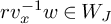
 by Definition 3.5. Therefore,
$rv_x^{-1}w\in W_J$
 for some
$r\in W_x$
 and consequently
$\sigma (w^{-1})\sigma (v_x)\sigma (r^{-1})\in W_J$
 as J is
$\sigma $
 -stable. Moreover,
$w^{-1}v_xw_x\sigma (w)\in W_J$
 since x is a
$(J,w)_\sigma $
 -alcove. Multiplying them together, we get
$rw_x\sigma (v_x)\sigma (r^{-1})\in W_J$
 so that
$\sigma ^{-1}(r)\eta _\sigma (x) r^{-1}\in W_J$
 .
3.4 Lemma 2.14 under some restriction
For
$r\in W_x$
 , let us denote by
$J_{r,x}$
 the
$\sigma $
 -stable subset
$\mathrm{supp}_\sigma (\sigma ^{-1}(r)\eta _\sigma (x)r^{-1})$
 .
Lemma 3.11.
x is a
$(J_{r,x},v_xr^{-1})_\sigma $
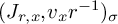 -alcove.
Proof. The first condition of Definition 2.9 can be checked easily because the finite part is
$rv_x^{-1}v_xw_x\sigma (v_xr^{-1})\in W_{J_{x,r}}$
 . For Definition 2.9 (2), we need to compare
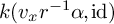
$k(v_xr^{-1}\alpha ,v_xt^{\mu _x}w_x)$
 and
$k(v_xr^{-1}\alpha , {\mathrm{id}})$
 for all
$\alpha \in \Phi ^+\setminus \Phi _{J_{x,r}}^+$
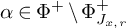 . The first one is
$k(r^{-1}\alpha ,t^{\mu _x}w_x)$
 which is
$\ge 0$
 if
$r^{-1}\alpha \in \Phi ^+$
 and
$0\ge k(v_xr^{-1}\alpha , {\mathrm{id}})$
 always. Hence, we only need to consider the case
$r^{-1}\alpha \in \Phi ^-$
 . However,
$r(\Phi ^+\setminus \Phi _x)\subset \Phi ^+$
 implies (again by the negation complement)
$r^{-1}\Phi ^+\subset \Phi ^+\cup -\Phi _x$
 . Therefore, we have
$r^{-1}\alpha \in -\Phi _x$
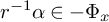 . By the definition of
$\Phi _x$
 , we have the same k-values.
Proposition 3.12. Let
$x\in \widetilde {W}$
 be an element with
$\ell (x)\gg 0$
 . If
$J_{r,x}\neq \mathbb {S}$
 for some
$r\in W_x$
 , then
$X_x(b)=\emptyset $
 .
Proof. By the previous lemma, x is a
$(J_{r,x},vr^{-1})_\sigma $
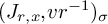 -alcove so [Reference Görtz, He and Nie7, Proposition 3.6.4] tells us that

Note that, inductively computing, when
$r=s_{i_m}\cdots s_{i_1}$
 ,

so that

Assume that the expression of r is reduced, then
$s_{i_1}\cdots s_{i_{j-1}}\alpha _{i_j}\in \Phi ^+$
 . Moreover,
$rs_{i_1}\cdots s_{i_{j-1}}\alpha _{i_j}\in \Phi ^-$
 . Hence,
$s_{i_1}\cdots s_{i_{j-1}}\alpha _{i_j}\in \Phi ^+\cap r^{-1}\Phi ^-\subset \Phi _x$
 implying that
$\langle s_{i_1}\cdots s_{i_{j-1}}\alpha _{i_j},\mu _x\rangle =0$
 or
$1$
 . Therefore, the
$\sigma $
 -average of the sum of coroots on the right hand side is bounded. However, for x such that
$\ell (x)\gg 0$
 , if
$\mu _x=\sum _ic_i\varpi _i^\vee $
 , then
$\sum _ic_i\gg 0$
 and, by Lemma 2.20, the coefficients in the linear combination of coroots are large enough so that
$\nu _{\mu _x}-\nu _{\sum _{j=1}^k\langle s_{i_1}\cdots s_{i_{j-1}}\alpha _{i_j},\mu _x\rangle \alpha _{i_j}^\vee }$
 has all positive coefficients. This is a contradiction.
Combining Proposition 3.12 and Corollary 3.10, we get
Theorem 3.13. Let
$b\in B(G)$
 be basic and suppose that
$x\in \widetilde {W}$
 satisfies
$\kappa (b)=\kappa (x)$
 and
$\ell (x)\gg 0$
 . Then

Proof of Theorem 1.3
Note that
$\widetilde {\mathrm{supp}_\sigma }(x)=\widetilde {\mathbb {S}}$
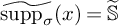 condition in Theorem 1.3 (1) is satisfied for x such that
$\ell (x)\gg 0$
 . As there are only finitely many x with
$\ell (x)$
 bounded by some number, Conjecture 1.2 holds.
Proof of Theorem 1.3 (2)
If
$x=v_xt^{\mu _x}w_x$
 is a translation element, we have
$w_x=v_x^{-1}$
 . In this case,
$\Phi _x$
 consists of
$\alpha \in \Phi ^+$
 such that
$0\le \langle \alpha ,\mu _x\rangle +\delta _{v_x\alpha }=\delta _{v_x\alpha }$
 so that
$\langle \alpha ,\mu _x\rangle =0$
 and
$v_x\alpha \in \Phi ^+$
 for all
$\alpha \in \Phi _x$
 . For
$x=v_xt^{\mu _x}$
 , we have
$w_x= {\mathrm{id}}$
 so that
$\alpha \in \Phi _x$
 satisfies
$\langle \alpha ,\mu _x\rangle +\delta _{\alpha }=\delta _{v_x\alpha }$
 so that
$\langle \alpha ,\mu _x\rangle =0$
 and
$v_x\alpha \in \Phi ^+$
 as well.
Hence, in both cases, we do not have
$\alpha \in \Phi _x$
 such that
$\langle \alpha ,\mu _x\rangle =1$
 . Therefore, in the proof of Proposition 3.12, all the terms
$\langle s_{i_1}\cdots s_{i_{j-1}}\alpha _{i_j},\mu _x\rangle \alpha _{i_j}^\vee $
 are zeros. Therefore,
$\nu _{r\cdot \mu _x}$
 is dominant still so that
$J_{r,x}\neq \mathbb {S}$
 is a contradiction assuming
$X_x(b)\neq \emptyset $
 .


4 One critical strip
4.1 Finding a simple root
We will prove the following:
Theorem 4.1. Let
$b\in B(G)$
 be basic and
$x\in \widetilde {W}$
 lie in exactly one critical strip
$CS_a$
 for some
$a\in \Phi $
 . Then
-
(1) $v_x^{-1}a$
is a simple root, and -
(2) $X_x(b)\neq \emptyset $
if and only if
$\kappa _G(b)=\kappa _G(x)$
and $$ \begin{align*}\text{ both } \mathrm{supp}_\sigma(\eta_\sigma(x)) \text{ and } \mathrm{supp}_\sigma(\sigma^{-1}(s_x)\eta_\sigma(x)s_x) \text{ are } \mathbb{S},\end{align*} $$where $s_x$
is the simple reflection corresponding to
$v_x^{-1}a$
.





This is slightly stronger than Theorem 1.3 (1). More precisely, compared to Theorem 1.3 (1), Theorem 4.1 has additional claims that
$v_x^{-1}a$
 is a simple root and has no restriction ‘
$\widetilde {\mathrm{supp}_\sigma }(x)=\widetilde {\mathbb {S}}$
 ’. In fact, one can easily show that
$v_x^{-1}a$
 must be a simple root (Lemma 4.2) from Proposition 3.4. The absence of the restriction
$\widetilde {\mathrm{supp}_\sigma }(x)=\widetilde {\mathbb {S}}$
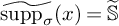 is the main reason why Theorem 4.1 is stronger. It is explained in Lemma 4.6.
Lemma 4.2. Suppose that x belongs to exactly one critical strip associated to a. Then,
$v_x^{-1}a$
 is a simple root.
Proof. By Proposition 3.4,
$\Phi _x$
 is a singleton such that
$\Phi ^+\setminus \Phi _x$
 is closed. As simple roots generate
$\Phi ^+$
 , we know
$\Phi _x$
 should contain a simple root.
We will denote by
$\alpha _x$
 the unique positive simple root such that
$x\in CS_{v_x\alpha _x}$
 .
4.2 Lemma 2.14 for one strip
Here, we prove that if
$\mathrm{supp}_\sigma (\eta _\sigma (x))\neq \mathbb {S}$
 or
$\mathrm{supp}_\sigma (s_x\eta _\sigma (x)\sigma (s_x))\neq \mathbb {S}$
 , then
$X_x(b)=\emptyset $
 .
Proposition 4.3. Under the assumption of Theorem 4.1, if
$\mathrm{supp}_\sigma (\eta _\sigma (x))\neq \mathbb {S}$
 then
$X_x(b)=\emptyset $
 .
Proof. By Lemma 2.14, it is enough to show that
$\nu _{\mu _x}\neq \bar {\nu }_b$
 . We follow the strategy of [Reference Görtz, He and Nie7, Proposition 3.6.5] here.
Let n be the order of
$W_0\rtimes \langle \sigma \rangle $
 and suppose that
$\nu _{\mu _x}$
 is central. Then
$0=\langle \nu _{\mu _x},\beta \rangle =\frac {1}{n}\langle \mu _x+\sigma (\mu _x)+\cdots +\sigma ^{n-1}(\mu _x),\beta \rangle $
 , but
$\sigma ^i(\mu _x)$
 are all dominant. Hence, if
$\beta $
 is positive then
$\langle \mu _x,\beta \rangle =0$
 . Considering the case
$\beta $
 being the maximal root, we get
$\mu _x$
 central. This implies that
$w_x= {\mathrm{id}}$
 and
$x=v_xt^{\mu _x}$
 . Note that
$\eta _\sigma (x)= v_x$
 .
As we assume that there is only one critical strip containing x, it means that the number of
$\alpha \in \Phi ^+$
 such that
$k(\alpha ,v_xt^{\mu _x})= k(\alpha , {\mathrm{id}})=0$
 is
$1$
 . But,
$k(\alpha ,v_xt^{\mu _x})=\delta _{v_x^{-1}\alpha }$
 . It means that
$|\Phi ^+\cap v_x \Phi ^+|=|\Phi ^+|-\ell (v_x)=1$
 so that
$\ell (v_x)=|\Phi ^+|-1$
 . However,
$\ell (v_x)\le |\Phi _{\mathrm{supp}_\sigma (v_x)}^+|<|\Phi ^+|-1$
 .
Now we consider the case
$\mathrm{supp}_\sigma (\sigma ^{-1}(s_x)\eta _\sigma (x)s_x)\neq \mathbb {S}$
 .
Lemma 4.4. Under the assumption of Theorem 4.1, denote by
$J_x$
 the set
$\mathrm{supp}_\sigma (\sigma ^{-1}(s_x)\eta _\sigma (x)s_x)$
 . Then x is a
$(J_x,v_xs_x)_\sigma $
 -alcove.
Proof. We have
$\Phi _x=\{\alpha _x\}$
 , so
$s_x\in W_x$
 because
$s_x\Phi ^+=\Phi ^+\cup \{-\alpha _x\}\setminus \{\alpha _x\}$
 . Now, the conclusion follows from Lemma 3.11.
Proposition 4.5. If
$J_x\neq \mathbb {S}$
 in Lemma 4.4, then
$X_x(b)=\emptyset $
 .
Proof. Note that x is a
$(J_x,v_xs_x)_\sigma $
 -alcove. Hence, it is enough to prove that

leads to a contradiction where
$\lambda ' := s_x \mu _x$
 following the proof of [Reference Görtz, He and Nie7, Proposition 3.6.4]. However,
$\lambda '=s_x\mu _x$
 is either
$\mu _x-\alpha _x^\vee $
 or
$\mu _x$
 . The latter case is already proved (Note that, as mentioned before, the proof in loc.cit. is incorrect when referring to ‘Section 3.5 (2)’ and you need to use Lemma 2.19 instead) in loc.cit..
Now, let us consider the case
$s_x\mu _x=\mu _x-\alpha _x^\vee $
 . We have

Let
$\varpi _i^\vee $
 be the fundamental coweights and
$\varpi _i$
 be the fundamental weights. For simplicity, denote by
$\mathcal {O}$
 the
$\sigma $
 -orbit of
$s_x$
 and by
$\alpha _{\mathcal {O}}$
 (resp.
$\varpi _{\mathcal {O}}$
 or
$\varpi _{\mathcal {O}}^\vee $
 ) the sum of the elements in the
$\sigma $
 -orbit of
$\alpha _x$
 (resp.
$\varpi _{\mathcal {O}}$
 or
$\varpi _{\mathcal {O}}^\vee $
 ) and take the inner product of (5) with
$\varpi _{\mathcal {O}}$
 . Then we get
$0$
 on the right hand side and, on the left hand side, we have
$\langle \varpi _{\mathcal {O}},s_x\mu _x\rangle = \langle s_x\varpi _{\mathcal {O}},\mu _x\rangle =\langle \varpi _{\mathcal {O}}-\alpha _x,\mu _x\rangle =\langle \varpi _{\mathcal {O}},\mu _x\rangle -1$
 .
Let
$\mu _x$
 be
$\sum c_i\varpi _i^\vee $
 for some
$c_i\in \mathbb {Z}_{\ge 0}$
 , we know that the coefficient
$c_x$
 of
$\varpi _x^\vee $
 is 1 from the assumption
$s_x\mu _x = \mu _x -\alpha _x^\vee $
 . Hence, we have
$1 = \langle \varpi _{\mathcal {O}} , \mu _x \rangle \ge \langle \varpi _x , \mu _x\rangle =\langle \varpi _x,\varpi _x^\vee +\sum _{i\neq x}c_i\varpi _i^\vee \rangle = \langle \varpi _x,\varpi _x^\vee \rangle + \sum _{i\neq x}c_i \langle \varpi _x, \varpi _i^\vee \rangle $
 . The first inequality comes from the fact that
$\mu _x$
 is dominant. In fact, if we denote the connected component of the Dynkin diagram containing
$\alpha _x$
 by D, the latter summation part is actually for i such that
$i\neq x$
 and
$\alpha _i$
 in D. Note that
$\langle \varpi _i,\varpi _j^\vee \rangle $
 is the
$(i,j)$
 -entry of the inverse of the Cartan matrix of D whose entries are all positive. In most cases, this already exceeds
$1$
 by [Reference Onishchik and Vinberg25, Reference Chapter. §2. Table 2]. Note that
$\langle \varpi _x,\varpi _x^\vee \rangle $
 is the corresponding entry on the diagonal of the inverse matrix.
Therefore, there are two possible cases: a)
$\langle \varpi _x,\varpi _x^\vee \rangle =1$
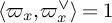 and all
$c_i$
 ’s are
$0$
 for i such that
$i\neq x$
 and
$\alpha _i$
 in D and b)
$\langle \varpi _x,\varpi _x^\vee \rangle <1$
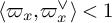 . The first case is when x is the unique vertex of degree=1 (with a single edge) in
$B_\ge 2$
 ,
$C_\ge 2$
 ,
$D_\ge 4$
 or the middle vertex of
$A_3=D_3$
 . The second case is when x is one of two degree=1 vertices in
$A_n$
 . As they contain a little tedious computation, we put it off to Section 5.1.
Combining Proposition 4.3 and Proposition 4.5, we get



4.3 On the condition
$\widetilde {\mathrm{supp}_\sigma }(x)=\widetilde {\mathbb {S}}$

Finally, the following lemma explains why the assumption
$\widetilde {\mathrm{supp}_\sigma }(x)=\widetilde {\mathbb {S}}$
 is not necessary in Theorem 1.3 (1). Note that
$\widetilde {\mathrm{supp}_\sigma }(x)\neq \widetilde {\mathbb {S}}$
 implies that
$\nu _x$
 is central.
Lemma 4.6. Let x be in exactly one critical strip and suppose
$\nu _x$
 is central. Then both
$\mathrm{supp}_\sigma (\eta _\sigma (x))$
 and
$\mathrm{supp}_\sigma (\sigma ^{-1}(s_x)\eta _\sigma (x)s_x)$
 are
$\mathbb {S}$
 .
Proof. Note that
$\nu _x=v_x\cdot \nu _{v_x^{-1}x\sigma (v_x)}$
 and
$v_x^{-1}x\sigma (v_x)=t^{\mu _x}w_x\sigma (v_x)=t^{\mu _x}\sigma (\eta _\sigma (x))$
 (Caution. This is not necessarily in the dominant Weyl chamber). Hence,
$\nu _{t^{\mu _x} \sigma (\eta _\sigma (x))}$
 is also central. On the other hand, similarly to Corollary 2.18, we have
$\nu _{\mu _x}-\nu _{t^{\mu _x}\sigma (\eta _\sigma (x))}\in Q_{\mathrm{supp}_\sigma (\sigma (\eta _\sigma (x))),\mathbb {Q}}^\vee $
 by applying Lemma 2.17. As
$\mu _x$
 is dominant,
$\nu _{\mu _x}$
 is dominant. If
$\mu _x$
 is non-central, then
$\nu _{\mu _x}$
 is also non-central and so Lemma 2.19 enforces
$\mathrm{supp}_\sigma (\sigma (\eta _\sigma (x)))=\mathbb {S}$
 . As above, we have

However,
$t^{s_x\cdot \mu _x}s_xw_x\sigma (v_x)\sigma (s_x)= (v_xs_x)^{-1} x\sigma (v_xs_x)$
 , but
$\nu _x$
 is central so the second term is central. We can now repeat the proof of Proposition 4.5.
When
$\mu _x$
 is central, we have
$x=v_xt^{\mu _x}$
 . We can repeat Proposition 4.3 to show that
$\mathrm{supp}_\sigma (\eta _\sigma (x))=\mathbb {S}$
 . Moreover, the one critical strip assumption tells us that
$w_0v_x^{-1}$
 is a simple reflection s (corresponding to
$\alpha \in \Phi ^+$
 ). Then,
$\alpha _x=v_x^{-1}\alpha $
 and so
$v_x\alpha _x\in \Phi ^+$
 , that is,
$\ell (v_xs_x)=\ell (v_x)+1=\ell (w_0)$
 . Hence,
$v_x=w_0s_x$
 and
$\sigma ^{-1}(s_x)\eta _\sigma (x)s_x=\sigma ^{-1}(s_x)w_0$
 whose support is
$\mathbb {S}$
 .
5 Some computations and applications
In this section, we show computations for possibly exceptional cases (mentioned in Proposition 4.5) when x belongs to exactly one critical strip. Moreover, we have some remarks on the type
$A_n$
 case and we prove Theorem 1.9.
5.1 Completion of the proof for the one critical strip case
Proof of Proposition 4.5 (cont’d)
We separate into two cases. (Note that we use [Reference Onishchik and Vinberg25, Reference Chapter. §2. Table 2] here.)
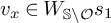
Case 1-1. x is the vertex of degree
$1$
 (with a single edge) in
$B_{\neq 2},C_{\neq 2},D_{\ge 4}$
 .
$\langle \varpi _x,\varpi _x^\vee \rangle $
 is already
$1$
 . So,
$c_i$
 ’s are all zero, that is,
$\mu _x=\varpi _x^\vee $
 . For simplicity, we use the notation
$*_1$
 instead of
$*_x$
 where
$*=s,\alpha , \varpi ^\vee $
 in this paragraph. For any positive root
$\alpha $
 with no support at
$\alpha _1$
 , we have
$x\not \in CS_{v_x\alpha }$
 and
$\langle \alpha ,\varpi _1^\vee \rangle =0$
 . So we have
$v_x\alpha \in \Phi ^-$
 and
$w_x^{-1}\alpha \in \Phi ^+$
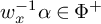 by Lemma 2.6. As
$x\in CS_{v_x\alpha _1}$
 and
$\langle \alpha _1,\varpi _1^\vee \rangle =1$
 , we have
$v_x\alpha _1\in \Phi ^+$
 and
$w_x^{-1}\alpha _1\in \Phi ^-$
 . Note that
$s_2\alpha _1=\alpha _1+\alpha _2$
 is different from
$\alpha _1$
 and in
$\Phi ^+$
 . Moreover,
$\langle s_2\alpha _1,\varpi _1^\vee \rangle =1$
 . Due to the uniqueness assumption of critical strips, either
$v_x(s_2\alpha _1)\in \Phi ^-$
 or
$ w_x^{-1}(s_2\alpha _1)\in \Phi ^+$
 by Lemma 2.6.
-
(1) The latter case: $w_x^{-1}(\alpha _1+\alpha _2)\in \Phi ^+$
so that
$w_x^{-1}s_1\alpha \in \Phi ^+$
for all positive simple roots
$\alpha $
. Hence,
$w_x=s_1$
so that
$\sigma ^{-1}(s_1)\eta _\sigma (x)s_1= vs_1$
. As
$J_x=\mathbb {S}\setminus {\mathcal {O}}$
,
$v_x\in W_{\mathbb {S}\setminus {\mathcal {O}}}s_1$
. However,
$\Phi ^+\ni v_x\alpha _1\in W_{\mathbb {S}\setminus {\mathcal {O}}}(-\alpha _1)\subset \Phi ^-$
as
$1\in {\mathcal {O}}$
. Contradiction. -
(2) The first case: Apply the same argument to $w_0v_x$
instead of
$w_x^{-1}$
and get
$v_x=w_0s_1$
. Then
$\sigma ^{-1}(s_1)\eta _\sigma (x)s_1=\sigma ^{-1}(s_1w_x)w_0$
. Consider
$\sigma (w_0)w_x^{-1}s_1\alpha _1$
which is in
$\Phi ^-$
by above, but
$\sigma (w_0)w_x^{-1}s_1\in W_{\mathbb {S}\setminus {\mathcal {O}}}$
so it should be a positive root which is a contradiction.











Case 1-2. x is the middle point in
$A_3$
 .
$\mu _x=\varpi _2^\vee $
 . As before,
$v_x\alpha _2\in \Phi ^+$
 and
$w_x^{-1}\alpha _2\in \Phi ^-$
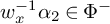 . It means that
$w_x\in s_2W_{\{1,3\}}$
 or
$w_x=s_2s_1s_3s_2$
 . Hence,
$s_2w_x\in W_{\{1,3\}}$
 or
$s_2w_x=s_1s_3s_2$
 and
$\sigma ^{-1}(s_2)\eta _\sigma (x)s_2=\sigma ^{-1}(s_2w_x)v_xs_2$
 . As it belongs to
$W_{\mathbb {S}\setminus {\mathcal {O}}}$
 , we have
$v_x\in W_{\mathbb {S}\setminus {\mathcal {O}}}s_2$
 so that
$v_x\alpha _2\in \Phi ^-$
 which is a contradiction or
$v_x\in s_2 W_{\mathbb {S}\setminus {\mathcal {O}}}s_2$
 . In the latter case, note that
$v_x$
 is supported at
$s_1$
 because
$v_x\alpha _1\in \Phi ^-$
 and so
$v_x\alpha _2\in \Phi ^-$
 from
$v_x\in s_2 W_{\mathbb {S}\setminus {\mathcal {O}}}s_2$
 .
Case 1-3. x is the vertex with an outward arrow in
$B_2=C_2$
 .
May assume
$B_2$
 and
$\mu _x=\varpi _1^\vee $
 . This is the same as Case 1-1 as
$s_2\alpha _1=\alpha _1+\alpha _2$
 .
Case 2. x is a vertex of degree
$1$
 in
$A_n$
 .
As the sum is
$1$
 ,
$D\cap {\mathcal {O}}=\{x\}$
 necessarily and
$\mu _x=\varpi _x^\vee +\varpi _y^\vee $
 where y is a vertex (possibly in another connected component) of degree
$1$
 not in
${\mathcal {O}}$
 .
For simplicity, we will call
$D'$
 the connected component containing
$\varpi _y^\vee $
 and use
$\varpi _{1,D}^\vee $
 instead of
$\varpi _x^\vee $
 and
$\varpi _{n,D'}^\vee $
 instead of
$\varpi _y^\vee $
 . Moreover,
$\sigma $
 does not shuffle
$1$
 and n in (distinct) connected components.
-
(1) The case $D\neq D'$
: The proof is exactly the same as Case 1-1. -
(2) The case $D=D'$
:
$\mu _x=\varpi _1^\vee +\varpi _n^\vee $
in the same connected component. The proof is similar. In a similar way, we have
$v_x\alpha \in \Phi ^-$
and
$w_x^{-1}\alpha \in \Phi ^+$
for
$\alpha $
not supported at both
$\alpha _1$
and
$\alpha _n$
. For
$\alpha =\alpha _1$
, we have the opposite situation. For the remaining case, it should not be the opposite situation.The method is essentially the same. Note that the goal in the above was to show that $w_x=s_1$
or
$v_x=w_0s_1$
. Here, the goal is to show that
$w_x=s_1\cdots s_m$
for some
$m\le n$
or
$v_x=w_0s_m\cdots s_1$
for some
$m\le n$
. Using that the roots are of the form
$\alpha _i+\alpha _{i+1}+\cdots +\alpha _j$
, one can prove that. We skip the proof.


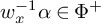







5.2 Sharper bounds for Theorem 1.3 (3)
Denote by
$Q^\vee _{>0}$
 the set of positive
$\mathbb {Q}$
 -linear sums of all simple coroots. Note that
$\nu _{\mu _x}\in Q^\vee _{>0}$
 unless
$\mu _x$
 is central.
Suppose that
$r\in W_x$
 and s is a simple reflection such that
$sr\in W_x$
 and
$sr>r$
 . Considering Equation (4), we know that
$sr\cdot \mu =r\cdot \mu - \langle r^{-1}\alpha ,\mu \rangle \alpha ^\vee $
 where
$\alpha $
 is the simple positive root corresponding to s. Moreover, as
$sr\in W_x$
 ,
$\langle r^{-1}\alpha ,\mu \rangle =0$
 or
$1$
 . Hence, as long as
$sr\in W_x$
 (assuming
$sr>r$
 ), we know that
$sr\cdot \mu $
 is the same as
$r\cdot \mu $
 or
$r\cdot \mu - \alpha ^\vee $
 .
Therefore, if
$\nu _{r'\cdot \mu _x}\in Q^\vee _{J,\mathbb {Q}}$
 for some
$J\subsetneq \mathbb {S}$
 and
$r'\in W_x$
 , we can find a minimal
$r_0\in W_0$
 such that
$\ell (r'r_0^{-1})+\ell (r_0)=\ell (r')$
 (so that
$r_0\in W_x$
 by Lemma 3.7) and
$r_0\cdot \mu \not \in Q^\vee _{>0}$
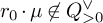 in the sense that
$sr_0\cdot \mu \in Q^\vee _{>0}$
 for any simple reflection s such that
$sr_0<r_0$
 . Note that it is not necessarily unique and we make any choice.
The minimality assumption tells us that any reduced expression
$s_{i_k}\cdots s_{i_1}$
 of
$r_0$
 has the same
$s_{i_k}$
 (the first simple reflection should be constant). Moreover,
$\langle s_{i_1}\cdots s_{i_{k-1}}\alpha _{i_k},\mu _x\rangle =1$
 considering Equation (4). Finally,
$ {\mathrm{supp}}(r_0)$
 should be connected. Now, the precise statement of Theorem 1.3 (3) is the following.
Proposition 5.1. In type
$A_n$
 , suppose that
$\mu _x\in Q^\vee $
 and assume
$\langle \varpi _1,\mu _x\rangle>1$
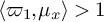 ,
$\langle \varpi _n,\mu _x\rangle>1$
 . Then Conjecture 1.2 holds.
Proof. Let
$r_0$
 be a minimal element chosen before and m be the unique number such that
$r_0\alpha _m<0$
 . Similar to Proposition 3.12, it is enough to show that
$r_0\cdot \mu _x\in Q^\vee _{\neq \mathbb {S},\mathbb {Q}}$
 is a contradiction. Note that
$\mu _x\in Q^\vee $
 , so we can assume
$r_0\cdot \mu _x\in Q_{\neq \mathbb {S}}^\vee $
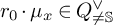 . Due to the minimality of
$r_0$
 , we have that
$\mathbb {S}\setminus {\mathrm{supp}}(r_0\cdot \mu _x)=\{m\}$
 . Moreover, for each
$i\in {\mathrm{supp}}(r_0\cdot \mu _x)$
 ,
$\alpha _i^\vee $
 -coefficient of
$r_0\cdot \mu _x$
 is a positive integer. Therefore, if
$m\neq 1$
 or n, we have
$\langle \alpha _m,r_0\cdot \mu _x\rangle \le -2$
 . However,
$r_0^{-1}\alpha _m\in -\Phi _x$
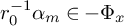 so that
$\langle r_0^{-1}\alpha _m,\mu _x\rangle =-1$
 which is a contradiction.
When
$m=1$
 (resp. n), note that
$r_0\cdot \mu _x\in Q_J^\vee $
 (where
$J=\mathbb {S}\setminus \{m\}$
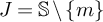 ) is weakly dominant in the sense of [Reference Nie23, Proposition 3.1]. Therefore,
$r_0\cdot \mu $
 and
$\mu $
 fit into the setting in [Reference Nie23, Lemma 5.9] so that
$\mu -r_0\cdot \mu $
 is the sum of some positive roots orthogonal to each other. However, no two positive roots containing
$\alpha _1$
 (resp.
$\alpha _n$
 ) can be orthogonal. This implies that the
$\alpha _1^\vee $
 (resp.
$\alpha _n^\vee $
 )-coefficient of
$\mu $
 is either that of
$r_0\cdot \mu $
 (which is
$0$
 ) or one larger than that. So it must be
$1$
 . This contradicts the assumption.
We remark that the above proof works for
$D_n$
 and
$E_n$
 types but needs one more assumption that
$\langle \varpi _{n-1},\mu _x\rangle>1$
 where
$n-1$
 is the vertex of degree
$1$
 other than the vertices
$1$
 and n.
5.3 Application: Cordial elements and generic
$\sigma $
-conjugacy class

We summarize relevant concepts. For more details, we refer to [Reference Milićević and Viehmann22].
Given
$x\in \widetilde {W}$
 , let
$B(G)_x$
 be the set of
$[b]\in B(G)$
 such that
$I\dot {x}I\cap [b]\neq \emptyset $
 . Then,
$B(G)_x$
 contains a unique maximal element called the generic
$\sigma $
 -conjugacy class and denoted by
$[b_x]$
 .
Definition 5.2 (Cordial element)
An element
$x\in \widetilde {W}$
 is called cordial if

where
$2\rho $
 is the sum of all positive coroots and
$ {\mathrm{def}}(b_x)$
 is the difference between the rank of G and
$J_{b_x}$
 over F, the
$\sigma $
 -centralizer of
$b_x$
 in
$\breve {G}$
 .
For example, x in the antidominant Weyl chamber is cordial (loc.cit. Theorem 1.2).
Lemma 5.3. Let x be a cordial element. Then,
$B(G)_x$
 is saturated in the following sense:
Suppose that
$[b_1]$
 ,
$[b_2]\in \! B(G)_x$
 satisfy
$[b_1]\le [b_2]$
 . Then, for any
$[b]\in \! B(G)$
 such that
$[b_1]\le [b]\le [b_2]$
 , we have
$[b]\in \! B(G)_x$
 .
Here,
$\le $
 is the partial ordering defined in
$B(G)$
 .
Hence, if the minimal and maximal elements are known, we have the full description of
$B(G)_x$
 which implies the complete classification of the nonemptiness of
$X_x(b)$
 for a fixed x.
Proof of Theorem 1.9
By [Reference He13, Proposition 4.2],
$x=vt^\mu $
 for a dominant
$\mu $
 is cordial and the generic
$\sigma $
 -conjugacy class is
$[t^\mu ]$
 . By Lemma 5.3, we only need to describe the minimal element in
$B(G)_x$
 .
For a central
$\mu $
 , we note that
$[t^\mu ]$
 is the minimal among the elements whose image under the Kottwitz map is
$\kappa _G(t^\mu )$
 . As it is minimal and maximal at the same time,
$B(G)_x=\{[t^\mu ]\}=B(G,\mu )$
 .
Let
$\mu $
 be non-central. We proved
$\Phi _x=\{\alpha \in \Phi ^+:\langle \alpha ,\mu \rangle =0\text { and }v\alpha \in \Phi ^+\}$
 in the last part of Section 3.4. Hence,
$\mu $
 is fixed by the reflection with respect to
$H_\alpha $
 for
$\alpha \in \Phi _x$
 . Now, we get

Now, by Theorem 1.3 (2),
$X_x(b_{\text {b}})\neq \emptyset $
 for the basic element
$b_{\text {b}}$
 satisfying
$\kappa _G(x)=\kappa _G(b_{\text {b}})$
 if
$\mathrm{supp}_\sigma (\sigma ^{-1}(r)\eta _\sigma (x) r^{-1})=\mathbb {S}$
 for all
$r\in W_x$
 . In such a case, by Lemma 5.3,
$B(G)_x=\{[b]\in B(G):[b_{\text {b}}]\le [b]\le [b_x]=[t^\mu ]\}=\{[b]\in B(G):[b]\le [t^\mu ]\}=B(G,\mu )$
 .
Acknowledgements
This is a part of the author’s thesis. The author thanks his advisor Sug Woo Shin for his introduction to the Deligne-Lusztig world. The author also feels gratitude to Ulrich Görtz and Xuhua He for their kind replies and encouragement, and to Sian Nie and Felix Schremmer for their careful readings and comments on the first draft. Lastly, Michael Rapoport’s comments on the history of affine Deligne-Lusztig varieties which the author was not aware of are appreciated.
This project started when the pandemic covered the world and many ideas came to the author during the stay at the Korea Institute for Advanced Study (KIAS). We would like to thank the institution for the support and hospitality.
Competing interests
The authors declare none.
Data availability statement
No new data were created or analyzed in this study. Data sharing is not applicable to this article.
Funding
None.


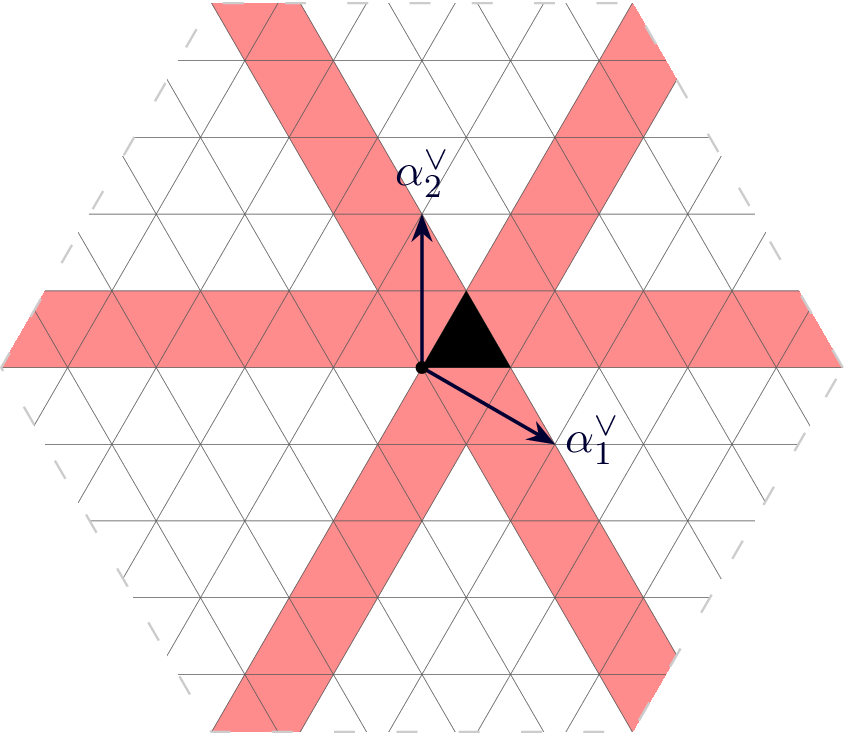


 Open access

