Events such as the terrorist attacks of September 11, 2001, Hurricane Katrina, and the H1N1 pandemic influenza have made disaster planning and preparedness a priority for health care providers. Preparedness is of particular importance when caring for special needs patients such as chronic kidney disease patients, who require routine dialytic therapy. There are 341 000 patients receiving dialysis in the United States dependent on this lifesaving treatment.1 Maintaining dialysis through a disaster can be a complex task. Dialysis facilities, like any health care facility, are susceptible to degradation of services from staff absenteeism during a disaster.Reference Counts2, Reference Kopp, Ball and Cohen3 In a small-scale event, it may be possible to bring in staff from other regions, but in a large-scale disaster, especially in the case of a pandemic, resources will be scarce everywhere and alternative staffing plans will be necessary.
Sufficient staffing has become a cause for concern in disaster planning, particularly in pandemic preparedness.Reference Duley4 In a system already experiencing a shortage of health care workers, during a disaster staffing easily could be the limiting factor.Reference Toner, Waldhorn and Maldin5-Reference Lam, Waldhorn, Toner, Inglesby and O'Toole7 Absenteeism has been shown to occur for many reasons during a disaster including caring for children; ensuring family, personal, and pet safety, and finding oneself physically unable to reach the workplace.Reference Toner, Waldhorn and Maldin5, Reference Lam, Waldhorn, Toner, Inglesby and O'Toole7-Reference French, Sole and Byers11 Staffing problems during a disaster can also result from patient surge. After Hurricane Katrina, the number of individuals seeking care overwhelmed the National Disaster Medical System teams serving in the Gulf region.Reference Franco, Toner, Waldhorn, Maldin, O'Toole and Inglesby12 Among chronic diseases end-stage renal disease was identified as a medical management priority because hospitals were ill-equipped to accommodate an increase in people requiring dialysis and many dialysis patients needed emergency transportation to distant locations.Reference Arrieta, Foreman, Crook and Icenogle13 Because a highly trained staff is necessary to run a dialysis facility, insufficient staffing has become a emergency preparedness issue for the dialysis community.Reference Counts2, Reference Kopp, Ball and Cohen3, Reference Kopp, Ball and Cohen14 Staffing problems caused by death or injury of personnel or their family members and property damage have occurred at dialysis facilities, such as after the 1999 Marmara earthquake in Turkey and after Hurricane Katrina.Reference Ellis8, Reference Sever, Erek and Vanholder15 For these reasons, planning for personnel problems is now considered a key part of preparedness planning for dialysis facilities.Reference Counts2
It is unrealistic and impractical to adapt or use the lengthy dialysis technician curriculum for training new staff in a disaster. Training extra staff in advance of an event, or “just in case” training, is costly and consumes resources. In addition, there is the risk of low retention of the information when it is finally needed. Just-in-time (JIT) training is an alternative method of cross-training, in which rapid training is done when the information is most contextual, making it compatible with disaster situations.Reference Leach and Haun16, Reference Schatell17 PReparing Emergency Personnel in Dialysis (PREP-D) is a program that takes advantage of JIT training to prepare nondialysis technician staff to perform basic assistive tasks for dialysis in a disaster, when staff shortage becomes the limiting factor. This program frees up the time of dialysis technician professionals to address more complicated issues.
PREP-D is intended for use in situations in which significant degradation of staffing has occurred. The actual hemodialysis procedure requires the presence and actions of a skilled professional. It cannot be taught in a short time frame without jeopardizing patient care. Instead, PREP-D is structured to train individuals to perform basic treatment processes and basic troubleshooting, including simple but time-consuming tasks such as taking vital signs or being able to recognize concerning symptoms or machine alarms. Because of the importance of maintaining a dialysis patient's vascular access and the skill required to obtain access, it was decided that this would be inappropriate to teach safely in a JIT fashion.
Because the goal of PREP-D is to teach a complex process in a short time, we targeted trainees who already possessed basic knowledge of the following:
• Bloodborne pathogens
• Exposure control
• Basic Occupational Safety and Health Administration standards training
• Kidneys function and the purpose of dialysis
An understanding of the first 3 areas is important for ensuring the safety of both employees and patients. Some knowledge of the kidney and dialysis will decrease training time and ensure that individuals understand why continuity of services is vital for the patients.
With these basic requirements as a guide, a variety of groups may be candidates for training. Freestanding dialysis facilities should be able to use their nontechnician dialysis staff. Many of these individuals may have training in bloodborne pathogens, exposure control, and Occupational Safety and Health Administration standards. In addition, this staff works in the dialysis environment every day, and all of the individuals have jobs that require some knowledge of dialysis or dialysis patients. Dialysis facilities within a hospital have access to other groups in the hospital system that could be trained, such as licensed practical nurses. In a teaching hospital, it may be possible to use clinical-year (third and fourth years) medical students and other students of the health sciences such as nursing and dentistry students. Some trainee groups may come from neither environment. For example, emergency medical technicians and paramedics have the knowledge base for PREP-D and may be excellent candidates.
For this study we chose to train both nontechnician dialysis staff and clinical-year medical students in the PREP-D curriculum. We hypothesized that these 2 groups would be able to demonstrate an acquisition of knowledge related to the performance of dialysis when comparing pretest and posttest scores. A secondary analysis was performed to determine whether either group showed greater improvement on test scores after PREP-D training.
Methods
PREP-D is a collaborative project between the University of Pittsburgh Medical Center, the University of Pittsburgh School of Medicine, ESRD Network 4, DaVita Inc, Fresenius Medical Care, Dialysis Clinic, Inc, and Amgen Inc. A range of dialysis professionals, including dialysis educators, was involved in creating and reviewing the curriculum for PREP-D. After reviewing the contents of dialysis training, we identified the following modules for inclusion in the program:
• Renal Basics
• Principles of the Kidney and Dialysis
• Hemodialysis Devices
• Hemodialysis Procedures
• Troubleshooting
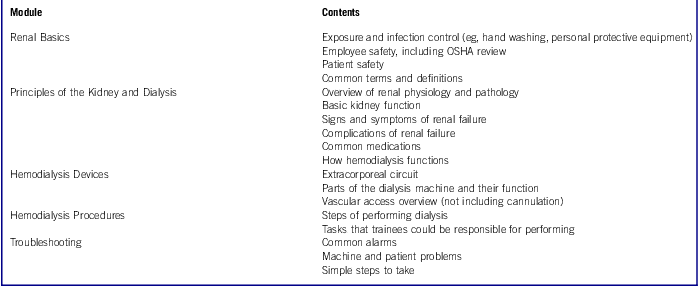
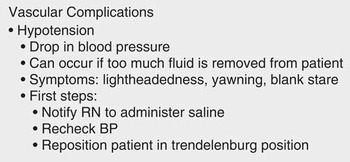
The contents of the individual modules are described in Table 1. Trainees are provided information for the more straightforward tasks. For example, dialysis equipment has many alarms, some of which can be silenced using extremely basic steps, and other alarms that require the assistance of a skilled professional to extinguish. PREP-D teaches basic troubleshooting steps that any trainee can undertake and the identification of problems that are complicated enough to require a trainee to seek assistance from a more highly skilled worker. An example is shown in the Figure.
PREP-D Curriculum
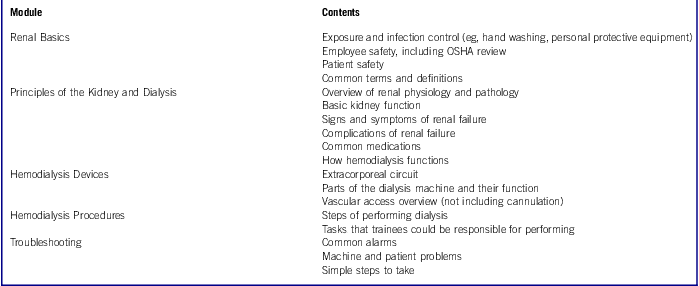
OSHA = Occupational Safety and Health Administration.
Sample slide from the Troubleshooting module of the PREP-D curriculum, providing basic information on hypotension as a complication of dialysis treatment.

The teaching material for PREP-D was developed in conjunction with several experienced dialysis educators. A study was designed to vet the educational ability of the program. A proposal was submitted to and approved by the institutional review board at the University of Pittsburgh. Two populations were selected as study groups: third- and fourth-year medical students and nontechnician dialysis facility employees. Non-technician dialysis employees included any employees at a standalone dialysis facility who did not have detailed previous knowledge of the process of dialysis. These employees ranged from administrators to dieticians. Both groups have very different backgrounds. Medical students have a background in kidney failure and the science behind hemodialysis, and dialysis facility employees have had exposure to the equipment and more practical aspects of dialysis.
Medical students were recruited by e-mail, and dialysis facility employees were recruited by ESRD Network 4. A meal during the program was offered as an incentive for participation. Before each session, consent forms were signed by each participant. Didactic sessions were held in small classrooms. The teaching was performed by the authors of PREP-D and trained dialysis educators. The total teaching time, including time for teaching, testing, and questions, for all 5 modules was approximately 5 hours. Before the start of the training, all of the participants completed a 20-question pretest. After the modules were completed, the participants completed a 40-question post-test. The pretest and posttest were developed using teaching materials from local dialysis facilities and the Core Curriculum for the Dialysis Technician,Reference Schatell17 in collaboration with experienced dialysis educators. The participants were permitted to use training materials during the posttest.
The difference between pretest and posttest scores was compared. The change in score was calculated for each participant. Means, standard deviations, and 95% confidence intervals (CIs) were computed. A paired-samples t test was performed. Calculations were made for the entire group of participants, in addition to separately comparing the change in pretest to post-test scores for medical students and for dialysis facility employees. A power calculation was performed showing that with a study size of 40, a 14% increase in score would be statistically significant. No specific passing score was predesignated to determine proficiency.
Results
A total of 40 participants were enrolled—20 dialysis facility employees ranging from administrators to dieticians and 20 clinical-year medical students. Pretests and posttests were scored from 100%, and the change in score for each participant was calculated. For the entire study population, the mean improvement was 28.9% (95% CI [24.4-33.4]). Improvements for medical students and dialysis employees were compared separately. For dialysis facility employees there was a mean increase in score of 21.8% (95% CI 15.9-27.6). The medical student group had a mean increase in score of 36.4% (95% CI 30.9-41.8). A paired-samples t test was used to calculate significance for the change in participants’ scores. For the study group as a whole and each study group individually, the change in score was significant, with P < .05 for all of the calculations. The raw scores for these groups are shown in Table 2.
Scores by Participant Group

Comment
Although it may be possible to mitigate some of the causes of absenteeism with effective disaster preparedness, it is unlikely that preparedness will completely prevent the degradation of services. To continue dialysis services during a disaster, cross-training employees from outside the usual clinical staffing may be needed.Reference Duley4 Cross-training includes both readiness training, done in advance of an event, and JIT training, used when the need for personnel arises. JIT was chosen as the basis for the PREP-D program.
Cross-training has been shown to have many benefits in health care. It has been in use in medicine since the 1970s, in perinatal units. The concept has spread and has led to programs being developed to train nurses to function in multiple types of units.Reference Nichols and Palmer18-Reference Snyder and Nethersole-Chong22 Cross-training has flourished as a method to cope with changes in a unit's census. This inherent staff flexibility increases overall cost-effectiveness in an institution.Reference Nichols and Palmer18, Reference Riley19, Reference Snyder and Nethersole-Chong22-Reference Kozlowski25
Opponents of cross-training are concerned that this method permits subpar caregiving, because cross-trained nurses are not qualified to fulfill the same roles as the traditionally trained specialized nurse. A poorly created cross-training program allows for this possibility, which only emphasizes how imperative careful program design is to its success. If a cross-training program creates specific roles and performance objectives for new trainees and a support system to help them in their new position, then employees can move beyond a minimal level of competence.Reference Crissman and Jelsma20, Reference Snyder and Nethersole-Chong22, Reference Phillips and Griffin23 In a disaster, these trainees could be used to fill specific gaps in staffing caused by severe levels of absenteeism.
Cross-training emphasizes competence rather than expertise. Expertise is “an expert level of knowledge that is attained with an accumulation of experience over time,” whereas competence is “the ability to meet a certain level of practice as defined by specific criteria.”Reference Nichols and Palmer18 The goal of cross-training is not to create new experts in a field, but to create new skilled workers able to perform a well-defined set of tasks. In planning a cross-training program, specific competency-based outcomes are established.Reference del Bueno, Barker and Christmyer26 These are abilities centered on performance and assessment/evaluation tools for the measurement of accomplished outcomes should accompany them.Reference Nichols and Palmer18, Reference del Bueno, Barker and Christmyer26 Such an evaluation assesses only the specific skills that the trainee will be required to perform, minimizing the use of time while ensuring that the role will be filled appropriately. Following these principles when developing a cross-training program can lead to an efficient teaching method that produces staff with a strong ability to perform a set of tasks.
JIT training is a subset of cross-training aimed at teaching individuals when they are most interested in learning.Reference Leach and Haun16 This is different from traditional teaching, which can be thought of as “just-in-case” teaching. Almost all disaster training is traditional or just-in-case training: Individuals are taught rarely used information in advance just-in-case they need it later.Reference Leach and Haun16 If a long period elapses between teaching and use, then this leads to low retention of information. JIT training is an approach targeted to these types of topics, by training the individual when the information is useful.Reference Leach and Haun16
The convenience of JIT training also has proven useful in disasters, in which by virtue of the circumstances, preparation time is often limited. Because JIT training is designed to match educational efforts to the immediate needs of the individuals or organizations, it minimizes the use of both resources and time. After the 2004 earthquake and tsunami that devastated parts of Southeast Asia, many relief workers were needed, but little time was available for training. Project HOPE was limited to 1 full day of predeployment training for all of the relevant topics and 1.5 hours to train personnel in all of the anticipated mental health issues.Reference Benedek and Ritchie27 Mental health professionals developed a JIT training program, which was found to be a useful adjunct to pre-deployment education.Reference Benedek and Ritchie27
The need to create and distribute information rapidly has further strengthened the place of JIT training in disaster management. With both the severe acute respiratory syndrome outbreak in 2003 and Hurricanes Katrina and Rita in 2005, there was an unanticipated need for educational materials.Reference Chotani, LaPorte, Linkov, Dodani, Ahmed and Ibrahim28, Reference Linkov, Ardalan and Dodani29 In all of these situations, the University of Pittsburgh's Supercourse offered downloadable lectures containing the most critical information.Reference Chotani, LaPorte, Linkov, Dodani, Ahmed and Ibrahim28, Reference Linkov, Ardalan and Dodani29 In the case of the severe acute respiratory syndrome outbreak these lectures provided the most recent information to health professionals during a time of great confusion caused by the global outbreak of an unfamiliar disease.Reference Chotani, LaPorte, Linkov, Dodani, Ahmed and Ibrahim28
JIT training has a strong foundation in adult education theory. When teaching adults, the contextual relevance of the information is important, with retention being highest when information is relevant to the present situation.Reference Nichols and Palmer18 The proximity of JIT training to the time of information use conforms well to this ideal. In the previously described examples, JIT training was used immediately in advance of or in response to a disaster. JIT training also has been used in a more integrated fashion, further increasing the contextual relevance of the information. Kahn etal developed TEMPO,1 a JIT training program for radiologists to earn continuing medical education credits.Reference Kahn, Santos, Thao, Rock, Nagy and Ehlers30 The software was designed to present the radiologist with the opportunity to do a short module relevant to his or her present case.Reference Kahn, Santos, Thao, Rock, Nagy and Ehlers30, Reference Kahn, Ehlers and Wood31 This highly contextual model was well received by radiologists as an easy-to-use, relevant program that worked well for continuing medical education.Reference Kahn, Santos, Thao, Rock, Nagy and Ehlers30
JIT training has been used to train new staff for specific medical service during a disaster. Denver Health worked with the Department of Health and Human Services’ Office of Public Health Preparedness and Response and the Agency for Healthcare Research and Quality to create Project XTREME: Model for Health Professionals’ Cross-Training for Mass Casualty Respiratory Needs.32 The project objective was “to develop, implement, and evaluate a model to cross-train non-respiratory therapy health care professionals in providing basic respiratory care and ventilator management in the event of a mass casualty disaster resulting in a surge of patients needing mechanical ventilation.”32 The group used the principles of cross-training and JIT training to create a curriculum and evaluation tools available for distribution on DVD. The program requires a total of 90 minutes to view the DVD and complete the tests, but it can be done in a flexible time frame.32 Project XTREME was pilot tested on a variety of health care professionals, including respiratory therapy students, internists, nurses, physician's assistants, nurse practitioners, veterinarians, and physical therapists.32 After viewing the DVD, subjects completed the competency tests, which included both questions and skills testing. When tested, each group scored between 83% and 100%. This program served as a model for the development of the PREP-D training program.
PREP-D was designed to be taught in a JIT fashion. The training program contains a large amount of information. The study participants demonstrated significant short-term retention of this information, with a mean test score improvement of 28.9% (95% CI 24.4-33.4). The results demonstrate that this training program could be a way to train individuals to supplement the workforce in a dialysis facility during a disaster. Ideally, this course would be taught by a dialysis educator; however, because it is a fairly basic program and detailed in its layout, it also could be taught by an experienced dialysis nurse. Participants are taught basic, specific information and should emerge from the training program with an understanding of how to perform basic but important and potentially time-consuming tasks. Trainees are used primarily to take vital signs, obtain pre- and posttreatment weights, and monitor patients receiving dialysis. In speaking with dialysis technicians, they felt that it would be extremely helpful to have trainees perform simple tasks and provide the technicians with the time to perform the skilled tasks such as cannulation of fistulas and grafts.
There was a difference between the mean increase in score for the dialysis facility employees and the medical students— 21.8% (95% CI 15.9-27.6) and 36.4% (95% CI 30.9-41.8), respectively. There may be several reasons for this gap. A difference exists in the educational background between the 2 groups. Medical students have a background in science and medicine, which is likely the more complex material within the program. In addition, medical students are by definition still in training and are primed to learn. Regardless, both groups improved significantly on their posttest scores as compared with their pretest scores.
Some adjustments and refinements need to be made before deploying PREP-D in practice. Quick reference guide sheets will be developed that trainees can reference onsite at the dialysis facility. These guide sheets will be included on the same DVD as the module presentations. In addition, guidelines will be developed for the practical portion of instruction. Presently, PREP-D is informational, with no practical learning session. Practical time was not included because of the high variability of dialysis machines. There is not a reasonable “standard” machine on which to train individuals. PREP-D, however, would put participants in a position to transition easily from informational learning to a short period of practical training at the individual facility. The program contains universal information about the parts of a dialysis machine that should allow individuals to apply the knowledge to individual machines.
From an implementation perspective, the fact that individuals who are not officially certified in the field would be providing care may be a limitation. Although these individuals will not be certified technicians, provisions in state and federal laws allow for flexibility in the delivery of medical care during a disaster. The most recent instance was during the H1N1 pandemic. A national emergency was declared in October 2009, “enabling—if warranted—the waiver of certain statutory Federal requirements for medical treatment facilities.”33 The premise is based on the Social Security Act (42 USC ch 7), which allows the waiver of certain requirements for health care facilities if there is a declaration of a public health emergency and a presidential declaration of an emergency or major disaster.33 Although the situation of emergency staffing for a dialysis facility has not been addressed specifically, there is a significant precedence for exceptions to standard medical care being allowed. This proviso being practically applied, facilities will need to take note of local and federal laws, in addition to ongoing declarations before enacting PREP-D.
Conclusions
PREP-D is a JIT training program that will emergently supplement the dialysis workforce during a disaster. In pilot tests of the program, study participants gained a significant amount of knowledge about dialysis, which was demonstrated by improved test scores in the short term. This knowledge provides the groundwork for them to be able to function in a dialysis facility. Refinements need to be made to PREP-D before it is deployed, but it holds considerable promise.
Author Disclosure
Ms Stevenson is an employee of ESRD Network 4; the other authors report no conflicts of interest.
Published Online: April 28, 2011. doi:10.1001/dmp.2011.34
Acknowledgments
The authors thank DaVita Inc, Fresenius Medical Care, Dialysis Clinic, Inc, and Amgen Inc for assistance in developing the content of the PREP-D program modules, and ESRD Network 4 for providing materials and facilities for training study participants.