IDIOM COMPREHENSION IN FIRST GRADERS
The interest in studying idioms arises from the features that characterize these expressions: (a) often they are ambiguous sentences that have both a literal and a figurative meaning which significantly differ from each other (e.g. consider the literal and figurative meaning of the idiom ‘to break the ice’); (b) they are conventionalized expressions, shared by the members of the linguistic community and are represented in the mental lexicon; and (c) as such they have to be acquired by children as part of the linguistic repertoire (Levorato & Cacciari, Reference Levorato and Cacciari1992; Levorato, Reference Levorato, Cacciari and Tabossi1993). Despite the fact that these expressions are very common in both in oral and written language (for details, see Nippold & Rudzinski, Reference Nippold and Rudzinski1993), children's ability to comprehend and use them develops during their school years, when they are already competent speakers, whereas children younger than seven tend to interpret them literally. Idiom acquisition, then, is a long lasting and complex process: it is presumably for this reason that the study of the processes underlying idiom acquisition in children, which began in the 1970s (Lodge & Leach, Reference Lodge and Leach1975), is still a subject which arouses interest.
Idiom acquisition is based on a variety of abilities, different in nature and complexity, involving cognitive, linguistic and pragmatic competence. Various factors affecting developmental changes in idiom comprehension have been identified, the most important of which are familiarity, semantic analyzability and context.
Familiarity with idioms refers to the frequency with which idioms occur in communication. The ‘language experience hypothesis’ states that idioms which occur frequently in the language are easier for children to understand than less frequently occurring ones (Nippold & Rudzinski, Reference Nippold and Rudzinski1993; Nippold & Taylor, Reference Nippold and Taylor2002; Nippold, Moran & Schwartz, Reference Nippold, Moran and Schwarz2001). Certainly, the opportunity to encounter an idiomatic expression is an important factor, but researchers agree that exposure per se is not sufficient to explain its acquisition.
The semantic analyzability, or the degree of transparency, of idioms can account for the ease with which they are understood. This aspect refers to the similarity between the literal meaning of the constituents and their figurative meaning (Cacciari & Levorato, Reference Cacciari and Levorato1998; Gibbs, Reference Gibbs1991; Levorato & Cacciari, Reference Levorato and Cacciari1999; Nippold & Rudzinski, Reference Nippold and Rudzinski1993).
The ability to use linguistic context has been shown to be the factor which accounts most for children's performance in idiom comprehension: it has been consistently shown that idiomatic expressions are better understood when embedded in informative contexts than when they are presented out of context. The first evidence emerged in the 1980s (Ackerman, Reference Ackerman1982; Cacciari & Levorato, Reference Cacciari and Levorato1989; Gibbs, Reference Gibbs1987) and more recent studies have also shown interest in this factor (Levorato & Cacciari, Reference Levorato and Cacciari1992, Reference Levorato and Cacciari1995). In order to interpret an idiom correctly, the child must be able to look for the contextual information necessary to construct a coherent semantic representation of the text and to activate the meanings associated with the idiomatic string in the light of its context. This is the main assumption of the Global Elaboration Model (henceforth GEM, Levorato & Cacciari, Reference Levorato and Cacciari1995), which proposes that: (a) the acquisition of figurative language occurs parallel to the acquisition of the ability to process language in general rather than depending on specific mechanisms; and (b) idiom interpretation is based on the processing of the complete textual information into which it is inserted: when a coherent semantic representation of the text is constructed, the idiomatic meaning can be recognized. Young children fail to comprehend idioms because they process the text word by word, rather than searching for a global and coherent meaning of the whole linguistic context and therefore, in the first phase of acquisition, idioms are interpreted literally (Abkarian, Jones & West, Reference Abkarian, Jones and West1992; Levorato & Cacciari, Reference Levorato and Cacciari1992). In the course of their development, children set aside this exclusively literal approach and develop more mature forms of processing: the semantic information conveyed by the text/discourse in which the idiom is embedded induces a search for a figurative meaning in order to integrate incoming information with both the previous text/discourse and general knowledge (Cacciari & Levorato, Reference Cacciari and Levorato1998). For this reason, idiomatic expressions are a good case study for the analysis of the relationship between the ability to interpret non-literal sentences and text comprehension skills; as also noted in Nippold et al. (Reference Nippold, Moran and Schwarz2001), their comprehension requires both that word level and sentence level meanings be combined and that contextual information be exploited in order to make the inferences necessary to comprehend an idiom's meaning.
Whereas until the 1990s studies focused primarily on factors which favour idiom comprehension, more recent research has turned its attention to individual differences and the relationship between idiom comprehension and other linguistic abilities. The relationship between idiom comprehension and text comprehension is considered particularly interesting in the light of the importance of processing of the linguistic context. In primary school children this relationship has been studied by Levorato, Nesi & Cacciari (Reference Levorato, Nesi and Cacciari2004), who showed that children who were more advanced in text comprehension also gave more figurative interpretations of idiomatic expressions embedded in brief stories than children who had poor text comprehension skills. This relationship was further strengthened by the study which investigated a relation between text comprehension and idiom production (see Nesi, Levorato, Roch & Cacciari, Reference Nesi, Levorato, Roch and Cacciari2006, for details). A previous study by Nippold et al. (Reference Nippold, Moran and Schwarz2001) found that preadolescents' ability to comprehend idioms was related to both written and oral text comprehension skills. Taken together, these recent findings suggest that differences in idiom comprehension can be accounted for by differences in children's text comprehension skills. This is coherent with what Oakhill & Yuill (Reference Oakhill, Yuill, Cornoldi and Oakhill1996) state about less-skilled text comprehenders, who fail to ‘go beyond what is explicitly stated, to link up ideas within the text, and to bring their general knowledge to bear on their understanding of it’ (p. 69).
The most recent study by Cain, Oakhill & Lemmon (Reference Cain, Oakhill and Lemmon2005) has extended this finding through an analysis of the role of other skills: reading and vocabulary. Cain et al. (Reference Cain, Oakhill and Lemmon2005) found that fourth graders who had good text reading comprehension skills were able to identify the meaning of semantically non-analyzable idioms embedded into stories, whereas this ability was scarce among poor text reading comprehenders. This study has moreover demonstrated that the relationship between idiom and text comprehension is robust even when children's reading abilities and vocabulary are controlled. This result suggests that neither poor word reading skills nor scarce knowledge of vocabulary are responsible for the relationship between idiom and text comprehension. Rather it confirms the theory that higher level cognitive and linguistic processes are involved and that good text comprehenders are more able than poor ones to benefit from contextual information to disambiguate idiomatic expressions.
In the light of these findings, the present investigation furthers the analysis of the relationship between idioms and text comprehension, making two new contributions. The first contribution concerns the use of the longitudinal method: This is the first longitudinal study aimed at identifying the developmental relationship between text and idiom comprehension. A group of children who scored as less-skilled text comprehenders on a test when they were six- to seven-year-old first graders were retested on text comprehension and idiom comprehension eight months later. We expected that if these two abilities were connected, only children who improved in text comprehension would improve in idiom comprehension as well.
Participants in this study were younger than those who participated in earlier studies; previous research considered children who had already consolidated their text comprehension abilities (second graders and beyond). There is no evidence of a relationship between text and idiom comprehension in children who are in the early phases of literacy acquisition, when a literal interpretation is preferred (Abkarian et al., Reference Abkarian, Jones and West1992; Levorato & Cacciari, Reference Levorato and Cacciari1992). The hypothesis of the current investigation can be specified as follows: the tendency to interpret idioms literally is much stronger among less-skilled text comprehenders, whose processing of the text is shallow, than skilled text comprehenders, who are able to search for a coherent meaning of the text.
The second new contribution of this study is that it is the first to take into consideration the role of sentence comprehension as a possible mediating factor of the relationship between text and idiom comprehension, so we have analyzed the relations between text and sentence on one hand and between idiom and sentence on the other hand. As already mentioned above, Cain et al. (Reference Cain, Oakhill and Lemmon2005) showed that lexical knowledge is not involved in the relationship between text and idiom comprehension.
Idioms are sentences, albeit ambiguous ones, and the processing of these sentences must take place whether they are interpreted literally or figuratively (on the role of syntactic competence in idiom comprehension, see Hamblin & Gibbs, Reference Hamblin and Gibbs1999; Papagno & Genoni, Reference Papagno and Genoni2004; Peterson, Burgess, Dell & Eberhard, Reference Peterson, Burgess, Dell and Eberhard2001). It is thus possible that children who are more skilled in understanding literal sentences are also more skilled in understanding figurative meanings. To our knowledge, the only other study to investigate the relationship between idioms and sentence comprehension was carried out by Norbury (Reference Norbury2004), who analyzed a series of linguistic and non-linguistic skills associated with idiom comprehension in children having different types of linguistic impairment and who found that sentence processing and idiom comprehension are related.
Moreover, the comprehension of sentences is obviously a prerequisite to understanding a text, and thus children who are more skilled in sentence comprehension might also be more skilled in text comprehension. It is true that several studies have pointed out that text comprehension difficulties are not always related to deficits in more basic linguistic processes (Cain & Oakhill, Reference Cain and Oakhill1999; Stothard & Hulme, Reference Stothard and Hulme1992), and that studies on syntactic skills are not in agreement on their role in reading comprehension: Willows & Ryan (Reference Willows and Ryan1986) found that syntactic knowledge was related to reading comprehension whereas Bowey & Patel (Reference Bowey and Patel1988) found that syntactic ability did not account for significant variance in reading comprehension, to mention only two.
In an analysis of the relationship between text comprehension and idiom comprehension, it is therefore opportune to consider the role played by literal sentence comprehension in that it is possible that the relationship, found in various studies, between text and idiom comprehension may be mediated by an underlying ability to process sentences.
We agree with Oakhill & Yuill (Reference Oakhill, Yuill, Cornoldi and Oakhill1996) in their conclusion that difficulties in text comprehension are less linguistic in nature than difficulties in inference-making and in monitoring of the comprehension process. If this is true, sentence comprehension should play a lesser role in idiom comprehension than text comprehension does since idiom comprehension is more dependent on the ability to process a text adequately, on inferential capacity and on text comprehension monitoring. We also prefer this hypothesis because it is in agreement with the GEM, a model which has proven to be able to explain idiom acquisition: it assumes that the search for the global coherence of a text is the process underlying the understanding of idioms.
A longitudinal analysis of idiom comprehension skills and literal sentence comprehension skills in children whose text comprehension improves over time will allow the direction taken by the developmental changes of the linguistic skills examined here to be analyzed. In short, the investigation carried out here evaluated the comprehension of idiomatic and literal sentences in children who had different levels of text comprehension skills at two different moments: at six to seven years of age (first graders – Phase 1) and eight months later (second graders – Follow-up). The hypothesis that an improvement takes place in children's linguistic skills when they pass from first to second grade is legitimated by various evidence of improvements in verbal and literacy skills (Palladino, De Beni & Cornoldi, Reference Palladino, De Beni and Cornoldi1995). Moreover, it is reported in the literature that at the end of the second grade, a third of the children who had previously had difficulty with reading and comprehension had already improved these skills and that the differences between those who improved and those who did not were maintained over time (Greenfield Spira, Storch Bracken & Fischel, Reference Greenfield Spira, Storch Bracken and Fischel2005).
PHASE 1: IDIOM COMPREHENSION IN SIX-YEAR-OLD FIRST GRADERS, IN RELATION TO TEXT AND SENTENCE COMPREHENSION
METHOD
Participants
One hundred and seventy-two Italian first graders aged from 6 ; 4 to 7 ; 5 (82 females and 90 males) attending public elementary schools in the north of Italy were administered a standardized test which evaluated text reading comprehension skills, the MT test (Cornoldi & Colpo, Reference Cornoldi and Colpo1998) (for a description of the test, see the section ‘Materials and procedure’). This test led to the identification of 29 children who had poor text reading comprehension. Their teachers were interviewed and reported that none of these children was dyslexic nor had cognitive impairments or severe learning difficulties. From the remaining group of 143 children, 23 skilled comprehenders of the same age (and standard deviation) as the poor comprehenders were selected: for both groups the mean age was 6 ; 9 and standard deviation 4 months. The skilled comprehenders can be considered a control group matched for chronological age with the group of less-skilled comprehenders.
Materials and procedure
Evaluation of text comprehension
Participants were administered a standardized test specifically designed for assessing text comprehension in Italian school-age children (the MT Test, Cornoldi & Colpo, Reference Cornoldi and Colpo1998). The MT Test has different standardized versions, one for each grade of the Italian mandatory school. Its validation is based on a wide population of Italian children (5700 children) and it is a sensitive test for determining the different levels of skill in reading comprehension; it is extensively used with Italian children; the test–retest correlation ranges from 0·57 to 0·70.
The test provides for each participant to read a one-page story and then to answer multiple-choice questions concerning the story content, which may be either explicitly or implicitly stated in the text. There are no time limits, and to minimize the memory load children are allowed to return to the text whenever they want while answering the multiple-choice questions. The text reading comprehension test was administered, in accordance with the standard administration procedure, collectively.
In Phase 1, the children were presented with the version of the test appropriate for the end of the first year of primary school. A short story is followed by a multiple-choice task consisting of ten questions, each having three options, which in five cases were verbal and in the other five cases were presented through pictures. The score consisted of the sum of the correct answers and for the test appropriate to first graders ranged from 0 to 10.
According to the normative data of the text comprehension test, children's performance can be divided into four levels of text comprehension, depending upon the score they obtained on the test: very poor (score 0–2), poor (score 3–4), adequate (score 5–7) and good (score 8–10). The first two groups are pooled together in the present study and constitute the group of less-skilled comprehenders. On the other hand, skilled comprehenders are those children who, on the basis of the criteria of the MT test, were categorized as adequate and good text comprehenders. These categories refer to general differences in text comprehension and are not diagnostic of word reading skill or learning disabilities.
Normally, the proportion of less-skilled comprehenders is about 25% among first graders, and therefore a large number of young children were presented with the test in order to find the necessary number of less-skilled comprehenders; 16·9% of the whole group of first graders who were administered the MT test were identified as less-skilled comprehenders.
Participants were not evaluated with respect to their decoding abilities. For written Italian, the crucial aspect to test decoding abilities is speed: the text comprehension test we used had no time limits and the children were allowed to read at their own pace; this procedure eliminated any advantage to children who are faster in decoding. Children who were very slow in decoding written texts, however, were excluded from the group of participants – only those protocols that were completed within the time employed by 90% of the participants were considered valid. Moreover, an additional reason for not taking speed in reading into consideration was that any differences in the reading abilities of the two groups were not crucial for the idiom comprehension task, which was presented orally (see below for a description of the task): there is no reason to hypothesize a relationship between reading and the comprehension of an orally presented test.
No standardized text for evaluating listening comprehension presently exists for native Italian speakers, and the MT test is the only standardized battery for the evaluation of the written text comprehension of Italian speakers. However, various studies have found significant correlations between listening and reading comprehension (Nation & Snowling, Reference Nation and Snowling1998; Savage, Reference Savage2001).
Idiom comprehension
The task used to measure idiom comprehension has been used in several studies on idiom acquisition (Cacciari & Levorato, Reference Cacciari and Levorato1989; Levorato & Cacciari, Reference Levorato and Cacciari1992, Reference Levorato and Cacciari1995) and has proven to be sensitive to the developmental changes which occur in the course of idiom acquisition (for details on the role of different tasks on idiom comprehension, see Levorato & Cacciari, Reference Levorato and Cacciari1995). It consisted in reading to each child a set of stories ending with an idiom, followed by a multiple-choice task, which has the advantage of not being influenced by language production skills involved in other types of tests such as paraphrase. Twelve idioms were chosen from among a wide class of Italian idioms on the basis of a procedure consolidated in previous studies (Levorato et al., Reference Levorato, Nesi and Cacciari2004), which includes the following four steps:
(1) A list of ambiguous idiomatic sentences was identified within a wide corpus (Pittano, Reference Pittano1992) that had both an idiomatic and a literal meaning, such as ‘to break the ice’.
(2) From this list, idioms were chosen that elementary school teachers judged as being expressions that children encounter quite frequently, but not extremely frequently, in storybooks and TV programmes (Levorato & Cacciari, Reference Levorato and Cacciari1992). According to this criterion, expressions such as ‘give a hand’ were excluded because their figurative meaning is extremely familiar.
(3) The remaining idioms were presented to a group of fourth graders, who were asked to evaluate how often they encountered each of them (never, sometimes, quite frequently, frequently). The idioms judged as having been encountered ‘quite frequently’ or ‘frequently’ by 30–70% of these children were identified.
(4) Lastly, a choice was made from the remaining idioms of those which in previous studies have been shown to have a discriminating power, being understood in their figurative meaning to a different extent by children of different ages, i.e. they had never obtained a ceiling nor a floor effect in the choice of correct answers (See Appendix A for the list of idioms and their English translations).
Given the importance of the linguistic context for the interpretation of their figurative meaning, idioms were presented embedded within short stories in which the literal interpretation was nonsense. For each idiom, two stories (Story A and B) were used which had already been used in previous studies (Levorato et al., Reference Levorato, Nesi and Cacciari2004). The stories, which had an average number of 66 words (s.d.=7·7) were written according to the schema proposed by story grammar – a setting followed by an episode – where the last sentence of each story, which expressed the consequence of the sequence of actions, consisted of the idiom (for an example, see Appendix B). Each idiom was presented to all of the children. In Phase 1, half of the participants were presented with Story A and half of them were presented with Story B; in the follow-up study, children were presented with the same idioms but in different stories. This procedure avoided the problem that differences in the children's understanding of the idioms was due to a difference in the linguistic contexts. As previously stated, the idioms used were ambiguous sentences having both a literal and an idiomatic interpretation, such as ‘to cry over spilt milk’ and ‘to break the ice’, but in the stories only the idiomatic interpretation was plausible; idioms could be interpreted in the figurative meaning if the global meaning of the story had been understood.
Each story was followed by a question: ‘What does it mean that he/she did (or was) … idiom?’ (e.g. ‘What does it mean that he broke the ice?’). Children could choose from among three answers: (a) an idiomatic interpretation of the string (idiomatic answer); (b) a paraphrase of the literal meaning (literal answer); and (c) a response referring to an aspect of the context presented by the story but neither literal nor idiomatic (e.g. an antecedent of the character's behaviour: filler answer). The choice of the idiomatic answer shows that the figurative meaning is recognized as appropriate in the context. Often idioms have a fuzzy meaning and thus their meaning has to be adapted each time to the context and the communicative intentions of the speaker. Therefore, even if the expression is familiar, it has to be integrated into the semantic representation of the story. A literal choice shows that a shallow processing of the text is performed and that the linguistic information undergoes a piece by piece analysis. The choice of the filler shows that the literal meaning is recognized as inappropriate but nevertheless the global meaning of the story is not grasped.
The stories were read aloud by an experimenter while the child was allowed to follow a printed version. At the end of the story, the experimenter read both the question and the three answers and the child was invited to choose the one s/he believed to be most appropriate. The experimenter marked the answers chosen by each child on the response sheet.
Sentence comprehension
Sentence comprehension was tested by using a standardized test, ‘Assessment of linguistic comprehension’ (Rustioni, Reference Rustioni Metz Lancaster1994), for Italian children from three to eight years old. Its validation is based on a wide population of Italian children (2622 children) sampled in different areas of Italy. This test is similar to other tests which are used in most studies on children's linguistic abilities, such as TROG (Bishop, Reference Bishop1989), and consists of a list of sentences that include the most important linguistic structures: gender, number, prepositions, active sentences, future tenses, passive sentences, relative clauses, time clauses, negatives, double negatives, reflexives, adversatives and causatives. For each sentence the child has to choose one of four pictures; for example, for the sentence ‘The page of the note-book, which is on the table, is dirty’ the four pictures showed the correct image, a dirty page on a table, a page on a dirty table and a dirty page falling from the table. The test is formed from eight protocols which vary according to the age of the children. The same protocol, consisting of sixteen sentences, was used both in Phase 1 and in the Follow-up study and is appropriate for children from six to eight years of age. On the basis of the normative data of the test, the sum of correct answers is transformed into a corresponding weighted score, which varies according to the child's age. These standardized scores have been determined on the basis of the performance of the normative sample of typically developing children on each sentence. Thus, more difficult structures, such as relatives, have a higher weighted score than simpler structures such as future tense. The standardized scores, ranging from 1 to 100, result from the sum of weighted scores for each correct answer.
RESULTS
The group of less-skilled comprehenders had a mean score of 3·14 (s.d.=0·83) in the MT test whereas the group of skilled text comprehenders obtained a mean score of 7·96 (s.d.=1·5). The first analysis was aimed at the type of answers chosen by children in the idiom comprehension test according to their text comprehension level.
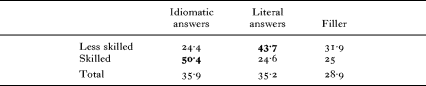
A log-linear saturated model was computed on the frequencies of idiomatic, literal and filler answers (factor Type of answer) given by less-skilled and skilled text comprehenders (factor Level of text comprehension). The association between the two factors yielded significance (χ2(2)=47·61, p<0·0001). The analysis of the parameters showed that children characterized by different levels of text comprehension differed as to their choice of both idiomatic and literal answers: skilled text comprehenders choose the idiomatic answers more than expected (z=6·52, p<0·001) whereas less-skilled text comprehenders choose the literal answers more than expected (z=4·55, p<0·001). The two groups did not differ in their choice of fillers. Table 1 shows the percentages of idiomatic, literal and filler answers chosen by less-skilled and skilled text comprehenders.
Percentages of idiomatic, literal and filler answers chosen by less-skilled and skilled text comprehenders (bold type shows the answers in which the two groups differ)

The results of this analysis demonstrate that first graders with different text reading comprehension skills differ in their ability to interpret figurative expressions: skilled comprehenders prefer the idiomatic interpretation while the less-skilled ones prefer the literal interpretation.
The next analysis was intended to verify if the relation between text and idiom comprehension is mediated by linguistic abilities that are at a lower level in linguistic processing, namely sentence comprehension. In the sentence comprehension test, less-skilled and skilled comprehenders obtained mean scores of 43·7 (s.d.=9·62) and 52·2 (s.d.=14·68) respectively. Less-skilled and skilled comprehenders were compared through a t test for independent samples which showed that skilled text comprehenders process literal sentences better than their peers with less developed text comprehension abilities (t(50)=2·5, p<0·05). Since the children who participated in this study had no specific impairment, their linguistic abilities progressed uniformly and children who tend to have lower performance in one test congruently have lower performance in other linguistic tests.
A fixed order multiple regression was run to identify the contribution of text and sentence comprehension to performance on the idiom comprehension task. The dependent variable was the percentage of idiomatic responses; in Model 1, the score obtained in the MT text comprehension test entered and in Model 2 also the score at the sentence comprehension test entered.
Model 1 explains 31·8% of the variance. The factor Text comprehension significantly predicts performance on the idiom comprehension task (β=0·57; t=4·8, p<0·001). Model 2, in which sentence comprehension was also entered as predictor, does not explain further variance (R 2-change=0·008).
In order to test the real contribution of sentence comprehension independently of the contribution of text comprehension, an additional fixed order regression was computed. Again, two models were compared. In Model 1, the sentence comprehension entered as first predictor and in Model 2 text comprehension entered after sentence comprehension. The factor Sentence comprehension explains 8·2% of variance. Model 2, in which text comprehension is also inserted, 32·6% of variance was explained. Thus, also in this latter regression analysis, the contribution of text comprehension ability is clearly more significant to explain idiom comprehension. Tables 2a and 2b show the results of the two regression analyses.
Results of the fixed order regression analysis on idiomatic answers: first analysis

Results of the fixed order regression analysis on idiomatic answers: second analysis

This pattern of results is consistent with a series of hypotheses: (a) that idiom comprehension is facilitated if text comprehension abilities are well developed; (b) that the same type of abilities are involved in both idiom and text comprehension; and (c) in particular, that the ability to construct a coherent semantic representation of complex linguistic information, such as a text, is at the basis of the ability to search for the figurative meaning of an ambiguous expression embedded within a context. The follow-up study on children who were less-skilled comprehenders should shed more light on the nature of the relation between idiom and text comprehension.
THE FOLLOW-UP STUDY: IDIOM COMPREHENSION IN SEVEN-YEAR-OLD SECOND GRADERS IN RELATION TO TEXT AND SENTENCE COMPREHENSION
In this longitudinal study we investigate the relationship between text and idioms, focusing on the relation between an improvement in text comprehension and the development of figurative language competence. The relationship between these two abilities has been identified in Phase 1 of the study. We can strengthen this result if we find that improvement in one of these abilities is accompanied by improvement in the other. This is true even more so if the improvement of the two skills is unaccompanied by improvement in other aspects of the language, namely sentence comprehension. If this ability does not significantly improve in the passage from Phase 1 to the Follow-up study, while the other two skills – text and idiom comprehension – improve in parallel, then it means that the improvement does not involve general language ability.
The rationale of the Follow-up study was that since the children in Phase 1 with low performance in text reading comprehension had normal development, at least some of them would improve their linguistic abilities, as had also been reported in previous research (Greenfield Spira et al., Reference Greenfield Spira, Storch Bracken and Fischel2005; Palladino et al., Reference Palladino, De Beni and Cornoldi1995). If the relation between idiom and text comprehension is maintained throughout the various phases of development, as shown in other studies (Cain et al., Reference Cain, Oakhill and Lemmon2005; Levorato et al., Reference Levorato, Nesi and Cacciari2004; Nippold et al., Reference Nippold, Moran and Schwarz2001), then it may be hypothesized that children who improve their text comprehension will improve their idiom comprehension as well.
The Follow-up study involved children who yielded low scores on the text comprehension test in Phase 1: These were 29 less-skilled comprehenders who at the time of the Follow-up study, which took place eight months after Phase 1, were attending the second grade of primary school.
As far as idiom comprehension is concerned, we expected that all children would show an improvement; in fact, the test for idiom comprehension was not upgraded and we predicted an increase in idiomatic choices due both to the children's exposure to idiomatic expressions and to their cognitive and linguistic development. Nevertheless, we expected that improvement in idiom comprehension would be greater in children who improved in text comprehension than in children who did not. Moreover, we wanted to explore whether an improvement in literal sentence comprehension might occur parallel to an improvement in text comprehension and if so, its relationship with idiom comprehension.
METHOD
Participants
Twenty-nine less-skilled comprehenders from Phase 1 participated in the Follow-up study. The mean age was 7 ; 7; standard deviation was 4 months.
During the period between Phase 1 and the Follow-up, the children attended normal school activities and did not receive any special instruction either in idiom meanings or in text comprehension. The teachers did not know the focus of our study nor that these children were chosen to participate in the study because of their poor text comprehension skills. Therefore, in the event an improvement was found in their text comprehension abilities or in idiom comprehension, it should be ascribed only to their spontaneous development or normal literacy activities.
Material and procedure
Three tasks were aimed at evaluating children's understanding of idioms, texts and sentences. The text comprehension test was the same as the one adopted in Phase 1 (Cornoldi & Colpo, Reference Cornoldi and Colpo1998), but the form appropriate for second graders was used, which included the same number and type of questions. The sentence comprehension test was the same one as used in Phase 1 but the weighted scores were appropriate to seven-year-olds. For the evaluation of idiom comprehension, the participants were presented with the same idioms that they had seen in Phase 1; they were embedded, however, in different contexts: children who had been presented with stories A were now presented with stories B and vice-versa (see the description in ‘Materials and procedure’ in Phase 1).
RESULTS
The improvement in text comprehension
Children were considered to have improved in text comprehension when they gave at least three more correct answers than they had given in Phase 1, that is to say, when their performance improved by 30% with respect to Phase 1. Fifteen children (51·7%) met this criterion whereas 14 (48·3%) did not. The mean score obtained by children who did not improved was 5·5 (s.d.=1·5) whereas the mean score of children who improved was 7·9 (s.d.=1·1). A t test on the scores obtained by the two groups in Phase 1 indicated that the text comprehension ability was identical.
The improvement in idiom comprehension
An analysis was carried out in order to ensure that the two stories, A and B, did not obtain different performances: a t test compared the proportions of idiomatic answers in the two stories into which the idioms were embedded and no difference emerged.
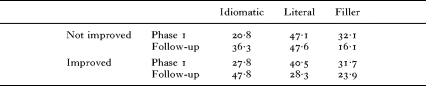
Table 3 shows the percentages of idiomatic, literal and filler answers chosen in Phase 1 and at Follow-up both by children who improved in text comprehension and by those who did not.
Percentages of idiomatic, literal and filler answers in Phase 1 and at Follow-up chosen by children whose text comprehension skills improved and those whose did not

A log-linear saturated model was carried out having one factor between subjects – Improvement (children who improved in the text comprehension test and children who did not improve) – and two factors within subjects – Type of answer (idiomatic, literal and filler) and Time (Phase 1 and Follow-up). The analysis showed that type of answer was significantly associated both with the factor Time (χ2(2)=27·6, p<0·001) and with the factor Improvement (χ2(2)=12·5, p<0·01). The analysis of the parameters showed that:
(a) in the follow-up study, idiomatic answers are more frequent than in Phase 1 (z=5·15, p<0·001) whereas fillers are less frequent than in Phase 1 (z=−3·72, p<0·001).
(b) children who improved and those who did not improve differ both in the choice of idiomatic answers, which are more frequently associated with an improvement in the text comprehension test (z=2·07, p<0·001), and in the choice of literal answers, which are more frequently associated with a lack of improvement in the text comprehension test (z=3·55, p<0·001). This result suggests that an improvement in text comprehension is related to the ability to understand idioms.
Considering the percentages shown in Table 3, it appears that not only children who improved in test comprehension, but also those who did not improve in text comprehension, chose more idiomatic answers in the Follow-up study than in Phase 1 (t(13)=4·1, p<0·01). We argue that this development in the ability to interpret idioms figuratively is due to normal development and regular language acquisition. The increase in the choice of idiomatic answers in children who do not improve in text comprehension was due to a decrease in the choice of fillers, whereas a decrease of literal answers did not occur (47·1% and 47·6% of literal answers at the two times of the study). Moreover, if we consider the number of contextually plausible answers chosen in Phase 1 by children who do not improve in text comprehension (idiomatic plus filler=52·9%) and compare it with the answers chosen in the Follow-up (idiomatic plus filler=52·4%), it clearly emerges that these children performed similarly in the idiom comprehension task in Phase 1 and at Follow-up.
The pattern of the results is different for children whose text comprehension improved. The percentage of idiomatic choices increases because the other two types of answers decrease, with literal choices decreasing the most. This means that these children are more able to identify the appropriate idiomatic meaning and have became more idiomatically oriented by the time of the Follow-up study. An improvement in text comprehension skills was paralleled by an improvement in idiom comprehension.
The improvement in sentence and text comprehension
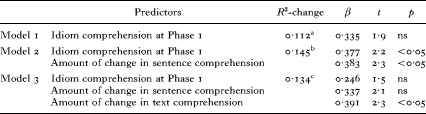
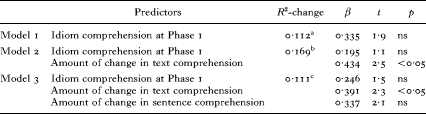
A hierarchical linear regression was run on the percentage of idiomatic answers at Phase 2. The percentage of idiomatic answers at Phase 1 of the study entered as first predictor, followed by the improvement in sentence comprehension and finally by text comprehension. Taken together, the three factors explain 39·2% of variance in idiom comprehension at Phase 2. The results of the analysis are illustrated in Table 4a. As can be seen, sentence comprehension explains 14·5% of variance controlling for idiom comprehension at Phase 1 (Model 2); when the improvement in text comprehension is also considered (Model 3), a further 13·4% of variance is explained, but sentence comprehension is not predictive any more. Therefore, this analysis shows the importance of both sentence and text improvement in determining the improvement in idiom comprehension. In order to consider the role of sentence and text comprehension separately, a second hierarchical regression was performed, changing the order of entrance of the improvement in text and sentence comprehension (see Table 4b). Improvement in text comprehension, partialling out idiom comprehension at Phase 1 (Model 2), explains 16·9% of variance. When improvement in sentence comprehension is also considered (Model 3), a further 11·1% of variance is explained, but again improvement in sentence comprehension plays no role. The two analyses suggest that the improvement in sentence comprehension plays a role in the improvement in idiom comprehension, but this contribution is related to the improvement in text comprehension, which turns out to be the most important factor in explaining the development of the ability to interpret idioms.
Results of the fixed order regression analysis on idiomatic answers at Follow-up: first analysis

a ns.
b F(2, 28)=4·5, p<0·05.
c F(3, 28)=5·4, p<0·01.
Results of the fixed order regression analysis on idiomatic answers at Follow-up: second analysis

a ns.
b F(2, 28)=5·1, p<0·01.
c F(3, 28)=5·4, p<0·01.
DISCUSSION
The primary purpose of this longitudinal study was to determine the relationship between idiom comprehension on one hand, and the comprehension of text and literal sentences on the other hand. The main result was that idiom comprehension is related to text comprehension more than to sentence comprehension, which shows that, in order to understand an idiom, a mere elaboration of literal linguistic information is not sufficient, and it is necessary to integrate the idiom's meaning into a semantic representation of the text/discourse in which it is embedded (Levorato & Cacciari, Reference Levorato and Cacciari1992). This conclusion is in line with previous empirical data (Levorato et al., Reference Levorato, Nesi and Cacciari2004; Cain et al., Reference Cain, Oakhill and Lemmon2005) and with the interpretation proposed by the Global Elaboration Model (Levorato & Cacciari, Reference Levorato and Cacciari1995). In fact, the GEM states that a coherent semantic representation of the text provides the child with the key to interpret the idiom figuratively. In the light of this model, results reported in the literature on the facilitating effect of context can be interpreted. The more coherent the semantic representation of the text is, that is, the richer and more complete the situational model (Kintsch, Reference Kintsch1998), the easier the identification of the figurative meaning of the idiomatic expression is.
The rather weak relationship between the understanding of idioms and the ability to recognize the appropriate meaning of literal sentences is a new result in the literature. Recent studies by Cain et al. (Reference Cain, Oakhill and Lemmon2005) have shown that even when children are matched as far as their lexical competence is concerned, text and idiom comprehension are strongly related; taken together, the results of the current study and that of Cain et al. show that the relationship between text comprehension and idiom comprehension is mediated neither by lexical knowledge nor by sentence processing. There is no question that both lexical knowledge and sentence processing are prerequisites for the comprehension of a text, and it is impossible to conceive of understanding a text without understanding the words and the sentences which compose it. Nevertheless, much more processing is involved in text comprehension than in sentence comprehension. The processing of an isolated sentence requires that each of its constituent words be put into a relation with all other constituents; on the other hand, the comprehension of a sentence in a text is guided by the information which has been previously processed (Kintsch, Reference Kintsch1998). The understanding of the relation between one sentence and the others of the text is precisely the result of an integration process between the sentence meaning and the semantic text representation built up to that point. This process often needs inferential processes and integration processes (Cain, Oakhill, Barnes & Bryant, Reference Cain, Oakhill, Barnes and Bryant2001), especially when ambiguous sentences are encountered. Idioms which have both a literal and a figurative interpretation are the ambiguous sentences we used: This ambiguity made them an interesting linguistic input since, in order to understand their figurative meaning, the child has to go beyond the information conveyed by the constituent words.
A difference between skilled and less-skilled text comprehenders emerged in their ability to recognize the appropriate figurative interpretation. Less-skilled text comprehenders differ from skilled comprehenders in the process of comprehension even when they do not differ in their knowledge of word meanings (Cain & Oakhill, Reference Cain and Oakhill1999) or in their world knowledge (Cain et al., Reference Cain, Oakhill, Barnes and Bryant2001). On the other hand, the difficulties which less-skilled text comprehenders encounter consist in: (a) detecting inconsistencies between information contained in different parts of the text; (b) retrieving relevant knowledge in order to perform elaborative inferences (Cain & Oakhill, Reference Cain and Oakhill1999); (c) recognizing the relevant information, previously presented in the text, that allows a semantic gap to be filled (coherence inferences) (Long & Chong, Reference Long and Chong2001); (d) detecting inconsistencies between textual information and previous knowledge (Hannon & Daneman, Reference Hannon and Daneman2001); and (e) monitoring their processing of the global text rather than performing a partial processing of individual pieces of linguistic information (Barton & Sanford, Reference Barton and Sanford1993). As a consequence of these difficulties, text processing is shallow, and a semantic representation which is not completely coherent is produced. A shallow processing of linguistic information makes it difficult to identify the figurative meaning of semantically ambiguous sentences. The GEM describes the type of linguistic processing of idiomatic sentences by young children as shallow processing (Cacciari & Levorato, Reference Cacciari and Levorato1989): every single piece of information is processed but no search for a global meaning is made. The model of text comprehension proposed by Hannon & Daneman (Reference Hannon and Daneman2001) is coherent with the hypothesis that the difference between less-skilled and skilled comprehenders is based on the degree to which deep processing is performed. When an idiomatic sentence is interpreted literally, a semantic anomaly is produced. The inability to recognize such an anomaly and to search for the contextual cues allowing the identification of the contextually appropriate interpretation is one of the consequences of the difficulties encountered by less-skilled text comprehenders. Detecting the semantic anomaly is just the first step towards recognizing the idiomatic meaning, since further analysis has to be carried out in order to be able to identify which meaning might be appropriate in a given context.
In most cases, skilled text comprehenders were able to identify the idiomatic meaning among the three proposed answers. At the present state of the research, we cannot say that they first recognized the semantic incongruence of the literal interpretation and then figured out what the appropriate meaning was, nor can we maintain that they immediately recognized and accessed the appropriate meaning, bypassing literal processing. Further investigation, especially involving skilled comprehenders, should manipulate the degree of semantic anomaly of the idiomatic expression (degree of semantic analyzability) and the strength of the context (biasing toward an idiomatic interpretation vs. a literal one): this method might allow us to single out the relative contribution of the two factors (semantic analyzability and context) – and to recognize the respective roles of (a) the local analysis of the sentence and (b) the context in inducing an integration of the local meaning into the global representation.
The present study was carried out with first and second graders. According to the GEM (for details see Levorato & Cacciari, Reference Levorato and Cacciari1995), at this age children are more literally oriented because they interpret idioms constituent by constituent and so they have difficulty in going beyond the literal meaning of the idiom. However, on the basis of the results of the present study, we cannot conclude that literal interpretation is simply preferred by first graders and that these children are unable to process ambiguous expressions figuratively. Rather, we argue that the literal interpretation is a function of text comprehension abilities. In other words, the literal interpretation is preferred when text processing abilities are weak. Therefore, even among children in the first phase of their formal literacy acquisition, the ability to understand a text and to construct a coherent representation of the semantic content is a discriminating factor with respect to the ability to go beyond the literal interpretation of an expression that has both a literal and a figurative meaning. It seems that less-skilled comprehenders have difficulty in even recognizing the semantic anomaly of the idiom. In fact, in the present study, two out of the three answers – the idiom and the filler – were semantically appropriate in the context; nevertheless, less-skilled children preferred the literal answer, showing that they simply perform a local processing of the idiomatic sentence, so that for them ‘to break the ice’ means to break a piece of ice.
The Follow-up study on idiom comprehension in children who were less-skilled comprehenders at six years of age showed that an improvement in text reading comprehension, which was observed for some children, was paralleled by an improvement in the understanding of idiomatic expressions. This result strengthens the existing relation between text and idiom comprehension. This relation should be analyzed further in order to study the possible role played by a unitary factor which explains both text and idiom comprehension, presumably a high-level cognitive factor. The inferential processes are an important source of difference between skilled and less-skilled text comprehenders: They are involved both in idiom comprehension and in text comprehension and could be the unitary factor, and therefore further research might also consider these processes.
APPENDIX A
Italian idioms used in the study with English word-by-word and meaning translations
piangere sul latte versato‘to cry over split milk’
fare un buco nell'acqua[to make a hole in the water] ‘to be unsuccessful’
cadere dalle nuvole[to fall from the clouds] ‘to be astounded’
tagliare la corda[to cut the rope] ‘to escape’
essere al verde[to be at the green] ‘to be broke’
prendere per il naso[to take someone by the nose] ‘to tease someone’
essere sulle nuvole[to be on the clouds] ‘to be absent-minded’
mangiare la foglia[to eat the leaf] ‘to smell a rat’
non sapere che pesci prendere[not to know which fish to catch] ‘to be very uncertain’
vuotare il sacco[to empty the sack] ‘to spill the beans’
rompere il ghiaccio‘to break the ice’
far ridere i polli[to make the chickens laugh] ‘to be socially unsuccessful’
APPENDIX B
Story example
It was winter and Paul moved house and went to a new school. His mommy told him to make friends with his new class-mates. When he arrived at school, Paul lent his crayons to one of his class-mates. Paul broke the ice.
What does ‘Paul broke the ice’ mean?
(a) That he made friends with a class-mate. (idiomatic answer)
(b) That he broke a piece of ice. (literal answer)
(c) That he lent his crayons to a class-mate. (filler)