After completion of primary treatment for early breast cancer, the aim of follow-up mammography is to detect new disease in the treated or opposite breast at an early stage when it is potentially curable (1). Overall the risk of local recurrence in the treated breast is 0.5–1 percent per annum (including new primaries), and the risk of developing a cancer in the opposite breast is estimated to be just under 0.03 percent per annum (2).
Breast cancers that are detected by mammography whilst impalpable tend to have a better prognosis than those that are detected when larger and palpable, (3) and more frequent surveillance mammography will detect more impalpable recurrent cancers. However, an optimal mammographic strategy will balance the financial costs, and patient concerns (e.g., anxiety) of increased frequency of mammography with the benefits of detecting more impalpable local recurrence. Given that not all women have the same risk of recurrence, the costs and benefits of follow-up mammography may differ between different subsets of patients. It is possible that by defining different risk profiles, we can tailor mammographic schedules that are more effective and efficient.
International guidelines recommend annual follow-up mammography for all women, but no randomized controlled trial (RCT) evidence supports this schedule over any other (2–Reference Grunfeld, Dhesy-Thind and Levine7). While RCTs can provide an unconfounded estimate of effect, there are barriers to performing RCTs in follow-up imaging in cancer. These include difficulties with patient accrual (for example, if patients have a 50 percent chance of receiving follow-up that is less frequent than current guideline recommendations they are unlikely to consent to be in a trial), and the large sample size and long follow-up (and thus cost implications) required to demonstrate significant differences between alternative programs for different patient subgroups (Reference Grunfeld, Noorani and McGahan8). Many observational studies have investigated the clinical (but not economic) effects of mammographic surveillance. Reviews have shown these studies to be of poor quality and prone to bias, particularly length bias (Reference Robertson, Arcot Ragupathy and Boachie9). As such, observational studies provide a limited basis for the cost-effectiveness analysis of alternative surveillance strategies (Reference Robertson, Arcot Ragupathy and Boachie9).
Decision analytic modeling facilitates data synthesis to describe disease progression over an extended time horizon to capture all important differences in costs and benefits between alternative strategies. Benefits are commonly represented as gains in quality-adjusted life-years (QALYs), where one QALY is equivalent to 1 additional year of life in perfect health.
We have previously described the development, calibration, and cost-effectiveness analyses of an early breast cancer surveillance discrete event simulation (DES) model. The model was used to analyze three alternative mammographic follow-up schedules for 407 postmenopausal women who were disease free following primary treatment for moderate prognosis early breast cancer (Reference Bessen and Karnon10). The aim of this study is to report the full set of cost-effectiveness results from that model, comparing alternative follow-up mammography schedules for 1,100 postmenopausal women across four different risk profiles (excellent, good, moderate, and poor prognosis); taking into account age and adherence to mammography.
METHODS
The development and population of the model has been previously described in detail (Reference Bessen and Karnon10). Here, a brief summary of the methods is provided.
Model Structure
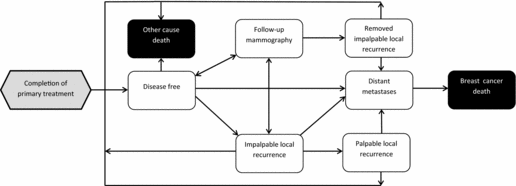
A DES model was developed in Simul8® (Figure 1), to represent progression of early breast cancer in women who are disease free after completion of primary treatment. Patients move between the events represented in the model over time, with the events experienced and their timing being influenced by individual patients’ personal (e.g., age, menopausal status) and tumor (e.g., size, nodal status, grade) characteristics, which in turn impacts on health service costs, quality of life, and overall survival.
Structure of DES model describing the possible progression of early breast cancer after completion of treatment, and the detection of impalpable disease by follow-up mammography.

Women enter the model disease-free, but are at risk of developing a recurrence. A woman will leave the disease-free state if she develops a local recurrence. Initially this will be an impalpable local recurrence, and only detectable by means of mammographic surveillance. If an impalpable local recurrence is not detected, and the patient does not die in the intervening period, the recurrent tumor will either continue to grow locally and be detected clinically by the doctor or patient (palpable local recurrence) or metastasize to other parts of the body (distant metastases).
Women can develop distant metastases from any health state, which is typically incurable, and such women are assumed to die of causes related to breast cancer (breast cancer death). Before the development of distant metastases, women can die from causes unrelated to breast cancer at any time (other cause death).
For women with an impalpable local recurrence, a true positive follow-up mammogram results in the removal of the lesion (removed impalpable local recurrence). Following a false negative follow-up mammogram, the lesion will remain undiagnosed, and continue to grow. For women in the disease-free state, a false positive follow-up mammogram results in a biopsy and upon a negative result, such women return to the disease-free state.
The full set of model assumptions is presented here:
• All patients are women
• Women aged ≥ 50 years are defined as postmenopausal
• Local recurrence refers to recurrence of breast cancer in the treated breast/axilla or new primary breast cancers in the contralateral breast
• A local recurrence is curable, and women with local recurrence will not experience a breast cancer death unless they develop metastatic disease
• A local recurrence will be initially impalpable and if untreated will continue to increase in size and eventually become palpable
• Early detection of a local recurrence when impalpable reduces the risk of metastatic disease compared with late detection of a local recurrence when palpable
• Once a local recurrence (impalpable or palpable) is detected, it will be surgically removed (± adjuvant treatment) rendering the patient disease-free.
• Distant metastases include all systemic relapses outside the breast/axilla, and includes supraclavicular lymphadenopathy as well as visceral metastases in lung, liver, bone, brain and other sites
• Women are at risk of developing distant metastases with and without the prior development of local recurrence
• Distant metastases are incurable and result in death from breast cancer.
Model Scenarios
Separate cost-utility analyses of alternative mammographic follow-up schedules were performed for four different risk profiles, based on the Nottingham Prognostic Index (Reference Galea, Blamey and Elston11) of the primary breast cancer. Three different mammographic schedules were assessed (annual, annual for 5 years, followed by 2 yearly (mixed), and two yearly) in two different age groups (50 to 69 years, and 70 years and above). Analyses were performed assuming two different levels of adherence to mammographic follow-up (90 percent and 75 percent).
Mammographic schedules were chosen to reflect the current annual follow-up interval and two less intense schedules that were deemed feasible options within Australia, as informed by expert consultation. The least intensive option was 2 year mammography (one surveillance episode every 2 years), which is the frequency currently recommended for population-based screening. A “mixed” schedule consisted of annual mammography for 5 years, then 2 year mammography, which was designed to reflect an intermediate follow-up frequency, between annual and 2 yearly surveillance. A “no surveillance” option was not considered to be a realistic option for women who have a personal history of breast cancer.
In the absence of South Australian or national data describing adherence with follow-up mammography by women with a personal history of breast cancer, we assumed adherence would be higher than with screening mammography of asymptomatic women with no personal history of breast cancer. In 2009–10 in Australia, 55 percent of eligible women attended Breast Screen Australia (12). We separately modeled 75 percent and 90 percent adherence probabilities, applied to each follow-up mammography encounter, to provide feasible lower and upper boundaries of mammographic attendance by Australian breast cancer survivors.
Model Inputs
Initial values for model input parameters were estimated from data routinely collected on women with breast cancer in South Australia (SA), data from the published literature, and parameter ranges elicited from clinical experts. Relevant combinations of input parameter values were specified based on a calibration process in which model outputs were compared with a range of calibration targets derived from the routinely collected data sources.
Relevant routinely collected data were stored in multiple data sources, and so ethics approval was obtained from the SA Health Human Research Ethics Committee to extract and link routinely collected data from the South Australian Cancer Registry, and clinical and administrative hospital databases. We constructed a patient level dataset of eleven hundred postmenopausal women diagnosed with early breast cancer between 2000 and 2008, who had their primary breast cancer treatment and mammographic follow-up in the public healthcare system in South Australia.
Women, categorized by age and Nottingham Prognostic Index (NPI) category of the primary breast cancer, were followed up to death, or to 30 June 2011 with respect to mammographic follow-up, recurrence events, and mortality (breast cancer or other cause mortality). A total of 113 women were excluded due to missing data for one or more of tumor, node, or grade status that prevented the calculation of the NPI for those women.
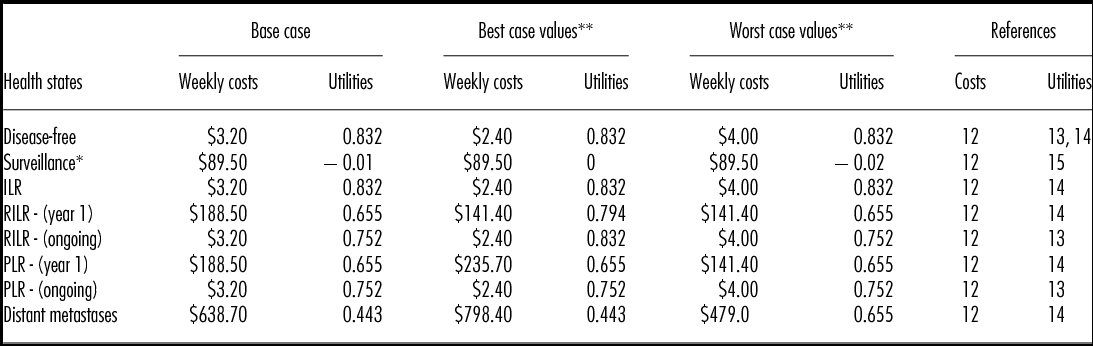
Estimates of health service costs and quality of life weights associated with each event represented in the model were identified from the literature (Table 1) (Reference Verry, Lord and Martin13–Reference de Koning, van Ineveld and van Oortmarssen16). Nonbreast cancer mortality rates were calculated by subtracting the proportion of Australian women who died from breast cancer from age specific mortality rates derived from Australian life-tables (17;18).
Base-Case, Best and Worst Case Weekly Costs in $A2011 and Utilities, for Health States in the Model

Note. Disease free = costs of history and examination x 2 (i.e., two clinic visits). *Surveillance = costs of single mammogram encounter. Base-case = the applied QALY decrement associated with follow-up mammography of 0.01 is equivalent to a 0.5 utility decrement for 1 week, or a 0.25 utility decrement for 2 weeks, reflecting the heightened anxiety around the surveillance period. The QALY decrement also capture false positive effect for the small proportion of patients who undergo further investigations to rule out recurrence. **Best and worst case scenarios = from the perspective of increased surveillance frequency, costs as shown, and utility decrement decreased in best case scenario (to zero) and increased in worst case scenario (to −0.02).
ILR, impalpable local recurrence; RILR, removed impalpable local recurrence; PLR, palpable local recurrence; QALY, quality-adjusted life-year.
Model Calibration
Model calibration was performed to identify the best fitting sets of input parameter values, according to the seven step approach described by Vanni et al. (Reference Vanni, Karnon and Madan19). Four calibration targets (5 and 10 year in-breast recurrence, and breast cancer mortality rates) were specified for postmenopausal women in each of the four NPI prognostic groups (excellent, good, moderate, and poor) (Supplementary Table 1). Rates of recurrence within the breast were determined from pathology and mammography data for each of the eligible 987 women, and breast cancer death rates were extracted from the SA Cancer Registry. For each prognostic group, 2,000 sets of convergent input parameters were identified, each of which produced model outputs for each of the four calibration targets that were within the 95 percent confidence intervals of the observed data. Based on the chi squared statistic for each convergent set of input parameter values, probability weights were estimated to represent the relative accuracy with which they predicted the observed calibration target values.
Model Analysis
The model was run for the same 2,000 sampled sets of convergent input parameter value sets for each scenario. Model outputs were total costs (health state costs + costs of surveillance), and total QALYs. Within each age and adherence scenario (e.g., 50- to 69-year-olds assuming 75 percent adherence), the mean incremental cost-effectiveness ratios (ICERs) were estimated between mammographic schedules arranged in increasing order of effectiveness. A probabilistic sensitivity analysis informed probabilities that each follow-up strategy is the most cost-effective for each scenario, at alternative assumed monetary values for the gain of additional QALYs. Best and worst case scenario analyses were also defined with respect to the cost-effectiveness of more frequent surveillance (Table 1).
RESULTS
Base-Case Analysis
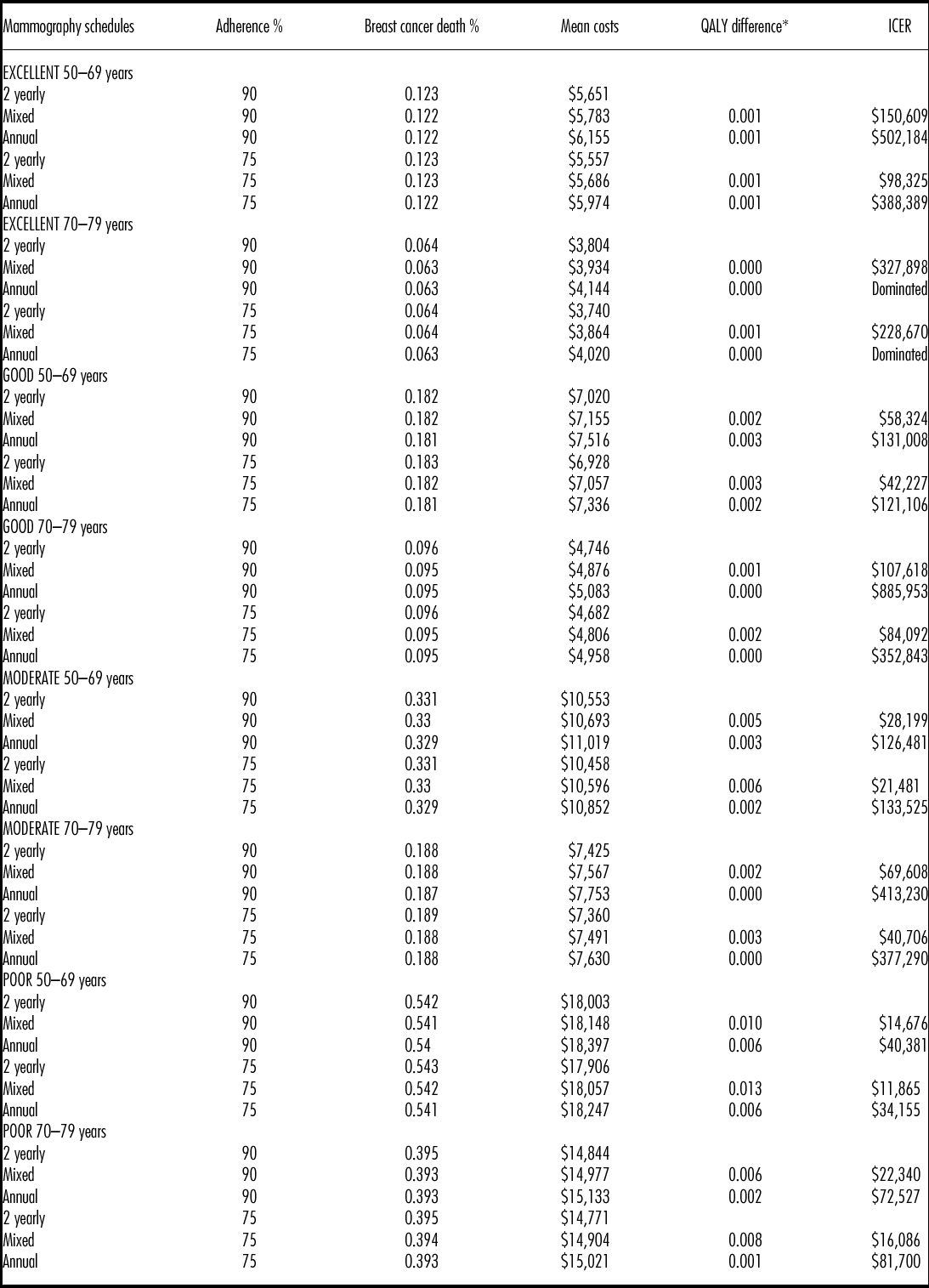
Table 2 reports the results of the base-case scenarios for the alternative mammographic follow-up schedules in women with four different risk profiles, by age at diagnosis and adherence with follow-up mammography. On the basis that an ICER of greater than $50,000 per QALY gained is unlikely to represent good value for money, the mean results indicate that 2 yearly surveillance is cost-effective for the excellent and good prognosis groups, and older women with a moderate prognosis. The mixed strategy might be considered for younger women with a good or moderate prognosis, depending on adherence. Annual surveillance is only indicated for younger women with a poor prognosis. For all other groups, the mixed strategy is indicated.
Base-Case Analysis

QALY, quality-adjusted life-year; ICER, incremental cost-effectiveness ratio.
Best and Worst Case Scenario Analyses
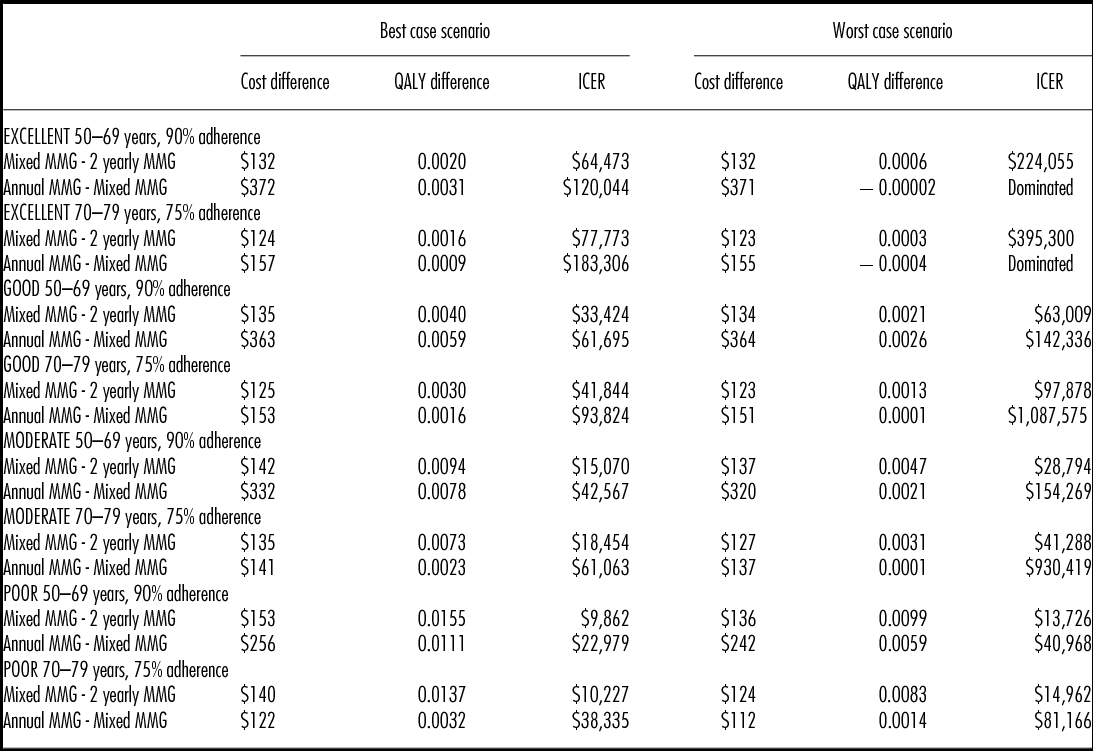
Best and worst case scenario analyses were undertaken around the cost and utility input parameters, as presented in Table 3. Compared with the base-case results, the best case cost and utility weight scenario results in substantially lower ICERs in all prognostic subgroups, primarily due to the best case assumption of lower costs associated with the treatment of mammographically detected local recurrence (impalpable local recurrence) compared with the costs of treatment for local recurrence that is detected clinically (palpable local recurrence). The worst case scenario did not result in any policy relevant variation, that is, the ICER did not move significantly toward recognized cost-effectiveness thresholds.
Best and Worst Case Scenario Analysis

Probabilistic Sensitivity Analyses
The results of the probabilistic sensitivity analysis are shown in Supplementary Figure 1, which describe the probabilities of cost-effectiveness for alternative follow-up schedules and adherence rates, by QALY threshold value, for the 50- to 69- and 70- to 79-year-old cohorts, in each prognostic subgroup.
The outputs from the probabilistic analysis represent significant levels of uncertainty around the mean results. Even in the older, excellent prognosis group, where the mean ICER for the mixed strategy is $327,898 (with 90 percent adherence), there is a 30 percent chance that the mixed strategy is cost-effective. For most of the analyses, the strategy with the lowest ICER has a probability of less than 50 percent of being the most cost-effective option. The uncertainty is partly driven by the small magnitude of the QALY gains between the alternative strategies. This means that small differences in QALY gains across the probabilistic analyses, result in potentially large differences in the incremental net benefits (or incremental cost-effectiveness ratio).
DISCUSSION
This study has presented the results of a model-based cost-effectiveness analysis of alternative surveillance strategies for women with varying levels of risk of recurrent breast cancer, following primary surgery for early breast cancer. Using a discrete event simulation model, the results suggest that, for most postmenopausal women, annual mammographic follow-up may not be cost-effective. For women with excellent prognosis tumors, two yearly follow-up mammograms is most likely to be cost-effective, regardless of age (that is, for women aged 50–69 years and 70–79 years). For women with good and moderate prognosis tumors, there is some uncertainty regarding the most cost-effective schedule. If high adherence rates can be achieved, 2 yearly surveillance for good prognosis women is likely to be cost-effective. For moderate prognosis women, a mixed surveillance strategy may be most cost-effective, especially in the younger age group. For women with poor prognosis tumors, annual mammography is potentially cost-effective for women aged 50–69 years, but the mixed schedule may be most cost-effective schedule for women aged 70–79 years.
A recent health technology assessment of surveillance strategies for women with early breast cancer in the United Kingdom, used an alternative modeling approach to analyze a broader set of follow-up options (Reference Robertson, Arcot Ragupathy and Boachie9). Robertson et al. represented disease progression in more detail, but they did not calibrate (or externally validate) their model. Sub-group analyses, representing higher and lower likelihoods of relapse within the breast suggested that more intensive follow-up of women judged to be at high risk, and less intensive follow-up of women judged to be a low risk, may be cost-effective (Reference Robertson, Arcot Ragupathy and Boachie9). This is consistent with findings reported in this study, which stratified results for excellent, good, moderate, and poor risk groups. Although different modeling approaches were used, the results of the two studies are broadly similar, which reinforces our findings that a one-size-fits-all, annual surveillance strategy may not be the optimal approach to monitoring breast cancer survivors.
There are no randomized controlled trials to date, that examine the optimal frequency of mammographic follow-up in women who are disease free following primary treatment for early breast cancer. In the likely continued absence of RCTs in this field, we need to embrace alternative research techniques, such as decision analytic modeling.
The key strengths of our DES model include the use of probabilistic model calibration and the use of longitudinal data that includes patient level surveillance pathways and outcomes. In cancer follow-up, we cannot observe the time at which patients develop asymptomatic recurrence. Calibration is often used to fit values for these parameters, such that the models’ outputs match some observed data for the population being evaluated (Reference Vanni, Karnon and Madan19). This process is most common in models of population based screening programs (Reference Karnon, Goyder and Tappenden20), although previous models have not used patient-level data to represent observed surveillance pathways to inform the calibration of the underlying disease progression parameters. The use of longitudinal data that includes patient-level surveillance pathways and outcomes, may provide a more robust basis for calibrating surveillance models, and increase confidence that the model reflects reality. This approach removed the need to estimate surveillance frequency, an important parameter that is generally subject to significant uncertainty. In addition, the methods described in this study could readily be applied to optimizing follow-up schedules for other cancer types.
The main limitations of the reported study relate to the data sources. Recurrence and follow-up data are not routinely collected by the South Australian Cancer Registry. This meant that data had to be extracted and linked across four separate data sources (each built for different purposes), which resulted in some uncertainties regarding the capture of all relevant follow-up and recurrent events. Hormonal receptors, HER2 receptor, and breast density data were not available over the study period. In addition, our data were limited to the public healthcare sector, as privacy laws prevented access to mammography reports from the private healthcare sector.
We chose to combine ipsilateral recurrence in the treated breast/axilla (IBTR), and new contralateral breast cancer (CLBC) as “local recurrence.” This was due to the much smaller annual event rate for CLBC (2), and the findings of an existing economic evaluation that the exclusion of CLBC had little impact on the results (Reference Robertson, Arcot Ragupathy and Boachie9).
The model could be expanded to include premenopausal women and women over the age of 80 years; to study a range of adherences between 55 percent and 100 percent, and to subdivide the primary breast cancer into six NPI prognostic subgroups (Reference Blamey, Ellis and Pinder21). We did not model alternative surveillance strategies incorporating other imaging modalities (e.g., MRI, ultrasound) as these are not currently recommended in international guidelines for routine breast cancer follow-up. Other frequencies of mammographic surveillance could also be explored, but less frequently than two yearly follow-ups is unlikely to be accepted by most breast cancer survivors.
To maximize the potential of decision analytic modeling to guide clinical practice, we need to improve the quality of the data that inform such models. We need robust data on primary tumor stage at diagnosis, and ideally to extend the data that we collect to include receptor status and details of the primary treatment received (both local and adjuvant). More importantly, we need more complete capture of recurrence data in our population based cancer registries. We need to know the timing and site of first relapse (treated breast, opposite breast, distant relapse) and the method of detection of relapse (imaging detection of an impalpable lesion or clinical detection of a palpable lesion). We also need easily accessible granular data on the frequency and results of clinical examinations and diagnostic imaging to assess adherence with follow-up. All of these areas for improvement will better inform the validity and value of cost-effectiveness models to inform optimal surveillance strategies, based on recurrence risk.
CONCLUSION
Our results suggest that annual mammographic follow-up is not cost-effective for most postmenopausal women, and that mammographic follow-up can be tailored according to risk of recurrence based on the NPI score of the primary breast cancer and age at diagnosis. Whereas models rely on existing data, their strength lies in the ability to be rapidly updated and extended in response to new knowledge. If validated with a more robust dataset, our model could potentially provide the foundations toward a significant change to current mammographic and diagnostic imaging practice in breast cancer follow-up.
SUPPLEMENTARY MATERIAL
Supplementary Table 1 and Supplementary Figure 1 http://dx.doi.org/10.1017/S0266462315000598
CONFLICTS OF INTEREST
The authors report no potential or real conflict of interest.