Introduction
Several countries in Latin America, such as Argentina, Brazil, Chile, Colombia, Costa Rica, Mexico and Uruguay, have adopted specific policies to promote the formation of new information and communications technology (ICT) clusters, most commonly to attract direct investment from ICT multinationals.Footnote 1 Costa Rica has been one of the most successful cases, often considered as a benchmark by both multilateral organisations and governments in Latin America. It has attracted investments from several of the leading ICT companies, including sequential investments by Intel, which has fostered the growth of its emerging cluster and made it internationally visible.Footnote 2
Generating new agglomerations of high-tech firms does not necessarily reproduce the developmental dynamics that helped India and Israel to become leading players in the global ICT industry. The positive developmental effects of industrial clusters materialise when the companies that form them not only compete but also become engaged in collaborative linkages with other firms, universities and other actors.Footnote 3
Despite the fact that it is used as a benchmark, there is empirical evidence that linkages among the different organisational actors in the Costa Rican ICT cluster remain weak. Examining the reasons for this could provide interesting insights for the other countries in Latin America that are promoting the formation of ICT clusters. The objective of this study is thus to discuss the reasons why the organisations within the cluster – local firms, multinational corporations (MNCs) and universities – are not involved in more inter-organisational linkages. It differs from other studies because it looks not only at linkages between MNCs and local companies, but also at linkages among local companies and with universities.Footnote 4
The paper leverages in-depth qualitative information about processes of linkage formation in the emerging ICT cluster of Costa Rica in order to consider how far the findings correspond to the explanations provided by different streams of the literature on clusters in Latin America.Footnote 5 It relies on new information collected in the Costa Rican cluster over four years through more than 150 direct interviews with producers, MNC senior management, academics and government representatives. The discussion focuses on linkages that connect organisations involved in the development or production of ICT goods and services, which are governed neither by the market nor by hierarchy, and which entail joint actions and the sharing of some organisational resources.
Information was collected with an exploratory mindset, without pre-determined hypotheses, in order to allow interviewees to explain freely their reasons for shunning the idea of establishing linkages with other actors in the cluster. Their answers are analysed in the light of a set of potential obstacles to linkage formation extrapolated from the literature. These include the type of transactions in which companies are involved, and companies’ capabilities, access to information, trust and adherence to customs. The paper also examines the effects of the social ties of the actors who lead the organisations of the cluster.
The article starts with a brief introduction to the literature on linkages in industrial clusters, followed by an outline of the research methodology. The three sections that follow then examine in more detail the obstacles that have hindered the formation of linkages among local firms, the linkages that connect local firms to MNCs, and the linkages between universities and private sector companies.
Inter-Organisational Linkages in ICT Clusters
Most of the products of the electronics industry, such as personal computers, smartphones and video games, are designed to be connected to the internet and to communicate with each other. They incorporate a broad range of hardware and software technologies. This means that companies producing final goods often have linkages with the suppliers of key components, as well as companies that specialise in applications, system integration and other services.Footnote 6 For example, the microchips produced by Intel are hardware components, to be sold to producers of final goods such as computers and smartphones. The development and production process for microchips has to take into account the specifications not only of the computers or phones that will incorporate them but also the operating systems, as well as the type of applications that consumers will use, such as video games and data processing software. On the other hand, the developers of operating systems and software programs also have to ensure that their work is in line with that of hardware manufacturers. This study thus defines the ICT industry as including companies that produce hardware, such as electronic components and microchips; those that develop software programs; and those that provide information technology (IT) services, such as IT consulting and data warehousing. Several scholars of the ICT industry and governments in Latin America use the same definition.Footnote 7
Some industries, like ICT, are characterised by high levels of clustering: they are organised in spatially concentrated agglomerations that host a variety of organisational actors.Footnote 8 This observation, together with the impressive growth of ICT agglomerations located far from the industry's global core in Silicon Valley, such as the Indian and Israeli clusters, inspired Latin American governments also to design policies promoting ICT clusters.Footnote 9 Clusters are agglomerations of companies and organisations involved in the production of a given range of related goods and services, such as leather and leather shoes, or computer hardware and software. They are characterised by their spatial concentration and also by the linkages that connect large and small companies, universities, and other types of actors.Footnote 10
Linkages among companies operating in the same sector help to create flexible local systems of production, allowing firms to become more focused on their core businesses while spreading non-core activities across the collaborative networks in which they operate.Footnote 11 Linkages between local firms and MNCs are an important mechanism to facilitate technological upgrading and hence industrial development, especially in clusters located in the developing world.Footnote 12 Finally, linkages that connect universities, research laboratories and private companies allow the emergence of local and sectoral innovation systems which, in turn, sustain knowledge generation, circulation and diffusion.Footnote 13
Hubert Schmitz argues that a cluster has positive developmental effects when it generates collaborative phenomena that allow the organisations that form it, especially small local firms, to achieve better performance than they would if they were operating individually. He defines this effect as ‘collective efficiency’, and points out that two important elements of it are the active, voluntary effort to collaborate (joint actions) and the sharing of different types of resources.Footnote 14 There is empirical evidence, however, that linkages are weak in the clusters of Latin America.Footnote 15 Understanding the mechanisms that hinder the formation of these linkages is important for the countries that are promoting the formation of new ICT clusters as part of their development policies.Footnote 16
Several theories explain the obstacles to linkage formation in industrial clusters. Scholars who draw from the economics and international business literatures argue that inter-organisational linkages should emerge if and where they generate tangible benefits for the organisations involved.Footnote 17 Transaction cost economics illustrates that, depending on the type of transaction, an actor – for example, a company – may find it more convenient to carry out one-off transactions, such as purchasing a product off the shelf from a shop; to internalise transactions, for example by buying one of its suppliers; or to become involved in a linkage characterised by network-type governance, such as the inter-firm relationships linking electronics manufacturers, ICT service providers and a vast array of small software firms.Footnote 18 Collaborative linkages are more common where ‘technical interdependencies’ make it too difficult for companies to organise their exchanges via market transactions or hierarchy. For example, the provision of a customised service integrating data storage, applications management and intranet systems requires a certain degree of cooperation between the buyer and the service provider.Footnote 19 Examining the types of activities undertaken by companies and organisations should shed light on the extent to which they establish linkages with each other.
John Dunning and Sarianna Lundan explain linkages by looking at the determinants of foreign direct investment. They argue that MNCs investing to create an export-oriented operation, such as the companies that invested in Costa Rica, are less likely to collaborate with local suppliers than firms that invest in order to sell in a protected domestic market. Whereas the former export the vast majority of their output and often operate in export processing zones where they can import their inputs free of duties, the latter need to sell locally, and having local suppliers can help them to fine-tune products and services for local consumers.Footnote 20 This does not, however, exclude the possibility of export-oriented MNC subsidiaries having links with local firms.Footnote 21
Drawing from the resource-based and knowledge-based views of companies, both Theodore Moran, and Anabel Marin and Martin Bell, illustrate that MNC subsidiaries’ willingness to search for local suppliers depends upon their capabilities. Some MNCs may run simple assembly operations which use only imported inputs or inputs produced by other MNC subsidiaries. Other MNCs may need sophisticated inputs which local firms are not able to produce.Footnote 22 In line with this interpretation, Elisa Giuliani, Eva Paus and Kevin Gallagher argue that the lack of competencies among local companies contributes to an explanation of the scarce diffusion of linkages between MNCs and local firms in the ICT clusters of Costa Rica and Mexico.Footnote 23 The choice not to engage in collaborative linkages may also result from a lack of information about the suitability of potential partners.Footnote 24
Several authors point out that there are also non-economic factors, such as trust, that help to explain the formation of collaborative inter-organisational linkages.Footnote 25 The problem with trust is that it can be conceptualised in different ways.Footnote 26 Francis Fukuyama, for example, conceives trust as a diffuse phenomenon, encompassing trust in institutions as well as trust among individuals. He argues that history and culture explain why certain locations are characterised by higher levels of trust. The implication is that ‘low-trust’ locations, such as Latin America, should not promote clusters as they are very unlikely to generate inter-organisational linkages.Footnote 27 Other scholars focus on a different type of trust – trust between two parties involved in a given transaction, or ‘particularistic trust’.Footnote 28 This study attempts to explore the importance of both, letting the interviewees explain whether they decided not to be part of linkages because they operated in a location where culture and history produced a generalised low level of trust, whether they did not trust their potential partner with regards to a specific type of collaborative linkage, or whether there were other factors at play.
Economic sociologists emphasise that the organisations that populate industrial clusters are embedded in social networks which influence whether and how these organisations interact with each other. A company may establish a collaborative linkage because of factors related to the social ties of its CEO – for example, because her contacts gave her access to information about the capabilities of potential partners in the same cluster.Footnote 29 To understand how and why actors engage in collaborative linkages, it is necessary to take into account that their contacts, or social ties, are likely to affect their decisions in different ways.
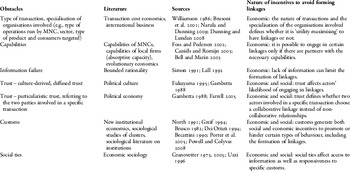
The literature streams discussed in this section thus provide several explanations as to why actors choose to engage in collaborative linkages in industrial clusters. Table 1 summarises the main insights from the literature in order to identify a set of obstacles that may hinder the formation of collaborative linkages. Extensive qualitative evidence has been collected to explore whether and how the determinants derived from the literature could explain the outcomes observed. The next section describes the research design, data collection and methodology.
Obstacles to the Formation of Collaborative Inter-Organisational Linkages

Source: Author's elaboration. Works cited in alphabetical order of author: Giacomo Becattini, ‘The Marshallian Industrial District as a Socio-Economic Notion’, in Frank Pyke, Giacomo Becattini and Walter Sengenberger (eds.), Industrial Districts and Interfirm Cooperation in Italy (Geneva: International Institute for Labour Studies, 1990), pp. 37–51; Sebastiano Brusco, ‘The Emilian Model: Productive Decentralization and Social Integration’, Cambridge Journal of Economics, 6: 2 (1982), pp. 167–84; Stefano Brusoni, Andrea Prencipe and Keith Pavitt, ‘Knowledge Specialisation, Organizational Coupling and the Boundaries of the Firm: Why Do Firms Know More than They Make?’, Administrative Science Quarterly, 46: 4 (2001), pp. 597–621; Marjolein C. J. Caniëls and Henny A. Romijn, ‘Agglomeration Advantages and Capability Building in Industrial Clusters: The Missing Link’, Journal of Development Studies, 39: 3 (2003), pp. 129–54; Gabi Dei Ottati, ‘Trust, Interlinking Transactions and Credit in the Industrial District’, Cambridge Journal of Economics, 18: 6 (1994), pp. 529–46; John H. Dunning and Sarianna M. Lundan, Multinational Enterprises and the Global Economy (2nd edition, Cheltenham: Edward Elgar, 2008); Henry Farrell, ‘Trust and Political Economy: Institutions and the Sources of Interfirm Cooperation’, Comparative Political Studies, 38: 5 (2005), pp. 459–83; Nicolai J. Foss and Torben Pedersen, ‘Transferring Knowledge in MNCs: The Role of Sources of Subsidiary Knowledge and Organizational Context’, Journal of International Management, 8: 1 (2002), pp. 49–67; Francis Fukuyama, Trust: The Social Virtues and the Creation of Prosperity (London: Hamish Hamilton, 1995); Diego Gambetta, Trust: Making and Breaking Cooperative Relations (Oxford: Basil Blackwell, 1988); Mark Granovetter, ‘The Strength of Weak Ties’, American Journal of Sociology, 78: 6 (1973), pp. 1360–80; Mark Granovetter, ‘The Impact of Social Structure on Economic Outcomes’, Journal of Economic Perspectives, 19: 1 (2005), pp. 33–50; Avner Greif and David D. Laitin, ‘A Theory of Endogenous Institutional Change’, American Political Science Review, 98: 4 (2004), pp. 633–52; Sanjaya Lall, ‘Technological Capabilities and Industrialization’, World Development, 20: 2 (1992), pp. 165–86; Anabel Marín and Martin Bell, ‘Technology Spillovers from Foreign Direct Investment (FDI): The Active Role of MNC Subsidiaries in Argentina in the 1990s’, Journal of Development Studies, 42: 4 (2006), pp. 678–97; Rajneesh Narula and John H. Dunning, ‘Multinational Enterprises, Development and Globalisation: Some Clarifications and a Research Agenda’, Oxford Development Studies, 38: 3 (2010), 263–87; Douglas C. North, ‘Institutions’, Journal of Economic Perspectives, 5: 1 (1991), pp. 97–112; Kelley Porter, Kjersten Bunker Whittington and Walter W. Powell, ‘The Institutional Embeddedness of High Tech Regions: Relational Foundations of the Boston Biotechnology Community’, in Stefano Breschi and Franco Malerba (eds.), Clusters, Networks and Innovation (Oxford: Oxford University Press, 2005), pp. 261–94; Walter W. Powell and Jeannette Colyvas, ‘Microfoundations of Institutional Theory’, in Royston Greenwood, Christine Oliver, Roy Suddaby and Kerstin Sahlin-Andersson (eds.), The SAGE Handbook of Organizational Institutionalism (New York: SAGE, 2008), pp. 276–98; Herbert A. Simon, ‘Bounded Rationality and Organizational Learning’, Organization Science, 2: 1 (1991), pp. 125–34; Brian Uzzi, ‘The Sources and Consequences of Embeddedness for the Economic Performance of Organizations: The Network Effect’, American Sociological Review, 61: 4 (1996); Oliver E. Williamson, Economic Organization: Firms, Markets and Policy Control (Brighton: Wheatsheaf, 1986).
Methods
The aim of this research, therefore, was to identify the obstacles that limit the diffusion of collaborative inter-organisational linkages in the new ICT clusters of Latin America, using Costa Rica as a starting point. In line with the use of the term by the Costa Rican government, Costa Rican producers, multilateral organisations and MNCs, ICT was defined in a broad and encompassing way. Other publications on high-tech clusters also adopt a broad definition of ICT clusters, underlining the connections among the different types of firms that operate in these agglomerations: electronics manufacturers, such as Intel; firms specialising in operating systems and databases, such as Microsoft and Oracle; firms that are simultaneously manufacturers and providers of services, such as HP; and small software developers.Footnote 30
The term ‘cluster’ has been used because many countries in Latin America designed explicit policies to support the formation and development of ICT ‘clusters’, intended as agglomerations of MNCs, local firms, universities and other organisations, which, it was hoped, would form linkages among these groups.Footnote 31 Michael Porter, one of the most famous proponents of cluster policy, uses the case of Costa Rica to explain how government policies can support the creation of new high-tech clusters. He highlights the point that the Costa Rican ICT cluster, though relatively new, has some of the basic features of clusters: it is spatially concentrated, in an area called the Central Valley; it includes different types of organisations involved in the production of ICT goods; and it possesses different types of inter-organisational linkages.Footnote 32 Although linkages are not as common as in more developed clusters, such as the Israeli ICT cluster, several of the organisations within the Costa Rican cluster are indeed linked to each other, and examining what hinders the formation of more of these linkages can provide policy implications for Latin America.Footnote 33
Drawing on the literature on ICT clusters, the organisations directly involved in the production of ICT goods and services, and their supporting government agencies and associations, have been considered to be part of the Costa Rican cluster for the purposes of this analysis.Footnote 34 These include MNCs specialising in hardware manufacturing; MNCs specialising in service provision; local companies producing software programs; local companies providing ICT services; the two universities involved in both training and research; the Coalición Costarricense de Iniciativas de Desarrollo (Costa Rican Investment Promotion Agency, CINDE); the Cámara de Tecnología de Información y Comunicación de Costa Rica (Chamber of Information and Communications Technologies of Costa Rica, CAMTIC); and Costa Rica Provee, the agency in charge of fostering local procurement by MNCs. CAMTIC is a voluntary, non-governmental, not-for-profit sectoral association. In 2007, 95 per cent of local producers were members of CAMTIC, whereas only one MNC had taken up membership. CINDE is a non-governmental, not-for-profit organisation in charge of promoting foreign direct investment in Costa Rica. It has been ranked among the best foreign investment promotion agencies in the world.Footnote 35 In contrast, the Costa Rican export promotion agency is part of the government and has not been considered to be part of the cluster because, according to the local firms interviewed, it does not offer specific services to support ICT exports. These are provided by CAMTIC.
Drawing upon the studies of clusters and the sociological literature on networks, linkages have been defined here as ties connecting two or more organisations that work together to achieve some goal related to their economic activities, and which entail some sort of long-term mutual commitment, repeated interactions, the sharing of resources and the performance of joint actions.Footnote 36 The study focuses on linkages that feature network-type governance, excluding not only relationships regulated solely by the market (or arm's-length transactions) but also hierarchical relationships, such as those between a subsidiary of an MNC and its headquarters.
In order to limit its scope, this study examines only linkages between local firms and organisations that are directly involved in activities related to the development, production and commercialisation of ICT goods and services, namely other local firms, MNCs and universities. Linkages with other organisations not related to the development or production of ICT goods and services, such as linkages that have philanthropic purposes, have been excluded from the analysis. Government agencies and associations are not directly involved in linkages that lead to the production and development of ICT goods and services, but they influence or could influence linkage formation in different ways, as will be discussed in the sections that follow.
The fieldwork collected qualitative information on the economic and social factors that underpin linkage formation through open-ended, semi-structured interviews. It drew on one of the principles of new institutional economics: that the behaviour of individuals is regulated by institutions, such as formal laws and informal customs, which generate rewards and sanctions that are both economic and social in nature.Footnote 37 It acknowledged that institutions do not necessarily reflect the sum of the individual preferences of the actors that they regulate. It took into account that institutions may endure through time if the actors who benefit from the status quo oppose change, or if the cost of changing their processes is higher than the cost of maintaining them.Footnote 38 In order to identify their incentives, actors were asked to ‘tell the story’ of their collaborative linkages – in particular, why, when and how they had established them. Most of them articulated clear reasons for not having linkages with other organisations. In other cases, actors were asked to provide further explanations using non-directive phrases such as ‘Could you tell me a bit more about that?’ The categories summarised in Table 1 were used as a reference point to guide the discussions and also as a means to codify the answers provided.
Information on social ties and their effects was collected following the ethnographic research of, among others, Mark Granovetter and Brian Uzzi.Footnote 39 Social ties were defined as the contacts of the individuals who led the organisations in the cluster – for example, the CEOs or founders of local companies – and used those contacts for purposes related to their economic activities, such as acquiring information. The interviewees were asked to list the ten individuals with whom they most frequently discussed matters related to the ICT industry and to their own business. Given that language is an important instrument for the construction of certain institutions, such as social norms, the interviews were analysed to detect behavioural incentives and the interviewees’ responsiveness to local customs.Footnote 40 For example, the use of ‘we’ and ‘them’ illustrated the extent to which actors perceived themselves as belonging to a certain group of professionals and how they perceived others. Phrases such as ‘We work this way – they are different’ have been considered to reveal a contrast between two groups of actors behaving in different ways, and possibly following different customs, as well as the speaker's identification with the ‘way of doing things’ of their own group.
The interviews were conducted by the author between June 2004 and April 2008 with the CEOs or directors of 80 local companies, the directors or highest available officers of 25 MNCs that produce ICT goods and services, five senior academics from the two research universities, and relevant government representatives.Footnote 41 The interviews were carried out in English or Spanish, depending on the preference of the interviewee, without using a translator. All academics and local producers preferred to be interviewed in Spanish. Twenty-three out of 25 MNC directors were interviewed in English, and two in Spanish. Another three MNC directors whose native tongues were neither English nor Spanish chose to be interviewed in English.
The existing database of local companies was checked and updated by contacting all of the listed firms by phone and excluding those that had ceased to operate. Of the 150 local firms, 110 were contacted, 80 of which made themselves available for interviews. This target group thus excluded 40 companies which did not comply with one or more of the following conditions: having at least two employees; being operational for at least two years; or having revenues of at least US$ 20,000.Footnote 42
The actors were identified by cross-referencing the databases provided by CAMTIC, CINDE and the Promotora del Comercio Exterior de Costa Rica (PROCOMER, the export promotion agency), with the help of senior experts from CAMTIC, the INCAE Business School, the University of Costa Rica and two ICT entrepreneurs. Representatives of the public sector were interviewed in order to understand the development and implementation of cluster policies. They included the president of Costa Rica, the vice-president, the minister of economy, the governor of Heredia province (where most MNCs are located), the Costa Rican ambassador to the United Kingdom, and representatives of PROCOMER, Costa Rica Provee and CINDE.
The Costa Rican ICT Cluster and Its Linkages
In 2007 the Costa Rican ICT cluster comprised 25 MNCs, 150 local firms, two research universities, CINDE, CAMTIC and Costa Rica Provee. The 25 MNCs include 15 hardware manufacturers and 10 companies specialising in ICT services, ranging from the development of databases to the management of intranet and data for corporate clients. Fifteen per cent of the Costa Rican companies are software developers, 70 per cent provide diversified ICT services for small and medium-sized businesses based in Central America, and 15 per cent provide targeted outsourced services for large clients based outside Central America. Most are small firms, with only 5 per cent employing more than 100 people.Footnote 43
The Costa Rican ICT Cluster in 2007

* Data on domestic sales of MNCs are not available. Most sales are intra-firm and target company HQs abroad.
Source: author's elaboration based on interviews and information from CAMTIC, and Monge-Gonzalez and Hewitt, ‘Innovation, R&D and Productivity’.
Some of the Costa Rican ICT companies have collaborative linkages with other local producers, universities and MNCs (Table 3), which generate positive effects, such as providing access to new clients and opportunities to learn new organisational practices. The exact effects of these linkages are beyond the scope of this study. The issue is that although they are perceived as positive by the firms that have them, linkages are still scarce in the cluster.
Costa Rican Firms’ Linkages in the Cluster

* One ICT company has been incubated by the Technological Institute of Cartago, one of the two research universities of Costa Rica. The case has not been examined here because the company had only a temporary linkage to the university and very limited interactions with its researchers and faculty.
Source: author's elaboration based on interviews.
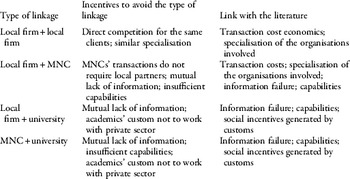
Table 4 summarises the incentives that hinder the formation of different types of linkages in the cluster, showing the type of linkage in the first column, the incentives that lead actors to avoid this type of linkage in the second, and the link to the theoretical perspectives summarised in Table 1 in the third.
Incentives to Avoid the Formation of Linkages

Source: author's elaboration based on interviews.
During the interviews, the actors of the Costa Rican ICT cluster clarified that they respond to both economic and social incentives. The actors who used ‘trust’ to explain their choices used it in a particularistic manner, referring to a specific transaction with a specific partner organisation rather than as a culture-derived factor.Footnote 44 When they did not ‘trust’ a potential partner, this was either because they lacked access to information or because they considered its capabilities to be insufficient. The explanations related to ‘particularistic trust’ of the type mentioned by Henry Farrell were closely linked to other factors, such as access to information and the capabilities of the actors involved.Footnote 45 Interviewees never referred to social ties as a direct determinant of linkage formation, yet such relationships affected many of the outcomes observed, for example by providing access to information and exposure to incentives.
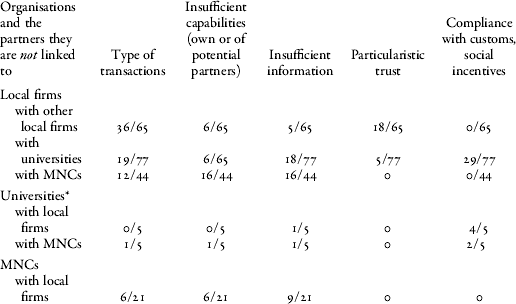
Table 5 provides a detailed summary of the most important reasons that actors identified as determinants for not engaging in collaborating linkages with a specific type of organisation. The first column from the left lists the organisations and the potential partners with whom they decided not to link. The second column shows the number of organisations that explained their decisions by referring to the type of transaction or business they run, such as their market specialisation or the sort of inputs they require. The third column shows the number of organisations that argued that they did not engage in linkages because either they or their potential partners did not possess the capabilities to do so. The fourth column lists the organisations that explained their choices by referring to the availability of information, and the last two those that referred to either particularistic trust or social incentives generated by customs, such as reputation within a given community.
Reasons for not Taking Part in or Forming Collaborative Linkages
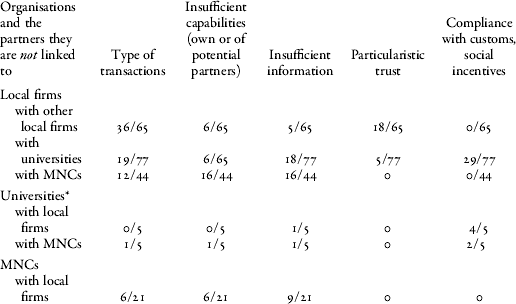
* In the case of universities, the five answers represent the opinions of five senior academics belonging to the only two universities that carry out research in ICT.
Source: author's elaboration based on interviews.
Linkages among local firms
Seventy per cent of the Costa Rican companies covered by the study provide generic ICT services for local businesses, supporting website development as well as the management of accounting, tax receipts and pension contribution records. Their services assist clients based in Central America, adapting existing products to local conditions and providing technical support.Footnote 46
The Costa Rican and Central American market for ICT services is characterised by a small number of large clients, many of them public, which offer remunerative contracts. Because they have little access to information about other export markets, many Costa Rican producers offer similar products to the same basket of clients, generating mutual rivalry and reducing incentives to collaborate. A local entrepreneur made the following comment, for example:
All of the Costa Rican ICT companies try to get a contract with the large Central American businesses … ICE [Instituto Costarricense de Electricidad, the national telecommunications and energy monopoly], INS [Instituto Nacional de Seguros, the national insurance monopoly] … This is why they always end up competing with each other for the same clients.Footnote 47
Fear that other local firms may use unfair tactics to win a specific contract explains why some producers mentioned that they ‘do not trust’ other Costa Rican companies to work with them. All of the local producers engaged in linkages with other Costa Rican firms sell most of their output outside Central America, and hence do not compete directly for the same clients.
The firms that export outside Central America are either software developers or providers of outsourced services. Among the former, some have developed highly specialised software such as programs to manage pension funds, which they export to several markets. The latter provide customised services, which require frequent face-to-face interactions with clients and with allied firms providing software applications, operating systems and databases. This allows them to charge higher fees than their competitors based in India, and to benefit from operating at short distance from the United States, where most of their clients are located.
The firms that exported beyond Central America explained that they reduced their costs through their linkages with other local firms, for example by sharing the same technological platform to develop two different products, and that they provided a broader range of services to foreign clients, for example by selling bundled software applications instead of individual products.
Size or years of experience did not have a significant effect on linkage formation. The 22 exporting companies that have established collaborative linkages are neither the largest nor the oldest firms: only five of them rank among the top 15 largest Costa Rican ICT producers in terms of sales, and only three among the largest 15 in terms of employment. The firms with linkages include two of the oldest companies in the cluster, which have been operating since the 1990s, but also 20 firms created between 2000 and 2007. According to the interviewees, the most important factor that determined decisions about collaboration with other local firms was whether they operated along similar business lines and targeted the same clients; this in turn affected particularistic ‘trust’, the second most important factor (Table 5).
Social ties affected the outcome in an indirect way. The few Costa Rican companies that export outside Central America are led by entrepreneurs who have contacts that are professionals working in the ICT industry abroad. They acquired these contacts through previous work or study experiences, and actively use them to support their internationalisation efforts – for example, to be introduced to clients abroad – or to find third companies willing to distribute their products. However, most local entrepreneurs lack social ties to professionals working outside Costa Rica, let alone outside Central America. This helps to explain why these companies focus on the Costa Rican and Central American markets, which creates incentives not to collaborate with each other.
When asked why they do not attempt selling in larger markets, many Costa Rican companies answered that in Central America they knew which clients to target, whereas in other locations they did not. Others mentioned language skills and way of doing business as a barrier, though they could not explain why they were not targeting large Spanish-speaking countries in Latin America, such as Mexico, Argentina, Colombia and Venezuela. This contrasted starkly with the perception of exporters, who, having maintained social ties with professionals working abroad, consider it a ‘normal thing’ to target the most promising markets rather than Central America, and also to cooperate with other local firms. Costa Rican producers commented that CAMTIC has greatly improved their image abroad through its marketing of Costa Rica as a hub for the knowledge economy. However, they also argued that in order to penetrate new foreign markets they would need more assistance, especially with regard to information about potential clients in specific fields of the industry.
Linkages between MNCs and local firms
MNCs argued that local companies lack the necessary competencies to work with them, and that since they operate in export processing zones they can import all of their inputs free of duty, which corroborates the findings of both Giuliani, and Paus and Gallagher.Footnote 48 Costa Rica Provee, a government agency in charge of matching local suppliers with MNCs, found it difficult to convince MNCs to buy even basic inputs locally.Footnote 49
Costa Rica Provee started as an independent agency partly funded by the Inter-American Development Bank. It was subsequently incorporated by the export promotion agency. It has a small budget, insufficient to hire professionals with experience in the different sectors it manages, which range from ICT to medical devices. As a result, its capacity to interact with MNCs was lower than that of CINDE, the investment promotion agency. CINDE has both a higher budget and an explicit policy of hiring people with proven private sector experience, who can liaise easily with MNC managers.Footnote 50 Its mission, however, is only to attract investments and to provide follow-up assistance, not to foster linkages. The main intermediary for MNCs in the cluster was CINDE. During the interviews MNC directors clarified that CINDE was the first organisation they would call for any issue they considered related to Costa Rica – for example, if they needed some information about regulations or infrastructure. None of the MNCs mentioned Costa Rica Provee as an organisation with which they are regularly in contact.
In order to promote linkages in the ICT cluster, Costa Rica Provee would need to have an in-depth knowledge of the ICT industry, as well as accurate information about both MNCs and local firms. In 2007, at the time of the fieldwork, it did not have any of these, and thus its work was circumscribed to promoting the purchase of basic products, such as packaging material, from local suppliers. With one exception, MNCs were also not part of CAMTIC, the chamber of Costa Rican ICT producers, a forum where they could acquire more information about local firms.
Besides the low capabilities of Costa Rica Provee, there are other reasons for the scarcity of linkages between MNCs and local firms, such as the type of activities that MNCs carry out in Costa Rica. Fifteen of the 25 MNCs that have invested in the cluster operate plants that assemble microchip-related components; there are no Costa Rican hardware manufacturers that can supply them with the necessary inputs.Footnote 51 These MNCs also use various types of ICT services which Costa Rican companies can, and in a few cases do, provide, ranging from specific software applications to the management of intranet systems. Out of these 15 MNC manufacturers, eight are small subsidiaries assembling components for Intel which have no capability and no mandate to buy inputs from local firms. The other seven hardware producers are large operations which carry out not only assembly but also R&D and back office and logistical support, and coordinate the purchase of software programs and ICT services from small providers based in the United States and other locations. Out of these seven, only one has linkages with Costa Rican companies that supply it with services such as website development, just-in-time logistic operations management and human resource management. One of these Costa Rican companies co-developed an enterprise resource management programme with the hardware manufacturing MNC which was subsequently adopted by several other subsidiaries of the same MNC.
Ten out of the 25 MNCs specialise in ICT services – for example, integrating software programs purchased from smaller firms and selling them in a bundle. Two of them are small operations which simply source their inputs from the parent company in the United States and process information in Costa Rica. The other eight have large Costa Rican subsidiaries which engage in direct relationships with their suppliers of software applications and specific services. Of these eight, only three have local providers.
The MNCs which have the capabilities to look for Costa Rican suppliers (seven of the hardware producers and eight of the service providers) claim that they would have more local partners if more Costa Rican companies possessed the necessary capabilities. However, the majority of MNC executives also admitted to having very little, if any, information about Costa Rican ICT producers. Several local firms also claimed to have little information about the activities of MNCs. This contributes to explaining why only four MNCs have linkages with local firms.
Information about the Costa Rican ICT cluster is not easy to gather, except for data on foreign direct investment produced by CINDE. Between 2004 and 2007, when the fieldwork was being conducted, data on Costa Rican ICT producers was unreliable. The Costa Rican government did not have an official list of the companies that operated in the cluster. This failure to generate up-to-date and reliable information that was easy to access made it more difficult for actors to find potential partners in the cluster.
In the Costa Rican case, the fact that the directors of MNC subsidiaries lack social ties to Costa Rican professionals working in the same cluster aggravated the information failure. The MNCs’ executives form a self-contained community because although they are from different ethnic backgrounds, the majority are expatriates (in 2007 only one MNC was directed by a Costa Rican) with few links to the local society. Seventy-six per cent of the MNC executives interviewed were from the United States, 8 per cent from Latin America, 4 per cent from Asia, 4 per cent from the Middle East and 8 per cent from Europe. Only 12 per cent of them spoke fluent Spanish. Among the Spanish-speakers, only the Costa Rican national showed himself to be interested in, informed about and linked to other actors, organisations and professionals in the cluster besides MNCs. All other MNC executives shared the context of being foreigners, as well as uncertainty about the next location to which their HQs would assign them. According to their own accounts, they do not have incentives to learn more about the socio-economic context in which they operate, precisely because they consider it temporary. They used ‘us’ to refer to expatriates and ‘them’ to refer to Costa Ricans. One MNC director neatly summed this up: ‘I do not have many Costa Rican friends. I hang out mainly with other expatriates. I know all about the multinational corporations and the foreign investors. But do not ask me about local firms.’Footnote 52
The interviews revealed that expatriates live in the same communities – for example, the gated communities located near the international airport, where most MNCs are based. They read the Tico Times, an English-language newspaper, listen to English-speaking radio stations, watch North American television, play golf in the same clubs (such as Cariari Golf Club or Los Sueños), and go to a limited number of restaurants and bars where English is commonly spoken by both staff and customers. Not having social ties to local actors operating in the same sector limits their understanding of the cluster, especially their knowledge of the businesses and competencies of local companies.
The director of the subsidiary of a US multinational whose explicit strategy includes looking for small ICT producers to incorporate into its global network of allied software developers was asked whether they had invested in any Costa Rican firms:
Author: Do you have any local partners?
Director: Are there Costa Rican software companies?
Author: There are 150 Costa Rican ICT firms, mostly software developers …
Director: What? 150 ICT firms? Here? I had no idea about that. I knew that there are a couple of firms … I know about multinational corporations that work here … You see, we don't really do much with local firms … We have our global partners, and partners are managed from the HQ … But that's good information though; maybe there are some good firms and we just have no idea. Do you know where I could find a list?Footnote 53
The MNC director was amazed to learn that his office was 20 metres away from one of the largest Costa Rican software producers. The conversation reported above shows that even when there may be economic incentives for MNCs to establish more collaborative linkages with local partners, information failure, partly caused by lack of contacts with ‘locals’, can hinder such efforts. In other cases the factors limiting the formation of linkages between multinationals and local firms are the specialisation and capabilities of local companies.Footnote 54
Linkages between universities and private firms
Linkages between universities and private firms, whether MNCs or local companies, are scarce in the cluster.Footnote 55 Most MNCs do not undertake R&D activities in Costa Rica, and thus have no incentives to engage universities in joint research projects. In other words, the types of activities that MNCs carry out in Costa Rica (the nature of transactions and the MNCs' operations overall) impede the development of contacts. The MNCs that do have R&D departments do not interact with local actors because it is beyond their mandate, and there are no partners with adequate competencies to carry out joint research activities.Footnote 56 Universities claim that they do not possess enough information about the type of research that would be useful for MNCs, and that in several fields they may not have the competencies to work with MNCs such as Intel.Footnote 57 In addition, when interviewing Costa Rican academics and ICT producers, it became clear that customs and social norms were another important factor hindering the formation of linkages.
Academics and local entrepreneurs share similar ethnographic profiles: most of them are Costa Rican males who have studied electronic engineering or informatics in the two public universities. Yet they perceive themselves as belonging to two different communities, defined by their profession and role in society. They interact most often with members of their own community, academics with academics and entrepreneurs with entrepreneurs. Most of them study and work in the same country, target domestic clients and have little contact with external actors operating in the same sector or with MNCs.
Among academics, collaborating with the private sector is still considered inappropriate, as testified by the experience of a professor-turned-businessman who has been marginalised and had career obstacles thrown up before him because he had established a spin-out firm that collaborated with researchers from the university. Costa Rican academics follow a long-standing custom of not collaborating with the private sector, which they perceive as distorting the nature of scientific research. Cumbersome regulations regarding universities’ relationships with the private sector, such as limits on the right of academics to earn extra income from consulting and other activities, strengthen these customs.
Studies of the emergence of university–private sector linkages in the United States show that initially academics also resisted commercial involvement there. US universities took some decades to establish routines (or institutions) that normalised research activities carried out with private sector partners and to integrate these routines into the mission that defines the academic profession.Footnote 58 However, there are now a number of Costa Rican academics who do perceive incentives to change their customs, which suggests that they may be in the first stage of a gradual transition towards establishing linkages with ICT companies.
Some 37 per cent of local producers pointed out that in the cluster it is not a ‘normal thing’ to work with universities, and that they would consider it only if the latter changed their bias against the private sector; 24 per cent explained that their business is not compatible with a potential linkage to a university; and 23 per cent claimed not to have enough information about universities. Finally, 8 per cent were concerned about the capabilities of universities to work with them, and 6 per cent about universities’ ‘trustworthiness’ as partners in a hypothetical linkage. The custom of not working jointly seems, therefore, to be an important factor not only for academics but also for local producers, who regard universities as ‘too left–wing’ and ‘too anti-business’. Information failure stemming from the fact that academics and ICT professionals do not communicate with each other emerged as the second most important factor hindering linkage formation.
There are only two cases of academics starting an ICT company linked to the university where they work. Both of them are professionals who have studied and worked abroad, where they observed that linkages between universities and companies can generate interesting synergies. Their social ties to professionals abroad informed them about the different ways in which they could find commercial avenues for their research work. Both of them expressed their concerns about their involvement in the private sector being badly received in their faculties.
Conclusion
A growing number of countries in Latin America are adopting policies to promote the formation of ICT clusters, often attempting to emulate the case of Costa Rica. Many of these ‘clusters’, despite diverging from some of the definitions developed by the literature, have already become part of the discourse of donors, governments, enterprises and other stakeholders in the region. The fact that they differ from the models of Silicon Valley and the Italian industrial districts – often considered as benchmarks in the academic literature – suggests that it may be useful to ‘Latin Americanise’ the concept of the cluster, taking into account how the term is received and understood in the region.Footnote 59 The Costa Rican case illustrates that, in spite of their limitations, new ICT clusters can generate highly skilled jobs, attract investments in technologically advanced sectors, and foster exports of sophisticated goods and services.Footnote 60 They are tangible examples of development policy which deserve to be examined.
This study has corroborated some arguments made by other scholars – for example, the fact that MNCs lack incentives to search for local partners because they operate in export processing zones, or that many of the local firms and universities have insufficient capabilities to work jointly with MNCs.Footnote 61 It has also discussed features of the cluster that earlier authors had not yet examined, revealing that information failure is an important obstacle to the formation of linkages.
In Costa Rica, this problem stems primarily from the insufficient efforts made by the government to identify the organisations that form the cluster, monitor them and circulate this type of information, an issue that CAMTIC, the sectoral organisation of the cluster, is attempting to address. Information failure is aggravated by the social disembeddedness of the expatriates who direct the subsidiaries of multinational firms and by the fact that local academics and entrepreneurs tend not to interact with each other.Footnote 62 Costa Rican academic institutions lack linkages with the private sector because the prevailing custom among academics is to avoid this type of venture. Local firms retort that they are unwilling to approach universities unless the latter adopt a friendlier stance towards collaborating with the private sector. There are, however, signs that these customs are changing, which may foster the emergence of new linkages in the cluster in due course.Footnote 63
Within the Costa Rican ICT cluster, the number of local firms is still limited. Too many of them develop similar products and target the same clients, and hence fail to grow. Remaining focused on the Costa Rican or Central American market reduces the opportunity for them to cooperate with one another and with MNCs. This aspect of the findings is consistent with the tenets of transaction cost economics. As predicted by the principles of economic sociology, social ties also help to explain the phenomena observed.Footnote 64 The few local entrepreneurs who had contacts with professionals working abroad were also those who exported to countries outside Central America and established collaborative linkages with other local companies because they were not competing for the same clients. Local entrepreneurs who lacked contacts outside the cluster followed the example of other Costa Rican firms, targeting Central American clients only.
This study also demonstrates the value of a multidisciplinary, multicausal approach, a method particularly useful for the study of new phenomena such as the Latin American ICT clusters.Footnote 65 Although generalisation of findings from a single country case study may be limited, the study does offer a basis for hypothesis testing regarding linkage formation in other Latin American countries.
The policy implication is that unless both economic and social obstacles to linkage formation are tackled, policies that promote ICT clusters may fail to generate the outcomes intended. Information failure, an obstacle hindering the formation of different types of linkages, is caused partly by lack of communication among the actors within the cluster. The local procurement agency does not interact frequently with MNCs. Due to resource constraints, it has insufficient information on both MNCs and local firms to function as a broker fostering linkage formation. MNCs interact mainly with CINDE, the investment promotion agency, which also assists them after their initial investment. CINDE, however, has no contact with local producers, as this falls outside its mission. CAMTIC is in touch with most local firms but has very limited contacts with MNCs, only one of which has become a member. As a result, there are no organisations or forums where MNCs and local firms interact on a regular basis.Footnote 66
Costa Rica could put pressure on MNC subsidiaries to become members of CAMTIC, attend a minimum number of its yearly meetings and contribute to its efforts in collecting and processing information about the cluster. Alternatively, it could expand the mission and financing of CINDE. With extra resources, CINDE could take advantage of its highly respected reputation with MNCs, gather information about the inputs they need and serve as a bridge linking them to local providers with sufficient capabilities. CINDE could work jointly with CAMTIC to achieve this objective. In order to reduce information failure, therefore, the government of Costa Rica should invest more resources in the gathering and diffusion of information about the cluster, either by supporting CINDE and CAMTIC or by creating its own databases of firms and their specialisations. It could also sponsor events that facilitate the formation of social ties between MNC directors and local entrepreneurs.
Given that the two research universities are public, the government might also provide incentives for academics to change their customs, such as simpler regulations related to the formation of linkages with the private sector. It could also integrate universities more closely with the activities of CINDE and CAMTIC. Finally, different policies could be adopted to foster the internationalisation of local firms outside the Central American region, which should also reduce obstacles to the formation of linkages among them. Evidence from the Israeli, Taiwanese and Indian ICT industries suggests, for example, that overseas study programmes can be an important means of supporting the internationalisation of local firms.Footnote 67
In order to develop the international links of its ICT sector, therefore, the Costa Rican government could provide overseas study scholarships for domestic and foreign students of engineering and computing, as well as financing local producers’ participation in international technology fairs. It could also support the opening of offices to promote Costa Rica's ICT services abroad, as it has already done to promote investment and tourism in Costa Rica. When observing the Costa Rican case, it is important to note that the cluster, like other high-tech agglomerations in Latin America, is still relatively new. It is possible that as the number of Costa Rican firms increases, the cluster will become more outward-oriented and develop more linkages. Given that most Latin American countries export only a minor share of their domestic ICT production and that they began promoting ICT clusters only recently, it would be interesting to explore whether they suffer from similar problems to Costa Rica's.Footnote 68
Certainly, the Latin American countries that are promoting ICT clusters should watch the Costa Rican case closely, taking note not only of its success in attracting foreign investment but also of its difficulties in fostering linkages among firms, especially between MNCs and local entrepreneurs. This study suggests that these countries should try to avoid information failure, monitoring their clusters accurately from the early stages of their development. The Costa Rican case illustrates that it would be beneficial to examine the specialisation of their domestic firms and, if necessary, provide information and services to support their internationalisation.