

Introduction
The referendum is a ‘device’ of direct democracy (Morel, Reference Morel2011) enabling citizens to express opinions on a specific issue. Accordingly, the aim to explain citizens’ voting choices in referenda implies considering a kaleidoscopic set of factors related to national contexts, individual attitudes and both political and civil society actors. According to LeDuc (Reference LeDuc and Pammett2002), factors such as party cues, social cleavages and ideology have a stabilizing effect, making citizens’ voting predictable. Other factors such as campaign events, government actions and the economy, on the contrary, increase uncertainty (or ‘volatility’, LeDuc, Reference LeDuc and Pammett2002), because of their contingent nature. The weights of each factor along a continuum between predictability and uncertainty explain referendum outcomes in each context (LeDuc, Reference LeDuc and Pammett2002, 714, figure 1). These weights, however, are not the only explanations of voting choices. Political actors are indeed very important from the very beginning of a referendum, when a coalition proposes a ballot paper. How do institutional actors affect voting in a referendum? And, specifically, how does the engagement of the government (and its leader) affect citizens’ voting? Our study addresses this last question by investigating the case where the government, along with its leader and parliamentary coalition, takes the initiative in a referendum.
Studies on European integration have shown that attitudes towards the government affect people’s voting in referenda on EU treaties (Franklin et al., Reference Franklin1995). In these cases, where the referendum issue was not the most salient and there were ‘first-order’ national issues prevailing on the European ones, people used proxies to cast their vote, resulting in more likelihood of approving EU Treaties when confidence in the incumbent government was high.Footnote 1 Except for the referenda on European integration, the effects of government direct engagement in a referendum campaign remain underexplored. How do predictability and uncertainty factors interact in these cases? Does the government become the fulcrum around which explanatory factors of voting work?
The present study will investigate the impact of government-led referenda by focussing on the Italian constitutional referendum of 2016. As we will see in the next section, this case is crucial since Renzi’s government represented the engine of constitutional reform and the prime minister resigned after the (negative) referendum results. Our analyses prove that the leading role of the government in the referendum campaign reshaped explanatory factors of voting within a dynamic of being for/against the incumbent government. These factors are shown to be significantly relevant when related to both the characteristics and the performance of Renzi’s government, while the impact of the leader’s image remains marginal.
The first section shows the commitment of the government towards the approval of the reform. We then go on to present a theoretical framework within which seven research hypotheses have been formulated. Third section describes the variables, the data and the models used to test the hypotheses. Finally, we will show the results of the study, concluding with theoretical and empirical remarks.
The Renzi-Boschi constitutional reform
The Renzi-BoschiFootnote 2 reform was a proposal for constitutional reform that started formally on the 8 April 2014 with a draft law presented to the Parliament by the government coalition of the former Italian Prime Minister Matteo Renzi. It established several changes within the Italian institutional system including: an end to the equality between the two Houses of Parliament,Footnote 3 a reduction in the number of members in the Senate and their indirect election,Footnote 4 direct elections only for the Chamber of Deputies, limits to the legislative power of the regions (Title V, Art. 117), a change in the rules of direct democracy instruments such as the referendum and the laws of popular initiative, the abolition of the provinces and of the National Council for Economics and Labour (CNEL).Footnote 5
The reform was strongly linked to a new electoral law (nicknamed the Italicum) establishing a new set of rules, with the main aim to give to the most voted list (reaching 40% of the votes) a large majority within the Chamber of Deputies.Footnote 6 It was definitely a part of the new constitutional design defined by the Renzi-Boschi reform and was integrated within the arguments for and against the reform during the electoral campaign by both opponents.
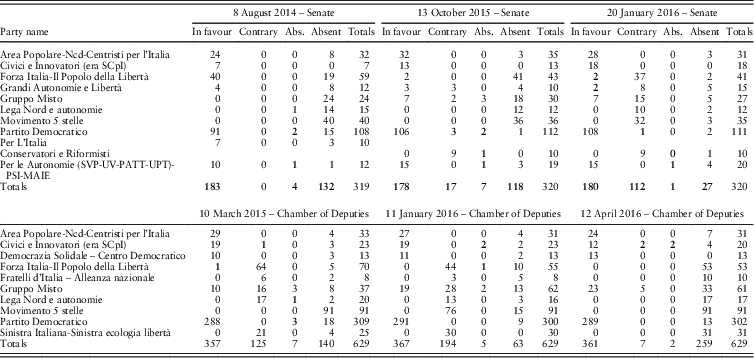
The reform followed the Patto del Nazareno,Footnote 7 an agreement between Renzi and the leader of the right-wing opposition Silvio Berlusconi. The agreement concerned crucial changes to the Italian political system such as constitutional reform, the electoral law, and the forthcoming election of the President of the Republic (Parisi, Reference Parisi2015; Pasquino, Reference Pasquino2016). The Patto del Nazareno was broken by Berlusconi the following year during the process that brought the constitutional reform for approval before the two Houses of Parliament. This process, as stated by the Constitution, establishes that each constitutional reform must be approved twice in an identical form in both the Senate and the Chamber of Deputies.Footnote 8 As a result the Renzi-Boschi constitutional reform was voted on six times from August 2014 to April 2016.Footnote 9 On 15 April, the official Journal (Gazzetta Ufficiale) of the Republic published the reform. An overview of the votes cast in the two Houses by each party/group gives a clear picture on how political groups and partiesFootnote 10 supported the reform within Parliament (see Table A1 in the Appendix). Groups and parties supporting the government (Democratic party – PD; Centrists – Area Popolare, NcD, Centristi per l’Italia, Civici e Innovatori per l’Italia; For Autonomies – SVP, UV, PATT, UPT, PSI, MAIE; Democratic Centre – Democrazia Solidale, Centro Democratico) approved the reform almost unanimouslyFootnote 11 in all the roll call votes.
The same occurred within the parties and groups of the opposition. The Northern League, the Five Stars Movement, Italian Brothers, Left Ecology and Liberty, and the Conservatives and Reformists unanimously rejected the reform either casting opposing votes or exiting from the House at the time of voting. No members of these parties approved the reform throughout the entire process. Berlusconi’s party, Forza Italia, on the contrary, shows a clear U-turn: it approved the reform at the first vote in 2014, agreeing with the Patto del Nazareno, but then voted against in the following calls. At the end, very few members (about two in the Senate and one in the Chamber) of Forza Italia approved the reform from the second roll call voting. The Mixed Group voted mainly against or exited from the room in both Houses, although on average one third of its members approved the reform.
The analysis of the votes cast by each group/party within the Parliament shows that from when the Patto del Nazareno ended, the constitutional reform was mainly a product of the government coalition. This coalition, despite the diverging opinions in the Democratic Party that appeared during the electoral campaign, showed a high level of alignment and few opposing deputies.
The second important finding demonstrated by this analysis is that the reform was approved by simple majorities in both Houses. In April 2016, this led some deputies of the majority and the opposition to make a request for a constitutional referendum, by virtue of article 138 of the Constitution.Footnote 12
The following electoral campaign showed that Renzi’s government was highly committed to gaining a ‘yes’ majority in the referendum. On 2 May 2016 in Florence, Renzi announced a massive electoral campaign by the governmental forces with about 10,000 groups of supporters throughout Italy. He also affirmed that the constitutional reform was the biggest challenge for his government.Footnote 13 Some newspapers reported that the Prime Minister conducted about 90 meetings to support the vote for the reform in a couple of months,Footnote 14 hiring international strategists (such as Obama’s staff member Jim Messina) and spending about 3 million euros out of the budget of the Democratic Party.Footnote 15 The parties were not the only political subjects bearing large expenses during the campaign. The government also had expenditures linked to the campaign. These include the travels of the Prime Minister and his members of cabinet to campaign for the reform, and millions of letters (both in Italy and to Italian residents in other countries) to explain the reasons for approving the reform. Finally, during the campaign, Matteo Renzi tied the result of the referendum to the life of the government itself by saying that if citizens rejected the reform he would resign.
These arguments show that Renzi’s constitutional reform, although transforming fundamental aspects of the Italian political and institutional system, was first of all a product of the Prime Minister and of his government. As Pasquino argued ‘Renzi has already deliberately transformed this into a plebiscite on his person and has indicated that his governmental and, possibly, even his political career will come to an end if the voters reject his constitutional reforms’ (Reference Pasquino2016: 397). The government, and the parliamentary groups supporting it, created the reform, approved it (almost unanimouslyFootnote 16 ) within the Parliament, spent many resources to persuade citizens to vote ‘yes’ in the referendum and ended its mandate following the referendum.
The constitutional referendum held on 4 December 2016 did indeed reject the reform, and 3 days later the Prime Minister resigned.
Research hypotheses: the role of the government in the referendum vote
Referenda present by definition crucial differences with elections (LeDuc, Reference LeDuc and Pammett2002), and are very context dependent. Voting choices in a referendum relate at least to: (a) the issue which the vote refers to; (b) the alignment of the parties on voting options (LeDuc and Pammett, Reference LeDuc1995; Johnston et al., Reference Johnston, Blais, Gidengil and Nevitte1996; Hobolt, Reference Hobolt2009); (c) the rules and the institutional contexts where referenda are held (Vatter, Reference Vatter2000; Aguiar-Conraria and Magalhães, Reference Aguiar-Conraria and Magalhães2010); (d) short-term political issues not necessarily linked to the referendum issues (Franklin, Reference Franklin, Van der Eijk and Marsh2002); (e) the media framing (Lupia, Reference Lupia1992; Bowler and Donovan, Reference Bowler and Donovan2002; de Vreese and Semetko, Reference de Vreese and Semetko2004; de Vreese, Reference de Vreese2007); (f) old and new ideological divisions (Sinnott, Reference Sinnott2002); and (g) the performance of the government (Franklin et al., Reference Franklin1995).
All these factors, although together forming the voting choice, have different weights in explaining uncertainty and, therefore, the referendum results. According to LeDuc (Reference LeDuc and Pammett2002), it is indeed possible to draw a continuum from voting predictability (i.e. voters’ clear divisions within society and politics that lead to very predictable results) to uncertainty (i.e. unexpected alignments and referendum outcomes). Factors such as social cleavages, ideologies, beliefs, and party cues increase predictable outcomes. While campaign events, media, government performance, and the state of the economy give rise to uncertainty. Predictability factors mostly pertain to the ideological sphere, while uncertainty factors mainly relate to contingent situations and attitudes.
In a logic of zero-sum competition, the main political subjects of a referendum (namely the political groups, parties and forces supporting the two opposing positions) take advantage of factors increasing predictability and suffer from elements that raise uncertainty. What is the role of the government in this process? Quite often the government takes a clear position promoting one of the two sides. When this happens, it brings some important advantages into the electoral competition but also critical aspects increasing uncertainty. Governmental intervention in a referendum increases visibility, reinforces party cues, and ideological aspects. However, although the issue at stake could be very far removed from governmental activity, the involvement of the government in the referendum campaign implies an increase in uncertainty, because of government popularity and judgements on its policies. Franklin et al. (Reference Franklin1995) showed that, in the cases of the referenda on the Maastricht Treaty in the early 1990s, support for government played a crucial role in the final results, as a proxy effect. By starting from the same theoretical perspective, we want to see how predictability and uncertainty factors have been moderated by government action. We will then move to an extreme theoretical implication of the proxy effect by showing whether the direct complete involvement of the government, as in the Italian referendum of 2016, transforms it into the fulcrum around which explanatory factors of voting leverage.
We group these factors into two types: ideological (increasing predictability) and contingent (increasing uncertainty). The models testing our hypotheses will also include other factors considered as control variables. The reasons for including these controlling indicators will be explained in the methodological section.
Ideological factors increasing predictability
According to the continuum traced by LeDuc (Reference LeDuc and Pammett2002), in the 2016 referendum, the governmental majority is supposed to gain consensus first of all on classical attachment and ideological factors. As a result, our first hypothesis is that voters who indicate being closer to a party within the government coalition are more likely to approve the constitutional reform (Hypothesis 1).
Closeness/distance from a party within the government coalition, however, cannot fully represent ideological orientations on a left-right continuum. Ideological positions do not indeed fully overlap with party closeness especially in a context, such as the Italian case, where the biggest party of the opposition (i.e. the Five Stars Movement) refuses to take a clear position on the left-right continuum. In this case, then, voters’ ideology may be ‘independent’ from party closeness. As a result we expect that ideology also has an effect on voting even when party closeness is considered. This effect is related to the ideological ‘nature’ of the government coalition that, although involving both centre-left and centre-right parties, shows the paramount role of the Democratic Party, imprinting on the government a centre-left orientation. According to this observation we expect that right-wing voters will be more likely to reject the reform (Hypothesis 2) and voters placing themselves at the extremes of the ideological continuum (extreme left and extreme right), will tend to oppose the reform (Hypothesis 3).
Contingent factors increasing uncertainty
Along with ideological factors, other studies in the field showed a proxy effect of attitudes towards the government in cases of referenda concerning complex and not salient issues (Franklin et al., Reference Franklin1995). The Italian referendum of 2016 may be included in these cases due both to the characteristics of the issue (a technical constitutional reform) and the direct involvement of the government. As a result, contingent sentiments about the government may have played a crucial role in voting choices: beyond ideological constraints people approve (or reject) the performance of the government, influencing voting. Accordingly, we expect that positive overall judgements of government performance make voters more likely to vote YES (approve the reform) in the referendum (Hypothesis 4). Moreover, as voters punish or reward the incumbent government on an economic evaluation (see Lewis-Beck and Paldam, Reference Lewis-Beck and Paldam2000), both perceptions of the current state of the economy and the evaluation of economic policies are supposed to affect voting in the referendum. Accordingly we hypothesize that voters perceiving the economic situation negatively tend to reject the reform (Hypothesis 5a) and negative evaluations of the employment policy increase the probability of rejecting the reform (Hypothesis 5b).
How do performance evaluation and ideology interact on voting? And specifically, if ideology is supposed to produce predictable results, which side of the ideological continuum is expected to be influenced by judgements on performance?
Once again the centre-left nature of the government coalition suggests that extreme right voters would refuse the reform no matter what their judgement on government performance, because they are the most distant in ideological terms. Extreme left voters, on the contrary, are expected to be more affected by government performance and more likely to vote yes as they have good judgements. As a result: the interaction between judgements of governmental performance and voters’ ideology has a positive effect on the approval of the reform for extreme left voters and negative for extreme right voters (Hypothesis 6).
Up to this point, we have considered the government as an institutional actor resulting from the cartel of different political parties. Along with the parties of the government coalition, however, the prime minister is the main figure representing the government. He/she gives the name to the incumbent government and predominates in institutional terms (see Calise, Reference Calise2007) and in the relationship between citizens and the government coalition. Moreover, since the personalization of politics increases the prominence of the leader within parties and institutional actors (for the Italian case see the special issue of Bellucci et al., Reference Bellucci, Garzia and Lewis-Beck2017), the image of the leader may have a crucial role in shaping citizens’ attitudes towards the government and, then, in voting choices in a referendum where the government has a leading role. The charismatic personality of Matteo Renzi could have strongly affected voting choices: by approving or rejecting the reform, voters expressed a clear approval/rejection of Renzi as leader and Prime Minister. Renzi’s declarations about the future of his own political career may have empowered voting on leadership: voters having negative views about Renzi realized the opportunity to put an end to his government leadership and political career by rejecting the constitutional reform. Accordingly we will test whether attitudes towards Matteo Renzi affect voting choices for or against the reform (Hypothesis 7).
Data, variables, and methods
In order to test our research hypotheses, we used the Italian National Elections Studies Association (ITANES) referendum surveys, conducted by the ITANES on a representative sample of the Italian population 6 months before the constitutional referendum of 2016 and after the vote of 4 December 2016.Footnote 17 The panel of respondents (about 3050) has been interviewed through similar questionnaires.Footnote 18
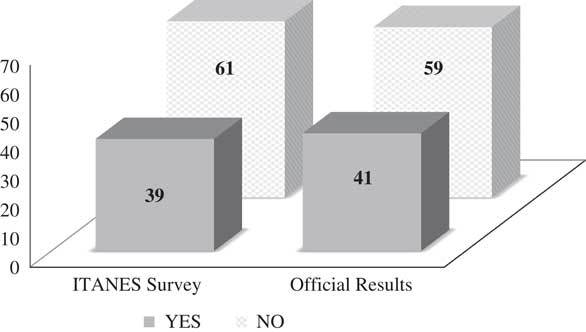
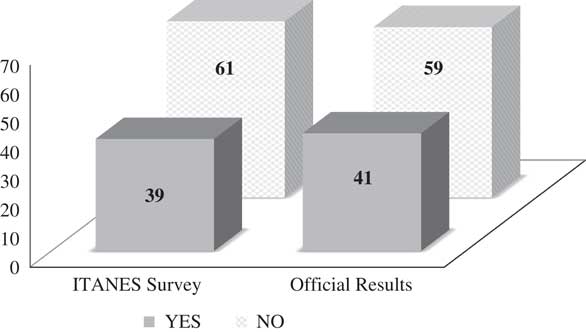
Our dependent variable is the voting choices declared after the referendum vote. The question reads as follows: How did you vote in the referendum of 4 December? In the explanatory model, we retained only cases of ‘I voted No’ (recoded as 0), and ‘I voted Yes’ (recoded as 1), while other answers (blank voting and ‘I did not vote’) were dropped.Footnote 19 Descriptive analyses show that voting choices collected by the survey overlap with real voting cast at the referendum (Figure 1).
Voting choices Italian National Elections Studies Association (ITANES) 2016 and official referendum results in percentages. ITANES pre–post-referendum survey 2016 and Ministry of Interior (interno.gov.it).
The first independent variable considered is closeness to a party of the government coalition. We first identified the parties which respondents feel closer to, by using two specific questions.Footnote 20 After that we created a new variable indicating whether respondents’ closeness refers to a party in the coalition supporting the government (PD, NCD, UDC, DS, SC, PSI, CD, Indipendenti) or to a party of the opposition.Footnote 21 We then considered the degree of closeness to the selected partyFootnote 22 and merged the two variables to generate one with the following categories: very close to an opposition party (0), fairly close to an opposition party (1), not very close to an opposition party (2), no identification with any of the parties (3), not very close to a government party (4), fairly close to a government party (5), very close to a government party (6).
This is the crucial variable to test Hypothesis 1 (people who indicated being closer to a party within the government coalition are more likely to approve the constitutional reform). Ideology has been operationalized through two variables: the first measures the respondents’ position on a 10-point left vs. right scale;Footnote 23 the second uses the same scale but distinguishes not radicals (respondents reporting values between 3 and 9 included) from extremists of the left (respondents reporting values from 1 to 2) and of the right (values from 10 to 11). Ideological positions will be used to test Hypotheses 2 and 3, the variable distinguishing extremists (of the left and of the right) from not radicals will also be used to test Hypothesis 6. Voters’ evaluation of government performance is another variable measured on a 10-point scale questionFootnote 24 and will be used to test Hypothesis 4. The effect of performance was also tested for the employment policy launched by the Renzi government with the ‘job act’ reform. We labelled it support for job policy,Footnote 25 and used this variable to test Hypothesis 5b; while perceptions of the economic situation in the last yearFootnote 26 (testing Hypothesis 5a) have been recoded into three categories (much/somewhat worse; much/somewhat better; and the same). Hypothesis 7 is tested by using the leaders’ barometer question of the survey. This asks respondents to evaluate different political leaders (included Matteo Renzi) on a 10-point scale ranging from ‘completely negative’ and ten ‘completely positive’.Footnote 27
Along with some socio-demographic variables (gender, age, education,Footnote 28 and occupation), we also added other control variables that will allow us to test for the robustness of our results. Some of these indicators control for respondents’ orientations towards the reform and for their actions during the electoral campaign. We specifically included in the models opinions on the electoral law,Footnote 29 interest in the referendum campaign,Footnote 30 timing of the voting decision,Footnote 31 activism on the internet,Footnote 32 and a knowledge index.Footnote 33 The first will show the link between the constitutional reform and the electoral law in voters’ minds. The two laws have been conceived as complementary parts of the reform of the Italian institutional system and we expect them to be related to each other. The existence and the strength of such relation will show voters’ agreement to a complete reform of the political system. Knowledge of the reform and interest during the campaign (along with education) will control for respondents’ cognitive skills and will test whether people having better knowledge of the reform and more interest during the campaign tended to support one of the two sides. Also, activism on the internet will test whether more active people are more likely to vote in a specific way. Unfortunately this is the only kind of activism during the campaign that we are able to measure, since the questionnaire does not investigate other forms of activism. Vote timing will control whether the time of voting decision has played an effect on voting choice. This information may be important for understanding and controlling the effect of predictability and uncertainty, since it may show some patterns in voting choices related to an early (months before voting) or ‘late’ (inside the polling booth, at the moment of voting) decision. We finally controlled for attitudes towards the EU and specifically for support for the EuroFootnote 34 and the EU.Footnote 35 The inclusion of these variables reflects the growing influence that the issue of European integration has in national politics (see among others Evans, Reference Evans1999 and Gabel, Reference Gabel2000). Moreover, this is a very sensitive issue for some parties in the opposition such as the Five Stars Movement and the Northern League, brandishing populist arguments against the single currency and the EU nomenclature.
In order to test the hypotheses, we ran three different logistic regression models which fit using maximum likelihood (VCE oim). The models are equal except for the indicators related to ideology. These variables (i.e. left-right and extremism) are used to test three different hypotheses (2, 3, and 6) and should be included separately in the models since they are based on the same information (left-right self-positioning).
We also made robust checks by running the same models on a (dependent) variable distinguishing between people voting (coded as 0) from people abstaining (coded as 1). The reason to conduct this check concerns the fact that non-voting in the Italian history of referenda has represented a way to contest the reform at stake. In this case, however, the absence of a specific quorum to make the referendum valid has deprived non-voters from an abstaining power: whatever the quorum in the referendum it will indeed be valid. Our results confirm that our main independent variables have no effect on non-voting.Footnote 36
Results
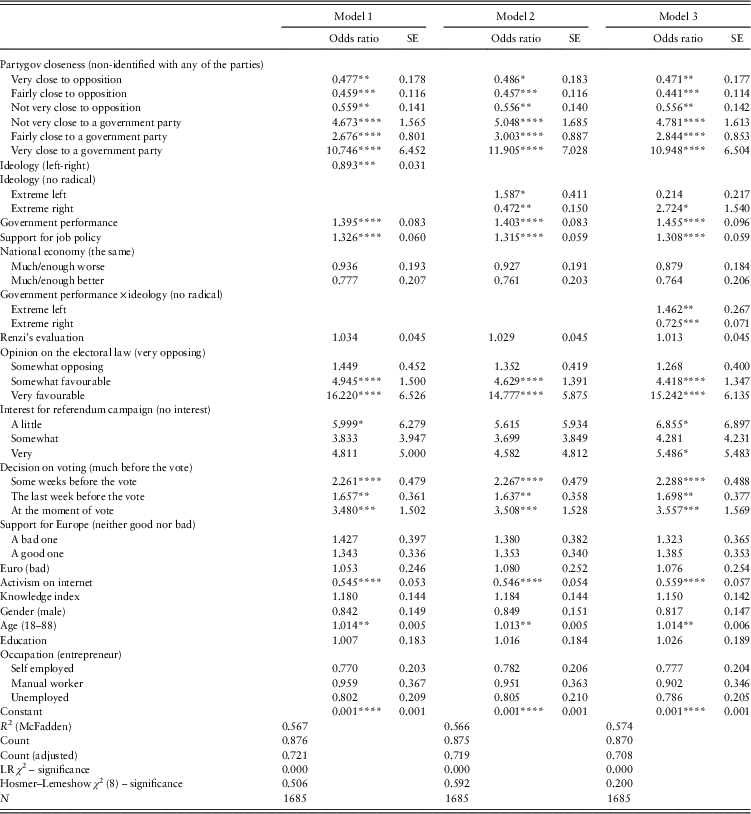
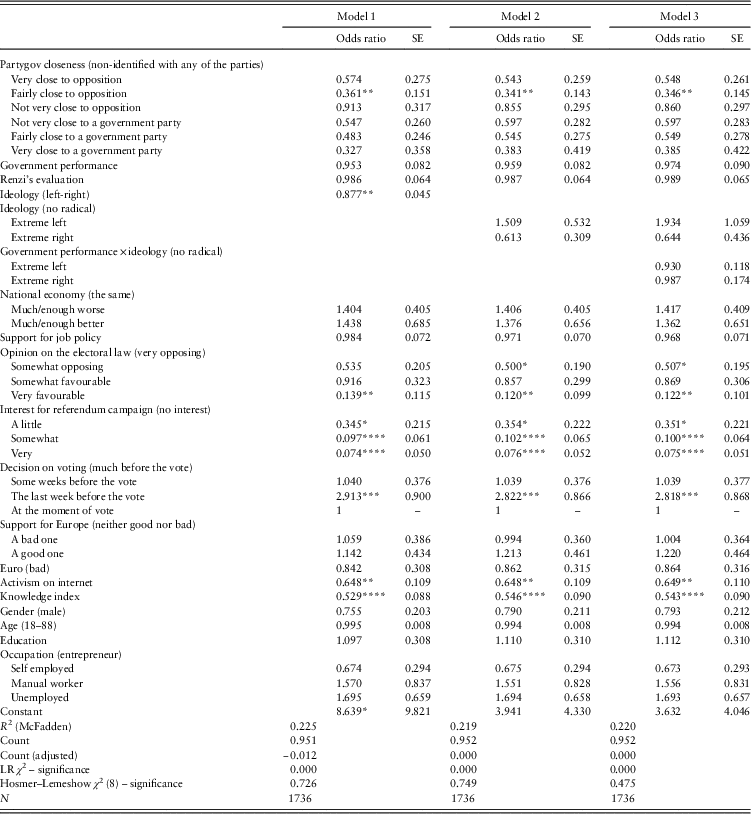
Table 1 shows the odds ratio of the three models built to test the hypotheses formulated in this study. We opted to describe the table for each observed variable (rows), rather than for each model (in columns), since all the variables show consistent results (significance level and direction) through the three models.
Predictors of support for the constitutional reform.

****P<0.001; ***P<0.01; **P<0.05; *P<0.10.
Italian National Elections Studies Association pre–post-referendum survey 2016.
Closeness to a party significantly affects voting choice during the referendum. People feeling closer to a party in opposition tend to reject the reform. Since odds ratios are quite similar for the three levels of closeness (very, fairly, and not very), voting ‘no’ does not seem strongly related to how close the respondent was to a party of the opposition. In contrast, people close to a party of the government, although they tend to all vote yes, have more odds to approve the reform when they feel ‘very close’. All in all we can confirm that there is a significant and positive relationship between voter closeness to a party in the government coalition and voting yes (Hypothesis 1). Similarly, our analyses of model 1 confirm that right-wing voters tend to reject the reform (Hypothesis 2). Ideological distance from the centre-left governmental coalition is also shown to affect radicals but with opposite results (model 2): left radicals have higher odds to approve the reform while right radicals significantly tend to reject it.Footnote 37 As a result, Hypothesis 3 is only partially confirmed, because those on the extreme left are more supportive of the reform than not radicals. Voters judging positively the performance of the government, significantly tend to approve the constitutional reform (Hypothesis 4). This result is reinforced by the odds of support for the governmental employment policy: respondents approving the ‘job act’ tended to vote yes in the referendum (Hypothesis 5b). At the same time, a true economic voting effect could not be argued since evaluations of the progress of the national economy have no significant effect on voting (Hypothesis 5a rejected).
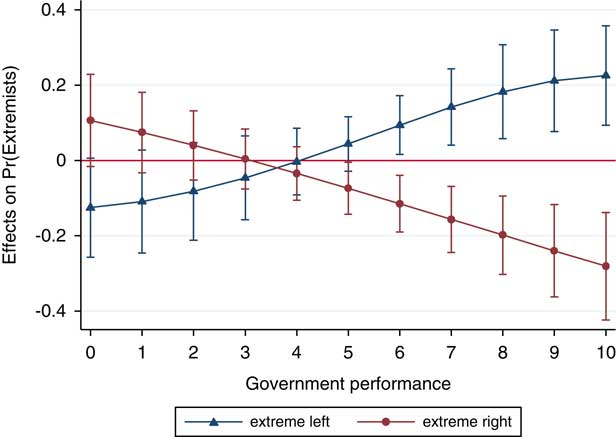
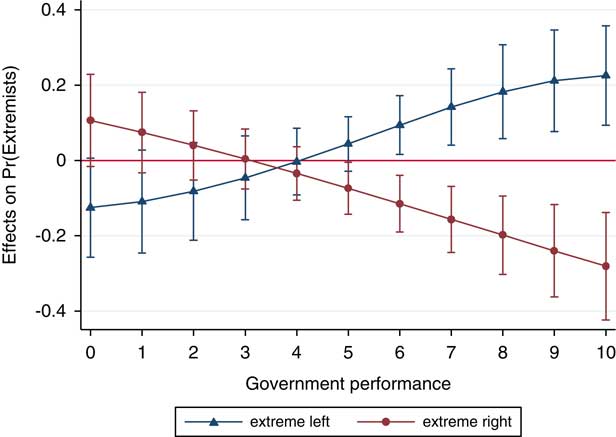
When we make an interaction between the judgements of government performance with extremism we find that these two variables create significantly different outputs for right and left extremists. The first will tend to reject the reform even if the evaluation of the performance of the government increases. Extremists on the left, on the contrary, will tend to approve the reform as positive judgements on government increase (Figure 2) (Hypothesis 6). Although evaluation of governmental performance has been shown to be a significant factor affecting voting choices, attitudes towards the prime minister do not show statistically significant results (Hypothesis 7 rejected). Beyond the personalization of politics, our results show that people seem to target the government rather than the person leading it.
Marginal effects of extremists on the referendum vote as government performance changes.
The control variables do not report any surprising results. Socio-demographic variables are basically not significant except for age: older people (slightly) tend to support the reform. Consistently with the results on education, the index of knowledge of the reform does not show significant results. Activism, however, is shown to significantly affect voting. Being interested in the referendum campaign (both at the lower and the higher level of the scale in model 3) increases the odds of voting yes, while respondents active on the internet tend to reject the reform. This is a quite interesting evidence since it suggests that the internet was the favoured field of activists of the opposition.
Opinion on the electoral law is strictly linked to that of the reform: voters very favourable to the electoral law have the highest odds to vote yes in the referendum. The timing of the choice to vote has the same positive sign for the three options (weeks before the vote, last week before, and at the moment of the vote) and clearly shows that people who decided close to the voting date (from some weeks onward) have higher odds to vote yes than people deciding much before the vote. According to these results, the government campaign seems to have been successful in convincing uncertain people to support the reform.
Support for both the European Union and the Euro did not play any significant role in voting choices although recently the main opposition (the M5S) party launched a campaign against the EU common currency.
Conclusions
This study investigates explanatory factors of voting in a referendum, by focussing on the 2016 Italian referendum on the Renzi-Boschi Constitutional reform. It represents an emblematic case of government engagement as the reform was conceived and supported by the government coalition. Its results are, therefore, crucial to understand the effects of government engagement on citizens’ voting in referenda.
By using the ITANES pre–post-referendum survey data and applying different logistic regression models, we show six main results:
1. Party closeness strongly predicts voting choices, and particularly: people who indicated being closer to a party within the government coalition are more likely to approve the constitutional reform (Hypothesis 1 confirmed). The higher the degree of closeness the more likely are people to vote yes.
2. Ideology matters, although it acquires a specific meaning only when considering the distance from the Renzi centre-left government. People on the right and extreme right of the political spectrum tend to reject the reform. Radicals of the left, less distant ideologically, will tend to approve the reform especially as positive evaluation of the performance of the government grows.
3. Positive overall judgements of the government make citizens more likely to approve the reform (Hypothesis 4 confirmed). This is also the case of policies reforming labour for economic development (Hypothesis 5b, confirmed), although perceptions about the national economy did not play a significant effect on voting (Hypothesis 5a, rejected).
4. Cognitive mobilization elements such as knowledge of the reform and education show no significant effects on voting, while interest in the referendum campaign has a significant impact.
5. Support for Europe seems to have had no role in the vote. Although EU integration and EU policies are highly politicized nowadays in Italy, the referendum vote was immune to these influences.
6. Although the figure of Matteo Renzi is hardly distinguishable from his government, evaluations of Renzi do not show significant effects on voting. Attitudes towards the government are the main factors affecting voting.
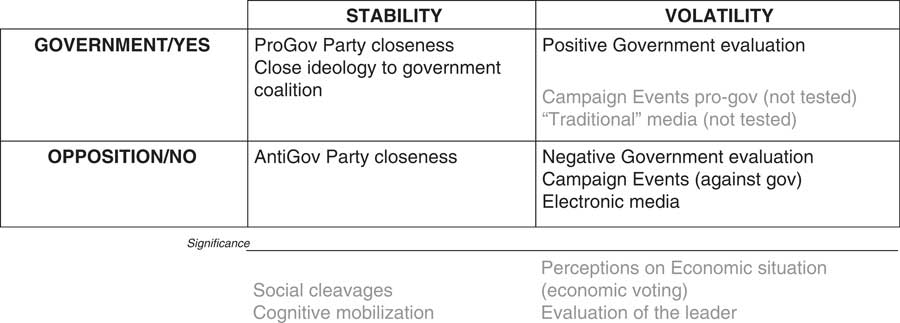
These results have interesting implications for understanding voting choices in referenda. As Franklin et al. (Reference Franklin1995) showed, referendum issues with a low level of saliency transform attitudes towards the incumbent government into significant determinants of voting choices. We reinforce this finding by observing that when governmental forces lead the promotion of a referendum, the proxy effect is maximized, the government becomes the fulcrum around which all the explanatory factors of voting come into play and the referendum results in a plebiscite for/against the incumbent government. In this case, the explanatory factors on the predictability-uncertainty continuum traced by LeDuc (Reference LeDuc and Pammett2002) work differently, since they are redirected to a traditional government vs. opposition dynamic (Figure 3).
Stability and volatility elements in government-led referendum.
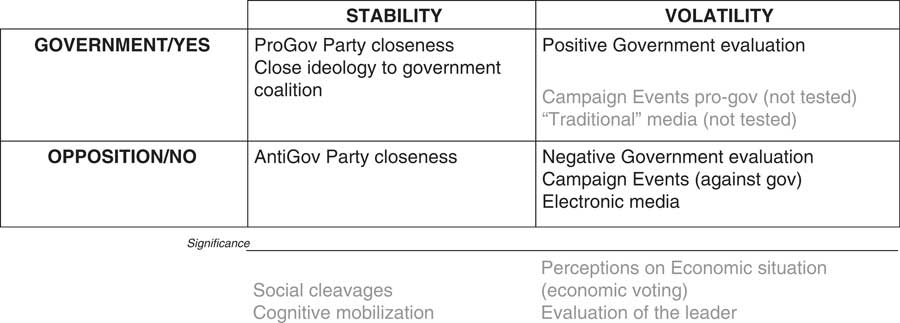
Closeness to a party in the government coalition along with close ideological position are the factors increasing predictability and support of the reform. Closeness to opposition and distant (right-wing) ideological positions result in opposition to the reform. As we move to the uncertainty quadrants, positive evaluations of the performance of the government lead to support for approval. Pro-governmental campaign events and traditional media are thought to favour the approval of the reform since their opposite affects rejection. As far as the fourth quadrant of the figure is considered, we observe, in fact, that the opposing campaign of part of the Democratic Party against the government resulted in a dissenting minority voting no within the main party of the government coalition. Moreover, activism on the internet related to non-traditional media (blogs, social media, etc.) was significantly related to opposition.
Factors beyond the significance line in Figure 3 were not significantly related to voting choices. Social cleavages (operationalized through occupational situation) and economic evaluations surprisingly had no effect, confirming that referenda in recent times show a strong emotional component (see Jackson et al., Reference Jackson, Thorsen and Wring2016 on the UK Referendum). At the same time the majority vs. opposition dynamic disables cognitive mobilization: as the issue of the referendum is relegated in the background people do not need special cognitive skills to support either opposition or government forces. Finally, judgements about the leader of the government do not show any significant effect on voting.
Acknowledgements
This study participates to the ‘2016 Italian Constitutional Referendum Research Preacceptance Competition’ launched by the ITANES, the Società Italiana di Scienza Politica (SISP) and the Italian Political Science Review (IPSR) within the Open Science Framework of the Center for Open Science (COS). The project has been originally preregistered at https://osf.io/dphu6/. The authors are grateful to the above-mentioned organizations for inspiring our work, to ITANES for providing the data and to the anonymous referees for their comments and suggestions.
Financial Support
The research received no grants from public, commercial, or non-profit funding agency.
Data
The replication data set is available at http://thedata.harvard.edu/dvn/dv/ipsr-risp
Appendix
Roll call voting on the Renzi-Boschi’s constitutional reform

Predictors of non-voting in the constitutional referendum