Online Career Exploration and Guidance
The provision of online career information and guidance continues to grow in popularity among vocational counsellors and policy makers, primarily due to the multiple benefits associated with such guidance (Harris-Bowlsbey & Sampson, Reference Harris-Bowlsbey and Sampson2005; Kettunen, Vuorinen, & Ruusuvirta, Reference Kettunen, Vuorinen and Ruusuvirta2016). The need for more economic solutions in the area of career guidance arose after the global financial crisis, an event that led to increased budget deficits accompanied by high levels of youth unemployment and a problematic skills mismatch in many developed countries (Biavaschi et al., Reference Biavaschi, Eichhorst, Giulietti, Kendzia, Muravyev, Pieters and Zimmermann2012). Evidently, even in the absence of in-depth cost benefit analyses looking at the relative value of online and face-to-face services, online self-service career assessment and guidance is viewed as an economic way to provide career guidance (Gati & Asulin-Peretz, Reference Gati and Asulin-Peretz2011; Hooley, Shepherd, & Dodd, Reference Hooley, Shepherd and Dodd2015). However, the research evaluating the usefulness of such approaches for the young people facing career decision difficulties, and identifying user demographics, is limited and requires extension in its depth and breadth.
Many countries have recognised that persons’ ‘private troubles’ (Gale, Reference Gale2015, p. 260) over career choice should, in fact, be dealt with as public matters because they can affect societies as a whole (Watts, Reference Watts2005). Some governments have started to provide public funding for the development of online career guidance resources in order to equip their citizens as decision makers with necessary information and support (Barham & Dent, Reference Barham and Dent2004). The Australian Government, for example, has developed a series of self-service information and guidance web resources such as the Myfuture (www.myfuture.edu.au) and Job Guide (www.jobguide.thegoodguides.com.au) websites, both of which are primarily targeted towards young people in their postschool transitions to work or further education and training.
Government enthusiasm for the development of web-based career guidance resources is not surprising. Various scholars have outlined the benefits of internet-based career guidance systems for advice-seeking individuals, career counsellors, and researchers (Gati, Saka, & Krausz, Reference Gati, Saka and Krausz2001; Harris-Bowlsbey & Sampson, Reference Harris-Bowlsbey and Sampson2005; Hooley et al., Reference Hooley, Shepherd and Dodd2015; Kleiman & Gati, Reference Kleiman and Gati2004). For instance, users can benefit from the convenience of online career guidance resources, with access available via any device at their preferred time and location (Gati & Asulin-Peretz, Reference Gati and Asulin-Peretz2011). The speed offered by modern technologies allows for quick assessment and immediate access to feedback for those who are going through career decision making (Barak & Cohen, Reference Barak and Cohen2002). Individuals are able to store their personal information and career preferences confidentially, use improved decision-making algorithms, and access information adapted for different levels of users’ needs (Harris-Bowlsbey & Sampson, Reference Harris-Bowlsbey and Sampson2005). All of these indicate a broad range of possibilities being afforded by online technologies for enthusiastic career option explorers.
Modern online career guidance systems are also able to provide career advisers and counsellors with a comprehensive toolbox for their advisory practice. They can access a wide variety of resources for use with their clients, such as standardised assessments, structured personalised feedback, and up-to-date information about education and training options and the labour market (Harris-Bowlsbey & Sampson, Reference Harris-Bowlsbey and Sampson2005). Practitioners are also able to further develop as professionals by accessing information about new theoretical approaches, research evidence, training and education opportunities, best practice, and moderated forums (Harris-Bowlsbey & Sampson, Reference Harris-Bowlsbey and Sampson2005). All of these benefits, in theory, should improve the efficiency and quality of the career guidance provided to young people.
Overall, the benefits of online self-service career guidance are so great that its shortcomings are often neglected or mentioned only briefly. Kleiman and Gati (Reference Kleiman and Gati2004), for example, caution that clients can be overwhelmed by the amount and structure of the information provided. They are also concerned that some users might experience difficulties interpreting feedback and making judgments about the quality of content presented via different websites. As a result, career uncertain high school students might be negatively affected when using those websites designed for self-service. Indeed, recent research has found that career uncertain young people tend to have low academic and problem-solving abilities (Galliott, Graham, & Sweller, Reference Galliott, Graham and Sweller2015) — characteristics that may reduce the effectiveness of self-service career guidance approaches.
Considering that one of the main reasons for creating career exploration websites such as Myfuture is to provide to students an opportunity to improve their postschool transitions (Galliott & Graham, Reference Galliott and Graham2014b), the present paper seeks to investigate whether the dissemination of career information in this format is useful in assisting those young people experiencing difficulties in their career decision making. In answering this research question, the current article will first present some background information regarding the existing research in the area of internet-based career assessment, information provision and guidance, and its effects on career decision makers. The second part of the article will discuss the empirical findings of a survey conducted with high school students in Australia's most populated state, New South Wales (NSW). Lastly, the discussion of the findings will be followed by the implications for practitioners and policy makers.
Effects of Online Career Guidance on Career Decision Makers
Research to date demonstrates that well-designed internet-based career planning systems can act as reliable self-assessment tools and provide useful related information and guidance to career advice seekers, as well as career counsellors (Dozier, Sampson, Lenz, Peterson, & Reardon, Reference Dozier, Sampson, Lenz, Peterson and Reardon2014; Sampson & Bloom, Reference Sampson, Bloom, Locke, Meyers and Herr2001). However, some findings suggest that in cases when users are self-selected, it is likely that different groups of individuals will derive varied (and unequal) benefit from such systems. As such, persons with different demographic characteristics are likely to use such systems to differing extents (Kleiman & Gati, Reference Kleiman and Gati2004), and some can potentially misuse the system to make inappropriate decisions (Sampson & Lumsden, Reference Sampson and Lumsden2000).
Multiple research findings suggest that internet-based career assessment tools can be equivalent to paper-and-pencil administered versions of the same tests (Gati & Saka, Reference Gati and Saka2001) and tend to enhance career exploration behaviour of clients (Dozier et al., Reference Dozier, Sampson, Lenz, Peterson and Reardon2014). Users tend to prefer the computer-based format (Lumsden, Sampson, Reardon, Lenz, & Peterson, Reference Lumsden, Sampson, Reardon, Lenz and Peterson2004), and the vast majority of those who tried using internet-based career planning systems were willing to recommend them to a friend (Gati, Kleiman, Saka, & Zakai, Reference Gati, Kleiman, Saka and Zakai2003). When asked about their expectations of online career-related assessments and the associated guidance, users indicated that they prefer relevant, not too complicated or sophisticated content and a certain level of anonymity (Kleiman & Gati, Reference Kleiman and Gati2004). Furthermore, they frequently expect increased career options and strengthening of occupational knowledge, as well as enhanced self-knowledge (Osborn, Peterson, Sampson Jr, & Reardon, Reference Osborn, Peterson, Sampson and Reardon2003).
Other research has also demonstrated high levels of self-focus and self-concern among users of internet-based career guidance systems. Users tend to indicate that they are most interested in the outcomes of their dialogue with the system rather than with the process (Gati et al., Reference Gati, Kleiman, Saka and Zakai2003) and that obtaining information about themselves is more difficult than getting external information about careers and pathways. In fact, users expressed that the information about themselves seemed to them to be more subjective and difficult to interpret. Kleiman and Gati (Reference Kleiman and Gati2004) also found that the search for information about the self was one of the main reasons for seeking individual consultation with a career adviser or counsellor, despite the use of online career guidance. This indicates that while being helpful to clients, online career-related self-assessment tools might not provide full satisfaction to all career advice seekers.
Overall, research shows that unassisted self-service or internet-based career planning systems have both benefits and shortcomings. As such, on one side, Harris-Bowlsbey and Sampson (Reference Harris-Bowlsbey and Sampson2001) identified a range of positive effects arising from the use of career exploration websites, ranging from an increased awareness of the need to plan, through to improved occupational knowledge and career decisiveness. On the other side, Sampson and Lumsden (Reference Sampson and Lumsden2000) have highlighted some potential problems with internet-based career assessments. They argue that inappropriate administration, problems understanding instructions, hasty responses, and lack of concentration can all potentially lead to inappropriate decisions on the user's part (Sampson & Lumsden, Reference Sampson and Lumsden2000). This indicates that young people who do not have the ability to read, interpret, and follow instructions, as well as obtain feedback, can receive little or no benefit from the use of online career guidance services.
In addition, in their meta-analysis of studies regarding help-seeking behaviour, Kleiman and Gati (Reference Kleiman and Gati2004) found that websites with self-help tools such as career planning related self-assessments tend to attract twice as many females as males, indicating that online career guidance is likely to attract users with particular demographic profiles. Thus, there is potential for different individuals to unevenly derive benefit from online career guidance services due to different levels of exposure to such services. The research investigating the personal characteristics of users attracted to modern career exploration websites for self-service, however, is limited to this one finding.
Overall, there seems to be government overreliance on student agency in the self-exploration of career pathways. The research to date demonstrates that computer-assisted guidance systems with a range of automated interactions (Hooley et al., Reference Hooley, Shepherd and Dodd2015), if used appropriately, can potentially be very effective and helpful in assisting users in career decision making (Betz & Turner, Reference Betz and Turner2011; Harris-Bowlsbey, Reference Harris-Bowlsbey2013; Tracey, Reference Tracey2010). Perhaps influenced by benefits like these, some policy makers argue that young people should be responsible for their own future, and should actively use the opportunities provided to them, such as online career guidance, to reach beyond their horizons (Sellar, Reference Sellar2013). Currently, limited budget spending on career education in Australian schools (Career Industry Council of Australia, 2015) and budget cuts for such educational activities in 2016 (Jacks, Reference Jacks2015), force a lot of young people to exercise self-help or be left without any proper career guidance. Web-based, self-service approaches to career exploration and planning, however, may not be the sole solution to the career uncertainty of young people.
A number of researchers evaluating web-based career planning systems suggest that while self-service may be helpful for some individuals, it is not as effective on its own as it is in combination with individual or group consultations with career advisers or counsellors (De Raaf, Shek-wai Hui, & Vincent, Reference De Raaf, Shek-wai Hui and Vincent2012; Dozier et al., Reference Dozier, Sampson, Lenz, Peterson and Reardon2014; Howieson & Semple, Reference Howieson and Semple2013; McLaren, Reference McLaren2013). There may be multiple reasons why some young people find online career guidance services useful for improving their career certainty while others do not, ranging from client exposure to such resources, their personal characteristics, and the quality of the web resources.
The aim of the current article is to address three research questions related to the effectiveness of current online career guidance services on Australian high school students. The first question investigates whether high school students are aware of the online career guidance websites targeted towards them and whether they access those resources. Knowing that people using self-help and self-service resources are likely to differ from those who are not exercising similar behaviour, the second research question of this article explores demographic characteristics associated with students who are aware of and access online career guidance resources. Lastly, this study is concerned with the question of whether knowledge and access to these web resources is associated with the career certainty of high school students.
Method
This article reports findings from a cross-sectional survey that was conducted as part of a sequential phase mixed-method research design (Creswell, Reference Creswell2009) in a larger project researching high school student career choice capability, where the grouping of students to career certain and uncertain served as a proxy for career choice capability (for conceptual foundations of the study see Galliott & Graham, Reference Galliott and Graham2014b). Human research ethics approval was obtained from Macquarie University and the NSW Department of Education and Communities. The survey data were collected via an online questionnaire with 37 questions, designed and administered using Qualtrics software (Qualtrics, 2015) from October through December 2012.
Participants
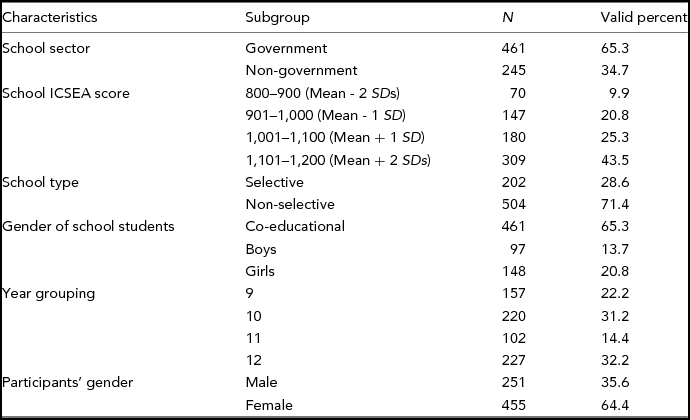
The survey was conducted with Years 9–12 high school students (N = 706) from 12 schools in the most populated state of Australia, New South Wales. The schools invited to participate in the research were selected using disproportionate stratified simple random sampling, with eight government and four non-government schools in each of the two strata. The larger proportion of government schools was invited in order to reflect the actual split in enrolments between the school sectors, where about 70% of NSW students attend government schools (Australian Bureau of Statistics, 2015). Two of the government schools were academically selective. Participating schools had different scores on the Index of Community Socio-Educational Advantage scale (ICSEA; Australian Curriculum Assessment and Reporting Authority, 2012) with seven schools being above and five schools being below the average national score (national average = 1,000, SD = 100). Table 1 provides a summary of the participants’ demographics, including school-level and individual-level characteristics.
Demographic Characteristics of Survey Participants

Measures
Awareness of and access to the career exploration websites
Participating students were presented with the list of career exploration web resources targeting Australian youth. Each of the items in the list was accompanied by a visual clue (logo) for better recall. Some of these web resources were identified by participants in focus groups conducted prior to the current survey (Galliott & Graham, Reference Galliott and Graham2014b), while others were found as a result of online research. While there were nine websites presented in the survey, some have been excluded from the current analysis. This is due to the fact that some web resources were recalled by so few students that these results were not suitable for statistical analysis and, in other cases, because the websites are no longer available online. Thus, the current article includes analysis based on the following four websites: Myfuture (www.myfuture.edu.au), Job Guide (www.jobguide.deewr.gov.au), ADF GAP Year (www.defencejobs.gov.au/ADFGapYear), Year 12 — what next? (www.year12whatnext.gov.au).
Students were asked to click one of the following mutually exclusive options for each of the presented websites: (1) No idea about this website, (2) I know about this website, (3) I've accessed this website.
Demographic characteristics
As part of the survey, students were asked to indicate their gender (male or female), the primary language spoken at home, and their year grouping at school (Year 9, 10, 11, or 12). Information about the school-related characteristics of participating students, such as school sector (government or non-government), school ICSEA score, and the gender of the school population (co-educational, boys or girls) was obtained through the use of unique survey links provided to schools and their students. As such, each of the 12 participating schools received its own link to the survey, meaning that when a student used a link, school characteristics were recorded against that participant.
Career certainty
Students’ career certainty was assessed by two variables. First, they were asked, ‘What would you like to do when you finish school?’ The possible responses to this question included ‘Get a job’, ‘Get an apprenticeship’, ‘Go to TAFE/College’, ‘Go to University’, ‘Not sure’, ‘Nothing’, and ‘Other’, with an open-ended response box for specification. Those respondents who clearly indicated what they were planning to do after finishing school were grouped into a ‘career certain’ cluster, while the remaining students who answered ‘Not sure’, ‘Nothing’ or similar were allocated into a ‘career uncertain’ group. The validity of this grouping was then tested with a second variable, where students responded on a sliding scale of 0–100% to the question ‘How much certainty do you have in choosing your future career?’ Analysis using an independent-samples t test, t(624) = 5.65, p < 0.0005, d = 0.86 (a large effect size; Cohen, 1988) provided support for this grouping, as career certain participants were significantly more likely to express certainty in their future careers (M = 64.68%, SD = 29.27) than career uncertain students (M = 38.73%, SD = 31.14; Galliott & Graham, Reference Galliott and Graham2015).
Analysis
Survey data were analysed using IBM SPSS Statistics 22 software (IBM, 2015). Descriptive statistics and inferential tests were performed in order to examine the relationships between knowledge about and access to the career guidance websites, students’ demographics, and career certainty. As all variables used in the current analyses were categorical, associations between the variables were examined with chi-square tests of independence. Those tests with significant overall chi-square results were followed by Bonferroni adjusted z tests for multiple comparisons of the column proportions, controlling the false discovery rate at alpha = .05 (Hochberg, Reference Hochberg1988). The effect sizes of significant chi-square tests were analysed by Cramér's V and accompanied by odds ratios.
Results
Career exploration websites: Knowledge and access
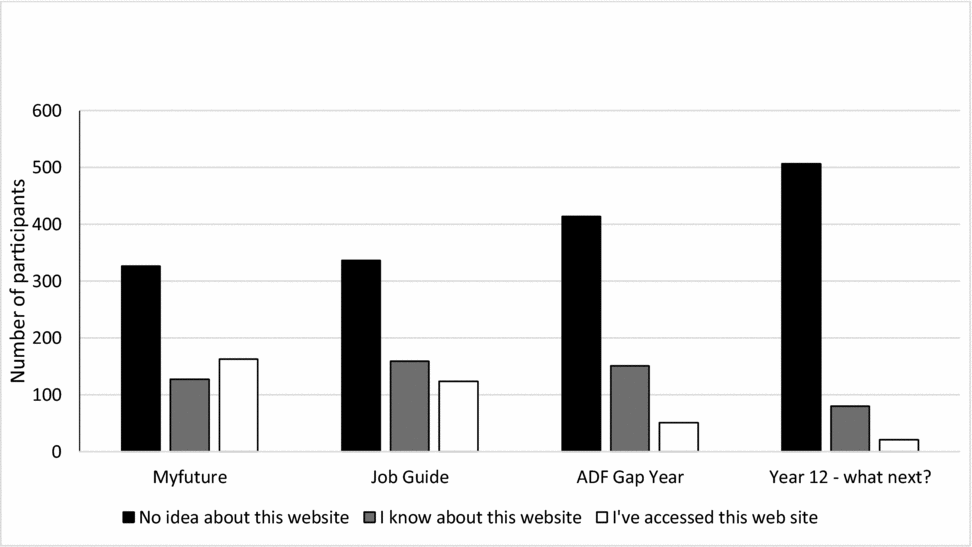
Figure 1 illustrates that the majority of survey participants indicated that they had ‘no idea about’ the online career exploration and guidance websites Myfuture (53%), Job Guide (54%), ADF Gap Year (67%), and Year 12 — what next? (83%). Some of these websites, however, were recalled more often than others, with more awareness (without access) of the Job Guide (26%), ADF Gap Year (25%) and Myfuture (21%), and the highest access levels being recalled for the Myfuture (26%) and Job Guide (20%) websites (see Figure 1).
Awareness of and access to online career guidance websites.

Students’ demographics and exposure to online career guidance
In order to discover which types of students were being exposed to the listed websites, the relationships between students’ demographics and their answers to questions about knowledge and access to the websites were analysed.
Individual characteristics variables
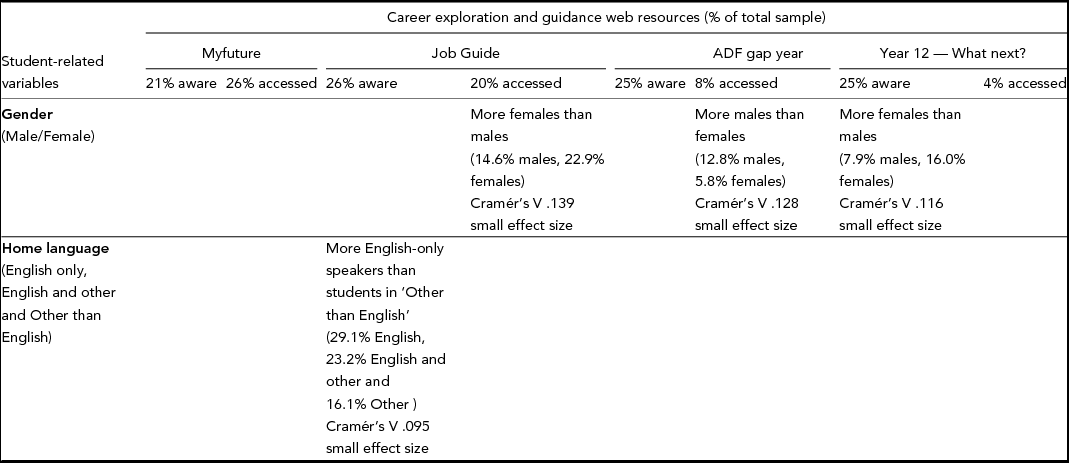
Table 2 presents the direction of all statistically significant relationships that were found between students’ student-related variables and whether they were aware of and accessed web resources listed in the survey. Empty cells mean that there were no significant relationships between the variables tested.
Statistically Significant* Relationships Between Career Exploration of Online Resources and Students’ Student-Level Demographics

Note: *Significant at p < .05; χ 2 non-significant if cells are blank.
Female students were more likely to access the Job Guide website and know about the Year 12 — what next? site. A higher proportion of male students, however, reported accessing the ADF Gap Year web resource. Based on the odds ratio, girls were 1.74 times more likely to access the Job Guide and 2.22 times more probable to know about the Year 12 — what next? website. The odds (or risk) of accessing the ADF Gap Year were 2.4 times higher for boys than girls.
A higher proportion of students speaking English only at home than a language other than English knew about the Job Guide. Based on the odds ratio analysis, students who spoke only English at home were 2.14 times more likely to know about the Job Guide in comparison to those who spoke a language other than English.
School-related variables
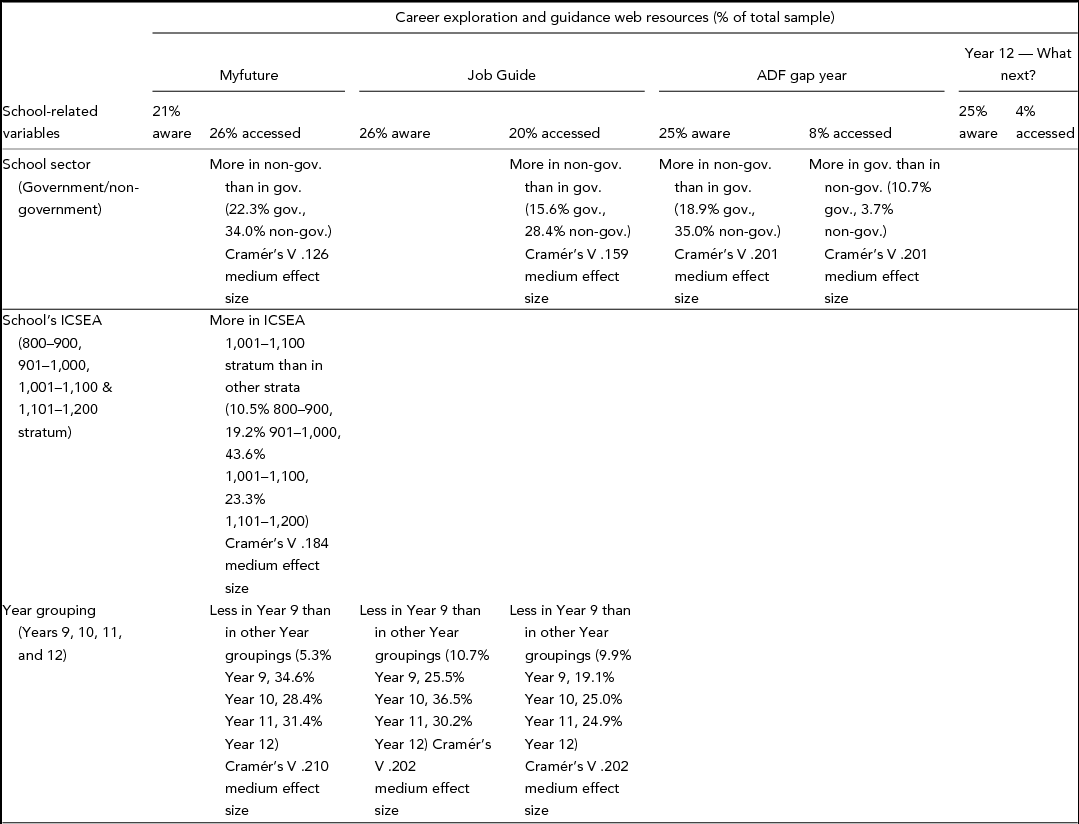
Table 3 provides the direction of all statistically significant relationships that were found between students’ school-related variables and whether the participants were aware and accessed listed web resources. The empty cells represent the absence of a significant relationship between the variables tested.
Statistically Significant* Relationships Between Career Exploration of Online Resources and Students’ School-Level Demographics

Note: *Significant at p < .05; χ 2 non-significant if cells are blank; gov = government; non-gov = non-government.
Students of non-government schools were more likely to access the Myfuture and Job Guide websites and be aware of the ADF Gap Year web resource. Government school students, however, were more likely to access the ADF Gap Year. Based on the odds ratio, the odds (or risk) of accessing the Myfuture and Job Guide websites and being aware of the ADF Gap Year site were 1.79, 2.15, and 2.32 times higher for students in non-government schools. Students in government schools, however, were 3.08 times more likely to access the ADF Gap Year website.
Being from a school within the 1,001–1,100 ICSEA stratum (1 SD above the national average of 1,000) was significantly associated with reporting access to the Myfuture website in comparison to other student groups. The odds (or risk) of accessing the Myfuture website was 6.57 times higher for students in schools with ICSEA 1,001–1,100 when compared to their peers at schools with ICSEA 800–900, 3.25 times higher in comparison with participants at schools within ICSEA 901–1,000 and 2.55 times higher than young people at schools within the 1,101–1,200 stratum.
Year 9 participants were less likely to know about and access the Job Guide and the Myfuture websites. Based on the odds ratio, Year 9 students were 4 to 5 times less likely to access Myfuture and 3 to 6 times less likely to have any exposure to the Job Guide.
Online career guidance and its effect on career certainty
The relationship between students’ career certainty status and whether they knew about and accessed online career exploration websites was examined with cross-tabulations and chi-square tests; however, there were no significant associations found between these variables (all p > .05).
Discussion
Modern government initiatives eagerly include online technologies in the provision of social services to their citizens. Individuals, as consumers of government services, are expected to exercise their agency in actively identifying problems, searchingand evaluating available information, as well as selecting and implementing solutions to their problems. The use of online career exploration and guidance web resources, as one example of the provision of such services, is justified by the tremendous economy of human and financial resources in state budget spending. This study, however, shows that the online career guidance currently provided to young people facing career decision making and postschool transitions lacks effectiveness in terms of achieving the desired outcome of improving youth career certainty. This paper problematises the reliance on self-service online career guidance in targeting career uncertain young people from the three perspectives; namely, (1) insufficiency of youth's awareness of resources targeted towards them, (2) the inability of current websites to evenly reach of a variety of young people, and (3) the ineffectiveness of such web resources in improving the career certainty of high school students.
Youth's Unawareness of Online Career Guidance
The findings of this study raise questions about the current emphasis on attributing responsibility for accessing self-help and improving career outcomes on young people themselves. Currently, there appears to be a strong movement from the provision of career guidance at school to reliance on a self-service model of career decision making (Jacks, Reference Jacks2015), linked to the use of free access online career guidance resources. The data in relation to awareness of online career exploration services available for self-use suggest, however, that the vast majority of Year 9–12 school students had ‘no idea’ about the existence of such resources. Logically, if someone lacks knowledge about a particular resource, she or he is not likely to use it in any way and can hardly be blamed for failing to utilise it. The suggestion here is to create an awareness of online career guidance services among young people before expecting them to use such resources.
Raising awareness of online career guidance resources, however, might drastically increase the cost of this alternative to face-to-face career education provision through schools. Based on learning and stimulus-reaction theories (Blythe, Reference Blythe2013; Pavlov, Reference Pavlov2003), repetitive exposure is a necessary key for successful learning and subsequent recall of the information to occur. As a result of their meta-analysis on effective frequency in advertising, Schmidt and Eisend (Reference Schmidt and Eisend2015) recommend 10 or more exposures to a message in order to maximise enhancement of recipients’ attitude and recall of information. While less exposure may be required when students see the importance of the message, such as the importance of thinking about one's future career, there is no guarantee that every high school student will place a high value on their career decision-making process without prior scaffolding. In any case, considering the potential cost of extensive promotion of the career websites to the target audience, online career guidance may not be as cost effective as is often thought, calling into question to the original cost-benefit analysis behind the use of such resources.
Unevenness in Career Websites Reach
Given that the provision of free access online career guidance is supposed to result in the fair distribution of career-related information to all young people, of particular interest was whether there were any differences between those students who recalled being exposed to different career websites. Analysis of the characteristics of those students who indicated exposure to the listed web resources showed significant differences in career websites’ reach. This suggested that the listed websites varied in their appeal to different student groups.
Exploration of the possibilities regarding differences in appeal showed that both website content and students’ personal characteristics can play a role in the way that young people perceive the information. According to Montoya-Weiss, Voss, and Grewal's (Reference Montoya-Weiss, Voss and Grewal2003) research, the nature of the information and the way in which it is presented on the websites can all affect the kinds of young people attracted to them, the levels of student engagement with those resources, and their subsequent recall. As such, while male students reported more frequent access of the job-oriented ADF Gap Year web resource, female students tended to access more general career websites such as Job Guide and Year 12 – what next? In relation to differences in levels of engagement, the results of this study correlate with previous research findings showing that females are more likely than their male counterparts to engage with the use of self-help tools (such as general career exploration websites) in their career decision making (Kleiman & Gati, Reference Kleiman and Gati2004).
The associations between students’ personal characteristics and their levels of exposure to career exploration websites suggest that current features and functions of these online resources are not appealing evenly across student demographics. Further research delving into the attitudes and perceptions of a variety of student groups in regard to existing career websites might offer some ideas for improvement. Interestingly, however, while personal characteristics had significant associations with exposure to websites, with small effect sizes represented by Cramér's V (Table 2), all of the analysed school-level variables were shown to have even greater associations, as indicated by their medium effect sizes of relationships with exposure to websites (Table 3).
In terms of school-related variables, students exposed to career guidance resources tended to be from advantaged non-government schools and those from within the 1,001–1,100 ICSEA score. The only instance where a higher proportion of students from government schools was observed was in reported access of the ADF Gap Year web resource. In addition, younger students in Year 9 were less likely to be exposed to the most popular career exploration websites (Myfuture and Job Guide) in comparison to Years 10–12. All of this suggests that existing career exploration websites have quite selective audiences in relation to school-level students’ characteristics, and information distributed through these web resources does not disperse evenly across various student groups.
Currently, most Australian schools that provide career education are doing it in Year 10, and this can explain the significantly higher proportions of Year 9 students in the current study not being aware of online career exploration resources. Finishing Year 10, however, does not guarantee that students will receive information about available career guidance resources. Previous research shows that career guidance in NSW is often very patchy, with individual schools and career advisers making their own individual decisions regarding the content and amount of time spent on career education sessions with students (Galliott & Graham, Reference Galliott and Graham2014a, Reference Galliott and Graham2014b, Reference Galliott and Graham2015; Patton, Reference Patton2005). As a result, not all career advisers will choose to expose students to, or even inform them about, online career exploration and guidance services.
The evidence of inconsistent reach of career guidance resources to high school students is evident in recent research findings, both in Australia and also overseas. Mission Australia's 2014 Youth Survey (Fildes, Robbins, Cave, Perrens, & Wearring, Reference Fildes, Robbins, Cave, Perrens and Wearring2014), for example, found that students from high socio-economic areas, especially from major cities, are more likely to search for help and/or support online in comparison with less-advantaged individuals. As such, more advantaged students are more likely to use career exploration websites. The research of Langley, Hooley, and Bertuchi (Reference Langley, Hooley and Bertuchi2014) from the United Kingdom compares career advice distribution with ‘postcode lottery’, where recent changes in career guidance provision arrangements lead to extreme inequalities in the delivery of career guidance services to young people. In particular, the UK's ethnic minority, working-class, girls, lower-attaining, and those who are uncertain of their aspirations or planning to leave school post 16 years old are all significantly more likely not to receive any career education (Archer & Moote, Reference Archer and Moote2016). Combining these findings suggests that, following the career education budget cuts in Australia, the most disadvantaged youth who tend to rely more on school-based career counselling are going to be hit the hardest.
Ineffectiveness of Online Career Guidance
The last, although very important, finding in this article is related to the ineffectiveness of online career guidance in improving the career certainty of young people. The findings of this study showed no significant relationships between exposure to career exploration websites and the career certainty of young people. Thus, apart from lack of knowledge about these websites and students’ personal perceptions of the various kinds of information, the problem with reliance on online career guidance is that it does not have same effect as face-to-face career counselling in improving career certainty. While online career guidance was not found to improve career certainty of students, this author is not in any way advocating its removal. In fact, the researcher agrees that it is a great way to make career education more efficient. What is suggested here, however, is that rather than diminish the human nature of career counselling, online career guidance can and should be incorporated to enhance the practices of school-based career educators.
Conclusion and Recommendations
Career guidance theories and policies targeting the postschool transitions of young people often rely on human agency in problem identification, information searches, the evaluation of alternative solutions, and making rational choices (Perry, Dauwalder, & Bonnett, Reference Perry, Dauwalder and Bonnett2009). This study demonstrates, however, that reliance on the agency of young people does not always provide fruitful results. Bright (Reference Bright2007) suggests that individuals in career decision making should not be considered to be rationally seeking information, weighing their career options, and making choices in isolation from emotional distractions. Young people in a process of career decision making are affected by a range of personal and environmental factors (Walsh & Savickas, Reference Walsh and Savickas2005) that can affect their rationality in decision making and the extent of readiness to act as their own agents of change. This is particularly true when referring to teenagers, who often have an extra need for guidance, even though they may not realise it.
Thus, in order to increase the usefulness of online career guidance resources for young people experiencing career decision-making difficulties, several initiatives can be implemented by educational policy makers and career advice practitioners. First, the developers of the career exploration and guidance websites should continuously provide up-to-date information about the range of existing careers and pathways in an accessible, usable, and culturally appropriate manner for different student groups. Second, as was discussed at the beginning of this article, online career guidance, while greatly satisfying the need for information, is likely to be more effective when used in combination with face-to-face counselling (Gati et al., Reference Gati, Saka and Krausz2001). Third, online career exploration and guidance tools and services targeted towards high school students should be promoted directly to the target audience (including students and their parents and guardians) through schools and, if possible, through mass and social media channels relevant to the audience. Lastly, students should be presented with opportunities to access and explore online career information and guidance resources through schools or government-provided services. It is especially relevant for those young people who have limited family resources and cultural capital, which restrict opportunities to access online career services outside school hours.