I. INTRODUCTION
Increasing access to digital works and the proliferation of digital genres has changed the way in which we conceive of information, particularly legal information. Scholars and legal professionals now face diverse representations of law and scholarly publication in addition to traditional text-based hard copies. Further, the way in which legal scholars and the profession engage with scholarly works through dissemination, sharing, collaboration and comment, is changing thanks to electronic formats.Footnote 1 These two facets of scholarship, research enhanced through information and communication technologies, and its social iterations, are included in what we call here ‘digital scholarship’.Footnote 2 Digital legal scholarship encompasses a raft of differences from traditional analogue processes that require analysis in terms of legal citation methods.
There are a number of key differences between hard copy and digital publications. Locating digital resources requires practices different from those used to locate paper sources. Hard copy works contained in volumes on shelves, summarised in annotators and digests, have been replaced with databases, both proprietary and open access. Most are available electronically as discrete documents in various formats,Footnote 3 rather than being enclosed within an entire bound collection. In many, but not all digital versions of works in print, pinpoints for quotes are irrelevant where the phrase in question can be searched. ‘Pages’ in e-books do not have a single page number, as e-book programs will alter the page location as the reader reads.Footnote 4 Digital works presuppose interactivity, hyperlinking to external resources, endnotes and elsewhere within that digital object. This feature in particular enhances sharing and dissemination of scholarship. Further, subject to licensing limitations, digital works can be reproduced and shared endlessly and simultaneously in contrast to a hard copy, which exists physically in the possession of only one person at a time.
Digital formats of traditional forms of scholarship now dominate the sources used by lawyers and legal scholars. Law libraries are increasingly divesting their hard copy primary and secondary sources in favour of digital databases, and books may be acquired as e-books.Footnote 5 Additionally, as academics and lawyers are encouraged to blogFootnote 6 and to publish in other diverse media shared freely online, the stock of non-traditional formats of digital legal scholarship grows.
The store of works is amplified further when accounting for academic repositories.Footnote 7 Universities have enthusiastically adopted the open access movement,Footnote 8 itself a product of digital scholarship. Academics are required to post their work online to be freely available to the public, although the work itself may be embargoed to protect publishers’ copyright. Academic networking repositories such as ORCID,Footnote 9 Academia.edu,Footnote 10 Researchgate,Footnote 11 SSRN,Footnote 12 ResearcherID,Footnote 13 SocArXiv,Footnote 14 and FigshareFootnote 15 all provide individual academics with the means of uploading and sharing their scholarship. Some works in these repositories are pre-prints, working papers, and some are post-prints, personal unformatted versions of published (and therefore refereed) articles. Even where such papers are not refereed, their ready availability online makes them open to public review and ongoing commentary.Footnote 16
Digital publication of legal scholarship therefore tests our understanding of the categories of works identified in legal citation guides generally, including for example, the leading Australian guide, the Australian Guide to Legal Citation (AGLC).Footnote 17 Further, and particularly through open access, digital publication offers alternative sources of the same work that may challenge existing perceptions of authority. Finally, the AGLC itself arguably presupposes that the citation will appear in a paper format, or an electronic facsimile of the paper format. It does not yet cater for an author's digital format of publication, or reference to diverse digital works, including the connectivity of hyperlinks that is a feature of digital ‘texts’.
This article identifies tensions inherent in decisions about legal citation practice that need to cater for hard copy works and digital formats, and that uphold the existing need for authority and traceability in the face of new forms and sources of scholarship and open access versions. It considers how we might resolve them in a principled way to make legal knowledge accessible to as broad an audience as possible while promoting authority as a goal of citation systems. In Part II, this article articulates the principles behind standardised citation for law, using the AGLC as an example of a conventional standard for legal citation. In Part III, it identifies the challenges facing legal scholars in the digital context and proposes suggestions to cater for the proliferation of diverse formats and media that take account of the contemporary landscape of digital legal scholarship.Footnote 18
II. THE BASIS FOR STANDARDISED LEGAL CITATION
A. History of Legal Citation
Since the earliest reported common law decisions, citation practices emerged to manage the resulting information.Footnote 19 From the 13th century, English law had been recorded as a question of official record.Footnote 20 Separately however, were law reports that managed the information of the courts, and therefore the law, quite differently. More than the record, reports were curated to reflect likely appeal to general legal interest, and included matters of general principle beyond the minutiae of any particular action. Unlike the official record, reports were privately produced. The earliest reports were named after the reporter, and referred to by an abbreviated citation.Footnote 21
As reported cases came to stand for the common law and legal knowledge and further to the refinement of the doctrine of precedent, regularised and abbreviated citation practice was essential to the effective and efficient reproduction of law. In 1865, members of the Bar of England and Wales together with the Attorney-General and Solicitor-General standardised law reporting practice, including citation practice, through the launch of The Law Reports.Footnote 22 Citation practice thus evolved and continues to evolve, through a merger of private ingenuity and public endorsement. Its purpose however, has remained.
The first role of citation is to take the reader to the relevant source where those schooled in the law could readily locate the relevant principle. Further, citation within case law evidences transparency of decision-making according to law, that it is not arbitrary but grounded in the law itself and provides legitimacy to this branch of government.Footnote 23 Additionally, and consonant with the role of citation practice more broadly, judicial citation evidences information flows as communication, in this case between courts, and development of knowledge as they disclose judicial innovation.Footnote 24 Moreover, citations speak not only to the past, but to the future,Footnote 25 a notable feature of the purpose not only of law but of scholarship more broadly.
In the same way as common law citation developed, so too did statutes follow record-keeping conventions that remain to this day. As with the court record, statutes were official, and official record-keeping methods drove the development of citation practice. It was not until the end of the 14th century that citation of statutes adopted its contemporary form. Before then statutes were cited according to the meeting place of Parliament or according to the first words of the text such as Quia Emptores (1290). Once Parliament met consistently at Westminster, statutes came to be cited by the ‘date of the regnal year of the parliamentary session in which the statute was passed’.Footnote 26
This system was somewhat complicated as sessions became longer and statutes might be passed in a session that spanned regnal years. Matters of citation in England were clarified by the Interpretation Act 1889.Footnote 27 Citation of statutes came to reflect common usage, through the use of short titles (eg. Statute of Frauds 1677) and reference to revised statutes. Citation practice was thus separated from claims to authenticity of the source of law, a practice that is unfamiliar in contemporary Australian statute citation.
As well as primary sources of law, leading jurists over centuries produced treatises that became authoritative, and which were cited according to conventions that were understood within the discipline.
There are also other authors, to whom great veneration and respect is paid by the students of the common law. Such are Glanville and Bracton, Britton and Fleta, Hengham and Littleton, Statham, Brooke, Fitzherbert, and Staundforde, with some others of antient [sic] date; whose treatises are cited as authority.Footnote 28
Whether sources of law or sources of legal scholarship, all of these citation methods adhered to a system to enable discovery by those coming afterwards and to facilitate and legitimate the spread of legal thinking and of law itself. The historical system of citation established a legal information architecture as a means of organising information to facilitate sharing within the discipline community.Footnote 29 As legal scholarship evolved to encompass texts, journals, parliamentary reports and speeches, the discipline's information architecture has expanded to establish norms for citation of authority for legal principle and associated scholarship.
B. Contemporary Legal Citation
These norms of citation remain. For primary sources of law, the weight of authority is encoded within the cues of citation, notably through courts’ preferences for authorised reports, a practice established at the beginning of the 19th century.Footnote 30 The advent of publication of electronic versions of judgments, however, challenges this preference.Footnote 31
While paper-based primary sources remain, many of these are also found digitally.Footnote 32 On the other hand, some primary sources are found only digitally.Footnote 33 Digital publication of secondary sources too, has proliferated both in proprietary databases and through open access law reviews and repositories. As ‘both adjudication, a central practical activity of the legal system, and legal research are citation-heavy activities’Footnote 34 the conventional system of legal citation needs to manage proliferating digital sources. The purpose of citation within legal information architecture remains: to support legal scholarship that is readily authenticated and to facilitate sharing that scholarship through consistent citation practice.Footnote 35 As has been pointed out, a ‘legal citation has only one purpose: to lead its reader to the work cited, and this without enforced recourse to any other source of information, for data which should have been given in the citation itself’.Footnote 36
Legal scholars working outside the practice of law or the courts have adopted and enhanced the conventions of citation in the profession, not only as to style or form but also as to the purpose.Footnote 37 In common with adjudication, referencing in legal scholarship aims to add weight to arguments presented, but does more than trace legal authority. It acknowledges sources of ideas, including of law and demonstrates the breadth and depth of research. Proper acknowledgement through citation situates the scholarship within the field while rendering it recognisably the work of the author.Footnote 38
Legal scholarship uses footnotesFootnote 39 to make explicit the source of an idea or a law with the concomitant purpose of implying, with clarity and brevity,Footnote 40 a further body of work synthesised within the writing at hand.Footnote 41 Sometimes they serve the extra purpose of acknowledging contrary, or supporting argumentFootnote 42 and, occasionally, to provide additional information that is not suitable to include in the main text.Footnote 43
While the purpose of a convention of citation may be clear at the discipline level, Posner notes in particular the difference between the author's motive and the reason for citation.Footnote 44 Reasons may be informational, ie. the author seeks to have the means to back up their claims to legitimacy and quality of argument. On the other hand, some motives for citing may be to flatter others or for self-promotion.Footnote 45 While informational reasons for citation ostensibly lie at the heart of a system of citation and thus its architecture regardless of the author's motivation, motivation enters this analysis when considering the role of citation in the digital contexts of scholarship.
The open access movement for example,Footnote 46 represents a commitment to public access to law and to scholarship. It may therefore challenge traditional informational norms that demand an assumed quality and authority of proprietary sources that are not openly available. The same text might be found in two sources and an author's motive for choosing one of those sources may meet discipline norms of authority (such as an authorised report) while the other may not.
The legal citation system still in use originated at a time when all sources were paper-based. We suggest that contemporary development continues within what might be described as an ‘analogue mindset’Footnote 47 despite the parallel debate about open access to the law.Footnote 48 To use the AGLC as an example, the categories of scholarly sources and their medium are interpreted as though they were physically available.Footnote 49 Further more, the citation system assumes a hard copy publication, or electronic version of print without provision so far, of embedded links. An analogue mindset therefore potentially limits the extent to which the goals of citation might be realised.Footnote 50
C. Legal Information
Legal information has now however, extended well beyond print and beyond single authoritative sources. Beyond the record-keeping functions of courts, parliaments and government, can be added open source and proprietary databases, universities and libraries. Non-institutional sources can also be added: repositories, commentators including bloggers, tweeters, podcasters and so on, where the platform of publication itself adds to, reproduces, or amplifies discipline information.
At this point it is timely to identify the relationship between information and scholarship, both of which inform this discussion. It is beyond the scope of this article to delve into the depths of this complex and contested field. Meadows for example, identifies several hundred definitions of ‘information’.Footnote 51 We use information in this article to mean components of legal knowledge and these components range from the elements of a citation through to the artefact of scholarship itself. Thus scholarship is one kind of information, but information is not necessarily scholarship.
In terms of citation in particular, information comprises the identifiers of the location of legal information, say, an article or a case. In a case citation, a case name is one component of case location, the year another, and the reports yet another. Together these components of identifying information point to the location of law, or legal information. As part of information infrastructure, a standardised legal citation system (such as the AGLC) is a mechanism for the organisation of information within a social context, where information is legal information, and the social context is the discipline of law.
Understanding the identifiers within a citation and what they signify, is a form of legal knowledge. For example, those with legal knowledge will know that authorised reportsFootnote 52 carry more weight than unauthorised versions of case law. Further, they will know that whether a report is authorised is denoted by its label, the citation, despite the likelihood that content of decisions themselves is identical.
At the heart of legal scholarship lies communication,Footnote 53 which points both to the social nature of knowledge and of scholarship. The practices of situating one's scholarship within the literature, drawing on what has come before, and the ongoing process of peer review, pre-prints, conferences and symposia, and post-print publication, all point to the discipline community and the social norms that inform legal scholarship.Footnote 54 Some social processes of scholarship are private, down to discussions with colleagues in the corridor, and some are public, including the increasing use of blogs in the field.Footnote 55
Standardised citation thus supports the channels of communication, recognising the socio-technical nature of knowledge and scholarship.Footnote 56 It does this through establishing the means of tracing sources to verify claims made, in Borgman's terms, to facilitate scholars in ‘following the scholarly trail’.Footnote 57 Secondly, and relevant to digital scholarship, to be traceable, sources must be accessible. Accessibility now embraces the open access movement, and this challenges historical presumptions about authority that persist. Finally, as digital scholars, sources must connect us, making the most of digital formats as means of communication and collaboration.
The challenge is how to adapt existing norms of citation to facilitate scholarship-communication-beyond print and into the realm of otherwise frequently fickle digital formats.
III. Rethinking Legal Citation Practices
It is difficult to conceive of any contemporary legal scholarship, whether produced by a first year law student or a senior judge that has not in some way incorporated digital sources or processes. At the risk of overstating our case, all contemporary legal scholarship is digital scholarship.
Having made such a bold pronouncement, we acknowledge that ‘rarely is anything a complete break with the past. Old ideas and new, old cultures and new, old artefacts and new, all coexist’.Footnote 58 A standardised citation system must thus embrace the new while being cognisant of the coexistence of what has gone before. For this reason, we suggest that legal scholarship be considered as digital scholarship, but where digital scholarship presupposes the inclusion of analogue information and knowledge. The key to this conceptualisation is reorienting our thinking from analogue to digital, in the interests of designing a system that can best incorporate both.
We canvass here four challenges in shifting from an analogue to a digital mindset in standardised citation practice, using the AGLC as the benchmark. These challenges involve the use and citation of ‘internet materials’, e-books, pre-print and post-print papers and the vexed issue of permanent links.
A. Internet Materials
The AGLC provides for a category of sources described as internet materials.Footnote 59 A source is to be cited as internet material ‘…if it does not exist in a published form and no other rule within the Guide applies to it.’Footnote 60 In light of the proliferation of information published online, this rule warrants attention. It is difficult to make sense of this as a category of information where the internet is more an information infrastructure technology than a genre of legal information or knowledge.Footnote 61 In one sense, almost all legal information is now ‘internet material’ and the distinction referring to ‘published form’ is difficult to apply.Footnote 62
The AGLC does, however, distinguish blogs and forums, as well as electronic journals, as particular types of internet materials, presumably existing in a ‘published’ form. Citation of blogs adhere to similar conventions as websites,Footnote 63 while electronic journalsFootnote 64 and electronic newspapersFootnote 65 follow the conventions of their print counterparts. The existing taxonomy however, is unlikely to stand up to contemporary publishing practice.
In the first place, any committed categorisation such as ‘blog or forum’ will inevitably be overtaken by the constant proliferation of new formats. Indeed by the time this article is published, there will be new formats emerging. The term ‘blog or forum’ is itself a case in point, where the ‘forum’ per se has been overtaken in popularity by microblogging platform Twitter,Footnote 66 Reddit,Footnote 67 Facebook,Footnote 68 Youtube,Footnote 69 and more recently, by podcasts.Footnote 70 All of these are, arguably, ‘internet materials’ yet in distinguishing some but not others, the term fails to encapsulate the diversity of digital formats.
Further difficulties arise in the attempt to distinguish between print and online. For example, ‘If an article appears in a printed journal, even where a similar version is available online, the printed journal should be cited instead, in accordance with the other rules in this chapter’.Footnote 71 The use here of ‘printed’ seems to equate with ‘published’ used in rule 6.15. Increasingly however, journals are published fully online with no printed version. Publication occurs ‘on the internet’. For the most part, the print version will simply be uploaded as a fully formatted electronic copy, an image of the print. In some cases however, the online version is html, without equivalent pagination.Footnote 72 Many databases offer a choice of formats.Footnote 73
In a further example, ‘[e]lectronic newspapers should only be cited where an identical printed edition (of the newspaper or the article cited) does not exist’.Footnote 74 This rule is increasingly difficult to comply with. In the first place, many researchers would avail themselves of online news services. It would be difficult to assess whether the online version was ‘identical’ to a printed version, in particular as even print editions are updated during the day, and headlines in online news alter during the news cycle. Secondly, print newspapers are not necessarily widely available, raising the question of accessibility.
We observe also the proliferation of reports online, published in PDF format. While such reports are standalone works, they are also, through their publication online, ‘internet materials’. In the interests of accessibility and connection, it would be useful for the reader to have a URL for such reports in addition to other citation elements.
The final issue we raise with internet materials is the form of the URL itself. URL shorteners proliferate, as do extended search strings. Ideally, it is the distinctive ‘pure’ URL that should guide the reader to the source. Those who have marked undergraduate assignments however, will have seen the citation of lengthy search strings, even those within a proprietary database, such as Informit. This is an indicator of the knowledge, or information literacy, required of authors in choosing appropriate formats.Footnote 75 These are questions that likewise require consideration in citation formatting.
If all of these sources of information, websites, blogs, journals, and newspapers, are likely to be found online, and if we were to consider citation with a digital mindset, the issue becomes one not of distinguishing between a work that is ‘published’ and a work that is ‘online’. Rather, it becomes a question of how can the author render this reference to be traceable, accessible, and connected. Having to distinguish between particular formats according to the platform on which it is published does not assist in the traceability of that source. For this reason, we suggest a generic citation standard for published works that comprehends that they may be digital.
B. E-books
In support of our contention that ‘internet materials’ is not a useful category per se, we observe that e-books fall neither in the category of internet materials, nor of books as presently conceptualised in the AGLC. To further complicate any understanding of e-books, they come in different formats and from diverse contexts. For our purposes, an e-book is a self-standing published textual work, designed to be read on a digital device. Importantly, a ‘true’ e-book:
…present[s] correctly formatted text and images no matter the size of the screen it's being displayed on. In order to do this, ebooks get rid of the idea of a page; the text will format to flow properly, and when one screen is full, will flow to the next – that is, they are reflowable.Footnote 76
Although the PDF format is not ‘reflowable’, we include this format within e-books for the purposes of this discussion. Although an e-book may have citation details fully aligned with its hard copy counterpart (if one exists), the ‘reflowability’ of pagination will mean by definition, that there is no stable pinpoint reference. This is compensated for by the search function within an e-book text (or indeed any digital text that is not an image). The solution, we suggest, is to treat this source as though it were a book, but to include in the citation that it is an e-book. This way, the reader knows that to locate a pinpoint, they will need to search an electronic version.
It should be noted that many hard copy books are digitally reproduced and publically available via Google Books,Footnote 77 AmazonFootnote 78 and even websites as html.Footnote 79 These are not strictly e-books, but will afford the reader access to works or parts of works that would otherwise be out of reach. In terms of pinpoint references, the Google Books and Amazon versions are images of printed pages, so the citation and pinpoints will reflect the hard copy version. For web versions however, indicating that the resource is online will obviate the need for a pinpoint.
C. Pre- and Post-prints
The concept of ‘publication’ has radically altered from one of a process mediated through commercial publishers, to self-publication through uploading a digital file to the internet. While debate continues as to the authority of works that are unmediated through traditional forms of review and assessment (the role served by ‘reputable’ publishers), commitment to open access, research impact through dissemination, and the connectivity arising from digital networks have together created a new environment for scholarly work.Footnote 80 While an author with sufficient funds has always been able to self-publish, the primary ground for debate over scholarly forms is that of e-prints: both pre- and post-print works.
In this article, we use ‘post-print’ to mean an author's version of a published work, published independently on an open access platform, generally a repository. That repository may be institutional, such as a university repository, and it may be discipline-basedFootnote 81 or it may be author based.Footnote 82
A pre-print on the other hand, would otherwise be known as a working paper.Footnote 83 Such scholarship has not been peer reviewed, although once it is published in an open access repository, it is open to review and comment, or what is known as post publication review.Footnote 84 As the norms of traditional publishing and peer review are challenged, many disciplines have been receptive to such an open review process.Footnote 85 Although Hibbetts predicted the rise of self-published scholarship as long ago as 1996,Footnote 86 in general the discipline prefers the traditional review process, as evidenced by the constraints of the citation rules in the AGLC. In broad terms, this puts the pre-print as an increasingly acceptable contemporary form of scholarship.
Although pre- and post-prints may exist in analogue terms, it is the advent of digital repositories on open platforms that has made them widely accessible. Unlike a digital library, which implies curation according to norms of information management, a repository is simply a database. For institutions like universities, the repository is effectively a publisher of published articles, presentations, theses, working papers and so on. More than an internal database however, a repository is now seen to:
constitute a building block in a distributed international service which is a virtual database composed of a user-defined set of cooperating databases on the network. This is, therefore, an essentially subversive technology, capable of allowing grassroots publishing by non-publishers, and delivering a service with the same functionality and feel as large commercially published databases.Footnote 87
The AGLC does provide for working papers ‘and similar documents’.Footnote 88 Given the examples cited however, it is not likely that the intention of this rule is to provide for alternative formats of published works. The challenge for an author in applying the rules of the AGLC is the multiple publications of the same scholarship. The ubiquity of institutional repositories as well as both free and commercial academic platforms have made readily available institutional and non-institutional working papers, and post-publication versions of published scholarship.
1. Pre-prints
Unlike a post-print, a pre-print has not yet been through formal peer review, raising different issues altogether. The question here is less one of the traceability of the source, and more one of its authority.
As it seems that the discipline has not yet embraced the norm of continuous peer-review, mediated through digital publication, a reader may reject the pre-print cited as authority. This of course is a question of judgment for the author, and for the reader. As for citation however, the proliferation of pre-prints in repositories means that the form will inevitably become more widely accepted, especially when accounting for the reputation of the author.
On this basis, legal citation must accommodate the citation of pre-prints. As to the format of the citation, we suggest adopting the baseline elements of citation suggested below.
2. Post-prints
As with an e-book, post-prints will generally not be formatted in the same (and often proprietary way) of their published counterparts,Footnote 89 although some are an uploaded electronic version of the typeset published article or book.Footnote 90 Post-prints that are facsimiles of the published version may simply bear the same citation as published.Footnote 91 Those that are unformatted raise two questions.
The first question is whether to cite the open source or the published version, assuming both hold the same content. According to the logic of the third edition of the AGLC, it is the published version alone that would qualify for citation. Such a preference may challenge principles of open access, potentially putting some scholarship out of reach of some authors.
Although the AGLC itself nominates the citation format of a published article (and of a working paper), the complexity for researchers is revealed when searching repositories. For example, the following papers is cited on SSRN as:
Galloway, Kate and Greaves, Kristoffer and Castan, Melissa, Interconnectedness, Multiplexity and the Global Student: The Role of Blogging and Micro Blogging in Opening Students’ Horizons (March 18, 2013). (2012) 20 Journal of the Australasian Law Teachers Association 177–188; Monash University Faculty of Law Legal Studies Research Paper No. 2013/12. Available at SSRN: https://ssrn.com/abstract=2251736
The same paper is published in an institutional repository as:
Galloway, Kathrine, Greaves, Kristoffer, and Castan, Melissa (2012) Interconnectedness, multiplexity and the global student: the role of blogging and micro blogging in opening students' horizons. Journal of the Australasian Law Teachers Association, 5 (1&2). pp. 1–12.
While two citations direct the reader to the same published source, albeit using different citation formats, there are also two parallel citations reflecting two different, alternative sources. One operates with a textual reference to a research paper series with URL, and the other is an embedded link to an institutional repository. The iteration of the same work, differently formatted and differently located, requires thought as to which elements of citation should be used to reflect best the principles of traceability and connectivity.
This is uncomplicated to the extent that to locate the work requires nominated elements (author, title, year, volume, etc). It is slightly more complicated when considering whether to embed hypertext to facilitate connection. At this stage, the AGLC does not provide a protocol for embedding hypertext; in URLs, in cross-references within the document or in citation of social media posts.Footnote 92
The analogue mindset of citation assumes reading on paper, which of course does not facilitate connection like that available in digital formats. If the system adopts a digital mindset however, and in the interests of the principle of connectivity, it should make provision for embedding hypertext. Those reading the work digitally can then take advantage of the connectivity to link direct to source. This will not work for works behind a paywall, such as subscription databases. It will only work for those works in open repositories or free on the internet. Whether or not to hyperlink therefore becomes a question of judgement for the author, who may choose to cite the published version of the article with a link to the accessible version. It is difficult to articulate a firm rule on this. Despite the desire for connectivity, being prescriptive about a hyperlink will inevitably fail to comprehend the circumstances of any one citation. It may be that the requirement for brevity in citationFootnote 93 will trump the desire for connectivity.
A more foundational matter is the question of which source is the ‘valid’ or preferred source. Applying the logic of the authorised case, it is the citation of the published version that would be preferred. Such a version conforms to the academic standard of peer review that is itself currently under debate.Footnote 94
Yet while there might be a rationale to dispense with the ‘authorised version’ preference for cases in the interests of open justice, there is a small possibility of copyright issues with pre- and post-print versions of published articles. A cautious author would thus prefer to cite the publisher's version.
Such a conclusion does run counter to the open access movement. The tension between publishers' copyright and open access is not yet resolved. Further, it is complicated by institutional imperatives for open access and increasing institutional demands that academics upload their research in institutional repositories. To this end, any decision made by the AGLC, in particular in light of its wide adoption, reflects a particular standpoint. It may support the open access movement by providing for the citation of pre- and post-prints, or it may support the status quo providing only for the citation of the published version of a work.
D. Permanence
For all the promise of the world wide web: connectivity, open access, efficiency and autonomy, the downside is that of impermanence. The possibility that a digital source will disappear from its cited location is real, and must be accommodated to achieve the goal of traceability. Further, the impermanence of digital resources may cast doubt upon authority. The process of peer review and publication by a global publisher on a stable platform imports the gravitas of tradition and permanence.
The impermanence of a URL, if not of the digital source itself, is known as link rot.Footnote 95 ‘Link rot refers to the URL no longer serving up any content at all. Reference rot, an even larger phenomenon, happens when a link still works but the information referenced by the citation is no longer present, or has changed’.Footnote 96
We acknowledge that one of the benefits of open repositories is that even without a URL, a reader can search for a citation online. While marginally less convenient than simply clicking on a link, it will frequently locate the relevant work, albeit in multiple iterations. This is considered, however, to be an ad hoc process that fails to negotiate the principles of traceability at the heart of citation.
Zittrain, Albert and Lessig offer plausible solutions for link rot. The first is the DOI (digital object identifier)Footnote 97 that is attached to a published work to provide a permanent and searchable location for that work. While other disciplines have readily adopted the DOI within the fabric of their information architecture as evidenced through other standard citation formats,Footnote 98 law journals have tended not to do so.Footnote 99 Accordingly the AGLC is itself silent on the issue.
Until the DOI becomes widespread in legal publishing, it will likely remain the background. Of note however, institutions are increasingly interested in gaining permissions to allocate DOIs, which may lead to repository e-prints becoming permanently identifiable. This would challenge publishers, including university law reviews, to participate in this aspect of information architecture.
In the meantime, the DOI seems out of reach for much legal scholarship and the question of link rot remains. Zittrain, Albert and Lessig also discuss other alternatives of archival permalinks. In each case cited however, there are limitations in relying on such a source. Ultimately therefore, they mount the case for Perma: ‘a platform that will allow authors and editors to automatically generate, store, and reference, in a freely and publicly accessible manner, archived data representing the relevant information of a cited online resource’.Footnote 100 Perma is a system subscribed to by a number of US law school libraries and non-profit entities.Footnote 101 When an author references a work using Perma, the system itself archives the referenced content. Perma generates a link to the archived page, in perpetuity. Thus the reader can always rely on the cited link to find the relevant work.
While Zittrain, Albert and Lessig advocate for this as a solution to link rot, Keele distinguishes between the DOI and archiving tools such as Perma. Keele points out that DOIs are suitable for publishers to direct readers to articles, ie scholarly works. He contrasts other types of online resources, suggesting other web archiving services such as Perma are more suitable.Footnote 102 Of note however, in an obvious endorsement of Perma, the US Supreme Court style guide was updated in 2016, adopting Perma in its citation requirements.Footnote 103
It is not clear whether this system will gain traction in Australia. It may be that the AGLC, as a leader in establishing Australia's legal information architecture, is in a good position to start a conversation about these issues. However, it will require a digital mindset to recognise the relevance of digital locators within the citation system.
IV. A SUGGESTED FORMAT
The landscape for legal citation seems more complex than ever. It traverses the discipline domains of the law, both in practice and in academia and of information science. We approach the topic from the standpoint of legal academics, both researchers and teachers. To this extent, we acknowledge attempting to navigate a pragmatic path through what we see to be sometimes competing imperatives.
We do not pretend to have a comprehensive, definitive statement of practice for legal citation. We are hopeful, however, of starting a conversation amongst scholars and practitioners that will grapple with some of the thorny issues inherent in establishing new norms that support discipline norms of authority and verifiability, while accommodating more contemporary norms of accessibility and connectivity.
In considering the next generation of legal citation guides, such as the AGLC, our own suggestions for evolution aim to adopt traditional norms of citation through a digital mindset. We attempt to navigate the tensions we see as inherent in the contemporary context for legal scholarship. Ultimately however, there is a crucial aspect of information architecture that will remain, regardless of the decisions made by style guide editors and the publishers who apply their conventions. That aspect is information literacy as a component of broader digital literacies. All legal scholars must become familiar with the social context within which we work, to be able to make appropriate decisions about citation so that it achieves its purpose. The format of citation is only part of the overall information infrastructure.
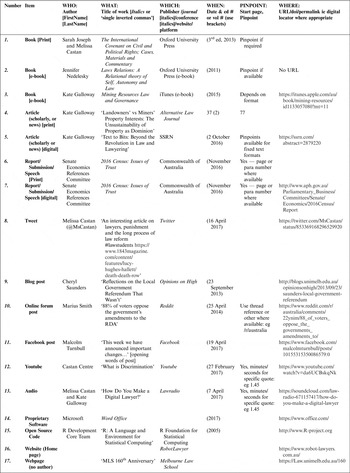
To represent our thinking about citation, we use a table that accumulates the possible categories of works cited. The table is based upon what we see to be the core components of citation, derived from the existing AGLC rules, so as to support authority, traceability, accessibility, and connectivity.
We identify in Table 1 the key components of citation of non-legal sources (ie sources other than cases and legislation) as who, what, which and when. Additional and more particular location, both pinpoint and URL or ‘where’, may be added where appropriate. Of note, the ‘where’ is a digital locator. Rather than a steadfast rule, a writer needs to consider how the reader will ‘follow the scholarly trail’, and to distinguish a digital source from an analogue one. From this foundation, we tested diverse forms of scholarship, adopting and adapting the formatting requirements of the AGLC to create a taxonomy.
Key elements of citation

Many of the elements are uncontroversial. Most works, except, frequently, a web page, will have an author, whether a person (or group of people) or institution (see items 15 and 16). Similarly, works are likely to have a title. To avoid confusion between formatting of titles in italics or enclosed by inverted commas, we identify from the AGLC system that where the title is standalone, it is italicised. This principle thus applies to books (items 1 and 2), articles whether pre- or post-prints (item 5), and the home page of a web site (item 16). Where a title forms part of a larger work, such as a journal or edited volume, or a named page within a web site, the AGLC provides for the title to be enclosed by inverted commas, with the larger work in italics, and we agree with this approach.
The ‘which’ relates to the publisher, the journal, or the platform for publication. While publisher and journal are familiar under the existing rules, the platform for publication resolves issues regarding e-books (items 2 and 3), repositories (item 5), and social media platforms (items 8–13). Thus by extending the existing rules, any media can be accurately cited according to foundation principles. Because a repository differs from a journal or collection, it is cited as a de facto publisher (item 5). The information-literate reader will appreciate the authority and standing of the work signalled by this component of the citation.
In a change from existing practice and to align with foundation principles, we suggest also that a conference or event is taken to be a ‘collection’, effectively a platform for publication of a paper, presentation, or speech. Thus the title of the paper would be enclosed in inverted commas and the name of the conference or event where the paper was presented is italicised (items 6 and 7).
E-book citation will vary. A commercially published e-book, while not paginated in the way of a hard copy book, will be located simply with reference to the publisher. However it should be noted as ‘(e-book)’, to alert the reader to the issue of pinpoints (see items 2 and 3). Some e-books will appear online on one or more platforms. Those platforms will assist the reader in locating the e-book, just as noting the publisher will assist in tracking. We suggest citing the website (for example the author's own website) or platform (eg iTunes) as the ‘where’, followed up with the URL (item 3).
The AGLC citation format designates the ‘when’ of publication through dates, as well as by volume and issue numbers as proxies for more specific time of publication. This is generally straightforward, but for the practice of noting dates of publication online where the uploading date differs from the actual date of publication. As journals take on rolling publication, uploading articles as they complete the editorial process, the actual date of publication will precede the date of publication of that edition of the journal. Indeed the full citation may not become available for some time after the individual article is itself published. Pending the release of the full citation, the publication date will necessarily prevail.Footnote 104
For other articles, as busy academics take time to upload their work onto repositories, there may be instances of a paper presented at a conference some years ago that bears a much later publication date. In this case, as a presentation, the date of the presentation is the relevant date rather than the date of publication.
The start page of a work or its pinpoint necessarily comprehends a hard copy or a digital reproduction of the hard copy. Some services, such as LexisNexis, interpose the hard copy page numbers within html or PDF text, so that the writer can avail themselves of the traditional starting page and pinpoint. With so many other digital works however, this is not available. There should, however, be other pointers in the citation, either as an e-book or through a URL, so that the reader can comprehend why there is no pinpoint, but still has sufficient information to track the pinpoint readily.
This takes us to the final element of ‘where’: the digital locator of that resource. In the absence of wide adoption of Perma or similar digital archiving tools in Australian legal scholarship, for now the ultimate ‘where’ is a URL. We suggest however that where available, a DOI should be used. A digital locator will not be relevant in circumstances where a proprietary database houses a journal article, for example. It will be relevant for most resources that are located in open access locations online. Rather than second guess formats in terms of digital or ‘published’, it is suggested that where an open digital locator is available, that locator is cited.
Beyond these traditional forms of scholarship, we include audio (item 13) and audiovisual formats (item 12), as well as code, both proprietary (item 14) and open source (item 15). Increasingly, such formats will contain legal scholarship or be the subject of legal scholarship, and so will need to conform to the discipline's norms of citation.
V. CONCLUSION
It is clear that the information architecture of law has travelled a long way from the challenges of standardising case reporting to enhance the common law. Legal scholarship is digital scholarship and therefore the norms of its information architecture need to adjust to contemporary imperatives, while upholding the traditional role of verification.
We note the need for a broad engagement of our discipline in issues of digital sources such as the authority attached to diverse representations of the same scholarship and questions of link and reference rot and the consequences for citation. Such a discussion, or possibly a hotly contested debate, can only enhance the way in which the discipline addresses the digital contexts of our research. It is difficult to draw exact parallels with debates in other disciplines in light of the hierarchical nature of the law and the influence of the judiciary in questions of tradition and authority. In the absence of enhanced information literacies in the discipline, there is a possibility that legal scholarship may take different tracks; scholarship that embraces the digital and scholarship that maintains traditional standards.
It is an opportune time to reconsider particular notations within conventional guides to legal citation in light of the contemporary digital landscape, and this paper grapples with with longer term and broader questions about digital legal scholarship. The importance of these guides in both representing and in leading the practice of legal scholarship in Australia and elsewhere makes them (and their editors) key stakeholders in developing legal scholars' thinking around digital scholarship more broadly. The issues raised in this paper are designed to contribute to that debate.