Introduction
An Extreme Hot Weather Event (EHWE) is defined as weather that is hotter and sometimes more humid than average at a given time and duration.1 Many studies report that there is a definite increase in temperature-related diseases with increasing temperature and a significant increase in morbidity and mortality of chronic patients.Reference Hajat, Kovats and Lachowycz2–Reference Hess and Ebi6 In people exposed to this weather phenomenon, health problems such as altered consciousness, agitation, restlessness, loss of consciousness, delirium, neuropsychiatric syndrome, and even death are observed with heat stroke.Reference Trang, Rocklöv and Giang7, Reference Ozturk, Baltaci and Akkoyunlu8 Such health problems are often seen among at-risk groups such as the elderly, pregnant women, children, people with low socioeconomic status, those with chronic diseases, substance abusers such as smoking and alcohol, social isolation, lack of awareness of EHWE, and lack of access to air conditioning.Reference Brennan, O’Keeffe and Mulkerrin9, Reference Hajat, O’Connor and Kosatsky10 With the increase in temperature, the risk of heat-related mortality among risk groups increases significantly, and there is an acute pressure on public health and health services.Reference Smith, Elliot and Hajat11 Moreover, these negative effects are causing great concern among politicians, scientists, and the general public.Reference Xu and Tong12 For this reason, the public health authorities of countries are implementing public health protection measures, such as alerting people to EHWE, developing health warning systems that trigger emergency actions, and similar EHWE-related public health protection measures.Reference Brennan, O’Keeffe and Mulkerrin9, Reference Hajat, O’Connor and Kosatsky10
Many studies emphasize the necessity for individuals to be aware of the potential dangers associated with heat and to adhere to protective measures in order to cope with the health issues caused by hot weather.Reference Kalkstein and Greene13–Reference Baltaci and Arslan15 In order for individuals to realize and adapt to the dangers against EHWE, information messages should be created before the event. Such messages to be created for information purposes should be prepared by taking into account the vulnerable groups and risks in society.Reference Becker16 There are many messages in the literature to raise awareness of individuals against disasters and emergencies.Reference Shenhar, Rozenfeld and Radomislensky17–25 While preparing these messages, importance should be given to various elements such as making the message attractive, expressing the same thing for everyone, using clear, understandable, and memorable words, and increasing memorability with pictures.Reference Adame and Miller26
In the literature, there are very few studies against EHWE with the above-mentioned characteristics. One of these studies is a slogan poster consisting of 3 words (Stay cool, Stay hydrated, Stay informed) by the “Centers for Disease Control and Prevention (CDC)” in order to raise awareness in society against EHWE.27 The fact that the word group in this poster is repeated more than once increases the memorability. However, there are no studies evaluating the effect of this material on people, and no study on the evaluation of public information material for primary protection before EHWE. Therefore, there is a need for a study on the evaluation of public information material for primary protection before EHWE. With this study, individuals’ knowledge and awareness of EHWE can be increased, and health problems that may arise from learning simple actions can be prevented. In this study, it was aimed to develop a poster that informs and encourages people to take action against EHWE in a systematic structure.
Method and Material
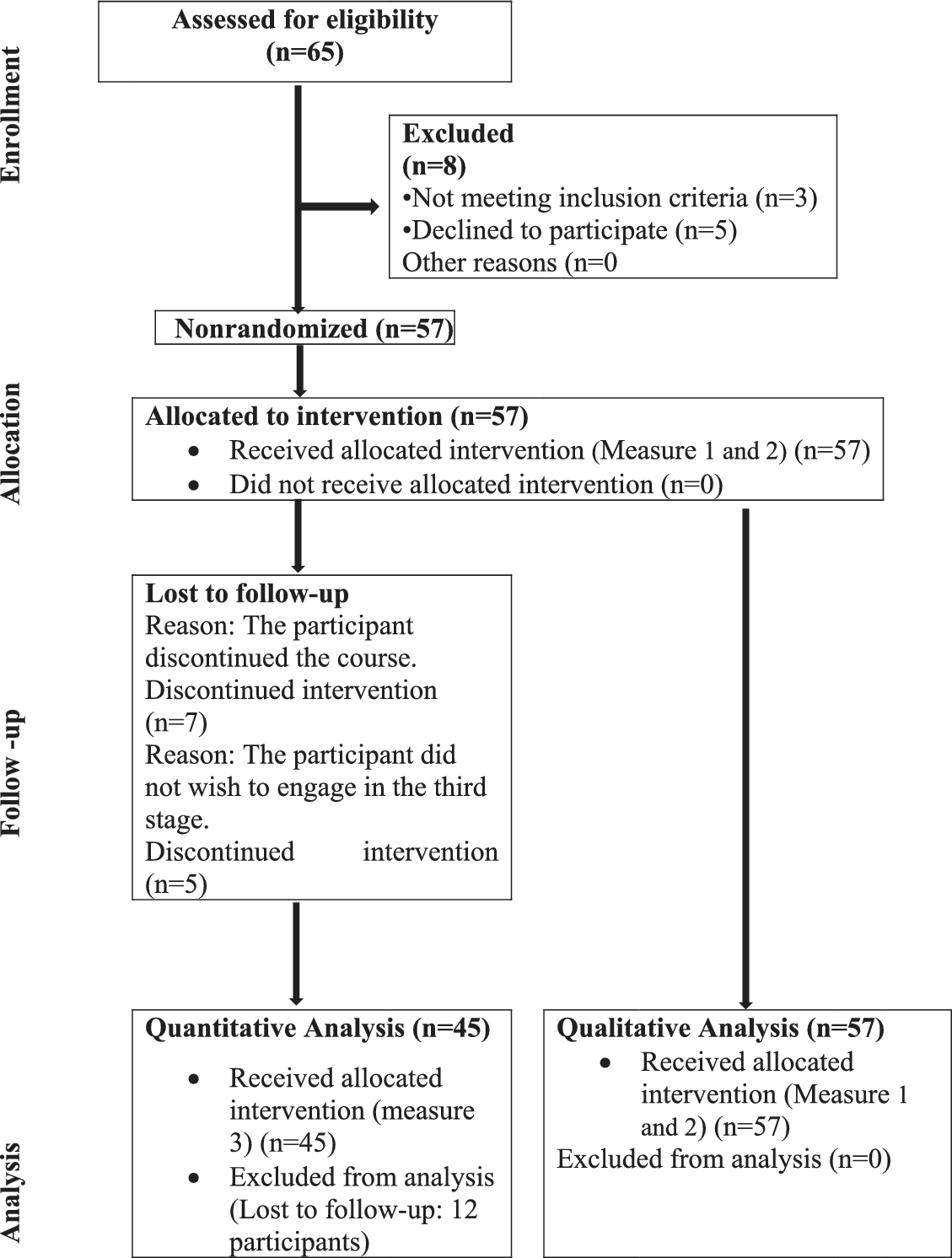
The study was a quasi-experimental epidemiological study and followed the Transparent Reporting of Evaluations with Nonrandomized Designs (TREND) guidelines. The TREND flowchart is used to improve reporting standards for nonrandomized evaluations of behavioral and public health interventions (Figure 1).28
Flowchart of the Transparent Reporting of Evaluations with Nonrandomized Designs shows the number of participants through each stage of the study.

Participants, Assignment Method, and Sample Size
The population of the research consists of employees and trainees in Üsküdar Public Education Centre. People (ÜPEC) who want to participate in the research and who meet the inclusion criteria of the study constitute the research group.
Quota sampling, one of the sampling techniques with unknown probability, was used to represent the population. The sample of the study was determined by using ANOVA: Repeated measures, within factors statistical test in G-Power 3.1 program. Accordingly, as a result of the analysis made by considering 95% power, 5% margin of error, and 25% effect size F (medium-sized effect), it was calculated that the study should be conducted with at least 43 participants.
Inclusion criteria
-
• To be over 18 years old.
-
• Working or being a trainee in ÜPEC.
-
• To be able to read and write Turkish.
-
• Being involved in 3 phases of the research.
Exclusion criteria
-
• Abandoning or leaving the study at any stage of the research.
-
• Color blindness and similar eye problems.
-
• Not fulfilling the inclusion criteria.
Interventions
Forms used in the study
Within the scope of the research, 2 types of materials were used: data collection forms and information material. The forms used to obtain the research data were prepared by the researcher based on the literature.29, Reference Carter, Weston and Symons30 The information material was developed in line with the objectives of the study by taking the literature27 and expert (disaster medicine, disaster management, and public health) opinions. Three forms were used to collect the data in the study: (1) Personal Data Collection Form for Sociodemographic Characteristics of the Participants (PDCF), (2) Information Level Measurement Form for EHWE (ILMF), (3) Data Collection Form for Slogan Poster and Scenario Characteristics (DCF).
Information (Slogan Poster) Material
Within the scope of the research, “EHWE Information Poster” was designed as a public information material containing primary protection at community level before EHWE. The poster includes the definition of EHWE, diseases related to EHWE, groups at risk, and the 3-word slogan “Check, Choose, Beware,” which provides primary protection against EHWE.
Poster design phase
The poster design stage consists of the preparation of the EHWE informational poster and obtaining expert opinions. During the preparatory process, the researcher conducted a literature review on previously created slogan posters aimed at increasing public awareness and explored the official websites of organizations. The outputs of these studies were saved in a Word document. Utilizing the information gathered, a slogan poster targeting primary prevention at the community level was prepared for EHWE. Several considerations were taken into account during this preparation process, including: “(1) Definition of the problem, (2) data collection, (3) creativity and invention process, (4) problem-solving, (5) implementation”. In the poster design stage, attention was paid to the poster’s attention-grabbing nature, simplicity, aesthetics, appropriateness of the intended message, verbal hierarchy, and coherence.Reference Karakaya31
The slogan poster prepared by the researcher underwent consultations with disaster medicine, disaster management, and public health experts to gather their opinions. To obtain feedback from experts regarding the poster, a survey was prepared. The slogan poster was then revised based on the feedback received from the experts.
Data Collection Method of the Research (Outcomes)
The data collection method of the study was conducted by referencing the Single Group Pretest–Posttest Design, which is a type of quasi-experimental design. The Single Group Pretest–Posttest Design is a method used to examine behavior patterns before and after an intervention and to determine the effectiveness of the intervention. This method does not include randomized control. However, it aims to evaluate the intervention by comparing the pretest responses of a single participant group with their posttest responses. Therefore, participants in the intervention group also serve as the control group.Reference Harris, McGregor and Perencevich32 The research consists of 3 stages: pre-intervention, post-intervention, and 2 months after intervention (Figure 2).
Three-step intervention flowchart of research.

Preliminary Trial
The pilot study of the research involved conducting a preliminary trial with 5 participants who met the research criteria to check the comprehensibility of the data collection forms and make necessary adjustments. Following the implementation, necessary modifications were made, and the final version of the data collection form was made suitable.
Blinding
In this study, blinding was not implemented regarding the allocation of participants, intervention implementers, and outcome assessors.
Data Analysis of the Research
Qualitative analysis of the research
In qualitative analysis, the data collection forms, which include methods such as observation, interviews, and document analysis, were analyzed. Content analysis of the research follows the stages of (1) data coding, (2) identification of themes, (3) organization of codes and themes, and (4) description and interpretation of findings. Depending on the purpose and nature of the research, the “Coding within a General Framework” method was employed.Reference Bütün and Demir33 A thematic framework was established based on the appropriateness of the coding: Information provision, memorability, comprehensibility, color, visuals, healthcare institution, sense of security, willingness. After conducting the survey, no adjustments were deemed necessary for the coding and themes. The codes and themes from the documents were categorized into sub-themes and entered into a Word document to create a table. Following this process, the analysis and interpretation of findings were conducted.
Statistical analysis of the study
The data of the study were analyzed using the SPSS 22.0 package program. In the research, participants’ sociodemographic characteristics, comparison of responses to EHWE questions according to various features, EHWE knowledge level, and descriptive (frequency, percentage, median, min–max) and inferential (parametric and non-parametric) statistics values for data related to the slogan poster and scenario were provided. Questions were developed to explore participants’ opinions on EHWE, the slogan poster, and the scenario. In this regard, 15 questions related to EHWE and 12 questions related to the slogan poster and scenario were asked. A score for EHWE knowledge level was measured by assigning “1” to those who answered correctly and “0” to those who did not answer correctly. Accordingly, the lowest score for EHWE is 0, and the highest score is 15. EHWE questions were collected at 3 different times (pre-poster, immediately after, 2 months later). Pearson correlation was conducted to examine the associations between participants’ knowledge scores measured at 3 different time points. Since the skewness and kurtosis coefficients of the scores obtained for protective actions at 3 different times showed a distribution between ±1.96, it was assumed that they were normally distributed.Reference Can34 One-way repeated measures ANOVA tested whether knowledge scores differed across time points, using P < 0.05 as the threshold for significance.
Results
Before EHWE, a slogan poster consisting of the words “Check, Choose, Beware” for primary protection has been developed (Figure 3). To measure the impact of this poster on individuals for primary protection before EHWE, EHWE knowledge questionnaire was administered to individuals at 3 different times: before the poster (measurement 1), after the poster (measurement 2), and 2 months later (measurement 3).
Primary protection against extreme heat events slogan poster.

Initially, 65 participants were assessed, of whom 8 were excluded for not meeting the eligibility criteria. A total of 57 participants were enrolled in the intervention and completed Measurement 1 and Measurement 2. At Measurement 3 (2-month follow-up), 12 participants withdrew from the study (7 discontinued the course; 5 declined to participate in the third stage). The final analysis was conducted with 45 participants who completed all 3 stages. Qualitative feedback (slogan/poster evaluations) was collected from the 57 participants who completed Measurement 1 and Measurement 2, whereas quantitative 3-stage statistical analyses were performed with the 45 participants (Figure 1).
Qualitative feedback on the poster and scenario was collected after Measurement 2 from all participants who completed the first 2 stages (n = 57). Content analysis followed 4 steps: (1) open coding, (2) theme identification, (3) organizing codes into subthemes, and (4) interpretation. Coding was performed by 2 researchers, with disagreements resolved by consensus. The themes are presented in Table 4 (n = 57). The 3-stage quantitative follow-up (including Measurement 3) was completed by 45 participants, and those results are reported in the repeated-measures analysis.
Sociodemographic Characteristics and Association Statistics
Among the participants, 86.7% (n = 39) were female, 22.2% (n = 10) were retired, 75.6% (n = 34) were married, and 77.8% (n = 35) had at least 1 child. The mean age (SD) of the participants was 49.0 (10.2), the median was 49.0, the youngest age was 30 and the oldest age was 69. 53.3% (n = 24) of the participants considered their health status as good. However, 37.8% (n = 17) of the participants had a chronic disease, and 31.1% (n = 14) of the participants stated that they had previously encountered a heat-related health problem (Table 1). The mean scores of the participants aged 30-39 years (10.43) in measure 1, 60-68 years (14.33) in measure 2, and 50-59 years (12.33) in measure 3 were found to be higher compared to other age ranges. However, it is seen that the mean scores of the participants with some sociodemographic characteristics were higher than the other participants in all 3 measurements (Table 1).
EHWE knowledge scores of the participants according to their sociodemographic characteristics

Knowledge Scores Across Time Points
The mean EHWE knowledge scores were 9.36 (SD = 2.39) at Measurement 1 (baseline), 13.93 (SD = 0.94) at Measurement 2 (immediately post-intervention), and 12.07 (SD = 1.80) at Measurement 3 (2-month follow-up) (Table 2).
Analysis of the EHWE slogan poster

Correlation Analysis
Pearson correlation analyses indicated significant positive associations between scores at different time points: Measurement 1 and Measurement 2 (r = 0.42, P < 0.01), Measurement 1 and Measurement 3 (r = 0.66, P < 0.01), and Measurement 2 and Measurement 3 (r = 0.28, P < 0.05). These findings suggest that participants who scored higher immediately after the intervention also tended to maintain relatively higher scores at follow-up.
Repeated Measures ANOVA
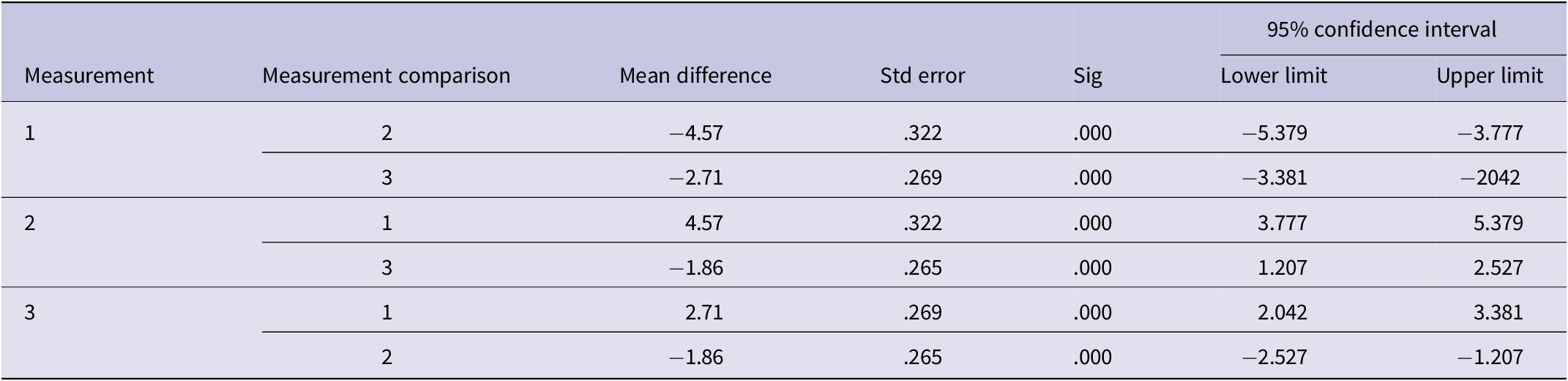
A one-way repeated measures ANOVA demonstrated a statistically significant effect of time on knowledge scores, F(2.88) = 129.13, P < 0.01, partial ηReference Hajat, Kovats and Lachowycz2 = 0.70. Post-hoc pairwise comparisons with Bonferroni adjustment showed significant differences between Measurement 1 and Measurement 2 (mean difference = –4.57, 95% CI: –5.38 to –3.78, P < 0.001), Measurement 1 and Measurement 3 (mean difference = –2.71, 95% CI: –3.38 to –2.04, P < 0.001), and Measurement 2 and Measurement 3 (mean difference = –1.86, 95% CI: –2.53 to –1.21, P < 0.001) (Table 3, Figure 2).
Statistical comparison of EHWE knowledge level

Participants’ Opinions on the Slogan Poster and the Scenario
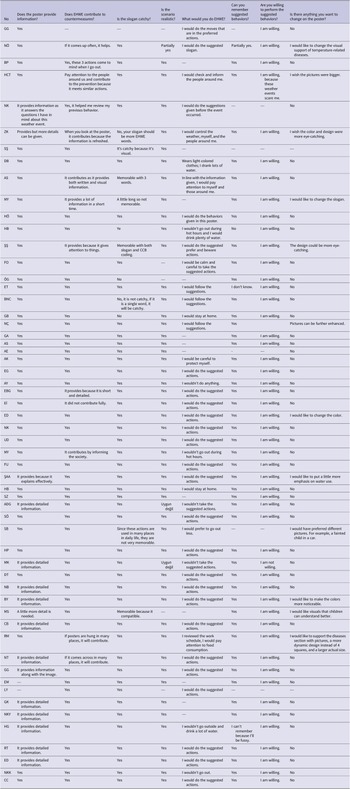
The findings regarding the opinions of 57 participants who participated in Measure 1 and Measure 2 of the research on the EHWE slogan poster are given. Table 4 shows the questions prepared for the slogan poster and the answers of the participants. When asked whether the EHWE slogan poster provides information about EHWE, 54 participants think that the slogan poster provides detailed information about EHWE, while 1 participant thinks that more detailed information should be given about EHWE. When the participants were asked about their willingness to remember and do the behaviors suggested in the slogan poster during the event, 2 participants stated that they would not remember the behaviors during the event. One participant stated that he/she was not willing to do the behaviors suggested about EHWE during the event (Table 4).
Opinions of participants regarding slogan poster and scenario

In response to the question about the catchiness of the slogan, 5 participants stated that the slogan was not catchy. These participants think that the slogan is not memorable because it is long, it does not consist of words related to EHWE, it is not a single word, and the slogan words are used in many places in daily life. In response to the question about the appropriateness of the scenario prepared for EHWE, 2 participants said that the scenario did not reflect reality and therefore it was not appropriate. The participants were asked if there was anything they would like to change in the slogan poster. To this question, 3 participants stated that they would like to change the design, 3 participants stated that they would like to change the color, and 5 participants stated that they would like to change some parts of the pictures (number, size, etc.) (Table 4).
Discussion
This study evaluated the effectiveness of a slogan poster designed for primary protection against Extreme Hot Weather Events (EHWE). The findings indicated that exposure to the poster was associated with immediate improvements in knowledge levels, and although knowledge declined after 2 months, it remained higher than baseline. This pattern highlights the challenge of sustaining knowledge through a single, passive intervention and aligns with previous literature on knowledge decay in health communication.
EHWE is prolonged humidity and extreme hot weather, which causes the development of various health threats for every individual in society.Reference Xu and Tong12 As a result of EHWE, various health problems develop or existing diseases increase.Reference Ozturk, Baltaci and Akkoyunlu8, Reference Ozturk, Baltaci and Akkoyunlu35 The increase in health problems or diseases caused by this weather event can be reduced to a certain extent. One of the biggest factors in reducing this rate is the precautions taken by individuals against hazards before the event. Therefore, there is an urgent need for primary protection measures against EHWE.Reference Lowe, Ebi and Forsberg36 However, it is necessary to inform individuals against various diseases caused by EHWE, such as heat stroke, heat exhaustion, and rash. With this information, public health problems caused by EHWE can be significantly reduced.Reference Acar37
In order to inform people before EHWE, it is necessary to provide information not only about the hazards, risks, or the way the event occurred, but also about protective measures to reduce the danger, risk, damage, and losses caused by the event.Reference Ulaş Kadioğlu and Uncu38 It is important to choose a good communication tool to inform people about these issues. For example, posters are mass media with the feature of integrating text, pictures, graphics, and similar interesting designs. This feature of posters creates a potential learning environment.Reference Rissal and Muhtadi39 Thus, it may be advantageous to use posters as informative materials in various events. There are some slogan posters developed for this purpose in the literature. Some of these slogan posters are as follows: “Run, Hide and Tell” for armed attack,40 “See It, Say It, Stored” for a railway emergency,41 “Remove, Remove, Remove” for chemical emergency,Reference Carter, Weston and Symons30 “Report, Remove and Rinse” for acid attack,42 “Mask, Distance, Hygiene” for the COVID-19 pandemic and “Stay Cool, Stay Hydrated, Stay Informed” for hot weather events.43 In this study, a slogan poster was developed in order to inform and mobilize individuals against EHWE. In this poster, with the slogan “Check, Choose, Beware”, it is aimed that people pay attention to various temperature-related diseases, risky groups, and practices for protective actions. Nevertheless, the observed changes should be interpreted with caution. The quasi-experimental single-group pretest–posttest design does not allow causal inference. Knowledge gains may have been influenced by external factors (e.g., concurrent awareness campaigns), repeated exposure to the same questionnaire (testing effect), or attrition at follow-up. Moreover, the study was conducted in a single adult education center with a demographically homogeneous sample (86.7% female, mean age 49 years), limiting the external validity of the findings. The effectiveness and reception of slogan posters may differ across genders, age groups, occupational groups, and literacy levels.
There are a few studies examining the impact of developed slogan posters on individuals.Reference Carter, Weston and Symons30 However, investigating the effect of such campaigns on individuals contributes to measuring the benefits of the campaign. For example, in a study related to informing, it was concluded that the developed poster contributed to informing participants and raising awareness.Reference Carter, Weston and Symons30 In another study, a slogan poster was developed against terrorist incidents occurring in hospitals. An improvement in knowledge was observed after poster exposure, although this association should be interpreted with caution.Reference Kusulas, Drenis and Cooper44 It is emphasized that the poster will be a reminder when participants forget preventive measures against hospital terrorist attacks in the future.Reference Kusulas, Drenis and Cooper44 Another study conducted with a similar method aimed to develop the most appropriate educational materials for children against various disaster events. It was concluded that one of the developed educational materials, the poster, improved children’s disaster preparedness and response skills.Reference Bandrova and Marinova45 Similarly, in this research, the developed educational material was linked to higher knowledge and awareness scores among participants. A research similarly indicates that immediate improvements are often observed after informational interventions, but the persistence of these effects over time remains uncertain.Reference Carter, Gauntlett and Amlôt46 Therefore, in the study, participants’ EHWE knowledge levels were measured 2 months after the poster. As a result of the measurements, knowledge scores declined from the immediate post-intervention level (13.93) to the 2-month follow-up (12.07), although they remained higher than baseline. This indicates that participants relatively forget the information contained in the EHWE slogan poster. However, it was concluded that they were more conscious about EHWE compared to before the poster application. Therefore, the findings suggest that repeated or reinforced exposure may be necessary, though further research is required to assess feasibility and cost-effectiveness. However, the decline in knowledge observed at the 2-month follow-up highlights the challenge of long-term retention. To address this, future interventions should consider using reinforced messaging through digital media, community-based reminders, or integrating content into routine education programs. The decline in knowledge observed at 2 months underscores the need for reinforced or multi-modal strategies. Practical approaches could include spaced repetition (rotating posters, newsletters), multi-channel delivery (SMS, social media, radio), interactive elements (QR codes linking to videos or quizzes), and community-based reinforcement through local health centers or leaders. Future research should compare these strategies, assess their cost-effectiveness, and determine whether knowledge improvements translate into sustained protective behaviors and health outcomes. Also, a concise slogan poster may be a low-cost component of broader EHWE awareness strategies, providing a rapid, immediately accessible cue to action.
To identify the shortcomings of the slogan poster, it is necessary to obtain individuals’ opinions about the poster. Some studies in the literature have addressed individuals’ views on posters designed for various topics. One of these studies suggests that providing information on exposure symptoms in the poster will increase individuals’ preparedness and prompt them to take action against the event. Other participants, however, argue that including such information in the poster will lead to fear, anxiety, misconception, and skepticism. Additionally, some participants have expressed their opinions on the design aspects of the poster, such as color, visuals, and typography. Based on the participants’ opinions, updates were made to the information material.Reference Carter, Weston and Symons30
In the study, 3 individuals expressed their opinions on the design, 3 individuals on the color, and 5 individuals on changing certain aspects of the images (number, size, etc.). Moreover, participants stated that the poster provided sufficient information, contributed to taking precautions, and expressed willingness to take protective actions during the event. Another study also reported that participants were willing to take the protective actions indicated in the poster.Reference Carter, Gauntlett and Amlôt46
Limitations
Several limitations should be acknowledged. This study employed a single-group pretest–posttest design, which is subject to several threats to internal validity. First, history effects may have influenced outcomes, as concurrent heatwaves or public awareness campaigns could have contributed to knowledge increases. Second, a testing effect may have occurred, since repeated exposure to the same knowledge questionnaire might artificially improve scores. Third, maturation effects cannot be ruled out, as natural changes in knowledge may take place over time. Fourth, regression to the mean may have influenced results, particularly for participants with extreme baseline scores. Fifth, Hawthorne and social desirability effects may have led participants to respond in ways they perceived as expected by researchers. Finally, attrition poses a limitation: twelve participants (n = 12) did not complete the 2-month follow-up, and differences between completers and dropouts may have introduced bias. Taken together, these threats mean that the findings should be interpreted as associations between poster exposure and knowledge changes, rather than as evidence of causality. To more rigorously evaluate the effectiveness of slogan posters, future research should employ randomized controlled trials or controlled cohort designs.
Conclusion
In conclusion, exposure to the developed slogan poster was associated with immediate improvements in EHWE knowledge, and knowledge levels at 2 months remained higher than baseline despite a significant decline compared with immediate post-intervention scores. These findings suggest that the poster may serve as a useful component of public health communication; however, a single, passive exposure appears insufficient for long-term knowledge retention.
Because of the quasi-experimental single-group design, causality cannot be inferred, and external validity is limited. The study was conducted in a single adult education center with a demographically homogeneous sample (predominantly female [86.7%], mean age 49 years). Quota sampling and the single-site setting restrict the generalizability of results to broader populations. The effectiveness and reception of poster-based interventions may differ substantially across genders, age groups (e.g., younger adults), occupational groups (e.g., outdoor laborers), and individuals with lower literacy or different socioeconomic backgrounds.
Future research should therefore include larger, more diverse, and representative samples, and employ controlled designs to rigorously evaluate the effectiveness of slogan posters in real-world settings. Studies should also investigate reinforcement strategies (e.g., repeated exposure, multi-channel communication) to address knowledge decay and to determine the extent to which improved knowledge translates into sustained protective behaviors and health outcomes.
Author contribution
Nihal Dağ: Conceptualization, data curation, formal analysis, investigation, methodology, visualization, writing—original draft.
Kerem Kınık: Conceptualization, formal analysis, investigation, methodology, supervision, writing—review and editing.
Cüneyt Çalışkan: Investigation, writing—review and editing.
Funding statement
No funding was received from any institution during the scope of the research.
Competing interests
None.
Ethical approval
This study was approved by the Health Sciences University Hamidiye Scientific Research Ethics Committee, Approval No. 13779.