It is well established that women and men differ in their psychological orientation to politics (Burns, Schlozman, and Verba Reference Burns, Schlozman and Verba2001; Dolan Reference Dolan2011; Fox and Lawless Reference Fox and Lawless2004; Thomas Reference Thomas2012). In addition to willingness to run for office, expressing interest in politics, and political efficacy, men and women tend to differ in reporting their factual knowledge of politics, but how do we explain the gap? This question is not merely important from a measurement standpoint (e.g., Mondak and Anderson Reference Mondak and Anderson2004) but also has implications for our understanding of gendered political attitudes and behaviors. The gap can be reduced when controlling for a number of factors, but there remains a residual when measuring knowledge with the scale most widely used. This paper aims at providing insight on how we think not only about measuring something like “political knowledge” but also how we theorize gendered political behavior. We present a behavioral genetic analysis of sex differences in political knowledge using a genetically informative twin design to parse out the source of variation in knowledge.Footnote 1 We do so predicated on a framework for thinking about gendered patterns in political behavior as well as findings from the existing literature on gender differences in the psychological orientation to politics. We believe our findings give us insight on what is wrong with current and seemingly gender-neutral measures of political knowledge.
A SOCIO-RELATIONAL FRAMEWORK
The study of political attitudes and behaviors in our discipline has historically tended to assume similarities between the sexes, even while relevant differences were being (re)discovered throughout the social sciences. Gilligan argued “theories formerly considered to be sexually neutral in their scientific objectivity are found instead to reflect a consistent observational and evaluative bias” (1982, 6). Even prior to that, Chodorow (Reference Chodorow1978, 167) suggested that girls' psychological development resulted in their unique experiences of individuation and relationship but were not derivative of or inferior to that of boys—a notion that countered the male-centric theories dominating psychoanalysis at the time. Different does not mean inferior, according to Chodorow and others, and it seems relevant to echo such sentiments today. The assumptions we make about political behaviors and the way we go about measuring them may reflect the “consistent observational and evaluative bias” Gilligan suggested. We contend the residual gender gap in political knowledge is an artifact of a measurement that is not gender neutral. The empirical test we present later in this article is one way to illustrate our contention, but empirical tests are not the solution. We need to think carefully about what political knowledge means, not just to scientists but to the subjects of our studies.
In political science, the measurement of attitudes and behaviors has proceeded without much reference to research outside the discipline that has identified potentially relevant sex differences. Certain attitudes and behaviors that have been theorized as epitomizing democratic citizenship are expected of both sexes, but should they be? As an example, Lazarsfeld, Berelson, and Gaudet stated the following:
Sex is the only personal characteristic which affects non-voting, even if interest is held constant. Men are better citizens but women are more reasoned: if they are not interested, they do not vote … [a] man, however, is under more social pressure and will therefore go to the polls even if he is not “interested” in the events of the campaign (1944, 48–49).
We think Lazarsfeld and colleagues were partially correct in their explanation that men and women perceive and engage in politics differently; however, the pressure on men to go to the polls is not the only issue. That we expect interest or knowledge to translate into reasoned action seems gender neutral, but what do we accept as political knowledge (and appropriate civic action, for that matter)?Footnote 2
Fowler and Schreiber (Reference Fowler and Schreiber2008) refer to our human capacity for thinking about politics as “playground cognition.” They note:
On the playground, we are figuring out whom to cooperate with and whom to avoid; we are cognizant of social hierarchy and we engage in coalitional cognition, knowing that alliance with one group will entail exclusion from another. Even at rest on the playground we are constantly monitoring our social environment and our place in it (913).
Going beyond our disciplinary boundaries, may help guide our thinking about politics. Sapiro (Reference Sapiro, Sears, Huddy and Jervis2003) cites that “[r]elatively little research explores the impact of physiological variation associated with sex on politically relevant phenomena … [M]ost political psychology research involving gender focuses on socio-cultural forces” (604). Motivation to attend to politics, for example, should no longer be explained merely from the perspective of sociocultural gender role expectations like the pressure men of Lazarsfeld's time felt that drove them to go to the polls more than women. This motivation also involves consideration of patterns of emotionality in affiliative and avoidant behaviors, for example, as consistent with “playground cognition.” We then need to connect such motivations to the articulated values and actions of citizens.
The most basic expression of emotionality is the motivation to respond to socially relevant stimuli. Social contexts elicit affiliative and avoidant responses very fundamentally, and scholars argue there is form and functionality associated with gendered patterns of approach and avoidance. Women tend to have greater sensitivity to social and emotional cues of capacity and trustworthiness and tend to signal trustworthiness (e.g., kindness, sympathy, integrity) more than men who tend to signal capacity (Geary Reference Geary2009; Vigil Reference Vigil2009). These general patterns are argued to be a result of a long human history of men and women using different strategies to get what they need to survive in complex and changing social contexts. Further evidence of this is the unique perceptual, neuroendocrine, and expressive biases that underpin approach and avoidance behaviors. These underpinnings differ between men and women in various sociorelational contexts, including politics (Geary Reference Geary2009). They also carry different meanings for people in the contexts in which the live.
Research suggests women's greater prosociality is the result of a long human history of male-biased philopatry, where women dispersed to live with nonkin. Where women have had to be (or are still today) reliant on nonkin or distantly related kin, more sociorelational maintenance behaviors for ensuring reciprocity would have been (or are) necessary (Geary Reference Geary2009; Hrdy Reference Hrdy2009; Low Reference Low2000). Studies from social psychology illustrate women's preference for particular social arrangements that facilitate reciprocal trust cues—women tend to form and maintain smaller networks or groups than men. Experiments from psychology, experimental economics, and political science show that women are more interpersonally oriented, avoiding overt hierarchies, and men are more group oriented and gravitate to hierarchies (Baumeister and Sommer Reference Baumeister and Sommer1997; Eckel and Grossman Reference Eckel and Grossman1998; Gabriel and Gardner Reference Gabriel and Gardner1999). Further, men tend to engage in competitive between-group interactions more than women (Niederle and Vesterlund Reference Niederle and Vesterlund2007; Pemberton, Insko, and Schopler Reference Pemberton, Insko and Schopler1996; Van Vugt, De Cremer, and Janssen Reference Van Vugt, De Cremer and Janssen2007). These social psychological capacities are not distinct from politics, but rather underpin men and women's orientation to politics. In many ways, they are politics.
Those sociorelational differences between men and women underpin many complex social behaviors. For example, men's achievement goals may be predicated on mastery of a task and separating themselves from others and further directed at the use of status and power. Even if in subtle ways, if competition and status are cued, men may respond in ways distinct from women. Women's goals, alternatively, may be predicated on affiliative outcomes or setting themselves in harmony with others (Gaeddert Reference Gaeddert, Stewart and Lykes1985; Geary Reference Geary2009). Stress responses in anticipation of events further reinforce these findings. Men tend to produce greater stress response to events that display capacity (e.g., public demonstration of intelligence) whereas women's stress systems tend to be more sensitive to social exclusion (Stroud, Salovey, and Epel Reference Stroud, Salovey and Epel2002). These findings articulate general patterns, and, as with any trait or characteristic, we expect to see variation both between and within the sexes, though most studies stop at merely identifying mean differences between men and women.
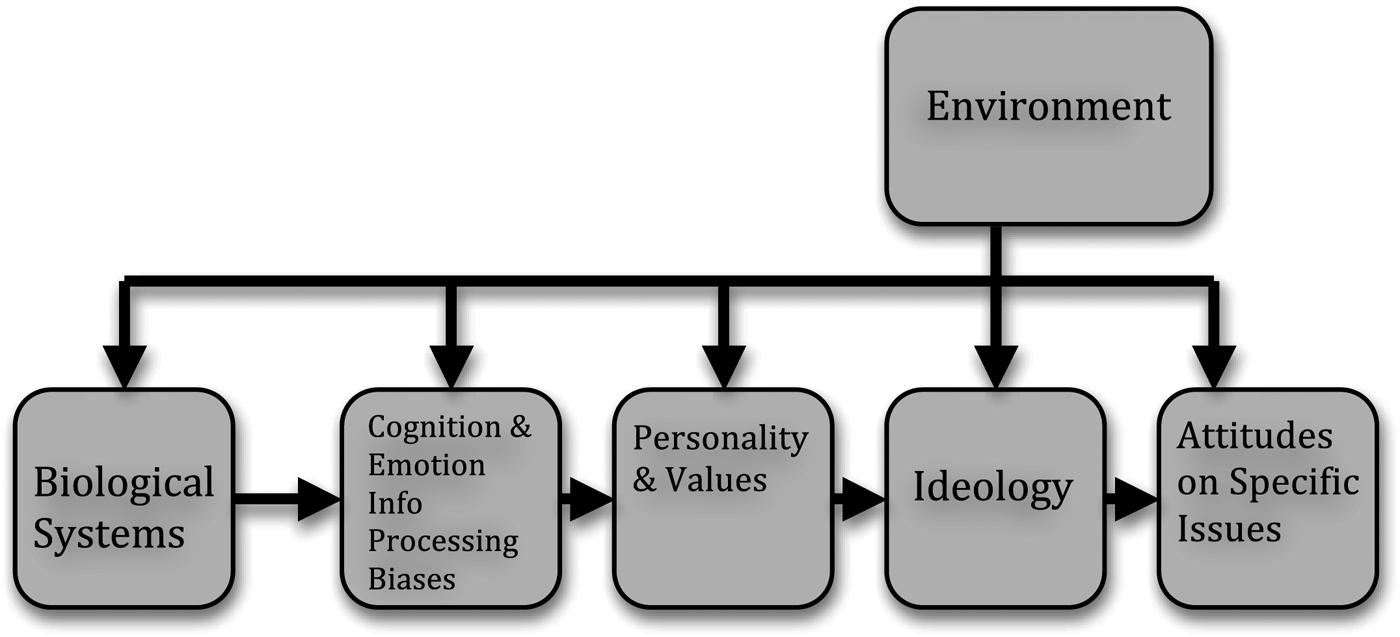
The framework that we propose to guide research on gender and political behavior involves the dynamic interaction of individual physiology, psychology, and sociorelational processes that give rise to specific political behaviors consistent with “playground cognition.” Smith et al. (Reference Smith, Oxley, Hibbing, Alford and Hibbing2011) presented a theoretical framework for thinking about the influence that genes have on political attitudes. They demonstrated that the influence is quite indirect, and the levels of analysis between genes and behavior include relevant biological systems, neurological bases of information processing and cognition, personality and values, and ideology (Smith et al. Reference Smith, Oxley, Hibbing, Alford and Hibbing2011).Footnote 3 This perspective suggests influences on individual behavior arise from both external social influences and internal psychophysiological processes but what truly drives behavior are the meaning and values of individual orientations to socio-relational contexts. We would add that external sociorelational contexts may influence men and women differently. Their model may have been put forth as gender neutral, but if we want to proceed as a predictive social science (as opposed to one that is merely descriptive), sex differences must be considered. The framework we propose to guide our thinking about modeling sex differences adapts elements from Smith et al. (Reference Smith, Oxley, Hibbing, Alford and Hibbing2011) and is presented in Figure 1.
Socio-relational framework of biologically relevant systems, information processing bias, personality/values, ideology, and specific political behaviors (adapted from Smith et al. Reference Smith, Oxley, Hibbing, Alford and Hibbing2011).

To explain briefly how Figure 1 may be useful in guiding research on political behavior with an eye to sex differences, consider that the realm of understanding sex differences in political science research exists largely within the last two boxes on the far right of the diagram: Political Ideology and Specific Political Attitudes. We understand them as influenced by the Environment but as typically neglecting influence from the boxes on the left (as Sapiro reminds us in the quote cited above). The puzzle of the knowledge gap, which we discuss in the next section, is a case in point. Much of the gap has been empirically reduced by taking account of changes in environmental variables (e.g., level of education), but what of the residual gap? Perhaps moving to the categories on the left side of the diagram can provide insight. For example, how do men and women perceive the "political" aspects of their lives? And how do their values influence what motivates them to act?
In the next section we review the empirical findings to date regarding a “gender gap” in political knowledge. We then present an empirical test utilizing a twin study as a way to examine the potential source of the variation in political knowledge between men and women that may provide insight into what we are not accounting for in current measures. We conclude with a discussion of our findings in light of our theoretical framework.
WHITHER THE GENDER GAP IN POLITICAL KNOWLEDGE?
Dolan (Reference Dolan2011) cites, “That women exhibit lower levels of political knowledge than men is a common and consistent finding in political science research” (97), but a series of studies have identified measurement nuances and intervening variables that greatly decrease (and even reverse) the gap.Footnote 4 We argue here that the statistical tests to date explain the reduction in the gap, but the source of the gap that remains is yet to be understood.
The notion that men are more knowledgeable has been brought into question by their greater propensity to guess in response to survey questions as opposed to selecting a “don't know” response (Mondak and Anderson Reference Mondak and Anderson2004).Footnote 5 Lizotte and Sidman (Reference Lizotte and Sidman2009) found that in 11 of the 12 surveys they administered, women were 1.5 times more likely to choose the “don't know” response. The authors find that models accounting for the inclination to say they “don't know” produce knowledge estimates for women that are much closer to, and sometimes exceed, the estimates for men. Further, stereotype threat produces relatively lower levels of reported political knowledge for women as contrasted with men when such threats are absent. For example, when the survey was presented as nondiagnostic and when the interviewer was female, female respondents achieved higher accuracy (McGlone, Aronson, and Kobrynowicz Reference McGlone, Aronson and Kobrynowicz2006). Such findings are consistent with what we might expect given the response to complex sociorelational contexts. When competition is cued, men perform better and women's performance decreases.
The ability to retain learned information, opportunity or access to the information in the first place, and motivation or interest in politics (Delli Carpini and Keeter Reference Delli Carpini and Keeter1996; Luskin Reference Luskin1990; Popescu and Tóka Reference Popescu and Tóka2009) have all been cited as important pieces of the constellation that is political knowledge and have been assessed individually for their specific role in explaining the gap.Footnote 6Ability has been operationalized as level of education or type of education (i.e., civics). In most of the studies that take education into consideration, the gender gap is largely reduced (Burns, Schlozman, and Verba Reference Burns, Schlozman and Verba2001; see also Lay Reference Lay2011 for an example of knowledge favoring women and girls). Closely related to ability is opportunity, which refers to the availability of information in a certain context (Delli Carpini and Keeter Reference Delli Carpini and Keeter1996; Luskin Reference Luskin1990; Popescu and Tóka Reference Popescu and Tóka2009). Where women have greater access to political information, they tend to do as well as men in response to knowledge questions (Burns, Schlozman, and Verba Reference Burns, Schlozman and Verba2001). In other words, the gap is reduced when education and opportunity are controlled for.
Motivation seems to be the critical area in examining the gender gap in political knowledge. Verba, Burns, and Lehman Schlozman (Reference Verba, Burns and Schlozman1997) demonstrate that women are less politically interested than men, echoing Lazarsfeld, Berelson, and Gaudet (Reference Lazarsfeld, Berelson and Gaudet1944). They refer to this as the “engagement gap” and argue that such gender differences seem to be specific to politics and not a result of general personal attributes.Footnote 7 However, Karp and Banducci (Reference Karp and Banducci2008) find that the presence of women as candidates and office holders can stimulate political engagement among women (see also Campbell and Wolbrecht Reference Campbell and Wolbrecht2006).
Dow (Reference Dow2009) finds that similarly situated men and women (i.e., controlling for SES [ability], working outside the home [opportunity], etc.) may invest the same in obtaining political knowledge, but men get a different return on investment than women. Using American National Election Studies (ANES) data, Dow finds that at least two-thirds of the gap in political knowledge results from differences in returns on investment in obtaining political knowledge. This also squares with why men are more inclined to guess. They get a different sociorelational “reward” (so to speak) than women would by doing so. We argue that if the “knowledge” men and women invested in was cuing something that motivated women the way the current knowledge questions appear to motivate men, this same conclusion could be drawn, instead favoring women.
As it turns out, this is precisely what happens. When the knowledge questions concern government services and programs (Stolle and Gidengil Reference Stolle and Gidengil2010; Thomas, Harell, and Gosselin Reference Thomas, Harell and Gosselin2013) or on women's representation in national government (Dolan Reference Dolan2011), the gender gap in political knowledge is substantially reduced to the point that women and men have similar levels of knowledge, or the gap favors women. In short, the traditional way of measuring knowledge is tapping something that motivates men (both to attend to the information in the first place but also to guess) but not as much for women. According to our framework, we would argue that the sociorelational benefit to knowing about how many votes it takes to overturn a presidential veto is different for men and women. As long as such questions are the measure of knowledge that counts as “knowing about politics,” women as a group are likely to elicit less knowledge in addition to less efficacy than men as a group.
These above-cited studies appear to converge on a common theme. The gap in political knowledge can be greatly reduced by accounting for ability and opportunity, which is addressed by theorizing about the changing role of women in society, but also by measurement manipulations such as the absence of stereotype threat and discouraging guessing. We believe our sociorelational framework assists in explaining why each of these manipulations reduces the gap. What seems to be underpinning the residual gap is something particular to the type of questions asked (as illustrated by the Stolle and Gidengil and Thomas, Harell, and Gosselin studies). Are the seemingly gender-neutral questions that measure political knowledge actually biased? We believe the findings of our empirical test suggest as much.
In the next section we present an empirical test for the sources of variation in response to the traditional battery of political knowledge questions via a twin study. Twin studies have been employed by behavioral geneticists since the 1970s to explore the sources of variation in social and political attitudes (Eaves and Eysenck Reference Eaves and Eysenck1974, Martin et al. Reference Martin, Eaves, Heath, Jardine, Feingold and Eysenck1986). It has only been in the last decade that political scientists adopted this method (e.g., Alford, Funk, and Hibbing Reference Alford, Funk and Hibbing2005). Political reasoning (or thinking about politics), unlike subjects taught in the classroom such as mathematics or other matters involving complex reasoning, is neurologically more similar to other forms of social reasoning. Again, “playground cognition” is a better way to conceptualize how most people think about politics. Fowler and Schreiber (Reference Fowler and Schreiber2008) argue that “[w]hen people … are asked for judgments of political issues,” they utilize the same parts of the brain as when thinking about solving social situations; “such findings suggest that political thinking is akin to social cognition” (914). We take this a step further and argue that because what matters socially often differs for men and women, political thinking does as well.
A twin study provides one way to examine the gender gap in political knowledge by considering the sources of individual variation on a trait (such as responses to a battery of political knowledge questions) instead of merely focusing on mean differences between men and women. Since social forces largely diminish the “gap” or mean differences, our test of variance can look at what is driving the differences. If differences in variance are due to additive genetic influences, this provides a different path for thinking about the residual gap as opposed to the status quo where discrepancies are assumed to be derived solely from environmental or societal factors.
A twin study is possible because there are individuals who differ in their genetic similarity—monozygotic (MZ) twins, who are genetically identical, and dizygotic (DZ) twins, who share roughly 50% of the genes transmitted from their parents—but who grow up in the same environment. Variation in complex traits (i.e., political knowledge) can be parsed out via variance components modeling or via genetic and environmental influences (Medland and Hatemi Reference Medland and Hatemi2009). Correlations can be made between the two types of twins on the trait of interest, in this case responses to the political knowledge questions. If MZ cotwin correlations are much higher than those of DZ twin pairs, this suggests the presence of additive genetic influences.
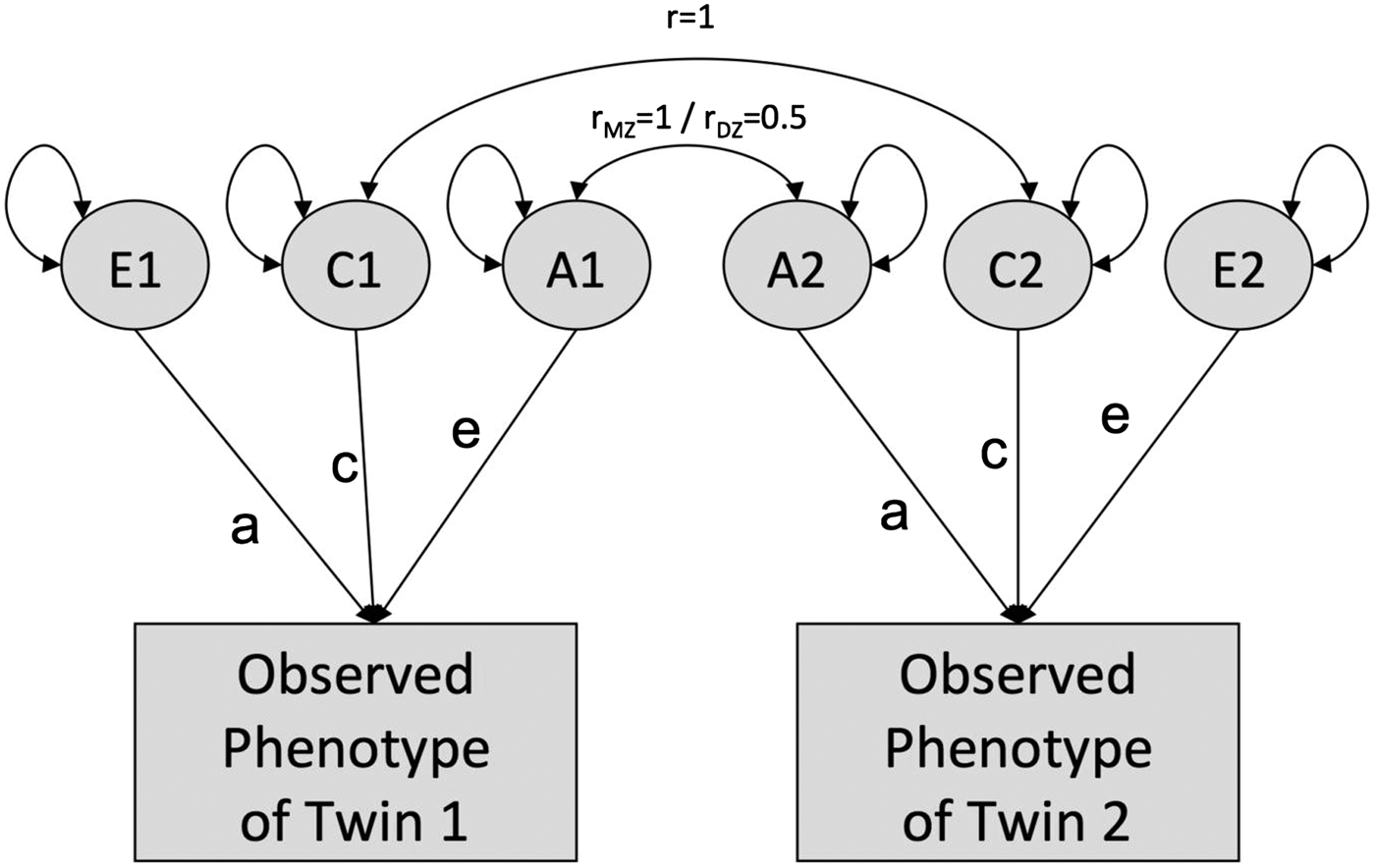
Correlations do not suffice, however. Figure 2 depicts the basic path model for twin resemblance. The test that remains is to assess which combination of additive genetic influences (A), common environmental influences (C), and unique environmental influences (E) best fit the data. In other words, the combination of parameters (ACE, AE, CE, or E) must be determined to be the most parsimonious explanation for the patterns of MZ and DZ twin pair correlations (Hatemi et al. Reference Hatemi, Dawes, Frost-Keller, Settle and Verhulst2011a, Reference Hatemi and McDermott12). We perform this analysis and report the results in the following section.
ACE twin design. A = [A]dditive genetic effect; C = [C]ommon Environmental Effect; E = Unique [E]nvironmental Effect for Twin 1 and Twin 2.
DATA AND METHODS
The data come from a study of social and political attitudes collected in 2008–2009 administered to a sample of twins selected from the Minnesota Twin Family Registry. The Minnesota Twin Family Registry is comprised of about 8,000 twin pairs born in the state of Minnesota between 1936 and 1955. The registry was compiled between approximately 1983 and 1990 (see Krueger and Johnson Reference Krueger and Johnson2002 and Lykken et al. Reference Lykken, Bouchard, McGue and Tellegen1990 for additional information on the Minnesota Twin Family Registry).
The Minnesota twin study of social and political attitudes is the first twin study specifically devoted to the subject matter. The mode of data collection was a web survey that was fielded between July and December of 2008 with a supplementary collection effort using a self-administered paper-and-pencil questionnaire between July and October of 2009. Given the characteristics of the Minnesota Twin Family Registry, the sample is restricted in its age coverage. All respondents were between the age of 53 and 61 at the time of the interview. Only same-sex twin pairs were selected in the sampling phase. N = 1349 interviewed individuals yielded n = 596 matched twin pairs (MZ Males = 143 pairs, MZ Females = 213 pairs, DZ Male s= 86 pairs, DZ Females = 154 pairs).Footnote 8 The sample also included 157 twins whose cotwin data were missing. Item and unit-missing data still produced coverage over 80.8% in the covariance estimation for the structural equation model.
The dependent variable, political knowledge, is operationalized using the 5-question, multiple-choice quiz (this operationalization is widely used in the research cited above and is the basis for claiming the existence of a gap) by adding up correct responses adding up to a 6-point knowledge scale. Incorrect responses, “not sure” responses, and missing responses on some the knowledge questions were marked as wrong and summed to produce the knowledge score.Footnote 9 For respondents who failed to fill out any of the knowledge questions, overwhelmingly due to incomplete questionnaire with the knowledge questions near the end, we marked as missing. The questions can be found in the Appendix.
ANALYSES
All analyses to explore the data were conducted with Mplus using each individual (not pair) as an observation and always correcting for the nonindependence of twins from each other through cluster sampling correction.Footnote 10 The average respondent got 3.539 questions correct with a variance of 2.321. The age and sex corrected mean difference for MZ and DZ twins is –0.001 (p = 0.993). Age and sex corrected variances are MZ = 2.166, DZ = 2.185 (where the p-value for the difference is p = 0.906). Male and female variances of knowledge differ more substantially (male = 1.607, female = 2.513; male-female, p < 0.001) suggesting that separate treatment of males and females is warranted when decomposing the variance into additive genetic, common, and unique environmental effects. The means are also significantly different; women get 0.765 fewer questions correct (p < 0.001). Despite the highly restricted variance of age in the sample, a year increase in age will lead to a correct answer on 0.031 more questions (p < 0.1). This coefficient needs to be interpreted with caution to ensure that no inferences made outside of the sample's age range of 53 and 61. Since age is still a significant predictor, age is corrected for in subsequent analyses.
To decompose the variance in political knowledge we use a structural equation ACE model. Due to space restrictions, we offer only a brief summary of the model. For a more extensive discussion please see Medland and Hatemi (Reference Medland and Hatemi2009).Footnote 11 In the ACE model, the variance of the dependent variable is decomposed into additive genetic (A), common environmental (C), and unique environmental (E) effects using a structural equation model that treats these components as latent variables. Given the use of a genetically informative twin sample, we know that additive genetic effects are perfectly correlated for MZ cotwins and, on average, 0.5 correlated for DZ cotwins. Common environment is perfectly correlated for both MZ and DZ cotwins while the unique environment is uncorrelated across the twin pairs. For a visual representation of this structural equation model, again, see Figure 2. This structural equation model is estimated using maximum likelihood. Alternative models are then compared.
The classic two-group model where MZ twins constitute one of the model groups and the DZ twins constitute the other can be extended into a four-group model that also separates the groups by sex. The classical two-group model assumes equal additive genetic, common, and unique environmental contribution to the variance for both males and females. It also assumes equality of variance in the dependent variable for males and females. The utilization of this more complex four-group model is necessary since both the means and variances for knowledge are different between sexes, and therefore we expect that the effects of A, C, and E may also be different.
Just like with the two-group model, where certain parameters of the model can be fixed and the fit of the more parsimonious model tested, the same is possible with the four-group model. In addition to fixing certain parameters to zero, proportions or absolute sums of the variance explained by the different sources can also be equated between sexes. The following section presents the fit of the full and reduced models.
RESULTS
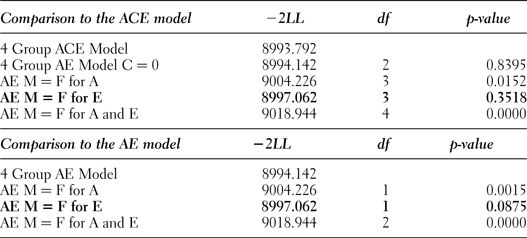
We start model fitting through comparing the four-group saturated model that does not decompose the variance to the ACE components that estimates different additive genetic, common, and unique environmental effects for males and females separately. (See Table 1 for model fitting.) The p-value for the difference in model fit is within a 4-decimal rounding error of 1 suggesting, it is appropriate to use the ACE model. Since C is estimated at 0, we move to an AE model that fixes the C component at 0. This also does not deteriorate the fit significantly (p = 0.84). We then equate the unstandardized A and E variance components across the sexes individually and jointly. Equation of the E component leads to an insignificant decrease in fit (p = 0.0875) while fixing the A or jointly fixing the A and E components equal to each other across the sexes deteriorates the fit significantly (p < 0.01 and p < 0.001, respectively).
Saturated and ACE model fit statistics
Note: Best-fitted model bolded; Chi-square difference in fit between the saturated model and 4 group ACE model is insignificant at p > 0.9999.
In essence, this means that the amount of the variance explained by the environment (E) is the same for men and women. But there is a difference in the variance explained by additive genetic effects (A). The difference in variance for men and women comes from additive genetic sources and not environmental sources. It is also important to highlight that variance in political knowledge does not appear to be influenced by socialization sources (C).
Medland and Hatemi (Reference Medland and Hatemi2009) criticized model reduction for small samples specifically in the context of fixing a variance component to 0. Their arguments could easily apply to equating parameter estimates across the sexes. We agree with Medland and Hatemi's arguments because with small samples it is always more difficult to detect actual differences (between sexes or from a 0 estimate), and fixing parameters might only seem to work for good-fitting models because they lack the power to detect actual differences. In other words, fixing components of the ACE model to 0 because they are not significant is inappropriate when the sample size is small and the reason for the lack of significance is the lack of power and not because the effect is close to 0. The best way to overcome this is to estimate an insignificant component regardless. It leads to less power and wider confidence intervals but to more trustworthy results, especially with small samples.
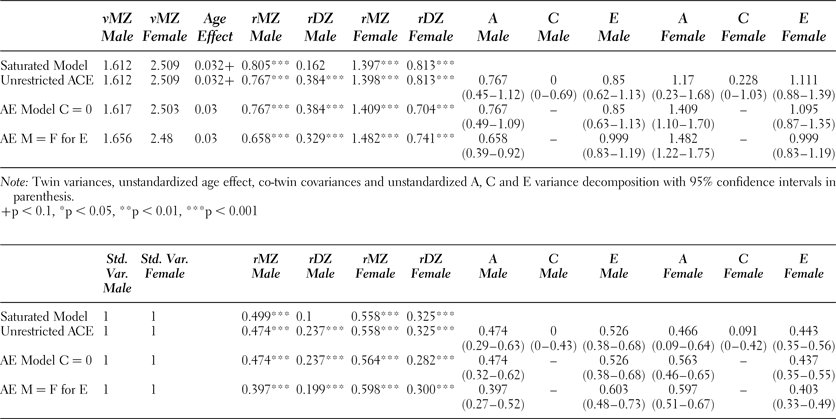
In light of these potential concerns, we present the complete results for every model that is less restricted than the final best fitting model identified during the model fitting process. Based on those results depicted in Table 2, it is clear that no matter which model we run, we are consistently yielding similar results (although confidence intervals do get narrower with the more restricted models). Every parameter that is significantly different from 0 in the most restricted ACE model is also significantly different from 0 in the least restricted model. The qualitative magnitudes of the parameter estimates also do not change substantially.
Twin variances, co-twin covariances, correlations and A, C and E variance decomposition with 95% confidence intervals
Note: Standardized age effect, co-twin correlations and standardized A, C and E variance decomposition with 95% confidence intervals in parenthesis.
+p < 0.1, *p < 0.05, **p < 0.01, ***p < 0.001
While past studies within political science focus predominantly on the standardized proportion of variance attributed to additive genetic, common, and unique environmental components, given the differences in total trait variance across the sexes, the unstandardized components are more telling in our case.Footnote 12 For reference, Table 2 presents both standardized and unstandardized results. The amount of variance unique environmental effects is responsible for is practically the same for men and women. There is a sex difference, however, in the amount of variance additive genetic effects is responsible for. In fact, additive genetic effects seem to drive the difference in variance almost entirely.Footnote 13
Beyond the difference in variation, there is also a mean difference present between sexes. Based on the available information, we can only speculate what contributes to the differences in the means, but seeing that most of the people in the sample got all knowledge questions right serves as a guide. Since the unique environmental contributions between the sexes are the same, it suggests that the differences in the additive genetic components are forcing the mean political knowledge downward for females in presence of a ceiling effect produced by a low number of relatively easy questions asked.Footnote 14
LIMITATIONS
One limitation of the ACE model is that it tests the impact of certain sources on the variance, not the mean. Reasonable questions could arise: What is the source of the difference in means between men and women? Is the difference in means due to genetic differences? We cannot definitively answer this question with the data we have available to us in the Minnesota Twins Political Survey. To pursue an answer to this type of question, we would need to explore the impact of potential sex chromosomes (Hatemi, Medland, and Eaves Reference Hatemi, Medland and Eaves2009) or differential functioning of specific genotypes across men and women. Such differences or differential functioning are unlikely to answer our questions.
The analysis does come with limitations provided by the data and assumptions made by the model.Footnote 15 The Minnesota Twins Political Survey is one of the first sources to provide detailed political data collected on a twin sample. Unfortunately, this sample is heavily restricted by age and geography, and we have little information as to how these results would generalize to other age groups and people from different areas of the country. Also, the sample is relatively small. This is one of the reasons DZ cotwin correlation statistics might be insignificant, rendering the classical twin model unreliable. Further, males in the sample are underrepresented, though this is not uncommon for twin samples. Additionally, various survey behaviors, such as nonresponse or response biases, can also be heritable, producing additional confounds to our study (Littvay Reference Littvay2010; Littvay, Popa, and Fazekas Reference Littvay, Popa and Fazekas2013; Thompson, Zhang, and Arvey Reference Thompson, Zhang and Arvey2011).
Finally, the presented twin models cannot rule out the possibility of an omitted variable bias. It does not take into account interaction effects both within and across the A, C, and E components, and the best-fitting AE model assumes that C is 0. While we know that the AE model shows superior model fit statistics compared to the ACE model, with a much larger sample it is possible that a significant C component would be detected and a more nuanced picture could be drawn, fine-tuning the exact proportions of contribution to the total variance. The omission of gene-by-gene and gene-by-environment interactions can also bias the results, though Verhulst and Hatemi (Reference Verhulst and Hatemi2013) suggests this bias is negligible.Footnote 16
DISCUSSION
Our empirical findings suggest that the environment is not the sole source driving the differences, but rather that the differences stem from variation driven by heritable factors when using a conventional scale for measuring political knowledge. We address our findings in this section in two ways. First, we articulate what the findings of our analyses do not mean. In light of this, we argue that the concept and subsequent measurement of political knowledge itself contains a gender bias that is tapping something that is driving the difference (i.e., lesser variance for men as compared to women). Second, we discuss how researchers should think about and measure political knowledge (see Stolle and Gidengil Reference Stolle and Gidengil2010; Thomas, Harell and Gosselin Reference Thomas, Harell and Gosselin2013), and we hope to set the stage for more nuanced approaches to studying gender and political behavior.
The preceding analysis suggests that the variance explained by the environment is the same for men and women. There is, however, a difference in the amount of variance explained by additive genetic effects. This finding is potentially controversial, but we want to caution readers not to interpret “amount of variance explained by additive genetic effects” as “caused by genes.” Twin studies do not test for a direct genetic causal relationship. They are a tool to identify presence of heritability. We do this not to pronounce that men are “genetically inclined to X …” or “women are genetically inclined to Y …” but to illuminate the possibility that the way we have been thinking about and measuring political knowledge might be gender biased, as our test illustrates that the current scale widely used for measuring political knowledge elicits more than mean differences. It elicits greater variance for women and less variance for men.
Interpretation of our results suggests the variation among women is being driven by additive genetic effects as opposed to environmental sources, which is what the literature to date has pointed to as the causal mover of the knowledge gap (e.g., the more education and access women have, the better they perform on the knowledge questions). We again caution the reader not to misinterpret our findings. To think about this in a more nuanced way and in a way that we hope might inform future measurement of political knowledge, we now turn to the notion of variance in political knowledge being heritable. What could that possibly mean?
A finding such as the one presented in this paper raises an important theoretical question: Why would the additive genetic component influence variation in women's political knowledge more than men's? To respond to this question, we draw on recent studies that have considered heritability and a gender gap. When there is a difference in heritability between men and women on a trait with more variation in one sex but not the other, there may be adaptation involved—or something in the psychological or behavioral trait that is relevant for survival and reproduction to one sex but not the other. Hatemi, Medland, and Eaves (Reference Hatemi, Medland and Eaves2009) cite that the genetic variation will be less for traits exposed to stronger selection. Logic would have us predict lower variance on the heritable trait since things that matter most for survival and reproduction are most tightly regulated. So the key interpretation of this difference has less to do with a greater variance in political knowledge for women and more to do with this particular measure of political knowledge tapping into something that is particularly salient for men. Consistent with “playground cognition,” we attend to those aspects of social and political life that are most likely to serve us well. We do not need a genetic test to understand that. We could simply ask people waht is important and why.
What the literature on the knowledge gap cited above converge upon is the notion that men and women are more or less likely to be motivated to attend to various kinds of political knowledge given the relative “return on investment.” We suggest the “return on investment” can mean anything from the social acceptability of reporting you “don't know” on a test of knowledge, cueing competition and hierarchy, or the extent to which spending time learning one type of political knowledge over another is likely to bring about practical social and material benefits.
Lizotte and Sidman (Reference Lizotte and Sidman2009); McGlone, Aronson, and Kobrynowicz (Reference McGlone, Aronson and Kobrynowicz2006); and Mondak and Anderson (Reference Mondak and Anderson2004) all illustrate differing forms of risk-taking or risk-averse behaviors and find changes in the knowledge gap accordingly. In addition to the “propensity to guess” research, perhaps the most important clues regarding political knowledge and the gender gap come from Stolle and Gidengil (Reference Stolle and Gidengil2010), who illustrate that “politics” is not merely the campaign horse races, the who's who of office holders, and other civics quiz-type questions. Politics is also about goods and services, access, and identifying contexts when one's views are more likely to be represented.Footnote 17 Women are as, if not more, knowledgeable as men about these aspects of politics (see also Dolan Reference Dolan2011; Karp and Banducci Reference Karp and Banducci2008). Although women are nearly as likely to correctly respond to the knowledge questions when controlling for education, SES, and so forth, there remains a gap that is remedied by changing the nature of the questions. Unfortunately, our data does not allow us to run the analyses using those “practical” knowledge questions, but we hope that providing our framework for thinking about why there may be differences and what types of questions may tap a gendered response will encourage others to further investigate this hypothesis.Footnote 18
Based on our sociorelational framework, men and women may attend to different types of information in varying social contexts and in response to the affiliative or capacity-driven consequences. Thinking about these differences may assist in better predicting attitudes and behaviors. And returning to Chodorow (Reference Chodorow1978), Gilligan (Reference Gilligan1982), and Saprio (2003), such findings need not result in men's focus of attention or resulting behaviors being more valid than women's. Measuring “political knowledge” could arguably be undertaken in a number of different ways. We may understand politics to be about the operation of government and how power is distributed, but also to be about the distribution of goods and services and even the relationship between citizens and government (e.g., Thomas, Harell, and Gosselin Reference Thomas, Harell and Gosselin2013). We encourage the reader to think more broadly about the questions measuring political knowledge in their survey instruments. Political knowledge, as presently measured in the traditional battery of questions, is all about the contest, the hierarchy, and power. Politics so defined may be particularly salient for men because they get a greater sociorelational return on investment for knowing about these aspects of politics. Women may be more likely to have a greater psychological orientation to other aspects of politics, such as services and policies impacting their communities and their families (Stolle and Gidengil Reference Stolle and Gidengil2010; Thomas, Harell, and Gosselin Reference Thomas, Harell and Gosselin2013), as well as to whom they may look to for furthering their political interests the best.
We use statistics in the social sciences to tell a story. The story we are telling is that these particular questions measure an aspect of politics that resonates with men's psychological orientation more than an aspect of politics that would resonate with women's. Change the “cueing” of that orientation, and you change knowledge reports as well as related behavior. Due to the limits of our data and methods, we cannot directly test this hypothesis, but we hope to see other scholars and engage this inquiry further using more appropriate data and methods.
Politics is about the ability to identify and negotiate for what you need within the spheres of political exchange in which you operate. There are good reasons for these spheres to be perceived somewhat differently by men and women and for their strategies in attending to information to be different as well. Madeleine Kunin, a former ambassador and governor of Vermont, described her experience of entering “politics” the following way:
I was unknowingly preparing for a political life … None of the activities I engaged in met the definition of “political,” but they taught me political skills. The difference between community activities and political action is simply one of scale … When I was eventually elected to public office, I discovered I was far better prepared than I had anticipated. I had underestimated the enormous amount that I had learned in the community and was unaware of my ability to transfer my knowledge to public life (as cited in Mayhead and Marshall Reference Mayhead and Marshall2005, 74).
Kunin did not realize what she was doing was political or had any transference to “politics” because it did not match up with the prevailing conception of political behavior and politics. Her perception of what needed to be attended to and her motivation to make it happen was political behavior. When we begin asking women (and men) about their communities and things that immediately matter for their well-being and how they negotiate for those things. We will better understand the relationship between political knowledge and modes of citizenship that include many aspects of political behavior. As Mondak and Anderson (Reference Mondak and Anderson2004) state, “it makes no sense to seek out a reliable scale that measures the wrong thing … reliability is desirable only as a means toward validity, not as a substitute for validity” (507).
Widespread assumptions about men's and women's political behavior are ripe for reconsideration, and research pertaining to women's political behavioral repertoires requires a multidisciplinary approach. We strongly advocate for further investigations pertaining to gender differences in political attitudes and behaviors that employ more nuanced theoretical frameworks to inform empirical analyses.
APPENDIX
Multiple-choice Knowledge Questions with Offered Responses
1. Who has the final responsibility to decide if a law is constitutional or not? (the president, congress, the Supreme Court, not sure)
2. Whose responsibility is it to nominate judges to the federal courts? (the president, congress, the Supreme Court, not sure)
3. Which of the political parties is more conservative than the other at the national level? (Democrats, Republicans, not sure)
4. How much of a majority is required for the U.S. Senate and House to override a presidential veto? (a bare majority of 50% plus one, two-thirds majority [67% or more], three-fourths majority [75% or more], not sure)
5. What is the main duty of the U.S. Congress? (to write laws, to administer the president's policies, to supervise states' governments, not sure)