INTRODUCTION
Human and animal archaeological remains (bone, tooth, ivory, and antler) are very complex materials that are used in the radiocarbon (14C) dating technique. Bones are basically built up by an organic collagen (a scleroprotein composed of amino acids such as glycine, proline, hydroxyproline etc.) and an inorganic mineral (calcium phosphate containing structural carbonate) fraction. Although carbon from the mineral fraction might be suitable for 14C dating (Saliège et al. Reference Saliège, Person and Paris1995; Major et al. Reference Major, Dani, Kiss, Melis, Patay, Szabó, Hubay, Túri, Futó, Huszánk, Jull and Molnár2019), extraction of the organic collagen fraction is the most preferred method in dating of bones (Longin Reference Longin1971). Fresh bone contains about 20 wt % collagen but this value drops steadily during burial and its chemical composition can be altered significantly due to diagenetic processes and ambient carbon-containing compounds such as fulvic and humic acids, polysaccharides, lipids and carbonates (van Klinken and Hedges Reference van Klinken and Hedges1995).
The earliest 14C dates were obtained on whole bones, thus the dates were often inaccurate, compared to the associated dates on charcoal. Krueger (Reference Krueger1965) proposed demineralization at low temperature and pressure, with relatively weak acids, to increase collagen yields. Longin (Reference Longin1971) suggested the separation of the acid-insoluble collagen from acid-insoluble organic contaminants, by heating the sample in weak acid to hydrolyze the collagen into soluble gelatin. Later, an additional base wash step (using diluted NaOH) was introduced into the protocol to remove humic substances. Although this protocol provides collagen that generally yields more accurate 14C dates, NaOH may significantly decrease the collagen yield, and does not completely remove organic contaminants (Brown et al. Reference Brown, Nelson, Vogel and Southon1988). Since then, other improved methods for purification of collagen have been developed (e.g. ninhydrin method, step combustion technique or protein remnant cleaning by ion-exchange columns) but ultrafiltration is currently the most popular protocol for collagen purification (Bronk Ramsey et al. Reference Bronk Ramsey, Higham, Bowles and Hedges2004). Ultrafiltration separates collagen compounds with high molecular weight (HMW, >30 kD) from low molecular weight (LMW, <30 kD) fraction. The HMW fraction is expected to contain large fragments of intact bone collagen, while LMW compounds include broken collagen chains and soil-derived organic compounds. However, numerous studies have demonstrated that the glycerol used to keep the membrane of the ultrafilter moist may contain old or post-bomb organic carbon, of which removing might be problematic (Hüls et al. Reference Hüls, Grootes and Nadeau2007, Reference Hüls, Grootes and Nadeau2009). Nonetheless, according to Higham et al. (Reference Higham, Jacobi and Bronk Ramsey2006), using ultrafiltration can be strongly associated with the reduction of the 14C background limit of ancient bones, which has made the investigation of bone background limit and reproducibility a major topic in many laboratories (Wood et al. Reference Wood, Bronk Ramsey and Higham2010; Naysmith et al. Reference Naysmith, Dunbar, Scott, Cook, Tripney and Brown2017). For the purpose of background determination, 14C laboratories have begun to use 14C free infinite aged bones, which are treated in parallel with the unknown samples to identify any contamination-derived 14C introduced during the chemical pretreatment, CO2 conversion or graphitization sub-steps (Dunbar et al. Reference Dunbar, Naysmith, Cook, Scott, Xu and Tripney2017). The vast majority of bone samples submitted for dating are less than one 14C half-life in age, thus younger known-age samples are also worth studying to monitor the variability and uncertainty of the 14C date determinations. Subsequently, when a large number of results of repeated samples have already been collected, statistical methods may also help to reveal the long-term reproducibility of the measurements, in addition, to determine the most adequate blank correction procedure (Wood et al. Reference Wood, Bronk Ramsey and Higham2010).
The main purposes of this study are to (1) gain a better understanding of the background and reproducibility of our modified Longin (MLM) bone preparation protocol and suggest an adequate blank correction procedure, and (2) additionally, evaluate and establish an ultrafiltration protocol (UF) at our laboratory, using our internal standard bone samples of different ages and preservation.
MATERIALS AND METHODS
Since the start of the AMS laboratory at the Hertelendi Laboratory of Environmental Studies (HEKAL, Department of the Isotope Climatology and Environmental Research Centre, ICER), numerous internal procedural blanks and known-age bones have been prepared. Our study uses 82 background and 70 known-age measurements carried out between February 2016 and September 2018 to evaluate mathematically the background and uncertainty of our current protocol. The blank correction process can be applied to unknown samples, as well. Usually, only the uncertainty of the 14C measurement is given in analysis reports, which, despite the instrument blank correction and normalization, may not include the standard deviation (SD) related to the sample pretreatment and processing. At HEKAL, background bones with infinite 14C age are routinely prepared and measured in each AMS bone measurement batch, which has resulted in a large number of dates over the last two and a half years. Although, our bone preparation protocol appears to be adequate based on the dates of blank and known-age samples, we have recognized the need for the continuous development. Hence, we inserted an ultrafiltration step into our current bone processing protocol and tested it on three bone samples covering a wide range of 14C ages from modern to blank. The quality of collagen was monitored by carbon and nitrogen stable isotope ratio measurements and atomic C/N ratio determination (DeNiro et al. Reference DeNiro, Schoeninger and Hastorf1985).
Description of Test Samples
As internal procedural standards, three different blank and one known-age sample applied at our laboratory were studied. All three blank samples were classified and kindly provided by Mihály Gasparik (Hungarian Natural History Museum, Budapest). The first two samples (ProBl_1 and ProBl_2) belonging to a steppe bison (Bison priscus) were found in the same gravel pit in 2012. The third bone blank (ProBl_3) originates from a complete mandible of a woolly mammoth (Mammuthus primigenius). This individual was found during a cleaning campaign of the bed of the river Tisza, most probably during the second half of the 19th century. Unfortunately, in both cases, the exact localities of the remains are not known. The ages of these bones were considered to be infinite with regard to 14C dating. As a known-age sample (K-Age), a larger tibia fragment of a Eurasian auroch (Bos primigenius primigenius) from the Early Neolithic period was used, which had been offered by János Dani (Déri Museum, Debrecen). Based upon the circumstances of the archaeological excavation, its expected age falls into the period of the Körös culture (Hencida-Gyűrűszeg archaeological site, Eastern Hungary), which was also confirmed by 14C age measurements of two other contemporaneous sites (Szentpéterszeg-Körtvélyes and Berettyóújfalu-Morotva-liget) (Gamba et al. Reference Gamba, Jones, Teasdale, McLaughlin, Gonzalez-Fortes, Mattiangeli, Domboróczki, Kővári, Pap, Anders, Whittle, Dani, Raczky, Higham, Hofreiter, Bradley and Pinhasi2014). For the ultrafiltration tests, in addition, a modern pig (Sus scrofa domestica) bone (referred as Modern) was purchased at a butcher shop at the beginning of summer 2018. This bone was not identified by a zoologist, but it is expected to be a leg bone (humerus or femur) of an 8–9-month-old individual, which was slain 1 or 2 months before. After a thorough rinsing in ultrapure water, the bone was freeze-dried, and the meat was removed by a scalpel.
Bone Preparation Using Modified Longin Method (MLM)
At HEKAL, all bone samples containing collagen are processed as follows. At the beginning of the pretreatment, all samples are visually inspected and all visible marks on its surface are noted along with the initial mass. After repeated ultrasonication in ultrapure water, the bones are dried at 60°C overnight. The outer surface of the bones is removed by thorough abrasion. Then, larger bone fragments are ground and sieved to get the adequate size fraction of 0.5–1.0 mm. For chemical pretreatment, 500–1000 mg (min. 100 mg) of the ground powder is placed in a special designed Omnifit™ glass column. These columns are used as flow cells in our semi-automatic system that was constructed for performing the ABA (acid-base-acid) cleaning method on bone samples (Molnár et al. Reference Molnár, Janovics, Major, Orsovszki, Gönczi, Veres, Leonard, Castle, Lange, Wacker, Hajdas and Jull2013a). At the end of the chemical pretreatment, the pH is adjusted to 3 to eliminate any ambient CO2 absorbed in the base-treatment step. Subsequently, the acid-insoluble collagen is transferred into a test tube containing 5 mL of HCl solution at pH 3, and it is put into a block heater at 75°C for 24 hr. Dissolved gelatin is then filtered via a 2 μm glass fiber filter (Milles AP20) into a 20 mL vial precleaned by nitrogen gas, and after freezing, it is freeze-dried for at least 2 days.
Gelatin samples are then combusted using a modified sealed-tube combustion method where the sample and MnO2 reagent are together placed in a borosilicate combustion tube. After flame sealing, the closed tubes are placed in a muffle furnace at 550°C for at least 12 hr to combust the gelatin. The CO2 gas produced is then transferred and purified from any other by-product gases using a dedicated vacuum line where the carbon content is quantified as well (Janovics et al. Reference Janovics, Futó and Molnár2018).
Bone Preparation Using Ultrafiltration (UF)
Regarding the use of ultrafiltration, numerous aspects of its benefits and drawbacks have been presented and discussed in the literature. Bronk Ramsey et al. (Reference Bronk Ramsey, Higham, Bowles and Hedges2004) found evidence that the ultrafiltration method is a considerable advance in terms of removing environmental contamination and produces more accurate ages (mainly for bones of Paleolithic age) than less rigorous bone pretreatment methods. Nonetheless, the filters can contaminate the gelatin with glycerol deriving from the surface of filters, but Brock et al. (Reference Brock, Ramsey and Higham2007) have shown that this humectant can effectively be removed applying a profound cleanup procedure before use. Furthermore, Hüls et al. (Reference Hüls, Grootes and Nadeau2009) have shown that the fragmentation of ultrafilter membrane itself, which is ancient in age, could also contaminate the filtrate fraction (<30 kDa) but no significant contamination was seen in the supernatant fraction (>30 kDa). However, this effect has not yet been independently confirmed by other laboratories (Wood et al. Reference Wood, Bronk Ramsey and Higham2010). As 14C investigations regarding VIVASPIN 15R filters appear to give clear evidence for no contamination with either young or old carbon for both the filtrate and supernatant fractions (Hüls et al. Reference Hüls, Grootes and Nadeau2009), we used the ultrafilters of this type for our tests.
In all cases, the ultrafilter cleaning step occurred on the day before the ultrafiltration of the actual gelatin samples. Briefly, the ultrafilters (VIVASPIN 15R, 30,000 MWCO HY, regenerated cellulose membrane) are filled with 15 mL of ultrapure water and centrifuged at 3500 rpm for 15 min. This step is repeated two more times. Then, the filters are completely filled with ultrapure water and ultrasonicated for at least 60 min followed by centrifuging 15 mL ultrapure water two more times. Our ultrafiltration protocol was set up based on other already tested protocols published in the peer-reviewed literature (Brock et al. Reference Brock, Ramsey and Higham2007; Hüls et al. Reference Hüls, Grootes and Nadeau2009). The bone samples were treated in parallel using the MLM and ultrafiltration bone cleaning protocols. The two collagen extraction procedures are the same up to the point of filtration using 2-μm syringe filters. After this step, in the case of ultrafiltration, the gelatin solution was transferred to a precleaned ultrafilter and centrifuged at 3000 rpm for 15 min. The filtrate (referred as UFB in the text) and supernatant (UFA; less than 1 mL in each case) fractions were collected separately into individual 20 mL vials and were freeze-dried for 2 days. Subsequent combustion and CO2 cleaning steps are the same as described earlier for the non-ultrafiltered collagen preparation.
Applied Analytical Methods
Carbon and nitrogen stable isotope measurements were calibrated by control measurements of IAEA 600 (caffeine) and sulfanilamide standards after every fifth unknown sample. Measurements were performed by a Thermo Finnigan Delta Plus XP isotope ratio mass spectrometer. Briefly, gelatin sub-samples (∼0.3 mg) are packed into ultraclean aluminum cups and combusted by an elemental analyzer (Thermo Scientific™, EA IsoLink CNSOH). The carbon and nitrogen stable isotope ratios and percentages are determined in the same run. The stable isotope results are expressed as delta value which is defined as follows: δ(‰)=(Rsample/Rreference–1) ×1000, where Rsample and Rreference is the 13C/12C (or 15N/14N) ratio in the sample and in the reference material, respectively. The overall uncertainty of the δ13Cvs.VPDB and δ15Nvs.AIR measurements is ± 0.2‰ and ± 0.3‰, respectively.
For 14C dating by AMS, graphite targets from the purified CO2 samples were prepared using a customized sealed tube graphitization method (Rinyu et al. Reference Rinyu, Molnár, Major, Nagy, Veres, Kimák, Wacker and Synal2013). The 14C measurements reported below were performed using the EnvironMICADAS AMS instrument at HEKAL (Molnár et al. Reference Molnár, Rinyu, Veres, Seiler, Wacker and Synal2013b). The overall measurement uncertainty for modern samples is < 3.0‰, including normalization, background subtraction, and counting statistics. The conventional 14C ages were evaluated by the “Bats” software package (version 3.66; Wacker et al. Reference Wacker, Christl and Synal2010; Stuvier and Polach Reference Stuiver and Polach1977).
RESULTS
Evaluation of the Bone Procedural Blank
The two bones of a steppe bison (hereafter ProBl_1 and ProBl_2) and the remains of a woolly mammoth (hereafter ProBl_3) were applied sequentially as internal blank samples during the studied two and a half years to assess the procedural background of our current bone preparation method (in total 82 graphite targets). In all cases, the blank samples were assumed to have an infinite age although this was not independently confirmed by archaeological findings or other dating methods. The amount of the extracted gelatins ranged from 10 to 100 mg while the mass of combusted gelatin scattered around 4 mg. For example, Wood et al. (Reference Wood, Bronk Ramsey and Higham2010) has suggested a new correction method to avoid the under-correction of large and overcorrection of very small samples. In our case, the 14C ages of the three blank samples plotted as a function of the gelatin yield (mg) does not show any significant correlation (max. R2 is 0.15 for ProBl_3), therefore we do not use any special gelatin yield dependent correction.
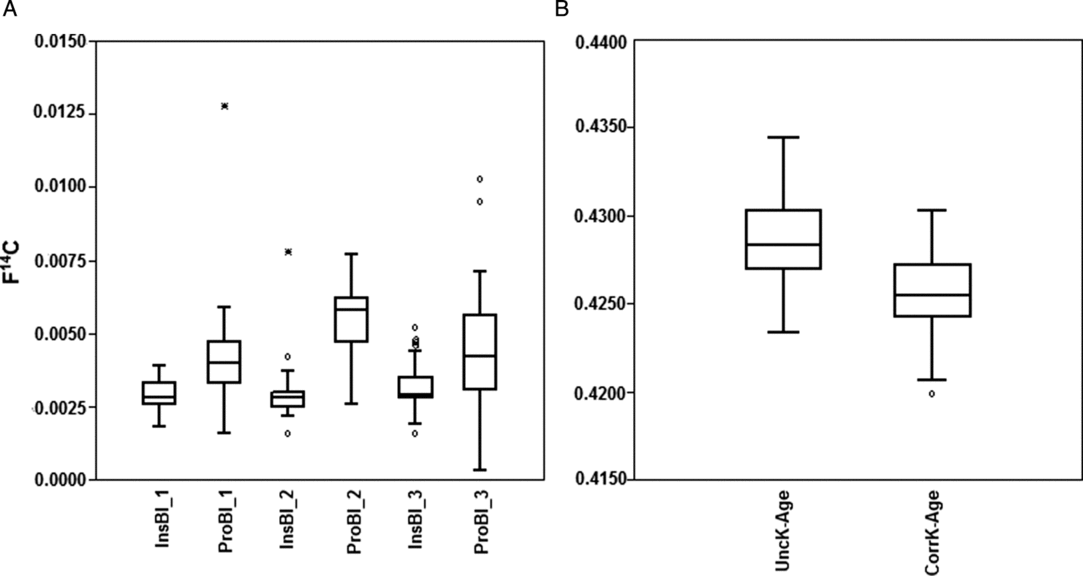
First, we studied the instrument background (InsBl) itself and compared it to the bone procedural blanks (ProBl, Figure 1A). The instrument blanks are made from high purity fossil CO2 borehole gas (Linde Hungary, Répcelak) requiring no chemical pretreatment; the gas samples are just graphitized and AMS measured (Molnár et al. Reference Molnár, Rinyu, Janovics, Major and Veres2012). The long-term mean F14C for the instrument blank is around 0.0029 ± 0.0007 (n = 78, 4 outlier) (F14C values quoted in this paper are all ± 1σ). In each measurement batch (22 targets in total), three instrument blanks can be found of which mean value is subtracted from all the unknown samples measured in that certain run. Therefore, all the bone results presented in this paper have already been corrected for the instrument blanks. In case of the blank bones, the uncorrected values are also given for comparison. After discarding the apparent outlier results (indicated by circles and dots in Figure 1), bone blank samples coded as ProBl_1, ProBl_2 and ProBl_3 gave the following mean F14C and SD values: 0.0039 ± 0.0012 (n = 25, uncorr.: 0.0068), 0.0054 ± 0.0012 (n = 19, uncorr.: 0.0082) and 0.0043 ± 0.0013 (n = 35, uncorr.: 0.0074), respectively. As the mean data show, the corrected F14C value for the sample ProBl_2 is more than 0.001 higher than that of the other two blank samples.
(A) Comparison of the mean F14C values for the associated instrumental (InsBl_1-3, fossil CO2) and procedural blanks (ProBl_1-3, fossil bones). The procedural bone blanks are already ins. blank corrected. (B) Comparison of the mean F14C values of the known-age bone sample, before and after procedural blank correction (UncK-Age nad CorrK-Age, respectively). Circled and dotted results are those that are at least 1.5 or 3 times the interquartile range(Q3–Q1) from the lower or upper quartile, respectively.

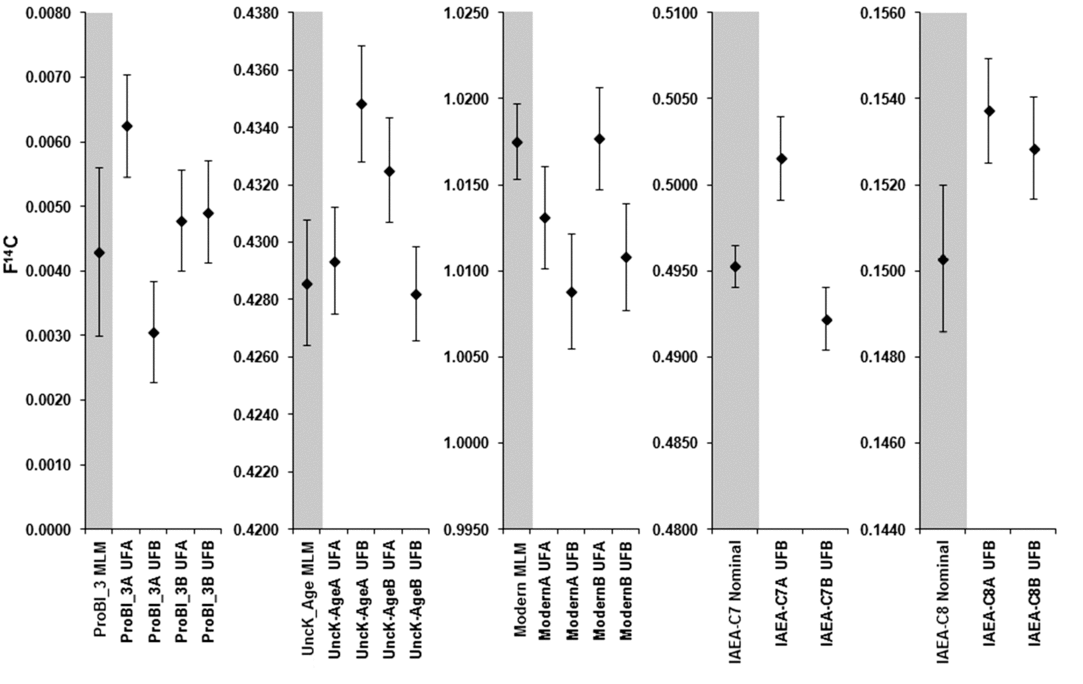
Comparison of the Longin and ultrafiltration methods using bone samples of different F14C values (procedural blank, uncorrected known-age, modern, IAEA-C7 and IAEA-C8). The gray bars represent the results obtained by our current method. UFA and UFB denote the ultrafiltred supernatant and filtrate fractions, respectively.

Assuming equal variance, this mean value is significantly different from that of the other two blanks (analysis of variance, p-value <0.05). Based upon archaeological aspects, the ProBl_1 and 2 samples should have the same age due to their finding in the same gravel pit. The difference may be caused by a procedural reason, i.e. the cleaning process of glassware of the bone preparation system was changed when we switched from ProBl_1 to ProBl_2. That time, a new decontamination detergent (Contrad 90) was introduced in the protocol instead of chromic acid. Finally, when we changed to the blank bone ProBl_3, the soap and chromic acid regents were already applied sequentially, thus the blank again achieved a lower value, close to the initial one. Based on other procedures, the detergent is suitable for removing organic contamination but, probably, the cleaning steps in our procedure were not worked out properly. Despite the wider interquartile range of the ProBl_3 sample (relative to ProBl_1), there is no statistically significant difference in the mean value and SD of these samples (two sample t and F-tests, p-value 0.05) thus they can be regarded as identical blanks.
Comparing the long-term mean values of 0.0029 ± 0.0007 (n = 78) and 0.0041 ± 0.0013 (n = 60, ProBl_1 and ProBl_3, discarding the mean value of ProBl_2) for the instrument and corrected procedural blanks, respectively, the former one significantly differs from the latter one (two sample t-test, p-value 0.05). Dunbar et al. (Reference Dunbar, Naysmith, Cook, Scott, Xu and Tripney2017) reported that the running mean F14C value of their modified Longin extraction method at SUERC is around 0.0030 ± 0.0009, which is higher than the value of a wood blank (Heidelberg tree) applied in parallel. They concluded that the complexity of collagen extraction procedure is unlikely to be solely responsible for the higher background contribution of bone measurements. Other studies have also indicated that the slight differences in the procedures undertaken by different staff members can also result in the variation of the final results (Fülöp et al. Reference Fülöp, Heincze, John and Rethenmeyer2013; Dunbar et al. Reference Dunbar, Naysmith, Cook, Scott, Xu and Tripney2017). At our laboratory, bone preparation is performed by only one technician thus the higher bone blank is likely due to procedural (more probably mixed) factors. In the future, we would like to perform some physical tests regarding the filamentous structure of the gelatin (it has a large and adhesive surface relative to charcoal) whether or not it can be responsible for the increased background.
Blank Correction for Bone Samples
The results regarding the procedural bone blanks point to the importance of an adequate background correction method, thus the F14C value of the blank sample measured in each bone measurement batch was used for blank correction of all the other bone samples to obtain more accurate ages. The instrumental-only and procedural blank-corrected mean F14C results for the known-age bone sample are shown in Figure 1B. The replicated measurements of this bone offered a raw average F14C value of 0.4286 (n = 70), which corresponds to a 14C age of 6806 BP. The mean measurement uncertainty obtained by the Bats software is around 0.0017 F14C (30 yr). Although the uncertainty of the raw AMS measurements is of the correct magnitude, it does not evidently account for the entire variation of the 14C results. If we look at the standard deviations of 0.0020 and 0.0022 (40 yr) related to the procedural blank corrected and uncorrected F14C values, respectively, these better characterize the variation of the results obtained (in 1σ range). The SD of the procedural blank-corrected result is identical in magnitude with the uncorrected one, but the mean F14C value is a slightly lower. Moreover, the SD of blank samples is also very similar that confirms the magnitude of the estimated uncertainty. We applied the following classical mass-balance equation for contamination correction:
 $${{\rm{F}}^{{\rm{14}}}}{{\rm{C}}_{{\rm{measured}}}} \times {{\rm{m}}_{{\rm{sample}} + {\rm{cont}}}} = {\rm{ }}{{\rm{F}}^{{\rm{14}}}}{{\rm{C}}_{{\rm{sample}}}} \times {{\rm{m}}_{{\rm{sample}}}} + {{\rm{F}}^{{\rm{14}}}}{{\rm{C}}_{{\rm{cont}}}} \times {{\rm{m}}_{{\rm{cont}}}}$$
where, F14C and m represents the specific 14C activity and mass of the sample and contamination, respectively. Based on the expected and measured mass and 14C data of the blank sample, the mass of the contaminant can be calculated and applied in the correction of unknown samples. As other labs have noted, the contamination added in the laboratory is usually assumed to be modern in age (Vogel et al. Reference Vogel, Nelson and Southon1987). This modern carbon appears to contaminate the bone blank samples with similar amounts as the unknown samples since all samples are handled in the same way. The procedural blank-corrected F14C value of this sample is 0.4256 ± 0.0020 corresponding to a date 6862 BP, indicating that this sample is slightly affected by modern contaminating carbon. Assuming equal variance, the corrected mean value is significantly different from the uncorrected one (two sample t-test, p value 0.05). The majority of bone samples processed in the laboratory are of Neolithic or younger age, thus the blank correction only slightly shifts the results, but these small changes can gain greater importance in the Paleolithic range.
Ultrafiltration Tests on Bone Samples
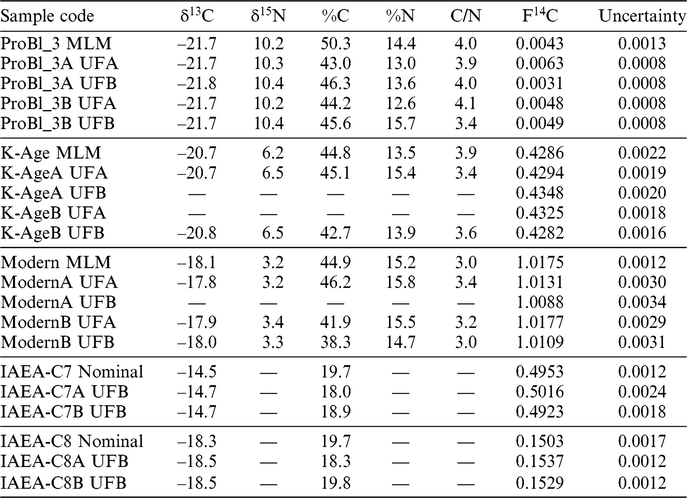
The ultrafiltration protocol was tested on our three internal standard bones of different ages, to see if any contamination remains in the samples (soil-derived) after chemical pretreatment or is introduced during the ultrafiltration step. The results are shown in Table 1. Ultrafiltration is a widely-used procedure for better purification of gelatin, but due to the risk of contamination derived from the surface of membranes, the filter requires thorough cleaning before use. To check whether or not any supposed humectants come from the surface of the filters and influence the collagen, IAEA-C7 (nominal δ13CPDB and F14C values are −14.48 ± 0.21‰ and 0.4953 ± 0.0012, respectively) and IAEA-C8 (nominal δ13CPDB and F14C values are −18.31 ± 0.11‰ and 0.1503 ± 0.0017, respectively) oxalic acid reference samples were also prepared in the test process, in parallel with bone samples. As the oxalic acid (dissolved in ultrapure water) has a molecule weight less than 30 kDa, only the filtrate fraction passing through the filters could be 14C dated. According to our assumption, if the humectant has an effect on the filtrate fraction of bones, the supernatant fraction would show the contamination as well. However, if the filtrate fraction is confirmed to have no significant contamination present, the supernatant fraction above the filter can also be regarded as contamination free, as Hüls et al. (Reference Hüls, Grootes and Nadeau2009) has suggested.
Result of the analytical measurements performed on the bone samples included in the ultrafiltration tests (procedural blank, uncorrected known-age, modern, IAEA-C7 and IAEA-C8). The uncertainties for δ13C and δ15N measurements are ± 0.2 and ± 0.3 ‰, respectively.

Looking at the carbon and nitrogen stable isotope data (δ13C, δ15N) there are no significant differences between the values of the Longin and ultrafiltration methods (Table 1). The values obtained for the IAEA C7 and C8 standards are also in good agreement with the nominal values in 1σ range. The %C, %N and atomic C/N data for the tested gelatin samples could be indicators for the poorly preserved or contaminated gelatins. We cannot observe significant differences in the values between the two preparation methods, but the high C/N ratios might be indicative for the not well-preserved collagen. In case of the ProBl_3 sample prepared by the Longin method, the C/N ratio is around 4.0 that can be indicative of some extra carbon-containing contamination in the gelatin. However, both of the filtrate and supernatant fractions yielded similar values (3.4–4.1) for the ultrafiltered materials, thus we can suppose that the high ratios out of the accepted range are not caused by different contaminants having been collected in either fraction. The C/N ratios of the known-age sample is also slightly higher than the conventionally accepted value (2.9–3.4; DeNiro et al. Reference DeNiro, Schoeninger and Hastorf1985), but visual inspection did not show poor preservation of the bone.
Regarding the 14C data, the procedural blank sample (ProBl_3) has regularly been prepared using our current method for two and half years and its long-term mean F14C value of 0.0043 ± 0.0013 is used in the comparisons. The mean values for the ultrafiltered supernatant (UFA) and filtrate (UFB) fractions are 0.0055 ± 0.0010 and 0.0040 ± 0.0013, respectively, which are very similar to each other and agree in 1σ uncertainty range. Gelatin extracted using the ultrafiltration protocol produces similar results, suggesting that the bone is not contaminated appreciably with young carbon. K-Age samples (with an age around one 14C half life) show a mean F14C value of 0.4286 ± 0.0022 (without ultrafiltration). The mean values for the ultrafiltered supernatant and filtrate fractions are 0.4310 ± 0.0022 and 0.4315 ± 0.0047, respectively, which are also very similar to each other and to the conventional value. These ultrafiltered samples were measured in different measurement batches so the external uncertainty (SD) of different measurements can also be studied. This suggests that the ultrafilters do not appreciably contaminate the samples with young carbon either. The mean F14C value for the duplicated modern pig samples prepared conventionally and corrected for the measurement blank is 1.0175 ± 0.0012. The mean F14C values obtained for the supernatant and filtrate fractions of the duplicated samples ultrafiltered are 1.0154 ± 0.0032 and 1.0098 ± 0.0014, respectively. Seemingly, the filtrate fraction values are lower than that of the supernatant fraction. This could be an indication that the filter humectant contains a small amount of “old carbon” (having no large effect on the supernatant fraction) but this was not confirmed by the results of the blank or known-age samples. The mean value of the samples prepared using our current method is effectively identical with the mean of supernatant fraction within the uncertainty range; moreover, it does not differ from the mean of the filtrate fraction. Unfortunately, we do not yet have sufficient measurement data for statistical tests on the ultrafiltered bone gelatin.
If we look at the mean F14C value of the filtrate fraction of IAEA-C7 standard samples, we can see a value of 0.4969 ± 0.0066 that is slightly higher than the nominal value (0.4953 ± 0.0012) but is still within 2σ. These samples were measured in different measuring batches, thus the higher SD in an indication of the external error. The IAEA-C8 standard samples gave a mean value of 0.1533 ± 0.0006, which is 0.003 higher than the nominal value (0.1503 ± 0.0017), indicating a small modern effect during the filtration process. The results of some other studies showed that ultrafiltration did not yield statistically different ages in comparison to the values obtained for subsamples treated by the Lognin method. It appears that the ultrafiltration method has reached a point where sample size and AMS precision are no longer the limiting factors; rather, human error during pretreatment and sample handling plays a key role in delivering the expected accuracy of bone 14C dating (Fülöp et al. Reference Fülöp, Heincze, John and Rethenmeyer2013). Our results measured for our test bones of different 14C ages also show that the mean values for both the modified Longin and the ultrafiltration gelatin extraction methods are indistinguishable, but we will continue our tests, involving bones having poor preservation or low collagen yield. Seemingly, the differences in ages obtained (at 1σ level) could be due to procedural or mixed factors, which have been overlooked, or AMS measurement variability, as we have seen in the case of background and known-age sample measurements. We can conclude that further procedural and mathematical investigations are needed.
CONCLUSIONS
In the last two and a half years, numerous procedural blank and known-age bones were prepared and measured at HEKAL. In this paper, we tried to evaluate mathematically the results and in addition, an ultrafiltration protocol was also tested. In the first section, we showed that our internal procedural blank samples give a background of around 0.005 F14C (∼42,500 BP) or even better due to the efficient bone pretreatment protocol. A good reproducibility was confirmed by the results of internal laboratory known-age bones as well, where the standard deviation of the sample is better than 0.0025 in F14C. We presume that any variation is probably caused by natural variability during the sample pretreatment and measurement. We have also demonstrated that the actual date of a sample with a Holocene age becomes slightly older after blank correction.
In the second section, we evaluated a new ultrafiltration protocol, which was inserted into our current bone processing protocol. The selected bones of different ages were processed in parallel using our modified Longin and ultrafiltration preparation methods, but no notable differences were obtained in 2σ uncertainty range. The results suggest that our modified Longin method removes properly the contamination out of the selected bones, but we will continue our procedural and mathematical tests, involving bones having poor preservation or low collagen yield.
ACKNOWLEDGMENTS
The research was supported by the European Union and the State of Hungary, co-financed by the European Regional Development Fund in the project of GINOP-2.3.2-15-2016-00009 “ICER.” This work was done under the auspices of IAEA (International Atomic Energy Agency) in the frame of the CRP (Coordinated Research Projects): Enhancing Nuclear Analytical Techniques to Meet the Needs of Forensics Sciences. The paper was supported by the Momentum Mobility research project of the Hungarian Academy of Sciences. In addition, a special thanks to Renáta Gönczi and Krisztina Szathmári for the careful sample handling and preparation and to M. Daróczi-Szabó for the zoological determination.