In the past twenty years, given the burgeoning field of postcolonial studies and its inquiry into the identity politics of race, ethnicity, and imperialism, significantly more critical attention has been paid to Charlotte Brontë's portrayal of Bertha Rochester in Jane Eyre (1847) than in the prior one hundred and forty years of Brontë scholarship. While in The Madwoman and the Attic (1979), Gilbert and Gubar present an earlier reading of Bertha as “Jane's truest and darkest double” (360), any reading of Bertha's darkest in terms of a cultural or racialized identity came about in later criticism. Gayatri Spivak was instrumental in positioning Bertha within a discourse of imperialism rather than reading her merely in psychological terms, which then precipitated more recent studies on Bertha's colonial heritage, her financial and cultural imperialist inheritance and her ambiguous ethnic status as a Creole women.Footnote 1 Contemporary critics have also addressed how Rochester in a sense becomes Bertha's “truest and darkest double.” However, his darkness has proven to be far more quizzical, for unlike Bertha he is neither Creole nor raised in the West Indies; quite to the contrary, Rochester was desired by the Masons precisely because of his heritage, being “of a good race.”Footnote 2 Still, as readers, we have had to grapple with Brontë's numerous descriptions of Rochester's dark visage.
Piqued by these descriptions, contemporary critics have proposed very illuminating and provocative interpretations in an effort to resolve this question of Rochester's darkness and its correlation to his being of good British stock. Some argue that by marrying and consorting with Bertha, who is imbued with Caribbean darkness and impurity, Rochester thereby becomes sullied. John Kucich comments that as “the ‘mixed’ product of European and non-European cultures, Bertha presents unmistakably the fears of contamination that afflict the imperialist imagination” (105), which then affect Rochester. Susan Meyer tackles this issue by proposing that Rochester becomes “like a person of the ‘dark races’” (83), when he compares himself to a Grand Turk with his seraglio during his outing with Jane to Millcote. Joyce Zonana also examines the embedded Orientalism in Brontë's novel and asserts that Rochester assumes the position of an Eastern man, and more specifically as a sultan and despot (597). Elsie Michie provides an even deeper examination of Rochester and Emily Brontë's hero Heathcliff in Wuthering Heights (1847) as oriental despots, by revealing that the allusions to Orientalism displace and veil the more immediate Irish problem “of local colonialism by shifting from oppressions that were uncomfortably close to home to those which seemed more peripheral or more exotic” (127). Therefore, Rochester's physical darkness and “emotional volatility,” while having a most exotic appearance, befit Victorian stereotypes of the Irish (130).
These critiques have had a profound impact on Brontë scholarship and have opened readers’ eyes to the embedded discourses of imperialism, race, ethnicity and their intersections with gender and class, which prior to Gayatri Spivak's “Three Women's Texts and a Critique of Imperialism” (1985) were quite opaque to most readers. These readings by Meyer, Zonana, and Michie collectively demonstrate how Rochester becomes, for various ideological reasons, represented as a figure of the “dark races” or non-English, be it Turkish, Persian, Muslim, or Irish. Yet, these very critics also have to ask whether Brontë would conceive of marrying her pale heroine to this figure of the “dark races,” bordering on questions of miscegenation in a figurative sense. To resolve this dilemma, critics instead suggest that Bertha's death and the immolation of Thornfield exorcize his racial markings. Meyer concludes that “Jane Eyre ends with the purified, more equalitarian world created by this figurative sacrifice of the ‘dark races’ (93). Michie concludes that with Bertha's death, Rochester can eradicate “the trace of racial difference he brought back with him from Jamaica,” thereby becoming “‘whitened’” (139).
While these conclusions are intriguing and insightful, Brontë has complicated these readings by refusing at the end of the novel to “whiten” Rochester. Brontë presents Rochester's dark physiognomy, quite to the contrary, as a distinguishing mark of his masculinity, which is described in a very rich, yet surprisingly ignored, poignant scene toward the close of the novel. On the morning after her arrival to Ferndean, Jane leads Rochester out for a walk; whereupon, Rochester discloses the dire despair he suffered upon discovery of her flight from Thornfield. He recounts how he searched her apartment only to find that she had taken neither money “nor anything which could serve as an equivalent,” not even his wedding gift of the pearl necklace, which “lay untouched in its little casket” (440; vol. 3, ch. 11). He relates how this gift was spared the conflagration of Thornfield. “Do you know, Jane, I have your little pearl necklace at this moment fastened round my bronze scrag under my cravat?” (446; vol. 3, ch. 11). While the donning of a pearl necklace by such a manly figure as Rochester is quite an anomaly for early Victorian literature, what is equally provocative is Rochester's description of his neck as a “bronze scrag.” One might try to fit it within the framework of race, ethnicity, and imperialism; however, this scene resists such enclosure. While Rochester may be self-deprecating, especially as he describes his neck as a “scrag,”Footnote 3 and he may even see his darkness as a flaw, Brontë refigures his dark complexion as “bronze,” which does not connote the negative association of being tainted, impure or any particular association with imperial contamination or disease. Given that Rochester is the sole character in the novel whose darkness is portrayed as a positive feature, his dark complexion is more quizzical than critics may have realized. However, what makes Rochester's darkness so unique and distinct from Brontë's portrayal of other darkly hued characters in her novel? In order to answer this question we must briefly consider Brontë's portrayal of other dark complexioned characters in Jane Eyre and then turn to her other writings as well to better understand this enigma.
Critics have effectively pointed out that other characters besides Bertha and Rochester are noted for their dark complexions, namely John Reed who “reviled [his mother] for her dark skin, similar to his own” (15; vol. 1, ch. 2) along with Blanche Ingram, depicted as “dark as a Spaniard” (173; vol. 2, ch. 2). Whereas Bertha's status as a Creole woman has given critics cause to speculate about her darkness, which by association might cause Rochester to become tainted, Brontë never suggests that either the Reeds or the Ingrams have any ties to non-western regions or even, closer to home, to the Irish. Meyer proposes an alternative rationale for their darkness arguing that “the British aristocracy in particular has been sullied, darkened, and made imperious or oppressive by the workings of empire,” and thus “the class structure at home has been contaminated by imperialism abroad” (79). Yet, Brontë's novel does not entirely follow this logic either, for some characters with dark complexions fall outside the ranks of the squirarchy of the Reeds, Masons, and Rochesters or the aristocracy like the Ingrams.Footnote 4 Moreover there are other characters that fall within the ranks of the squirarchy that are not figured with dark skin, such as the Eshtons, whose daughters are described as “fair as lilies” (171; vol. 2, ch. 2) or Mrs. Colonel Dent, who is endowed with “a pale, gentle face” (171; vol. 2, ch. 2). Given the Colonel's “military distinction” (175; vol. 2, ch. 2), he and by extension his wife would be directly “contaminated by imperialism abroad,” but Brontë does not figure either as being “sullied.” And if Meyer is correct, why is it then that when Jane is bequeathed her uncle's wealth, acquired through imperialist ventures, does neither she nor her female cousins become “sullied, darkened, and made imperious or oppressive by the workings of empire”? Ultimately an equal number of characters in Jane Eyre, in terms of skin color, fit the postcolonial framework as do not; thus, a postcolonial reading cannot entirely account for Rochester's “bronze scrag.”
Unable to ferret out a satisfactory rationale for the enigma of Rochester's “bronze scrag” within the final chapters of Jane Eyre, we must turn back to Brontë's early juvenilia as well as look forward to her next novel, Shirley (1849), to find greater insight into the significance of Rochester's dark skin. One of Brontë's early stories “Albion and Marina,” written in 1830 relates the tragic tale of love between a nobleman, Albion, the Marquis of Tagus, and the fair maiden Marina. The eponymous hero bears a countenance befitting his name with “a forehead resembling the purest marble in the placidity of its unveined whiteness” (Alexander, Early Writings I: 288). However, his younger brother, Lord Cornelius, inherits a countenance reminiscent of Rochester's physiognomy, bearing a “grave, sententious, stoical, rather haughty and sarcastic; of a fine countenance though somewhat swarthy” (emphasis added, I: 287–88).Footnote 5 Though the tale divulges little more about Cornelius, the ersatz author of the story, “C. Wellesley” explains in his preface how the “reader will easily recognize the characters through the thin veil which I have thrown over them” (I: 286). In her extensive footnotes to this story, Christine Alexander clarifies that Cornelius is another persona of “C. Wellesley,” who is Brontë's fictional portrayal of Lord Charles Albert Florian Wellesley, the Duke of Wellington's second son, and Albion represents Brontë's fictional rendering of Wellington's eldest son, Arthur Wellesley, the Marquis of Douro, later called Zamorna.Footnote 6 Brontë figures both sons as the major characters in her stories and attributes Lord Charles with supposed authorship of many of these tales such as “My Angria and the Angrians” (1834). As Carol Block remarks, “Charles Wellesley is one of Charlotte's favorite narrators” in her juvenilia (41). Having selected the Duke of Wellington as her favorite historical figure to play a central role in her and Branwell's imaginary kingdom of Angria,Footnote 7 Brontë developed, according to Juliet Barker, a hero-worship of Wellington that “emerges time and again, even in seemingly irrelevant passages”(160).Footnote 8 Given her focus on Wellington as a British hero, it is rather unlikely that Brontë would represent Wellington's son as a figure of the “dark races.” Moreover there is nothing to suggest that she is calling into question his Anglo-Irish heritage. So, as with Rochester, we have another dark hero, for whom a “swarthy” countenance adds a formidable masculine edge.Footnote 9
By far the most exceptional clue to our understanding of Rochester's manly darkness can be found in a novella that Charlotte Brontë penned just three years later called The Foundling: A Tale of Our Own Times (1833),written under the pseudonym Captain Tree. The story recounts the life of a foundling, Edward Sydney, who as a young man ventures off to Africa to escape from the devastating discovery that his recently deceased father was not his real father. Just after his arrival in Verdopolis, Glass Town, he is mysteriously detained and brought to the residence of Arthur Wellesley, the Marquis of Douro. Edward then falls in love with the Marquis’ cousin Julia Wellesley but is forbidden from marrying her due to his lack of any noble lineage. Distraught, he leaves Verdopolis and eventually finds himself on a solitary beach. Suddenly a mysterious stranger appears and explains that if he returns in three weeks he will learn the origins of his lineage. Returning in three weeks, Edward makes his rendez-vous with the stranger in the dead of night on the same desolate beach. Under the cover of night, he cannot discern any particular features of this “mysterious incognito,” other than his height, but as dawn arrives, the light reveals the man's features (Alexander, Early Writings II.1:108).
Brontë's description of this stranger is rather lengthy but merits our attention, for we discover an uncanny resemblance, though not identical, between this stranger and Edward Rochester.
He was, as I have said, tall and apparently about forty years of age. His countenance, though handsome, was more remarkable for its singular striking expression than for the regularity of its features. A Roman nose, and a pair of dark bright falcon eyes infused into it such a degree of stern and searching keenness as would have been rather appalling to anyone who might fall by chance under his piercing eagle glance, but for the redeeming softness of the calm, yet not altogether sweet smile, which generally played round a very finely formed mouth, and the imperturbable placidity of his smooth, ample forehead. It was this contradiction in the expression of his features, this quiescence of the external man, contrasted with the active energy of that mighty spirit shining deep in the quick sparkling eye, which gave that peculiar air, that je ne sais quoi, to his whole countenance, and though it declared at once that his mind and genius were of an infinitely loftier rank than that assigned to the common herd of men, yet a casual spectator, on first beholding him, felt more of admiration than love, and more of fear than either. For the rest, his complexion was dark, almost swarthy; his hair, of a glossy brown colour. (II.1:110)
Brontë's description of the stranger's stern “dark falcon eyes” clearly foreshadows Jane's description of Rochester's “full falcon-eye flashing” with his dark stern physiognomy (273; vol. 2, ch. 9). Yet the difference between these two characters concerns less their physical traits than the difference in the stature of these two men, for this “mysterious incognito” reveals himself to be none other than the Duke of Wellington.
Christine Alexander offers an invaluable insight in regard to Brontë's fashioning of Wellington in her early writings. She notes that while the Romantic and Victorian hero-worship of such figures as Byron, Napoleon, and Wellington greatly influenced the Brontë family, “Charlotte's response to historical figures like the Duke of Wellington is not simple idolatry (‘veneration’ was the term she preferred) but part of the complex self-fashioning.”Footnote 10 Brontë draws upon the historical figure of Wellington, but at the same time, “Charlotte's fictional Wellington is a construct” (“Autobiography” 10). Brontë's refiguring of Wellington as darkly hued is certainly a fictional construct. While the narrator Captain Tree often takes liberties in his stories and might be trying to disparage Wellington by describing him as “almost swarthy,” rather than referring to him as bronzed, like some of Brontë's later heroes, this passage clearly foreshadows Brontë's later representations of her darkly hued heroes such as Rochester and Robert Moore.Footnote 11
While some critics have studied Charlotte Brontë's juvenilia, most critics unfortunately ignore her early writings and focus exclusively on her novels.Footnote 12 Thus, they have not been able to trace how these stories have significantly influenced her modeling of the heroes in her later novels, especially in Jane Eyre and Shirley. In her 1928 article on Brontë's Angrian tales, Fannie E. Ratchford concludes that these tales had tremendous influence on her later writings, arguing that “after she quitted Angria, that is after her twenty-third year, she created nothing”(499). While this conclusion is rather debatable, Ratchford does show how integral these stories were to her novels. “The characters, plot incidents, and general situations which make up The Professor, Jane Eyre, Shirley, and Villette were all drawn from her Angrian storehouse” (499). In particular, she notes how in Jane Eyre, Rochester is “derived from her arch-hero, Arthur Wellesley” (500). Surprising, she fails to identify how Charlotte Brontë's portrayal of Wellington influenced her characterization of Rochester. Even Christine Alexander who has painstakingly compiled, edited, and provided extensive commentary and annotations on Brontë's Glass Town tales in her multi-volume work An Edition of the Early Writings of Charlotte Brontë (1987, 1991) and is the foremost expert on her juvenile writings has not made reference to the stunning physical resemblance between this description of Wellington and Brontë's rendering of Rochester fourteen years later in Jane Eyre.
Most critics have instead focused on the figure of Zamorna, Wellington's eldest son Arthur, along with the Byronic hero as the central literary precursors to Rochester. Winifred Gérin remarks that Brontë “borrowed every Byronic attribute of mind and of person” in her portrayal of Zamorna and afterwards these Byronic traits, once “purified and matured by the passing years,” reappear in Rochester (5). John Maynard argues that even in her juvenilia Brontë created “a more purely seductive version of Byronism” that influenced her later portrayal of Rochester (11). While Byron's influence upon Brontë's early and later writing is undeniable, as these critics note, an important distinction must be made between the darkness of the Byronic hero in terms of temperament and proclivities, as displayed by Zamorna, resurfacing later in Rochester, and the physical darkness of Wellington's almost swarthy skin, which becomes a defining trait of Rochester's countenance. This physical darkness has too often been conflated with poetic descriptions of the dark, brooding and tempestuous nature of the Byronic hero. Brontë's rendering of Wellington in The Foundling invites us to reconsider the difference between the literal and figurative representation of darkness displayed by Brontë's various male protagonists. Wellington and Rochester's physical darkness emerges as a unique entity, which is not merely a reflection of the Byronic temperament; likewise, it proves to be quite different from postcolonial readings of darkness. Simply stated, Brontë presents Wellington as darkly hued, but not Byronic; whereas, his son Arthur, the Duke of Zamorna, embodies the dark and tempestuous nature of the Byronic hero, but is fair-skinned.
Though highly esteemed by Brontë, Wellington disappears early on from her Angrian tales. In her 1933 compilation of Brontë's early writings, Ratchford notes, “Her earlier hero, the Duke of Wellington, had receded into the background, and in the center of the stage was now his elder son,” who develops into an “unrestrained Byronic hero, possessing in a highly exaggerated degree the characteristics of Rochester” (xxiv). Thus, Wellington though darkly hued is not an “unrestrained Byronic hero.” Rather he remains throughout her writings as a national hero. In “Charlotte Brontë and the Duke of Wellington,” Alexander effectively traces Brontë's fascination with Wellington from the age of ten, which was influenced by her own father's adoration of him, and how he became the focal point of her early writings. “Every scrap of information on the Duke was stored for this purpose of appropriation” (143). Even later, while studying in Brussels, “an essay she ostensibly wrote on the ‘Death of Napoleon’ became instead a eulogy on the Duke: ‘His character equals in grandeur and surpasses in truthfulness that of every other hero, ancient and modern’” (143). Therefore, Brontë's fictional rendering of the Duke of Wellington forces us to reassess Brontë's portrayal of Rochester's dark skin and its significance. In particular, given Brontë's veneration of Wellington, we could not imagine that her fictional rendering of him would be otherwise than praiseworthy. Her description of him as “almost swarthy” is provocative, but Brontë's portrayal of Wellington in The Foundling shows him to be nothing less than noble and a greatly revered leader, reflecting her accolades in “Death of Napoleon.” Thus, his dark complexion has no association with any moral taint, racial or cultural degeneracy or his being an “Oriental despot.” While Wellington was of Anglo-Irish lineage, Brontë does not make here or elsewhere in her writing any allusion or negative commentary about his Anglo-Irish lineage in the way she will with other Irish characters.Footnote 13 To the contrary, some years later in Shirley, she writes, “Wellington is the soul of England.”Footnote 14 Wellington first appears in one of her earliest stories “Two Romantic Tales” (1829), as the young military leader Arthur Wellesley, years before he was awarded the title of the Duke of Wellington.Footnote 15 This tale is set in Western Africa in the land of the genii in 1793, well before the Battle of Waterloo.Footnote 16 One of the genii foretells how he will one day “gain eternal honour and glory” for vanquishing “the desolator of Europe” who will die in exile, as Napoleon did. Thereafter, “kings and emperors shall honour him, and Europe shall rejoice in its deliverer,” and even after his death “his name shall be everlasting!” (Alexander, Early Writings I:14). In this early story, Brontë limits her descriptions of Wellington to his heroic feats and great leadership without any reference to his physical attributes. Two months later in “Tales of the Islanders” (1829), she offers but scant detail about her hero, merely noting “his stern countenance and flashing eye,” which are the very features she will attribute to Rochester almost two decades later (I: 32). In Jane Eyre, shortly after her arrival to Thornfield, Jane encounters her “mysterious incognito” on horseback whom she describes as having “a dark face, with stern features” (113; vol. 1, ch. 12). Here, the very characteristics that she attributed years earlier to Wellington reappear as salient features of Rochester.
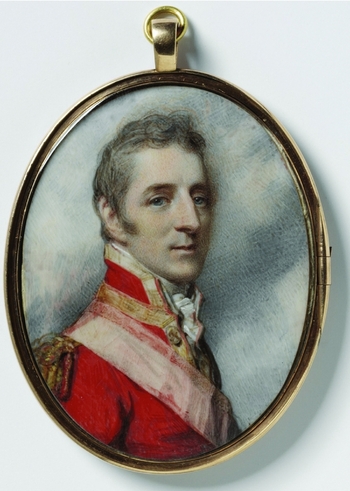
Whereas Brontë endows the Duke of Wellington with a dark complexion, she has, in truth, taken considerable poetic license, for portraits of him by renowned painters such as Francisco de Goya and Sir Thomas Lawrence along with the hundreds of sketches and hand-colored lithographs by lesser known artists consistently show him to be fair skinned. Even one of the earliest portraits of Wellington, a miniature from 1808 by Richard Cosway, which was painted years before his victory at Waterloo, presents him as fair skinned (Figure 5).
Richard Cosway, R.A. Portrait of Arthur Wellesley, later 1st Duke of Wellington. Watercolor on ivory, 1808. © Victoria and Albert Museum.

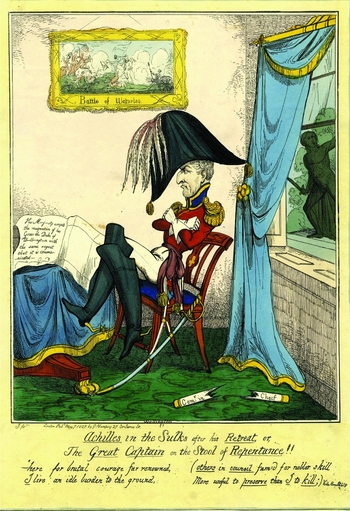
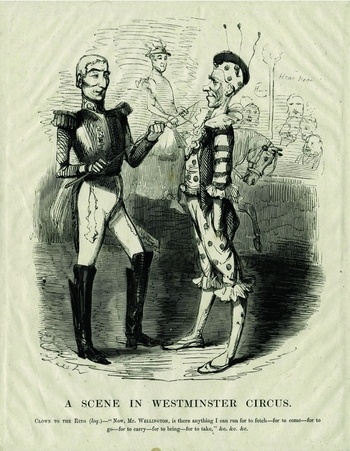
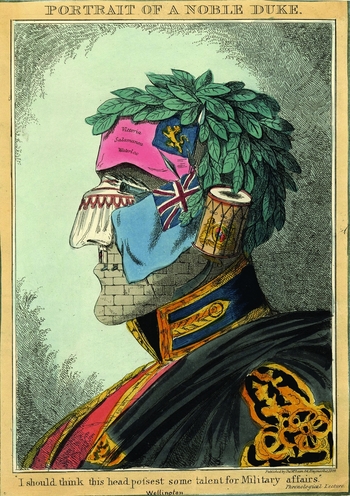
Moreover, due to Wellington's famed military career and later his tenure as Prime Minister, he became the target of innumerable political cartoons by both British and French artists. Given how these satirical drawings repeatedly highlight the unbecoming shape of his nose, if he were darkly hued, then no doubt these same artists would have exaggerated that feature or at least have represented it in some dramatic or disparaging way, as they do with his nose (Figures 6, 7, and 8).Footnote 17 Thus, Brontë's rendering of Wellington as darkly hued is her own myth-making, establishing the groundwork for her other darkly hued heroes.
“Achilles in the Sulks, or, the Great Captain on the stool of repentance!!.” Hand-colored etching, published by George Humphrey, 1827. © The Trustees of the British Museum

“A scene in Westminster Circus.” Wood-engraving, after John Leech, 1843. © The Trustees of the British Museum.

“Portrait of a noble duke.” Hand-colored etching. Published by Thomas McLean, c. 1829 © The Trustees of the British Museum.

While many of Charlotte Brontë's tales include various other male characters with dark countenances, one story in particular offers us another key clue to Rochester's “bronze scrag.” In “Something about Arthur” (1833) Charles Wellesley narrates a story of conspiracy and intrigue, in which his brother seeks revenge against the Baron of Caversham and conspires against him by plotting to burn down the Baron's mill.Footnote 18 Arthur commands a group of brawny men to launch his attack on the mill.
Tall and strongly built with brawny shoulders and sinewy limbs, each might have passed for a model of Hercules or Miletus. Their dress was uniform doublets and breeches of undressed skin, with laced buskins of the same, and high sugar-loaf hats, from under the broad brims of which dark dishevelled elf-locks straggled over their bronzed and weather-beaten visages. (emphasis added, Alexander, Early Writings II.1: 26–27).
While these men differ significantly in rank and dress from Rochester, there are some notable resemblances. At the end of Jane Eyre, while she scrutinizes Rochester's sad state, Jane asks “to comb out this shaggy black mane,” describing him like Vulcan “a real blacksmith, brown, broad-shouldered” (emphasis added, 438, 441; vol. 3, ch. 11). Furthermore, the description of these men's “elf-locks” hanging out from under “the broad brims” of their hats is repeated by Brontë in Jane Eyre, when Jane describes the “elf-locks” bristling under “a broad-brimmed gipsy hat,” when Rochester masquerades as a fortune-teller (196, 195; vol. 2, ch. 4). However, what is most significant here is the connection between Rochester's “bronze scrag” and these men's “bronzed and weather-beaten visages.” These brawny men with “weather-beaten” faces are clearly not of the squirarchy, like Rochester, or of the noble ranks, like Wellington, but of the laboring class. For centuries, skin, bronzed and darkened from the sun, along with muscularity were class markers of the laboring class for both men and women. However, Brontë is refashioning these class markers as desirable masculine traits for both the gentry and middle-class men. If we return for a moment to Brontë's description of the Duke of Wellington and his “dark, almost swarthy” complexion, we can see how his complexion would likewise be bronzed or darkened by the sun in his active life as a soldier exposed to the elements. So though Wellington's military ventures were definitely part of the imperialist agenda, his dark complexion signifies, not his having been tainted by imperialism, but rather his dark complexion is a mark of his heroic soldiering to preserve and advance Britain's empire. His “almost swarthy” complexion signifies his vital masculinity and heroic valor. Thus, Brontë constructs a unique and most novel image of Britain's hero as darkly hued.
However, unlike his father, Lord Charles, the sardonic storyteller, does not in fact have the “somewhat swarthy” complexion that Cornelius, his alter ego, is given in “Albion and Marina.” All other accounts of him portray him as fair skinned. In an earlier piece “Characters of the Celebrated Men of the Present Time” (1929), Brontë describes Charles as having hair that “falls in light yellow ringlets over his forehead” (Alexander, Early Writings I: 125), so unlike Cornelius’ “long thick hair, black as the hoody's wing” (I: 288). Six months later, Brontë provides a more extensive physical description of Charles Wellesley in “Third Volume of Tales of the Islanders” (1830). “His forehead, fair as ivory, was shaded by ringlets of gold, which hung in beautiful clusters over his temples” (I: 143–44). Moreover, Lord Charles lives a voluptuous life of leisure and indolence, so unlike Brontë's portrayal of his father, the Duke of Wellington. Lord Charles recounts one afternoon spent “reposing in one of the orange groves”: “Oppressed by the broiling heat, I plucked listlessly the golden fruit from the graceful bough which shaded me” (I: 171). While he “fried with heat under an African summer's sun,” he still retains his fair complexion (I: 171). In the October 1830 installment of her “Young Men's Magazine,”Footnote 19 Charles Wellesley quibbles with his compatriots about his complexion. When Sergeant Bud remarks that he looks “fresh and rosy”; he retorts, “Nonsense, I hope I'm rather tawny” (I: 237). When De Lisle, the famous Verdopolitan court painter, adds that his countenance looks “of a purer white than before,” Charles protests: “That's a flat lie! I'm not fair” (I: 237–38). In this tale, as well as in “Albion and Marina,” Lord Charles may wish to be darkly hued like his valiant and manly father, but he falls far short.Footnote 20
Even under the most unlikely circumstances, Lord Charles's fair complexion cannot be thwarted. In a later piece “Something about Arthur”(1833), Lord Charles recounts how he lived for sometime incognito in Verdopolis’ underworld, staying in “pot-houses” or in “the open fields” among “tavern-keepers, poachers, park-breakers, highwaymen, murderers, the flashmen about town, etc., etc.”(Alexander, Early Writings II.1: 10). He explains how he learned their urban cant and scurrilous behavior, “imitating them to such a perfection that they soon declared that I might have been born and bred amongst them” (II.1:10–11). However, his complexion and his elegant shape betray his noble rank. “My complexion, despite of incessant exposure to all weathers, continued tolerably fair” (II.1:11). Ultimately Brontë's Glass Town stories demonstrate how the complexion of these male characters is not just tied to external elements such as exposure to the sun, but equally reflects a character's conduct. Whereas Lord Charles basks under the African sun or lives on the city streets and open fields, his indolence and vicarious living will never afford him a “bronze scrag.”
While Brontë's Glass Town and Angrian stories of the Wellington dynasty should make us reassess Rochester from a new perspective, Shirley acts as a most intriguing counterpoint to both Brontë's early writings and Jane Eyre in regard to not only Rochester's dark physiognomy but also to his donning of the pearl necklace, which is something Brontë's Duke of Wellington would never do. Shirley, though, offers no darkly hued Zenobias,Footnote 21 Berthas, or Mrs. Reeds; instead, only certain male characters are darkly hued. In fact, four of her central male characters are identified as having darker physiognomies: Mr. Malone, Mr. Hall, Mr. Helstone, and most importantly Robert Moore, the novel's hero. By examining these four figures we will be able to have a better grasp as to what Rochester's darkness signifies and how it relates to Brontë's remodeling of masculinity in Jane Eyre.
Brontë opens her 1849 novel with a scathing critique of the gluttony of some of the local curates including Mr. Malone, “a native of the land of shamrocks and potatoes” (8–9; vol. 1, ch. 1), noted for his partiality to whiskey. Brontë provides a detailed account of his face, which is not identified as specifically dark but rather as “the high-featured, North-American-Indian sort of visage, which belongs to a certain class of the Irish gentry” (8; vol. 1, ch. 1). Elsie Michie deftly notes how Brontë's portrayal of Malone illustrates Victorian stereotypes of the Irish as one of the “dark races” that becomes “more clearly racially differentiated” (128). While this description of Malone certainly validates her claims, his face is distinctly unlike the dark visages of the Duke of Wellington and Rochester. Malone's face is “ruddy” (24; vol. 1, ch. 2) not brown, bronze or swarthy, which suggests that Brontë may be associating Malone with nineteenth-century stereotypes of Native Americans as “redskins.” Thus, Brontë's disparaging portrait of her Irish curate proves to be equally denigrating to Native Americans and the Irish alike. Malone's ruddiness may also be suggestive of his alcohol consumption and roseca, given his predilection for “a tumbler of whisky-and-water” (17–18; vol. 1, ch. 1).Footnote 22 His lineage becomes a point of contention and ridicule among the younger curates. Malone “reviled them as Saxons and snobs at the very top pitch of his high Celtic voice; they taunted him with being the native of a conquered land. He menaced rebellion in the name of his ‘counthry,’ vented bitter hatred against English rule; they spoke of rags, beggary, and pestilence” (10; vol. 1, ch. 1). Furthermore, Malone's physiognomy and lineage differ from the references to the other three men, whose skin is described as brown or dark but not ruddy.
In contrast to Malone, Brontë presents a British man of the cloth, the pious “dark complexioned, and already rather grey-haired” vicar of Nunnely, Cyril Hall, who shows true compassion for the impoverished workers like William Farren and for the “anathematised race”Footnote 23 of old maids (119; vol. 1, ch. 8). All references to him, either by the narrator or the other characters, reflect his noble character; thus, his darkness is in no way suggestive of his being tainted or sullied by anything ignoble. Being neither of the aristocracy, the squirarchy, nor of Irish lineage, his dark complexion cannot be owed to Meyer's contentions about “the workings of the empire” or Michie's observations about British stereotypes of the Irish as a simanized race. Whereas the young curates like Malone are flawed men of the church, Hall embodies true piety and good works; his darkness then cannot be attributed to any form of religious corruption or hypocrisy.
Another man of the cloth, whose darkness is even more prominently portrayed in this novel, is Caroline's uncle, the Reverend Helstone, who like Donne is of British lineage and of modest income and has a “keen brown visage” (emphasis added, 12; vol. 1, ch. 1). Though a minister by trade, Brontë clarifies early on how “he had missed his vocation: he should have been a soldier” (32; vol. 1, ch. 3). He, like Brontë, reveres the great military figure Wellington by elevating him to the status of an epic hero: “Wellington is the soul of England. Wellington is the right champion of a good cause; the fit representative of a powerful, a resolute, a sensible, and an honest nation” (34; vol. 1, ch. 3). Throughout the novel, Brontë alludes to Helstone as if he were a “veteran officer” (12; vol. 1, ch. 1), “marching nimbly and erect, looking browner, keener, and livelier than usual” (109; vol. 1, ch. 8). Brontë's description defies Victorian stereotypes of darkly hued skin, where brown skin would be associated either with non-western cultures or as an attribute of the laboring class. While a browned complexion from sun exposure and outdoor labor was a class marker, Brontë is not using it in such a way to demean or denigrate Helstone's middle-class status as a clergyman. Rather he is always described as an active man, traveling about on horseback to care for his parishioners. His looking “browner” renders him “keener” and “livelier,” as physically robust, like a soldier.
His brown complexion signifies health and vigor, bearing no connotation of moral taint or pollution. At one point Shirley even refers to Helstone as “my bronzed old friend” (emphasis added, 181; vol. 2, ch.1). Brontë shows that being darkly hued suggests strength of character, but this masculine power must not be abused or tyrannical. Shirley, who finds Helstone's “brown, keen sensible old face” endearing, asks Caroline if she is fond of him. When Caroline describes her uncle as rather austere and taciturn, Shirley then queries, “Is he tyrannical?” to which Caroline replies, “‘Not in the least’” (181; vol. 2, ch. 1). Even after Caroline confides that he is “stern and silent at home,” Shirley adds, “I can well conceive, my bronzed old friend is quite innocent” (181; vol. 2, ch. 1). Earlier in the novel Brontë also describes Helstone as a “little man of bronze” (85; vol. 1, ch. 7), which refers to his bronzed complexion but may also relate to his hard and austere nature.
We gain even greater insight into Brontë's rendering of Helstone when we observe the parallels that she draws here and elsewhere between Helstone and the novel's dark hero Robert Moore. These men, seemingly, physically so different, with Moore standing six feet tall and Helstone more diminutive, have one notably similar physical attribute – their dark physiognomies. Early on, Brontë describes Moore's face as having “a new-found vivacity mantling on his dark physiognomy” (32; vol. 1, ch. 3). His lineage, though, distinguishes him from Donne and Helstone, for he is only “but half a Briton” (25; vol. 1, ch. 2). The initial description the reader is given of Robert presents him as “rather a strange-looking man; for he is thin, dark, sallow; very foreign of aspect,” but at the same time “his physiognomy is agreeable” (24; vol. 1, ch. 2). Furthermore, Brontë clarifies how he is without any taint or corruption, for “he has no moral scrofula in his mind, no hopeless polluting taint, such, for instance, as that of falsehood; neither was he the slave of his appetites” (113; vol. 1, ch. 8). The narrator follows up by noting how the “same might be said of old Helstone: neither of these two would look, think, or speak a lie” (113; vol. 1, ch. 8). Both men's honor, abstemious nature, and iron will set them apart from the other men in the novel. During the attack on the mill, Shirley refers to both men as the “earth's first blood” (289; vol. 2, ch. 8). They are both described heroically as “men of steelly nerves and steady-beating hearts” (32; vol. 1, ch. 3), even though, they have opposing views regarding Anglo-French politics. While Helstone adamantly defends Wellington, Moore vows victory for Napoleon.Footnote 24 Still they put their political differences aside by forming an alliance to save the mill from Luddite sympathizers and their parish from the Dissenters. Heroic though their actions may be, Brontë portrays Helstone and Moore's rigidity and misanthropic views as flawed models of masculinity, where their devotion to their public lives and professions comes at the expense of their private lives.
While Brontë presents her darkly hued males characters of Moore, Helstone, and Hall positively as hard working and devoted men of community, her ideal hero must also desire the romantic companionship of a woman and marriage. Both Helstone and Hall prove, for very different reasons, incapable of such an attachment to a woman. Helstone cruelly neglected his wife and “made no pretense of comprehending women” (45; vol. 1, ch. 4). Hall, though beloved by the women in the community, is not destined to marry, for “he was wedded already to his books and his parish: his kind sister Margaret, spectacled and learned like himself, made him happy in his single state” (228–29; vol. 2, ch. 3). J. Russell Perkin astutely observes that Hall's parish is “appropriately called Nunnely,” associating him with the celibacy of nuns and with “the unattractive spinster Miss Ainley” (395). Both men choose their professions over marriage. In the end, they belong to an older generation of men and lack the erotic power most desired in Brontë's heroes. Neither seeks a woman as romantic partner nor desires companionate marriage. In Helstone's estimation, “a wife could not be her husband's companion, much less his confidant” (45; vol. 1, ch. 4). Yet Brontë's heroes must allow for companionate marriage, esteeming women as both intellectual and romantic mates. Her heroes also must embody an erotic, masculine power, what Shirley calls, a “true-throbbing, manly love” (447; vol. 3, ch. 7).Footnote 25
We gain another perspective on Rochester's “bronze scrag” by looking at how Robert, like Rochester, comes to embody that “true-throbbing, manly love.” Though, Robert and Rochester are only capable of such a manly love after they suffer near mortal blows, become gravely hurt and experience a loss of masculine power. While Robert is recuperating after being shot, Brontë describes him as “the meagre man,” and Caroline observes his “thin, wasted figure” (486; vol. 3, ch. 10). He becomes stripped not only of his masculine strength and vigor, but also of his dark complexion. Yorke notices how his wounded body looked “pallid, lifeless, helpless” (470; vol. 3, ch. 9). Later, Robert even recognizes his own pallor by describing himself as “a mere ghost” (488; vol. 3, ch. 10). Finally he tells Caroline how he has become “unmanned” (489; vol. 3, ch. 10). Although these descriptions feminize and emasculate him, Brontë at the same time reminds her reader of his potential physical power as Mrs. Horsfall must care for this man of “six feet” with “his manly thews and sinews” (473; vol. 3, ch. 9). Robert may feel “unmanned,” but Brontë reminds her reader of his virility, which is only temporarily held in check. His illness reforms his hardened sensibility that had become too steeped in business and work to achieve the ideals of companionate marriage. Even his marriage proposal to Shirley, proved to be entrepreneurial, being motivated by the base pecuniary interests of a mill owner, rather than by a “true-throbbing, manly love” (447; vol. 3, ch. 7).
Earlier in the novel, Robert articulates how men can be base creatures. “Men, in general, are a sort of scum, very different to anything of which you have an idea; I make no pretension, to be better than my fellows” (73; vol. 1, ch. 6). Finally his illness awakens his manly sensibility, which surfaces upon Caroline's departure after her clandestine visit to him. As Caroline gently puts Robert's “thin fingers” to her lips, “a large tear or two coursed down his hollow cheek” (489; vol. 3, ch. 10). His tears symbolize his newfound sensibility and mark a shift away from the “hard bilious” (33; vol. 1, ch. 3) nature of Robert Moore, the mill owner. Here, Brontë critiques the hardened masculinity of the “industrial male,” so lauded by Victorian society. Earlier in the novel, Robert even describes his heart as an impenetrable “sepulchre,” with “mercantile blood” coursing through his veins (107; vol. 1, ch. 8). He proclaims that he “scarcely breathes any other air than that of mills and markets,” setting him apart from the “lamb-like” men of the region (106, 105; vol. 1, ch.7).Footnote 26 Moreover, Robert earlier believed that his violent retaliation to protect his industrial interests was a manly and courageous reaction.Footnote 27
Ironically his violence unmans him, rendering him helpless as a lamb under the care and “brawn of Mrs Horsfall,” who successfully manhandles him into “docility” (473; vol. 3, ch. 9). Interestingly, only after he renounces his retribution against Michael Hartley does Brontë give Robert back his physical strength along with his dark complexion in the final chapter of the novel.Footnote 28 Gazing up at the planet Venus, Caroline suddenly feels someone's caress and turns about to find, not her mother, but instead a “dark manly visage” (535; vol. 3, ch. 14). Thus, Robert's darkness reemerges when his “true-throbbing, manly love” is awakened. Afterwards, he tells Caroline how he can now “think of marriage” (537; vol. 3, ch. 14).
This inquiry into the enigma of Rochester's “bronze scrag,” which led us back to Brontë's early writings and then forward to Shirley, demonstrates that Rochester's darkness, like that of Robert Moore's, is not a mark of corruption or impurity that must be eradicated or “whitened.” Rather coupled with manliness and virility, their dark physiognomies render them as ideal models of masculinity, even though both heroes initially need tempering. From the onset of these novels both heroes are shown to be flawed, lacking a certain self-restraint that renders them less noble and less manly in their actions. Both commit acts of violence, though Rochester's violence proves to be more ignoble in nature and circumstance. By far, Rochester has a greater need for reformation than Robert Moore.
When Brontë first introduces Edward Rochester, he may be darkly hued and has a “taille d'athlète” (140; vol. 1, ch. 15), but he does not embody the ideal of manliness, for he does not exercise the prerequisite moral restraint, a defining trait of Victorian manliness. In the first years after his marriage to Bertha, he ventures across Europe, manifesting more the proclivities of a Byronic hero than a Victorian gentleman. He readily discloses his youthful “prurience” (305; vol. 3, ch. 1) and dalliances with Céline, Giacinta, and Clara. He admits to having shot Céline's young paramour, the vicomte, in a jealous rage. Later, of course, he tries to seduce Jane into a bigamist marriage. While initially he is morally debauched, ultimately he becomes a tractable model of manliness. Brontë clearly distinguishes Rochester from unredeemable males like John Reed, where even their dark complexions differ significantly. Unlike Rochester's bronzed skin, John Reed's dark countenance becomes corrupted as “a dingy and unwholesome skin” (9; vol. 1, ch. 1), foreshadowing his complete degradation and unmanly demise. Brontë's heroes must eventually reform their violent tendencies and actions, as shown in Robert Moore's transformation. Manliness requires self-restraint and the ability to refrain from the abuse of masculine power over weaker creatures, especially women and children.
Brontë shows how Rochester struggles to refrain from using physical violence against his lunatic wife. His situation is particularly precarious, for while Bertha is described as a wild beast, she is still a woman, no matter how debased. Furthermore, her unchecked violence has the potential to unleash his own rage, which if acted upon would unman him by reducing him to the level of a brute. Even in the scene where Bertha grabs him with “virile force,” setting her teeth into his check, he must refrain from violence (293; vol. 2, ch. 11). Though he restrains himself, his deception costs him his “angel” (315; vol. 3, ch. 1), who flees Thornfield. Therefore, Brontë leaves Rochester's redemption in his own hands.Footnote 29 By not allowing Jane to stay with Rochester in his present demise, Brontë calls into question the Victorian masculinist paradigm, what George Moss calls the “aggressive, robust and activist masculinity”(49), by exposing Edward Rochester's impure masculinity, which must be reformed before the ideals of the companionate marriage can be achieved.
The Victorian ideal of manliness was predicated upon the idea that the dangerous energies of aggression and sexuality must, as Herbert Sussman writes, be “moderated in a consistent flow of energy harnessed to productive purpose” (34). Rochester's dangerous energies become dramatically evident after Jane's departure. When Jane leaves Moor House and arrives at the Rochester Arms Inn, she interviews the late Mr. Rochester's butler about the fire and Edward's condition. The butler explains how Mr. Edward “grew savage – quite savage on his disappointment: he never was a mild man, but he got dangerous after he lost [the governess]” (427; vol. 3, ch. 10). Sussman notes that the harnessing of male energy was often associated with the imagery of water and fire that must be regulated, especially with regard to any “imagery of flame” (10). Those flames in Jane Eyre are intimately tied to Bertha and the fires that burn down Thornfield. As Sue Thomas observes, Bertha's death is “figured as purification, as a chastening the blinded and maimed Rochester” (50). Through her eradication, Rochester appears to be freed from his infernal behavior, but this is not entirely the case. Susan Meyer adroitly reads this scene as more ambiguous, for it only seemingly “institutes the great act of cleaning in the novel, which burns away Rochester's oppressive colonial wealth and diminishes the power of his gender” (92). The butler's assessment of Rochester's savage state shows how those excesses have not been entirely burned away with the immolation of Bertha and Thornfield; those fires are still raging within him.
However, by the time that Jane returns and finds Rochester at Ferndean, a significant change in Rochester's identity has taken place. While some critics see Jane's return as a final reformation of Rochester, the imagery in this scene suggests that Rochester fires have already been quelled.Footnote 30 Upon entering his parlor, Jane finds the room gloomy, for “a neglected handful of fire burnt low in the grate” (432; vol. 3, ch. 11). Jane observes the next morning how “[h]is countenance reminded one of a lamp quenched, waiting to be relit” (439; vol. 3, ch. 11). This loss of fire equates to Rochester's temporary loss of his masculine power. The morning after her arrival at Ferndean, Jane describes the “mournful” state of his infirmity and “the powerlessness of the strong man” (439; vol. 3, ch. 11). Though Rochester sees his “crippled strength” as a hindrance to their union, Jane gently reassures him with a caress that provokes a telling response: “I saw a tear slide from under the sealed eyelid, and trickle down the manly cheek” (444; vol. 3, ch. 11). This scene parallels quite closely the scene in Shirley when Caroline caresses Robert's fingers, provoking tears – manly tears.
Shortly after this scene, Rochester reveals to Jane the rest of his story about the pearl necklace. Earlier, he had only told her how he had found her necklace after her departure, though he never mentioned what happened to it. Now, picking up the story again, he explains how he removed the pearl necklace from “its little casket,” thus saving it from the fire (440; vol. 3, ch. 1). He tells her: “Do you know, Jane, I have your little pearl necklace at this moment fastened round my bronze scrag” (446; vol. 3, ch. 11). Rochester, then, follows with the story of his redemption, saying that he is not the “irreligious dog” that she might take him to be (446; vol. 3, ch. 11). “I began to experience remorse, repentance; the wish for reconcilement to my Maker. I began sometimes to pray: very brief prayers they were, but very sincere” (446; vol. 3, ch. 11). His wearing of the pearl necklace points to his reformation, acting not in opposition to his darkness but rather highlighting it.Footnote 31 Patricia McKee argues, though, that dark characters like Bertha or Blanche cannot achieve “spiritual regeneration” (71). “The asymmetrical construction of racial contamination in Brontë's novel indicates that, whereas white persons may succumb to corruption, they can be purified; while dark persons are impervious to spiritual regeneration” (71). However, Rochester's confession disproves this conclusion. Rochester discloses to Jane that he had begun to pray and sought “reconciliation to [his] Maker,” which attests to his spiritual regeneration.
While Charlotte Brontë ends Jane Eyre and Shirley with her heroes Rochester and Robert, each endowed with a “dark, manly visage” and a refined sensibility, the society in which Brontë lived created a different ending for these novels. While Charlotte Brontë advocates in her novels for companionate marriage based on the bonds of love, friendship, and common interests, Victorian society still upheld the laws of coverture, at the expense of companionate marriage. Commenting on the ending of Shirley, Anna Krugovoy Silver argues that Caroline and Shirley are “colonized” by their husbands: “they have lost their names and identities and metamorphosed simply into Mrs. Louis and Mrs. Robert” (100). And the same can be said for the new Mrs. Edward. However, while the restrictive laws of marriage prevailed throughout her lifetime, Charlotte Brontë nevertheless defies the expectations of her historical moment by creating her British squire, a man of the landed gentry, as a darkly-hued hero. Moreover, in one of the most romantic, but unconventional scenes in Victorian literature, Brontë has her dark hero declare his love to Jane while wearing a pearl necklace.