The health care debate in Washington makes headlines regularly and stories daily. Many of these stories cite polls that purport to show how public opinion about health reform differs across groups in the electorate. Some focus on political affiliation. On October 28, 2009, Lydia Saad reported for the Gallup Poll that “Americans' reactions to the Republicans and Democrats in Congress for handling healthcare reform are sharply partisan, and independents show little faith in either side” (Saad Reference Saad2009b). Dan Balz and Jon Cohen wrote on October 20, 2009, “Seven in 10 Democrats back the plan, while almost nine in 10 Republicans oppose it. Independents divide 45 percent against 42 percent in favor of the legislation” (Balz and Cohen Reference Balz and Cohen2009).
Other stores focus on differences by demographic group. The Rasmussen poll of August 11, 2009, claimed, “Sixty-seven percent (67%) of those under 30 favor the plan while 56% of those over 65 are opposed. Among senior citizens, 46% are strongly opposed” (Rasmussen Reports 2009). The Gallup Poll of September 8, 2009, claimed, “Apart from Democrats, support for healthcare reform is highest among women, lower income Americans, those with post graduate degrees and residents of the East.” The poll also shows older people and Republicans opposed to reform while “a slight majority of upper-income Americans want their representatives to vote against healthcare reform” (Saad Reference Saad2009a).
This small sampling of polls reveals that political party, age, education, gender, and other characteristics likely affect people's views of health reform. However carefully these polls are done, though, they suffer from three limitations. First, the polls often do not spell out exactly what reform is under consideration. Second, few surveys present respondents with any estimates of the costs of reform. Virtually all health policy researchers agree that health reform involves difficult tradeoffs. Policies to reduce the number of uninsured, for example, will require changes to the way that currently insured people obtain coverage, reallocation of public funds from alternative uses, higher taxes, or higher deficits. Voters' preferences among these tradeoffs should therefore play a central role in legislators' decision making. However, surveys that do not confront people with real-world tradeoffs will fail to represent the likely responses of voters and their representatives to actual policy proposals.
Third, most of the literature's claims about differences in support across groups are based on simple bivariate comparisons. Because membership in groups is correlated, bivariate comparisons do not reveal which characteristics of respondents are the most important determinants of their opinions. For example, older Americans are often featured as a group that opposes reform because of their age, despite the fact that they differ from their younger counterparts on other dimensions such as income. If these factors, rather than age, are the true cause of their opinion, simple bivariate comparisons may be misleading.
To address these limitations, we conducted a large, national survey that used contingent valuation (CV) methods from environmental economics to estimate how much Americans are willing to pay to expand health insurance coverage (Kessler and Brady Reference Kessler and Brady2009). We asked respondents about their likelihood of supporting two specific reforms—insurance subsidies for low-income people and Medicaid expansions—if they had to pay more income taxes to cover the programs' costs. Based on the respondents' income (and the assumption that the cost of reform would be financed by an equiproportional increase in all taxpayers' personal income taxes), we told them approximately how much, in dollar terms, their tax increases would be. We also explained the benefits of each reform.
In this article, we investigate how support for reform varies among different groups of voters. We estimated regression models that are a function of a series of categorical variables describing each respondent's characteristics. In this framework, coefficient estimates represent the differences in mean support across groups, holding all other respondent characteristics constant.
The article proceeds as follows. In section I, we present our CV survey methods and questions. Section II presents our results, and section III concludes with some observations for public policy.
I. THE CV SURVEY
From January 8 through January 21, 2009, we conducted an Internet-based CV survey of 3,344 American adults on their preferences for health insurance and health policy reform through YouGov/Polimetrix. In addition to the policy-scenario questions, we also obtained information on respondents' income, age, gender, race,Footnote 1 education, and party affiliation (Democrat, Republican, independent). We introduced the policy questions by informing respondents that we wanted “to ask you some questions about proposals that have been made to provide health insurance to more Americans.” We then asked respondents, in random order, about their likelihood of supporting two different health reforms, a subsidy that would help low-income people to buy private insurance and an expansion of government insurance through the Medicaid program. One-half of the sample was queried about a major version of each reform; one half was queried about a minor version. In each case, the respondent was offered four choices of response: very likely, somewhat likely, not too likely, or not at all likely. The exact questions we asked are in appendix A.
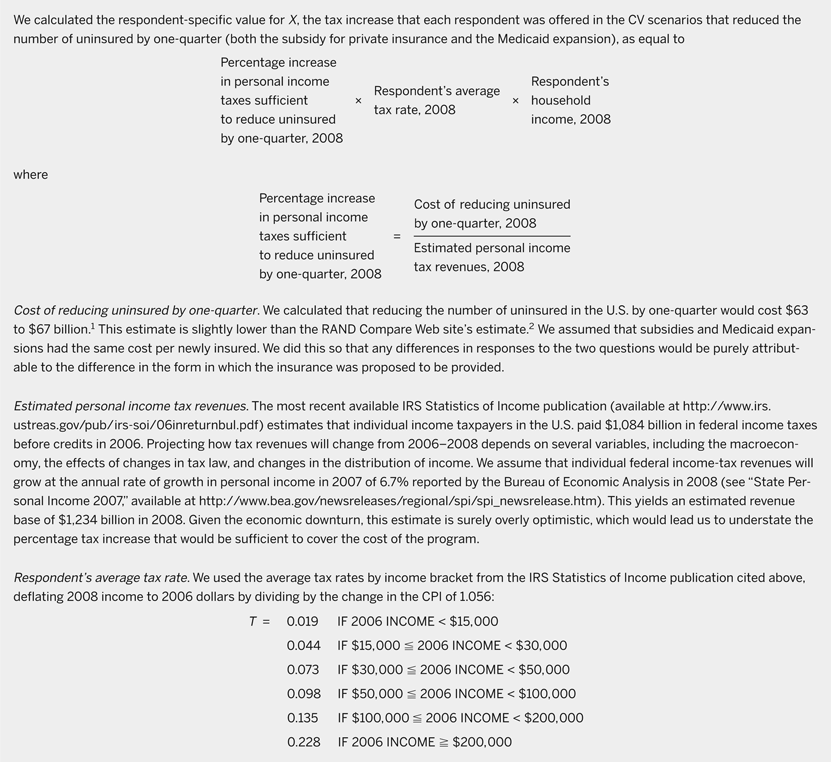
Calculating respondent-specific values for the cost to respondents of health reform X in the questions above involved three steps (see appendix B for a detailed discussion). First, we estimated the total cost of each policy. Second, assuming that the policy would be financed with an equiproportional increase in personal income taxes, we calculated how large of a tax increase would be needed. Third, based on the family income that each respondent reported in the survey, we calculated in dollar terms what this tax increase would be. We call this our baseline estimate.
To investigate the sensitivity of respondents' support for reform to its cost, we replicated our original survey on two additional samples. Respondents in the first additional sample were told that their tax increase would be 50% of our baseline estimate. Respondents in the second additional sample were told that their tax increase would be 150% of our baseline estimate. Thus the survey sample consists of six subsamples: respondents who were asked about minor reform at baseline cost, minor reform costing 50% of baseline, minor reform costing 150% of baseline, major reform at baseline cost, major reform costing 50% of baseline, and major reform costing 150% of baseline.
II. RESULTS
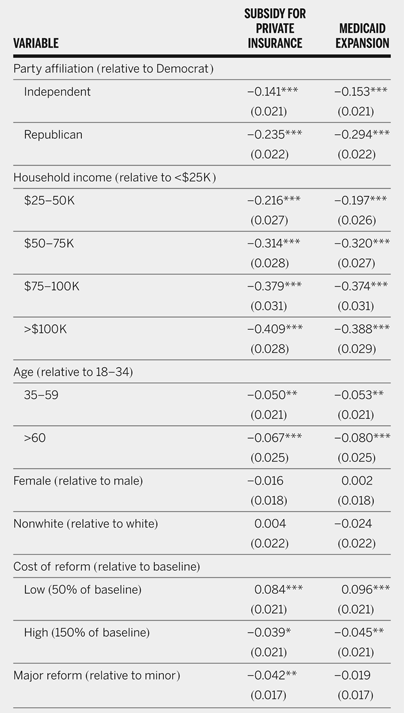
Table 1 presents OLS regression estimates of the effects of party affiliation and demographic characteristics on support for health reform. We report heteroscedasticity-consistent standard errors in parentheses below each coefficient. We define the dependent variable in the regressions as an indicator variable that equals 1 if the respondent was very or somewhat likely to support reform. We pooled respondents from all six of the subsamples and controlled for whether the respondent was asked about a major or minor version of the reform (minor version is omitted group) and whether the respondent was presented with the baseline cost, 50% of the baseline cost, or 150% of the baseline cost (baseline cost is omitted group). The left column presents estimates from a model of respondents' willingness to support a subsidy for private insurance; the right column presents estimates from a model of respondents' willingness to support an expansion of public insurance, that is, a Medicaid expansion.
Effect of Party Affiliation and Demographic Characteristics on Support for Health Reform

Notes: N = 3,344. Models also include controls for education. *, **, *** denote significance at the 10, 5, and 1% level. Heteroscedasticity-consistent standard errors in parentheses.
The first two rows show the effect of self-reported party affiliation on willingness to support reform. Consistent with other surveys, self-reported Republicans are the least willing to support reform; self-reported Democrats (the omitted group) are the most likely to support reform. Independents are in the middle, with their support for reform statistically distinguishable from that of respondents affiliated with either of the major political parties.
The next group of rows shows that willingness to support reform declines with income. Income has a statistically significant and politically important effect on support, even holding party affiliation constant. In other words, although political preferences affect people's willingness to support reform, the fact that higher-income people stand to benefit less from reforms and pay more in terms of increased income taxes also matters. The table also shows that the negative effect of income on support for reform starts early in the income distribution and rises relatively slowly. Lower-middle-income respondents (those with household incomes between $25,000 and the national median of $50,000 per yearFootnote 2) are much less supportive of reform than lower-income households (those with incomes <$25,000 per year). Indeed, the difference in support between households with incomes of less than $25,000 and $25,000–$50,000 per year (19.7 to 21.6 percentage points, depending on reform) is about the same as the difference in support between households with incomes of $25,000–$50,000 and greater than $100,000 (19.1 to 19.3 percentage points).Footnote 3
The remainder of the table presents the effects of other demographic characteristics and the cost and scope of reform on support. As conventional wisdom suggests, older Americans (age > 60) are significantly less likely to support either reform than are the young (age 18–35). The middle-aged (age 35–59) are also less likely to support either reform than the young, and although slightly more supportive of reform than older Americans, are not statistically distinguishable from them. This is likely due to the fact that the young are the group that is most likely to be uninsured (DeNavas-Walt, Proctor, and Smith Reference DeNavas-Walt, Proctor and Smith2009, table 7). However, it is surprising insofar as the middle-aged are more likely to have health problems than the young, and do not have an existing public insurance program like Medicare available to them as do Americans over 65. Neither gender (omitted group is male) nor race (omitted group is white) has a large or statistically significant independent effect on support for reform. The effects of the cost and scope of reform have their predicted signs. As the cost and scope of reform rise, support for reform falls. The regression results reported in the table also include a constant term and controls for respondents' levels of education (high school or less [the omitted group], some college, or college graduate), none of which were statistically significant.
We also estimated models separately on the (random) half of respondents who were asked about their willingness to support minor reform and the (random) half who were asked about major reform (results not reported in any table). Some of the determinants of respondents' willingness to support minor versus major reform were similar. Self-identified Republicans and independents were less supportive of both major and minor reform than Democrats, and high-income households were less supportive of both types of reform than low-income households. However, the negative effect of age on willingness to support reform was more pronounced for major versus minor reform. Support of middle-aged and older Americans for minor reform was not statistically distinguishable from that of young Americans. The opposition of middle-aged and older Americans to reform more generally arises from their opposition to major reform.
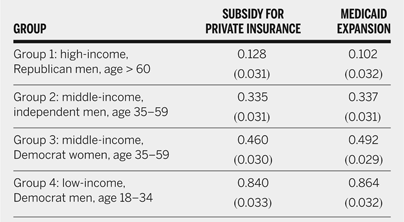
Table 2 shows how the coefficients from the regression models underlying table 1 can be used to construct estimates of the average extent of support of specific demographic groups. We chose four groups for reasons of exposition: high-income (>$100K), older Republican men (group 1); middle-income ($50–75K), middle-aged independent men (group 2); middle-income, middle-aged Democrat women (group 3); and low-income (<$25K), young Democrat men (group 4). The left column of the table presents the percentage of the group that is willing to support a subsidy for private insurance for minor reform at its baseline cost; the right column presents the percentage that supports a Medicaid expansion under the same terms.
Support for Health Reform in Specific Demographic Groups

Notes: N = 3,344. Heteroscedasticity-consistent standard error for each group in parentheses. For minor reform at baseline cost, at population average race and educational attainment.
The order of groups' support for reform is not surprising: group 1 is least supportive, and group 4 most supportive, of reform. Between 10.2 and 12.8% of high-income, older Republican men support reform, depending on its type; the analogous range for low-income, Democrat men is 84–86.4%. The groups' preferences between the two types of reform are also consistent with conventional wisdom. Group 1 is more supportive of a subsidy for private insurance, and group 4 more supportive of Medicaid, although neither of these differences is statistically significant.
The support for reform of groups 2 and 3 highlight the political challenges facing proponents of change. Middle-income, middle-aged independent men are reluctant to endorse even the minor version of reform we proposed. Only 34% of this group, when confronted with the increase in taxes necessary to pay for reform, responded positively. In our analysis, middle-income, Democrat women are almost exactly on the fence on this issue. We estimate just under a majority—between 46 and 49.2% of this group—was supportive of reform, with the 95% confidence interval of our estimates including 50%.
III. DISCUSSION
Who supports health reform? Although the answer to this question is vital for understanding the political dynamics of this issue, surprisingly little survey research has sought to investigate it empirically. In this article, we report results from a new CV study that surveyed a large, national sample of American adults about their willingness to pay for the two different types of health reform currently under consideration by the Congress: a subsidy for private insurance and an expansion of the Medicaid program.
As in previous studies, we found that self-identified Republicans, older Americans, and high-income Americans are less supportive of health reform. The preferences for reform of political independents lie between those of Republicans and Democrats. However, these basic findings mask important features of American public opinion. First, income has a statistically significant and politically important effect on support for reform, even holding political affiliation constant. Income, in fact, is the most important determinant of support for reform. According to table 1, the difference in support between a respondent in the top versus the bottom income bracket (more than $100,000 annual household income versus less than $25,000) is significantly greater than the difference between a Republican and a Democrat. In addition, income (and party affiliation) are much more important determinants of support than age, although older and middle-aged Americans are less supportive of reform than younger Americans.
Second, the negative effects of income on support for reform start early in the income distribution. Depending on the reform, respondents with family incomes from $25,000–$50,000 are 19.7 to 21.6 percentage points less likely to support reform than those with family incomes under $25,000 (table 1). Increasing income beyond $25,000–$50,000 reduces support for reform, but at a declining rate.
Third, although older Americans have a less favorable view about reform than younger Americans, much of their opposition is due to dislike of large public policy changes than to health reform per se. When asked about their support for a more moderately sized program of subsidies for private insurance, for example, older Americans' are statistically indistinguishable from their younger counterparts. In contrast, when asked about their support for a large program of subsidies, older Americans' are significantly less willing to lend support than younger Americans.
APPENDIX A: Questions
Subsidy for private insurance. [One/Another] of these proposals would give a government subsidy to low- and moderate-income people that would help them and their employers afford insurance. Under this proposal, people would get insurance from their employer, union, or an insurance company. The government would provide financial assistance, but would not provide the insurance itself.
[To one-half of the sample, we proposed a limited or minor version of this reform]
It would cut the number of uninsured by a quarter, from about 16% of the U.S. population to about 12%. If your family had to pay $X more per year in federal income taxes to finance this proposal, how likely would you be to support it?
[To the other half, we proposed a major version of this reform]
It would cut the number of uninsured in half, from about 16% of the U.S. population to about 8%. If your family had to pay $2X more per year in federal income taxes to finance this proposal, how likely would you be to support it?
Medicaid expansion. [One/Another] of these proposals would make Medicaid available to moderate-income people. Medicaid is a government health insurance program that has traditionally been available only to low-income people.
[To one-half of the sample, we proposed a limited or minor version of this reform]
It would cut the number of uninsured by a quarter, from about 16% of the U.S. population to about 12%. If your family had to pay $X more per year in federal income taxes to finance this proposal, how likely would you be to support it?
[To the other half, we proposed a major version of this reform]
It would cut the number of uninsured in half, from about 16% of the U.S. population to about 8%. If your family had to pay $2X more per year in federal income taxes to finance this proposal, how likely would you be to support it?
APPENDIX B: Calculation of the Cost to Respondents of Health Reform
Calculation of the Cost to Respondents of Health Reform

NOTES
1. According to Jonathan Gruber (Reference Gruber2008), public insurance expansions that would cover up to 10 million people could be expected to have a cost of $4,700–$5,000 (in 2006 dollars) per newly insured. Using the expected 12% 2006–2008 growth rate in national health expenditures per capita from the Centers for Medicare and Medicaid Services (2007), this translates into $5,264–$5,600 in 2008. Based on the Current Population Survey (DeNavas-Walt, Proctor, and Smith Reference DeNavas-Walt, Proctor and Smith2009), there were 47 million uninsured people in the U.S. in 2006. Accounting for population growth of 1.5% from 2006–08 (Centers for Medicare and Medicaid Services (2007), this yields an expected number of uninsured in 2008 of 47.7 million. Thus, we estimate that a program to reduce the number of uninsured by one-half would cost between $63 billion ($5,264 · 47.7 million · 0.25) and $67 billion ($5,600 · 47.7 million · 0.25).
2. The simulation model on the Web site reports that expanding Medicaid eligibility to everyone up to 200% of the federal poverty level would cost $55.5 billion and increase coverage by 9.42 million (i.e., decrease the number of uninsured by approximately 20%), which translates into a cost per newly insured of $5,892 ($55.5 billion/9.42 million). It also reports that providing a means-tested tax credit for the purchase of insurance (scenario C) that would increase coverage by 9.97 million (i.e., decrease the number of uninsured by approximately 21%) would cost $63.47 billion, which translates into a cost per newly insured of $6,366 ($63.47 billion/9.97 million). According to the Web site, Medicaid expansions and tax credits that lead to greater increases in coverage have higher costs per newly insured. See http://www.randcompare.org.