Spending one's early life in chronically stressful family environments, particularly those in which episodes of anger and aggression recur and relationships are cold, unsupportive, and neglectful, has damaging psychological and biological effects that are ultimately manifested in the mental and physical health of adults (Repetti, Taylor, & Seeman, Reference Repetti, Taylor and Seeman2002). This includes an increased risk of psychiatric disorder that is observed even after controlling for likely confounding variables, such as parental psychopathology and offspring characteristics (e.g., psychiatric disorders during early adolescence and difficult temperament in childhood; Johnson, Cohen, Kasen, Smailes, & Brook, Reference Johnson, Cohen, Kasen, Smailes and Brook2001). The adverse effects on physical health in adulthood range from higher rates of illness and physical complaints, to obesity, and more serious medical conditions (Repetti et al., Reference Repetti, Taylor and Seeman2002). In addition to the physical symptoms and medical diagnoses that are tied to traumatic experiences in childhood, such as a history of abuse (Walker et al., Reference Walker, Gelfand, Katon, Koss, Von Korff and Bernstein1999), there is a graded association between breadth of exposure to abuse or household dysfunction during childhood and risk for certain adult diseases, including ischemic heart disease, cancer, chronic lung disease, skeletal fractures, and liver disease (Felitti et al., Reference Felitti, Anda, Nordenberg, Williamson, Apitz and Edwards1998). Connections between exposure to family conflict and later physical health are robust enough to hold up after controlling for the offspring's psychological distress and mental illness (Lundberg, Reference Lundberg1993). In short, evidence suggests that growing up in a cold, unsupportive, or neglectful home or one with high levels of conflict and aggression increases risk for mental and physical health problems in adulthood.
Following Repetti et al. (Reference Repetti, Taylor and Seeman2002), we use the term “risky families” to refer to chronically stressful family environments that are characterized by overt conflict and/or deficient nurturing. Our approach is also consistent with that model's idea that chronically stressful rearing conditions influence health outcomes in adulthood through a cascade of risk processes. One of the key pathways, based on an allostatic load model, posits that regulatory systems for adapting to challenges (through neural, neuroendocrine, and neuroendocrine–immune mechanisms) are repeatedly stimulated in these family settings, which disrupts the ability to mount effective responses to stress and to quickly recover from those responses in the future, contributing to allostatic load. Of course, mapping the long-term effects of growing up in a risky family requires understanding both psychological and biological pathways. The incorporation of allostatic processes enhances what we can learn from studies of emotional and social development alone. For instance, emotional responses to family stressors are best understood when our models include physiological reactivity, and biological stress–response and immune processes help us connect stressful experiences in the family to certain health outcomes, such as upper respiratory infections (URIs). At the same time, an understanding of psychological processes enhances the allostatic load literature by defining specific “stressors” in the family and the cognitive, emotional, and behavioral responses of children to those events. The allostatic load model considers the impact of “repeated hits” on biological systems, but it is the psychological literature that suggests what constitutes those hits.
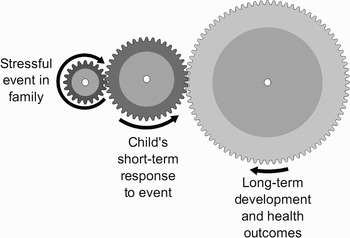
Modeling the cumulative damage that results from repeated reactions to recurring stressors in the family requires a transition from immediate responses to longer term repercussions. We use the action of meshed gears as a metaphor to illustrate how short-term reactions to stressful events in the family may, if persistent over time, come to influence long-term health and development. In Figure 1, each of the first two gears is a driver that turns a larger, driven gear. For the purposes of our paper, the gears in Figure 1 illustrate relationships between a stressful event in the family (represented by one turn of the smallest gear), a child's immediate response to the event (represented by one turn of the middle gear), and longer term developmental and health outcomes (represented by one turn of the largest gear). The key to addressing the gap between short-term responses and long-term outcomes is to connect the two smaller gears to the largest gear. By analogy, we are linking short-term reactions to a single event in the family to development over a much longer time frame. The length of the arrows in Figure 1 represent differences in the speed at which the gears turn; there is a reduction in speed as we move from revolutions of the first gear to revolutions of the last gear. Each successive gear turns more slowly. This characteristic of gears—that they change the speed of a power source—is consistent with our focus on connections between events and responses that are unfolding within one time frame and other developmental processes that take place over longer spans of time.
Gears as a metaphor illustrating connections between repeated short-term reactions and their long-term outcomes.

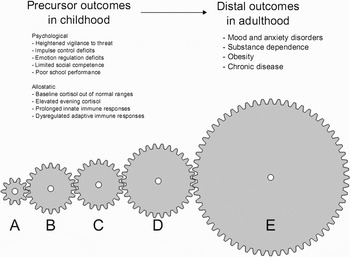
Because the developmental outcomes that are at the center of our article unfold within different time frames, we can imagine the third gear in Figure 1 replaced with a series of meshed gears that have increasingly large diameters. As shown in Figure 2, the series of larger gears represent outcomes that become progressively more stable and debilitating, and that appear more slowly and later in life. In other words, children growing up in risky families show early signs of changes or adjustments in their psychological and biological development—“precursors”—that drive later health outcomes.
Gears as a metaphor illustrating associations between precursor and later outcomes.

In the next section we explore psychological pathways linking early family experiences to later health, including short-term responses to family stressors as well as developmental sequelae of growing up in a chronically stressful environment. That is followed by an examination of two of the primary allostatic processes: the hypothalamic–pituitary–adrenal (HPA) axis and the immune system. The two subsequent sections discuss how a focus on individual differences and a life span perspective can help researchers identify and study precursor outcomes. Last, an integration of research findings suggests that some of the allostatic and psychological response patterns that emerge under harsh rearing conditions may serve common goals and have “snowballing effects” on development.
Psychological Pathways
Two research literatures have contributed to what we know about psychological processes that underpin the effects of growing up in a risky family. One examines children's immediate responses to stressful events in the family; a much larger body of longitudinal research connects stressful characteristics of families, such as high levels of conflict and deficient nurturing, to a wide variety of developmental and health outcomes. The first group of studies describes short-term processes that take place over minutes, and the second group addresses longer term processes that take place over years. Of interest, these literatures are rarely linked with each other. We summarize, and attempt to integrate, findings from these research traditions.
Short-Term Responses to Anger and Aggression Among Children From Risky Families
A small body of research suggests that children growing up in risky households show a heightened stress reaction to real-time emotionally arousing events. Three primary methodological approaches have been used to assess short-term reactivity to stress: home diary reports, observation of family interactions, and lab-based simulations. In the studies reviewed here, across all three methodologies, reactivity among children growing up in a harsh family environment is compared to that of children from warmer and more supportive environments.
To examine child responses to naturalistic interactions in the home, parents have been asked to complete daily diary reports before bed each night or contingent upon the occurrence of specific incidents of family conflict. Child emotional and behavioral reactions to these incidents are recorded and later compared across different types of families. For instance, parents of 8- to 11-year-olds were asked to describe their children's responses to incidents of interparental conflict that occurred each day for 5 weeks. According to both mother and father report, children from families with histories of physical conflict were particularly bothered by—and reacted with more emotional arousal and distress in response to—interparental discord compared to children from families without such histories (Garcia O'Hearn, Margolin, & John, Reference Garcia O'Hearn, Margolin and John1997). In another study, parental conflicts that were left unresolved or those that involved greater expressivity of anger, fear, and sadness were particularly troubling to children (Goeke-Morey, Cummings, Harold, & Shelton, Reference Goeke-Morey, Cummings, Harold and Shelton2003).
As early as toddlerhood, children from more conflictual households appear to be more sensitized to daily incidents of interparental fighting, as indicated by greater distress and anger and fewer incidents that evoke no emotional response at all (Cummings, Zahn-Waxler, & Radke-Yarrow, Reference Cummings, Zahn-Waxler and Radke-Yarrow1981). Moreover, parents who express more hostility and anger on a daily basis or who engage in frequent conflict have children who report using less constructive coping strategies (e.g., physical and verbal aggression) in response to daily stressful events (Valiente, Fabes, Eisenberg, & Spinrad, Reference Valiente, Fabes, Eisenberg and Spinrad2004). Thus, children from families characterized by hostility, anger, and negative expressivity not only exhibit heightened emotional responses to stressors, but also use maladaptive coping strategies in attempt to regulate their responses.
Immediate emotional and physiological reactions to stressful family interactions have also been observed in more controlled settings. In one of the first studies to use time-hazard analyses to capture the dynamics of parent–child social and emotional exchange in real time, parent behavior and emotional displays observed during structured and unstructured lab activities were shown to predict child emotion in the context of the ongoing interaction. An accumulation of emotionally unsupportive responses to kindergarteners' displays of anger (e.g., parent responses that were negative in tone, dismissive, angry, and condescending) increased the likelihood that the next unskilled parental response would evoke child anger (Snyder, Stoolmiller, Wilson, & Yamamoto, Reference Snyder, Stoolmiller, Wilson and Yamamoto2003).
In other lab-based studies, children are monitored as they view or listen to specific interactions, typically prerecorded or staged, that depict one or both parents engaging in a tense conversation. Emotional and behavioral reactions to the stimuli are observed and later compared across families. For example, greater interparental hostility and withdrawal predicted kindergarteners' distress in response to a simulated phone argument between parents (Davies, Sturge-Apple, Winter, Cummings, & Farrell, Reference Davies, Sturge-Apple, Winter, Cummings and Farrell2006). More intense nonverbal reactivity (e.g., watchful attention, facial, and postural distress) and self-reported emotional distress have also been observed among older children and adolescents from martially distressed homes when reacting to simulated arguments between the experimenter and the child's mother (Davies & Cummings, Reference Davies and Cummings1998) or between adult strangers (Ballard, Cummings, & Larkin, Reference Ballard, Cummings and Larkin1993). Witnessing an everyday videotaped conflict between parents, children and adolescents from homes with more marital aggression also appear to be more watchful for signs of constructive conflict tactics and positive emotion (Cummings, Kouros, & Papp, Reference Cummings, Kouros and Papp2007), reacting with less anger and believing the conflict to be more resolved as parents expressed more positive behavior and emotionality. When observed in the physical presence of a parent discussion, children from homes characterized by more interparental aggression were more likely to respond to even mild conflictual interactions with distraction techniques (acting silly, engaging in irrelevant behavior) aimed at drawing attention away from the discussion compared to children from families with less marital aggression (Gordis, Margolin, & John, Reference Gordis, Margolin and John1997). Distraction was also self-reported more frequently as a coping strategy by sons of physically and verbally aggressive parents, compared to low-conflict parents, while listening to a simulated family conflict and describing their thoughts and feelings (O'Brien, Margolin, John, & Krueger, Reference O'Brien, Margolin, John and Krueger1991).
Lab studies focusing on involuntary responses among abused and nonabused children also suggest a sensitization process that occurs in the context of repeated exposure to stress. In reaction to a staged argument between research assistants, 4- to 5-years-olds who were abused maintained a state of anticipatory monitoring of the environment, which was measured via autonomic nervous system changes and behavioral performance on a computer task, that continued even after a reconciliation. In contrast, nonabused children showed initial reactivity that was more quickly regulated (Pollak, Vardi, Putzer Bechner, & Curtin, Reference Pollak, Vardi, Putzer Bechner and Curtin2005). Abused children also judge ambiguous facial expressions as angry more often than do nonabused children (Pollak & Kistler, Reference Pollak and Kistler2002) and exhibit more rapid orienting to and delayed disengagement from visual and auditory anger cues (Shackman, Shackman, & Pollak, Reference Shackman, Shackman and Pollak2007). Moreover, the amount of attention devoted to threat cues was shown to mediate the association between a history of physical abuse and child-reported symptoms of anxiety (Shackman, et al., Reference Shackman, Shackman and Pollak2007). Using event-related potentials to examine the neural correlates of processing facial stimuli, Cicchetti and Curtis (Reference Cicchetti and Curtis2005) found evidence for similar patterns of attention–allocation in response to angry facial expressions among toddlers who experienced maltreatment as early as the first year of life. Abused children seem to maintain a heightened state of vigilance by exerting more cognitive effort to engage attention toward anger cues and to withhold processing of other affective cues in environment (Pollak, Klorman, Thatcher, & Cicchetti, Reference Pollak, Klorman, Thatcher and Cicchetti2001).
Most of the work assessing children's short-term responses to family stressors focuses on children growing up in households characterized by overt anger and aggression. Much less is known about the reactions of children from cold, unsupportive, and neglectful homes, in which the social climate may be marked by a lack of emotional expressivity. However, recent support for the validity and reliability of cell-phone monitoring of daily parenting behavior, including child neglect, represents a promising avenue for assessing short-term responses to a wider range of family stressors (Lefever et al., Reference Lefever, Howard, Lanzi, Borkowski, Atwater and Guest2008).
Research indicates that children growing up in homes characterized by conflict, overt anger, hostility, and abuse are more likely to maintain a heightened state of vigilance for signs of anger and are also more likely to respond with distress, anger, and aggression to incidents that involve anger, discord and tension. Compared to other children, they appear to be hyperprepared for threats and hyperresponsive to those threats, and the form that their responses take often matches the social behaviors with which they are familiar. These may be some of the early outcomes that are set in motion by stressful events in the family, represented by the first couple of gears in Figure 2.
Developmental Sequelae of Repeated Family Stressors
What are the cumulative results when the psychological responses described above recur over years spent in a chronically stressful family environment? Here we transition from a readiness to perceive and react to immediate threats, to consider downstream effects on social and emotional development. Using the gear analogy, we are now focusing on the gears positioned in the middle of Figure 2.
Infancy and early childhood
Signs of social and emotional dysregulation are associated with risky family characteristics as early as infancy. Less maternal sensitivity to infant distress during the first 12 months of life has been linked with behavior problems and less social competence at 24 months (Leerkes, Nayena Blankson, & O'Brien, Reference Leerkes, Nayena Blankson and O'Brien2009), signs of deficient self-regulatory abilities and executive functioning at 26 months (Bernier, Carlson, & Whipple, Reference Bernier, Carlson and Whipple2010), and more negative affect during mother–child interactions observed at 24 and 36 months (Allhusen et al., Reference Allhusen, Belsky, Booth, Bradley, Brownell and Burchinal2004). In an experimental study of mothers with irritable newborns, a 3-month intervention provided to half of the sample succeeded at improving maternal responsiveness, attentiveness, and control, and resulted in increased infant self-soothing behavior, sociability, and cognitively sophisticated exploration from 6 to 9 months of age (van den Boom, Reference van den Boom1994). Risky family characteristics have also been linked to deficient emotion processing and understanding. According to attachment theory, healthy social and emotional development relies upon a secure relationship with at least one sensitive, responsive, and consistent caregiver early in life. Less securely attached toddlers and those whose mothers show more anger and distress during family observations are less accurate in identifying emotions in facial expressions, puppet vignettes (Dunn & Brown, Reference Dunn and Brown1994), and everyday interactions with peers (Laible & Thompson, Reference Laible and Thompson1998). Children exposed to extreme forms of maltreatment, such as state agency-identified abuse, also have trouble recognizing the emotional expressions of others and they produce less recognizable emotional expressions themselves (Camras et al., Reference Camras, Ribordy, Hill, Martino, Spaccarelli and Stefani1988; Pollak, Cicchetti, Hornung, & Reed, Reference Pollak, Cicchetti, Hornung and Reed2000).
As children move into the preschool years, their emotion regulation abilities and social problem solving skills play an increasingly important role outside of the immediate caregiving environment. Child emotional responses and patterns of interaction at home are used as templates for managing behavior with peers and adults at school. For children raised in risky families, once-adaptive scripts for behavior and emotional expression can be maladaptive in this new developmental context. Harsh, inconsistent, and overly controlling parent behavior in early childhood predicts poor social and cognitive school readiness, indexed by substandard language ability, less competent social problem solving and conflict resolution strategies, and poorer emotion recognition skill in preschool and kindergarten (Crockenberg & Lourie, Reference Crockenberg and Lourie1996; Dodge, Greenberg, & Malone, Reference Dodge, Greenberg and Malone2008; Pettit, Dodge, & Brown, Reference Pettit, Dodge and Brown1988; Ybarra, Wilkens, & Lieberman, Reference Ybarra, Wilkens and Lieberman2007). Poor school readiness, in turn, is associated with parent- and teacher-reported externalizing problems, sociometric peer rejection, and academic failure a few years later, in Grades 1–4 (Dodge et al., Reference Dodge, Greenberg and Malone2008; Dodge, Pettit, & Bates, Reference Dodge, Pettit and Bates1994). Coercive and inconsistent discipline at home is also associated with impaired self-regulation, behavioral noncompliance, and higher levels of overt and relational aggression in early childhood, as reported by parents, teachers, peers, and children themselves (Combs-Ronto, Olson, Lunkenheimer, & Sameroff, Reference Combs-Ronto, Olson, Lunkenheimer and Sameroff2009; Deater-Deckard, Dodge, Bates, & Pettit, Reference Deater-Deckard, Dodge, Bates and Pettit1998; Dishion, Reference Dishion1990; Gershoff, Reference Gershoff2002; Hart, Nelson, Robinson, Olsen, & McNeilly-Choque, Reference Hart, Nelson, Robinson, Olsen and McNeilly-Choque1998; Kochanska, Aksan, & Nichols, Reference Kochanska, Aksan and Nichols2003). Parental neglect and insensitivity, especially during the first years of life, have also been linked with emotion dysregulation in preschool, which in turn predicts a cascade of social and emotional adjustment difficulties in subsequent years (Denham, Renwick, & Holt, Reference Denham, Renwick and Holt1991; Kim & Cicchetti, Reference Kim and Cicchetti2010; Maughan & Cicchetti, Reference Maughan and Cicchetti2002; Maughan, Cicchetti, Toth, & Rogosch, Reference Maughan, Cicchetti, Toth and Rogosch2007).
Further support linking parenting practices to academic and social adjustment upon school entry comes from intervention studies. Several programs targeting controlling, uninvolved, and dismissive parenting behavior among at-risk and community samples have demonstrated success by providing strategies aimed to enhance parental warmth, sensitivity, and autonomy support in the first 5 years of life (Ford, McDougall, & Evans, Reference Ford, McDougall and Evans2009; Niccols, Reference Niccols2008; Sheridan, Knoche, Edwards, Bovaird, & Kupzyk, Reference Sheridan, Knoche, Edwards, Bovaird and Kupzyk2010). These programs enhanced social, emotional, and behavioral school-readiness among participants compared to those in no-intervention control groups and to children attending traditional Head Start programs.
Middle childhood
A history of maltreatment as well as less severe rearing conditions (i.e., harsh parenting and ineffective disciplinary practices, parental rejection, or marital conflict) increase risk for a number of social, emotional, and behavioral problems during middle childhood (from about 6 to 12 years of age). In particular, these children are more likely to have trouble with impulse control, especially with respect to anger and aggressive behavior. The outcomes range from expressions of anger, to physical and relational aggression, to conduct problems and antisocial tendencies (Cullerton-Sen, Cassidy, Murray-Close, Cicchetti, Crick, & Rogosch, Reference Cullerton-Sen, Cassidy, Murray-Close, Cicchetti, Crick and Rogosch2008; Gonzales, Pitts, Hill, & Roosa, Reference Gonzales, Pitts, Hill and Roosa2000; Jenkins, Reference Jenkins2000; Snyder, Cramer, Afrank, & Patterson, Reference Snyder, Cramer, Afrank and Patterson2005; Vuchinich, Bank, & Patterson, Reference Vuchinich, Bank and Patterson1992). The same broad set of family risk factors are also linked with the prospect of less social competence and difficulty forming and maintaining relationships with peers (Schwartz, Dodge, Pettit, & Bates, Reference Schwartz, Dodge, Pettit and Bates1997; Booth, Rose-Krasnor, McKinnon, & Rubin, Reference Booth, Rose-Krasnor, McKinnon and Rubin1994; Brody & Flor, Reference Brody and Flor1998; Gonzales et al., Reference Gonzales, Pitts, Hill and Roosa2000; Kerns, Klepac, & Cole, Reference Kerns, Klepac and Cole.1996; MacKinnon-Lewis, Starnes, Volling, & Johnson, Reference MacKinnon-Lewis, Starnes, Volling and Johnson1997), as well as psychological adjustment problems and poor school performance (Davies, Winter, & Cicchetti, Reference Davies, Winter and Cicchetti2006; Khaleque & Rohner, Reference Khaleque and Rohner2002; Margolin, Oliver, & Medina, Reference Margolin, Oliver, Medina, Grych and Fincham2001; Troxel & Matthews, Reference Troxel and Matthews2004; Vuchinich et al. Reference Vuchinich, Bank and Patterson1992).
The struggles that these children encounter in their social interactions are partially mediated by deficient self-regulation (Brody & Flor, Reference Brody and Flor1998) and aggressive behavior (MacKinnon-Lewis et al., Reference MacKinnon-Lewis, Starnes, Volling and Johnson1997). In addition, cognitive biases during the processing of social information, such as a tendency to make hostile attributions, also contribute to their social and academic problems (Bascoe, Davies, Sturge-Apple, & Cummings, Reference Bascoe, Davies, Sturge-Apple and Cummings2009; McElwain, Booth-LaForce, Lansford, Wu, & Dyer, Reference McElwain, Booth-LaForce, Lansford, Wu and Dyer2008). According to emotional security theory, children's internalized representations of family relationships also help to link family discord with long-term adjustment outcomes (Davies & Cummings, Reference Davies and Cummings1994). For instance, interparental conflict predicted emotional and classroom adjustment difficulties over a 2-year period; this association was largely accounted for by children's emotional security (Cummings, Schermerhorn, Davies, Goeke-Morey, & Cummings, Reference Cummings, Schermerhorn, Davies, Goeke-Morey and Cummings2006; Sturge-Apple, Davies, Winter, Cummings, & Schermerhorn, Reference Sturge-Apple, Davies, Winter, Cummings and Schermerhorn2008). Insecure representations of the interparental relationship have also been linked with more negative processing of provocative peer events, as indicated by a tendency to attribute hostile intent to peers, interpret peer emotions as reflecting negative motives, and endorse hostile behavioral responses to provocation; negative social information processing, in turn, predicted increases in academic performance from first to second grade (Bascoe et al., Reference Bascoe, Davies, Sturge-Apple and Cummings2009).
Adolescence
An equally wide array of early family risk factors, from insecure parent–child attachments to an extreme like sexual abuse, is associated with an increased likelihood of psychological disorder during adolescence (the period from about ages 12 to 18 years). The outcomes include depressive symptoms and posttraumatic stress disorder (Steel & Herlitz, Reference Steel and Herlitz2005), as well as suicidal ideation and other risk factors for suicide (Fergusson, Woodward, & Horwood, Reference Fergusson, Woodward and Horwood2000; Prinstein, Boergers, Spirito, Little, & Grapentine, Reference Prinstein, Boergers, Spirito, Little and Grapentine2000; Perkins & Hartless, Reference Perkins and Hartless2002). Social problems now extend to romantic relationships, due to fears of rejection and abandonment in dating life, discomfort with intimacy, and trouble forming close bonds with partners (Tracy, Shaver, Albino, & Cooper, Reference Tracy, Shaver, Albino, Cooper and Florsheim2003). These teens also continue to fall behind their peers academically, and have more difficulty adjusting to college and achieving in higher education settings (Wintre & Yaffe, Reference Wintre and Yaffe2000).
Compounding the problems of adolescents who grew up in chronically stressful family environments is an increased likelihood of engaging in risky sexual behavior and substance abuse (Repetti et al., Reference Repetti, Taylor and Seeman2002). These behaviors are partly explained by the teens' greater propensities to disengage from their families and to befriend peers who are delinquent and facilitate drug use (Westling, Andrews, Hampson, & Peterson, Reference Westling, Andrews, Hampson and Peterson2008; Wills & Yaeger, Reference Wills and Yaeger2003). The results of intervention studies support a role for parenting in the development of both types of risky behavior. For example, one program improved parents' communication and monitoring of children and reduced risk behaviors (alcohol and marijuana use and sexual activity), but that effect was only observed among children with a genetic vulnerability factor—the short allele on the serotonin transporter linked polymorphic region gene 5-HTTLPR (Brody, Beach, Philibert, Chen, & McBride Murry, Reference Brody, Beach, Philibert, Chen and McBride Murry2009). Substances may help teens from risky families manage difficult emotions for which they do not have adequate coping skills. Unfortunately, drug use in adolescence predicts a wide assortment of serious outcomes down the road, such as failure to complete high school, criminal behavior, premature commencement of and problems with adult roles (e.g., job or marriage instability), physical health problems, loneliness, and psychopathology (Newcomb, Reference Newcomb1997).
Overall, the expectations of the adolescent years seem to present a greater challenge for the offspring of risky families compared to their peers; they face greater chances of failure in the realms of education, relationships, and self-maintenance of health and well-being. At the same time, we find evidence of a quickened pace of maturation with respect to sexual development and reproduction. Family characteristics, such as discord and conflict, harsh and controlling parenting, and parent psychopathology all predict earlier pubertal onset, with the evidence particularly strong for daughters (Belsky et al, Reference Belsky, Steinberg, Houts, Friedman, DeHart and Cauffman2007; Ellis & Garber, Reference Ellis and Garber2000; Kim & Smith, Reference Kim and Smith1998; Saxbe & Repetti, Reference Saxbe and Repetti2009). From an evolutionary perspective, when females cannot depend on others for support, it may be adaptive to begin reproduction sooner in order to increase number of offspring (and, therefore, the probability that some will survive; Belsky et al., Reference Belsky, Steinberg, Houts, Friedman, DeHart and Cauffman2007). This logic is consistent with the more risky sexual behavior observed in sons and daughters from more troubled families; for example, a history of sexual abuse by family members is associated with earlier sexual behavior and teen pregnancy (Kotchick, Shaffer, Forehand, & Miller, Reference Kotchick, Shaffer, Forehand and Miller2001). Early sexual behavior and pregnancy cannot be separated from the other challenges that these adolescents face in modern societies, such as the expectations for educational attainments and the demands presented by social and romantic relationships. Risky families seem to set their children on a trajectory with more hurdles to overcome in order to achieve health, a high level of functioning, and accomplishment in adulthood; a hastening of sexual maturation and behavior during adolescence only compounds their liabilities.
In sum, children from risky families appear to have a heightened readiness to perceive and respond to threats. Their vigilance for, and hyperresponsiveness to, perceived stressors may contribute to some of the problems that are observed throughout childhood and adolescence, particularly trouble with impulse control and emotion regulation. These difficulties are often exacerbated by a lack of social skill and cognitive biases that are likely to evoke stressful interactions both inside and outside of the family. Those repeated stressful interactions contribute to the accumulation of physiological “hits” that exact a toll on biological systems. A general proneness to action—coupled with an inability to effectively modulate the response—is a pattern that we also see in allostatic pathways discussed next.
Primary Allostatic Mediators: The HPA Axis and Immune Function
In this section, we review evidence on how risky family environments can influence two key allostatic mediators: the HPA axis and the immune system. In reviewing each system, we provide a brief primer on each allostatic mediator, discuss normative changes in those systems during development, and review research on the effects of chronic, family-related stressors on those systems. It is important that both systems are assessed in established measures of allostatic load (Seeman, McEwen, Rowe, & Singer, Reference Seeman, McEwen, Rowe and Singer2001). We assume readers will have some familiarity with both the HPA axis and potentially less familiarity with the immune system; therefore, we will discuss these systems at broader conceptual levels whenever possible, and attempt to explain specific details in user-friendly terms.
The two primary features of allostatic load are (a) cumulative damage related to repeated biological responses to environmental demands, or physiologic reactivity and (b) “long-term elevations in physiologic activity outside the normal, basal . . . operating ranges” (Seeman, Singer, Rowe, Horwitz, & McEwen, Reference Seeman, Singer, Rowe, Horwitz and McEwen1997, p. 2263), or steady state. It is important that the latter was viewed as the more important contributor to allostatic load, and subsequent attempts to measure load involved steady-state measures like cholesterol and resting blood pressure. We discuss the impact of family environments on both steady-state and reactivity measures of the HPA axis and immune system, and review implications for physical health throughout development.
HPA Axis
The HPA axis is a primary allostatic mediator (McEwen, Reference McEwen1998b) along with the autonomic nervous system.Footnote 1 Under direct influence by neural regions implicated in cognitive and emotional responses to stressful events (Dedovic, Duchesne, Andrews, Engert, & Pruessner, Reference Dedovic, Duchesne, Andrews, Engert and Pruessner2009), output from the HPA axis extends to most bodily systems (Sapolsky, Romero, & Munck, Reference Sapolsky, Romero and Munck2000). Steady-state measures typically involve baseline cortisol levels measured across the course of the day in naturalistic settings (including slope parameters), primarily in saliva, and overnight cortisol levels assessed in urine (Lovallo & Thomas, Reference Lovallo, Thomas, Cacioppo, Tassinary and Berntson2000). Reactivity measures typically involve responses to psychological stressors and awakening responses.
Infancy and early childhood
Much of our understanding of how family stress influences HPA axis function in infancy comes from disrupted mother–infant relationships (either naturalistic or experimental) in nonhuman primates (Sanchez, Reference Sanchez2006). Although effects vary across studies, most studies show short-term elevations in daily cortisol levels and increased cortisol reactivity to stress (Sanchez, Ladd, & Plotsky, Reference Sanchez, Ladd and Plotsky2001). In the face of more chronic stressors, such as maternal abuse and maltreatment, infant monkeys initially show elevated basal cortisol levels, followed by hypocortisolism and blunted adrenal responses to stimulation with ACTH (Sanchez, Reference Sanchez2006). Worth noting, however, is that infant monkeys, developmentally, are more comparable to human toddlers and not infants (Coe & Lubach, Reference Coe and Lubach2003). In human infants, negative parenting behavior, particularly lower responsiveness to infant distress is related to greater cortisol responses to and/or slower cortisol recovery from acute stressors (Albers, Riksen-Walraven, Sweep, & de Weerth, Reference Albers, Riksen-Walraven, Sweep and de Weerth2008; Gunnar, Larson, Hertsgaard, Harris, & Brodersen, Reference Gunnar, Larson, Hertsgaard, Harris and Brodersen1992; Haley & Stansbury, Reference Haley and Stansbury2003; Spangler, Schieche, Ilg, Maier, & Ackermann, Reference Spangler, Schieche, Ilg, Maier and Ackermann1994). In addition to parenting quality, children in lower quality day care environments show larger increases in cortisol during the day (Gunnar & Donzella, Reference Gunnar and Donzella2002). It is important that children with greater dispositional negative affectivity, which includes many of the characteristics discussed earlier show larger increases in cortisol during daycare (Dettling, Parker, Lane, Sebanc, & Gunnar, Reference Dettling, Parker, Lane, Sebanc and Gunnar2000). More enduring characteristics of the family like socioeconomic status and parental psychopathology are also related to HPA axis function (Lupien, King, Meaney, & McEwen, Reference Lupien, King, Meaney and McEwen2000). It is interesting that the impact of maternal postnatal depression may extend far into development; adolescents whose mothers reported postnatal depression had elevated morning cortisol levels at age 13 (Halligan, Herbert, Goodyer, & Murray, Reference Halligan, Herbert, Goodyer and Murray2007). As children get older, high levels of interparental conflict are related to lower cortisol reactivity to simulated parental conflict in kindergarten age children (Davies, Sturge-Apple, Cicchetti, & Cummings, Reference Davies, Sturge-Apple, Cicchetti and Cummings2007), a pattern that is similar to children undergoing chronic stress in middle childhood, adolescence, and adulthood.
Middle childhood
Cross-sectional and longitudinal studies suggest that during middle childhood, basal activity and reactivity are lower compared to adolescence (Gunnar, Wewerka, Frenn, Long, & Griggs, Reference Gunnar, Wewerka, Frenn, Long and Griggs2009; Rosmalen et al., Reference Rosmalen, Oldehinkel, Ormel, de Winter, Buitelaar and Verhulst2005; Trickett, Noll, Susman, Shenk, & Putnam, Reference Trickett, Noll, Susman, Shenk and Putnam2010), although exposure to risky family environments is related to dysregulation in both HPA steady state and reactivity. The pattern for steady-state measures of HPA function is generally consistent across a small number of studies, including higher average cortisol levels and flatter slopes of change in children exposed to recent stressful life events and lower marital functioning (Bevans, Cerbone, & Overstreet, Reference Bevans, Cerbone and Overstreet2008; Pendry & Adam, Reference Pendry and Adam2007; Wolf, Nicholls, & Chen, Reference Wolf, Nicholls and Chen2008), and early physical and/or sexual abuse (Cicchetti & Rogosch, Reference Cicchetti and Rogosch2001; Cicchetti, Rogosch, Gunnar, & Toth, Reference Cicchetti, Rogosch, Gunnar and Toth2010). It is interesting that exposure to recent stressful events (but not past traumatic events) was related to steeper cortisol slopes during the day (Bevans et al., Reference Bevans, Cerbone and Overstreet2008), suggesting that longer duration of exposure to chronic stressful events is related to flatter cortisol slope and possibly elevated average daily levels during the day. In addition, the effects of adverse environments may also be most apparent during the evening when cortisol levels should be approaching their usual diurnal nadir and more importantly, when children are in their home environments. Exposure to chronic stressful life events (Bevans et al., Reference Bevans, Cerbone and Overstreet2008; Schreier & Evans, Reference Schreier and Evans2003; Wolf et al., Reference Wolf, Nicholls and Chen2008), crowding, noise, and family turmoil (Evans, Reference Evans2003; Evans & Kim, Reference Evans and Kim2007), and low marital functioning (Pendry & Adam, Reference Pendry and Adam2007) are related to elevated evening cortisol, although one study found that parental depression was not related to evening cortisol (Schreiber et al., Reference Schreiber, Shirtcliff, Van Hulle, Lemery-Chatfant, Klein and Kalin2006). At the same time, shorter duration of exposure (hence, recency of exposure) may be related to lower evening cortisol levels (Bevans et al., Reference Bevans, Cerbone and Overstreet2008).
In terms of HPA reactivity, findings for waking cortisol levels are less consistent, although two studies show higher waking cortisol levels related to lower marital functioning (Pendry & Adam, Reference Pendry and Adam2007) and exposure to recent stressors (Bevans et al., Reference Bevans, Cerbone and Overstreet2008; cf. Booth, Granger, & Shirtcliff, Reference Booth, Granger and Shirtcliff2008). It is interesting that exposure to past and recent traumatic events was related to lower morning cortisol levels, suggesting that a longer history and more accumulation of event exposures is related to lower morning cortisol (Booth et al., Reference Booth, Granger and Shirtcliff2008). By contrast, several studies suggest that early life stress (Gunnar et al., Reference Gunnar, Wewerka, Frenn, Long and Griggs2009), parental psychopathology (Hardie, Moss, Vanyukov, Yao, & Kirillovac, Reference Hardie, Moss, Vanyukov, Yao and Kirillovac2002), and maltreatment (Gordis, Granger, Susman, & Trickett, Reference Gordis, Granger, Susman and Trickett2008) are related to cortisol hyporesponsiveness to laboratory stressors (cf. Gump et al., Reference Gump, Reihman, Stewart, Lonky, Darvill and Granger2009).
Adolescence
HPA steady state and reactivity are elevated during adolescence compared to earlier in development (Gunnar et al., Reference Gunnar, Wewerka, Frenn, Long and Griggs2009; Rosmalen et al., Reference Rosmalen, Oldehinkel, Ormel, de Winter, Buitelaar and Verhulst2005; Wolf et al., Reference Wolf, Nicholls and Chen2008). Notably, in animal models, exposure to repeated stressors is related to greater exposure to glucocorticoids in “adolescent” rats compared to adults; adult rats appear to show habituation of HPA axis responses when exposed to repeated stressors, whereas adolescent rats do not (McCormick & Mathews, Reference McCormick and Mathews2007). Similar to the work described thus far and research in adults, the HPA axis continues to be sensitive to the effects of chronically stressful environments. For example, low socioeconomic status is related to elevated overnight cortisol levels (Evans & Kim, Reference Evans and Kim2007). In addition, acute cortisol responses to stress are similarly lower in adolescents and young adults from risky families characterized by negative relationships with the family of origin (Luecken, Kraft, & Hagan, Reference Luecken, Kraft and Hagan2009).
Implications for allostatic load
In general, repeated exposure to chronic stress is related to elevated basal cortisol, coupled with cortisol hyporesponsiveness during acute stressors, a pattern also found in adults with major depression (Burke, Davis, Otte, & Mohr, Reference Burke, Davis, Otte and Mohr2005). Cortisol's primary role is to provide the brain and the body with glucose in order to cope with environmental demands (Sapolsky et al., Reference Sapolsky, Romero and Munck2000). Thus, in a state of constant preparation and vigilance for threats, one would expect elevated cortisol levels (Gunnar & Donzella, Reference Gunnar and Donzella2002). Much like the broader literature on allostatic processes, short-term elevations in cortisol are adaptive, not only metabolically but also for a variety of bodily systems (Sapolsky et al., Reference Sapolsky, Romero and Munck2000). However, over the long term, repeated exposures to cortisol may cause damage to a variety of systems (McEwen, Reference McEwen1998a).
At the same time, children experiencing chronic stress also show “blunted” cortisol responses to stressors, a pattern previously observed in depressed preschool children (Luby et al., Reference Luby, Heffelfinger, Mrakotsky, Brown, Hessler and Spitznagel2003; Luby, Mratkotsky, Heffelfinger, Brown, & Spitznagel, Reference Luby, Mratkotsky, Heffelfinger, Brown and Spitznagel2004) but not adolescents (Rao, Hammen, Ortiz, Chen, & Poland, Reference Rao, Hammen, Ortiz, Chen and Poland2008). Hyporesponsiveness also appears in research on depression and cortisol responses in adults, but the psychobiological mechanisms are still unclear (Burke et al., Reference Burke, Davis, Otte and Mohr2005). The previous section strongly suggests that hypervigilance and hypperresponsiveness to perceived stressors, combined with a lack of social skills and cognitive biases creating further “repeated hits,” are key psychological mechanisms. In terms of biological mechanisms, repeated exposures of key HPA regulatory centers, such as the hippocampus and hypothalamus, to high levels of glucocorticoids may disrupt the ability to mount an HPA axis response, perhaps due to reduced sensitivity in the hypothalamus or pituitary gland to signaling from the brain, or reduced sensitivity of the adrenal cortex to signals from the pituitary gland. Another possibility is that elevated basal cortisol exerts enough negative feedback on the HPA axis to prevent large increases in cortisol despite stimulation from the brain. Diminished cortisol responses during stress may have a protective function, such as allowing responses that are normally restrained by cortisol (e.g., inflammation during an injury) to occur without restriction (Fries, Hesse, Hellhammer, & Hellhammer, Reference Fries, Hesse, Hellhammer and Hellhammer2005).
If allostatic load results from dysregulation of the neuroendocrine system, one of the challenges in observing early indicators of cumulative wear and tear is that the surrogate endpoints (biomarkers that are proxies for clinical outcomes, like blood pressure and cholesterol levels (Biomarker Definitions Working Group, 2001) that constitute allostatic load indices may not be sufficiently impacted in most children. For instance, hemodynamic and metabolic risk factors that constitute a major component of allostatic load indices may not show sufficient variability in children, particularly in infancy and early childhood. In “younger adults” between the age of 32 and 47, the highest loading measures on an allostatic load index were related to inflammation (fibrinogen, C-reactive protein [CRP], interleukin [IL]-6 levels) and metabolism (waist–hip ratio, insulin, triglycerides, and cholesterol levels; Seeman et al., Reference Seeman, Gruenewald, Karlamangla, Sidney, Liu and McEwen2010), and the domains with the weakest loadings included measures of autonomic regulation (heart rate variability) and neuroendocrine function (overnight cortisol, norepinephrine).
Perhaps earlier in development, the “precursors” of later allostatic load may be the factors that have weaker loadings in adulthood, precisely because if allostatic load reflects wear and tear, presumably the strongest signal of wear and tear in adulthood are surrogate endpoints like inflammation, metabolic outcomes, and blood pressure. Thus, we suggest that basal cortisol levels that are outside of normal ranges (either extremely low or extremely high), particularly for levels during the typical cortisol nadir in the evening, might be considered a candidate “allostatic load precursor” measure in childhood. More broadly, our recommendation reflects the importance of a life span perspective on understanding how allostatic load accumulates during development, and how measures of allostatic load may differ at different points in development.
Immune Function
Another primary allostatic mediator is the immune system, which is responsible for recognizing and eliminating “nonself” threats to the individual, including viruses, bacteria, parasites, and fungi (Rabin, Reference Rabin, Vedhara and Irwin2005). “Immune function” is not a singular construct, and cannot be fully understood outside the context of specific threats. Our threat of interest is viral infections, particularly URIs, although we will also discuss latent herpes virus infections (e.g., Epstein–Barr virus, responsible for infectious mononucleosis). URIs are the most common diseases in humans, are highly prevalent during childhood (Monto, Reference Monto2004) with an incidence rate of about two to three illnesses per year after age 9 (Heikkinen & Jarvinen, Reference Heikkinen and Jarvinen2003), and include illnesses caused by rhinoviruses (common cold), corona viruses, respiratory syncytial virus, and influenza (flu) viruses, which infect epithelial cells that line the nasal cavity and respiratory passages (Eccles, Reference Eccles2005). We review how risky family environments influence immune function throughout development. We focus on URIs in healthy children without chronic disease, although we acknowledge the important role of chronic stress in childhood chronic diseases such as asthma and other health problems (Chen & Schreier, Reference Chen and Schreier2008; Troxel & Matthews, Reference Troxel and Matthews2004).
The divisions of the immune system
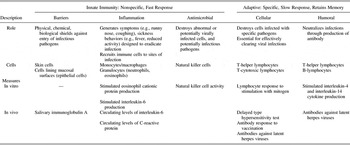
An excellent conceptual guide to integrating the wide and sometimes confusing psychoneuroimmunology literature is the primary divisions of the immune system: innate immunity and adaptive immunity (Rabin, Reference Rabin, Vedhara and Irwin2005; Segerstrom & Miller, Reference Segerstrom and Miller2004), which are further described in Table 1. Innate immunity is the first line of defense against infection, which includes barriers, inflammation that quickly generates physiological and behavioral changes designed to eradicate infections, and antimicrobial activity to destroy abnormal or infected cells and dangerous microbes. Adaptive immunity is a slower response, taking several days to mount immune responses that target specific infections (e.g., one out of many strains of influenza virus), but retains “memory” for a specific infection. Adaptive immunity further consists of two types of responses: cellular immunity, which focuses on killing virally infected cells, and humoral immunity, which focuses on neutralizing viruses by producing proteins called antibodies, which bind to viruses and render them ineffective. Cellular and humoral responses are important for combating viral infections, but ultimately, cellular responses are essential for clearing the infection. Moreover, humoral responses can inhibit cellular responses; thus, an overactive humoral response may actually be detrimental in the big picture of antiviral responses (Kohlmeier & Woodland, Reference Kohlmeier and Woodland2009).
Divisions of the immune system and their associated roles and cells and described measures

Note: Examples of functions, cells, and measures come from studies mentioned in this paper and are not an exhaustive list. In vitro refers immune assays performed on cells removed from an individual and placed in a controlled environment (e.g., removing cells, stimulating them with an antigen in a dish). In vivo, for our purposes, refers to immune assays performed directly on an individual (e.g., delayed type hypersensitivity test, where a weakened infectious agent is introduced into the individual's skin to assess skin-site reactions or vaccination, where a weakened infectious agent is injected into the person to assess antibody production) and/or immune assays involving products that are obtained directly from bodily fluids (salivary immunoglobulin A, circulating C-reactive protein, antibodies). For additional references, see Rabin (Reference Rabin, Vedhara and Irwin2005) and Vedhara and Wang (Reference Vedhara, Wang, Vedhara and Irwin2005).
Virtually all URI symptoms (runny nose, cough, etc.) are caused by inflammation (Eccles, Reference Eccles2005). For example, nasal congestion is caused by dilation of veins in the sinus cavity in direct response to inflammatory products, causing sinus expansion that blocks airflow. Moreover, inflammatory products mediate relationships between psychosocial factors, including elevated perceived stress and low positive affect, and symptoms of upper respiratory infection in experimental viral challenge studies (Cohen, Doyle, & Skoner, Reference Cohen, Doyle and Skoner1999; Doyle, Gentile, & Cohen, Reference Doyle, Gentile and Cohen2006).
Infancy and early childhood
In infant nonhuman primates, maternal separation is related to measures of reduced cellular immunity (e.g., lymphocyte proliferation; Laudenslager, Reite, & Harbeck, Reference Laudenslager, Reite and Harbeck1982). Although some studies show reduced innate immunity (Coe & Erickson, Reference Coe and Erickson1997), in general, disruptions in maternal behavior result in enhanced innate immune responses, including increased numbers of innate immune cells, greater activation of innate immune cells, and greater inflammatory responses (reviewed in Coe & Laudenslager, Reference Coe and Laudenslager2007; Coe & Lubach, Reference Coe and Lubach2003). These changes were relatively short term and were generally reversed after reuniting with mothers (Coe & Lubach, Reference Coe and Lubach2003), although more prolonged separations (around 2 weeks, rather than several days to a week) have lasting effects on immunity that persist into adulthood, including lower lymphocyte proliferation and enhanced natural killer (NK) cell function (Worlein & Laudenslager, Reference Worlein, Laudenslager, Ader, Felten and Cohen2001). Moreover, unless infants were challenged with specific pathogens, infection did not emerge spontaneously (Coe & Lubach, Reference Coe and Lubach2003). However, these studies provide insights that are comparable to understanding early childhood, rather than infancy. Studies of risky family environments and immune function in infancy and/or early childhood period are rare to nonexistent, which is unfortunate given that during infancy, the infectious burden is high, almost every infection encountered is a new infection, and the immune system is going through rapid expansion and development (McDade, Reference McDade2003). At the same time, these studies suggest that disruptions in the maternal bond in early childhood, through prolonged separations or cold, unsupportive parenting may predict enhanced innate immunity and impaired cellular immunity.
Middle childhood and adolescence
Compared to infancy and early childhood, infectious illness burden is lower during middle childhood and adolescence, as the number of novel infections decreases and the immune system has gained more experience with a variety of infectious agents (e.g., multiple strains of the flu or bacterial infections; McDade, Reference McDade2003). Despite lower rates of infection compared to earlier in development, chronic stress can influence susceptibility to URIs in middle childhood and adolescence. Unlike work on psychosocial factors and URI symptoms in adult volunteers, who are deliberately infected with rhinovirus or influenza virus (Cohen, Tyrrell, & Smith, Reference Cohen, Tyrrell and Smith1991), studies in children have focused on naturalistic observation of URI symptoms. Greater levels of parent-reported stressful life events over the past year were related to longer URI duration and severity in children between 1 and 11 years of age (Boyce et al., Reference Boyce, Jensen, Cassel, Collier, Smith and Ramey1977). In later work, children between 8 and 12 years of age classified as experiencing recurrent URIs reported stressful life event levels above the mean compared to healthy children (Drummond & Hewson-Bower, Reference Drummond and Hewson-Bower1997). Among children reporting low social support, URI incidence was higher over a 15-week period compared to children reporting high social support, for whom increased life stress was related to increased URI incidence (Cobb & Steptoe, Reference Cobb and Steptoe1998). Finally, elevated parent psychopathology and parent-reported chronic stress were related to higher rates of child illnesses (most of which—40%—were URIs) during a 3.5-year follow-up in children between 5 and 10 years of age (Wyman et al., Reference Wyman, Moynihan, Eberly, Cox, Cross and Jin2007).
In terms of innate immunity, children with a history of recurrent URIs had lower levels of secretory immunoglobulin A, an antibody that provides a barrier against pathogens in mucosal surfaces (Drummond & Hewson-Bower, Reference Drummond and Hewson-Bower1997). Recent work has examined NK cells, which are involved in innate immunity to viral infection (Kohlmeier & Woodland, Reference Kohlmeier and Woodland2009), and stimulated production of eosinophil cationic protein (ECP), typically associated with lung inflammation in asthma, but more recently implicated in responses to respiratory syncytial virus (Hogan et al., Reference Hogan, Rosenberg, Moqbel, Phipps, Foster and Lacy2008). Elevated parent psychopathology was related to elevated NK activity in children, which did not explain the relationship between parental psychopathology and illness rates (Caserta et al., Reference Caserta, O'Connor, Wyman, Wang, Moynihan and Cross2008; Wyman et al., Reference Wyman, Moynihan, Eberly, Cox, Cross and Jin2007). In healthy children, greater parental perceived stress was related to greater stimulated ECP production, and greater parent depressed mood was related to larger increases in stimulated ECP production over 6 month follow-up (Marin, Chen, Munch, & Miller, Reference Marin, Chen, Munch and Miller2009).
Regarding adaptive immunity, no published studies have documented the effects of adverse circumstances on cellular immunity against URIs in children; in adults, chronic stress impairs cellular immunity (Segerstrom & Miller, Reference Segerstrom and Miller2004). Existing data have primarily focused on the ability to control latent infections that stay dormant in the body following the initial infection, such as Epstein–Barr virus (EBV) and herpes viruses, and reactivate when cellular immunity is suppressed. Among rural children in Appalachia, greater traumatic life events were marginally related to elevated EBV antibody levels, which reflects decreased cellular immunity (McDade et al., Reference McDade, Stallings, Angold, Costello, Burleson and Glaser2000). More recently, elevated HSV virus levels and antibody levels (relative to healthy controls) were found in a sample of physically abused adolescents who were institutionalized in early childhood (Shirtcliff, Coe, & Pollak, Reference Shirtcliff, Coe and Pollak2009). Finally, higher family conflict and parental psychopathology were related to greater percentage of circulating T-lymphocytes that specifically attack the herpes virus cytomegalovirus (Caserta et al., Reference Caserta, O'Connor, Wyman, Wang, Moynihan and Cross2008), suggesting reactivation of the virus. The aforementioned studies also suggest that chronic stress may enhance humoral immunity, which is opposite of the pattern in adults (Segerstrom & Miller, Reference Segerstrom and Miller2004). In healthy children, chronic family stress was related to greater stimulated production of IL-4 and IL-14, which are cytokines (chemical messengers of the immune system) that promote humoral immune responses (Marin et al., Reference Marin, Chen, Munch and Miller2009).
How are risky family environments related to increased susceptibility to URIs, enhanced innate immunity, enhanced humoral immunity, and potentially diminished cellular immunity? For innate immunity, risky family environments may disrupt defensive barriers that prevent invasion of microorganisms (e.g., the skin, sIgA; Drummond & Hewson-Bower, Reference Drummond and Hewson-Bower1997). In addition, recent work suggests that chronic stress may increase the expression of genes that direct the molecular signaling involved in the inflammatory response (Miller & Chen, Reference Miller and Chen2006; Miller, Rohleder, & Cole, Reference Miller, Rohleder and Cole2009). Finally, chronic stress may disrupt the degree to which neuroendocrine signals are “heard” by cells; adolescents who reported early life exposure to risky family environments showed larger stimulated production of IL-6, a proinflammatory cytokine, over 18-month follow-up, and showed greater resistance to cortisol's anti-inflammatory effects (Miller & Chen, Reference Miller and Chen2010). By creating an enhanced state of preparedness in innate immune responses, including inflammation, chronic family stress should be related to more frequent and severe symptoms. Given that chronic stress impairs adaptive immunity, children in adverse environments should also have longer lasting illnesses. These patterns are observed in the studies reviewed above.
Implications for allostatic load
In adults, allostatic load is measured by assessing steady-state activity (Seeman et al., Reference Seeman, Singer, Rowe, Horwitz and McEwen1997), using biomarkers (cortisol, norepinephrine) that are either related to chronic diseases (e.g., Type 2 diabetes, cardiovascular disease) or that serve as surrogate endpoints for disease (e.g., fasting glucose, blood pressure; Biomarker Definitions Working Group, 2001). In adults, chronic disease is already at an intermediate or even advanced stage (e.g., half of all adults over the age of 50 have high blood pressure). By contrast, although the pathophysiology of the chronic diseases of aging have their origins in childhood, symptoms of those diseases will not come for most children for 30–40 years (Type 2 diabetes is one exception).
How might we assess cumulative damage to the body due to risky family environments? Certainly, many measures that reflect damage or dysregulation over time in adults could still be examined in children, such as metabolic indicators (weight, fasting glucose). However, damage or dysregulation in other bodily systems may not be sufficient to see changes in basal activity. For example, in adults, inflammation has emerged as an important biological process in adult allostatic load measures (Seeman et al., Reference Seeman, Gruenewald, Karlamangla, Sidney, Liu and McEwen2010). However, high-risk levels of CRP (>3 mg/l), a marker of systemic inflammation used in some allostatic load indices, are found in only 5% of children over the age of one (Skinner, Steiner, Henderson, & Perrin, Reference Skinner, Steiner, Henderson and Perrin2010). At the same time, recent work suggests that greater daily interpersonal stress (although not necessarily stemming from the family) was related to higher CRP levels in a small but diverse sample of Latino and European American adolescents (Fuligni et al., Reference Fuligni, Telzer, Bower, Cole, Kiang and Irwin2009). Given the importance of host defense (immune function) throughout development, one potential consideration for assessing allostatic load in childhood is to assess dysregulation in reactivity (McEwen & Seeman, Reference McEwen and Seeman1999) to relatively common biological threats (URIs) alongside measures of steady-state immune activity such as circulating CRP.
Perhaps immune “reactivity” to URIs might be a potential candidate for future work developing allostatic load measures in children. Candidate reactivity measures of innate immunity might include levels of proinflammatory cytokines produced during challenge with an infectious agent, either in vitro (Glaser, Kiecolt-Glaser, Malarkey, & Sheridan, Reference Glaser, Kiecolt-Glaser, Malarkey and Sheridan1998) or in vivo (Cohen et al., Reference Cohen, Tyrrell and Smith1991). The pattern of results in the small literature on innate immunity to date reflects our theme of heightened preparedness against threat and dysregulated reactivity. Moreover, although relatively new, candidate measures of interactions between allostatic mediators and innate immunity might include examining the ability of glucocorticoids to put the “brakes” on innate immunity (Miller & Chen, Reference Miller and Chen2010) or the expression of genes encoding inflammatory signaling pathways (Miller et al., Reference Miller, Rohleder and Cole2009). Candidate reactivity measures of adaptive immunity might include responses to in vivo challenge, such as the delayed type hypersensitivity test (Segerstrom & Sephton, Reference Segerstrom and Sephton2010), or antibody responses to influenza virus vaccination, which are responsive to psychological stress in young adults (Miller et al., Reference Miller, Cohen, Pressman, Barkin, Rabin and Treanor2004). Clearly, these speculations require collecting substantive data in large prospective studies that clearly establish that such measures are related to previous cumulative exposure to chronic stress, and assessing future clinically relevant outcomes that are conceptually linked to the larger allostatic load concept, including effects on the brain and on chronic disease.
Our broader point is that development is a dynamic period when children are being shaped by and are shaping their environments, when children still have considerable biological capacity to adapt to adverse circumstances. Severely adverse and prolonged circumstances can set the stage for long-term dysregulation in allostatic systems. Thus, allostatic load measures during childhood should find the right mix of measures that reflect the dynamic components of the allostatic load concept, notably reactivity to stimuli (physical or psychological), and the steady-state aspects of allostatic load that are measured in adulthood.
Mechanisms Associated With Individual Variability
Even individuals within the same household respond to family stressors in different ways. This variability must be part of our models describing how experiences in the family produce long-term health outcomes. Although a complete discussion of individual differences and their sources is beyond the scope of this article, it is important to note that it is not merely the case that people respond differently to harsh rearing conditions, some possess personal, social, and/or biological assets that promote resiliency in the face of stress. Many of the primary assets or “protective factors” described in the psychological resiliency literature, such as secure attachment, cognitive and emotional regulation, social support, self-efficacy, problem-solving skill, and optimism, are at least partly founded upon adequate and sensitive parenting from the earliest years of life. Religion, community support, close friendship, and neural organization/development have also been identified as important for a multilevel framework of resiliency and the family environment (Cicchetti & Rogosch, Reference Cicchetti, Rogosch, Skinner and Zimmer-Gembeck2009; Masten, Best, & Garmezy, Reference Masten, Best and Garmezy1990; Masten & Wright, Reference Masten, Wright and Reich2009).
Resilience to risky family environments—indeed all individual differences among children that influence how they react in those settings—clearly have multiple foundations, and one of them is genetic inheritance. Genes play a critical role at every point in the psychological and allostatic pathways outlined here. In addition to direct effects, we know from studies of human adoption and the cross-fostering of nonhuman primates that combinations of genetic risk and parenting predispose offspring to developmental outcomes (e.g., Cadoret, Yates, Troughton, Woodworth, & Stewart, Reference Cadoret, Yates, Troughton, Woodworth and Stewart1995; O'Connor, Deater-Deckard, Fulker, Rutter, & Plomin, Reference O'Connor, Deater-Deckard, Fulker, Rutter and Plomin1998; Suomi, Reference Suomi, Hall and Dooling1991). One of the ways that genes and rearing environments interact to produce outcomes is through the impact that early experiences have on the phenotypic expression of genes. Although this line of research is in an early stage, evidence indicates that rearing conditions influence gene expression. For instance, rats exposed to maternal separation and handling showed elevated expression of genes (for RC3 in the hippocampus) that are required for the development of brain circuitry. Resulting impairments in synaptic formations and plasticity may account for the long-term alterations in spatial learning and stress reactivity that have been observed in adult rats exposed to the same stressful early rearing conditions (McNamara, Huot, Lenox, & Plotsky, Reference McNamara, Huot, Lenox and Plotsky2002). Another mechanism involves genes shaping the impact of the family environment. That type of effect is illustrated by the finding that insensitive parenting during infancy predicted less controlled and more aggressive behavior at age three, but only among children with a particular allele of a gene involved with dopamine (D4) receptors in the limbic area of the brain; insensitive parenting did not predict behavioral problems in the absence of that allele (Bakermans-Kranenburg & van IJzendoorn, Reference Bakermans-Kranenburg and van IJzendoorn2006). In addition to gene–environment interactions, gene–environment correlations fuel some of the effects of a chronically stressful environment on development. Parents' characteristics shape the home environment and, to the extent that they are heritable, those traits can be passed on to the children. The result is a correlation between the traits of the child and of the family (e.g., an impulsive child and a chaotic home) that can multiply the effects of the environment alone.
This paper's focus on the transition from short-term reactions to family stressors to longer term sequelae of repeated exposures may suggest some ideas about how individual differences emerge. One way to examine differences between children growing up in risky families who develop a particular outcome and others who do not develop that outcome would be to consider the relationship between the accumulation of short-term responses to stressors and the progression of a precursor outcome. The more or less stable traits or circumstances associated with resilience may operate at both levels: limiting the accumulation of short-term responses to a family stressor and slowing the pace at which dysfunctional precursor outcomes develop.
Using the gears metaphor introduced above, imagine a driver gear that represents a short-term response to a family stressor (e.g., physiological or emotional responses) turning a driven gear that represents a dysfunctional precursor outcome that develops after many repeated exposures (e.g., flatter diurnal cortisol slopes or heightened vigilance for threat). Of course some children will not develop the precursor outcome because they have fewer exposures to the family stressor and thus experience fewer emotional and physiological responses. In addition, laboratory reactivity studies show that not all individuals respond in the same way to each occurrence of a stressor. Therefore, another group of children will simply be less responsive to the stressful event; for instance, they will be less physiologically aroused when exposed to the same family event. In either case, whether because of less exposure or lower reactivity, fewer revolutions of the driver gear (representing short-term responses to the stressor) means that the driven gear (representing a precursor outcome) turns more slowly.
Shifting focus from individual differences that are due to the accumulation of short-term responses to a family stressor (i.e., turns of the driver gear), consider a group of children who have had equivalent exposures to the same family stressor and who show the same level of reactivity. Even though in our analogy, the driver gears are the same size and turning at the same rate for all of the children, we would still expect that some children will, and some will not, develop the precursor outcome. Gear ratios can model that source of individual variability. A gear ratio is the relationship between the number of teeth on two gears that are meshed; it represents the number of revolutions that the driver gear must make to turn the larger gear one revolution. With larger gear ratios the driven gear turns more slowly per rotation of the driver. For example, in Figure 2, gears D and E have a relatively large gear ratio (gear D must make more than two revolutions before gear E makes one complete revolution). In smaller gear ratios it takes fewer turns of the driver for the driven gear to make one complete revolution; the driven gear turns more quickly. Gears B and C in Figure 2 depict a small 1:1 gear ratio. Individuals who are highly vulnerable to developing the precursor outcome of interest would be represented by a smaller gear ratio; in that scenario the driven gear is turning at a faster pace. Resilient individuals would be represented by a larger gear ratio; the driven gear has a larger diameter and is therefore turning more slowly per rotation of the driver gear. For resilient individuals, the dysfunctional precursor outcome progresses more slowly.
Bower, Low, Moskowitz, Sepah, and Epel (Reference Bower, Low, Moskowitz, Sepah and Epel2007) use the concept of “enhanced allostasis” to describe several physiological response profiles that may characterize resilient individuals. Their analysis suggests how the effects of an immediate response to a stressor may be curbed in some individuals. For instance, they may recover more quickly following termination of a stressor (i.e., a more rapid return to baseline), or physiological processes that serve restorative functions—such as heart rate variability, a measure of parasympathetic nervous system activity—may be more active during rest. Moreover, these enhanced allostatic mechanisms are associated with psychological processes like the experience of positive emotion during the stressor and more adaptive cognitive processing of the event (e.g., less threatening appraisals and less rumination; Bower et al., Reference Bower, Low, Moskowitz, Sepah and Epel2007). The allostatic and psychological responses described by Bower and her colleagues could help to explain how a precursor outcome develops more slowly in resilient children growing up in risky families.
Examining how the buildup of short-term reactions to family stressors relates to the pace of precursor development may be a fruitful way for researchers to study resilience as a developmental process. This approach can point to precursor outcomes that are promising to study, for example those showing the greatest individual variability. In the context of longitudinal investigations, links can then be traced between the development of those outcomes and longer term health endpoints. In short, study of connections between immediate responses to stressors and the rate at which precursors advance offers a novel perspective on individual variability in health outcomes among the offspring of risky families.
A Life Span Approach
Because the most significant health effects of early rearing in a chronically stressful environment may not be observed until adulthood, investigations of the underlying psychological and allostatic processes require a life span approach. As we have noted throughout, the forms that “outcomes” take change over the course of development. For example, problems with emotion regulation might be manifested as difficulty recognizing facial expressions during the toddler and preschool years and as ineffective coping strategies in childhood and adolescence, but perhaps not until adulthood would those problems be reflected in increased risks for depression and anxiety. For allostatic systems, precursor outcomes may include elevated evening cortisol levels, hyporesponsiveness to acute laboratory stressors, enhanced inflammatory responses to in vitro or in vivo immune challenge with infectious antigens, and impaired in vitro or in vivo cellular immune responses to infectious antigens. This paper highlights the benefits of studying precursors; searching for hard mental or physical health endpoints in childhood or adolescence will do little to advance our understanding of the pathways that link stressful family experiences to health.
There are other ways that a life span perspective complicates the investigation of family influences on health. Because of a tendency for family social environments to remain stable, it can be difficult to establish the timing of effects. Continuities in the family may contribute to observed associations between early experiences and later outcomes; an apparent influence of early events may be explained by current conditions in the home. Therefore, understanding how early rearing experiences are reflected in the behavior and social climate of the same family years later, and the extent to which that stability accounts for associations between early rearing and later allostatic and psychological outcomes is critical. One of the values of intervention studies is that they create discontinuities in family practices and allow researchers to discriminate effects of prior conditions from effects of current conditions. In addition, given that the psychological and biological effects of growing up in a risky family are transformed as offspring mature, developmental change cannot be adequately modeled merely by measuring the same outcome at two points in time. The implication here is that controlling for initial levels of an outcome variable when testing an association between the early family environment and the same outcome measured some time later is not sufficient.
In adulthood there are multiple sources of family influence on health. Besides continuing developmental pressures from the past, current adult relationships with the family of origin and with the present-day family (spouse and children) can be sources of stress with direct and indirect effects on health (Repetti, Flook, & Sperling, 2011). For instance, marital conflict and hostility have an impact on health that is mediated by depression and behaviors like alcohol abuse, and many of the same allostatic mediators discussed earlier: cardiovascular, endocrine, and immune system responses (Robles & Kiecolt-Glaser, Reference Robles and Kiecolt-Glaser2003). Moreover, problems with aggression, impulse control, and intimate relationships are among the most prominent legacies of growing up in a risky family. Therefore, conflict and hostility in the adult's current family relationships, and their impact on health, may represent another outcome of harsh early rearing.
A life span perspective has implications for researchers who study the effects of rearing in chronically stressful conditions. First, it calls for a much more nuanced picture than we currently have of the “outcomes” to be expected at different developmental stages. Second, stabilities in families over long time spans need to be recognized in the design of investigations of early rearing effects. Third, adult relationships with spouse, children, and members of the family of origin should be included in our models.
Adaptive Trade-Offs and Snowballing Effects
It is not surprising that repeated exposure to conflict and aggression or family relationships that are cold, unsupportive, or neglectful, influence both psychological and biological development. The research literature indicates that a childhood spent adapting to demanding and chronically stressful conditions has long-term consequences for the regulation of emotions, behavior, immune responses to infection, and HPA responses to stress. Some of the precursor outcomes discussed in this article appear to reflect a preferential allocation of resources to protection from danger. With respect to psychological responses, we see heightened vigilance and preparedness for threats posed by others, coupled with a readiness for aggressive responses. At the biological level, we see enhanced inflammatory and humoral responses to threats posed by infectious microorganisms. Another adaptation to a home life that does not provide a sense of security and support may be a quickened pace of maturation, most clearly reflected in early pubertal development and sexual behavior.
Outcomes like these may represent compromises that balance survival advantages in harsh rearing environments against long-term developmental disadvantages. The repeated activation of systems designed to respond to immediate threats may lead to ineffective modulation of those responses down the line. An acceleration of development when surrounded by adults who consistently fail to provide protection and support may facilitate separation from a risky family but may also lead to behaviors and relationships that increase risks for sexually transmitted diseases and teen pregnancy as well as other social, psychological, and health problems. Conceptualizing outcomes of chronic stressors in the family as adaptive trade-offs is another way for researchers to widen their search for precursor outcomes associated with chronic stressors in childhood.
The adaptive trade-offs that we have identified appear to involve an intial set of responses setting off a chain of events that build upon themselves with expanding negative consequences. We use the term “snowballing effect” to describe this phenomenon, others refer to a “cascade effect” (Masten & Cicchetti, Reference Masten and Cicchetti2010). There are many ways that these magnifying effects can emerge among children growing up in risky families. For example, psychological responses that may be adaptive within a risky family often produce more serious problems when carried into other settings and relationships outside of the home. Vigilance for threats and preparedness for defensive and protective responses may manifest as inattentiveness and poor concentration at school, and hostility and aggressiveness with peers, which generate a new array of difficulties and sources of stress in children's lives. The same social and psychological characteristics can also interfere with the establishment of supportive relationships in adulthood.
Moreover, children growing up in risky families may amplify the stressors that they are exposed to at home by social perceptions and behaviors that draw more aggressive and less supportive reactions from parents and siblings. This process can be compounded by the influence of family members' mood and physiology: through processes of emotion transmission (short-term links between one member's momentary negative mood and another member's concurrent or subsequent emotional experience) and physiological coregulation (e.g., linkages between family members' day to day fluctuations in cortisol levels; Saxbe & Repetti, Reference Saxbe and Repetti2010). Like a row of falling dominos, the mood and physiology of one family member can be affected by the mood and physiology of another family member. Gene–environment correlations, whereby child characteristics and features of life at home are correlated and mutually reinforcing, represent another type of magnifying effect within the family.
Tendencies to perceive threat and to provoke social challenges, because of hostility, difficulty with impulse control, and aggressive behavior, not only lead to the social and emotional problems discussed here but also cause repeated hits to stress-response systems. As a result, these precursor outcomes also hasten the impact that a harsh family environment has on allostatic processes. Thus, some of the psychological outcomes discussed in this paper may perpetuate and exacerbate both social and physiological risk factors in the child's life at home and outside of the home. Applying the gears metaphor, “snowballing effects” would represent feedback loops that result in more turns of multiple driver gears that are powering the system. Research on the precursor outcomes and the circumstances that facilitate the expansion and multiplication of stressors in children's lives may suggest other avenues for investigating individual differences among children growing up in chronically stressful homes.
The time is right for a greater integration of research on psychological and allostatic pathways. Framing inquiries about the effects of harsh early rearing conditions within a life span perspective and focusing more on short-term responses and precursor outcomes, as well as the connections between them, will advance our understanding of development in risky families.